Feeds:
Posts
Comments

Archive for the ‘Prospects’ Category

(Updated Sept. 20, 2024)

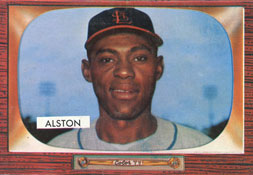
Two years after his professional baseball debut at the Class C level of the minor leagues, Tom Alston was the Opening Day first baseman for the Cardinals. Making that leap in such a short time would be a challenge for any prospect. Alston had the additional pressure of being the player who integrated the Cardinals.

tom_alstonOn April 13, 1954, Thomas Edison Alston became the first African-American to play in a regular-season game for the Cardinals, batting sixth and playing first base against the Cubs at St. Louis.

Seven seasons after Jackie Robinson joined the Dodgers, the Cardinals became the 10th of the 16 major-league teams to integrate.

Alston, 28, was the 14th African-American player in the Cardinals’ organization, but the only one on the big-league roster. (Among the other blacks in the Cardinals’ system in 1954 were pitchers Bill Greason, Brooks Lawrence and John Wyatt. All eventually pitched in the big leagues.)

Rapid rise

Alston and Jackie Robinson were born on the same date, Jan. 31. Robinson’s birth year was 1919 and Alston’s was 1926.

Alston’s rise from baseball novice to Cardinals pioneer was fast and unexpected. After serving in the Navy from 1945-47, Alston enrolled at North Carolina A&T in his hometown of Greensboro and earned a degree in physical education and social sciences. College was where Alston first played organized baseball.

In 1952, he entered professional baseball with Porterville, Calif., of the Class C Southwest International League, hit .353 in 54 games and caught the attention of the San Diego club of the Class AAA Pacific Coast League.

Alston joined San Diego midway through the 1952 season and hit .244.

In 1953 for San Diego, Alston had 207 hits in 180 games, with 101 runs scored, 23 home runs, 101 RBI and a .297 batting average. Cardinals scouts recommended him.

On Jan. 26, 1954, the Cardinals sent first baseman Dick Sisler, pitcher Eddie Erautt and $100,000 to San Diego for Alston. San Diego manager Lefty O’Doul called Alston “a great prospect who can field as good as any first baseman in the big leagues.”

He “looks like he’s going to be a great hitter, too,” O’Doul told The Sporting News.

Said Cardinals owner Gussie Busch: “When we purchased the Cardinals, I promised there would be no racial discrimination. However, Alston was not purchased because of his race. Our scouts and manager Eddie Stanky believe he is a great prospect. While he may need more experience, we didn’t want him to slip away from us.”

Bill Starr, president of the San Diego club, offered to cut the cash portion of the deal to $75,000 if the Cardinals would wait until 1955 to take Alston, according to the Los Angeles Daily Mirror, but the Cardinals wanted Alston for 1954. The incumbent at first base was Steve Bilko, who hit 21 home runs for the 1953 Cardinals but also led the National League in striking out (125 times). The Cardinals used spring training in 1954 as a competition between Alston and Bilko for the first base job.

“I think we have a real ballplayer in this colored boy,” Stanky said to The Sporting News in March 1954.

Said Alston: “They treat me here just the same as any other ballplayer and that’s how I want to be treated.”

Major leaguer

Stanky said he’d platoon Alston (a left-handed batter) and Bilko (right-handed), but Alston got the Opening Day start against Cubs left-hander Paul Minner.

“I guess I’ve come a long way in a short time,” Alston said. “I guess I came up like a real rocket.”

Alston went 0-for-4 with a strikeout and committed an error in his debut game. Boxscore

In his next game, April 17, 1954, at Chicago, Alston went hitless in his first four at-bats. In the eighth, he led off with a home run, his first big-league hit, against Cubs reliever Jim Brosnan. Boxscore

The next day, April 18, Alston got his second hit, a pinch-hit, three-run homer off left-hander Jim Davis, lifting the Cardinals to a 6-4 triumph. Boxscore

On April 30, in an endorsement of Alston, the Cardinals sent Bilko to the Cubs.

In a doubleheader against the Giants on May 2, Alston was 5-for-6 with five RBI, an inside-the-park home run and three walks. His performance was overshadowed by teammate Stan Musial, who hit five home runs with nine RBI. Game 1 boxscore Game 2 boxscore

In The Sporting News, Bob Broeg wrote of Alston’s inside-the-park home run: “His speed enabled him to circle the bases easily after Willie Mays misjudged his long wind-blown drive to left-center.”

Slowed by slump

Alston hit .301 (37-for-123) in May and was at .285 overall on May 30, but he slumped in June, enduring a 2-for-27 stretch and batting .181 (15-for-83) for the month. He had seven RBI in his last 42 games.

On June 30, the Cardinals sent Alston to Class AAA Rochester and called up another rookie, Joe Cunningham, to replace him at first base. Alston’s overall numbers for the 1954 Cardinals: 60 hits in 66 games, 14 doubles, four home runs, 34 RBI and a .246 batting average. He made 62 starts at first base.

Said Cardinals general manager Dick Meyer: “Alston wasn’t ready … Eddie (Stanky) and I still have a very high regard for Alston as a prospect.”

Cunningham hit .284 with 11 home runs in 85 games for the 1954 Cardinals. The next season, the Cardinals moved Musial from the outfield to first base.

Alston made brief appearances with the Cardinals in 1955, 1956 and 1957. According to the Associated Press, when Gussie Busch asked Cardinals manager Fred Hutchinson why he didn’t play Alston, Hutchinson coldly replied, “If you want a clown to play first base, why don’t you hire (circus performer) Emmett Kelly?”

In 91 big-league games, all with St. Louis, Alston had 66 hits and batted .244.

Ten years after Alston’s big-league debut, the Cardinals became World Series champions, building a reputation as a franchise that embraced diversity with players such as Bob Gibson, Bill White, Curt Flood, Lou Brock and Julian Javier.

Tom Alston took the first steps toward making that possible.


Read Full Post »

Their given names were John and George.

Their baseball names were Sonny and Sparky.

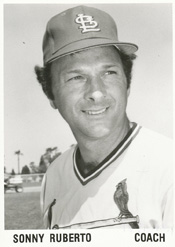
sonny_rubertoTogether, they contributed to a standard of teaching that became a hallmark of the Cardinals.
Sonny Ruberto, mentored by Sparky Anderson in the Cardinals’ system, influenced St. Louis players and prospects from 1977-81 as a big-league coach and minor-league manager.

Two of his pupils in the Cardinals system, Jim Riggleman and John Stuper, carried on with reputations as first-rate instructors. Riggleman managed five big-league teams. Stuper, who started and won Game 6 of the 1982 World Series for the Cardinals, coached the Yale University baseball team.

George “Sparky” Anderson, who built a Hall of Fame career as manager of the Reds and Tigers, was 30 when he began his managerial career with Class AAA Toronto in 1964. A year later, he became a manager in the Cardinals system.

John “Sonny” Ruberto was 24 when he began his managerial career with the Padres’ Class A Lodi club in 1970. At 31, he became the youngest coach in the major leagues when he joined the staff of first-year Cardinals manager Vern Rapp in 1977.

Cardinals prospect

A standout catcher at Curtis High School in Staten Island, N.Y., where he played with other future major leaguers such as Terry Crowley and Frank Fernandez, Ruberto signed with the Cardinals as an amateur free agent in 1964. Two years later, he was on a Class A St. Petersburg team managed by Anderson.

In a 1966 game that began on June 14 and ended at 2:30 a.m. on June 15, the visiting Miami Marlins beat St. Petersburg, 4-3, in 29 innings. “It was the darndest thing I’ve ever seen,” Anderson told The Sporting News.

Ruberto played all 29 innings _ the first nine as catcher and the last 20 at shortstop. He had two hits in 10 at-bats and scored a run.

Ruberto hit .283 in 88 games for St. Petersburg. The next year, he played for the Cardinals’ Class A Modesto club, managed by Anderson.

On May 22, 1969, the Cardinals traded Ruberto and second baseman John Sipin to the Padres for infielder Jerry DaVanon and first baseman Bill Davis. Ruberto made his big-league debut as a player with the Padres that month.

Big Red Machine

After a season managing Lodi, Ruberto in 1971 joined the Reds organization, where he was reunited with two key figures from his Cardinals days: Anderson (the Reds’ manager) and Bob Howsam, the former Cardinals general manager who took over the same role with Cincinnati.

Ruberto resumed his playing career and was sent to Class AAA Indianapolis. His manager there for the next five years, 1971 through 1975, was Rapp. As catcher, Ruberto was credited with helping the progress of several Reds pitching prospects, including Joaquin Andujar, Ross Grimsley, Tom Hume, Milt Wilcox and Pat Zachry.

“I feel I had something to do with their development,” Ruberto told The Sporting News.

When Rapp was named Cardinals manager, replacing Red Schoendienst, for the 1977 season, he selected Ruberto to be the first-base coach.

Wrote The Sporting News: “Like Rapp, Ruberto had been a career Triple-A catcher highly regarded for his ability to handle pitchers. Ruberto even has some ideas on helping Ted Simmons improve his backstopping duties.”

Rapp was brought to the Cardinals to instill discipline. At spring training in 1977, The Sporting News reported, “Rapp sized up his charges to make sure that the regulation baseball uniforms were worn properly. He had coach Sonny Ruberto demonstrate how he wanted the uniforms worn.”

At the helm

Rapp was fired in April 1978 and replaced by Ken Boyer. After the season, two of the coaches Boyer had inherited, Ruberto and Mo Mazzali, were replaced by Schoendienst and Dal Maxvill.

The Cardinals, though, kept Ruberto in the organization, naming him manager of the 1979 St. Petersburg club, succeeding Hal Lanier, who was promoted to Class AAA Springfield.

“What kind of manager will I be?” Ruberto said in response to a question from the St. Petersburg Times. “Well, a little of Vern Rapp, a little of Sparky Anderson, a little of Billy Martin and a lot of Sonny Ruberto.”

St. Petersburg finished 64-71, but the Cardinals were pleased with how their prospects, such as Stuper and fellow starting pitcher Andy Rincon, developed under Ruberto.

In 1980, Ruberto managed the Cardinals’ Class AA Arkansas team to an 81-55 record and a Texas League championship. Stuper had a 7-2 record for Arkansas. Riggleman, a third baseman, hit .295 with 21 home runs and 90 RBI in 127 games.

Ruberto managed the Cardinals’ Class A Erie team to a 44-30 record in 1981.

He operated a photography business in St. Louis and resided there with his family for 26 years.

Read Full Post »

(Updated July 14, 2019)

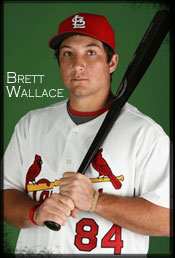
In dealing Brett Wallace, the Cardinals acquired one of the cornerstones of their batting order, left fielder Matt Holliday, and cleared the way for David Freese to become their third baseman.

brett_wallaceHolliday and Freese became key players for Cardinals teams that won a World Series championship and two National League pennants.

Heavy hitter

Wallace, a left-handed batter, was chosen by the Cardinals with the 13th pick in the first round of the June 2008 amateur draft. At Arizona State University, he twice led the Pacific-10 Conference in batting average, home runs and RBI.

Though the Cardinals hoped Wallace could handle third base, scout Chuck Fick said, “His position is hitting.”

“It’s too difficult to walk away from a guy who has this kind of chance to hit … He’s a dangerous hitter,” Fick said to the St. Louis Post-Dispatch.

Said Jeff Luhnow, the Cardinals’ vice-president of player development: “He knows, as do we, his value is what he does at the plate.”

Wallace was listed at 6 feet 1 and between 230 and 245 pounds. The Cardinals’ other 2008 first-round pick, awarded for the loss of free-agent reliever Troy Percival, was pitcher Lance Lynn.

Derrick Goold of the Post-Dispatch wrote, “Lynn, like Wallace, has a bulky frame and the Cardinals acknowledge both players will have to watch their weight to reach the potential that got them drafted.”

After receiving an estimated bonus of $1.8 million from the Cardinals, Wallace reported to the minor leagues in July 2008. In 54 games combined for Class A Quad Cities and Class AA Springfield, Wallace had 68 hits and a .337 batting average.

Big deal

Wallace was playing third base and batting .293 (65 hits in 62 games) for Class AAA Memphis in 2009 when he was traded on July 24 to the Athletics with two other prospects, pitcher Clayton Mortensen and outfielder Shane Peterson, for Holliday.

Wallace was the “keystone of the deal,” said Cardinals general manager John Mozeliak, who added that his counterpart, Billy Beane of the Athletics, insisted on Wallace being involved in any trade talks.

“He’s a guy we’ve always sort of longed for,” Beane told the San Francisco Chronicle.

The Cardinals were bullish on Wallace’s offense _ Mozeliak said Wallace “is not the type of hitter you’re going to replace easily” _ but didn’t see him fitting a position. With Albert Pujols at first base, the Cardinals saw third base as the best option for Wallace.

“There was debate within the Cardinals’ front office whether he could be an everyday third baseman in the majors,” the Post-Dispatch reported. “Uncertainty about that made him available in the right trade.”

Post-Dispatch columnist Bernie Miklasz endorsed the trade: “Wallace represents tomorrow, but you don’t worry about tomorrow when Albert Pujols is batting third in your lineup today. Make the most of it.”

Steal for St. Louis

Freese, who was at Springfield, replaced Wallace as Memphis’ third baseman. He became the Cardinals’ starter the next year and was a World Series hero in 2011.

Holliday immediately boosted the 2009 Cardinals’ production. He batted .353 (83 hits in 63 games) with 55 RBI, helping the Cardinals win the Central Division title.

Wallace never played in a big-league game for the Athletics. He was traded to the Blue Jays and was stuck in their minor-league system until he joined the Astros, where he eventually was reunited with Luhnow, who became their general manager in December 2011.

In six major-league seasons with the Astros (2010-13) and Padres (2015-16), primarily as a first baseman, Wallace batted .238 and had more strikeouts (432) than hits (305).

Previously: Fernando Salas: Cool Hand Luke of 2011 Cardinals

Read Full Post »

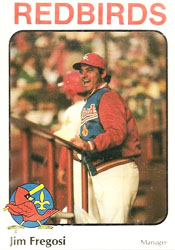
In 35 years as a major-league manager, Tony La Russa was fired once. The White Sox replaced him with Jim Fregosi.

jim_fregosiFregosi managed the Cardinals’ Class AAA club at Louisville from 1983 until he replaced La Russa as White Sox manager in June 1986. Among the prospects managed by Fregosi at Louisville were Vince Coleman, Danny Cox, Ken Dayley, Ricky Horton, Tito Landrum, Greg Mathews, Jose Oquendo, Terry Pendleton, Andy Van Slyke and Todd Worrell. Seventeen of the players on the 1985 National League championship Cardinals club played for Fregosi at Louisville.

Path to the majors

An all-star shortstop for the Angels in the 1960s, Fregosi managed the Angels from 1978-81, leading them to their first division title in 1979, before he was fired and replaced by Gene Mauch. After sitting out the 1982 season while running a food brokerage business, Fregosi became Louisville manager in 1983. Lee Thomas, the Cardinals’ director of player development, had been an Angels teammate of Fregosi and was instrumental in bringing him into the St. Louis organization.

Louisville won back-to-back American Association championships (1984-85) under Fregosi, but with Whitey Herzog entrenched as Cardinals manager Fregosi’s best hope of managing again in the major leagues was with another organization. The Mariners contacted him, but Fregosi wanted an opportunity with a franchise prepared to win.

In June 1986, White Sox general manager Ken “Hawk” Harrelson fired La Russa and pitching coach Dave Duncan. The White Sox were 26-38 and Harrelson had been clashing with La Russa and Duncan. “The record is not indicative of the talent involved,” Harrelson told the Chicago Sun-Times.

Fregosi was Harrelson’s first choice. Harrelson had sent scouts to Louisville and their reports on Fregosi were glowing, the Sun-Times reported.

Tireless teacher

Here is what others said about Fregosi’s work in the Cardinals system:

_ Rick Bozich, columnist, Louisville Courier-Journal: “When you roll the highlights films of what Fregosi has accomplished in Louisville, the two American Association championships won’t even make the top 10. No, the lingering images will be of the consistently long hours he worked developing the young players who carried the St. Louis Cardinals to the 1985 National League pennant and the wonderfully tranquil clubhouses he presided over. There was never a reason to check Fregosi’s time card. He reported to Cardinal Stadium at 2 every afternoon. One day he’d be in the cage convincing Vince Coleman he could make millions chopping down on the ball; the next day you could find him in the bullpen tinkering with Todd Worrell’s fastball grip.”

_ Mo Mozzali, Cardinals scout: “As fantastic as Jimmy has been for baseball in Louisville, he’s done even more for the players in the Cardinals organization. I’ve never seen anybody better working with young players.”

_ Dyar Miller, Louisville pitching coach: “Jim is a great teacher. He works on the field for three or four hours before every game, on theories of hitting, turning the double play, getting ready to pitch in the bullpen, whatever.”

_ Tony La Russa to the Sun-Times after learning Fregosi had replaced him: “When Jim Fregosi was in this league (as Angels manager), I thought he did an outstanding job. He’s been ready to manage in the big leagues for several years.”

Tales from Tony

White Sox owner Jerry Reinsdorf said La Russa told him, “If you have to fire me, hire Jim (Fregosi) or Jim Leyland … Fregosi is a good manager. I like him.”

La Russa went to the Athletics and won three American League pennants and a World Series title before joining the Cardinals. La Russa won two World Series titles and three National League pennants with the Cardinals and was elected to the National Baseball Hall of Fame.

Fregosi managed the White Sox from 1986-88 before stints as manager of the Phillies (1991-96) and Blue Jays (1999-2000). He won a National League pennant with the 1993 Phillies.

In 1996, La Russa’s first season as Cardinals manager, he was asked by the St. Louis Post-Dispatch about Fregosi during a series with the Phillies. La Russa replied, “The old line had me asking, ‘What does Fregosi have that I don’t have?’ The answer was, ‘Your job.’ “

Read Full Post »

Thinking they had the next Bo Jackson, the Cardinals turned down the chance to draft Frank Thomas.

paul_colemanIn the first round of the June 1989 baseball draft, the Cardinals, with the sixth pick, selected outfielder Paul Coleman of Frankston (Texas) High School.

With the next pick, No. 7, the White Sox chose Thomas, a first baseman from Auburn University.

Thomas, a two-time winner of the American League Most Valuable Player Award, was elected to the National Baseball Hall of Fame on Jan. 8, 2014. Playing for the White Sox, Blue Jays and Athletics from 1990-2008, Thomas hit .301 with 521 home runs and 1,704 RBI in his big-league career.

Coleman never reached the major leagues.

The top seven selections in the first round of the 1989 draft:

1. Ben McDonald, pitcher, Orioles.

2. Tyler Houston, catcher, Braves.

3. Roger Salkeld, pitcher, Mariners.

4. Jeff Jackson, outfielder, Phillies.

5. Donald Harris, outfielder, Rangers.

6. Paul Coleman, outfielder, Cardinals.

7. Frank Thomas, first baseman, White Sox.

All except Jackson and Coleman played in the big leagues. Only Thomas made the Hall of Fame.

Sure bet

The Cardinals rated Coleman the fifth-best player in the draft, the St. Louis Post-Dispatch reported, and felt fortunate he was available at No. 6.

“We’ve been looking for a power hitter and we think Coleman is the type of guy who is going to come through,” Fred McAlister, Cardinals director of scouting, told Vahe Gregorian of the Post-Dispatch. “He’s built along the lines of a Bo Jackson.”

Coleman, 5 feet 11 and 215 pounds, hit .498 with 39 home runs in his high school career.

A right-handed batter, Coleman had 119 RBI in 93 high school games. As a senior, he was successful on all 25 of his stolen base attempts. He was 63-for-67 in steal attempts during his prep career.

“We’ve had five of our people look at him,” McAlister said. “I’ve seen him three times myself. He’s an outstanding individual. We’re very fortunate to have had the opportunity to select him.”

Cardinals scout Hal Smith, a former big-league catcher with St. Louis, saw Coleman hit a home run that soared more than 500 feet. “It just went on into the night and you never saw it again,” Smith said. “It left everything.”

Local hero

Coleman, the first outfielder chosen by the Cardinals in the first round since Andy Van Slyke in 1979, was delighted to be taken so early by St. Louis. “I lost my breath when I heard,” he said.

Said Sonny Perry, baseball coach at Frankston High School: “It’s the biggest thing that’s ever happened to this town. It’s the biggest thing that ever will happen to this town.”

Coleman spent five years in the Cardinals’ minor-league system, never advancing beyond Class AA.

His best professional season was in 1993 with the Cardinals’ Arkansas club in the Texas League. Playing for manager Joe Pettini as part of an outfield with John Mabry and Allen Battle, Coleman hit .244 with 24 doubles, seven home runs and 30 RBI in 123 games.

Big Hurt

Thomas, 6 feet 5 and 240 pounds, hit .403 with 19 home runs and 83 RBI for Auburn in 1989.

“He’s strong with outstanding power and not that bad defensively,” Al Goldis, White Sox scouting director, said to the Chicago Sun-Times on draft day. “He does need to lose weight, though.”

A year later, Aug. 2, 1990, Thomas made his big-league debut with the White Sox.

Previously: Frank Thomas let his bat do talking vs. Cardinals

Read Full Post »

Ellis Burton was a Cardinals outfield prospect who recovered from a near-fatal car accident to earn a spot on St. Louis’ Opening Day roster in 1960.

ellis_burtonThough he enjoyed stellar seasons in the Cardinals’ minor-league system and impressed St. Louis manager Solly Hemus during spring training in 1960, Burton’s stint with the club was short and largely unproductive.

Accident survivor

Burton signed with the Pirates after he was graduated from high school in 1955.

Two years later, Burton “was nearly killed in an automobile crash,” according to The Sporting News. The publication reported that Burton’s car “went over a 115-foot cliff.” Burton broke his collarbone and also suffered a concussion and internal injuries, The Sporting News wrote.

“I was supposed to be in a cast for six months, but I couldn’t keep it on,” Burton said to writer Jack Herman. “I was playing ball again inside of a month.”

Tony Governor, West Coast scout for the Cardinals, long had followed Burton’s athletic career. When the Pirates, concerned about Burton’s ability to recover fully from the accident, made him available in the minor-league draft in December 1957, Governor recommended the Cardinals select him.

Plucked by Cardinals

Paying the $3,500 draft price, the Cardinals followed their scout’s advice, acquired Burton and assigned him to Class AA Houston of the Texas League for 1958.

Burton opened the season as a second baseman. His collarbone still hadn’t healed sufficiently enough to allow him to make long throws. Harry Walker, Houston’s manager, “literally worked hours with (Burton) on improving his throwing,” The Sporting News reported.

Burton recovered well enough to move from second base to the outfield that year.

Meanwhile, Paul Waner, the Cardinals’ minor-league hitting instructor, had noticed Burton often jerked his head around when he batted. “I want your head steady,” Waner said to Burton.

The tip worked. A switch-hitter, Burton hit .286 with a league-high 41 doubles and 22 home runs in 147 games for Houston.

In September 1958, Burton, 22, was rewarded with a promotion to the Cardinals. In eight games for St. Louis, he batted .233 (7-for-30) with two home runs.

Burton spent the 1959 season with the Cardinals’ Class AAA club at Omaha and hit .292 with 26 doubles, 14 homers and 18 stolen bases.

Bright prospect

At spring training in March 1960, Burton caught the attention of Hemus. In an article headlined, “Burton, Cardinals Comet, Escaped Death By An Eyelash,” The Sporting News recounted Burton’s 1957 car accident and touted his spring training performance.

“He is one of the most promising youngsters in the St. Louis camp,” The Sporting News wrote of Burton. “He’s as versatile with the glove as he is with the bat.”

Burton opened the 1960 season as a reserve outfielder for St. Louis behind starters Stan Musial, Curt Flood and Joe Cunningham.

On April 16, 1960, Burton gave a glimpse of his potential. Batting leadoff, Burton had two of the Cardinals’ four hits off the Dodgers’ Don Drysdale, who pitched a complete game in a 3-2 victory for Los Angeles. Boxscore

Two months later, June 11, Burton sparked a three-run ninth-inning rally for St. Louis, driving in a run and scoring in the Cardinals’ 7-6 victory over the Pirates. Boxscore

But Burton batted just .214 (13-for-58) in 37 games for the 1960 Cardinals. In mid-June, he was sent to Class AAA Rochester, where he spent the remainder of the season, hitting .257 with 14 home runs.

After the 1960 season, the Cardinals sent Burton to Toronto, then an independent Class AAA franchise, to complete a trade for pitcher Al Cicotte. In his two stints with St. Louis, the Cardinals Comet produced an overall batting average of .224 (13-for-58).

Burton eventually returned to the big leagues and played for the Indians and Cubs. In five major-league seasons, he hit .216 with 17 home runs.

Previously: Clyde King mentored young Cardinals of 1960s

Read Full Post »

« Newer Posts - Older Posts »