Feeds:
Posts
Comments

Archive for the ‘Prospects’ Category

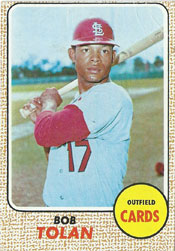
As a teen-ager, Bobby Tolan was a premier prospect for the Cardinals and was given a chance to displace Mike Shannon as the right fielder.

bob_tolanTolan was 19 when he debuted in right field for the Cardinals on Sept. 3, 1965. Batting leadoff, Tolan was 1-for-4 against the Mets. He singled to center in his first at-bat, but was picked off by pitcher Dick Selma and tagged out in a rundown. Boxscore

Sprinter speed

A left-handed batter, Tolan, 17, was signed by the Pirates in 1963 as an amateur free agent out of Fremont High School in Los Angeles. His cousin, Eddie Tolan, had been called the world’s fastest human after winning gold medals in the 100-meter and 200-meter sprints for the United States in the 1932 Olympic Games at Los Angeles.

After a season in the Pirates’ system, Tolan was left off the big-league roster and selected by the Cardinals in the December 1963 minor-league draft.

Converted from first baseman to outfielder by the Cardinals, Tolan made an immediate impact, hitting .297 with 34 stolen bases for Class AA Tulsa and being named to the Texas League all-star team.

In 1965, Tolan continued to impress. He hit .290 with 45 stolen bases for Class AAA Jacksonville.

A 1965 profile of Tolan in The Sporting News was headlined, “Teen-ager Tolan A Blur On Bases, Whiz With Stick.”

After Jacksonville beat the Dodgers in an exhibition game that year, Dodgers shortstop Maury Wills said, “He could challenge my base-stealing record.”

Said Dodgers catcher John Roseboro: “The kid looks too good to be true.”

Grover Resinger, who managed Tolan in consecutive seasons at Tulsa and Jacksonville, filed glowing reports to the Cardinals.

Another Billy Williams

“He’s improving all the time,” Resinger said. “… He’s going to be one of the better hitters in the game. He’s a line-drive hitter, with good power to all fields. Bobby is a Billy Williams type of hitter. He’s going to get stronger and I think he has a good chance to become a 25- to 30-homer hitter.”

Late in the 1965 season, Bob Howsam, Cardinals general manager, decided to give Tolan a chance to be St. Louis’ everyday right fielder for the final month of the season.

Shannon, who had become the Cardinals’ regular right fielder in the second half of 1964, struggled in 1965. He hit .221 and had almost as many strikeouts (46) as hits (54). The Cardinals’  backup right fielders _ Tito Francona (.259) and Phil Gagliano (.240) _ weren’t long-term solutions.

Howsam also was thinking ahead to 1966 when the Cardinals would move into their spacious new home, Busch Stadium II. He envisioned Tolan joining Lou Brock and Curt Flood in an outfield of speedsters who could chase down fly balls in the big stadium. Howsam also liked the thought of Tolan running the bases.

“His base-stealing ability is unlimited,” Resinger said of Tolan. “I think he’ll eventualy steal 50 bases in the big leagues. He’s not as fast as Brock, but he is above average.”

Too much, too soon

Tolan made 17 September starts in right field for the 1965 Cardinals, but he was overmatched at the plate. He hit .188 (13 hits in 17 games).

That performance prompted Howsam to alter his plans. After the 1965 season, the Cardinals acquired outfielder Alex Johnson from the Phillies. The Cardinals opened the 1966 season with Johnson in left, Flood in center and Brock shifting from left to right.

Johnson started poorly, though, and by mid-May was sent to the minors. The Cardinals moved Brock back to left and reinserted Shannon in right.

Tolan hit .172 in 43 games for the 1966 Cardinals. He was a backup to Roger Maris in right for the 1967-68 Cardinals clubs that won consecutive National League pennants and a World Series title.

After the 1968 season, the Cardinals traded Tolan to the Reds for right fielder Vada Pinson. Tolan was reunited with Howsam, who had become the Reds’ general manager.

Given a starting outfield spot, Tolan thrived with Cincinnati. He fulfilled Resinger’s prediction, producing a league-high 57 steals for the 1970 Reds. In four seasons with Cincinnati, Tolan hit .282 with 140 steals and helped the Reds win pennants in 1970 and 1972.

In a 13-year major league career with the Cardinals, Reds, Padres, Phillies and Pirates, Tolan hit .265 with 193 steals.

Previously: Here’s how Mike Shannon became a Cardinals catcher

Read Full Post »

(Updated April 5, 2026)

Determined to find a shortstop with the potential to quickly reach the majors as a starter, the Cardinals got it right when they chose Garry Templeton.

garry_templeton2Two years after he was drafted and taught how to switch-hit, Templeton made his Cardinals debut and became a fixture at shortstop for six seasons in St. Louis.

Prep phenom

In 1974, the Cardinals wanted a shortstop to succeed Mike Tyson, who was better suited to play second base.

Templeton, 18, a senior at Santa Ana Valley High School in California, was the prospect who most excited the Cardinals. A right-handed batter, Templeton hit .437 as a senior and .402 for his high school career.

On June 4, the night before the 1974 draft, Cardinals scout Bob Harrison called Templeton’s high school coach, Hersh Musick, and said, “We’re going to take Garry on the first round if he isn’t grabbed up before we get a chance,” the Santa Ana Register reported.

The Cardinals had reason to be concerned about Templeton’s availability by the time they got to select with the 13th pick in the first round. Shortstops were in high demand. Three of the 12 teams selecting ahead of the Cardinals took shortstops. None, it turned out, developed into as good a player as Templeton.

Shortstops chosen ahead of Templeton: Bill Almon (No. 1 pick), Padres; Mike Miley (No. 10 pick), Angels; and Dennis Sherrill (No. 12 pick), Yankees.

Asked his reaction to being selected, Templeton told the Santa Ana newspaper, “It is what I have been working for since I was 8 years old. It didn’t make any difference to me what club took me, just as long as I get a chance … I just hope I can make it into Busch Stadium quickly.”

Said Musick: “Garry is a fantastic hitter, has tremendous speed, possesses a strong arm, can field with the best and is dedicated. What more could any ballclub ask for?”

Lot to learn

The Cardinals signed Templeton for about $40,000, The Sporting News reported.

Templeton was assigned to the Cardinals’ Gulf Coast League rookie club in Florida. One of his teammates was another Cardinals infield prospect, Scott Boras, who would become a high-profile agent for professional athletes.

In a May 2014 interview with Washingtonian magazine, Boras said one reason he became an agent was because of the Cardinals’ handling of the Templeton signing. “The thing that really got me into this was the unfairness of the draft,” Boras said. “I thought it was wrong for the game. I go back to Garry Templeton. He’s an African-American kid _ no representation _ he walks in and they have all the techniques to sign you. It’s a one-way situation. He did not get his value.”

Because of his speed, the Cardinals worked on teaching Templeton how to hit from both sides of the plate.

“I watched Templeton learn to switch-hit in three weeks,” said Boras. “Three weeks! He was a remarkable athlete.”

Templeton hit .268 for the Gulf Coast League Cardinals and advanced to Class A St. Petersburg, where he struggled, batting .211.

Stick with it

Templeton, 19, opened the 1975 season at St. Petersburg and continued to perform below expectations. Discouraged by his lack of progress, Templeton approached manager Jack Krol. According to Ron Martz, columnist for the St. Petersburg Tmes, the ensuing conversation went like this:

Templeton: “I want to hit just right-handed.”

Krol: “Stick with it (switch-hitting). It’s not like you’re 24 or 25 years old. You’ve got plenty of time to learn.”

“The Redbirds are thirsting for a shortstop who can switch-hit, run well and dazzle in the field,” The Sporting News reported. “That’s why they had Garry Templeton try switch-hitting shortly after landing him out of high school.”

With Krol’s patient prodding, Templeton got his batting average to .264 and was sent to Class AA Arkansas, where he hit .401 in 42 games.

Templeton began the 1976 season at Class AAA Tulsa and produced 142 hits in 106 games, earning a promotion to the Cardinals.

The 20-year-old made his big-league debut on Aug. 9, 1976.

Templeton had 911 hits in 713 games over six seasons for the Cardinals, batting .305 with 138 steals. He twice was named an all-star as a Cardinal and led the National League in triples for three consecutive seasons: 1977 (18), 1978 (13) and 1979 (19). In 1979, Templeton produced a National League-best 211 hits and became the first major-league player to get 100 hits from each side of the plate in one season.

(In the 2005 book “Cardinals Where Have You Gone?” Templeton said he regretted becoming a switch-hitter. “I should never have let them talk me into becoming a switch-hitter,” Templeton told Rob Rains. “I should have been a right-handed hitter my entire career. I think I could have achieved more.”)

He also committed the most errors among NL shortstops for three seasons in a row: 1978 (40), 1979 (34) and 1980 (29).

After a run-in with manager Whitey Herzog for failing to hustle and for making obscene gestures to Cardinals fans who booed him, Templeton was traded to the Padres after the 1981 season. The deal brought shortstop Ozzie Smith to St. Louis, launching him onto a Hall of Fame career.


Read Full Post »

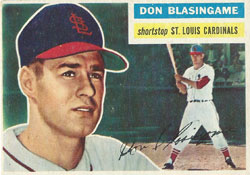
In 1956, Cardinals rookie second baseman Don Blasingame sprayed singles to all fields, ignited the offense with stolen bases and was superb at bunting for base hits.

don_blasingameWith the bases empty, Blasingame bunted for 66 hits in 77 attempts _ an 86 percent success rate _ during his 12-year big-league career, according to research conducted by James Gentile of SB Nation.

Of Blasingame’s 1,366 big-league hits, 1,105 (81 percent) were singles. In five years (1955-59) with the Cardinals, Blasingame produced 663 hits, with 528 (80 percent) being singles.

Blasingame got an opportunity to become the starting second baseman for the Cardinals because of a trade involving a fan favorite. In June 1956, the Cardinals dealt second baseman Red Schoendienst to the Giants, opening the position for Blasingame.

Gashouse Gang connection

In five games for the 1955 Cardinals after his promotion from the minor leagues in late September, Blasingame gave an indication of his electrifying potential. He had six hits and six walks in 23 plate appearances (a .545 on-base percentage).

Cardinals manager Fred Hutchinson opened the 1956 season with Schoendienst at second base and Alex Grammas at shortstop, but after three games Blasingame replaced Grammas.

Journalist Bob Broeg noted Blasingame wore uniform No. 3, the same worn from 1932-37 by Frankie Frisch, the Cardinals’ fiery Gashouse Gang second baseman who was elected to the National Baseball Hall of Fame.

In The Sporting News, Broeg wrote, “Blasingame’s skill at winning fans and followers _ as well as his share of games _ is no accident. For one thing, he’s extremely fast, probably the fleetest man on a St. Louis club that has its greatest collective speed since the famed Swifties of 1942.”

Blasingame said his playing style was inspired by Hall of Famer Ty Cobb. “I never saw him, of course, but I’ve read a lot about him, the way he could put the pressure on the other club and keep it there,” Blasingame said.

Firebrand like Fox

Because of his throwing arm, the Cardinals projected Blasingame as a better fit for second base than for shortstop. One of the players general manager Frank Lane acquired from the Giants for Schoendienst was Alvin Dark. Blasingame replaced Schoendienst at second, with Dark taking over at shortstop.

According to The Sporting News, Lane saw Blasingame “as a firebrand,” much like Nellie Fox, all-star second baseman of the White Sox.

“It was evident he had a chance for future greatness if he could be placed at second,” Lane said of Blasingame.

Wrote Broeg, “Blasingame, taking advantage of his speed and his small stature, has developed into an able leadoff man, a spray hitter and able drag bunter.”

Nicknamed the “Corinth Comet” (he hailed from Corinth, Miss.) and the “Blazer,” Blasingame finished his rookie season with 153 hits in 150 games, with 72 walks and 94 runs scored.

In his four full seasons (1956-59) with the Cardinals, Blasingame ranked in the top 10 in the National League in singles each year. In 1959, Blasingame led the league in singles, with 144, seven ahead of the runner-up, Reds second baseman Johnny Temple.

Blasingame also ranked among the top 10 in the league in stolen bases for three consecutive Cardinals seasons (1957-59).

The Cardinals, however, were last in the league in home runs in 1958 and sixth among eight teams in 1959. Desperate for power, Cardinals general manager Bing Devine traded Blasingame to the Giants for shortstop Daryl Spencer and outfielder Leon Wagner in December 1959.

Read Full Post »

In 1979, Kirk Gibson rejected a chance to play for the St. Louis Cardinals.

kirk_gibsonThat’s because he was committed to playing baseball, not football.

On May 4, 1979, the St. Louis football Cardinals selected Gibson, a wide receiver at Michigan State, in the seventh round of the NFL draft.

A year earlier, June 1978, Gibson had been chosen by the Tigers in the first round of baseball’s amateur draft and signed a $200,000 contract with Detroit. The outfielder spent the summer of 1978 playing for the Tigers’ Class A Lakeland (Fla.) team managed by Jim Leyland before returning to Michigan State for his senior football season.

Gibson established school single-season records for receptions (42) and receiving yards (806) in 1978. He finished his Michigan State football career with four-year totals of 112 receptions, 2,347 yards receiving and 24 touchdown catches, all school records.

Gibson would have been “a certain first-round pick” in the 1979 NFL draft if he hadn’t already signed with the Tigers, United Press International reported. The Tigers assigned Gibson to start the 1979 baseball season with their Class AAA Evansville (Ind.) team, again managed by Leyland.

Calculated risk

Bing Devine, longtime general manager of the St. Louis baseball Cardinals, had become vice president for administration of the St. Louis football Cardinals just a week before the 1979 NFL draft. Cardinals football scouts approached Devine before selecting Gibson to find out how baseball teams viewed Gibson.

Devine offered a positive report. Gibson hadn’t played baseball at Michigan State until his junior year. He still was relatively inexperienced at the game and some thought Gibson might change his mind and return to football.

“It was a calculated risk,” Devine said to the Associated Press of the football Cardinals’ decision to draft Gibson. “At this level of the draft, everyone’s a calculated risk. With his amount of football talent, I guess the people over in the drafting office figured he was worth taking a chance on.

“Besides,” Devine continued, “in baseball, just as in football, there’s no such thing as a sure bet.”

Tigers general manager Jim Campbell told the Associated Press, “We’re not surprised that any major (football) team would want Kirk, but we are convinced that he will honor his contract with us.”

Said Gibson regarding the football Cardinals: “I imagine they will call me and I’ll probably say, ‘Hi,’ but I’m a baseball player … as of now.”

The Cardinals offered Gibson a financial deal similar to what he had with the Tigers. When reporter Jim Hawkins, a baseball correspondent for The Sporting News, visited Gibson at Evansville a month after the NFL draft, Gibson showed him four one-year contracts totaling $200,000 sent by the football Cardinals. The contracts, Hawkins reported, were for $35,000, $45,000, $55,000 and $65,000 for each of the next four NFL seasons.

“Right now, I’m not thinking about football at all,” Gibson said. “I made up my mind last year to play baseball and I don’t want to be second-guessing myself. I want to keep my mind on baseball.”

Baseball lifer

In his first game for Evansville, against an Iowa club managed by Tony La Russa, Gibson had a two-run home run, a RBI-double, two walks and a sacrifice bunt. Gibson went on to bat .245 with 42 RBI in 89 games for Evansville.

The Tigers promoted Gibson to the big leagues in September 1979 and he made his major-league debut on Sept. 8. Tigers manager Sparky Anderson sent the rookie to bat against Yankees closer Goose Gossage, who struck him out.

Gibson never was tempted again to try football. He built a 17-year big-league playing career, helping the Tigers (1984) and Dodgers (1988) to World Series championships with memorable home runs (off Gossage in 1984 and off Dennis Eckersley in 1988) and earning the 1988 National League Most Valuable Player Award. As manager of the Diamondbacks, Gibson won the 2011 NL Manager of the Year Award.

Even without Gibson, the football Cardinals had a spectacular draft in 1979. Their selections in the first through fourth rounds all became starters:

_ Halfback Ottis Anderson (7,999 yards rushing and 46 rushing touchdowns in eight years with St. Louis).

_ Fullback Theotis Brown (10 rushing touchdowns in three years with St. Louis).

_ Offensive guard Joe Bostic (122 games, 114 as a starter, in nine years with St. Louis).

_ Wide receiver Roy Green (522 receptions, 8,496 yards receiving and 66 touchdown catches in 12 years with the Cardinals in St. Louis and Arizona).


Read Full Post »

(Updated April 5, 2026)

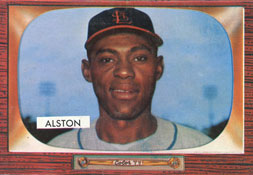
Two years after his professional baseball debut at the Class C level of the minor leagues, Tom Alston was the Opening Day first baseman for the Cardinals. Making that leap in such a short time would be a challenge for any prospect. Alston had the additional pressure of being the player who integrated the Cardinals.

tom_alstonOn April 13, 1954, Thomas Edison Alston was the first African-American to play in a regular-season game for the Cardinals, batting sixth and playing first base against the Cubs at St. Louis.

Seven seasons after Jackie Robinson joined the Dodgers, the Cardinals were the 10th of the 16 big-league teams to integrate.

Alston, 28, was the 14th African-American player in the Cardinals’ organization, but the only one on the big-league roster. (Among the other blacks in the Cardinals’ system in 1954 were pitchers Bill Greason, Brooks Lawrence and John Wyatt. All eventually pitched in the big leagues.)

Rapid rise

Alston and Jackie Robinson were born on the same date, Jan. 31. Robinson’s birth year was 1919 and Alston’s was 1926.

Alston’s rise from baseball novice to Cardinals pioneer was fast and unexpected. After serving in the Navy from 1945-47, Alston enrolled at North Carolina A&T in his hometown of Greensboro and earned a degree in physical education and social sciences. College was where Alston first played organized baseball.

In 1952, he entered professional baseball with Porterville, Calif., of the Class C Southwest International League, hit .353 in 54 games and caught the attention of the San Diego club of the Class AAA Pacific Coast League.

Alston joined San Diego midway through the 1952 season and hit .244.

In 1953 for San Diego, Alston had 207 hits in 180 games, with 101 runs scored, 23 home runs, 101 RBI and a .297 batting average. Cardinals scouts recommended him.

On Jan. 26, 1954, the Cardinals sent first baseman Dick Sisler, pitcher Eddie Erautt and $100,000 to San Diego for Alston. San Diego manager Lefty O’Doul called Alston “a great prospect who can field as good as any first baseman in the big leagues.”

He “looks like he’s going to be a great hitter, too,” O’Doul told The Sporting News.

Said Cardinals owner Gussie Busch: “When we purchased the Cardinals, I promised there would be no racial discrimination. However, Alston was not purchased because of his race. Our scouts and manager Eddie Stanky believe he is a great prospect. While he may need more experience, we didn’t want him to slip away from us.”

Bill Starr, president of the San Diego club, offered to cut the cash portion of the deal to $75,000 if the Cardinals would wait until 1955 to take Alston, according to the Los Angeles Daily Mirror, but the Cardinals wanted Alston for 1954. The incumbent at first base was Steve Bilko, who hit 21 home runs for the 1953 Cardinals but also led the National League in striking out (125 times). The Cardinals used spring training in 1954 as a competition between Alston and Bilko for the first base job.

“I think we have a real ballplayer in this colored boy,” Stanky said to The Sporting News in March 1954.

Said Alston: “They treat me here just the same as any other ballplayer and that’s how I want to be treated.”

Major leaguer

Stanky said he’d platoon Alston (a left-handed batter) and Bilko (right-handed), but Alston got the Opening Day start against Cubs left-hander Paul Minner.

“I guess I’ve come a long way in a short time,” Alston said. “I guess I came up like a real rocket.”

Alston went 0-for-4 with a strikeout and committed an error in his debut game. Boxscore

In his next game, April 17, 1954, at Chicago, Alston went hitless in his first four at-bats. In the eighth, he led off with a home run, his first big-league hit, against Cubs reliever Jim Brosnan. Boxscore

The next day, April 18, Alston got his second hit, a pinch-hit, three-run homer off left-hander Jim Davis, lifting the Cardinals to a 6-4 triumph. Boxscore

On April 30, in an endorsement of Alston, the Cardinals sent Bilko to the Cubs.

In a doubleheader against the Giants on May 2, Alston was 5-for-6 with five RBI, an inside-the-park home run and three walks. His performance was overshadowed by teammate Stan Musial, who hit five home runs with nine RBI. Game 1 boxscore Game 2 boxscore

In The Sporting News, Bob Broeg wrote of Alston’s inside-the-park home run: “His speed enabled him to circle the bases easily after Willie Mays misjudged his long wind-blown drive to left-center.”

Slowed by slump

Alston hit .301 (37-for-123) in May and was at .285 overall on May 30, but he slumped in June, enduring a 2-for-27 stretch and batting .181 (15-for-83) for the month. He had seven RBI in his last 42 games.

Alston complained that a mysterious physical ailment was causing him to feel weak. Medical exams turned up nothing. Eventually, Cardinals trainer Bob Bauman determined Alston was suffering from neurasthenia. A psychiatrist confirmed the diagnosis. According to the St. Louis Post-Dispatch, “The complicated emotional disorder somehow manifests itself in physical symptoms such as unexplained fatigue, sweating, vertigo and inability to sleep or concentrate.”

In June 1954, the Cardinals called up a black pitcher, Brooks Lawrence, from the minors and arranged with Lawrence and Alston to stay with a black family. As Lawrence recalled to Wendy Conlin of the Post-Dispatch, Alston would pray out loud at night in bed. “I would lie there and hear him praying, ‘I can hit, I can hit, I can hit.’ He made it kind of difficult to sleep sometimes,” Lawrence said.

On June 30, the Cardinals sent Alston to Class AAA Rochester and called up another rookie, Joe Cunningham, to replace him at first base. Alston’s overall numbers for the 1954 Cardinals: 60 hits in 66 games, 14 doubles, four home runs, 34 RBI and a .246 batting average. He made 62 starts at first base.

Said Cardinals general manager Dick Meyer: “Alston wasn’t ready … Eddie (Stanky) and I still have a very high regard for Alston as a prospect.”

Cunningham hit .284 with 11 home runs in 85 games for the 1954 Cardinals. The next season, the Cardinals moved Musial from the outfield to first base.

Alston made brief appearances with the Cardinals in 1955, 1956 and 1957. According to the Associated Press, when Gussie Busch asked Cardinals manager Fred Hutchinson why he didn’t play Alston, Hutchinson coldly replied, “If you want a clown to play first base, why don’t you hire (circus performer) Emmett Kelly?”

In 91 big-league games, all with St. Louis, Alston had 66 hits and batted .244.

In the 1990 book “Redbirds Revisited,” Alston told authors David Craft and Tom Owens, “I got a fair shake. It was just my physical condition that kept me from playing ball the way I knew I could play, the way the Cardinals expected me to play. My teammates treated me fairly. I don’t think they thought I was that good a hitter, though, and I guess I didn’t show them much while I was there.”

Ten years after Alston’s big-league debut, the Cardinals became World Series champions, building a reputation as a franchise that embraced diversity with players such as Bob Gibson, Bill White, Curt Flood, Lou Brock and Julian Javier.

Tom Alston took the first steps toward making that possible.

Troubled times

In 1958, Alston was arrested on arson charges after he admitted setting fire to a North Carolina church, the St. Louis Argus reported.

Police inspector M.L. Riley told the Argus that when he asked Alston why he set the church afire, Alston replied, “I had a fight with my sister and I just wanted to show her something.”

Alston spent from 1959 to 1969 in two state institutions in North Carolina, the Post-Dispatch reported.

In 1990, the Cardinals invited Alston to throw the ceremonial first pitch before a game against the Cubs at St. Louis. “I had more fun that visit than I ever had when I was playing,” Alston told Wendy Conlin of the Post-Dispatch.


Read Full Post »
Their given names were John and George.

Their baseball names were Sonny and Sparky.

sonny_rubertoTogether, they contributed to a standard of teaching that became a hallmark of the Cardinals.

Sonny Ruberto, mentored by Sparky Anderson in the Cardinals’ system, influenced St. Louis players and prospects from 1977-81 as a big-league coach and minor-league manager.

Two of his pupils in the Cardinals system, Jim Riggleman and John Stuper, carried on with reputations as first-rate instructors. Riggleman managed five big-league teams. Stuper, who started and won Game 6 of the 1982 World Series for the Cardinals, coached the Yale University baseball team.

George “Sparky” Anderson, who built a Hall of Fame career as manager of the Reds and Tigers, was 30 when he began his managerial career with Class AAA Toronto in 1964. A year later, he became a manager in the Cardinals system.

John “Sonny” Ruberto was 24 when he began his managerial career with the Padres’ Class A Lodi club in 1970. At 31, he became the youngest coach in the major leagues when he joined the staff of first-year Cardinals manager Vern Rapp in 1977.

Cardinals prospect

A standout catcher at Curtis High School in Staten Island, N.Y., where he played with other future major leaguers such as Terry Crowley and Frank Fernandez, Ruberto signed with the Cardinals as an amateur free agent in 1964. Two years later, he was on a Class A St. Petersburg team managed by Anderson.

In a 1966 game that began on June 14 and ended at 2:30 a.m. on June 15, the visiting Miami Marlins beat St. Petersburg, 4-3, in 29 innings. “It was the darndest thing I’ve ever seen,” Anderson told The Sporting News.

Ruberto played all 29 innings _ the first nine as catcher and the last 20 at shortstop. He had two hits in 10 at-bats and scored a run.

Ruberto hit .283 in 88 games for St. Petersburg. The next year, he played for the Cardinals’ Class A Modesto club, managed by Anderson.

On May 22, 1969, the Cardinals traded Ruberto and second baseman John Sipin to the Padres for infielder Jerry DaVanon and first baseman Bill Davis. Ruberto made his big-league debut as a player with the Padres that month.

Big Red Machine

After a season managing Lodi, Ruberto in 1971 joined the Reds organization, where he was reunited with two key figures from his Cardinals days: Anderson (the Reds’ manager) and Bob Howsam, the former Cardinals general manager who took over the same role with Cincinnati.

Ruberto resumed his playing career and was sent to Class AAA Indianapolis. His manager there for the next five years, 1971 through 1975, was Rapp. As catcher, Ruberto was credited with helping the progress of several Reds pitching prospects, including Joaquin Andujar, Ross Grimsley, Tom Hume, Milt Wilcox and Pat Zachry.

“I feel I had something to do with their development,” Ruberto told The Sporting News.

When Rapp was named Cardinals manager, replacing Red Schoendienst, for the 1977 season, he selected Ruberto to be the first-base coach.

Wrote The Sporting News: “Like Rapp, Ruberto had been a career Triple-A catcher highly regarded for his ability to handle pitchers. Ruberto even has some ideas on helping Ted Simmons improve his backstopping duties.”

Rapp was brought to the Cardinals to instill discipline. At spring training in 1977, The Sporting News reported, “Rapp sized up his charges to make sure that the regulation baseball uniforms were worn properly. He had coach Sonny Ruberto demonstrate how he wanted the uniforms worn.”

At the helm

Rapp was fired in April 1978 and replaced by Ken Boyer. After the season, two of the coaches Boyer had inherited, Ruberto and Mo Mazzali, were replaced by Schoendienst and Dal Maxvill.

The Cardinals, though, kept Ruberto in the organization, naming him manager of the 1979 St. Petersburg club, succeeding Hal Lanier, who was promoted to Class AAA Springfield.

“What kind of manager will I be?” Ruberto said in response to a question from the St. Petersburg Times. “Well, a little of Vern Rapp, a little of Sparky Anderson, a little of Billy Martin and a lot of Sonny Ruberto.”

St. Petersburg finished 64-71, but the Cardinals were pleased with how their prospects, such as Stuper and fellow starting pitcher Andy Rincon, developed under Ruberto.

In 1980, Ruberto managed the Cardinals’ Class AA Arkansas team to an 81-55 record and a Texas League championship. Stuper had a 7-2 record for Arkansas. Riggleman, a third baseman, hit .295 with 21 home runs and 90 RBI in 127 games.

Ruberto managed the Cardinals’ Class A Erie team to a 44-30 record in 1981.

He operated a photography business in St. Louis and resided there with his family for 26 years.

Read Full Post »

« Newer Posts - Older Posts »