Feeds:
Posts
Comments

Archive for the ‘Prospects’ Category

Kolten Wong is a native Hawaiian who bats left-handed and rates as a prized player for the Cardinals.

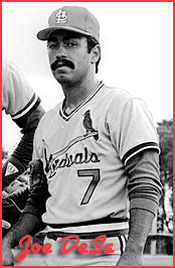
In 1977, the same description fit for Joe DeSa.

joe_desaWong, a second baseman and the 2011 first-round Cardinals draft choice, made his major-league debut with St. Louis on Aug. 16, 2013. He became the first native Hawaiian to play for the Cardinals since DeSa debuted with them in 1980.

DeSa, 17, was selected by St. Louis in the third round of the 1977 draft. A left-handed batter, he had been a high school standout in Honolulu.

DeSa, 5 feet 11, 170 pounds, entered the Cardinals’ minor-league system with a reputation as a line-drive hitter and smooth-fielding first baseman.

That reputation proved accurate.

In 1979, with the Cardinals’ Class AA Arkansas club, DeSa hit .317 with 32 doubles, 13 home runs and 86 RBI. He had 147 hits in 130 games.

In a 1979 interview with Larry Harnly of The State Journal-Register of Springfield, Ill., Cardinals manager Ken Boyer said of DeSa, “He’s about as good a looking hitter as you will see.”

No room at first

Though DeSa was performing to expectations, his path to the majors was blocked by Keith Hernandez, the Cardinals’ regular first baseman and 1979 National League batting champion.

DeSa was promoted to the Cardinals’ Class AAA Springfield (Ill.) team in 1980. The Cardinals’ 1980 media guide described DeSa as “a line-drive hitter with some power.”

He hit .293 with 25 doubles in 123 games for Springfield and was rated the best defensive first baseman in the league.

In September 1980, the Cardinals, far out of contention, called up DeSa.

After going hitless in his first five big-league at-bats, DeSa got hits in the last three games he played for St. Louis. His first was a pinch-hit single against the Expos’ Bill Gullickson on Sept. 30, 1980. Boxscore

In seven games for the 1980 Cardinals, DeSa batted .273 (3-for-11).

Those would be the only games he’d play for St. Louis.

Tony time

DeSa, converting from first base to the outfield, played the next three seasons for Cardinals Class AAA clubs. Then he became a minor-league free agent and signed with the White Sox.

In 1985, DeSa returned to the big leagues, appearing in 28 games for the White Sox, managed by Tony La Russa, and batting .182 (8-for-44) with two home runs.

DeSa spent the 1986 season with Buffalo, the Class AAA club of the White Sox, and was named the Bisons’ most valuable player. He hit 17 home runs and had 83 RBI.

After the season, DeSa became a minor-league free agent again, signed with the Royals and went to Puerto Rico to play winter league ball.

On Dec. 20, 1986, DeSa, 27, was killed in a car accident in Puerto Rico. He left behind a wife, Margarita, and a year-old son, Joe.

White Sox players collected more than $3,000 for his funeral expenses, The Sporting News reported. The Bisons established a memorial fund and raised nearly $7,000. The Class AAA club also established the annual Joe DeSa Most Inspirational Player Award. It still is presented to a Buffalo player near the end of each season.

On Aug. 16, 1987, the White Sox presented DeSa’s wife and son with a check for $120,000 in a ceremony honoring DeSa before a Pacific Coast League game between Portland and Hawaii in Honolulu.

Previously: Warren Spahn and his Cardinals connection

Read Full Post »

(Updated June 16, 2023)

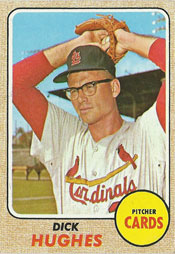
As a Cardinals rookie, Dick Hughes delivered a dominant strikeout performance against the Reds that stands out for its artistry and drama.

dick_hughesOn May 30, 1967, Hughes was perfect for seven innings against the Reds at Cincinnati. Then a string of bad breaks and bizarre plays occurred. Hughes struck out 13 in eight innings but took the loss in the Reds’ 2-1 victory.

A right-hander, Hughes spent nine seasons (1958-66) in the minor leagues. His vision was 20-75 in one eye; 20-300 in the other, according to The Sporting News.

In 1966, Hughes turned around his career by developing a slider and a no-windup delivery. He got his first call to the big leagues with the Cardinals in September 1966.

Hughes, 29, opened the 1967 season in the Cardinals bullpen. He joined the starting rotation in May, swapping roles with Al Jackson.

Five days after pitching a two-hit shutout in the Cardinals’ 5-0 victory over the Braves in Atlanta Boxscore, Hughes was paired against Reds ace Jim Maloney at Cincinnati’s Crosley Field.

The start of the game was delayed 1 hour, 35 minutes by rain. Unfazed, Hughes retired the first 18 batters. Then play was halted another 55 minutes by rain.

Hughes retired the Reds in order in the seventh, keeping his bid for a perfect game intact, but the second delay had been damaging.

“My slider was not going where I wanted it to and, after the rain stopped the game (a second time), I began relying on my fastball.” Hughes said to the Associated Press.

Said Cardinals manager Red Schoendienst: “The delay in the game by rain took a little of the edge off Hughes.”

With the Cardinals ahead 1-0, Tony Perez, leading off the eighth for Cincinnati, swung at a 3-and-2 fastball and lofted a high fly to center. The ball hit off the wall at cozy Crosley for a 380-foot triple “that would have been an easy out in any other park,” The Sporting News reported.

With the perfect game bid ended, Hughes focused on trying to preserve the lead. After he struck out Deron Johnson for the first out, Vada Pinson batted. “Pinson tried to duck from a high pitch, which he later confessed he never saw and, presto, he had a bloop, score-tying double to short left,” The Sporting News reported.

Pinson’s fluke double plated Chico Ruiz, who ran for Perez, tying the score at 1-1.

Trying to set up a double play, Hughes issued an intentional walk to Johnny Edwards, but Leo Cardenas followed with a single, scoring Pinson and giving the Reds a 2-1 lead. Edwards advanced to third on the play, but Cardenas was thrown out at second, trying to stretch the single into a double.

Maloney was due up next. Rather than lift him for a pinch-hitter and turn to a closer in the ninth, manager Dave Bristol opted to let Maloney bat and he ended the inning with a fly out.

Fortunately for the Cardinals, Maloney was tiring. Orlando Cepeda opened the ninth with a single. Tim McCarver followed with another single, sending Cepeda to third.

Bristol lifted Maloney and brought in Don Nottebart to face Phil Gagliano, subbing for third baseman Mike Shannon, who had a viral infection.

Gagliano swung at Nottebart’s first pitch and grounded sharply to Cardenas at shortstop. Cepeda should have raced for home. Instead, he hesitated. Cardenas fielded the grounder and flipped to second baseman Tommy Helms, forcing McCarver. Though McCarver slid hard into him, Helms relayed a throw to first baseman Deron Johnson, completing the double play.

(In his book, “Baseball for Brain Surgeons and Other Fans,” McCarver recalled, “I hit Helms so hard on that play that I was concerned enough to call him after the game. In my entire career, that was the only time I called an opposing player to find out if he was OK.”)

On Helms’ throw, Cepeda broke for home. Johnson spotted him and fired the ball to catcher Johnny Edwards, who tagged out Cepeda.

Triple play. Game over.

“Something, eh?” an astonished Bristol said to the Associated Press. “First time I ever threw my cap into the stands.

“I sent Nottebart in to pitch, hoping he would throw a low ball for a grounder. He sure did.” Boxscore

Hughes finished with a pitching line of eight innings, three hits, two runs, one walk and 13 strikeouts. Hughes held Pete Rose hitless, stopping Rose’s 25-game hit streak.

“If it hadn’t rained, we never would have got a hit off Hughes,” Chico Ruiz said. “Hughes was just great.”

Read Full Post »

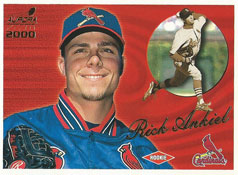
As a Cardinals rookie, Rick Ankiel struck out 11 batters in a game four times, twice doing it before his 21st birthday.

rick_ankiel3Here is a look at those performances:

_ Cardinals 7, Marlins 6, at St. Louis, May 25, 2000: Ankiel earned his fourth win of the season, striking out 11 in 6.2 innings.

The effort was controversial because Ankiel threw 121 pitches. Scott Boras, Ankiel’s agent, said he believed the Cardinals had agreed to limit Ankiel to 100 pitches a game.

Ankiel, who was averaging 4.25 walks per game, didn’t yield a walk to the Marlins. He struck out the side (Preston Wilson, Derrek Lee and Alex Gonzalez) in the second inning and did it again (Danny Bautista, Cliff Floyd and Wilson) in the fourth. Boxscore

_ Indians 3, Cardinals 2, at St. Louis, June 4, 2000: Six of the Indians’ first seven outs were on strikeouts. Ankiel struck out 11 in five innings and walked none, but was lifted after reaching 98 pitches.

“I had a lot of strikeouts, but I really wasn’t going that well,” Ankiel said to the St. Louis Post-Dispatch.

Ankiel struck out the side (Alex Ramirez, Jolbert Cabrera and Jim Brower) in the second and did it again (Sandy Alomar, Richie Sexson and Ramirez) in the fourth. Boxscore

_ Cardinals 12, Astros 1, at Houston, July 21, 2000: Two days after turning 21, Ankiel struck out 11 in seven innings and improved his record to 7-5. Ankiel struck out Craig Biggio twice and Lance Berkman once.

“He’s got an electric arm,” said Astros slugger Jeff Bagwell.

Said Cardinals manager Tony La Russa: “Sometimes it’s hard to remember how young he is. With him, it’s all about command. His stuff is so good.” Boxscore

_ Cardinals 9, Pirates 5, at Pittsburgh, Sept. 13, 2000: In the last game the Cardinals would play at Three Rivers Stadium before the Pirates moved into PNC Park, Ankiel struck out 11 in 6.2 innings, earning his ninth win of the season.

Ankiel struck out the side (John Wehner, Mike Benjamin and Adrian Brown) in the second.

“The ball explodes out of his hand,” said Pirates manager Gene Lamont. “He’s going to be one of the best pitchers we’ve seen in a long time.”

Said La Russa: “I’d love for him to get the Rookie of the Year (Award) because those nine wins do not reflect how well he’s pitched. He’s learning to pitch. He’s not just out there throwing.” Boxscore

Less than a month later, Oct. 3, 2000, Ankiel, a surprise starter in Game 1 of the National League Division Series against the Braves, walked six and threw five wild pitches in 2.2 innings, triggering the downward spiral that led to the end of his pitching career. Boxscore

Read Full Post »

(Updated Jan. 13, 2025)

Lacking an “h” in his first name was one of many differences between Cris Carpenter and the successful Cardinals ace of the similar name, Chris Carpenter. Still, there was a time when Cris Carpenter was regarded as a top talent in the St. Louis system.

cris_carpenterChris Carpenter, signed as a free agent by the Cardinals in December 2002, posted a 95-44 regular-season record in nine years with St. Louis (2004-2012)

Cris Carpenter, from the University of Georgia, was a first-round pick of the Cardinals in the 1987 amateur draft. He was the 14th overall selection, ahead of No. 1 picks such as the Astros’ Craig Biggio (22nd overall), the Orioles’ Pete Harnisch (27th) and the Tigers’ Travis Fryman (30th).

“No way I thought he would last until 14th, but he did,” Cardinals scouting director Fred McAlister told Cardinals Yearbook in 1988. “He might be the best pitcher in that draft.”

Afterward, Cris Carpenter spent the summer of 1987 pitching for Team USA in the Pan American Games. He was 6-1 with five saves and a 1.37 ERA. He signed with the Cardinals in September 1987.

Cris Carpenter began his first professional season as a starter for Class AAA Louisville in 1988. After seven appearances, he was called up to the Cardinals and started against the Braves in his major-league debut on May 14, 1988. The Braves were the boyhood favorite of Cris Carpenter, who grew up in Gainesville, Ga.

“It’s hard to believe I’ll be pitching against the Braves,” Cris Carpenter said to the St. Louis Post-Dispatch. “I watched Dale Murphy on television for so many years, but to see him in person and pitch against him … It’s going to be fun.”

Cris Carpenter’s debut game turned out to be one of the most memorable in Cardinals lore. The Braves won, 7-5, in 19 innings. Infielder Jose Oquendo pitched the final four innings for St. Louis and took the loss. Carpenter yielded five runs in six innings. Murphy was 0-for-2 with a walk against Carpenter. Boxscore

In five years (1988-92) with St. Louis, Cris Carpenter was 21-15 with a 3.66 ERA, primarily as a reliever. Under manager Joe Torre, Carpenter was 10-4 with a 4.23 ERA in 59 relief appearances in 1991 and 5-4 with a 2.97 ERA in 73 relief appearances in 1992.

The Cardinals made Cris Carpenter available in the National League expansion draft in November 1992 and he was selected by the Marlins. “He lost his confidence and tried to guide the ball,” Torre said. “When he gets into that mode of trying to guide the ball, he gets burned.”


Read Full Post »

(Updated Jan. 22, 2022)

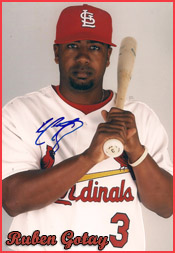
During spring training in 2010, Ruben Gotay was considered a candidate to earn an Opening Day roster spot with the Cardinals as a utility player. Instead, he spent the season in the minors.

ruben_gotayThree years later, Gotay was back in Cardinals spring training camp as a surprise fill-in at the minor-league level.

On March 27, 2013, during the last week of spring training camp at Jupiter, Fla., Gotay signed with the Cardinals and reported to Springfield to become the starting third baseman for the Class AA Texas League club.

The signing was a stunner because Gotay, 30, hadn’t received interest from any major-league organization after spending the 2012 season in the minor-league systems of the Blue Jays and Braves.

Five years removed from his last big-league appearance with the 2008 Braves, Gotay was home in Puerto Rico, trying to land a spot with an independent league team, when the Cardinals called.

According to Kary Booher of the Springfield News-Leader, Gotay became Springfield’s oldest player since infielder Aaron Miles, 34, was on the club in May 2010.

The Cardinals were in need of a Class AA third baseman because the projected starter, Matt Cerda, 22, left camp, saying he may pursue a different career. The Cardinals weren’t ready to put a top third base prospect, such as Patrick Wisdom, at Class AA, so they went looking for a veteran.

“I’ve been blessed,” Gotay said to the Springfield News-Leader. “It feels pretty good to be back in the field.”

Three years earlier, after signing a free-agent contract with the Cardinals, Gotay was considered a versatile talent who could fill a utility role for them.

He had played four seasons in the big leagues with the Royals (2004-05), Mets (2007) and Braves (2008) before spending 2009 in the minor leagues.

Gotay was one of four non-roster infielders at the 2010 Cardinals’ major-league spring training camp. The others: Daniel Descalso, Pete Kozma and Donovan Solano.

In 2010, Gotay was the best-known player in that group. As the starting second baseman for the Royals in 2005, Gotay had a 3-for-3 game against the Cardinals’ Matt Morris on May 21 Boxscore and followed that the next day with a home run off the Cardinals’ Jeff Suppan. Boxscore

His uncle, Julio Gotay, had been the Cardinals’ starting shortstop in 1962.

In January 2010, Joe Strauss of the St. Louis Post-Dispatch wrote, “Gotay is given the best chance among non-roster infielders to break camp with the club.”

That same month, Post-Dispatch columnist Bernie Miklasz wrote, “Gotay is intriguing. Could he surprise and do for the 2010 Cardinals what Abraham Nunez did for the 2005 team?”

In an exhibition game against the Mets at Jupiter, Gotay hit a walkoff home run for a 6-5 Cardinals victory. Noting that Gotay had fouled off several fastballs before hitting the full-count homer, Derrick Goold of the Post-Dispatch reported it was “the kind of ninth-inning at-bat that gets attention.”

Gotay’s chance of earning a spot with the 2010 Cardinals was set back when they signed free-agent infielder Felipe Lopez during spring training. With two weeks left in camp, the Cardinals reassigned Gotay to Class AAA Memphis.

Five months later, August 2010, Cardinals third baseman David Freese suffered a season-ending ankle injury. Gotay was batting .271 with a .400 on-base percentage at Memphis, but the Cardinals traded for fading veteran Pedro Feliz of the Astros rather than call up Gotay.

Strauss of the Post-Dispatch wrote that Gotay “fit a statistical profile” but was “judged unsuitable for promotion.”

“Gotay’s defensive shortcomings became obvious to the major-league staff before spring training ended,” Strauss wrote. “He never received consideration as an emergency option.”

Gotay finished the 2010 season with 135 hits in 139 games for Memphis. He had 30 doubles, 13 home runs, 70 RBI, 95 walks, a .285 batting average and a .410 on-base percentage. He made 17 errors at third base. Gotay was granted free agency after the season and signed with the Marlins organization.

With the Cardinals’ Springfield club, managed by Mike Shildt, in 2013, Gotay played third base, batted .279 in 133 games and led the team in hits (139) and RBI (89).

Read Full Post »

Stan Musial and Earl Weaver were Cardinals spring training teammates. Both were elected to the National Baseball Hall of Fame _ Musial for his accomplishments as a Cardinals player and Weaver for his success as an Orioles manager.

earl_weaverMusial, 92, and Weaver, 82, died on the same day, Jan. 19, 2013.

In March 1952, Musial, 31, was in his prime, having led the National League in batting average, triples and runs scored in 1951.

Weaver, 21, was in the Cardinals’ major-league camp for the first and only time. The 5-foot-7 second baseman was the youngest and shortest member of the Cardinals’ 40-man roster in March 1952, The Sporting News reported.

A St. Louis native, Weaver signed with the Cardinals at 17 in February 1948, a month after he was graduated from Beaumont High School. He played for the Woltman Jewelers team that won the St. Louis Intermediate Municipal League championship three times and also for the Fred W. Stockham American Legion team that won Missouri state titles in 1945 and 1947, The Sporting News reported.

In his first four seasons (1948-51) in the Cardinals’ farm system, Weaver played on four teams that won league championships: West Frankfort (Illinois State) in 1948, St. Joseph (Western Association) in 1949, Winston-Salem (Carolina) in 1950 and Omaha (Western League) in 1951. Weaver’s manager at Winston-Salem and at Omaha was George Kissell.

When Winston-Salem clinched the 1950 Carolina League title with a 3-1 victory over Burlington in Game 5 of the best-of-seven series, pitcher Vinegar Bend Mizell hit a home run and Weaver drove in the deciding runs with a bases-loaded single in the sixth inning. “Scouts of the parent St. Louis Cardinals describe Weaver as a Solly Hemus type,” The Sporting News declared, comparing Weaver with the Cardinals’ feisty shortstop.

After being named to the 1951 Western League all-star team along with Omaha teammate Ken Boyer, Weaver entered 1952 determined to win a spot on the Cardinals’ Opening Day roster as a backup to second baseman Red Schoendienst.

The Sporting News, in its March 5, 1952, edition, reported, “In Earl Weaver, the smallest athlete in camp _ 5 feet 7 _ the Cardinals have a fine infield prospect, a smooth workman around second base and a fair hitter.”

When the Cardinals opened their 1952 spring training schedule on March 8 against the Yankees at St. Petersburg, Fla., the top three in their batting order were Weaver at second base, Hemus at shortstop and Musial in left field. Weaver had two hits and Musial had one in the Yankees’ 11-5 victory over the Cardinals.

The next day, March 9, 1952, Weaver again batted leadoff and started at second base and Musial was in left field, batting third. Weaver and Musial went hitless, but the Cardinals beat the Yankees, 3-1.

What made that game remarkable is 10 of the players _ three Cardinals and seven Yankees _ became major-league managers. They were Weaver, Hemus and catcher Del Rice of the Cardinals; catchers Yogi Berra and Ralph Houk, shortstops Jerry Coleman and Gene Mauch, second baseman Billy Martin, pitcher Eddie Lopat and right fielder Hank Bauer of the Yankees.

(When manager Bauer was fired by the Orioles in July 1968, he was replaced by his first-base coach, Weaver.)

Weaver played and started in many spring training games for the 1952 Cardinals. Among his highlights:

_ On March 10, batting leadoff and playing second base, Weaver was 2-for-4 with two RBI in the Cardinals’ 8-5 victory over the Braves at Bradenton, Fla. Musial had a double in two at-bats.

_ On March 13, Weaver was 2-for-4 with a stolen base and Musial was 1-for-4 in the Reds’ 2-1 victory over the Cardinals at St. Petersburg.

_ On March 14, Weaver had two hits, including a home run off Bob Porterfield, when the Cardinals and Senators played to a 6-6 tie in a game called in the sixth inning because of rain at St. Petersburg.

_ On March 19, Weaver contributed a pinch-hit single for the Cardinals in a game won by the Red Sox, 3-2, at St. Petersburg. The starting left fielders were Musial and Ted Williams. Musial was 2-for-3; Williams, 0-for-3.

Though he impressed the Cardinals, Weaver was returned to the minor leagues at the end of spring training.

Weaver played two more seasons in the Cardinals’ system before his contract was purchased by Denver, a minor-league affiliate of the Pirates, in September 1953.

Weaver played 14 seasons in the minor leagues without appearing in a major-league game.

He established himself as big-league caliber as Orioles manager by winning 1,480 regular-season games, six division titles, four American League pennants and a World Series championship in 17 seasons.

Few recalled, though, his professional baseball career began as a Cardinals prospect who joined Musial as a regular for one glorious month in spring training.

Read Full Post »

« Newer Posts - Older Posts »