Feeds:
Posts
Comments

Archive for the ‘Prospects’ Category

As a youth in small-town Texas, Bobby Joe Conrad would go to a vacant lot near his house and practice kicking a football. He taught himself to boot the ball high and far and straight. After a while, he was kicking footballs over the arching branches of a cluster of hackberry trees.

“I guess a lot of it came naturally,” he recalled to the Bryan-College Station Eagle.

Conrad could throw, catch and run with a football, too. There wasn’t much, actually, he couldn’t do on a football field. When Conrad got to college at Texas A&M, he was a quarterback, running back, receiver and defensive back.

Those kicking skills, though, are what first got him national attention.

Home on the range

Conrad was from the Texas town of Clifton, which was settled by Norwegian immigrants in the 1800s. Located along the Bosque River, 100 miles south of Dallas, Clifton’s population never topped 3,500. Conrad felt right at home there. “I never found any compelling reason to leave,” he told the Waco Tribune-Herald.

A standout prep quarterback, Conrad planned to attend Texas Christian but the arrival of head coach Bear Bryant at Texas A&M in 1954 changed his mind. “A&M wasn’t among my top five choices but Bear came up and sold me, not only sold me on himself but the school as well,” Conrad told the Fort Worth Star-Telegram.

As Conrad explained to the Waco Tribune-Herald, “The main thing I wanted was a college degree because no one in my family had one.”

Conrad found the position he liked playing best in college was receiver but Texas A&M didn’t pass much. So he mostly played cornerback and substituted at quarterback and at running back (behind John David Crow and Loyd Taylor). “I never did anything spectacular,” Conrad told the Bryan-College Station Eagle. “I just did my job wherever they wanted me to play.”

One of his best games came as a senior in 1957 when Texas A&M won at Missouri, 28-0. Conrad totaled 196 yards. He ran back the second-half kickoff 91 yards for a touchdown, rushed for 92 yards on 13 carries and caught a pass for 13 yards.

Conrad also did some kicking on extra-point attempts, sharing that duty with two teammates. It was his skill as a cornerback, though, that enticed the New York Giants to select him in the fifth round of the 1958 NFL draft.

Going pro

A fellow Texan and former cornerback, Giants defensive coordinator Tom Landry, signed Conrad. However, in May 1958, four months after they drafted him, the Giants swapped Conrad and Dick Nolan (future head coach of the San Francisco 49ers and New Orleans Saints) to the Chicago Cardinals for Lindon Crow and Pat Summerall (the future sportscaster).

Noting how being dealt to New York led to Summerall getting national broadcast opportunities, Conrad later quipped to the Belleville (Ill.) News-Democrat, “If it weren’t for me, Pat Summerall would be a Falstaff beer salesman in St. Louis.”

Soon after the trade, Conrad earned a business degree from Texas A&M. He would put that to good use, but first he wanted to give the NFL a try.

His first test would come as a member of the college all-star team in an exhibition against the reigning NFL champion Detroit Lions at Chicago in August 1958. Though projected to be a reserve defensive back in that game, Conrad practiced placekicking while home in Clifton during the summer in order to be ready if the all-stars needed kicking help.

Getting his kicks

Being prepared paid off for Conrad. At workouts with the college all-stars in Chicago, he surprised and impressed head coach Otto Graham with his placekicking skills.

According to the Clifton Record, Graham said, “I knew nothing about his kicking except that he had done some kicking off and kicked some extra points (in college) … Conrad simply kicked better than anybody else during our workouts.”

Though the college all-stars had Lou Michaels, a lineman who had been a good placekicker for Kentucky, and Wayne Walker, an Idaho linebacker who, like Michaels, would kick successfully in the NFL, Graham chose Conrad to do the placekicking against the Lions.

“I never kicked a field goal before in my life _ high school or college,” Conrad said to the Clifton Record. “I never even tried to kick a game field goal before.”

In addition to doing kickoffs and placekicking for the all-stars, Conrad started in the defensive secondary after Jim Shofner of Texas Christian injured an ankle.

Playing before 70,000 spectators at Chicago’s Soldier Field and a national TV audience on Aug. 15, 1958, Conrad booted four field goals (19, 44, 24 and 24 yards) and three extra points in a 35-19 victory for the college all-stars.

In explaining why he’d never tried to kick a field goal in college, Conrad told the Chicago Tribune, “At Texas A&M we either scored (a touchdown) or didn’t get close enough to attempt a field goal.” Video

Eight days later, Conrad’s 30-yard field goal with four seconds left enabled the Chicago Cardinals to salvage a 31-31 tie with the Baltimore Colts in a NFL exhibition game at Austin, Texas.

Conrad followed that with 16 points _ a 17-yard touchdown catch, two field goals and four extra points _ in the Cardinals’ 27-26 exhibition game win against the Los Angeles Rams at Seattle.

Mr. Versatility

Cardinals first-year head coach Pop Ivy liked what he saw from his versatile rookie. Ivy gave Conrad three roles with the 1958 Cardinals _ placekicker, defensive back and punt returner.

In the Cardinals’ regular-season finale against the Pittsburgh Steelers, Conrad intercepted three Bobby Layne passes. Game stats

For the season, he totaled 51 points _ six field goals and 33 extra points.

Conrad remained the Cardinals’ placekicker in 1959, but Ivy moved him from defense to running back. In the season opener versus Washington, Conrad scored three touchdowns (35-yard run on a double reverse, 56-yard run and five-yard catch) and kicked seven extra points for a total of 25. Two of his touchdowns came in the second half when he played with a broken nose. Game stats

Conrad’s scoring total for the 1959 season was 84 points. He threw a touchdown pass (52 yards to Joe Childress against the Steelers) and returned a punt for a touchdown (69 yards versus the Giants). He also scored two touchdowns rushing and three receiving, and kicked six field goals and 30 extra points.

“You never could tell where I was going to be, or what I was going to do, throughout my football career,” he said to the Bryan-College Station Eagle.

The Cardinals relocated from Chicago to St. Louis in 1960 and Conrad no longer was the primary placekicker. Two years later, when Wally Lemm replaced Pop Ivy as head coach, Conrad became a fulltime receiver, moving to the flanker position, and he excelled in the role.

“Bobby Joe was a natural at flanker,” Cardinals quarterback Charley Johnson told the Waco Tribune-Herald. “He ran very precise patterns which made him hard to cover. He wasn’t afraid to go over the middle. Not every receiver was like that.”

Conrad had consecutive seasons of 62 catches (1962), a NFL-leading 73 (1963), 61 (1964) and 58 (1965). He caught passes in 94 straight games. Video at 3:10 mark

Conrad’s last season with the Cardinals was 1968. He ended his playing career with the 1969 Dallas Cowboys.

Back in Clifton, he raised cattle on 630 acres. Then he became a bank executive for 16 years. In 1994, Conrad was elected Bosque County judge and served eight years before retiring in 2002.

Read Full Post »

After he was graduated from Miami University in Oxford, Ohio, Walter Alston was ready to become a high school teacher. A knock on his door altered those plans.

Ninety years ago, in June 1935, Alston grabbed an opportunity to play professional baseball, signing a minor-league contract with the Cardinals.

The offer came from Frank Rickey, a Cardinals scout and brother of the club’s general manager, Branch Rickey. The day after Miami’s commencement ceremony, Alston was at home in tiny Darrtown, Ohio, when Frank Rickey surprised him with a rap on the door.

“Want to play pro baseball?” he asked.

In the book “Walter Alston: A Year at a Time,” Alston recalled to author Jack Tobin, “What a question to ask! I’d dreamed about that since I was old enough to throw that little rubber ball against the brick smokehouse out on our first farm.”

Alston went on to spend 10 seasons in the Cardinals’ system. He didn’t make it big as a player _ just one shaky appearance in a major-league game _ but it was the Cardinals who gave him the chance to manage in the minors.

That experience helped launch him into a long and successful career with the Dodgers that led to his election to the Baseball Hall of Fame.

Hard work and patience

Alston was born on a small farm just north of Cincinnati, in Venice, Ohio. (Renamed Ross Township.) His father was a tenant farmer and stonemason. The family moved from farm to farm, wherever work was available, in southwest Ohio.

When Alston was a boy, his parents bought him a black Shetland pony. He named her Night. Alston rode the pony bareback to grade school in Ohio villages such as Camden and Morning Sun.

The family fell into debt when Alston was in seventh grade and moved to the hamlet of Darrtown. Alston’s father found work in nearby Hamilton at a Ford auto plant, producing wheels and running boards for $4 a day.

Alston developed a passion for baseball. His father taught him to throw with velocity. “Put some smoke on the ball,” he’d say. The youngster did it so well he got nicknamed “Smokey” and pitched in high school.

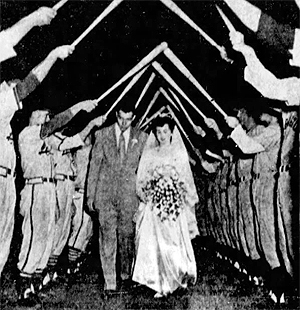
In May 1930, near the completion of his freshman year at Miami, Alston, 18, married his childhood sweetheart, Lela. The Great Depression had devastated the economy and Alston couldn’t afford to stay in college. He and Lela moved in with her parents in Darrtown and he took work wherever he could find it, going from farm to farm to seek pay for day labor. The county gave him a job cutting roadside weeds with a scythe. “That paid a dollar a day and I was happy to have it,” Alston told author Jack Tobin.

Two years later, in the summer of 1932, Alston still was whacking weeds when a local Methodist minister, Rev. Ralph Jones, an education advocate, urged him to return to Miami and earn a degree. According to author Si Burick in the book “Alston and the Dodgers,” Jones said to Alston, “Smokey, you’ve got a good mind. You can be somebody if you go back to college.”

Jones gave Alston $50 to use toward his tuition. Alston re-enrolled at Miami for the 1932 fall semester. “We never could have saved $50 on my dollar a day cutting weeds,” Alston told Jack Tobin. “That $50 … got me back in and paid a good part of my tuition for that year.”

Alston majored in industrial arts and physical education. He also played varsity baseball and basketball. There were no athletic scholarships and money was scarce. In between classes and athletics, Alston worked jobs on campus.

“I took a job driving a laundry truck for 35 cents an hour and I got my lunch free every day in exchange for racking up billiard balls in a pool hall,” he told journalist Ed Fitzgerald. “Summers, the college gave me a job painting dormitories.”

Alston played sandlot baseball for various town teams, too. One of those, the Hamilton Baldwins, had Alston at shortstop and Weeb Ewbank, the future football coach of the Baltimore Colts and New York Jets, in center field.

Cardinals prospect

Alston was taking an exam near the end of his senior year in 1935 when he was told someone was waiting to see him. It was Harold Cook, school superintendent in New Madison, Ohio. Cook was recruiting teachers and offered Alston a salary of $1,350 to come to New Madison. Alston accepted.

A few days later, Frank Rickey showed up at the door. (The Alstons didn’t have a home telephone then.) Rickey had seen Alston play two games _ one at shortstop and one as a pitcher _ for Miami and was impressed. When Alston mentioned he’d made a commitment to teach in New Madison, Rickey explained the minor-league season would be finished by Labor Day, enabling him to return to Ohio for the school year.

Rickey offered no signing bonus. He told Alston, 23, he’d be paid $135 a month to play in the Cardinals’ system that summer. Alston signed on the spot.

The next day, Alston’s wife drove him to Richmond, Ind., where he boarded a bus for St. Louis. Upon arrival, Alston checked into the YMCA downtown. The next morning, he went to the Cardinals’ offices to find out where he was being assigned. The Cardinals told him to come back tomorrow. This went on for a week until, finally, Branch Rickey informed Alston he would play for the Greenwood (Mississippi) Chiefs of the East Dixie League.

Cardinals scout Eddie Dyer (who, years later, became St. Louis manager) drove Alston from St. Louis to Mississippi in a roadster. Player-manager Clay Hopper put Alston at third base and he hit .326 in 82 games.

Every fall and winter for the next 14 years, Alston taught high schoolers _ six years at New Madison and eight at Lewiston, Ohio _ in order to make ends meet after spending spring and summer in the minors. He taught industrial arts, general science and biology, and coached basketball before leaving in March for spring training.

The teaching experience later helped him as a manager. “Like students, ballplayers can’t all be treated the same,” Alston told Si Burick. “Some need encouragement. Some do better if left alone. Others need to be driven. You simply have to study each individual and get him to produce the best that’s in him.”

Darrtown remained Alston’s home. Los Angeles Times columnist Jim Murray described it as “the place where time forgot” and “where the 11 o’clock news is the barber.” Alston built a house at the corner of Apple and Cherry streets. It was the first brick house in Darrtown. “My dad laid all the bricks and mixed the mortar,” he told Sports Illustrated.

In the backyard tool shed, Alston put his industrial arts skills to good use, making most of the furniture for his house. “His bookshelves and chests and spice racks and desks are a wonder of patient, meticulous workmanship,” Sheldon Ocker of the Akron Beacon-Journal reported.

When he wasn’t woodworking, Alston enjoyed skeet shooting, riding his two Honda motorcycles and playing billiards.

After Alston became an established big-league manager, billiards legend Willie Mosconi was a guest at Alston’s Darrtown home, where Alston had a pool table. “I ran 47 balls, which is pretty good for me,” Alston told Gordon Verrell of the Long Beach Press-Telegram. “He shot, made six or seven and missed, and then I ran 10 or 12. I didn’t get another shot. He ran the next 154.”

Alston didn’t mind losing to a master such as Mosconi. Getting defeated by Cardinals pitcher Steve Carlton in 1969 was another matter. “He beat us 1-0 that night at the ballpark and, if that didn’t make me mad enough, he beat me later that night in a game of pool,” Alston told Gordon Verrell. Boxscore

Ready or not

For his second season in the Cardinals’ system in 1936, Alston was assigned to Huntington, W.Va. Player-manager Benny Borgmann taught him to play first base. The club’s shortstop was a skinny teenage rookie, Marty Marion.

For the second consecutive year, Alston hit .326. He also produced 35 home runs and 114 RBI. Scout Branch Rickey Jr., son of the Cardinals’ general manager, was impressed. On Rickey Jr.’s recommendation, Alston was called up to the Cardinals in September and instructed to join the team in Boston.

Alston packed a beat-up cardboard suitcase and took a train to New York City, where he was to make a connection to Boston. At Grand Central Station, he was gawking at the ceilings and the people when he bumped into a woman. “The suitcase hit the floor, broke open and scattered all my clothes and belongings across the floor,” he recalled to Jack Tobin. “There seemed to be hundreds and hundreds of people all racing in a different direction. I was on my hands and knees, trying to pick up my shirts and shorts … and to keep from being trampled.”

A Good Samaritan directed him to a luggage shop nearby. Alston spent most of the $20 he had on a new suitcase and boarded the train to Boston.

When he arrived at the Kenmore Hotel, the team was at the ballpark. The desk clerk told Alston he could go to the dining room and sign for anything he ordered. “One look at the menu convinced me I was in for a hard time,” Alston told Jack Tobin. “I had never heard of half the things and couldn’t pronounce most of the words … Finally I decided on some clams. I’d always heard Boston was famous for them. When they brought them out, I wasn’t sure just how you were supposed to eat them.”

During his month with the Cardinals, Alston pitched batting practice, took infield practice with other rookies and otherwise sat on the bench. A fellow Ohioan, pitcher Jesse Haines, 43, took a liking to Alston, 24, and showed him what to do and how to do it. “No matter what I asked, he knew the answer,” Alston said to Jack Tobin. “Most days he took me to and from the ballpark. He was my buddy.”

Put me in, coach

On the final day of the season, the Cardinals played at home in the rain against the Cubs. Plate umpire Ziggy Sears had a miserable time. Neither team cared for the way he called balls and strikes. Sears ejected Cardinals coach Buzzy Wares and Cubs manager Charlie Grimm for arguing with him.

As the Cardinals came off the field in the seventh, first baseman Johnny Mize made a remark while passing the umpire. Offended, Sears ejected Mize.

Because the Cardinals’ other established first baseman, Rip Collins, had been used as a pinch-hitter a couple of innings earlier, manager Frankie Frisch had to go with his only other first baseman, Alston.

When the Cubs batted against Dizzy Dean in the eighth, Alston was at first, making his big-league debut. Augie Galan led off with a single. Phil Cavarretta followed with a bunt. Third baseman Don Gutteridge fielded cleanly and made an accurate throw to Alston, but the first baseman bobbled the ball. Cavarretta reached safely on the error and Galan stopped at second.

Next up was Billy Herman. He bunted toward Alston. The rookie threw to third, but not in time to nab Galan, and the bases were loaded. All three runners eventually scored, giving the Cubs a 6-1 lead.

In the ninth, the Cardinals scored twice and had a runner on base, with two outs, when Alston batted for the first time. The pitcher was Lon Warneke, a three-time 20-game winner. Alston fouled off a pitch. He ripped another down the line in left but it, too, curved foul near the pole. Then he struck out, ending the game. Boxscore

The next day, the headline in the St. Louis Star-Times blared, “Walter Alston Makes Blunders That Eventually Beat Dizzy Dean, 6-3.”

Follow the leader

The Cardinals put Alston on their 40-man winter roster, but Johnny Mize still was on the team and the club acquired another first baseman, Dick Siebert, from the Cubs. Because of his teaching job, Alston couldn’t report to 1937 spring training until March 15. A couple of weeks later, he was back in the minors.

Alston had a few more good seasons in the Cardinals’ system, but knew he likely wouldn’t be returning to the big leagues. “I had enough power, but … I couldn’t hit the good pitching, just the mediocre pitching,” he told Sports Illustrated.

Branch Rickey asked Alston to become a player-manager in 1940 and he eagerly accepted. Alston managed Cardinals affiliates for three seasons (1940-42). Then Rickey moved to the Dodgers. Alston kept playing for Cardinals farm teams desperate to fill rosters depleted by World War II military service.

In 1944, Alston was released by the Cardinals. He returned to Darrtown, figuring to go fulltime into teaching. Then came another bang on the door. It was the son of the man who operated the Darrtown general store. The boy told Alston there was an urgent long-distance phone call for him at the store. Alston darted the two blocks, grabbed the receiver and heard the voice of Branch Rickey.

“First thing he did was give me a good going over for not having a phone and told me to get one,” Alston said to Jack Tobin. “Then he offered me the manager’s job at Trenton (N.J.) in the Interstate League.”

Alston managed for 10 seasons in the Dodgers’ system. In November 1953, he was chosen to replace Chuck Dressen as Dodgers manager. Working on one-year contracts, Alston managed the Dodgers for 23 years, leading them to seven National League pennants and four World Series titles. He was inducted into the Baseball Hall of Fame in 1983.

As Jim Murray wrote, “He made his profession’s hall of fame not because he could hit or throw a curveball better than anyone else but because he excelled in the far more difficult area of human endeavor.”

Read Full Post »

While pitching in the Cardinals’ organization, Pete Mazar became known as much for his vocal cords as for his arm.

Dubbed the “Frank Sinatra of baseball” for his singing, Mazar, like Ol’ Blue Eyes, was from New Jersey. Sinatra’s hometown was Hoboken, site of the first organized baseball game played in 1846 between the Knickerbocker Club and New York Nine. Mazar grew up in High Bridge, a mere 50 miles from Hoboken but, otherwise, worlds apart.

An urban melting pot across the Hudson River from Manhattan, Hoboken in Sinatra’s time was known for its gritty industrial docks and was the setting for the film “On the Waterfront.” In contrast, the borough of High Bridge has a reputation as a place for parks, trails and scenic beauty. A resident, Howard Menger, wrote “The High Bridge Incident,” a book about his claim of having met space aliens in the woods near High Bridge when he was a boy. Otherworldly, indeed.

Little lefty

Pete Mazar had eight brothers (including a twin) and five sisters, according to The Sporting News. Though no more than 5-foot-9 and 150 pounds, he was a standout athlete in soccer, basketball and baseball at High Bridge High School.

After graduation in June 1940, Mazar was a machinist for the local Taylor-Wharton Iron and Steel Company, makers of railroad fittings and switches and dredging equipment. A left-handed pitcher, he played semipro baseball for the High Bridge team in the well-regarded Tri-County League.

Mazar’s success as a semipro player got him a contract in 1941 with a New York Giants farm club in Milford, Del., but he became ill, pitched briefly and got released, according to the Allentown (Pa.) Morning Call. Returning to High Bridge, Mazar went back to the iron and steel job (the company now was producing material for America’s World War II involvement) and pitched semipro baseball.

In May 1944, with the war depleting baseball team rosters, the Cardinals offered Mazar, 23, a tryout with their Allentown farm club. Allentown manager Ollie Vanek, who had a notable eye for talent (the Cardinals signed 16-year-old Stan Musial on Vanek’s recommendation), took one look at Mazar and gave him a spot on the team. Mazar rewarded him with an 11-6 record.

Promoted by the Cardinals to Columbus (Ohio) in 1945, Mazar pitched a no-hitter against manager Casey Stengel’s Kansas City Blues. Of the 27 outs Mazar recorded using a sharp-breaking curve, 20 came on grounders, the Kansas City Times reported.

American idol

Seven of Mazar’s eight seasons in the Cardinals’ system were spent either with Columbus or Houston. In 1947, he pitched for both. After going 0-4 for Columbus, he was sent to Houston and pitched better for manager Johnny Keane’s club, which was on its way to becoming Texas League champions.

On Aug. 19, 1947, an estimated 13,000 spectators packed into Houston’s Buffalo Stadium for a doubleheader on what was promoted as “appreciation night.” Looking for ways to show their appreciation to fans, club officials gave Mazar a microphone before one of the games and asked him to sing for the crowd. Mazar had “served as a vocalist in a nightclub near his home at High Bridge,” according to The Sporting News.

Crooning hit tunes, Mazar thrilled his audience and was touted as “the Sinatra of baseball,” the Associated Press reported. (Sinatra’s popular songs in 1947 included “Almost Like Being in Love,” “Autumn in New York,” and “Time After Time.”)

Word spread that the Houston club had a silky-voiced troubadour with a smooth delivery. “Now everywhere he goes to play ball, they want him to warble,” according to the Associated Press.

On Aug. 24, it was arranged for Mazar to sing a song before Houston’s game at Dallas. “The crowd of 6,000 roared its approval,” the Associated Press reported. “They called him back for another, and still another. They wanted him for a fourth except that the ballgame had to go on.”

The next night, Aug. 25, Mazar was the starting pitcher for Houston at Oklahoma City. He entertained a crowd of 4,937 with three songs, then got the win against an Oklahoma City club that featured hitters such as Ray Boone and Al Rosen.

Houston club president Allen Russell asked Mazar to spend the winter in Texas so that he could promote his singing.

Fan favorite

Back with Houston and Johnny Keane in 1948, Mazar, 27, had his best season as a pitcher. He won 12 of his first 14 decisions and finished 15-10 with a 2.53 ERA in 228 innings.

His most satisfying win came at home on July 17, 1948. When Houston fans learned Mazar and his wife were expecting their third child, they presented the couple with more than 100 gifts before that night’s game. Mazar thanked the crowd of 7,358, crooned several songs and then pitched a three-hit shutout to beat Tulsa. “I never wanted to win a game so much in my life … I didn’t want to let all of those good people down,” Mazar told The Sporting News.

Mazar’s successful 1948 season didn’t do enough to impress the Cardinals. When they didn’t put him on their 40-man winter roster, the Cubs claimed him in the November 1948 minor-league draft on the recommendation of scout Jigger Statz. Mazar reminded him of Tony Freitas, another pint-sized left-hander who pitched in the majors during the 1930s, Statz told the Los Angeles Times.

Assigned to the Cubs’ Los Angeles Angels farm team in 1949, Mazar was 2-4 for the Pacific Coast League team when he got sent back to Houston in May.

In April 1950, Mazar was struck by a line drive, breaking his left thumb. It didn’t hurt his singing, but it did his pitching. The 1951 season was Mazar’s last in the Cardinals’ system. He pitched three more years in the minors but never reached the big leagues _ either as a player or a singer.

Returning to High Bridge, Mazar and his wife operated a tavern and he also worked as a machinist for F.L. Smidth & Company, makers of equipment for mining and cement industries.

Read Full Post »

One year after they traded Steve Carlton because he wanted a $65,000 salary, the Cardinals offered a college pitcher a six-figure contract.

Michigan State’s Brad Van Pelt, a right-hander with a 100 mph fastball, was the prospect who prompted the Cardinals to consider coughing up the cash. He also was a football talent, a recipient of the Maxwell Award presented to the most outstanding college player in the sport.

Drafted in January 1973 by the baseball Cardinals and the NFL New York Giants, Van Pelt opted for pro football. He went on to play 14 seasons, helping to form one of the all-time best linebacking units.

Abundant athleticism

Van Pelt was from Owosso, Mich., a town 90 miles northwest of Detroit. Thomas Dewey, twice the Republican nominee for president, was from there, too. (Dewey lost to Franklin Delano Roosevelt in 1944 and to Harry Truman in 1948.)

An athlete who excelled in every sport he tried, including bocce, golf and soccer, Van Pelt was a high school sensation as a quarterback in football, a rebounder in basketball (he hauled down 42 in one game) and a pitcher in baseball (consecutive no-hitters as a senior).

The Tigers, his favorite team, chose Van Pelt, 18, in the 14th round of the 1969 June baseball draft but he took a football scholarship from Michigan State instead.

(It was the first of five times Van Pelt was selected in the baseball draft. He declined to sign each time. After the Tigers in June 1969, others to draft him were the Angels in June 1972, Cardinals in January 1973, Pirates in June 1973 and Indians in January 1974.)

“Rangy, fast and strong,” Van Pelt, 6-foot-5, 220 pounds, had the “defensive end’s body with the receiver’s speed,” according to the Lansing State Journal.

Michigan State guard Joe DeLamielleure (elected to the Pro Football Hall of Fame for his skill as a Buffalo Bills and Cleveland Browns lineman) told the newspaper, “Van Pelt was the modern day Jim Thorpe, and that’s no exaggeration … He could have been our starting quarterback because he could throw the ball a mile.”

Michigan State head coach Duffy Daugherty said Van Pelt could have played any position on the football team. “He is the most versatile athlete I’ve ever coached,” Daugherty told the Associated Press.

Daugherty dubbed Van Pelt his “secretary of defense” and put him at safety. Often called a rover back, Van Pelt had the size and speed to intimidate receivers, stuff rushers and pressure quarterbacks with blitzes. “I’ve never seen a safety able to come up to the line of scrimmage to make tackles as quick as Brad can,” Daugherty said to the Flint Journal.

George Perles, an assistant on Daugherty’s staff before eventually becoming head coach, told the Lansing newspaper, “During his college career, he (Van Pelt) might have been the biggest safety in the Big Ten (Conference), if not the country.”

In his three varsity seasons (1970-72), Van Pelt totaled 256 tackles and 14 interceptions. “He (Daugherty) gave me the freedom to blitz when I wanted and to go to the ball on every play,” Van Pelt said to the State Journal. “I can’t thank him enough.”

Man for all seasons

Described by Joe Rexrode of the Lansing newspaper as “the purest all-around athlete in Michigan State history,” Van Pelt played varsity basketball and baseball.

He got into 31 basketball games for head coach Gus Ganakas, who told the State Journal, “Van Pelt helped define the position of power forward.”

In baseball, Van Pelt pitched for head coach Danny Litwhiler, a former big-leaguer who played in two World Series (1943 and 1944) as the Cardinals’ left fielder.

As a sophomore, Van Pelt was on the 1971 Big Ten championship baseball team. The next season, he struck out 84 in 56.1 innings and had a 2.07 ERA. The Angels picked Van Pelt in the 13th round of the June 1972 draft and offered $100,000 _ “The first three days after they made the offer I really thought about signing,” Van Pelt told the Flint Journal _ but he chose to return to college for senior year.

Instead of spending the summer of 1972 pitching in the Angels’ system, Van Pelt went to the Netherlands with an amateur team from Grand Rapids, Mich., to compete in an international honkbal (Dutch for baseball) tournament.

Cardinals calling

After Van Pelt’s senior football season, big-league baseball held a winter draft on Jan. 10, 1973. In those days, a secondary phase was conducted for players who had been drafted in prior years but hadn’t signed.

Selecting seventh in the first round, the Cardinals chose Van Pelt. “He was one of a few premium players available,” Cardinals director of player procurement George Silvey told the St. Louis Post-Dispatch.

Cardinals general manager Bing Devine said to United Press International, “He’s an all-American boy in every sense of the word.”

(The Tigers, who had the next pick after the Cardinals, were planning to draft Van Pelt, the Post-Dispatch reported. When the Cardinals beat them to it, the Tigers went with Van Pelt’s Michigan State teammate, pitcher Larry Ike.)

Van Pelt told the Cardinals he’d wait until the NFL draft was held on Jan. 30, 1973, before making a decision.

When the Cardinals made it known they intended to sign Van Pelt, NFL teams didn’t want to risk losing a first-round pick in a bidding war with a baseball team. As the New York Times put it, Van Pelt became “a player of unquestioned ability but highly questionable availability.”

New York Jets head coach Weeb Ewbank told the Times, “We just didn’t see any sense in fighting baseball for him, but he is one hell of an athlete.”

The Giants, who had traded their first-round pick to the Browns for defensive end Jack Gregory, grabbed Van Pelt in the second round, where, as head coach Alex Webster noted to the Times, “he was worth the risk.”

Decision time

A year earlier, the Cardinals reportedly offered Steve Carlton a 1972 salary of $57,500. Carlton wanted more. As spring training got under way, Carlton said he and the club were less than $10,000 apart, The Sporting News reported, but owner Gussie Busch, angry when the pitcher didn’t sign, ordered Bing Devine to trade him. Carlton was sent to the Phillies, who gave him $65,000 in 1972, and he won 27 games for them that season.

Devine offered a lot more than that to Van Pelt in February 1973. Braving a snowstorm, Devine met with Van Pelt in Owosso and made an enticing pitch. “We went to a peak level with the offer we made him,” Devine told Milton Richman of United Press International. “By that I mean over $100,000.”

Giants owner Wellington Mara followed Devine to Owosso and presented Van Pelt with a three-year, no-cut contract worth $300,000.

Van Pelt said the money offered by the Cardinals and Giants was about the same. “The two offers were so close that I almost thought they had gotten together,” he remarked in an article published in the Post-Dispatch.

Van Pelt chose the Giants primarily because he could begin his pro career in the NFL rather than in baseball’s minor leagues.

(Danny Litwhiler told United Press International that Van Pelt would need at least two years of total concentration on baseball to become ready for the majors. Van Pelt acknowledged to the Jersey Journal, “I know I have a major-league fastball, but my curve leaves a lot to be desired.”)

As Devine said to Milton Richman, “With us, he would have had to go to the minor leagues to develop. With the football Giants, he went right to the big-league club. That was the key.”

Crunch Bunch

The Giants tried Van Pelt at tight end and strong safety during a frustrating rookie year. After Bill Arnsparger replaced Alex Webster as head coach in 1974, Van Pelt shifted to outside linebacker. His career soared when Marty Schottenheimer arrived as linebacker coach in 1975. “I’d say 85 percent of what I am now, I learned from him,” Van Pelt told the Detroit Free Press in 1979.

Van Pelt was named to the Pro Bowl five years in a row (1976-80) and was chosen as the Giants’ player of the decade for the 1970s. “If Brad Van Pelt played on a good team, he would be a household name,” Los Angeles Rams general manager Don Klosterman said to Mike Lupica of the New York Daily News.

The Giants had one winning record in Van Pelt’s 11 seasons with them. As club executive John Mara told the Daily News, “If you look at those (Van Pelt) years, our teams were as bad as could possibly be. We really had some awful teams in the 1970s. He was the one guy who was consistently a good player.”

Van Pelt played for five Giants head coaches _ Alex Webster, Bill Arnsparger, John McVay, Ray Perkins and Bill Parcells. (Bill Belichick was a Giants assistant coach from 1979-84 and Van Pelt’s linebacker coach from 1980-83.)

When Parcells joined the Giants as defensive coordinator on Perkins’ staff in 1981, he installed a 3-4 defense after the club drafted Lawrence Taylor. From 1981-83, the Giants’ four hard-hitting starting linebackers _ Harry Carson, Brian Kelley, Taylor and Van Pelt _ became known as the Crunch Bunch. (Carson and Taylor were elected to the Pro Football Hall of Fame.)

According to Newsday, Taylor called Van Pelt “one of the greatest players I ever played with.”

The arrival of linebacker Carl Banks, a first-round pick from, of all places, Michigan State in 1984 prompted the Giants to break up the Crunch Bunch. In July 1984, Van Pelt was traded to the Minnesota Vikings for fullback Tony Galbreath.

Van Pelt refused to report, telling the Vikings he preferred to be with a team either in California or Florida. He never played a game for the Vikings. They traded him to the Los Angeles Raiders for two draft choices. Van Pelt spent two seasons (1984-85) with the Raiders and one (1986) with the Browns.

In 1998, Van Pelt returned to Michigan State and completed his school work, earning a degree in health and physical education. Three years later, he was inducted into the College Football Hall of Fame. A son, Bradlee, was a quarterback for Colorado State and played in three games for the 2005 Denver Broncos.

Read Full Post »

As an amateur pitcher, Ryan Kurosaki experienced a dramatic change in climate, landscape and culture, leaving the tropical paradise of Hawaii after high school and going to the prairies of Nebraska to attend college.

After making that transition, a leap from the minors at Arkansas to big-league St. Louis might seem feasible, but it turned out to be too much too soon.

Fifty years ago, in 1975, as a right-handed reliever with barely more than a year of professional experience, Kurosaki was called up to the Cardinals from Class AA Little Rock. After only a month with St. Louis, Kurosaki was sent back to Arkansas and never returned to the big leagues.

A pitcher whose job it was to put out fires, Kurosaki built a second career as a professional firefighter.

Aloha

A grandson of Japanese immigrants, Kurosaki developed an interest in baseball as a youth in Honolulu. In June 1962, when he was 9, Kurosaki was among a group of pee-wee players shown receiving instruction from Irv Noren, manager of the minor-league Hawaii Islanders, in a photo published in the Honolulu Star-Bulletin.

Kurosaki eventually became a standout pitcher for Kalani High School. As a senior in 1970, he helped Kalani win a state championship. Lenn Sakata, the club’s junior shortstop, recalled to the Honolulu Star-Advertiser that Kurosaki “was captain of our team. We looked up to him. He was the leader.”

(Sakata went on to play 11 seasons in the majors with the Brewers, Orioles, Athletics and Yankees.)

Dave Murakami, a Hawaiian who played baseball for the University of Nebraska in the 1950s, recommended Kurosaki to Cornhuskers head coach Tony Sharpe, who offered a scholarship. At Murakami’s urging, Kurosaki accepted.

Asked in May of his freshman year about making the adjustment from Hawaii to Nebraska, Kurosaki told the Omaha World-Herald, “It is a lot different … I still miss Hawaii. When you’re stuck in the snow, you get that way.”

Any feelings of homesickness didn’t prevent Kurosaki from developing into a reliable starter for Nebraska. Highlights during his three seasons there included shutouts of Kansas State, Oklahoma and Oklahoma State.

In the summers after his sophomore and junior seasons, Kurosaki pitched for a semipro team in Kansas managed by former big-league outfielder Bob Cerv. “That’s where I developed my slider,” Kurosaki told the Honolulu Star-Bulletin.

Pitching well in the National Baseball Congress Tournament, Kurosaki impressed Cardinals scouting supervisor Byron Humphrey. Opting to forgo his senior season at Nebraska, Kurosaki, 21, signed with the Cardinals in August 1973.

Fast rise

Assigned to Class A Modesto of the California League, Kurosaki had a splendid first season in the Cardinals’ system in 1974. Playing for manager Lee Thomas, Kurosaki was 7-3 with six saves. He struck out 74 in 71 innings and had a 2.28 ERA. “Ryan has a great slider and keeps the ball low,” Thomas told the Modesto Bee. “He’s everything you want in a relief pitcher.”

Promoted to Class AA Arkansas for his second pro season in 1975, Kurosaki baffled Texas League batters. In his first 11 relief appearances covering 21 innings, he didn’t allow an earned run and was 4-0 with four saves.

In May, the Cardinals demoted starter John Denny to Tulsa, moved reliever Elias Sosa into the rotation and brought up Kurosaki to take Sosa’s bullpen spot.

When Arkansas manager Roy Majtyka informed Kurosaki he was headed to the big leagues, the pitcher called his parents in Hawaii. “The family went crazy when I gave them the news,” Kurosaki told the St. Louis Post-Dispatch. “I still can’t believe I’m up here.”

As he recalled to the Honolulu Star-Advertiser, “I was in awe when I reported. My teammates included Lou Brock and Bob Gibson.”

The Cardinals assigned first baseman Ron Fairly, 36, to be the road roommate of Kurosaki, 22, and help him get acclimated. Kurosaki was 6 when Fairly debuted in the majors with the 1958 Dodgers.

Good start

When Kurosaki entered his first game for the Cardinals on May 20, 1975, at San Diego, he became the first American of full Japanese ancestry to play in the majors, the Honolulu Star-Advertiser reported.

(The first Japanese native to play in the big leagues was pitcher Masanori Murakami with the 1964 Giants. The first Asian-born player with the Cardinals was Japanese outfielder So Taguchi in 2002.)

Kurosaki’s debut was a good one. He worked 1.2 innings against the Padres, allowing no runs or hits. Boxscore

His next three outings _ one against the Dodgers (two innings, one run allowed) and two versus the Reds _ had many pluses, too.

On May 31 against the Reds, Kurosaki retired Johnny Bench, Dan Driessen, Cesar Geronimo and Dave Concepcion before giving up a solo home run to George Foster. Boxscore

The next day, Kurosaki held the Reds scoreless in two innings of work. He gave up two singles but retired Joe Morgan, Bench, Driessen, Concepcion, Foster and Jack Billingham. Morgan and Foster struck out. Boxscore

In four appearances for the Cardinals, Kurosaki had a 2.45 ERA.

Rough patch

After that, Kurosaki faltered. He allowed four runs in less than an inning against the Reds, gave up a three-run homer to Cliff Johnson of the Astros, and allowed three runs in 1.2 innings versus the Pirates. Relieving Bob Gibson (making his first relief appearance since 1965) at Pittsburgh, Kurosaki gave up singles to pitcher Bruce Kison and Rennie Stennett. Kison stole third and scored on Kurosaki’s balk. (Cardinals manager Red Schoendienst got ejected for contesting the balk call.) Boxscore

Kurosaki was sent back to Arkansas. Little did he know his big-league days were over. His totals in seven appearances for the Cardinals: 7.62 ERA, with 15 hits allowed, including three home runs, in 13 innings.

“I think they might have brought me up a little too quick,” Kurosaki said to the Omaha World-Herald. “It’s tough on you mentally when you’re somewhere you know you don’t belong. I knew that I didn’t belong in St. Louis. I knew that I wasn’t pitching for them the way I knew I could pitch.”

Reflecting on Kurosaki’s stint with St. Louis, former American League umpire Bill Valentine, who became Arkansas general manager in 1976, told 501 Life Magazine of Conway, Ark., “It was one of the silliest things the Cardinals ever did … No way he could be ready.”

Getting sent back to Little Rock did have one significant benefit for Kurosaki: He met Sandra McGee there in 1975 and they married in 1978.

Sounding the alarm

Based on his work at Arkansas, it was reasonable to think Kurosaki would be heading back to St. Louis at some point. He was 7-2 with seven saves and a 2.03 ERA for Arkansas in 1975; 5-2 with six saves and a 3.25 ERA in 1976.

After two good seasons at Class AA, Kurosaki expected a promotion to Class AAA in 1977 but instead the Cardinals sent him back to Arkansas. Once again, he delivered, with 14 saves and five wins.

So it was tough for Kurosaki to take when the Cardinals told him to report to Arkansas for a fourth consecutive season in 1978.

“Same old story year after year,” Kurosaki told the Omaha World-Herald. “They told me I could go to the Mexican League, but I said I wouldn’t go. I asked them to trade me, but they wouldn’t. They told me it was either the Mexican League or Little Rock. It is getting to the point where I’m thinking that if the Cardinals don’t have any plans for me, perhaps it would be better if I went somewhere else.”

The Cardinals wanted Kurosaki to develop a screwball or forkball to go with his slider and sinker, The Sporting News and Honolulu Star-Bulletin reported.

Kurosaki, 26, earned 11 saves for 1978 Arkansas and finally got a mid-season promotion _ to Springfield, Ill., where he was 5-2 with three saves and a 2.40 ERA for the Class AAA club.

A second chance at the majors, though, wasn’t offered. As Bill Valentine suggested to 501 Life Magazine, the Cardinals “forgot about him.”

Kurosaki spent two more years in the minors, then was finished playing pro baseball at 28.

In 1982, after a year with the Benton (Ark.) Fire Department, Kurosaki began a 32-year career with the Little Rock Fire Department, retiring as a captain in 2014.

Read Full Post »

Early in his big-league playing career, Curt Flood had a tendency to try hitting home runs, which wasn’t a good idea for someone his size.

In 1958, his first season with the Cardinals, Flood, 20, clouted 10 homers. Those are the most home runs of any Cardinals player 20 or younger, according to researcher Tom Orf.

The long balls caused Flood to overswing. It wasn’t until a teammate helped him kick the habit that Flood became one of the National League’s top hitters.

Big talent

As a youth in Oakland, Flood was a standout art student and high school baseball player. A mentor, George Powles, also coached him with an American Legion team and in the semipro Alameda Winter League.

“This kid can do everything,” Powles told the Oakland Tribune. “He can run, throw, field and hit a long ball. He is smart and has great desire to get ahead.”

Big-league scouts took a look, but most determined Flood was too small to reach the majors.

In his autobiography “The Way It Is,” Flood recalled, “One day George Powles sat me down for a talk. He told me I had the ability to become a professional, but that I should prepare for difficulties and disappointments. He pointed out I weighed barely 140 pounds (and) was not more than five feet, seven inches tall … Small men seldom got very far in baseball.”

Reds scout Bobby Mattick, a former big-league shortstop, took a chance on Flood. In January 1956, after Flood turned 18 and graduated from high school, he signed with the Reds for $4,000.

Down in Dixie

Assigned to a farm club in High Point, N.C., a furniture factory town, Flood experienced racist teammates and fans.

“Most of the players on my team were offended by my presence and would not even talk to me when we were off the field,” Flood said in his autobiography. “The few who were more enlightened were afraid to antagonize the others.

“During the early weeks of the season, I’d break into tears as soon as I reached the safety of my room … I wanted to be free of these animals whose 50-cent bleacher ticket was a license to curse my color and deny my humanity. I wanted to be free of the imbeciles on the ball team.”

Flood’s pride kept him from quitting and he answered the bigots by performing better than any other player in the Carolina League. “I ran myself down to less than 135 pounds in the blistering heat,” he said in his book. “I completely wiped out that peckerwood league.”

The 18-year-old produced an on-base percentage of .448 (190 hits, 102 walks). He scored 133 runs, drove in 128 and slugged 29 home runs.

Called up to the Reds in September 1956, Flood made his big-league debut at St. Louis as a pinch-runner for catcher Smoky Burgess. Boxscore

The next season became another ordeal when the Reds returned Flood, 19, to the segregated South at Savannah, Ga. Adding to the pressure was the Reds’ decision to shift Flood from outfield to third base. One of his infield teammates was shortstop Leo Cardenas, a dark-skinned Cuban.

“Georgia law forbade Cardenas and me to dress with the white players,” Flood said in his book. “A separate cubicle was constructed for us. Some of the players were decent enough to detest the arrangement. I particularly remember (outfielder) Buddy Gilbert (of Knoxville, Tenn.), who used to bring food to me and Leo in the bus so that we would not have to stand at the back doors of restaurants.”

A future seven-time Gold Glove Award winner as a National League outfielder, Flood made 41 errors at third base with Savannah, but produced a .388 on-base percentage (170 hits, 81 walks), 98 runs scored and 82 RBI.

Earning another promotion to the Reds in September 1957, Flood’s first hit in the majors was a home run at Cincinnati against Moe Drabowsky of the Cubs. It turned out to be Flood’s last game with the Reds. Boxscore

Good deal

At the 1957 baseball winter meetings in Colorado Springs, Cardinals general manager Bing Devine and manager Fred Hutchinson met until 3 a.m. with Reds general manager Gabe Paul and manager Birdie Tebbetts, trying to make a trade, the St. Louis Globe-Democrat reported.

After much give and take, the Reds proposed sending Flood and outfielder Joe Taylor to the Cardinals for pitchers Marty Kutyna, Willard Schmidt and Ted Wieand. Devine, in his first trade negotiations since replacing Frank Lane as general manager, “had some fear and trepidation” about doing the deal, he said in his autobiography “The Memoirs of Bing Devine.”

As Devine recalled in his book, Hutchinson said to him, “Awww, come on. I’ve heard about Curt Flood and his ability. Flood can run and throw. He could probably play the outfield. Let’s don’t worry about it.”

Bolstered by his manager, Devine made the trade, his first for the Cardinals.

(Concern of having an all-black outfield of Frank Robinson, Vada Pinson and Flood prompted the Reds to trade him, Flood said in his autobiography.)

Devine told the St. Louis newspapers that Flood had potential to become the Cardinals’ center fielder. “We’re counting on him for 1959, not next year,” Devine told the Globe-Democrat.

Cardinals calling

The Cardinals opened the 1958 season with Bobby Gene Smith in center and sent Flood to Omaha, but Smith didn’t hit (.200 in April) and Flood did (.340 in 15 games). On May 1, they switched roles, Flood joining the Cardinals and Smith going to Omaha.

(When the Cardinals sent Flood a ticket for a flight from Omaha, he was concerned how he would get his new Thunderbird automobile to St. Louis. Omaha general manager Bill Bergesch kindly offered to drive the car there for him and Flood accepted, according to Bergesch’s son, Robert. Not knowing anyone in St. Louis, Flood rented a room in a house called the Heritage Arms on the recommendation of pitcher Sam Jones. In the book “The Curt Flood Story,” author Stuart L. Weiss noted that when Bill Bergesch arrived in St. Louis with Flood’s car, he found Flood was residing in one of the city’s most notorious bordellos.)

Flood, 20, played his first game for the Cardinals on May 2, 1958, at St. Louis against the Reds. The center fielder had a double and was hit by a Brooks Lawrence pitch. Boxscore

His first home run for the Cardinals came on May 15 at St. Louis against the Giants’ 19-year-old left-hander, Mike McCormick. Flood belted a changeup into the bleachers just inside the left field foul line. He also singled to center and doubled to right, prompting the Globe-Democrat to declare, “Flood resembled a junior grade Rogers Hornsby with a surprising ability to hit to all fields.” Boxscore

Among Flood’s 10 homers in 1958 were solo shots against Warren Spahn and Sandy Koufax. Boxscore and Boxscore

The power impressed, especially on a club with one 20-homer hitter (Ken Boyer), but Flood’s .261 batting average didn’t (the Cardinals had hoped for .280) and he struck out 56 times, the most of any Cardinal.

“I had fallen into the disastrous habit of overswinging,” Flood said in his autobiography. “Worse, I had developed a hitch in my swing. When the pitcher released the ball, my bat was not ready because I was busy pulling it back in a kind of windup.”

Fixing flaws

In February 1959, Flood got married in Tijuana, Mexico, to Beverly Collins, “a petite, sophisticated teenager with two children,” according to “The Curt Flood Story.” They’d met during the summer at her parents’ St. Louis nightclub, The Talk of the Town.

Solly Hemus, who’d replaced Fred Hutchinson as Cardinals manager, wanted a center fielder who hit with power. Trying to deliver, Flood went into a deep slump in 1959 and entered July with a batting mark of .192 for the season. “I now became more worried about my swing and more receptive to help,” Flood recalled in his book.

According to Flood’s book, when he asked Stan Musial for advice, Musial said, “Well, you wait for a strike. Then you knock the shit out of it.”

Help came from another teammate, pinch-hitter George Crowe, 38. “George straightened me out,” Flood said in his autobiography. “He taught me to shorten my stride and my swing, to eliminate the hitch, to keep my head still and my stroke level. He not only told me what to do, but why to do it and how to do it. He worked with me by the hour.”

It took a while, but Flood finally found his groove. In 1961, he hit .322, the first of six .300 seasons for the 1960s Cardinals. Flood twice achieved 200 hits in a season and finished with 1,854 in the majors.

In 1968, he told the Associated Press, “It took me five years to learn I’m not a home run hitter, and that’s the hardest thing in the world for a baseball player to tell himself. It’s a blow to your ego. You have to tell yourself you’re not as big and strong as the next guy. It hits at your masculinity, your manhood.”

Of Flood’s 85 big-league home runs, the most (15) came against the Reds. Flood hit four homers versus Juan Marichal and two each against Don Drysdale, Ferguson Jenkins and Sandy Koufax.

Read Full Post »

« Newer Posts - Older Posts »