Feeds:
Posts
Comments

Archive for the ‘Prospects’ Category

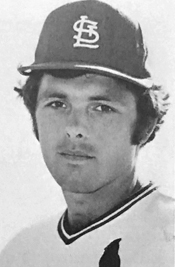
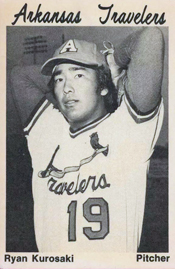
As an amateur pitcher, Ryan Kurosaki experienced a dramatic change in climate, landscape and culture, leaving the tropical paradise of Hawaii after high school and going to the prairies of Nebraska to attend college.

After making that transition, a leap from the minors at Arkansas to big-league St. Louis might seem feasible, but it turned out to be too much too soon.

Fifty years ago, in 1975, as a right-handed reliever with barely more than a year of professional experience, Kurosaki was called up to the Cardinals from Class AA Little Rock. After only a month with St. Louis, Kurosaki was sent back to Arkansas and never returned to the big leagues.

A pitcher whose job it was to put out fires, Kurosaki built a second career as a professional firefighter.

Aloha

A grandson of Japanese immigrants, Kurosaki developed an interest in baseball as a youth in Honolulu. In June 1962, when he was 9, Kurosaki was among a group of pee-wee players shown receiving instruction from Irv Noren, manager of the minor-league Hawaii Islanders, in a photo published in the Honolulu Star-Bulletin.

Kurosaki eventually became a standout pitcher for Kalani High School. As a senior in 1970, he helped Kalani win a state championship. Lenn Sakata, the club’s junior shortstop, recalled to the Honolulu Star-Advertiser that Kurosaki “was captain of our team. We looked up to him. He was the leader.”

(Sakata went on to play 11 seasons in the majors with the Brewers, Orioles, Athletics and Yankees.)

Dave Murakami, a Hawaiian who played baseball for the University of Nebraska in the 1950s, recommended Kurosaki to Cornhuskers head coach Tony Sharpe, who offered a scholarship. At Murakami’s urging, Kurosaki accepted.

Asked in May of his freshman year about making the adjustment from Hawaii to Nebraska, Kurosaki told the Omaha World-Herald, “It is a lot different … I still miss Hawaii. When you’re stuck in the snow, you get that way.”

Any feelings of homesickness didn’t prevent Kurosaki from developing into a reliable starter for Nebraska. Highlights during his three seasons there included shutouts of Kansas State, Oklahoma and Oklahoma State.

In the summers after his sophomore and junior seasons, Kurosaki pitched for a semipro team in Kansas managed by former big-league outfielder Bob Cerv. “That’s where I developed my slider,” Kurosaki told the Honolulu Star-Bulletin.

Pitching well in the National Baseball Congress Tournament, Kurosaki impressed Cardinals scouting supervisor Byron Humphrey. Opting to forgo his senior season at Nebraska, Kurosaki, 21, signed with the Cardinals in August 1973.

Fast rise

Assigned to Class A Modesto of the California League, Kurosaki had a splendid first season in the Cardinals’ system in 1974. Playing for manager Lee Thomas, Kurosaki was 7-3 with six saves. He struck out 74 in 71 innings and had a 2.28 ERA. “Ryan has a great slider and keeps the ball low,” Thomas told the Modesto Bee. “He’s everything you want in a relief pitcher.”

Promoted to Class AA Arkansas for his second pro season in 1975, Kurosaki baffled Texas League batters. In his first 11 relief appearances covering 21 innings, he didn’t allow an earned run and was 4-0 with four saves.

In May, the Cardinals demoted starter John Denny to Tulsa, moved reliever Elias Sosa into the rotation and brought up Kurosaki to take Sosa’s bullpen spot.

When Arkansas manager Roy Majtyka informed Kurosaki he was headed to the big leagues, the pitcher called his parents in Hawaii. “The family went crazy when I gave them the news,” Kurosaki told the St. Louis Post-Dispatch. “I still can’t believe I’m up here.”

As he recalled to the Honolulu Star-Advertiser, “I was in awe when I reported. My teammates included Lou Brock and Bob Gibson.”

The Cardinals assigned first baseman Ron Fairly, 36, to be the road roommate of Kurosaki, 22, and help him get acclimated. Kurosaki was 6 when Fairly debuted in the majors with the 1958 Dodgers.

Good start

When Kurosaki entered his first game for the Cardinals on May 20, 1975, at San Diego, he became the first American of full Japanese ancestry to play in the majors, the Honolulu Star-Advertiser reported.

(The first Japanese native to play in the big leagues was pitcher Masanori Murakami with the 1964 Giants. The first Asian-born player with the Cardinals was Japanese outfielder So Taguchi in 2002.)

Kurosaki’s debut was a good one. He worked 1.2 innings against the Padres, allowing no runs or hits. Boxscore

His next three outings _ one against the Dodgers (two innings, one run allowed) and two versus the Reds _ had many pluses, too.

On May 31 against the Reds, Kurosaki retired Johnny Bench, Dan Driessen, Cesar Geronimo and Dave Concepcion before giving up a solo home run to George Foster. Boxscore

The next day, Kurosaki held the Reds scoreless in two innings of work. He gave up two singles but retired Joe Morgan, Bench, Driessen, Concepcion, Foster and Jack Billingham. Morgan and Foster struck out. Boxscore

In four appearances for the Cardinals, Kurosaki had a 2.45 ERA.

Rough patch

After that, Kurosaki faltered. He allowed four runs in less than an inning against the Reds, gave up a three-run homer to Cliff Johnson of the Astros, and allowed three runs in 1.2 innings versus the Pirates. Relieving Bob Gibson (making his first relief appearance since 1965) at Pittsburgh, Kurosaki gave up singles to pitcher Bruce Kison and Rennie Stennett. Kison stole third and scored on Kurosaki’s balk. (Cardinals manager Red Schoendienst got ejected for contesting the balk call.) Boxscore

Kurosaki was sent back to Arkansas. Little did he know his big-league days were over. His totals in seven appearances for the Cardinals: 7.62 ERA, with 15 hits allowed, including three home runs, in 13 innings.

“I think they might have brought me up a little too quick,” Kurosaki said to the Omaha World-Herald. “It’s tough on you mentally when you’re somewhere you know you don’t belong. I knew that I didn’t belong in St. Louis. I knew that I wasn’t pitching for them the way I knew I could pitch.”

Reflecting on Kurosaki’s stint with St. Louis, former American League umpire Bill Valentine, who became Arkansas general manager in 1976, told 501 Life Magazine of Conway, Ark., “It was one of the silliest things the Cardinals ever did … No way he could be ready.”

Getting sent back to Little Rock did have one significant benefit for Kurosaki: He met Sandra McGee there in 1975 and they married in 1978.

Sounding the alarm

Based on his work at Arkansas, it was reasonable to think Kurosaki would be heading back to St. Louis at some point. He was 7-2 with seven saves and a 2.03 ERA for Arkansas in 1975; 5-2 with six saves and a 3.25 ERA in 1976.

After two good seasons at Class AA, Kurosaki expected a promotion to Class AAA in 1977 but instead the Cardinals sent him back to Arkansas. Once again, he delivered, with 14 saves and five wins.

So it was tough for Kurosaki to take when the Cardinals told him to report to Arkansas for a fourth consecutive season in 1978.

“Same old story year after year,” Kurosaki told the Omaha World-Herald. “They told me I could go to the Mexican League, but I said I wouldn’t go. I asked them to trade me, but they wouldn’t. They told me it was either the Mexican League or Little Rock. It is getting to the point where I’m thinking that if the Cardinals don’t have any plans for me, perhaps it would be better if I went somewhere else.”

The Cardinals wanted Kurosaki to develop a screwball or forkball to go with his slider and sinker, The Sporting News and Honolulu Star-Bulletin reported.

Kurosaki, 26, earned 11 saves for 1978 Arkansas and finally got a mid-season promotion _ to Springfield, Ill., where he was 5-2 with three saves and a 2.40 ERA for the Class AAA club.

A second chance at the majors, though, wasn’t offered. As Bill Valentine suggested to 501 Life Magazine, the Cardinals “forgot about him.”

Kurosaki spent two more years in the minors, then was finished playing pro baseball at 28.

In 1982, after a year with the Benton (Ark.) Fire Department, Kurosaki began a 32-year career with the Little Rock Fire Department, retiring as a captain in 2014.

Read Full Post »

Early in his big-league playing career, Curt Flood had a tendency to try hitting home runs, which wasn’t a good idea for someone his size.

In 1958, his first season with the Cardinals, Flood, 20, clouted 10 homers. Those are the most home runs of any Cardinals player 20 or younger, according to researcher Tom Orf.

The long balls caused Flood to overswing. It wasn’t until a teammate helped him kick the habit that Flood became one of the National League’s top hitters.

Big talent

As a youth in Oakland, Flood was a standout art student and high school baseball player. A mentor, George Powles, also coached him with an American Legion team and in the semipro Alameda Winter League.

“This kid can do everything,” Powles told the Oakland Tribune. “He can run, throw, field and hit a long ball. He is smart and has great desire to get ahead.”

Big-league scouts took a look, but most determined Flood was too small to reach the majors.

In his autobiography “The Way It Is,” Flood recalled, “One day George Powles sat me down for a talk. He told me I had the ability to become a professional, but that I should prepare for difficulties and disappointments. He pointed out I weighed barely 140 pounds (and) was not more than five feet, seven inches tall … Small men seldom got very far in baseball.”

Reds scout Bobby Mattick, a former big-league shortstop, took a chance on Flood. In January 1956, after Flood turned 18 and graduated from high school, he signed with the Reds for $4,000.

Down in Dixie

Assigned to a farm club in High Point, N.C., a furniture factory town, Flood experienced racist teammates and fans.

“Most of the players on my team were offended by my presence and would not even talk to me when we were off the field,” Flood said in his autobiography. “The few who were more enlightened were afraid to antagonize the others.

“During the early weeks of the season, I’d break into tears as soon as I reached the safety of my room … I wanted to be free of these animals whose 50-cent bleacher ticket was a license to curse my color and deny my humanity. I wanted to be free of the imbeciles on the ball team.”

Flood’s pride kept him from quitting and he answered the bigots by performing better than any other player in the Carolina League. “I ran myself down to less than 135 pounds in the blistering heat,” he said in his book. “I completely wiped out that peckerwood league.”

The 18-year-old produced an on-base percentage of .448 (190 hits, 102 walks). He scored 133 runs, drove in 128 and slugged 29 home runs.

Called up to the Reds in September 1956, Flood made his big-league debut at St. Louis as a pinch-runner for catcher Smoky Burgess. Boxscore

The next season became another ordeal when the Reds returned Flood, 19, to the segregated South at Savannah, Ga. Adding to the pressure was the Reds’ decision to shift Flood from outfield to third base. One of his infield teammates was shortstop Leo Cardenas, a dark-skinned Cuban.

“Georgia law forbade Cardenas and me to dress with the white players,” Flood said in his book. “A separate cubicle was constructed for us. Some of the players were decent enough to detest the arrangement. I particularly remember (outfielder) Buddy Gilbert (of Knoxville, Tenn.), who used to bring food to me and Leo in the bus so that we would not have to stand at the back doors of restaurants.”

A future seven-time Gold Glove Award winner as a National League outfielder, Flood made 41 errors at third base with Savannah, but produced a .388 on-base percentage (170 hits, 81 walks), 98 runs scored and 82 RBI.

Earning another promotion to the Reds in September 1957, Flood’s first hit in the majors was a home run at Cincinnati against Moe Drabowsky of the Cubs. It turned out to be Flood’s last game with the Reds. Boxscore

Good deal

At the 1957 baseball winter meetings in Colorado Springs, Cardinals general manager Bing Devine and manager Fred Hutchinson met until 3 a.m. with Reds general manager Gabe Paul and manager Birdie Tebbetts, trying to make a trade, the St. Louis Globe-Democrat reported.

After much give and take, the Reds proposed sending Flood and outfielder Joe Taylor to the Cardinals for pitchers Marty Kutyna, Willard Schmidt and Ted Wieand. Devine, in his first trade negotiations since replacing Frank Lane as general manager, “had some fear and trepidation” about doing the deal, he said in his autobiography “The Memoirs of Bing Devine.”

As Devine recalled in his book, Hutchinson said to him, “Awww, come on. I’ve heard about Curt Flood and his ability. Flood can run and throw. He could probably play the outfield. Let’s don’t worry about it.”

Bolstered by his manager, Devine made the trade, his first for the Cardinals.

(Concern of having an all-black outfield of Frank Robinson, Vada Pinson and Flood prompted the Reds to trade him, Flood said in his autobiography.)

Devine told the St. Louis newspapers that Flood had potential to become the Cardinals’ center fielder. “We’re counting on him for 1959, not next year,” Devine told the Globe-Democrat.

Cardinals calling

The Cardinals opened the 1958 season with Bobby Gene Smith in center and sent Flood to Omaha, but Smith didn’t hit (.200 in April) and Flood did (.340 in 15 games). On May 1, they switched roles, Flood joining the Cardinals and Smith going to Omaha.

(When the Cardinals sent Flood a ticket for a flight from Omaha, he was concerned how he would get his new Thunderbird automobile to St. Louis. Omaha general manager Bill Bergesch kindly offered to drive the car there for him and Flood accepted, according to Bergesch’s son, Robert. Not knowing anyone in St. Louis, Flood rented a room in a house called the Heritage Arms on the recommendation of pitcher Sam Jones. In the book “The Curt Flood Story,” author Stuart L. Weiss noted that when Bill Bergesch arrived in St. Louis with Flood’s car, he found Flood was residing in one of the city’s most notorious bordellos.)

Flood, 20, played his first game for the Cardinals on May 2, 1958, at St. Louis against the Reds. The center fielder had a double and was hit by a Brooks Lawrence pitch. Boxscore

His first home run for the Cardinals came on May 15 at St. Louis against the Giants’ 19-year-old left-hander, Mike McCormick. Flood belted a changeup into the bleachers just inside the left field foul line. He also singled to center and doubled to right, prompting the Globe-Democrat to declare, “Flood resembled a junior grade Rogers Hornsby with a surprising ability to hit to all fields.” Boxscore

Among Flood’s 10 homers in 1958 were solo shots against Warren Spahn and Sandy Koufax. Boxscore and Boxscore

The power impressed, especially on a club with one 20-homer hitter (Ken Boyer), but Flood’s .261 batting average didn’t (the Cardinals had hoped for .280) and he struck out 56 times, the most of any Cardinal.

“I had fallen into the disastrous habit of overswinging,” Flood said in his autobiography. “Worse, I had developed a hitch in my swing. When the pitcher released the ball, my bat was not ready because I was busy pulling it back in a kind of windup.”

Fixing flaws

In February 1959, Flood got married in Tijuana, Mexico, to Beverly Collins, “a petite, sophisticated teenager with two children,” according to “The Curt Flood Story.” They’d met during the summer at her parents’ St. Louis nightclub, The Talk of the Town.

Solly Hemus, who’d replaced Fred Hutchinson as Cardinals manager, wanted a center fielder who hit with power. Trying to deliver, Flood went into a deep slump in 1959 and entered July with a batting mark of .192 for the season. “I now became more worried about my swing and more receptive to help,” Flood recalled in his book.

According to Flood’s book, when he asked Stan Musial for advice, Musial said, “Well, you wait for a strike. Then you knock the shit out of it.”

Help came from another teammate, pinch-hitter George Crowe, 38. “George straightened me out,” Flood said in his autobiography. “He taught me to shorten my stride and my swing, to eliminate the hitch, to keep my head still and my stroke level. He not only told me what to do, but why to do it and how to do it. He worked with me by the hour.”

It took a while, but Flood finally found his groove. In 1961, he hit .322, the first of six .300 seasons for the 1960s Cardinals. Flood twice achieved 200 hits in a season and finished with 1,854 in the majors.

In 1968, he told the Associated Press, “It took me five years to learn I’m not a home run hitter, and that’s the hardest thing in the world for a baseball player to tell himself. It’s a blow to your ego. You have to tell yourself you’re not as big and strong as the next guy. It hits at your masculinity, your manhood.”

Of Flood’s 85 big-league home runs, the most (15) came against the Reds. Flood hit four homers versus Juan Marichal and two each against Don Drysdale, Ferguson Jenkins and Sandy Koufax.

Read Full Post »

If the Reds had heeded the advice of Johnny Bench, Yadier Molina would have been their catcher.

A few days before the June 2000 baseball draft, the Reds brought Molina, 17, from his home in Puerto Rico to work out with other potential picks at Cincinnati’s Riverfront Stadium.

Among those observing the workouts for the club were two of the game’s most accomplished former catchers _ Hall of Famer Johnny Bench and Bob Boone, a special assistant to Reds general manager Jim Bowden.

From 1968 to 1979, Bench and Boone were the only National League catchers to earn Gold Glove awards. Bench got the honor in 10 consecutive years (1968-77). Boone was the recipient in 1978 and 1979. Boone also won five American League Gold Glove awards for catching (1982 and 1986-89).

The prospect Bench and Boone watched that day in Cincinnati would become their equal, earning nine National League Gold Glove honors as a catcher _ for the Cardinals, not the Reds.

Cincinnati kid

As a teen in Puerto Rico, Molina played in top amateur leagues as well as on the high school team and took pride in finding ways to outsmart opponents. “That’s part of my game _ pay attention to the little details and try to take advantage,” he told the St. Louis Post-Dispatch.

Molina also benefitted from having a baseball family. His father, Benjamin, was a renowned youth coach. Two brothers, Bengie with the Angels and Jose with the Cubs, reached the majors as catchers.

Based on his performance at the workout in Cincinnati, Molina seemed headed for the Reds. In an interview with Stan McNeal for the 2019 Cardinals Yearbook, Molina recalled how pleased he was in Cincinnati to be timed throwing from home plate to second base in 1.7 seconds.

“I was like, ‘Oh, man, Cincinnati is going to draft me,’ ” Molina said to McNeal. “I started reading books about Cincinnati when I got home.”

Hawaiian punch

Instead of Molina, the catcher the Reds drafted, in the second round, was Dane Sardinha, 21, a Pepperdine University junior from Hawaii.

Recalling his reaction, Molina told Cardinals Yearbook, “I was like, yeah, Cincinnati is going to pay.”

Jim Bowden and Reds scouting director De Jon Watson were convinced Sardinha was nearly ready for the majors. Bowden told The Cincinnati Post he rated Sardinha as one of the top 15 players available in the draft. “Sardinha is the best catcher drafted since Charles Johnson (by the Marlins in 1992),” Bowden said.

Bob Boone told the Honolulu Star-Bulletin, “Sardinha can catch and throw in the big leagues right now. He is as advanced defensively as an catcher I’ve seen in the three years I’ve been here (with Cincinnati).”

Apparently, one who disagreed with the choice was Johnny Bench. Though asked for his advice, Bench didn’t have a front office role. Molina said to Cardinals Yearbook, “Johnny Bench told me, ‘I told them to draft you, but they never listen to me.’ “

Risky business

Nine catchers were drafted before the Cardinals selected Molina in the fourth round. Catchers chosen ahead of Molina were:

_ First round: Scott Heard (Rangers), Dave Parrish (Yankees).

_ Second round: Mike Tonis (Royals), Sardinha (Reds), Jared Abruzzo (Angels).

_ Third round: Scott Walter (Royals), Omar Falcon (Padres), Tommy Arko (Orioles), Sean Swedlow (Indians).

Only two of those nine _ Tonis and Sardinha _ reached the majors. Tonis played in two games for the Royals. Sardinha played in two games for the Reds, then was a backup for the Tigers and Phillies. In 59 games in the majors, Sardinha hit .166.

The Cardinals chose four players _ outfielder Shaun Boyd, pitchers Blake Williams and Chris Narveson, and shortstop Chase Voshell _ before drafting Molina. Of those four, only Narveson reached the majors. He never won a game for the Cardinals and spent most of his career with the Brewers.

Molina was the 113th player taken overall in the draft. “With catching particularly weak in the Cardinals’ farm system,” the Post-Dispatch noted, Molina was one of three catchers chosen by the club in the first 12 rounds. The others were Dan Moylan and Rodney Friar. John Mozeliak, then the Cardinals’ scouting director, said of Molina to reporter Stu Durando, “With his arm and catching ability, he’s fairly well-advanced.”

Wise investment

Three months after being drafted, Molina and the Cardinals hadn’t come to terms. As Mozeliak recalled to MLB.com, a Cardinals scout, Steve Turco, called him and said, “What’s the issue here? … Give him anything he wants.”

Molina signed for $325,000 and reported to the Cardinals in 2001. Under the guidance of minor-league catching instructor Dave Ricketts _ “My angel,” Molina told the Post-Dispatch _ he developed rapidly while playing for Johnson City (Tenn.) of the Appalachian League.

In August 2001, Mike Eisenbath of the Post-Dispatch wrote, “Keep an eye on Yadier Molina … His defensive work behind the plate has drawn raves. Pitchers rarely shake him off, and he has been adept at blocking balls in the dirt and throwing out runners.”

According to USA Today, when Cardinals starting catcher Mike Matheny saw Molina in the club’s major-league camp at spring training for the first time, he went home and told his wife, “I just saw the kid who (is) going to eventually take my job.”

Molina debuted with the Cardinals in June 2004 as a backup to Matheny. He hit .313 against the Reds that year and played in the World Series. When Matheny departed to the Giants, Molina became the Cardinals’ everyday catcher in 2005. He switched from uniform No. 41 to No. 4 the following year.

Generational talent

Molina made good on his promise to make the Reds pay for not drafting him. He totaled more home runs (28) and more RBI (127) against the Reds than he did versus any other club.

During Molina’s 19 seasons, the Cardinals won four National League pennants and two World Series titles. The Reds won none during that time and some of their fans took out their frustrations on him.

As Stan McNeal of Cardinals Yearbook put it, “No city in baseball has been less welcoming to Yadier Molina than Cincinnati, where No. 4 is Public Enemy No. 1.”

In remarks to Hal McCoy of the Dayton Daily News, Reds second baseman Brandon Phillips said of the Cardinals in 2010, “All they do is bitch and moan about everything, all of them. They’re little bitches … I really hate the Cardinals.”

The next night, when he stepped into the batter’s box, Phillips used his bat to tap Molina’s shin guards. Molina responded angrily, both benches emptied and the fight carried to the backstop.

Five years later, when Molina arrived at Cincinnati for the 2015 All-Star Game, he was assigned a locker in the Reds’ clubhouse used by Phillips. According to the Associated Press, Molina laughed and said, “It’s funny. You think they did that on purpose? I don’t mind. He’s a great ballplayer.”

When the Cincinnati crowd booed Molina during player introductions before the game, he laughed, turned his back and pointed with his thumbs to the name on his jersey. Video

In April 2018, while playing in Cincinnati, Molina moved ahead of Johnny Bench for career innings caught.

From 2004 to 2022, the time Molina played for the Cardinals, the Reds went through an array of starting catchers: Jason LaRue, David Ross, Paul Bako, Ryan Hanigan, Ramon Hernandez, Devin Mesoraco, Brayan Pena, Tucker Barnhart and Tyler Stephenson. The best of the bunch was Barnhart, who won two National League Gold Glove awards (2017 and 2020).

Barnhart told Derrick Goold of the Post-Dispatch in 2018, “I look up to Yadi. He’s a guy that I try to pattern every single part of my game after. I respect the hell out of him … As a catcher, that’s the poster guy that we look for.”

Mike Matheny said his generation spoke about Johnny Bench the way Barnhart spoke about Molina, Goold reported.

Two decades after Bench first saw Molina in that workout at Cincinnati, the torch _ one with a gold glove clutching it _ had been passed.

In assessing Molina, Hall of Fame catcher Ted Simmons said to Bob Nightengale of USA Today, “He’s defensively the best catcher I’ve ever seen … He’s as good a catcher as anyone who played the game … I can’t imagine anyone being more valuable to a team. He had the intellect of an engineer. He was the perfect extension of a manager’s intent … It was like having a Tony La Russa on the field the way he handled everything.”

Read Full Post »

Emerging from the coal country of northeastern Pennsylvania, Steve Bilko was something of a mythical baseball figure, a teen slugger as strong and dense as the anthracite mined in the region.

From the moment the Cardinals signed him, in 1945, Bilko intrigued with his power. He was big _ 6-foot-1 and, as the St. Louis Star-Times noted, “230 pounds of man” _ with thick legs and trunk.

A right-handed batter, he drilled line drives that jetted over fences like lasers. According to the Star-Times, a minor-league opponent said, “Someday a pitcher is going to throw one wrong to that guy _ low and outside _ and all they’re going to find on the (mound) are a glove and a pair of shoes.”

Before he played a game for the Cardinals, Bilko was being compared with the likes of Jimmie Foxx and Johnny Mize.

Cardinals calling

When Bilko was 16 in 1945, he was known in his hometown of Nanticoke, Pa., for his athletic feats. 

Cardinals pitcher Johnny Grodzicki also hailed from Nanticoke. After his debut with St. Louis in 1941, Grodzicki spent four years in the Army during World War II. He became a paratrooper and was dropped behind enemy lines into Germany in March 1945. Advancing on the town of Munster, an exploding shell sent shrapnel slicing into Grodzicki’s right hip and lower right leg, badly damaging the sciatic nerve. After surgery, he was sent home to recuperate.

Like nearly everyone from Nanticoke, Grodzicki was impressed with Bilko’s power. Grodzicki called Cardinals owner Sam Breadon and told him about the phenom, according to the Winston-Salem Sentinel. The Cardinals sent scout Benny Borgmann to take a look.

At a sandlot game in Nanticoke’s Honey Pot neighborhood (named for the large number of wild bees that once swarmed there), Borgmann, perched on a coal pile, watched Bilko blast a pitch about 400 feet, according to the Associated Press.

Borgmann arranged for Bilko to work out with the Cardinals’ affiliate in Allentown, Pa. Impressed, the Cardinals signed the 16-year-old in August 1945. Bilko made his pro debut on the final day of Allentown’s season, stroking a run-scoring single in his only plate appearance.

Creating a buzz

After a big season in 1947 for Winston-Salem (120 RBI, 109 runs scored), Bilko, a first baseman, flopped at Class AAA Rochester the next year. Given another chance with Rochester in 1949, Bilko became manager Johnny Keane’s project. At spring training, Keane “spent hours, day after day, pitching in batting practice” to him, according to the St. Louis Post-Dispatch.

In his first at-bat of the season, Bilko belted a grand slam, prompting Keane to dance a jig in the coaching box, the Rochester Democrat-Chronicle reported. With renewed confidence, Bilko walloped 34 homers, drove in 125 runs and scored 101.

According to the Post-Dispatch, Tigers scout Lena Blackburne called Bilko, 20, “a right-handed Johnny Mize.” Keane said his pupil has “more power than Jimmie Foxx.” Cardinals scout Joe Mathes told the newspaper, “He can hit a ball as far as anyone who ever played … He’ll hit them over any fence. His drive takes off like a good golfer’s tee shot.”

The Cardinals, in a pennant chase with Brooklyn, called up Bilko in late September 1949. In 22 plate appearances, he produced five hits and five walks. All signs pointed to him being the St. Louis first baseman in 1950.

Home cooking

After surgery to remove varicose veins, Bilko got married in January 1950. According to the Associated Press, “The couple ate regularly with the in-laws. Plenty of good, solid Polish food. The buttons started popping off his shirts.” Bilko told the wire service, “I didn’t want to hurt my mother-in-law’s feelings.”

A week before 1950 training camp opened, Cardinals owner Fred Saigh checked in with his prized slugger. “Bilko told me over the phone he was about six pounds overweight,” Saigh said to the Star-Times. “Well, I found out he had been estimating his weight. He never had been on a scale.”

“A walking ad for his mother-in-law’s cooking,” Bilko came to camp at 263 pounds, the Associated Press reported.

The Cardinals restricted his meals and went to work on his conditioning. “We had to get 30 pounds off him,” coach Terry Moore told the Rochester newspaper. “So we ran him ragged.”

For two weeks, Bilko wore a rubber pullover during workouts in the Florida sun. “Ounce by ounce, the fat drips off his frame,” the Associated Press reported.

Stan Musial said to the Rochester newspaper, “He’s melted off a lot of weight in a short time, and that bat feels to him as though it were made of lead.”

As Bilko recalled to the Los Angeles Mirror, “I starved 40 pounds off in six weeks and felt terrible.”

Bilko began the season with St. Louis, batted .182 with no homers in 10 games and was sent to the minors in May.

Polish power

Just as they’d done in 1950, the Cardinals put Bilko on their Opening Day rosters in 1951 and 1952, then sent him to the minors in May both years. The 1952 demotion came after he fractured an arm when he tripped going to the dugout.

A better break came in 1953. After a winter spent driving a 10-ton truck in Nanticoke, Bilko, 24, was one of three rookies who won starting jobs with the 1953 Cardinals. The trio of Bilko at first base, Ray Jablonski at third and Rip Repulski in center was dubbed the Polish Falcons.

(Cardinals left fielder Stan Musial and manager Eddie Stanky, born Edward Raymond Stankiewicz, also were of Polish descent.)

In the book “We Played the Game,” another 1953 Cardinals rookie, 18-year-old shortstop Dick Schofield, said, “You could look in some drinking spots and you’d find half the team in there. We had guys who could drink beer, like Steve Bilko, Rip Repulski and Ray Jablonski … We called Bilko ‘Humpty Bumpty.’ He was a big, strong, beer-guzzling guy who looked mean but was a very easygoing, nice man.”

Bilko was mean only to some National League pitchers. He had four games with four RBI for the 1953 Cardinals and totaled 84 RBI for the season. He also socked 21 home runs, but struck out the most (125) of any batter in the majors. In a game against the Reds, Bilko fanned five times. The next day, he bashed two doubles in one inning versus the Braves. Boxscore and Boxscore

Moving on

Rookie Tom Alston won the first base job in 1954, becoming the Cardinals’ first black player. After Bilko was sent to the Cubs at the end of April, Bob Burnes wrote in the St. Louis Globe-Democrat, “Bilko was not the type of ballplayer with which the Cardinals are trying to rebuild … Stanky wants a running ballclub, a team of players quick to react to situations and take advantage of them.”

The Cubs, who had sluggers Ernie Banks, Ralph Kiner and Hank Sauer, acquired Bilko primarily as a pinch-hitter.

In the book “We Played the Game,” Cubs pitcher Johnny Klippstein said of Bilko, “I roomed with him for a while, and no matter when he would come into the room, he would be carrying a six-pack. He was a great guy. He was very serious when he was playing, but away from the park he was completely different.”

(Bilko and Rip Repulski bought a cocktail lounge on East Grand Avenue in St. Louis in November 1954.)

As it turned out, joining the Cubs was good fortune for Bilko, because it eventually landed him with their affiliate, the Los Angeles Angels of the Pacific Coast League, and that’s where he became as famous as a Hollywood movie star.

La la land

In his three seasons with the Pacific Coast League Angels, Bilko was the Los Angeles version of Babe Ruth, or, at least, Tony Lazzeri. Bilko’s numbers: 37 homers, 124 RBI in 1955; 55 homers, 164 RBI in 1956; 56 homers, 140 RBI in 1957. The city of Angels was sky-high with excitement as Bilko pursued the league record of 60 homers hit by Lazzeri with the 1925 Salt Lake City Bees.

“When Bilko steps to the plate, an electric current of anticipation runs through the crowd,” Sid Ziff of the Los Angeles Mirror noted.

Angels manager Bob Scheffing told the newspaper in August 1956, “More people in L.A. today know of Bilko than Marilyn Monroe.”

Bilko became the first to belt 50 or more homers in consecutive seasons in the Pacific Coast League. “He has as much power as any of the home run hitters,” seven-time National League home run champion Ralph Kiner told the Los Angeles Mirror. “That goes for Mickey Mantle, Ted Kluszewski and Duke Snider.”

(From 1955-59, a TV comedy series, “The Phil Silvers Show,” on CBS featured Silvers as Sgt. Ernest Bilko. Silvers and Steve Bilko met and autographed baseballs for one another. A 1996 movie, “Sgt. Bilko,” starred Steve Martin as the title character.)

Impressing Ike

Bilko got back to the majors with the Reds in 1958. In June, they traded him to the Dodgers, who were playing their first season in Los Angeles after relocating from Brooklyn. The Dodgers gave up Don Newcombe for Bilko, a deal Sports Illustrated predicted “will be good for the fans although not good for the team.”

After a stint with the 1960 Tigers, Bilko was selected by the Los Angeles Angels, who joined the American League as an expansion team in 1961.

At spring training in Palm Springs, Calif., the 1961 Angels were visited by Dwight Eisenhower, who recently completed his second term as U.S. president. According to the Los Angeles Mirror, when Angels manager Bill Rigney introduced the club’s hulking first basemen, Bilko and Ted Kluszewski, Eisenhower said, “They’d make a couple of good bodyguards.”

Eisenhower also suggested to Rigney, “I’d never have them bunt.”

Eisenhower autographed a baseball glove for Bilko.

Bilko fit in well with the expansion Angels, a team with characters such as Rocky Bridges, Ryne Duren, Art Fowler and Leon Wagner.

In the book “We Played the Game,” Angels second baseman Billy Moran recalled how at spring training, “Bilko would go in the bathroom and turn on the hot water to steam up the place. Then he’d climb into the bathtub with a case of beer right beside him. He’d sweat and drink the case of beer. That was his routine for getting into shape. We’d laugh at him all the time, but he was one of my favorite people, a big, easygoing guy with no temper.”

Bilko, 32, slugged 20 home runs in a mere 294 at-bats for the 1961 Angels. He came back with them in 1962, his last season in the majors.

After his playing days, Bilko returned home to Pennsylvania and worked for Dana Classic Fragrances, makers of Chantilly perfume for women and English Leather cologne for men. (In its TV ads for the cologne, a woman purred, “All my men wear English Leather, or they wear nothing at all.”) A packaging inspector in the receiving department, Bilko was a member of the Oil, Chemical and Atomic Workers Union.


Read Full Post »

The Milwaukee Braves looked at Joey Jay and saw a problem pitcher. Fred Hutchinson looked at him and saw an ace.

A right-hander, Jay became the first former Little League player to reach the majors when he joined the Braves out of high school at 17 in 1953.

At 6-foot-4, 225 pounds, Jay looked like a man but acted like a boy. He was immature, got labeled a spoiled kid and the Braves were reluctant to pitch him.

Fred Hutchinson, when he managed the Cardinals, got a look at what Jay was capable of accomplishing. In 1958, Jay, who had seven wins that year as a fill-in starter, was 3-1 with an 0.86 ERA versus the Cardinals.

Two years later, when Hutchinson was Cincinnati manager, the Reds acquired Jay at Hutchinson’s urging and he prospered, achieving consecutive 21-win seasons and helping the club become 1961 National League champions.

Not ready for prime time

As a Little Leaguer in Connecticut, Jay played first base. He was a pitcher in high school. Multiple pro teams were interested, including the Pirates. Jay met with their general manager, Branch Rickey, but accepted a $40,000 bonus from the Braves, in part, because his summer league coach was a Milwaukee scout, according to Sports Illustrated.

Because of the bonus amount, Jay was required under baseball rules then to be on the Braves’ roster for two full years before he could be sent to the minors.

The teen didn’t receive much of a welcome when he joined the Braves in June 1953. He rarely pitched and manager Charlie Grimm “never said two words to me,” Jay told The Sporting News.

According to Sports Illustrated’s Walter Bingham, “Jay quickly won himself a reputation as an eater and sleeper of championship caliber. He seldom was seen awake without a candy bar or a soft drink, often with both. He would eat in the bullpen during games. At one point, he weighed 245 pounds, which, even at his height, made him look fat.

“On his first trip with the Braves, he overslept one day and arrived at the park 20 minutes before game time. Some of the older players, who resented bonus players anyway, didn’t let Jay forget it. Another time, Jay fell asleep on the bus coming back from Ebbets Field. When the bus arrived at the hotel, all the players tiptoed off and the bus driver drove away still carrying Jay, fast asleep.” 

Jay pitched 10 innings for the 1953 Braves and didn’t allow a run, but he was unhappy. “I felt I was a burden on the club,” he told The Sporting News. “My dad finally talked me out of quitting.”

The following year, he totaled 18 innings for the 1954 Braves and then 19 innings for the 1955 club before being sent to Toledo. Jay was in the minors in 1956 and for most of 1957.

“He hadn’t grown up,” Ben Geraghty, who managed Jay with Wichita in 1957, told Sports Illustrated. “He had an awful temper.”

One day, Jay got mad during a game, sulked and began lobbing pitches. Afterward, Geraghty said to him during a team meeting “that if he didn’t have the guts to act like a man, he could clear out,” Sports Illustrated reported.

Jolted, Jay went on to post a 17-10 record for Wichita.

Looking good

Jay, 22, began the 1958 season in the Braves’ bullpen, struggled (9.00 ERA in four appearances) and was “the lowest-ranking” of the club’s relievers, according to The Sporting News.

When starter Bob Buhl went on the disabled list in May because of elbow pain, Gene Conley replaced him but disappointed.

In desperation, manager Fred Haney started Jay on June 13 at St. Louis. He held the Cardinals scoreless and got the win in a game shortened to six innings because of rain.

“Stan Musial (0-for-2 with a walk) praised Jay” for showing the ability “to get over his good fastball, curve, changeup and slider,” the St. Louis Post-Dispatch reported. Boxscore

Nine days later, matched against Sal Maglie, Jay was a hard-luck loser in a 2-1 Cardinals triumph, but his impressive pitching in two starts versus St. Louis convinced Haney to keep him in the rotation. Boxscore

“He has the confidence to throw his best curve at two balls and no strikes,” Braves catcher Del Crandall told Sports Illustrated.

In seven July starts for the 1958 Braves, Jay was 5-2 with a 1.39 ERA. Two of those wins came against the Cardinals _ a four-hitter to beat Maglie at St. Louis on July 15, and a two-hit shutout at Milwaukee a week later. Boxscore and Boxscore

“There isn’t a better pitcher in our league right now,” Braves coach Whit Wyatt said to The Sporting News.

The good vibes didn’t last long, though. Jay pulled a tendon in his right elbow and was limited to 11 innings in August. Then, in his lone September appearance, a relief stint against the Cardinals, he fractured his left ring finger when he knocked down a hard grounder from Irv Noren. Boxscore

Milwaukee won the pennant but didn’t include Jay (7-5, 2.14 ERA) on the World Series roster.

Change of scenery

Jay regressed in 1959 (6-11, 4.09 ERA).  “He just won’t do anything in pregame drills,” Haney complained to Sports Illustrated. “He’s fat and he’s too lazy to get in shape.” In 1960, he was 9-8.

Fred Hutchinson, fired by the Cardinals near the end of the 1958 season, became Reds manager in July 1959 and needed pitchers. The Reds allowed the most runs in the National League in 1959 and the second-most in 1960.

Hutchinson and Braves pitcher Lew Burdette had homes on Anna Maria Island in Florida and attended cookouts together. Hutchinson asked Burdette about Jay and Burdette recommended him, Jay told the Cincinnati Enquirer.

In December 1960, the Reds dealt shortstop Roy McMillan to the Braves for Jay and Juan Pizarro. (Pizzaro was flipped to the White Sox for third baseman Gene Freese, who played for Hutchinson with the Cardinals.)

Jay got off to a shaky start in his Reds debut at St. Louis. In the first inning, after he gave up two runs, he walked a batter to load the bases with two outs. Jay expected to be lifted when Hutchinson came to the mound. Instead, the manager challenged him: “Don’t walk yourself out of there. Make them knock you out.”

As author Doug Wilson noted in a book about Hutchinson, “Jay, surprised and grateful, pitched his way out of the jam. Jay lost his first three decisions in 1961 but his manager stuck with him. Jay responded to this confidence by turning into one of the best pitchers in the league.” Boxscore

“That’s all I did for him: Let him pitch,” Hutchinson told The Sporting News.

Joining a rotation with Jim O’Toole and Bob Purkey, Jay helped transform the Reds’ pitching staff from one of the worst in the league to the best.

In his book “Pennant Race,” reliever Jim Brosnan recalled how during a clubhouse meeting at Pittsburgh a confident Jay held a scorecard in one hand and a cigar in the other while going over the Pirates’ batters. After the game, which Jay won, he sat next to Brosnan on the bus ride to the airport and puffed on a pipe.

“You always smoke a pipe when you win?” Brosnan asked him. “Usually you got a cigar in your mouth.”

“Pipe relaxes me,” Jay replied. “You should try one.”

Jay still packed on the pounds _ “I’m about 12 jelly rolls and 15 cream puffs too heavy,” he told Brosnan. “I buy them for the kids, then eat them myself” _ but was fattening up on wins, too. He led the league in wins (21) and shutouts (four) as the 1961 Reds (93-61) won a pennant for the first time in 21 years.

In the World Series against the Yankees, Jay got the Reds’ only win _ a four-hitter in Game 2. Video and Boxscore

Ups and downs

Jay won 21 again in 1962, though he was 0-3 versus the Cardinals. The 1962 Reds (98-64) totaled five more wins than they did in their championship season, but finished in third place.

On the final day of the 1963 season, Stan Musial played his last game for the Cardinals and exited after getting a pair of singles against Jim Maloney. The Cardinals won in the 14th on Dal Maxvill’s RBI-double versus Jay. He lost 18 that season, including all four decisions against the Cardinals. Boxscore

Jay was involved in another noteworthy game on the last day of the 1964 season. The Cardinals and Reds entered the day tied for first place.

At Cincinnati, Jay relieved in the fifth with one out, two on and the Phillies ahead, 4-0, and got Tony Taylor to ground into a double play. In the sixth, however, Jay gave up a two-run single to Tony Gonzalez and a three-run homer to Dick Allen. The Phillies won, 10-0, enabling the Cardinals to secure the pennant when they beat the Mets. Boxscore

In spring 1966, Cardinals general manager Bob Howsam agreed to trade Nelson Briles, Steve Carlton, Phil Gagliano and Mike Shannon to the Reds for Leo Cardenas, Gordy Coleman and Jay, but the deal was blocked by Cardinals upper management, The Sporting News reported.

Soon after, in June 1966, Jay was dealt to the Atlanta Braves and he completed his career with them that season.

Jay was 99-91 in the majors. Willie Mays batted .200 (8-for-40) against him and Stan Musial was at .208 (10-for-48).

In his autobiography, Musial said of Jay, “Fred Hutchinson gave him confidence and a good talking-to. At Milwaukee, Jay struck me as having pretty good stuff … but he threw a lot of slow curves and wasted his fastball. When the Reds got him, Hutchinson … made him throw that good fastball for strikes.”

Read Full Post »

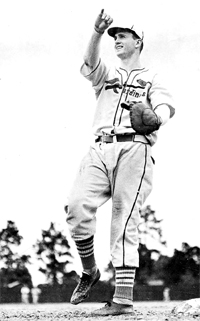
In a bid to contend with the Cardinals and others for the 1964 National League pennant, the Giants added the majors’ first Japanese import to their bullpen.

On Sept. 1, 1964, Masanori Murakami, 20, became the first Japanese native to play in the big leagues when he pitched in relief for the Giants against the Mets.

Possessing impressive command of his pitches, Murakami, a left-hander, made an impact. Though the Giants didn’t win a pennant in either of his two seasons with them, Murakami “was right at the top among relief pitchers in the National League,” Giants general manager Chub Feeney told the San Francisco Examiner in 1965. “Possibly only Ron Perranoski of the Dodgers was better.”

In two years with the Giants, Murakami was 5-1 with nine saves and struck out 100 batters in 89.1 innings.

He faced the Cardinals four times, all in 1965, and was 1-0 with a save.

Baseball rebirth

Murakami was born during World War II in Otsuki, Japan, a silk production center, on May 6, 1944.

After the war, Tsuneo “Cappy” Harada, a Japanese-American who served the Allies in military intelligence, was assigned by General Douglas MacArthur to encourage the resumption of baseball in Japan, according to the Hartford Courant.

Helping Harada in his efforts was Lefty O’Doul, two-time National League batting champion. O’Doul made multiple trips to Japan to promote baseball before the war and became a national institution, according to Red Smith of the New York Herald Tribune. In return visits there after the war, O’Doul was an influence on young Masanori Murakami, according to the Examiner.

Murakami was 19 when he joined the Nankai Hawks of the Japan Pacific League in September 1963. Cappy Harada was scouting for the San Francisco Giants then. Harada arranged with Nankai to let three of their teen prospects _ Murakami, infielder Tatsuhiko Tanaka and catcher Hiroshi Takahashi _ join the Giants’ organization in 1964. “They sent me over … to study the baseball system,” Murakami said years later to the New York Times.

New world

After getting a look at the Japanese teens in 1964 spring training, the Giants determined Murakami could pitch for the Class A Fresno farm club. The other two players were sent there with Murakami to observe before they’d join a rookie level farm team at Twins Falls, Idaho, in June.

The agricultural Fresno area then was home to 15,000 Japanese-Americans. Murakami and his two countrymen resided in the home of Keek Saiki and his wife Fumiko. “They drink milk by the gallon,” Fumiko said to the Examiner, “and go for fried chicken and westerns on TV. They are very quiet, write letters a yard long and ask where they can swim.”

Murakami’s manager at Fresno was Bill Werle. A former left-handed reliever for the Cardinals, he saw Murakami had the makeup to be a closer. “His control is incredible,” Werle told the Examiner. “That’s why I put him in tight spots in late innings … His low curve makes the batsmen tap grounders for double plays.”

Murakami was 11-7 with 11 saves and a 1.78 ERA for Fresno. He struck out 159 batters in 106 innings. Murakami made one start _ on Japanese-American Night in Fresno _ and pitched a complete game in a 3-2 win over Reno.

“He was too good for the league,” Werle told the Los Angeles Times.

The 1964 Giants entered September in third place in the National League and were a half game ahead of the Cardinals when they called up Murakami. Attempting the leap from Class A to the majors was formidable. The cultural significance of being the first Japanese-born big leaguer added to the challenge.

Big Apple

The rookie joined the Giants in New York for their series against the Mets. At Shea Stadium, he was greeted by general manager Chub Feeney and several Japanese reporters and photographers.

Murakami carried with him a Stan Musial model glove. When asked by the Examiner whether Musial was one of his favorites, Murakami shrugged. His English was limited.

Feeney “trailed him around the field, pen in hand, before the game,” trying to get Murakami to sign a major-league contract, the Times reported. Murakami didn’t want to sign until he understood what the contract meant. Feeney scrambled to find an interpreter and eventually got Murakami’s signature.

With the Mets ahead, 4-0, Giants manager Al Dark brought in Murakami to pitch the eighth. According to Newsday, “Many of the (39,379) fans stood and cheered when the pitcher came into the game.”

Mets starter Al Jackson told the newspaper, “We thought he might be a little nervous, but he wasn’t.”

Actually, Murakami told the San Francisco Chronicle, “I was afraid.” To calm his nerves, he said he hummed the tune “Sukiyaki” as he walked to the mound.

Murakami struck out the first batter, Charlie Smith. Chris Cannizzaro singled, then Ed Kranepool struck out and Roy McMillan grounded out. “As Murakami, with a spring in his gait and a wad of chewing gum in his mouth, strode toward the Giants’ dugout, Mets fans stood and cheered,” the Associated Press reported.

Stadium organist Jane Jarvis saluted Murakami’s successful debut with “The Japanese Sandman.” Boxscore

The next day, from Lefty O’Doul’s saloon near San Francisco’s Union Square, Examiner columnist Prescott Sullivan wrote that Murakami’s debut made the proprietor the happiest man in town. “Such was his joy, that for a period of six seconds, shortly before 11 a.m. when a slow bartender was on duty, all drinks served at his Geary Street tavern were on the house,” Sullivan noted.

Back in New York, Murakami was a guest on Ralph Kiner’s TV show, but, even with an interpreter, something got lost in translation, according to the Examiner.

Kiner: “What is your best pitch?”

Murakami: “Koufax.”

Kiner: “Who is your favorite pitcher?”

Murakami: “Curveball and a little bit changeup.”

Murakami asked to meet 74-year-old Mets manager Casey Stengel, who spoke his own unique style of English, Stengelese. Stengel posed with Murakami for a photo. Asked what he thought of him, Murakami said to the Examiner, “Nice old man. Very friendly.”

Sudden impact

In his first nine appearances for the 1964 Giants, covering 11 innings, Murakami didn’t allow a run. His first big-league win came against Houston at San Francisco’s Candlestick Park. Murakami pitched three scoreless innings and the game ended when Matty Alou of the Dominican Republic slugged a home run (his first in two years) against French-Canadian Claude Raymond in the 11th. Boxscore

In his next appearance, against the Cubs, Murakami faced three future Hall of Famers, Billy Williams, Ron Santo, Ernie Banks, and retired them in order. Boxscore

Described by the Examiner as “the slingin’ samurai,” he finished with a 1-0 record, one save and a 1.80 ERA for the 1964 Giants, striking out 15 and walking one in 15 innings. Batters hit .163 against him.

The Giants and Nankai Hawks both wanted Murakami to pitch for them in 1965, causing a dispute between the clubs. The matter got settled in late April 1965 when the Hawks agreed to let Murakami play for the Giants on the condition he’d be allowed to return to Japan in 1966 if he desired.

Murakami made his first appearance for the 1965 Giants on May 9, three days after he turned 21. (Murakami and teammate Willie Mays shared a birthday.)

When the Giants were at home, Murakami resided at the Benjamin Franklin Hotel in San Mateo. On the road, his roommate was fellow left-handed reliever Bill Henry, 37, a Texan, who began playing professional baseball in 1948 with the Clarksdale Planters of Mississippi.

Popular with teammates, Murakami “has an innate dignity, a quiet confidence and a sly sense of humor,” the Examiner’s George Murphy observed.

Giants manager Herman Franks was trying to find the players who were helping Murakami learn English. When Franks went to the mound to talk to Murakami during a game, the pitcher smiled and said to him, “Take a hike.” (Or words a good deal stronger than that.) Franks told the Examiner, “I don’t think he knows what he’s saying.”

Reliable reliever

Murakami beat the Cardinals the first time he faced them. With the score tied at 2-2 and Cardinals runners on first and second, one out, Murakami relieved Frank Linzy. He got Tim McCarver to pop out to second and fanned Carl Warwick. After Tom Haller’s two-run homer against Bob Gibson in the top of the 13th, Murakami retired the Cardinals in order for the win. Boxscore

A month later, with the Giants clinging to a 3-2 lead, the Cardinals had Julian Javier on second, two outs, in the ninth when Murakami relieved Linzy and struck out Bill White for the save. Boxscore

Murakami was especially effective against the Dodgers. In eight appearances covering 11 innings versus the 1965 Dodgers, he allowed one run (for an 0.82 ERA) and struck out 11. He also got his first big-league hit, a bunt single, against the Dodgers’ Sandy Koufax. Boxscore

Because of his delayed start to the season, Murakami wasn’t available when the Giants’ bullpen lost games to the Dodgers on April 30 and May 7.

“We lost the pennant to the Dodgers by only two games, and I missed one month,” Murakami said to Jim Murray of the Los Angeles Times. “If I pitched more, we would have won the pennant.”

Murakami was 4-1 with eight saves for the 1965 Giants. He struck out 85 in 74.1 innings and held batters to a .206 average.

Times have changed

Afterward, Murakami opted to play for the Nankai Hawks. “Murakami explained he wanted to stay with the Giants in 1966, but pressure from his parents, among others, forced him to return to Japan,” the Examiner reported.

Years later, asked by Jim Murray whether he wished he had stayed a Giant, Murakami replied, “Oh, yes.”

Murakami pitched in Japan for 18 years. His best season was 1968 when he was 18-4 with a 2.38 ERA for the Nankai Hawks. His teammates that season included second baseman Don Blasingame, a former Cardinal, and first baseman Marty Keough, who would become a Cardinals scout.

In 1983, when he was 38, Murakami attempted a comeback with the Giants but was released in spring training. “Fastball not so fast,” he told the Examiner.

Thirty years passed between the time Murakami last pitched for the 1965 Giants and the next Japanese player, Hideo Nomo of the 1995 Dodgers, reached the majors. A Japanese network arranged to televise Nomo’s games and hired Murakami as a broadcaster. On Aug. 5, 1995, at Candlestick Park, Murakami was honored by the Giants and threw the ceremonial first pitch. Then Nomo took the mound and hurled a one-hit shutout. Boxscore

Nomo received the 1995 National League Rookie of the Year Award. More Japanese players followed. The Cardinals signed their first, outfielder So Taguchi, in January 2002. In 2024, the most celebrated player in the game was the Dodgers’ Shohei Ohtani of Japan.

Read Full Post »

« Newer Posts - Older Posts »