Feeds:
Posts
Comments

Archive for the ‘Prospects’ Category

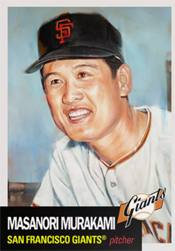
In a bid to contend with the Cardinals and others for the 1964 National League pennant, the Giants added the majors’ first Japanese import to their bullpen.

On Sept. 1, 1964, Masanori Murakami, 20, became the first Japanese native to play in the big leagues when he pitched in relief for the Giants against the Mets.

Possessing impressive command of his pitches, Murakami, a left-hander, made an impact. Though the Giants didn’t win a pennant in either of his two seasons with them, Murakami “was right at the top among relief pitchers in the National League,” Giants general manager Chub Feeney told the San Francisco Examiner in 1965. “Possibly only Ron Perranoski of the Dodgers was better.”

In two years with the Giants, Murakami was 5-1 with nine saves and struck out 100 batters in 89.1 innings.

He faced the Cardinals four times, all in 1965, and was 1-0 with a save.

Baseball rebirth

Murakami was born during World War II in Otsuki, Japan, a silk production center, on May 6, 1944.

After the war, Tsuneo “Cappy” Harada, a Japanese-American who served the Allies in military intelligence, was assigned by General Douglas MacArthur to encourage the resumption of baseball in Japan, according to the Hartford Courant.

Helping Harada in his efforts was Lefty O’Doul, two-time National League batting champion. O’Doul made multiple trips to Japan to promote baseball before the war and became a national institution, according to Red Smith of the New York Herald Tribune. In return visits there after the war, O’Doul was an influence on young Masanori Murakami, according to the Examiner.

Murakami was 19 when he joined the Nankai Hawks of the Japan Pacific League in September 1963. Cappy Harada was scouting for the San Francisco Giants then. Harada arranged with Nankai to let three of their teen prospects _ Murakami, infielder Tatsuhiko Tanaka and catcher Hiroshi Takahashi _ join the Giants’ organization in 1964. “They sent me over … to study the baseball system,” Murakami said years later to the New York Times.

New world

After getting a look at the Japanese teens in 1964 spring training, the Giants determined Murakami could pitch for the Class A Fresno farm club. The other two players were sent there with Murakami to observe before they’d join a rookie level farm team at Twins Falls, Idaho, in June.

The agricultural Fresno area then was home to 15,000 Japanese-Americans. Murakami and his two countrymen resided in the home of Keek Saiki and his wife Fumiko. “They drink milk by the gallon,” Fumiko said to the Examiner, “and go for fried chicken and westerns on TV. They are very quiet, write letters a yard long and ask where they can swim.”

Murakami’s manager at Fresno was Bill Werle. A former left-handed reliever for the Cardinals, he saw Murakami had the makeup to be a closer. “His control is incredible,” Werle told the Examiner. “That’s why I put him in tight spots in late innings … His low curve makes the batsmen tap grounders for double plays.”

Murakami was 11-7 with 11 saves and a 1.78 ERA for Fresno. He struck out 159 batters in 106 innings. Murakami made one start _ on Japanese-American Night in Fresno _ and pitched a complete game in a 3-2 win over Reno.

“He was too good for the league,” Werle told the Los Angeles Times.

The 1964 Giants entered September in third place in the National League and were a half game ahead of the Cardinals when they called up Murakami. Attempting the leap from Class A to the majors was formidable. The cultural significance of being the first Japanese-born big leaguer added to the challenge.

Big Apple

The rookie joined the Giants in New York for their series against the Mets. At Shea Stadium, he was greeted by general manager Chub Feeney and several Japanese reporters and photographers.

Murakami carried with him a Stan Musial model glove. When asked by the Examiner whether Musial was one of his favorites, Murakami shrugged. His English was limited.

Feeney “trailed him around the field, pen in hand, before the game,” trying to get Murakami to sign a major-league contract, the Times reported. Murakami didn’t want to sign until he understood what the contract meant. Feeney scrambled to find an interpreter and eventually got Murakami’s signature.

With the Mets ahead, 4-0, Giants manager Al Dark brought in Murakami to pitch the eighth. According to Newsday, “Many of the (39,379) fans stood and cheered when the pitcher came into the game.”

Mets starter Al Jackson told the newspaper, “We thought he might be a little nervous, but he wasn’t.”

Actually, Murakami told the San Francisco Chronicle, “I was afraid.” To calm his nerves, he said he hummed the tune “Sukiyaki” as he walked to the mound.

Murakami struck out the first batter, Charlie Smith. Chris Cannizzaro singled, then Ed Kranepool struck out and Roy McMillan grounded out. “As Murakami, with a spring in his gait and a wad of chewing gum in his mouth, strode toward the Giants’ dugout, Mets fans stood and cheered,” the Associated Press reported.

Stadium organist Jane Jarvis saluted Murakami’s successful debut with “The Japanese Sandman.” Boxscore

The next day, from Lefty O’Doul’s saloon near San Francisco’s Union Square, Examiner columnist Prescott Sullivan wrote that Murakami’s debut made the proprietor the happiest man in town. “Such was his joy, that for a period of six seconds, shortly before 11 a.m. when a slow bartender was on duty, all drinks served at his Geary Street tavern were on the house,” Sullivan noted.

Back in New York, Murakami was a guest on Ralph Kiner’s TV show, but, even with an interpreter, something got lost in translation, according to the Examiner.

Kiner: “What is your best pitch?”

Murakami: “Koufax.”

Kiner: “Who is your favorite pitcher?”

Murakami: “Curveball and a little bit changeup.”

Murakami asked to meet 74-year-old Mets manager Casey Stengel, who spoke his own unique style of English, Stengelese. Stengel posed with Murakami for a photo. Asked what he thought of him, Murakami said to the Examiner, “Nice old man. Very friendly.”

Sudden impact

In his first nine appearances for the 1964 Giants, covering 11 innings, Murakami didn’t allow a run. His first big-league win came against Houston at San Francisco’s Candlestick Park. Murakami pitched three scoreless innings and the game ended when Matty Alou of the Dominican Republic slugged a home run (his first in two years) against French-Canadian Claude Raymond in the 11th. Boxscore

In his next appearance, against the Cubs, Murakami faced three future Hall of Famers, Billy Williams, Ron Santo, Ernie Banks, and retired them in order. Boxscore

Described by the Examiner as “the slingin’ samurai,” he finished with a 1-0 record, one save and a 1.80 ERA for the 1964 Giants, striking out 15 and walking one in 15 innings. Batters hit .163 against him.

The Giants and Nankai Hawks both wanted Murakami to pitch for them in 1965, causing a dispute between the clubs. The matter got settled in late April 1965 when the Hawks agreed to let Murakami play for the Giants on the condition he’d be allowed to return to Japan in 1966 if he desired.

Murakami made his first appearance for the 1965 Giants on May 9, three days after he turned 21. (Murakami and teammate Willie Mays shared a birthday.)

When the Giants were at home, Murakami resided at the Benjamin Franklin Hotel in San Mateo. On the road, his roommate was fellow left-handed reliever Bill Henry, 37, a Texan, who began playing professional baseball in 1948 with the Clarksdale Planters of Mississippi.

Popular with teammates, Murakami “has an innate dignity, a quiet confidence and a sly sense of humor,” the Examiner’s George Murphy observed.

Giants manager Herman Franks was trying to find the players who were helping Murakami learn English. When Franks went to the mound to talk to Murakami during a game, the pitcher smiled and said to him, “Take a hike.” (Or words a good deal stronger than that.) Franks told the Examiner, “I don’t think he knows what he’s saying.”

Reliable reliever

Murakami beat the Cardinals the first time he faced them. With the score tied at 2-2 and Cardinals runners on first and second, one out, Murakami relieved Frank Linzy. He got Tim McCarver to pop out to second and fanned Carl Warwick. After Tom Haller’s two-run homer against Bob Gibson in the top of the 13th, Murakami retired the Cardinals in order for the win. Boxscore

A month later, with the Giants clinging to a 3-2 lead, the Cardinals had Julian Javier on second, two outs, in the ninth when Murakami relieved Linzy and struck out Bill White for the save. Boxscore

Murakami was especially effective against the Dodgers. In eight appearances covering 11 innings versus the 1965 Dodgers, he allowed one run (for an 0.82 ERA) and struck out 11. He also got his first big-league hit, a bunt single, against the Dodgers’ Sandy Koufax. Boxscore

Because of his delayed start to the season, Murakami wasn’t available when the Giants’ bullpen lost games to the Dodgers on April 30 and May 7.

“We lost the pennant to the Dodgers by only two games, and I missed one month,” Murakami said to Jim Murray of the Los Angeles Times. “If I pitched more, we would have won the pennant.”

Murakami was 4-1 with eight saves for the 1965 Giants. He struck out 85 in 74.1 innings and held batters to a .206 average.

Times have changed

Afterward, Murakami opted to play for the Nankai Hawks. “Murakami explained he wanted to stay with the Giants in 1966, but pressure from his parents, among others, forced him to return to Japan,” the Examiner reported.

Years later, asked by Jim Murray whether he wished he had stayed a Giant, Murakami replied, “Oh, yes.”

Murakami pitched in Japan for 18 years. His best season was 1968 when he was 18-4 with a 2.38 ERA for the Nankai Hawks. His teammates that season included second baseman Don Blasingame, a former Cardinal, and first baseman Marty Keough, who would become a Cardinals scout.

In 1983, when he was 38, Murakami attempted a comeback with the Giants but was released in spring training. “Fastball not so fast,” he told the Examiner.

Thirty years passed between the time Murakami last pitched for the 1965 Giants and the next Japanese player, Hideo Nomo of the 1995 Dodgers, reached the majors. A Japanese network arranged to televise Nomo’s games and hired Murakami as a broadcaster. On Aug. 5, 1995, at Candlestick Park, Murakami was honored by the Giants and threw the ceremonial first pitch. Then Nomo took the mound and hurled a one-hit shutout. Boxscore

Nomo received the 1995 National League Rookie of the Year Award. More Japanese players followed. The Cardinals signed their first, outfielder So Taguchi, in January 2002. In 2024, the most celebrated player in the game was the Dodgers’ Shohei Ohtani of Japan.

Read Full Post »

Pitcher Nelson Chittum never spent a full season in the majors, but during his time there he mingled with the sport’s aristocracy. For example:

_ In his big-league debut with the Cardinals, he got a start against the Dodgers and was opposed by Sandy Koufax.

_ In parts of three seasons in the majors, Chittum was a teammate of Stan Musial and Ted Williams. Chittum and Musial were road roommates for a while with the Cardinals. Then, with the Red Sox, Williams delivered a hit that helped set up Chittum to earn his first win.

_ In his best game as a Cardinal, Chittum struck out a pair of future Hall of Famers, Roberto Clemente and Bill Mazeroski.

In 40 big-league appearances, Chittum was 3-1 with a 3.84 ERA. Most of his professional career was spent as a starter in the minors.

Pitching prospect

Chittum moved with his family from Harrisonburg, Va., to Elizabethtown, Pa., about 20 miles from the state capital of Harrisburg, as a youth.

A right-handed pitcher, he threw two perfect games in high school. After he graduated in 1951, Chittum was approached by the Cardinals but opted instead to attend Elizabethtown College, according to the Elizabethtown Chronicle.

After two seasons of college baseball for coach Ira R. Herr, Chittum, 20, was signed by Cardinals scout Fred “Dutch” Dorman in October 1953. A week later, he was inducted into the U.S. Army and served for two years.

At 23, Chittum made his professional debut with the Cardinals’ Fresno farm club in the California League in 1956. A lanky sinkerball specialist, Chittum posted a 23-7 record in the regular season and pitched 266 innings. He earned three more wins in the playoffs, giving him a total of 26 for the year.

Promoted to the Cardinals’ Houston farm club, managed by Harry Walker, in 1957, Chittum was 16-12, developing a slider taught to him by pitching instructor Johnny Grodzicki.

“Nels is a low ball pitcher,” Houston general manager Art Routzong said to United Press. “He’s real tough and he’s got marvelous control until he lets loose with a high one. He’s hard to hit, real hard, when he keeps that ball down.”

Houston catcher Ray Dabek told the wire service, “You ought to get behind the screen and watch his ball move. He’s really got something on it. He has a good fastball that sort of sinks, and a good slider. Real good.”

Big-league debut

After compiling a 12-8 record and 2.84 ERA for manager Johnny Keane’s Omaha farm team in 1958, Chittum, 25, was called up to the Cardinals in August that year and given a start against Koufax and the Dodgers at Los Angeles.

Koufax, 22, was not yet the dominant ace he would become later with the Dodgers. He entered the start with a season record of 9-5 and a 4.19 ERA.

The first two Cardinals batters of the game, Curt Flood and Gene Freese, hit home runs against Koufax. The Cardinals totaled four runs in the inning.

Staked to the 4-0 lead, Chittum held the Dodgers scoreless in the first two innings. Koufax was taken out in the second.

The Cardinals made it 5-0 when Chittum got his first big-league hit, a single against Babe Birrer that scored catcher Gene Green from second.

Chittum, however, was unable to hold down the Dodgers, in part, because of poor fielding by his teammates. With two outs in the third, the Dodgers scored on a Gil Hodges bloop single “which Freese lost in the sun and which should, instead, have been taken in short left by Del Ennis,” the St. Louis Post-Dispatch reported. A Chittum balk brought in the Dodgers’ second run of the inning, cutting the St. Louis lead to 5-2.

In the fourth, the Cardinals scored three times, extending the lead to 8-2, but the Dodgers knocked out Chittum before he could retire a batter in the bottom half of the inning. Ken Boyer let a Charlie Neal grounder go over his shoulder for a fluke single. Two more singles followed, loading the bases. Carl Furillo, batting for reliever Fred Kipp, then doubled, driving in all three runners and making the score 8-5. After Jim Gilliam bunted for a single, Jim Brosnan relieved Chittum.

Brosnan limited the Dodgers to one run in six innings and got the win. Boxscore

St. Louis shakeup

Chittum next made two relief appearances for the Cardinals. The best of those outings was when he pitched 4.1 scoreless innings against the Pirates, including strikeouts of Clemente and Mazeroski. Boxscore

Three nights later, in the series finale versus the Pirates, Chittum started. He gave up three runs (a Dick Stuart solo home run and a two-run shot by Bob Skinner) in three innings and was the losing pitcher. Boxscore

Chittum pitched in nine more games, all in relief, for the 1958 Cardinals. According to the Spokane Spokesman-Review, the quiet rookie roomed with Musial on a couple of road trips.

With 10 games remaining, Cardinals general manager Bing Devine, on orders from club owner Gussie Busch, fired manager Fred Hutchinson.

A month later, with new manager Solly Hemus, the Cardinals traveled to Japan for a goodwill tour. Chittum opted not to go because he had committed to playing winter baseball in the Dominican Republic. “Maybe I missed my chance to impress (Hemus) in Japan,” Chittum told the Minneapolis Star Tribune, “but I know I didn’t stand much chance in the St. Louis organization.”

Moving on

At 1959 spring training, Cardinals pitcher Sal Maglie (who would become an instructor that season) said Chittum needed to develop a better curve to stay in the majors, the Elizabethtown Chronicle reported. Then, on March 15, 1959, Chittum was traded to the Red Sox for pitcher Dean Stone.

The Red Sox assigned Chittum to their farm team at Minneapolis, managed by Gene Mauch, who told the Star Tribune. “Nels … was one of the best right-handers in our league last year (with Omaha). He beat the top clubs.” One of those wins was a shutout against Minneapolis and Stone.

Red Sox farm director Johnny Murphy, a former Yankees reliever, noticed a flaw in Chittum’s delivery and worked with him to correct it. “When I let the ball go, it was traveling up instead of down, and it was taking all my stuff off,” Chittum told the Elizabethtown Chronicle. “John changed my motion so that now when I release the ball it travels in a downward arc.”

Chittum was 11-5 for Minneapolis when the Red Sox called him up for the last two months of the 1959 season.

On Aug. 28, 1959, the Orioles led the Red Sox, 4-2, in the seventh when Ted Williams, batting for catcher Sammy White, doubled, scoring Frank Malzone from second and getting Boston within a run at 4-3. Chittum entered in the eighth, pitched three scoreless innings and got the win, his first in the majors, when the Red Sox rallied. Boxscore

In September, Chittum got two more wins, beating the Indians and Senators. He finished 3-0 with a 1.19 ERA for the 1959 Red Sox. Chittum allowed earned runs in just two of 21 appearances and no one hit a home run against him.

No vacancies

Sal Maglie replaced Boo Ferriss as Red Sox pitching coach in 1960.

On April 6, on their way from spring training in St. Petersburg, Fla., to San Francisco to open the 1960 season at the new Candlestick Park, the Cardinals stopped in Scottsdale, Ariz., for an exhibition game against the Red Sox. Chittum, in relief of Bill Monbouquette, pitched 1.2 innings against his former team and gave up one run. Ted Williams had two singles in three at-bats but was upstaged by Stan Musial, whose three-run home run versus Ted Bowsfield in the eighth carried the Cardinals to a 13-10 victory.

(Asked on a 1962 questionnaire to name his biggest thrill in baseball, Chittum answered, “It has to be being teammates with two of the all-time great players _ Stan Musial and Ted Williams,” the Spokane Spokesman-Review reported.)

Chittum began the 1960 season with the Red Sox but on May 6 was traded to the Dodgers for Rip Repulski, the former Cardinal, and assigned to the minors. (In his first at-bat for the Red Sox, Repulski hit a grand slam. Boxscore)

Chittum never returned to the majors. In 1961, he was “packed and almost out the door” on his way to the Angels, an American League expansion club, but at the last moment the Dodgers reconsidered, the Elizabethtown Chronicle reported.

After pitching his last season for Rochester in 1964, Chittum managed a men’s clothing store and then became a U.S. postal inspector.

In February 1965, baseball innovator Bill Veeck told a banquet audience in Lancaster, Pa., he wanted to see interleague play, the elimination of the intentional walk, and a designated hitter for the pitcher.

Asked his opinion of a designated hitter, Chittum told the Lancaster New Era, “That’s a bunch of baloney … That would take the fun out of it. It’d be like telling some guys on a basketball team they had to play defense and couldn’t shoot.”

Read Full Post »

A right-handed pitcher and protege of Cardinals ace Harry Brecheen, Jerry Walker became the right-hand man to Cardinals general manager Walt Jocketty.

Walker was involved with professional baseball most of his adult life. At 18, he went from high school to the majors with the Orioles and was nurtured by Brecheen, the pitching coach who’d been a World Series standout with the 1946 Cardinals.
At 20, Walker became the youngest pitcher to start in an All-Star Game. He played eight seasons in the American League with the Orioles (1957-60), Athletics (1961-62) and Indians (1963-64).

After his playing days, Walker managed in the minors, then returned to the big leagues as a scout and went on to become a coach and general manager. For 13 years (1995-2007), he was an executive in the Cardinals’ front office, advising Jocketty on player personnel.

Mighty leap

Born and raised in Ada, Okla., Walker was a high school baseball phenom, posting a varsity pitching record of 52-1 and leading his club to state titles in 1956 and 1957. He hit .529 as a junior and .526 his senior season.

Most big-league teams tried to sign him, including the Red Sox, who projected Walker as a third baseman, but he chose the Orioles, in large part, because of Brecheen, an Ada resident. “Brecheen had a great deal to do with Walker’s decision,” the Baltimore Sun noted.

Brecheen told the newspaper, “I’ve known the boy and his family for a long time … I thought when I saw him in high school that he had the best curve of any kid I’d ever seen.”

After signing with the Orioles on June 28, 1957, Walker joined a pitching staff with the likes of former Negro League fastballer Connie Johnson, World War II combat veteran Hal Brown and ex-Dodgers standout Billy Loes.

A week later, Walker made a jittery big-league debut at Boston’s Fenway Park. With the Red Sox ahead, 6-2, Orioles manager Paul Richards sent Walker to pitch the seventh. He issued walks to the first two batters _ two-time American League batting champion Mickey Vernon and Jackie Jensen (past and future AL RBI leader) _ and went to a 2-and-0 count on Frank Malzone before being relieved by Art Ceccarelli, a winless left-hander. Malzone mashed a pitch that soared over the the head of right fielder Tito Francona for a triple. Boxscore

After three relief appearances, Walker made his first start, facing the hapless Athletics at Kansas City. Nervous and overanxious, he didn’t last an inning. Boxscore

Breakout game

A month later, after a few relief stints, none longer than two innings, Walker got his second start, this time at home, against the Senators. Though destined to finish in the basement, the Senators had Roy Sievers, the slugger from St. Louis who would lead the American League in home runs (42) and RBI (114) that year.

Pitching with the poise and stamina, Walker shut out the Senators for 10 innings and got the win, 1-0. He allowed four singles and a walk, totaling 111 pitches.

“Here is a kid who had never pitched nine innings in his life,” Paul Richards said to the Baltimore Sun. “The high schools where Jerry played limit their games to seven innings.”

Brecheen told the newspaper, “We knew he had a lot of ability, and he’s got a lot of heart.”

Walker dressed quickly after the game and dashed out of the clubhouse. As the Sun explained, “With a pocketful of hot change, the quiet-spoken, crew-cut kid was busting out all over in his (eagerness) to reach the nearest coin telephone to place a long-distance call to (his parents in) Oklahoma.” Boxscore

Seeing stars

After a tune-up season in the minors at Knoxville (18-4, 2.61 ERA) in 1958, Walker was one of three 20-year-old pitchers (Jack Fisher and Milt Pappas being the others) who contributed to the Orioles in 1959.

Walker sizzled early, winning his first four decisions, including a five-hitter against the Yankees. He struck out Mickey Mantle three times. Boxscore

In a rematch in July, Walker again beat the Yankees, fanning Mantle three more times and totaling 10 strikeouts for the game. “For 20 years old, you’d have to say the young man was amazing the way he struck my men out,” Yankees manager Casey Stengel said to the Sun. Boxscore

(Though he whiffed 12 times versus Walker in his career, Mantle had an on-base percentage of .500 _ 13 hits and 11 walks _ against him and slugged four home runs. Of Walker’s four career wins versus the Yankees, three came in 1959.)

A month later, Stengel, the American League manager, chose Walker to start in the All-Star Game at Los Angeles. Walker got the win, allowing one run in three innings. He twice retired the Cardinals’ Ken Boyer, struck out Eddie Mathews and got Willie Mays and Ernie Banks to ground out. Boxscore

Working overtime

On Sept. 11, 1959, the first-place White Sox, headed for an American League pennant, were at Baltimore for a Friday doubleheader on Westinghouse Night. As the Sun noted, “The air was electric with tension.”

Jack Fisher shut out the White Sox in the opener, 3-0, limiting them to three hits. Boxscore

Walker started Game 2 against a lineup headed by future Hall of Famers Luis Aparicio and Nellie Fox. He gave up two singles in the first but the White Sox never advanced another runner as far as third the rest of the night.

White Sox pitchers Barry Latman (9.1 innings) and Gerry Staley, the ex-Cardinal, were superb, too, but Walker was better. He pitched 16 scoreless innings and the Orioles prevailed, 1-0, when Brooks Robinson’s two-out single versus Staley, 39, drove in Al Pilarcik from third.

“That two 20-year-olds should pitch 25 scoreless innings in one night against the league leaders, even the light-hitting White Sox, borders on the unbelievable,” wrote Ed Brandt of the Sun.

His colleague, Lou Hatter, offered, “Walker’s performance was extra-special, incredible and then some.”

Walker told United Press International, “I could have pitched another couple of innings.” Boxscore

He finished the year 11-10 with a 2.92 ERA, but never had another winning season in the majors.

On the move

In 1960, Walker suffered from allergies “that sapped his strength,” the Sun reported, and posted a 3-4 season record. “From what they told me, I guess I was allergic to just about everything,” Walker told the Kansas City Times. “They gave me some shots and also some pills to take regularly. The shots are a long-range treatment and the doctors seem to think they should clear up the trouble completely in two or three years.”

Traded to the Athletics in April 1961, he spent two years with them, went 16-23 and got dealt again, to Cleveland, where he played his final two seasons in the majors. A highlight came on July 13, 1963, when Walker pitched four scoreless innings of relief, helping Cleveland teammate Early Wynn, 43, get career win No. 300. Boxscore

In May 1964, Walker was loaned by Cleveland to the Cardinals’ Class AAA farm club, the Jacksonville Suns, managed by Harry Walker (no relation). His teammates included pitchers Mike Cuellar, Bob Humphreys, Gordon Richardson and Barney Schultz, who went on to help the Cardinals win a pennant and World Series championship that season.

Walker was 10-9 with Jacksonville, including a one-hitter in a 1-0 victory versus Richmond in 10 innings. Called up to Cleveland in September, he pitched his final big-league games that month.

Still in the game

Walker was a manager in the Yankees’ farm system for six seasons (1968-73) and his pitchers included a pair of future American League Cy Young Award winners _ Ron Guidry and LaMarr Hoyt. Walker was a Yankees scout from 1974 to 1981, then became their pitching coach for parts of the 1981 and 1982 seasons.

From 1983-85, Walker was Astros pitching coach. His staff ace was Nolan Ryan.

After a stint from 1986-91 as special assignment scout for the Tigers, Walker was promoted to general manager by club president Bo Schembechler and tasked with rebuilding the roster. As Gene Guidi of the Detroit Free Press noted, “Walker stepped into a tough spot in Detroit. He wants to make the Tigers a better team but he has few marketable players to trade and a limited spending budget to pursue free agents.”

In Walker’s first season as general manager, the Tigers were 75-87. They improved to 85-77 in 1993, but the franchise underwent an ownership change, and Walker was fired in January 1994.

Cardinals influencer

In November 1994, Walt Jocketty, who replaced Dal Maxvill as Cardinals general manager, hired Walker to be the club’s director of major league player personnel. “He was the first guy I hired in St. Louis,” Jocketty told the Cincinnati Enquirer.

“Walker’s duties will feature special assignment scouting and recommendations to Jocketty,” the St. Louis Post-Dispatch reported.

Three years later, in February 1997, Walker was promoted, with the title of vice president of player personnel. The Post-Dispatch referred to him as Jocketty’s “right-hand man.”

According to the Cardinals 1997 media guide, Walker “assists Jocketty in personnel matters with the major league club and he is also responsible for overseeing the Cardinals player development and scouting activities.”

One of the up-and-coming Cardinals staffers in 1997 was a scouting assistant, John Mozeliak. According to the Post-Dispatch, Walker was a mentor to Mozeliak.

During Walker’s 13 years with the Cardinals, they won two National League pennants (2004 and 2006) and a World Series title (2006).

In October 2007, Jocketty was fired and replaced by Mozeliak. “One of Walt’s strong points was how he used his people,” Walker told the Post-Dispatch. “He allowed Mo (Mozeliak) to be involved, to increase his responsibilities.”

When the Reds then hired Jocketty to be team president and general manager, he brought in Walker to serve as his special assistant for player personnel.

Read Full Post »

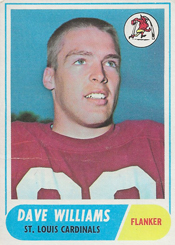
A hurdler in track, Dave Williams used those skills on the football field to spring above defenders and catch passes in a crowd.

The NFL St. Louis Cardinals projected him to be the deep threat who would replace longtime standout Sonny Randle.
Williams came through for St. Louis in his first three seasons, but couldn’t sustain the success. 

Athletic ability

Though born in Cedar Rapids, Iowa, Williams grew up in Tacoma, Wash., and went to Lincoln High School, where he excelled in football and track. He won a state championship for Lincoln in the hurdles in 1963.

Williams then competed in both sports at the University of Washington. According to Bob Broeg of the St. Louis Post-Dispatch, Washington head football coach Jim Owens said, “He’s the finest natural athlete I ever coached.”

Williams was a collegiate all-America in four different events in track and field _ broad jump, 120-yard hurdles, 440-yard hurdles and 440-yard relay. He qualified to compete in the 1964 Olympic trials in the decathlon.

His football career at Washington was not as consistent. As Tacoma News Tribune sports editor Earl Luebker noted, “Much of his time was spent in frustration.”

In his first varsity season as a sophomore in 1964, Williams made a mere three catches. “He started his sophomore season as one of the most widely heralded pass receivers,” the News Tribune reported, “yet, before the year had progressed too far, he found himself working as a third-stringer in the defensive secondary.”

Williams’ breakout season came as a junior in 1965 when he made 38 catches, including 10 for touchdowns. The 6-foot-2 receiver had 10 catches, including one for a touchdown, against Stanford and another 10 catches, for 257 yards and three touchdowns, versus UCLA.

“We couldn’t cover that fellow Williams,” UCLA head coach Tommy Prothro told the Los Angeles Times. “We tried to play him loose, but it was no go … Williams, who sort of reminds me of (the Green Bay Packers’) Don Hutson, has such deceptive speed. Looks like he’s running slow with that easy gait.”

As a senior in 1966, Williams “was used largely as a decoy,” the Tacoma News Tribune reported, and had no touchdowns among his 21 catches.

Promising rookie

Williams caught the attention of the Cardinals with his play in college all-star games after his senior season. In the East-West Shrine Bowl, he snared a 48-yard touchdown toss from Stanford’s Dave Lewis. Then, in the Hula Bowl, Purdue’s Bob Griese connected with Williams on touchdown throws of 43 and 40 yards.

The Cardinals picked Williams in the first round of the 1967 NFL draft. He was the second wide receiver taken. The first was Michigan State’s Gene Washington by the Minnesota Vikings.

“Williams was the surest bet to help us,” Cardinals head coach Charley Winner said to the Post-Dispatch. “He has ideal size. In addition to speed, he’s big enough to crack back as a blocker and he definitely can catch the ball in a crowd.”

Cardinals receivers coach Fran Polsfoot told the newspaper, “He excels at catching the hard passes. He’ll go up and fight for the ball with a good spring in his legs and intense desire.”

At training camp with the 1967 Cardinals, Williams was accepted by veteran receivers Bobby Joe Conrad and Sonny Randle, and quarterback Charley Johnson.

“I’ve been really surprised by the help I’ve got from the other receivers,” Williams told the Post-Dispatch. “Bobby Joe Conrad showed me how to break on my pass patterns. Sonny Randle helped me in learning to make certain alignments. Charley Johnson has helped in telling me how to read defenses and be in the right place.”

Randle said to the newspaper, “He has all the tools. As soon as he knows the right places to be, he’ll be a good one.”

Williams did so well in exhibition games that the Cardinals traded Randle to the San Francisco 49ers for a draft choice three days before the 1967 season opener.

On Monday night, Oct. 30, 1967, the reigning NFL champion Green Bay Packers played at St. Louis. Matched against Herb Adderley, destined for election to the Pro Football Hall of Fame, Williams caught touchdown passes of 49 and 48 yards from Jim Hart. On a halfback option play, Johnny Roland also completed a pass to Williams in the end zone but it was nullified by an offsides penalty on a lineman. Described by the Green Bay Press-Gazette as “jet-like” and “explosive,” Williams made six catches for 147 yards in the game.

“The kid’s good,” Adderley told the Post-Dispatch. “I predict a great future for him. He’s not like most of these rookies who go out and see how fast they can run. Williams makes moves. I backed off and played him loose the second half. He could have those short ones, but no more bombs.” Game stats and Video

Williams completed his rookie season with 28 catches and five touchdowns.

Hard to cover

Convinced Williams was headed for stardom, the Cardinals traded Billy Gambrell to the Detroit Lions for a draft choice just before the start of the 1968 season, making Williams and Bobby Joe Conrad the starting wide receivers.

Williams had 43 catches, including a team-high six for touchdowns, in 12 starts for the 1968 Cardinals before an injury to his left knee sidelined him for the final two games.

One of his season highlights was a 71-yard touchdown catch on a pass from Hart against the Pittsburgh Steelers. “I was supposed to cut him off short and (safety) Clendon Thomas was supposed to take him long,” Steelers cornerback Marv Woodson told the Post-Dispatch, “but Williams just outran Thomas, and Jim Hart threw a perfect pass. No cornerback can stop a good receiver from catching a perfect pass, no matter how well he covers his man.” Game stats

(Of Williams’ 22 touchdown receptions in his five seasons with St. Louis, 12 were of more than 30 yards.)

In 1969, Williams led the Cardinals in receptions (56). His seven touchdown catches came in two games.

On Nov. 2, 1969, Williams scored four touchdowns on passes from Charley Johnson, but the Saints beat the Cardinals, 51-42. “Here I am with my greatest day statistically, but the luster is taken off,” Williams said to the Post-Dispatch. “You come away with an empty feeling because you lost the ballgame.” Game stats

A month later, Jim Hart connected with Williams on three touchdown passes against the Steelers. Game stats

Unhappy days

Based on his first three seasons, the Cardinals had high hopes for Williams in 1970. At training camp, Bob Broeg of the Post-Dispatch observed that Williams “gives promise of leadership because he’s sharp, articulate and the kind of performer who can inspire.”

Broeg added, “Williams’ forte is the incredible leaping ability and possessiveness that permits him to get higher than backfield defenders and to out-grapple them for the ball.”

The season, though, was a bust. Williams clashed with head coach Charley Winner and told the Post-Dispatch, “Most of the players didn’t respect him.”

Williams had 23 receptions in 1970 (33 fewer than the year before) and, according to the Post-Dispatch, Jim Hart lost confidence in him. “Dave Williams was a dejected, withdrawn football player, dressing quickly and leaving the locker room before his teammates, and intentionally ostracizing himself from the club,” the Post-Dispatch reported.

Charley Winner was fired after the season and became an assistant on the staff of Washington Redskins head coach George Allen. The Cardinals offered to trade Williams to Washington for a second-round draft pick, but Winner recommended to Allen that he decline the proposal, the Post-Dispatch reported.

Bob Hollway was the Cardinals’ head coach in 1971 but Williams regressed, losing his starting job to rookie Mel Gray and finishing with 12 catches.

On Feb. 1, 1972, after the Cardinals made Oregon wide receiver Bobby Moore (who later became Ahmad Rashad) their first pick in the draft, they traded Williams to the San Diego Chargers for wide receiver Walker Gillette. (Like Williams, Moore went to high school in Tacoma.)

“Williams had been a big disappointment to the Cardinals,” the Post-Dispatch exclaimed. “His teammates often accused him of not running correct patterns, and this alienated him from the squad.”

Never a dull moment

After a season and a half with the Chargers (21 total catches, three touchdowns), Williams was placed on waivers and acquired by the Steelers in October 1973. He played in one game for them and joined the Southern California Sun of the World Football League in 1974.

Playing for head coach Tom Fears, Williams spent two seasons with the Sun and revived his career _ 59 catches, 11 touchdowns in 1974, and 21 catches, nine touchdowns in 1975. “Williams runs like a deer, is sure-handed and runs exemplary pass patterns,” the Los Angeles Times noted.

In November 1975, Williams, 30, became the first player to sign with the Seattle Seahawks, an NFL expansion team slated to begin its inaugural season in 1976. Part of his contract required Williams to make promotional appearances to generate interest in the fledgling franchise.

Williams entered a professional indoor track meet in Seattle in the spring of 1976 after receiving approval from the Seahawks. While running an obstacle course, his spikes caught in the boards and he tore cartilage in his left knee.

Meanwhile, in June 1976, Williams filed a damage lawsuit against Dr. Arnold Mandell, a former team psychiatrist for the Chargers, who wrote a book, “The Nightmare Season,” about his experiences with the team. In his lawsuit, Williams said Mandell falsely accused him of “defects of character.”

Two months later, in August 1976, the Seahawks put Williams on waivers because he failed a physical. Williams threatened to sue the Seahawks, claiming they were responsible for the knee injury he suffered in the track meet.

In December 1976, Williams told the Tacoma News Tribune that he and the Seahawks reached an out-of-court settlement. “We sat down and resolved the matter in about 20 minutes,” Williams said to the newspaper.

With his playing career done, Williams eventually became a spokesman for the Pro Football Retired Players Association.

In May 1979, a San Diego County Superior Court jury awarded Williams $300,000 in his libel trial against the former Chargers psychiatrist.

Read Full Post »

During the 10 years he was a catcher in the big leagues, Bill Plummer may have been the most patient man in baseball. For most of that time, he sat and watched, waiting to get called into a game.

Plummer had hoped to play for the Cardinals, the club that signed him to his first professional contract, but it didn’t happen. Instead, he was mostly with the Reds, whose starting catcher, Johnny Bench, performed at a level that earned him election to the Baseball Hall of Fame.

Being Bench’s backup kept Plummer on the bench. On the rare times Plummer did get on the field, the team he often did the best against was the Cardinals.

In the genes

Plummer came from a baseball family. His father, also named Bill, was a pitcher in the minor leagues for five seasons in the 1920s. An uncle, Red Baldwin, was a longtime minor-league catcher. Plummer’s father and uncle were teammates on the 1924-25 Seattle Indians.

Playing baseball at Shasta College in Redding, Calif., in April 1965, Plummer caught the attention of the reigning World Series champion Cardinals. Scout Bill Sayles offered him $10,000 and said the club also would finance the remainder of Plummer’s college education. “I came from a small country town (Anderson, Calif.), so I jumped at the offer,” Plummer recalled to the St. Louis Post-Dispatch.

According to the Redding Record Searchlight, “The Cardinals were interested in Plummer because of his hitting, ability as a catcher and rifle arm.”

Plummer, 18, joined the Cardinals’ 1965 Florida Rookie League team in Sarasota managed by George Kissell.

Behind the plate, Plummer looked terrific. He was “reputed to have one of the best arms in the Cardinals organization,” the Modesto Bee reported. Standing at the plate, he looked helpless. With Class A Eugene (Ore.) in 1966, Plummer batted .144 and had more strikeouts (33) than hits (18).

Catching on

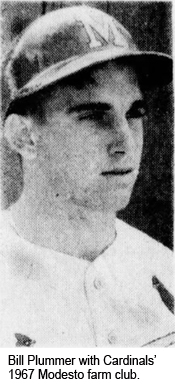
Assigned to Class A Modesto in 1967, Plummer was managed by Sparky Anderson. The relationship did not begin well.

“I was using Sonny Ruberto for most of the catching early in the season and Plummer didn’t like it,” Anderson told the Post-Dispatch. “He gave me a mean stare one day as he entered the shower. I told him that stare would only get him back to Eugene if he kept it up. He played better after that.”

Plummer said to the Dayton Daily News, “I was young and had temper problems. I was frustrated and depressed because baseball was my career and I was floundering in the minors. I used to get so depressed I’d hide somewhere, and have a few cocktails where nobody talked baseball.”

Anderson eventually moved Ruberto to the infield and made Plummer the everyday catcher. Though he struggled to make contact (100 strikeouts, 93 hits), his catching skills were impressive. Modesto won a league championship.

The Cardinals organization had an abundance of talent in 1967. The big-league club became World Series champions that year. One of its core players was the catcher, Tim McCarver. The Cardinals’ first-round pick in the amateur draft that year was McCarver’s heir apparent, Ted Simmons.

Plummer’s hopes of becoming a Cardinal went down the drain when they left him off the 40-man big-league winter roster after the 1967 season. The Cubs claimed him in the November 1967 Rule 5 draft.

Forgotten man

By drafting him, the Cubs were required to keep Plummer, 21, on their big-league roster the entire 1968 season or else offer him back to the Cardinals, but manager Leo Durocher wasn’t inclined to use a catcher who hadn’t played above the Class A level.

As the Chicago Tribune noted, Plummer “appears doomed to little work if Randy Hundley stays healthy behind the plate.”

Hundley caught nearly every game for the 1968 Cubs. Plummer was mostly ignored. He got into two games all season. In his debut, April 19, 1968, at St. Louis, he batted for pitcher Chuck Hartenstein and was struck out by Cardinals rookie reliever Hal Gilson. Boxscore

Plummer’s only other appearance came on May 12 during a Mets rout of the Cubs in the second game of a doubleheader at Wrigley Field. Plummer caught two innings as a replacement for Hundley and was retired on a fly to right. Boxscore

“It was so bad that when we played an exhibition game in the middle of the year against the White Sox they called a catcher from the minors up to catch the game,” Plummer told the Cincinnati Enquirer. “They didn’t even use me then.”

Spending most of his time in the bullpen located along the outfield sideline at Wrigley Field, Plummer was similar to a spectator in the stands. Mike Murphy, a founder of the ballpark’s Bleacher Bums, told McClatchy News Service, “He was like one of us. He sat on a bench, just like we did. He’d wave and smile at us. He hit lots of home runs in batting practice. All the girls noticed him.”

Though popular, the season of inactivity “set me back a couple of years,” Plummer said to the Associated Press.

Reserve duty

Plummer hoped to get drafted by one of the four expansion teams (Expos, Padres, Pilots, Royals) that entered the majors in 1969, or go to any other club needing to play a catcher, but instead the Cubs sent him to the Reds in January 1969 for reliever Ted Abernathy.

Johnny Bench, who in 1968 won National League Rookie of the Year and Gold Glove awards, had a lock on the Reds starting catching job and his backup was the former Cardinals veteran, Pat Corrales.

According to the Redding Record Searchlight, “there was some talk of converting Plummer into a pitcher,” but the Reds reconsidered. 

Plummer spent most of the next three seasons (1969-71) in the minors before emerging as Bench’s backup in 1972. According to the Modesto Bee, Sparky Anderson, who became Reds manager in 1970, said Plummer “already has an arm better than two-thirds of the catchers up here.”

Asked to describe the catching strengths he and Bench possessed, Plummer said to the Cincinnati Enquirer, “John had the excellent release, great foot movement and super hands. He was excellent at receiving throws from the outfield and making tags. I was the kind of guy who stayed in and blocked the plate and crunched people. Those were my skills.”

The Enquirer added, “Plummer was adept defensively. He was a fine handler of pitchers and had a strong arm. He could make all the plays behind the plate.”

Reds pitcher Jack Billingham said to the newspaper, “He couldn’t carry Bench’s bat, but, defensively, you didn’t lose much at all when Plummer was in there.”

In 797 career at-bats for the Reds, Plummer hit .186, but there were some highlights, especially against the Cardinals and one of their former pitchers.

Magic moments

On June 8, 1974, facing Steve Carlton at Veterans Stadium in Philadelphia, Plummer slugged two home runs and Bench, playing third, hit another, but the Phillies prevailed, 6-5. In 16 career plate appearances versus Carlton, Plummer batted .429 and had a .500 on-base mark. Boxscore

Plummer’s most productive game came almost exactly two years later, June 6, 1976, a Sunday afternoon at St. Louis. Filling in for Bench, who was experiencing muscle spasms, Plummer had seven RBI in the Reds’ 13-2 triumph at Busch Memorial Stadium.

Plummer had a RBI-single against Pete Falcone in the second, a three-run triple that knocked Falcone out of the game in the third, and a three-run home run versus Danny Frisella in the sixth.

“I actually felt chills when I circled the bases after hitting that homer,” Plummer told The Cincinnati Post. “Seven RBI. That’s almost a full season’s work for me.”

Plummer’s home run would have been a grand slam if George Foster hadn’t been picked off second on the previous play with the bases loaded.

As for Plummer’s bases-clearing triple, it came about when his liner took a high hop on the AstroTurf, went over the head of right fielder Willie Crawford and rolled to the wall. It was Plummer’s only big-league triple. Boxscore

A week later, playing the Cardinals at Cincinnati, Plummer had three hits, a walk, two RBI and scored twice, but the Cardinals won, 12-9. Two of Plummer’s hits _ a single and a home run _ came against Bob Forsch. Boxscore

Plummer had three three-hit games in the majors and two of those were against the Cardinals.

Of Plummer’s 19 RBI for the Reds in 1976, 10 came against the Cardinals. For the season, he hit .248 overall but .381 versus St. Louis.

Baseball teacher

During his time with Cincinnati, the Reds played in four World Series but Plummer never appeared in any of those games.

Released by the Reds in 1978, he played a final season with the Mariners.

Plummer managed in the minors for 20 years, primarily in the farm systems of the Mariners, Tigers and Diamondbacks. He also coached in the majors with the Mariners (1982-83 and 1988-91) and Rockies (1993-94).

Plummer got one chance to manage in the majors. That was with the Mariners in 1992. Though the team had future Hall of Famers Edgar Martinez (the American League batting champion that year), Ken Griffey Jr. and Randy Johnson, the 1992 Mariners finished with the worst record in the league (64-98). Plummer was fired and replaced by Lou Piniella.

A grandson of Plummer, Conner Menez, pitched in the majors for the Giants (2019-21) and Cubs (2022).

Read Full Post »

In late July 1944, Allied troops were on the outskirts of Brest, a strategic seaport town in northwest France that the Germans occupied during World War II and turned into a submarine base. The Allies were determined to drive out the Nazis, and hoped to make the harbor a supply hub.

Among the infantry advancing on Brest was a U.S. Army private, Eddie Kazak, a St. Louis Cardinals infield prospect. In the combat that ensued, Kazak had a bayonet driven through his left arm and had his right elbow crushed during an artillery attack. It took more than a year for him to recover. Discharged in December 1945, doctors warned him against playing baseball again.

Four years later, Kazak was the Cardinals’ rookie third baseman and the starter for the National League in the 1949 All-Star Game.

Dangerous work

A son of Polish immigrants, Edward “Eddie” Tkaczuk was born in Steubenville, Ohio, and raised in Muse, Pa., 20 miles south of Pittsburgh. His father, Joseph Tkaczuk, was a coal miner, working “down deep where the sun and fresh air are withheld by earthen barriers as formidable as prison bars,” Bob Broeg wrote in the St. Louis Post-Dispatch.

After Eddie graduated from high school, he joined his dad as a coal digger. “To blink his way into the daylight and up to the cashier’s cage above ground for $50 checks every two weeks, he had to load 130 or more tons,” Broeg reported. 

One day, a coal car, swinging around a bend too fast, jumped a rail, overturned and pinned Eddie against a tunnel wall, cracking several ribs.

When he recovered, Eddie, 19, resumed playing amateur baseball, including on Sundays for the coal mine team. He got an offer to turn pro with the Valdosta (Ga.) Trojans, a Class D minor-league club with no big-league affiliation.

Eddie wanted to sign but sought approval from his father because it meant giving up the steadier income he shared with the family from mining. “Papa Tkaczuk was eager for his son to have an opportunity to spend his life above ground at an easier task,” Bob Broeg wrote. “The boy was given parental blessing.”

Purple heart

A second baseman who hit for average, Eddie played for Valdosta in 1940 and impressed Joe Cusick, manager of the Cardinals’ Albany (Ga.) farm team. On Cusick’s recommendation, the Cardinals bought Eddie’s contract for $1,000 and brought him into their system. He batted .378 with 221 hits for Albany in 1941.

While with the Houston Buffaloes in 1942, Eddie met Thelma Bee Gregg and they became a couple. After the season, Eddie, 22, enlisted for military duty and went into the Army. That’s how he ended up in France in the summer of 1944.

The Germans fortified their defenses at Brest and the fighting was intense. In hand-to-hand combat with a German soldier, Eddie was knocked to the ground. He rolled over as the attacker rushed forward and thrust a bayonet through Eddie’s left arm, just missing an artery. “I think I shot him then because suddenly I was free,” Eddie said to Bob Broeg.

The wound required 19 stitches and left a huge scar.

Two weeks later, during an advancement, Eddie came under heavy fire. Shell fragments rained all around, striking Eddie and bringing down a structure he was near. He was buried in bricks and his right elbow, the one he used for throwing a baseball, was shattered.

Eddie spent the next year and a half in military hospitals. Doctors wanted to amputate the arm but he was against it. “For nearly a year of that time, his right arm was shaped like a capital ‘L’ and he couldn’t move the first three fingers of his right hand,” Broeg reported. “Then there was a delicate operation. Pieces of crushed bone were removed and plastic was used to repair the shattered elbow.”

Movement returned to the fingers, but when he was cleared to return to civilian life, Eddie, 25, had to weigh the advice of doctors against his desire to resume his baseball career. “I was warned to give up baseball because throwing might dislocate the synthetic elbow,” he told the Associated Press. “The doctors also said that, if the elbow should lock, there was nothing they could do about it.”

Eddie thought it over and chose baseball.

Lots of changes

In 1946, Eddie married Thelma Bee Gregg and they settled in her hometown of Austin, Texas. He took an off-season job as a postman, delivering mail. “I like the walking, the exercise,” he told Broeg. He also chose a simplified spelling of his last name, changing Tkaczuk to Kazak. As broadcaster Harry Caray might say, Kazak spelled backwards is still Kazak.

Kazak came to 1946 spring training to play second base in the Cardinals’ system but almost quit. He told the Newspaper Enterprise Association, “I couldn’t throw or swing properly. The pain killed me.”

He did daily exercises to strengthen his right arm and gradually made enough progress to perform. He also changed his batting style to compensate for the damaged arm, moving his hands up the handle and using a choked grip. Broeg described him as a good wrist hitter, “meaning Kazak can delay his swing until the last second and then snap into a pitch, buggy-whipping the ball.”

As the Newspaper Enterprise Association noted, “His powerful wrists make him an extraordinary line drive hitter. He gets the bat around so quickly that he gives the impression of jerking the ball out of the catcher’s glove, pulling it into left field.”

Kazak’s hitting kept him in the game. He made 47 errors at second with Columbus (Ga.) in 1946, but batted .326 with 88 RBI in 93 games for Omaha in 1947.

Promoted to Class AAA Rochester in 1948, Kazak was moved to third base by manager Cedric Durst. “I hate to have to pivot and make those snap throws (at second),” Kazak told the Associated Press. As the Pittsburgh Post-Gazette noted, “The throw from third is longer but it is easier for Eddie to make.”

After hitting .309 with 85 RBI for Rochester in 1948, Kazak, 28, got called up to the big leagues in September and made his debut with the Cardinals. He got six hits, including three doubles, in six games.

Opportunity knocks

After Cardinals third baseman Whitey Kurowski had bone chips removed from his right elbow late in the 1948 season, he came to training camp the following spring and was unable to throw, opening the door for Kazak to make the team.

The 1949 Cardinals began the season with rookie Tommy Glaviano as the third baseman and Kazak as backup. When Glaviano struggled to hit, Kazak became the starter in the fifth game of the season. Kazak hit .385 in April and .359 in May.

On May 5, Cardinals second baseman Red Schoendienst was injured and Kazak replaced him, starting five games at second. It didn’t hurt his hitting. On May 9, he slugged his first big-league home run, a grand slam versus the Dodgers’ Joe Hatten at Brooklyn’s Ebbets Field. Boxscore

Two months later, Kazak was back in Ebbets Field as the National League starting third baseman for the All-Star Game. Kazak was selected ahead of the Giants’ Sid Gordon and the Braves’ Bob Elliott in fan balloting. “It’s the greatest thrill I’ve ever had,” Kazak told The Sporting News.

(The National League all-star catcher was the Phillies’ Andy Seminick, who, like Kazak, grew up in Muse, Pa.)

Kazak went 2-for-2 in the game _ a single against Mel Parnell in the second and a RBI-single in the third versus Virgil Trucks.

He also was involved in a fielding controversy in the first. After scooping up a George Kell grounder, Kazak made a low throw to first baseman Johnny Mize, who dropped the ball. According to umpire Cal Hubbard, Kell would have been out if Mize had held onto the ball. Official scorer Roscoe McGowen charged Kazak with the error, but later reversed his ruling, giving Mize the error instead. Boxscore

Painful slide

Two weeks later, the Cardinals (52-36) were in Brooklyn to play the first-place Dodgers (53-34). Facing Joe Hatten again in the second inning, Kazak drove a ball to deep center. It smacked against the wall and caromed directly to center fielder Duke Snider.

Kazak, not expecting the ball to get to Snider so quickly, initially thought he had a stand-up double. “I realized all of a sudden I had to slide,” he recalled to the Austin American-Statesman. “I was too close to the bag for a normal slide and I plowed right on through the cushion, breaking the strap and separating the bag from the iron pin.”

Kazak writhed in pain and was carried on a stretcher to the clubhouse. “I was scared to death because it hurt way up into my hip,” Kazak told the Austin newspaper. Boxscore

He suffered chipped bones in his right ankle, jamming it where it fits the socket, and was unable to play the remainder of July and all of August.

On Labor Day, Sept. 5, 1949, the Pirates led the Cardinals in the seventh inning at St. Louis when Kazak made a surprise appearance, hobbling to the plate to bat for pitcher Ted Wilks. The holiday crowd responded with a thunderous ovation. In a game for the first time since injuring his ankle, Kazak swung at the first pitch from Bill Werle and whacked it into the bleachers in left for a home run.

“As he limped slowly around the bases, the roar of the crowd increased in appreciation,” The Sporting News reported. Boxscore

Kazak made four more pinch-hit appearances that month. For the season, he batted .304 (including .312 versus the Dodgers) and had an on-base percentage of .362. The Cardinals (96-58) finished a game behind the National League champion Dodgers (97-57). “We’d have won it with Kazak in the lineup all season,” Cardinals manager Eddie Dyer said to the Austin American-Statesman.

In October, Kazak had an ankle operation. He was the 1950 Cardinals’ Opening Day third baseman. He started again the next night, made three errors and didn’t start again until June.

After beginning the 1951 season with the Cardinals, Kazak was demoted to the minors in May. A year later, he was dealt to the Reds. He appeared in 13 games for them and spent the rest of his playing days in the minors.

Read Full Post »

« Newer Posts - Older Posts »