Feeds:
Posts
Comments

Archive for the ‘Prospects’ Category

The number stands out from the stats line like a wart, ugly and embarrassing: 162.00. That’s the earned run average Tom Qualters had in his rookie season with the Phillies.

The Cardinals were responsible for giving him that statistical shiner. Qualters, 18, made his big-league debut against them. He faced seven Cardinals and retired one. Six scored. His line: 0.1 innings, six runs, 162.00 ERA in his lone appearance of the 1953 regular season.
To his credit, Qualters recovered from that clobbering. He eventually went to the minors and became a teammate of Satchel Paige and Whitey Herzog. Then he returned to the majors and pitched for an American League pennant contender, retiring the likes of Mickey Mantle and Ted Williams.

Bonus baby

A standout amateur athlete in McKeesport, Pa., near Pittsburgh, Qualters developed into a dominating right-handed pitcher. He struck out 22 in a no-hitter against Donora (hometown of Stan Musial). In 1951, at Pittsburgh’s Forbes Field, Qualters started for a team of American Legion all-stars managed by Hall of Famer Pie Traynor.

After he graduated from high school in June 1953, Qualters was offered a signing bonus of at least $25,000 by Pirates general manager Branch Rickey, according to The Pittsburgh Press, but instead accepted a $40,000 offer from the Phillies. Qualters “had his heart set on joining the Phillies from the time he was in knee pants,” The Sporting News reported.

Major League Baseball had a rule then that any amateur who got a signing bonus of more than $4,000 had to stay with the big-league club for two full years. (It was intended to keep the wealthiest clubs from signing scores of prospects and stockpiling them in the minors.) That meant Qualters, who signed on June 16, 1953, had to remain in the majors with the Phillies until at least June 16, 1955.

“I might have been better off going to the minors for experience and a chance to pitch regularly, but I just couldn’t pass up that money,” Qualters said to The Pittsburgh Press. “I used most of it to fix up our home in McKeesport and also pay for an operation on my mother.”

(More than 30 years later, in a 1987 interview with the Pittsburgh Post-Gazette, Qualters said baseball’s bonus rule “was devastating to me” because “I had no business being there” in the majors.)

Learning curve

When he joined the Phillies, “I was really scared,” Qualters said to The Pittsburgh Press. “It was the first time I ever had been away from home and I didn’t know what kind of a reception I’d receive … Being a bonus player, I thought they’d give me the cold shoulder, but they treated me like one of the boys and were always giving me advice. I spent a lot of time with Jim Konstanty in the bullpen and he went out of his way to be nice. Robin Roberts, too.”

(Decades later, Qualters gave conflicting versions of how his Phillies teammates received him. In 1984, Qualters said to the Philadelphia Daily News, “Guys like Robin Roberts, Curt Simmons, Richie Ashburn _ they were great. They made the ride a little smoother, and they certainly didn’t have to.” Three years later, Qualters told the Pittsburgh Post-Gazette, “The players and the manager (Steve O’Neill) were from the old school and didn’t accept me. You can imagine the resentment. As a result, I was off by myself most of the time.”)

The Phillies’ plan was for Qualters to learn by observing rather than pitching. Though he was occupying a roster spot, there was no desire to put him into a regular-season game. “I was a batting practice pitcher, a high-priced batting practice pitcher,” Qualters told the Philadelphia Daily News.

On June 29, 1953, in an exhibition between the Phillies and Athletics for the benefit of the Junior Baseball Federation of Philadelphia, Qualters started before a crowd of 15,293 at Shibe Park. The jittery teen got through the first inning, but gave up six runs in the second before he was lifted.

Two weeks later, Qualters pitched in another exhibition game for the Phillies against the minor-league Baltimore Orioles and yielded five runs in three innings.

Though those exhibition performances did nothing to entice manager Steve O’Neill to pitch Qualters when the Phillies played for keeps, he told the Philadelphia Bulletin, “The boy has everything he needs, a fastball and a terrific curve. If he isn’t a real pitching prospect, then I’ve never seen one.”

Rough stuff

On Sept. 13, 1953, a Sunday at St. Louis, the Cardinals led the Phillies, 11-1, entering the bottom of the eighth. With the outcome not much in doubt, O’Neill waved a proverbial white flag, choosing to let Qualters make his official debut. The Cardinals, though, were all business.

The first batter Qualters faced, hulking slugger Steve Bilko, slammed a home run. The next to come up was Bilko’s physical opposite, Peanuts Lowrey. He drew a walk, then scooted to second on a Qualters wild pitch.

Qualters hit the next batter, Rip Repulski, with a pitch. Harvey Haddix, the Cardinals’ pitcher, followed with a single, loading the bases. Solly Hemus also singled, scoring Lowrey, and reloading the bases.

The first out Qualters recorded came when a future Hall of Famer, Red Schoendienst, grounded to first. Hemus was forced out at second, but Repulski scored from third on the play.

Next up was Stan Musial.

“I was told never to give him the same pitch twice, and this stuck with me like a nursery rhyme,” Qualters said to The Pittsburgh Press. “Our catcher (Stan Lopata) called for a slow curve and Musial swung and missed. I felt pretty good. Then the catcher decided to call for the same pitch and I shuddered. I knew what the boys in the bullpen told me, but who was I to shake off the catcher? So I threw the slow curve again and Musial hit it against the wall.”

Musial’s two-run double knocked Qualters out of the game. Jim Konstanty relieved and gave up a single to Enos Slaughter, driving in Musial and making the score 17-1. Boxscore

It would be four years before Qualters pitched in another regular-season game in the majors.

Starting over

Qualters spent the entire 1954 season with the Phillies and, though healthy, never played in a regular-season game. 

In 1955, as mandated by the bonus rule, the Phillies began the season with Qualters on their roster but he again didn’t get into a regular-season game. The Sporting News referred to him as “Money Bags” because he was being paid without having to perform.

When Qualters completed his two-year stint on the big-league roster in June 1955, he was sent to a Class B farm club in Reidsville, N.C. “I just want to pitch in games, somewhere, anywhere,” Qualters said to the Associated Press.

Years later, he told the Pittsburgh Post-Gazette, “When I went to Reidsville, I found I had lost my velocity. I didn’t have my riding fastball anymore.”

With the Class AAA Miami Marlins in 1956, Qualters, 21, was a teammate of Satchel Paige, 50. Paige was 11-4 with a 1.86 ERA. Qualters had his first good season as a pro _ 5-5 with a 3.38 ERA.

Paige and Qualters were back with Miami in 1957. Joining them was an outfielder, Whitey Herzog, 25, who hit .272. Qualters led the pitching staff in appearances (46) and innings pitched (186) and won 11. Paige had 10 wins and a 2.42 ERA.

Qualters admired the glove Paige used, an aged Mort Cooper model. “It looks like it belongs in the museum at Cooperstown but I like the way it handles,” Qualters told the Miami News. Qualters swapped Paige a new glove for his relic.

The Phillies called up Qualters in September 1957 and he made six relief appearances for them. In one, against the Cardinals, he gave up two runs in 0.2 innings. Boxscore

Qualters began the 1958 season with the Phillies, pitched in one game, got waived and was claimed by the White Sox.

A highlight came on May 25, 1958, in a game against the Red Sox. Qualters relieved starter Dick Donovan with the bases loaded and got Ted Williams to fly out to center. Boxscore

Two months later, at Yankee Stadium, Qualters pitched two scoreless innings and retired Mickey Mantle on a pop-up to second. Boxscore

Qualters made 26 relief appearance for the 1958 White Sox, who finished second behind the American League champion Yankees.

The White Sox had Qualters in their plans for 1959 until he injured his pitching elbow in spring training. Assigned to Class AAA Indianapolis, managed by Mort Cooper’s brother, Walker Cooper, Qualters developed nerve problems in his pitching hand and never got back to the majors. The 1959 White Sox won the American League pennant. “I was all set to be on that pitching staff (until getting injured),” Qualters said to the Pittsburgh Post-Gazette. “That really hurt.”

Qualters became a regional supervisor for the Pennsylvania Fish Commission and was responsible for overseeing enforcement for 10 counties, according to the Pittsburgh Post-Gazette. He was in charge of 15 field officers and 80 deputies.

Read Full Post »

If not for a tragic twist of fate, baseball fans today might be recalling Charlie Peete much like they do Lou Brock or Curt Flood as being an integral part of Cardinals championship clubs.

An outfielder and minor league batting champion in the Cardinals system, Peete was on the cusp of becoming a prominent player in the majors.
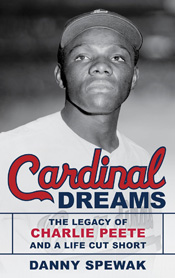
On Nov. 27, 1956, four months after he made his major-league debut with the Cardinals, Peete, 27, was killed in an airplane crash in Venezuela. His wife and three children died with him.

Author Danny Spewak has written a biography of Peete. It’s a compelling page turner. If you appreciate good writing, original research and a gripping yarn, this book is for you. It’s “Cardinal Dreams: The Legacy of Charlie Peete and a Life Cut Short.” Order a copy on Amazon by clicking on this link.

Here is an email interview I did with Danny Spewak in February 2024:

Q: Congratulations on the book, Danny. As Jack Buck used to say, it’s a winner. What prompted you to choose Charlie Peete as the subject?

A: “Thank you so much, Mark. I’m a St. Louis native, lifelong Cardinals fan and avid reader of your site. Charlie Peete’s name first came on my radar after the tragic death of Oscar Taveras in 2014. The circumstances surrounding the loss of Taveras, a promising young Cardinals outfielder, shared many similarities with Peete’s passing in a 1956 commercial plane crash. More recently, when I began researching topics for my second nonfiction book, I revisited Peete’s story and discovered an incredible legacy worth sharing. Peete is not widely known to Cardinals fans, but he’s one of the franchise’s greatest ‘what-if?’ stories, the kind of player who could have developed into a real star if not for his premature death. More importantly, Peete played a key role in the integration of the Cardinals in the 1950s and, as the book argues, laid the foundation for the groundbreaking World Series teams of the next decade.”

Q: What qualities made Charlie Peete a top prospect?

A: “The Cardinals viewed Peete as a classic five-tool prospect and were thrilled by his performance in the minor leagues after drafting him in late 1954. Bing Devine, who eventually became the Cardinals general manager, singled out Peete as an example of how an organization could build a winning franchise through the draft process. At Class AAA stops in Rochester and Omaha, Peete displayed an impressive ability to hit for both power and average, and his outfield range and throwing arm were among the best in the organization.”

Q: Charlie Peete’s manager at Omaha in 1955 and 1956 was Johnny Keane. Keane later was an influential mentor for Bob Gibson. Was Keane a similar mentor to Peete?

A. “Absolutely. In a questionnaire he completed in 1956, Peete specifically listed Johnny Keane as one of his top influences in baseball and he flourished tremendously under Keane’s tutelage in 1955-56. Keane, who once compared Peete to Hack Wilson, worked closely with him on his batting stance and helped him to greatly improve his power numbers.”

Q: Tom Alston, the first black to play for the Cardinals, was a teammate of Charlie Peete at Omaha. Any insights on how they got along?

A: “Peete and Alston seemed to have a strong relationship with each other, and as two of the trailblazing players in the Cardinals minor-league system, their careers were wholly intertwined in the mid-1950s. At Omaha, they were the first two black players to break the professional baseball color barrier in that city, which at the time still had many segregated institutions such as the municipal fire department. Although they never did play together in St. Louis, Peete and Alston both helped to change public perceptions at a time when the American civil rights movement was quickly accelerating.”

Q: Jackie Robinson’s last season in the majors was Charlie Peete’s first and only season in the majors. The Cardinals played the Dodgers in St. Louis soon after Peete got called up in July 1956 and again a month later. Any indication of interaction between Robinson and Peete?

A: “Peete and Robinson appeared briefly on the same field at Busch Stadium on July 22, 1956, when an aging Robinson pinch-hit for the Dodgers while Peete played center field as a defensive replacement in the top of the ninth. It was a remarkable moment for Peete, who in 1949 had tried out unsuccessfully for the Dodgers organization in his home state of Virginia and undoubtedly drew inspiration from Robinson’s entrance into the majors in 1947. Although it is not known whether Peete met Robinson on that day in 1956, he certainly drew Robinson’s attention by recording two outfield assists, including a double play he completed with Stan Musial at first base.”

Q: The Cardinals were late to integrate. Do you think Charlie Peete was comfortable being with the franchise? How was he treated?

A: “It’s difficult to say. Publicly, Peete said he valued his time with the big-league club in St. Louis, and the organization had nothing but praise for him as a player. His teammates also recalled very fond memories of him. However, the experience for Peete must have been extremely isolating, given that he was one of only a handful of black players in the organization at the time and the only black player on the major-league squad during that portion of the 1956 season. That was a hard time for any black player anywhere in baseball. When Peete played in Omaha, he could not even bring his family to live with him because the housing market was so deeply segregated. Also, as you mentioned, the Cardinals had resisted integration in the late 1940s and early 1950s and drew significant criticism from civil rights leaders in St. Louis because of that decision. That all changed when Anheuser-Busch and Gussie Busch took ownership of the franchise in 1953 and immediately took steps to integrate the organization. Despite Busch’s more tolerant and forward-thinking stance, it still took some time for the Cardinals to shake their negative perception _ which certainly impacted Peete. For example, after Peete’s demotion from St. Louis in August 1956, one of the city’s leading African American newspapers, the Argus, questioned why he had been sent back to the minors so quickly and felt the Cardinals were still applying unfair and unrealistic standards to black players.”

Q. What kind of teammate was Stan Musial to Charlie Peete?

A. “Peete adored Musial. When asked, ‘Who is the greatest player you have ever seen?’ Peete listed Musial because he ‘was a real ballplayer all around.’ “

Q. In 1957, following Charlie Peete’s death, the Cardinals shifted third baseman Ken Boyer to center field. Do you think if he had lived that Peete would have been the center fielder for the 1957 Cardinals?

A. “Although there are no guarantees, I do believe Peete would have started in center field for the Cardinals in 1957. In the months after his death, the Cardinals struggled to find another candidate for the job and ended up making the emergency decision to shift Boyer to center _ something I don’t think they would have needed to do if they still had Peete. I think Peete had clearly shown during his 23-game trial in 1956 that he could play defense at an elite major-league level, given his perfect fielding percentage and several dazzling plays in the outfield. Peete’s .192 batting average with the Cardinals in 1956 was not good, but as the reigning Class AAA batting champion there wasn’t much doubt in the organization that he would hit eventually.”

Q. Do the Cardinals still trade for Curt Flood in December 1957 if Charlie Peete was on the team?

A. “This is a fascinating question. Bing Devine’s first trade as general manager was the one that brought Flood over from Cincinnati at the winter meetings that year. I can see a scenario where Devine, satisfied with Peete as his center fielder, opts not to trade for Flood. In that scenario, does Peete become the center fielder for the World Series teams of the sixties? Does Flood, having never been traded to St. Louis in the first place, ever challenge the reserve clause and take his case to the Supreme Court? The whole history of major-league labor relations might have been impacted. However, I still think it’s possible Devine might have traded for Flood anyway in December 1957, even if he had Peete on the roster. Flood had played infield during his brief time in the majors with Cincinnati and Devine seemed to like his overall skillset as a position player, not solely as a center fielder. (It was manager Fred Hutchinson who came up with the idea of putting Flood in the outfield.) It’s possible Peete and Flood could have co-existed together for the next decade.”

Q. Anything else you’d like to tell our readers about the book and why they should buy it?

A. “Despite the tragic ending, I hope readers will walk away from the book with a better appreciation for Charlie Peete’s remarkable life and accomplishments. This was someone who grew up in segregated Virginia and began his professional career in the Negro Leagues, at a time when opportunities for black baseball players were still extremely limited. Over the course of the 1950s, Peete played an important role in the integration of both the minor leagues and the major leagues, and he bridged a gap in Cardinals history that laid the groundwork for some truly historic teams of the 1960s. Charlie Peete is a name that Cardinals fans should know and remember.”

Read Full Post »

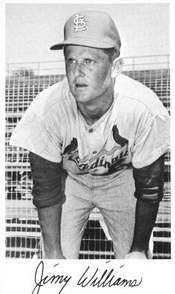
An introduction to the big leagues with the 1966 Cardinals was about as challenging as it gets for Jimy Williams.

A middle infielder whose professional baseball experience consisted of one season at the Class A level of the minors, Williams got his first at-bat in the majors against none other than Sandy Koufax. His second plate appearance also came against a future Hall of Famer, Juan Marichal.
As if that wasn’t enough of a test, the rookie leaped into a frog-jumping contest involving Cardinals and Giants players.

Though his stint with the Cardinals was short, Williams went on to become a manager in the majors with the Blue Jays, Red Sox and Astros. He also managed the Cardinals’ top farm team.

Name of the game

James Francis Williams, known as Jimmy, was the son of farmers who raised cattle and garbanzo beans on 800 acres in Arroyo Grande, Calif. (Asked where Arroyo Grande is located, Williams told the Boston Globe, “It’s about three miles past ‘Resume Speed.’ “)

In high school, Williams changed the spelling of Jimmy, dropping one “m” as a prank. “I spelled it that way on a term paper or a test, and the teacher didn’t say anything about it, so I kept it,” he told the San Luis Obispo Tribune.

Williams played college baseball at Fresno State, earned a degree in agribusiness and was signed in June 1965 by Red Sox scouts Bobby Doerr and Glenn Wright. With Class A Waterloo (Iowa) that summer, Williams led the Midwest League’s shortstops in fielding percentage and hit .287.

When the Red Sox didn’t protect Williams on their winter roster, the Cardinals drafted him in November 1965 on the recommendation of scout Joe Mathes.

After Cardinals manager Red Schoendienst got his first look at Williams during 1966 spring training, he said to the St. Louis Post-Dispatch, “I can see why Joe was so hot about the kid. He sure looks like a comer.”

According to the Post-Dispatch, Williams at shortstop displayed “agility as he moved with speed to field balls hit to either side.”

Schoendienst, whose career as a second baseman got him elected to the Baseball Hall of Fame, mentored Williams on how to play that position and was pleased by the rookie’s progress in making the double play, the Post-Dispatch reported.

By being able to play both shortstop and second base, Williams enhanced his value as a utility player and earned a spot on the 1966 Cardinals’ Opening Day roster, joining Jerry Buchek, Phil Gagliano, Julian Javier and Dal Maxvill as the middle infielders.

On their way from St. Petersburg to St. Louis to begin the season, the Cardinals stopped in Kansas City to play exhibition games against the Athletics. In one, Williams entered as a replacement for Javier at second base and produced two hits and three RBI in the Cardinals’ 7-6 triumph.

Candlestick croakers

When the 1966 season opened, Williams sat for two weeks. His debut came on April 26 at Dodger Stadium when he replaced Maxvill at shortstop in the sixth inning. The first batter, Nate Oliver, hit a ground ball to Williams. The next, John Kennedy, hit a pop fly to him. Williams handled both chances flawlessly.

In the eighth, Williams got his first at-bat, facing Koufax. Asked what he was thinking as he came to the plate, Williams replied to the San Luis Obispo Tribune, “That I was going to get a hit. That’s the only reason to get into the batter’s box.”

Koufax struck him out. “I punched out two foul balls and got a hook (curveball) and it was, ‘Sit down, Jimy Williams,’ ” the rookie said to the San Luis Obispo newspaper. Boxscore

Two weeks later, at St. Louis, Williams got his second plate appearance. Facing Marichal, he grounded out, but two innings later, he singled to center versus Marichal, driving in Tim McCarver from third. Boxscore

In the time between his at-bats versus Koufax and Marichal, Williams and the Cardinals were in San Francisco for a series. A frog-jumping contest was planned at Candlestick Park before the Sunday finale. Ten players _ five Cardinals (Nelson Briles, Curt Flood, Mike Shannon, Bob Skinner and Williams) and five Giants (Bob Barton, Len Gabrielson, Bill Henry, Ron Herbel and Bob Priddy) _ were the participants. The player who coaxed his frog to make the longest jump would win $50 and the frog would be entered in the Calaveras Frog Jumping Contest made famous in the Mark Twain short story.

“I can sure use the $50 prize,” Williams told the Post-Dispatch. According to the newspaper, Williams practiced at a pond the day before the contest. (In a line Twain might have appreciated, Williams said to the Boston Globe, “If a frog had wings, he wouldn’t bump his booty.”)

The winner, however, was Gabrielson, whose frog (named Bat Legs) jumped 11 feet, eight inches. Priddy placed second (10 feet even) and Williams was third (nine feet, one inch).

In the game that followed, Gabrielson hit a home run against Bob Gibson, and the Giants won. “What a day,” Gabrielson exclaimed to the Oakland Tribune. Boxscore

Big break

Williams, 22, rarely played for the 1966 Cardinals. He had three hits in 11 at-bats before his season was cut short by a six-month stint in the Army reserve.

The Cardinals sent Williams to the minors in 1967. He returned to them in September, played in one game and was traded after the season with Pat Corrales to the Reds for Johnny Edwards.

Williams never again played in the big leagues. He was in the farm systems of the Reds, Expos and Mets before a bum shoulder ended his career in 1971. Williams hurt the shoulder in 1969 while working an off-season job at a Ford plant in St. Louis. “An employee who was playing around threw a Styrofoam cup at me,” Williams recalled to the San Luis Obispo Tribune. “When I threw it back at him, I felt something pop in my shoulder.”

After his playing career, Williams returned to St. Louis and operated a convenience store for two years, according to the San Luis Obispo newspaper.

A former Fresno State teammate, Tom Sommers, brought Williams back into baseball. Sommers was director of minor league operations for the Angels and needed a manager in 1974 for the Class A Quad Cities team in Davenport, Iowa. He gave the job to Williams, 30. “I was the happiest man in the world when Sommers called,” Williams said to the El Paso Times.

Williams rose through the Angels’ system and managed their top farm team, the Salt Lake City Gulls, in 1976 and 1977.

“I like to get young players to do things they don’t think they can,” Williams told the Deseret News. “That way, they boost their confidence and increase their potential. Our players will have freedom on the field to expand their talents.”

Back and forth

In October 1977, Tom Sommers was fired by Angels general manager Harry Dalton. Many of Sommers’ hires, including Williams, got fired, too.

Williams landed back in the Cardinals’ organization as manager of their Class AAA Springfield (Ill.) club in 1978. He accepted the job after Florida State University baseball coach Woody Woodward turned it down, according to Larry Harnly in The Sporting News.

Springfield had players such as Terry Kennedy, Dane Iorg, Tommy Herr, Ken Oberkfell, Silvio Martinez and Aurelio Lopez. The club finished 70-66.

According to the Salt Lake Tribune, Williams and A. Ray Smith, owner of the Springfield franchise, had “a personality conflict” and Williams was looking to manage somewhere else in 1979.

Art Teece, owner of the Salt Lake City franchise, pushed for the Angels to rehire Williams, and they agreed. “Bringing Jimy back to Salt Lake was the key in my resuming a working agreement with the Angels,” Teece told The Sporting News.

Williams said to the Salt Lake Tribune, “I enjoyed being with the Cardinals. They have a good organization and good people, but I really had a nice time in Salt Lake and I’m anxious to return.”

Major moves

Salt Lake City was nice but it wasn’t the majors. When Williams was offered a chance to be third-base coach on the staff of Blue Jays manager Bobby Mattick in 1980, he took it. After Bobby Cox replaced Mattick in 1982, he retained Williams.

After leading the Blue Jays to their first division title in 1985, Cox became general manager of the Braves and Williams replaced him. “Cox did a great job with the players, but I think Jimy’s style might be a little more imaginative,” Blue Jays general manager Pat Gillick told The Sporting News.

(When Gillick fired him in 1989, he told the Toronto Star that Williams was “too nice a guy and too honest.”)

In 12 seasons as a big-league manager with the Blue Jays (1986-89), Red Sox (1997-2001) and Astros (2002-04), Williams had a 909-790 record, but never had a pennant winner.

(When the Red Sox fired Williams in 2001, Cardinals manager Tony La Russa said he was “shocked,” the Post-Dispatch reported. “I think he’s a hell of a baseball man,” La Russa said. “He’s as qualified as anybody around and he got results. You kind of scratch your head.”)

As a coach with the Braves (1990-96) and Phillies (2007-08), Williams was part of five National League pennant winners and two World Series championship teams.

Read Full Post »

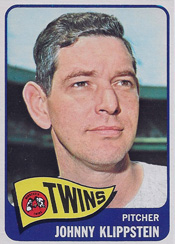
Johnny Klippstein was 16 when he pitched his first season of professional baseball in the Cardinals’ system. When he got to the big leagues at 22, it was with the Cubs, not the Cardinals.

A right-hander who converted from starter to reliever, Klippstein spent 18 years in the majors and pitched in two World Series _ one for the Dodgers and the other against them.

The Cardinals tried to reacquire him, along with a rangy first baseman who would become the star of a hit television series, but it didn’t work out.

Young and restless

Born at Walter Reed Army Medical Center in Washington, D.C., Klippstein was raised in suburban Silver Spring, Md. His father, who immigrated to America from Germany as a boy in 1894, served 30 years in the U.S. Army and retired as a master sergeant, according to the Brooklyn Daily Eagle.

A lanky kid with a strong arm, Johnny Klippstein learned to pitch in his one season playing American Legion baseball. In the summer of 1943, when he was 15, Klippstein and his mother took a bus to visit relatives in Appleton, Wis. By coincidence, the Cardinals were holding a tryout camp there and Klippstein went.

In the book “We Played the Game,” he recalled, “I arrived with a softball glove and softball hat and looked like a dope.”

Nonetheless, he impressed the Cardinals, who told him he would hear from them the following spring after he turned 16. With many young men in military service during World War II, ballclubs were reaching into the prep ranks to fill the talent pipeline. When Klippstein completed his junior year of high school, the Cardinals signed him and he was sent to their farm club in Allentown, Pa., in June 1944.

“All the guys were between 18 and 21 and I felt they were old enough to be my father,” Klippstein said to author Danny Peary. “The first time I went to the mound, I was so scared that my knees shook.”

Playing for manager Ollie Vanek (who a few years earlier gave a tryout to an amateur left-hander named Stan Musial and recommended him to the Cardinals), Klippstein pitched in six games for Allentown before spending the rest of the summer at a farm club in Lima, Ohio.

Afterward, Klippstein went back home to attend his senior year of high school. When he graduated in June 1945, Klippstein was so eager to return for a second season in the Cardinals’ system, “I didn’t even wait for my diploma. I told them to mail it to me,” he recalled to the Philadelphia Daily News.

Johnny on the spot

Klippstein, 17, was with Winston-Salem, N.C., for most of the summer of 1945. He posted an 8-7 record and led the team in ERA (2.48) but he also threw 19 wild pitches and hit batters with pitches eight times.

“He was rated (by the Cardinals) as a real prospect from the start, but he was young, didn’t even have his full growth,” the Winston-Salem Sentinel noted. “He was temperamental. He had a lot of stuff on the ball, but he was wilder than the usual rookie.”

Klippstein spent all of 1946 in the Army, returned to baseball the next year and pitched in the minors through 1948. After four years in the Cardinals’ system, Klippstein’s progress seemed to have stalled. As the Winston-Salem Sentinel noted, “The Cardinals did not want to let him go because they knew he had the stuff. They didn’t want to send him up because he was so wild.”

In the “We Played the Game” book, Klippstein said, “I was getting discouraged because I felt I was failing … The Cardinals didn’t have me in their plans.”

In November 1948, the Dodgers selected Klippstein in the minor-league draft. Sent to their farm club at Mobile, Ala., in 1949, he won 15 and had a 2.95 ERA.

The Cardinals wanted to get Klippstein back. In October 1949, Cardinals owner Fred Saigh met with Dodgers general manager Branch Rickey in Brooklyn and talked trade. The Cardinals offered pitcher Red Munger, a 15-game winner in 1949, for outfielder Gene Hermanski, first baseman Chuck Connors and Klippstein, the Associated Press reported.

(Connors, 28, made his big-league debut with the 1949 Dodgers, hitting into a double play in his lone at-bat. He later did better as an actor, playing the lead role of Lucas McCain in the TV Western series “The Rifleman.”)

Regarding the proposed trade, Rickey told the Associated Press, “Our greatest need is one more pitcher. I am willing to trade one of my outfielders for a good front-line pitcher. There is a chance to make that deal.”

Ultimately, the Dodgers decided to fill their need from within (Carl Erskine moved into the rotation in 1950) and the trade wasn’t made.

The Dodgers projected Klippstein for a spot with their Montreal affiliate, but the pitching-poor Chicago Cubs, who gave up the most runs in the National League in 1949, claimed him in the November Rule 5 draft.

In the big leagues

At spring training in 1950, Cubs manager Frankie Frisch said Klippstein would be part of the club’s pitching staff on Opening Day. “All he needs is confidence,” Frisch told the Brooklyn Daily Eagle. “He seems to have everything else.”

Klippstein had mixed results with the 1950 Cubs. He was bad as a starter (1-8, 7.99 ERA) and good as a reliever (2.98 ERA in 22 appearances) and as a hitter (.333 in 33 at-bats).

After the season, the Cubs acquired Chuck Connors from the Dodgers. He and Klippstein were teammates with the 1951 Cubs.

Klippstein did not have a winning record in any of his five seasons with the Cubs. He was sent to the Reds in October 1954 and had his most success as a starter with them.

On Sept. 11, 1955, Klippstein pitched a one-hit shutout against the Dodgers, who were on their way to becoming World Series champions that year. As Dick Young noted in the New York Daily News, “This was no humpty dumpty lineup. It had all the big sticks available.” Included were five future Hall of Famers: Roy Campanella, Gil Hodges, Pee Wee Reese, Jackie Robinson and Duke Snider.

The Dodgers’ hit came with one out in the ninth when Reese blooped a single to right-center. According to Dick Young, when the inning ended, Reese crossed paths with Klippstein, patted him on the rump and said, “Tough luck, John. It’s just one of those things.”

Klippstein just smiled at him. Boxscore

On the move

In 1956, his seventh year in the majors, Klippstein had his first winning season, finishing 12-11 for the Reds. On May 26, he held the Braves hitless for seven innings before manager Birdie Tebbetts lifted him for a pinch-hitter, with the Reds trailing, 1-0. (The Braves scored on a Frank Torre sacrifice fly after Klippstein loaded the bases by hitting Hank Aaron with a pitch and walking two.) Boxscore

“I don’t blame Birdie for taking me out,” Klippstein told the Chicago Tribune. “We were a run behind, had a man in scoring position, and only one more turn at bat.”

After a good spring training with the Reds in 1957, Klippstein was their Opening Day starter against the Cardinals. He got shelled, giving up five doubles (including two to Stan Musial). Boxscore

He ended the season much better than he started it. On Sept. 28, 1957, Klippstein pitched a one-hit shutout against the Braves, who were headed to a World Series title. The Braves’ hit was a Bob Hazle single with two outs in the eighth. Boxscore

Traded by the Reds to the Dodgers for Don Newcombe in June 1958, Klippstein was used mostly in relief the rest of his career.

In Game 1 of the 1959 World Series versus the White Sox, he pitched two scoreless innings for the Dodgers. Boxscore The Cleveland Indians obtained him in 1960 and he had an American League-leading 14 saves for them.

He went on to pitch for the Senators (1961), Reds (1962), Phillies (1963-64), Twins (1964-66) and Tigers (1967).

On Aug. 6, 1962, at Houston, Klippstein pitched three scoreless innings and walloped a Don McMahon slider for a home run, breaking a 0-0 tie with two outs in the 13th. Boxscore  (Klippstein hit five home runs in the majors, but was hitless in 37 career at-bats against the Cardinals.)

He had a 1.93 ERA for the 1963 Phillies and was 9-3 with five saves and a 2.24 ERA for the 1965 Twins, who became American League champions. Klippstein pitched in Games 3 and 7 of the 1965 World Series against the Dodgers and didn’t allow a run. Boxscore and Boxscore and Video

For his big-league career, Klippstein was 101-118 with 65 saves.

After his playing days, he was a Cubs season ticket holder. In October 2003, Klippstein was listening at his bedside to a Cubs game (a 5-4 win over the Marlins) when he died. His son John told the Chicago Tribune, “He passed away just after the Cubs scored that fifth run” in the 11th.

Read Full Post »

Roric Harrison was an intriguing talent with a distinctive name. A right-hander, he possessed power on the mound and at the plate.

After seeing Harrison pitch at spring training in 1973, Phillies ace Steve Carlton told the Philadelphia Daily News, “Just a super, fantastic arm. He could win 20 with that arm just throwing strikes with his fastball.”

Harrison had some special performances, but inconsistent command of his pitches, as well as injuries, hampered him. A pitcher for the Orioles (1972), Braves (1973-75), Indians (1975) and Twins (1978), he had a career mark of 30-35 with 10 saves. He also produced 15 hits _ six were home runs.

During his five seasons in the majors, Harrison earned two wins versus the Cardinals. Both were complete games. He hit a home run in each, including one against Bob Gibson.

Later, Harrison went to spring training with the Cardinals but failed in an attempt to make the club as a reliever.

Top of the morning

Roric Harrison was from Los Angeles but his family roots were in Ireland, which is how he got his name. He told the St. Louis Post-Dispatch in 1973, “I’m Irish and the first rebel king of Ireland was named Roric. My father liked it.”

(The rebel king in the 1500s was Brian O’Rourke, or O’Ruairc in Irish Gaelic. Handsome, proud, defiant, he got into territorial disputes with the English, who arrested and executed him for his rebelliousness.)

Harrison was a Dodgers fan as a youth. He turned 13 a couple of weeks before they clinched the 1959 World Series title against the White Sox at Chicago. At the Los Angeles airport, Harrison hung on a fence to glimpse the players arriving home. “I had tears in my eyes seeing my heroes get off the plane _ Maury Wills, Don Drysdale, Gil Hodges,” he recalled to the Rochester Democrat and Chronicle.

Five years later, when he turned 18, Harrison signed with the Astros. Pitching in their farm system, he threw hard, not accurately. Harrison struck out the first seven batters he faced as a pro, then walked the next five, according to the Akron Beacon Journal. He told the Rochester newspaper, “My fastball was hard to control at times. I was overthrowing.”

In 1969, still in the minors, Harrison tore up his left knee while fielding a bunt and had surgery. (He’d need operations on the knee again in 1971 and 1974.) An American League expansion team, the Seattle Pilots, took a chance on him while he mended. On Aug. 24, 1969, they traded pitcher (and “Ball Four” author) Jim Bouton to the Astros for Harrison and Dooley Womack.

The Pilots moved from Seattle to Milwaukee in 1970 and were renamed the Brewers, but Harrison was not in their immediate plans. He got assigned to the minors for a sixth straight year.

Change of plans

Finally, at spring training with the Brewers in 1971, Harrison had a breakthrough. He pitched well and made the Opening Day roster. Then, the day before the season opener, with the Brewers in need of a left-hander, he got traded to the Orioles for Marcelino Lopez.

“It was the kind of deal you sometimes hate to make because a fine young arm can come back to haunt you,” Brewers general manager Frank Lane told The Sporting News. “Harrison showed a lot of stuff this spring.”

The 1971 Orioles (who would win the American League pennant) were loaded with pitchers, so Harrison was sent again to the minors. He joined a Rochester Red Wings team featuring prospects such as Don Baylor, Bobby Grich and Ron Shelton, who later became director and screenwriter of the 1988 film “Bull Durham.”

Harrison found his groove with Rochester. In June 1971, he pitched a two-hit shutout and slugged a grand slam versus the Toledo Mud Hens. A month later, against Toledo again, he struck out 18, pitched a three-hitter and drove in a run with a triple. Harrison told the Rochester newspaper, “My fastball was really doing its thing. Jumping. Tailing off.”

On Aug. 12, 1971, Harrison pitched a one-hitter against Syracuse. Three days later, he was in the dugout when a foul ball struck him on the right side of the head, damaging an ear drum. “Thank God he turned his head,” Dr. Armand Cincotta told the Rochester Democrat and Chronicle. “If he hadn’t turned his head, the ball would have hit him flush in the face.”

Harrison was treated at a hospital, but two days after the accident he started the first game of a doubleheader versus Syracuse. Despite a ringing sound in his right ear, he pitched a seven-inning one-hitter. “It was a strange feeling,” he told the Rochester newspaper, “because I couldn’t hear the ball hit the catcher’s mitt.”

Harrison finished with a 15-5 record, including five shutouts, and a 2.81 ERA for Rochester in 1971. He struck out 182 in 170 innings. He also hit .273 with four home runs.

At spring training in 1972, Harrison impressed Orioles manager Earl Weaver, who told the Baltimore Evening Sun, “Harrison exceeds my expectations. He throws as hard as anyone we’ve got in this camp except maybe one guy (Jim Palmer).”

With a starting staff of Palmer, Mike Cuellar, Pat Dobson and Dave McNally, Harrison primarily was a reliever with the 1972 Orioles, but, at last, he was in the big leagues for the first time. The rookie led the club in appearances (39) and was second (to Palmer) in ERA (2.30).

When the Orioles made a pitch for Braves slugger Earl Williams after the season, they had to include Harrison (along with Davey Johnson, Pat Dobson and Johnny Oates) to complete the trade. Video

Clashes with Cardinals

After beginning the 1973 season in the bullpen, Harrison became part of the starting rotation for the Braves. His first win for them was on June 10, a 5-2 victory against the Cardinals. His home run against Tom Murphy broke a scoreless tie in the third. Harrison held the Cardinals to one hit (a Ken Reitz triple in the sixth) in eight innings before Danny Frisella relieved in the ninth.

Regarding Harrison, Cardinals manager Red Schoendienst told the Post-Dispatch, “He’s the best pitcher they got.” Boxscore

Two months later, the Cardinals torched Harrison in a seven-run third inning capped by pitcher Rick Wise’s grand slam, but the Braves (with four RBI from Dusty Baker, three from Hank Aaron and three scoreless innings of relief from Phil Niekro) rallied and won, 11-7. Boxscore

Harrison made 38 appearances, including 22 starts, for the 1973 Braves and finished 11-8 with five saves.

Placed in a Braves starting rotation with Phil Niekro, Ron Reed and Carl Morton, Harrison struggled in 1974. He had ERAs of 5.20 in April and 4.41 in May.

A highlight came on June 14, 1974. Matched against Bob Gibson, Harrison hit a two-run homer and limited the Cardinals to one unearned run for the win. Braves manager Eddie Mathews told the Atlanta Journal, “It might have been the best I’ve seen him look since he got here last year.” Boxscore

A month later, Gibson and Harrison were matched again. Gibson needed three strikeouts to become the first National League pitcher with 3,000. He got two. Harrison gave up a three-run home run to Ted Simmons and departed after six innings, but it was Gibson who took the loss. Boxscore

Out of luck

In June 1975, Harrison was traded to the Indians for Blue Moon Odom and Rob Belloir. Ten months later, in April 1976, the Indians sent him to the Cardinals for Harry Parker.

When Harrison, 29, learned the Cardinals would assign him to the minors, he thought about not reporting, but reconsidered after a talk with general manager Bing Devine. “He assured me that I was obtained with the big-league club in mind,” Harrison said to the Tulsa World.

Harrison’s 1976 season got curtailed in June when he had surgery to remove bone chips from his right elbow. “The surgery made me a sort of bionic man,” he told The Sporting News. “It seemed they put in a new arm.”

The Cardinals put him on their big-league winter roster and he went to spring training with them in 1977 as a candidate for a relief role.

The luck of the Irish was with Harrison on St. Patrick’s Day when he pitched three scoreless innings for the win in a spring training exhibition against the White Sox. “My arms feels as good as it did when I was a rookie with the Orioles,” he told The Sporting News.

His other performances, though, were inconsistent. In four Grapefruit League appearances, his ERA was 4.64.

First-year Cardinals manager Vern Rapp opted to keep nine pitchers on the Opening Day roster _ four starters (Bob Forsch, John Denny, Pete Falcone, Eric Rasmussen), a swingman (John D’Acquisto) and four relievers (Al Hrabosky, Clay Carrol and rookies John Urrea and John Sutton).

Released by the Cardinals, Harrison pitched in the farm systems of the Tigers (1977) and Twins (1978). The Twins called him up in June 1978 and he ended his big-league career with them, making nine relief appearances.

Read Full Post »

Danny Cox began the 1983 baseball season in the low level of the minors and ended it as a member of the starting rotation of the reigning World Series champion Cardinals.

Matched against Steve Carlton and facing a lineup with Pete Rose, Joe Morgan and Mike Schmidt, Cox pitched 10 scoreless innings versus the Phillies in his big-league debut on Aug. 6, 1983.

The stellar performance didn’t get Cox a win, though. That came a couple of weeks later when he opposed another future Hall of Fame pitcher, Nolan Ryan.

Fun in Florida

A right-hander attending Troy University, Cox, 21, was chosen by the Cardinals in the 13th round of the 1981 amateur draft, a couple of picks after the Mets took a high school outfielder, Lenny Dykstra, in the same round.

Cox pitched for a rookie team and a Class A club his first two seasons in the Cardinals’ farm system. Then in 1983, he was assigned to rookie manager Jim Riggleman’s Class A team, the St. Petersburg Cardinals. Even at that level, Cox was matched against an exceptional pitching opponent.

After losing his first two decisions in 1983, Cox, 23, started on May 12 at home against the Fort Myers Royals. Their starter, Bret Saberhagen, 19, was in his first season of professional ball. (Two years later, Saberhagen received the first of his two American League Cy Young awards with the Kansas City Royals.)

Pitching before 882 spectators at Al Lang Stadium in St. Petersburg, Cox threw a four-hitter in a 2-1 victory. Saberhagen went six innings and allowed both runs.

Facing a Fort Myers lineup that included future big-leaguers Mike Kingery and Bill Pecota, Cox retired the last 11 batters in a row. “He dominated,” St. Petersburg catcher Barry Sayler told the St. Petersburg Times. “He was working the inside of the plate, mixed his fastball and slider, and threw hard.”

Cox credited the advice he received from St. Petersburg teammate and closer Mark Riggins (who went on to become pitching coach of the St. Louis Cardinals, Chicago Cubs and Cincinnati Reds). “I started off throwing my fastball inside, and then Mark Riggins told me to take a little off my slider and mess up their timing,” Cox said to the St. Petersburg Times. “I was wanting to win real bad.”

Five days later, in a rematch at Fort Myers, Cox, with relief help from Riggins, again beat Saberhagen in a 7-2 St. Petersburg triumph.

On the rise

After five starts for St. Petersburg (2-2, 2.53 ERA), Cox was promoted to Class AA Arkansas. Playing for manager Nick Leyva, Cox was 8-3 with a 2.29 ERA in 11 starts. In July, he got promoted again, to manager Jim Fregosi’s Class AAA Louisville club. Cox made two starts for Louisville and pitched well (2.45 ERA).

Then came a special audition. The St. Louis Cardinals chose him to start against the Baltimore Orioles in the Baseball Hall of Fame exhibition game at Cooperstown, N.Y., on Aug. 1.

The Orioles, on their way to an American League pennant and World Series championship in 1983, were limited to three hits and no runs in the six innings Cox worked against them. “He was very impressive,” Cardinals manager Whitey Herzog said to the St. Louis Post-Dispatch.

Herzog wanted to see more. The Cardinals put Cox on their roster. His next start came in a big-league game against the Phillies.

Tough task

Cox’s debut assignment was daunting. The opposing starter, Steve Carlton, had dominated the Cardinals since being traded by them to the Phillies in 1972.

The matchup was intriguing for other reasons as well:

Chase Riddle, head coach of Troy’s baseball team when Cox pitched there, was the Cardinals scout who signed Carlton two decades earlier.

_ Like Cox, Carlton also impressed the Cardinals by pitching well in a Hall of Fame exhibition game. On July 25, 1966, Carlton, 21, was at Class AAA Tulsa when the Cardinals chose him to start against the Minnesota Twins in the Cooperstown exhibition. Carlton pitched a complete game, striking out nine, and was the winning pitcher. He never went back to the minors.

Carlton and Cox engaged in a mighty duel. The ace was in top form, pitching nine scoreless innings. The newcomer matched him, then surpassed him, pitching a scoreless 10th after Carlton was relieved by Al Holland.

Cox “didn’t look like a rookie to me,” Joe Morgan told the Associated Press. “I was really impressed by the way he located his pitches and hit the corners.”

Phillies manager Paul Owens said to the Philadelphia Inquirer, “He moved the ball around and threw strikes. That kid was excellent.”

Bruce Sutter, who hadn’t pitched in a week because of the funeral of his father, took over for Cox in the 11th and gave up a run. The 1-0 victory moved the Phillies ahead of the Pirates and into first place in the National League East.

“That was a World Series type of game,” Owens told the Inquirer. “Nobody even left the park.”

Morgan said, “These are the games that win pennants.”

Indeed, the Phillies went on to become National League champions in 1983. Boxscore

Sweet win

In his next start, Cox gave up a grand slam to ex-Cardinal Leon Durham and was beaten by the Cubs. Boxscore

His first win came in his fourth start on Aug, 21. Matched against Nolan Ryan and the Astros, Cox prevailed in a 5-2 Cardinals victory. Cox pitched 7.2 innings and allowed two runs. Ryan surrendered five runs in six innings. Cox also got his first big-league hit in that game, a single against Ryan in a two-run sixth. Boxscore

Cox made 12 starts for the 1983 Cardinals and was 3-6 with a 3.25 ERA. He pitched a total of 218 innings _ 129.1 in the minors, 83 with the Cardinals and another six in the Hall of Fame exhibition game.

Money ball

Two years later, Cox had his best year in the majors. He was 18-9 for the Cardinals during the 1985 regular season, flirted with a perfect game bid against the Reds, and won Game 3 of the National League Championship Series versus the Dodgers.

The 1985 World Series matched Cox and the Cardinals against Bret Saberhagen and the Royals. In starts against Joaquin Andujar and John Tudor, Saberhagen beat the Cardinals twice, including Game 7, and was named most valuable player of the World Series. Cox was just as good but not as fortunate. He started Games 2 and 6, allowed just two runs in 14 total innings, but didn’t get a decision in either game.

Cox helped the Cardinals win another pennant in 1987. He shut out the Giants in Game 7 of the National League Championship Series. Video

In the World Series versus the Twins, Cox won Game 5, beating Bert Blyleven, but was the losing pitcher in relief of Joe Magrane in Game 7.

In six seasons with St. Louis, Cox was 56-56. As a reliever with the 1993 Blue Jays, he got to be part of a World Series championship club.

Read Full Post »

« Newer Posts - Older Posts »