Feeds:
Posts
Comments

Archive for the ‘Prospects’ Category

Danny Cox began the 1983 baseball season in the low level of the minors and ended it as a member of the starting rotation of the reigning World Series champion Cardinals.

Matched against Steve Carlton and facing a lineup with Pete Rose, Joe Morgan and Mike Schmidt, Cox pitched 10 scoreless innings versus the Phillies in his big-league debut on Aug. 6, 1983.

The stellar performance didn’t get Cox a win, though. That came a couple of weeks later when he opposed another future Hall of Fame pitcher, Nolan Ryan.

Fun in Florida

A right-hander attending Troy University, Cox, 21, was chosen by the Cardinals in the 13th round of the 1981 amateur draft, a couple of picks after the Mets took a high school outfielder, Lenny Dykstra, in the same round.

Cox pitched for a rookie team and a Class A club his first two seasons in the Cardinals’ farm system. Then in 1983, he was assigned to rookie manager Jim Riggleman’s Class A team, the St. Petersburg Cardinals. Even at that level, Cox was matched against an exceptional pitching opponent.

After losing his first two decisions in 1983, Cox, 23, started on May 12 at home against the Fort Myers Royals. Their starter, Bret Saberhagen, 19, was in his first season of professional ball. (Two years later, Saberhagen received the first of his two American League Cy Young awards with the Kansas City Royals.)

Pitching before 882 spectators at Al Lang Stadium in St. Petersburg, Cox threw a four-hitter in a 2-1 victory. Saberhagen went six innings and allowed both runs.

Facing a Fort Myers lineup that included future big-leaguers Mike Kingery and Bill Pecota, Cox retired the last 11 batters in a row. “He dominated,” St. Petersburg catcher Barry Sayler told the St. Petersburg Times. “He was working the inside of the plate, mixed his fastball and slider, and threw hard.”

Cox credited the advice he received from St. Petersburg teammate and closer Mark Riggins (who went on to become pitching coach of the St. Louis Cardinals, Chicago Cubs and Cincinnati Reds). “I started off throwing my fastball inside, and then Mark Riggins told me to take a little off my slider and mess up their timing,” Cox said to the St. Petersburg Times. “I was wanting to win real bad.”

Five days later, in a rematch at Fort Myers, Cox, with relief help from Riggins, again beat Saberhagen in a 7-2 St. Petersburg triumph.

On the rise

After five starts for St. Petersburg (2-2, 2.53 ERA), Cox was promoted to Class AA Arkansas. Playing for manager Nick Leyva, Cox was 8-3 with a 2.29 ERA in 11 starts. In July, he got promoted again, to manager Jim Fregosi’s Class AAA Louisville club. Cox made two starts for Louisville and pitched well (2.45 ERA).

Then came a special audition. The St. Louis Cardinals chose him to start against the Baltimore Orioles in the Baseball Hall of Fame exhibition game at Cooperstown, N.Y., on Aug. 1.

The Orioles, on their way to an American League pennant and World Series championship in 1983, were limited to three hits and no runs in the six innings Cox worked against them. “He was very impressive,” Cardinals manager Whitey Herzog said to the St. Louis Post-Dispatch.

Herzog wanted to see more. The Cardinals put Cox on their roster. His next start came in a big-league game against the Phillies.

Tough task

Cox’s debut assignment was daunting. The opposing starter, Steve Carlton, had dominated the Cardinals since being traded by them to the Phillies in 1972.

The matchup was intriguing for other reasons as well:

Chase Riddle, head coach of Troy’s baseball team when Cox pitched there, was the Cardinals scout who signed Carlton two decades earlier.

_ Like Cox, Carlton also impressed the Cardinals by pitching well in a Hall of Fame exhibition game. On July 25, 1966, Carlton, 21, was at Class AAA Tulsa when the Cardinals chose him to start against the Minnesota Twins in the Cooperstown exhibition. Carlton pitched a complete game, striking out nine, and was the winning pitcher. He never went back to the minors.

Carlton and Cox engaged in a mighty duel. The ace was in top form, pitching nine scoreless innings. The newcomer matched him, then surpassed him, pitching a scoreless 10th after Carlton was relieved by Al Holland.

Cox “didn’t look like a rookie to me,” Joe Morgan told the Associated Press. “I was really impressed by the way he located his pitches and hit the corners.”

Phillies manager Paul Owens said to the Philadelphia Inquirer, “He moved the ball around and threw strikes. That kid was excellent.”

Bruce Sutter, who hadn’t pitched in a week because of the funeral of his father, took over for Cox in the 11th and gave up a run. The 1-0 victory moved the Phillies ahead of the Pirates and into first place in the National League East.

“That was a World Series type of game,” Owens told the Inquirer. “Nobody even left the park.”

Morgan said, “These are the games that win pennants.”

Indeed, the Phillies went on to become National League champions in 1983. Boxscore

Sweet win

In his next start, Cox gave up a grand slam to ex-Cardinal Leon Durham and was beaten by the Cubs. Boxscore

His first win came in his fourth start on Aug, 21. Matched against Nolan Ryan and the Astros, Cox prevailed in a 5-2 Cardinals victory. Cox pitched 7.2 innings and allowed two runs. Ryan surrendered five runs in six innings. Cox also got his first big-league hit in that game, a single against Ryan in a two-run sixth. Boxscore

Cox made 12 starts for the 1983 Cardinals and was 3-6 with a 3.25 ERA. He pitched a total of 218 innings _ 129.1 in the minors, 83 with the Cardinals and another six in the Hall of Fame exhibition game.

Money ball

Two years later, Cox had his best year in the majors. He was 18-9 for the Cardinals during the 1985 regular season, flirted with a perfect game bid against the Reds, and won Game 3 of the National League Championship Series versus the Dodgers.

The 1985 World Series matched Cox and the Cardinals against Bret Saberhagen and the Royals. In starts against Joaquin Andujar and John Tudor, Saberhagen beat the Cardinals twice, including Game 7, and was named most valuable player of the World Series. Cox was just as good but not as fortunate. He started Games 2 and 6, allowed just two runs in 14 total innings, but didn’t get a decision in either game.

Cox helped the Cardinals win another pennant in 1987. He shut out the Giants in Game 7 of the National League Championship Series. Video

In the World Series versus the Twins, Cox won Game 5, beating Bert Blyleven, but was the losing pitcher in relief of Joe Magrane in Game 7.

In six seasons with St. Louis, Cox was 56-56. As a reliever with the 1993 Blue Jays, he got to be part of a World Series championship club.

Read Full Post »

There was a time in the late 1950s when the Cardinals thought a left-handed slugger from the streets of New York City might be the successor to Stan Musial.

Duke Carmel certainly fit the part. He was named after Duke Snider, had the mannerisms of Ted Williams and could hit with the power of Mickey Mantle.
Rangy (6-foot-3) and strong (200 muscular pounds), “Duke Carmel on a baseball field looks like the player you’d put together if somebody asked you to draw a picture of a prospect destined for major-league stardom,” The Buffalo News reported. “The throwing arm, the running speed, the hitting power, the ideal size, the versatility.”

Problem was, he also had a hitch in his swing.

From city to country

Born and raised in East Harlem (“A pretty rugged neighborhood,” he told The Sporting News. “I’ve had to fight my way through all my life.”), Leon James Carmel was nicknamed Duke for his favorite player.

“All the kids there at the time rooted for either the Yankees or Giants,” Carmel told The Sporting News. “When I took up for the Dodgers, and particularly for Duke Snider, they started calling me Duke, too, and it stuck.”

As for his given name of Leon, Carmel said, “If anyone called me that, I might not turn around. I wouldn’t know who they meant.”

A first baseman and pitcher at Benjamin Franklin High School, Carmel, 18, was signed by Cardinals scout Benny Borgmann in 1955.

His breakout season came in 1957 for the Class C farm club at Billings, Mont., 2,000 miles (and worlds apart) from East Harlem. Carmel, 20, hit .324 with 29 home runs and 121 RBI. Moved from first base to the outfield, he had 18 assists. “The best prospect I have ever managed,” Billings manager Eddie Lyons told The Sporting News.

Though Carmel tried to downplay the achievements _ “The pitchers there are mostly throwers and sooner or later they run out of gas,” he told The Sporting News _ the Cardinals were intrigued and brought him to spring training in 1958.

Carmel has “a batting form and a willowy swing that remind observers of Ted Williams,” The Sporting News reported in February 1958.

A manager in the Cardinals’ farm system, former pitcher Cot Deal, said, “Carmel reminds you of Ted Williams.”

J. Roy Stockton of the St. Louis Post-Dispatch noted, “Carmel seems to have most of the requisites _ sharp eyes, lithe muscles, a cocky, happy disposition, and a sparkling desire to bash a baseball to distant places.”

Blind spot

Facing better pitching at Cardinals camp than he did at Billings, Carmel struggled to hit pitches with movement, especially those that jammed him. That’s when the flaw in his swing became evident.

Cardinals hitting coach Stan Hack, who batted .301 in 16 seasons in the majors, told the Post-Dispatch, “He has a hitch. He lowers his hands, holding the bat, and when the pitch is high, he’s helpless. He can correct it if he listens, understands and keeps trying, but it takes a lot of work. You can’t correct a thing like that in an hour, or a day, or a month.”

Carmel said to The Buffalo News, “You have to stay loose and relaxed to play this game, and every time I go up to the plate determined to hit that long ball, I hitch too much. Then I get upset, and before you know it, I’m in a slump. I have to conquer myself, not the pitcher.”

Looking to find a groove, Carmel spent most of 1958 and 1959 at the Class AA and AAA levels of the minors. He played for Johnny Keane at Omaha, Cot Deal at Rochester, Harry Walker at Houston and Vern Benson at Tulsa. There were flashes of brilliance, but nothing like the kind of season he’d had at Billings.

Carmel, 22, got called up to the Cardinals in September 1959. He and teammate Tim McCarver, 17, made their big-league debuts in the same game. After striking out against Braves reliever Don McMahon, Carmel told The Sporting News, “I still haven’t seen any of the three pitches he threw by me.” Boxscore

Cardinals general manager Bing Devine said Carmel was in the club’s plans for 1960. “He’s showing signs of arriving,” Devine told the Rochester Democrat and Chronicle. “His possibilities for the future look very good.”

Traveling man

Carmel went to spring training with the Cardinals for the third straight year in 1960, and, like the other times, didn’t make the Opening Day roster.

The Cardinals traded him each of the next three seasons and reacquired him every time. They traded him to the Dodgers in 1960, reacquired him that year, traded him back to the Dodgers in 1961 and reacquired him again. In 1962, Carmel was sent to the Indians, then the Cardinals got him back a third time. In his stints with the Dodgers and Indians, Carmel never got out of the minors.

Carmel was not on the Cardinals’ roster when he went to spring training with them in 1963. Little was expected, but he became “the pleasant surprise of the spring,” The Sporting News reported. In his first 29 at-bats in the exhibition games, Carmel made 14 hits, including two home runs, two doubles and a triple.

The performance earned him a spot as a reserve outfielder and first baseman on the 1963 Opening Day roster of Cardinals manager Johnny Keane.

In his first at-bat of the season, Carmel hit his first big-league home run, tying the score in the bottom of the ninth against Pirates closer Roy Face. Boxscore

The highlights, though, were too few. Carmel was batting .227, with more strikeouts (11) than hits (10), when the Cardinals traded him for the fourth time. He was shipped to the Mets on July 29, 1963. This time, there would be no return.

Carmel had mixed emotions about departing. “I had been with that organization for eight years and it had become like a home to me,” he said to The Sporting News. However, he told the New York Daily News, “I didn’t want to sit around there, playing maybe 60 games a year. I want to make money in this game, and if I do the job, I’ll make it here (with the Mets).”

Meet the Mets

In joining the Mets, Carmel, 26, became a teammate of his boyhood idol, Duke Snider. In his Mets debut, Carmel started at first base and Snider was the right fielder. Boxscore

A week later, Aug. 8, 1963, Carmel hit a game-winning home run against Cardinals left-hander Bobby Shantz at the Polo Grounds in New York. Shantz threw him a slow curve and Carmel propelled it “onto the overhanging scaffold which fronts the upper tier in right,” the New York Daily News reported. Boxscore

(That was the first major-league game I attended. I was 7, and to my eyes, Duke Carmel was quite a mighty player.)

Carmel hit .235 with three home runs for the 1963 Mets. After the season they acquired two outfielders who, like Carmel, batted from the left side (George Altman from the Cardinals and Larry Elliot from the Pirates). Another left-handed batter, Ed Kranepool, 19, was projected to take over at first base.

Carmel did himself no favors at spring training in 1964, hitting .217 and getting into a personality clash with manager Casey Stengel, according to the New York Daily News.

Expecting to make the 1964 Mets’ Opening Day roster, Carmel instead was sent to the Buffalo farm club. “I don’t think they have anybody on the Mets better than I am,” Carmel told The Buffalo News.

Playing for Buffalo manager Whitey Kurowski, a former Cardinals third baseman, Carmel, 27, had a big season _ 35 home runs, 99 RBI and 100 walks. In August, the Yankees tried to acquire him for the 1964 pennant stretch but the Mets wouldn’t deal, general manager Ralph Houk told United Press International.

(If the Yankees, who won the 1964 American League pennant, had gotten Carmel, he would have faced the Cardinals in the World Series.)

New York, New York

After the Cardinals won the 1964 World Series title, manager Johnny Keane left for the same job with the Yankees. Two of the coaches he hired were Vern Benson and Cot Deal. All three had managed Carmel in the Cardinals’ system. On their recommendations, the Yankees chose Carmel in the November 1964 draft of players left off big-league rosters.

Keane told Carmel he would open the 1965 season as a Yankees utility player. “He had a golden chance to have a glorious new life in his hometown, playing for the team that cashes checks every fall,” George Vecsey wrote in Newsday. “All he had to do was not get hit by the D train.”

Carmel avoided getting hit by a train, but also avoided getting any hits for the Yankees. He was 0-for-26 in spring training exhibition games and then 0-for-8 in the regular season.

Released in May 1965, Carmel returned to the minors. His last season was in 1967 with Buffalo, then a Reds farm club. Among his teammates was a 19-year-old catching prospect, Johnny Bench.

New game

In 1972, five years after Carmel’s professional baseball career ended, Joe Gergen of Newsday found him playing as a ringer for a CBS-TV softball team in New York’s Central Park.

At 230 pounds, Carmel was the team’s catcher and slugger. In the game Gergen saw, Carmel had a single, a triple and a three-run home run, “a towering fly ball which carried over the right fielder’s head.”

“Between innings,” Gergen wrote, “there was time for Duke to eat an ice cream pop, drain a bottle of soda, puff on a cigarette and sit with the kids.”

Carmel said, “I enjoy this. Here, there’s no curfew.”

Read Full Post »

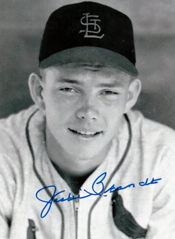
Jackie Brandt was an outfielder who earned a National League Gold Glove Award and was named to the American League all-star team, but people wanted more from him.

He was supposed to be the next Mickey Mantle, but he wasn’t.

He was supposed to be a sure bet to receive the National League Rookie of the Year Award with the Cardinals, but he didn’t.

He was supposed to be a flake, but maybe was just good at pretending to be one.

Quick rise

Brandt was an accomplished amateur pitcher and outfielder in his hometown of Omaha, but he didn’t get any offers to turn pro. Three months after he graduated from high school in 1952, he was wielding a sledgehammer as a boilermaker’s helper for the Union Pacific Railroad when Bob Hall, president of the minor-league club in Omaha, contacted the Cardinals and recommended Brandt to them, The Sporting News reported.

Cardinals scout Runt Marr went to Omaha, saw him throw and offered a contract, Brandt recalled to The Sporting News. A right-handed batter, Brandt preferred playing the outfield instead of pitching, and the Cardinals went along with his request, he told the Associated Press.

In his first regular-season game as a pro for Ardmore (Okla.) in the Class D Sooner State League, Brandt tore ligaments in his right leg and was sidelined for a month. When he came back, he tore up the league, hitting .357 with 131 RBI in 120 games.

Brandt made an impressive climb through the Cardinals’ system, hitting .313 for manager George Kissell’s Class A Columbus (Ga.) team in 1954 and .305 for Class AAA Rochester in 1955.

His performance for Rochester marked Brandt, 21, as a prime prospect for the majors. He excelled as a hitter (38 doubles, 12 triples), fielder (20 assists, 420 putouts) and base runner (24 steals). “Brandt is one of the best-looking kids I’ve ever seen,” Rochester manager Dixie Walker told the Rochester Democrat and Chronicle. “He’ll be a major league star.”

Cardinals general manager Frank Lane said his Reds counterpart, Gabe Paul, offered $100,000 for Brandt. In rejecting the proposal, Lane told The Sporting News, “If Gabe offers $100,000 for him, the kid is worth every bit of $400,000.”

After Cardinals manager Fred Hutchinson saw Brandt play winter ball in Havana following the 1955 minor-league season, he said to The Sporting News, “He has a physical makeup similar to Mickey Mantle. He’s got the same kind of sloping shoulders, strength and speed. He showed exceptional aptitude defensively, a great knack of getting a jump on the ball and a strong arm.”

When New York Times columnist Arthur Daley got his first look at Brandt during spring training in 1956, he observed that the rookie had the “cat-like gait of Mickey Mantle. In fact, he looks as if he might be Mickey’s little brother.”

Another New York columnist, Red Smith, described Brandt as “a smaller, slighter version of Mickey Mantle.”

Great expectations

Brandt’s spring training performance earned him a spot on the Cardinals’ 1956 Opening Day roster and heightened expectations. Cardinals outfielders had won the National League Rookie of the Year Award in 1954 (Wally Moon) and 1955 (Bill Virdon), so Brandt was being touted as a favorite to get the honor in 1956.

“He is faster than either Moon or Virdon, both on the bases and in the outfield,” The Sporting News reported. “He loves to run, loves to hit and he doesn’t know the meaning of pressure.”

Brandt “could be another Terry Moore,” Cardinals chief scout Joe Mathes said to the St. Louis Globe-Democrat, referring to the center fielder on the club’s 1940s championship teams.

Unfazed, Brandt told The Sporting News he could hit as well as any Cardinals player “except Stan” Musial. “Confidence is my major asset,” Brandt said.

Hutchinson, though, preferred a lineup with experienced big-leaguers. The Cardinals opened the 1956 season with Hank Sauer in left field, Virdon in center, Musial in right, Moon at first base and Brandt on the bench. In May, they dealt Virdon to the Pirates for Bobby Del Greco and made him the center fielder.

When Del Greco got injured, Brandt filled in and came through with consecutive three-hit games. Boxscore and Boxscore

Future shock

After a few starts in late May, Brandt was back on the bench. Dissatisfied with sitting and watching, he asked the Cardinals to send him to the minors so he could play every day, he told author Steve Bitker in the book “The Original San Francisco Giants.”

Instead, the Cardinals traded him. He was part of the June 1956 deal that sent second baseman Red Schoendienst to the Giants for shortstop Al Dark and others. The Giants insisted on Brandt being included. “We wouldn’t have made the deal without him,” Giants general manager Chub Feeney told United Press. “Frankly, we were surprised that the Cards would let him go.”

Brandt batted .286 with one home run in 42 at-bats for the Cardinals and fielded flawlessly. (According to researcher Tom Orf, Brandt is one of two players who began his career with the Cardinals, hit one home run for them and went on to slug 50 or more in the majors. The other is Randy Arozarena.)

On the day the trade was made, the Cardinals were 29-23 and one game out of first place in the National League. Frank Lane thought having Dark as their shortstop could spark them to a pennant. “Brandt could come back to haunt us, but we’re concerned about 1956 and not the future,” Lane explained to The Sporting News.

J. Roy Stockton of the St. Louis Post-Dispatch countered: “We don’t consider the Cardinals a sufficient threat in 1956 to justify trading away Brandt.”

(The Cardinals hit the skids in July and finished 76-78, 17 games behind the champion Dodgers.)

Schoendienst told the Post-Dispatch, “Lane didn’t hurt the Cardinals trading me. It was his dealing off young players like Bill Virdon and Jackie Brandt … Brandt alone, counting what he can do now and what he’ll do in the future, is worth all four players the Cardinals got in the Giants deal.”

Golden gate

The Giants made Brandt their left fielder and he hit .299 with 11 home runs for them in 1956.

After spending most of the next two seasons in military service, Brandt was the Giants’ left fielder when they opened the 1959 season at St. Louis against the Cardinals. In the ninth inning, with a runner on first, one out and the score tied at 5-5, Brandt made two unsuccessful sacrifice bunt attempts, then ripped a Jim Brosnan pitch 400 feet to left-center for a double, driving in the winning run. Boxscore

Brandt went on to hit .270 for the 1959 Giants and ranked first among National League left fielders in fielding percentage (.989), earning him a Gold Glove Award. The other NL Gold Glove outfielders that season were teammate Willie Mays (center) and the Braves’ Hank Aaron (right).

(According to the authorized biography “Willie Mays: The Life, The Legend,” there were tensions between Brandt and Mays. “Brandt was outspoken and he was always criticizing Mays,” Giants broadcaster Lon Simmons said.)

Brandt was traded to the Orioles after his Gold Glove season.

Offbeat Oriole

Brandt played six seasons (1960-65) for the Orioles and was their center fielder for most of that time. In 1961, when he hit .297 and scored 93 runs, Brandt was named to the American League all-star team, but it was during his Orioles days that he got labeled a flake.

Teammate Boog Powell told the Baltimore Sun, “He had a pair of alligator shoes and, at a team party, decided to take them for a swim. He just walked into the pool, then out, and continued the evening like nothing had happened.”

(Decades later, when Powell operated a barbecue stand at Camden Yards in Baltimore, Brandt tapped him on the shoulder, said, “Pardon me, sir, but can you spare a poor man a sandwich?” and then kissed his old teammate square on the lips, the Sun reported.)

In a spring training game, Brandt got caught in a rundown and did a backflip to avoid the tag, the Sun reported. Another time, Brandt scored ahead of Jim Gentile, who missed the plate with his slide. Brandt bent down, picked up Gentile’s foot and placed it neatly on the plate, according to the Philadelphia Daily News.

Brandt’s words could be as amusing as his actions.

According to Milton Gross of the North American Newspaper Alliance, after the 1964 season, when Brandt hit less than .250 for the second straight year, Orioles general manager Lee MacPhail wished him a good winter. Brandt replied, “I always have a good winter. The bad summers are what troubles me.”

Regarding his inability to measure up to Mickey Mantle, Brandt told Gross, “I do everything pretty fair, but I’m not up to my potential. Maybe I’m living in the future.”

Orioles manager Hank Bauer said to the Sun, “I asked him how he managed to misplay a fly. He said, ‘I lost in the jet stream.’ “

According to the Baltimore newspaper, other gems uttered by Brandt included:

_ “This year, I’m going to play with harder nonchalance.”

_ “It’s hard to tell how you’re playing when you can’t see yourself.”

Brandt told author Steve Bitker, “My mind works crazy. I don’t do anything canned. Whatever comes to mind, I say or do.”

At least one popular story told about Brandt turned out to be untrue. As reported by the Associated Press and the Newspaper Enterprise Association, Brandt, wanting to experience some of the 40 flavors offered at an ice cream place, drove 30 miles out of his way to get there _ and then ordered vanilla. In 1983, the Baltimore Sun reported it was Ed Brandt, a reporter who covered the Orioles for the newspaper, who drove the extra miles for the ice cream and settled for vanilla. Over time, Jackie, not Ed, got associated with the tale.

“I’m shrewder than most of the guys think,” Brandt, the player, said to North American Newspaper Alliance.

Being a pro

When the Phillies swapped Jack Baldschun to the Orioles for Brandt in December 1965, Larry Merchant of the Philadelphia Daily News called it a trade of “a screwballing relief pitcher for a screwball of an outfielder.”

Regarding his reputation for being a flake, Brandt told Merchant, “We’re paid to entertain. It’s like being on stage. People want a show. They pay three bucks, so they ought to get one.”

The 1966 Phillies were a haven for free spirits, with Bo BelinskyPhil Linz and Bob Uecker joining Brandt on the roster. Brandt didn’t play regularly, but was serious about finding ways to contribute.

“For weeks at a stretch, he would pitch batting practice 25 minutes a day,” Bill Conlin reported in the Philadelphia Daily News. “He would catch batting practice and became Jim Bunning’s preferred warmup catcher because of his knack of setting a low target with his glove.”

The Phillies sent Brandt to the Astros in June 1967 and he completed his final season in the majors with them. In his last big-league appearance, on Sept. 2, 1967, at St. Louis, Brandt singled versus Steve Carlton. Boxscore

In 11 seasons in the majors, Brandt produced 1,020 hits, including 112 home runs.

Read Full Post »

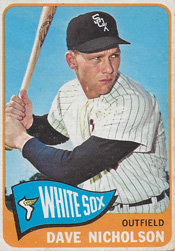
Born and raised in St. Louis, Dave Nicholson was one of baseball’s all-time best power-hitting prospects, but the Cardinals were unwilling to pay the price it took to sign the hometown slugger.

In January 1958, Nicholson was 18 when he signed with the Orioles for more than $100,000, a shocking sum for an amateur at that time.
A right-handed batter, he was “probably the hottest prospect in the country,” the Cleveland Plain Dealer reported.

Though he went on to hit some mighty home runs in the majors, the records Nicholson set were for striking out. As Frank Hyland of the Atlanta Constitution noted, Nicholson “turned around the can’t-miss label. He could miss, and did almost every opportunity.”

An outfielder, Nicholson played seven seasons in the majors with the Orioles, White Sox, Astros and Braves.

Special talent

At 6-foot-3, 215 pounds, strong and swift, Nicholson attracted pro scouts to St. Louis to see him play in amateur leagues and for Southwest High School. “He has power, physique, the arm and speed,” White Sox farm director Glen Miller told the Chicago Tribune. “His hands are as big as hams.”

The Cardinals scouted Nicholson for two years, The Sporting News reported.

In the summer of 1957. when Nicholson was playing in the amateur Ban Johnson League after his junior season in high school, Orioles scout and former Cardinals catcher Del Wilber tracked him. “Best prospect I’ve ever seen,” Wilber told the St. Louis Globe-Democrat.

The Orioles sent seven scouts at various times to St. Louis to verify Wilber’s glowing reports on Nicholson. All liked what they saw. Paul Richards, who had the dual role of general manager and manager of the Orioles, and his pitching coach Harry Brecheen, the former Cardinal, showed up, too. They put Nicholson through a special workout, with Brecheen pitching to him. Nicholson passed the test, according to the Globe-Democrat. 

By the end of the summer, scouts from every big-league team had come to see the teen who crushed baseballs with the power of a hulk.

Your bid

In the fall of 1957, Nicholson, a senior, dropped out of high school and took a job with a St. Louis printer for $60 a week, the Baltimore Sun reported. According to the Chicago Tribune, Nicholson withdrew from school because of a disagreement with a coach who wanted him to play football. The Sporting News reported he left because of “weakness in the classroom.”

The pro scouts didn’t care. Every big-league team, except the Tigers, made Nicholson an offer, the Associated Press reported. It put the teen and his parents in a strong negotiating position. They let the clubs drive up the bidding in visits to the family’s Arthur Avenue home.

The Cardinals dropped out when the price reached $60,000, the Globe-Democrat reported. The Yankees didn’t stick around long either. Their scout, Lou Maguolo, who signed the likes of Tony Kubek, Norm Siebern and Lee Thomas, told The Sporting News, “Nicholson struck out seven times in 10 trips when I saw him, and I can’t recommend anybody like that.”

When the bidding reached six figures, three teams were left in the running: Cubs, Orioles, White Sox. According to The Sporting News, the Cubs and White Sox made the highest offers, but Nicholson said he chose the Orioles because, “I like Paul Richards, and I honestly think the quickest road to the majors is through the Orioles’ farm system.”

In addition to the bonus of more than $100,000 (published estimates of the amount ranged from $107,000 to $150,000), the deal included two new Pontiacs _ one for Dave and one for his father, Larry, The Sporting News reported. Larry Nicholson also was given a part-time scouting job with the Orioles.

According to the Globe-Democrat, the only other baseball amateurs to get signing bonuses of $100,000 or more were Paul Pettit (Pirates, 1950), St. Louisan Frank Baumann (Red Sox, 1952) and Hawk Taylor (Braves, 1957). Nicholson “is worth every penny,” White Sox scout Pat Monahan told the Globe-Democrat.

Learning curve

A month after signing, Nicholson was at the Orioles’ spring training camp in Scottsdale, Ariz. Watching him in batting practice, Richards told The Sporting News, “He has as much bat speed as I have seen in a youngster.”

The quick bat didn’t result too often in contact, especially against breaking pitches. Nicholson struck out in seven of his first eight at-bats in spring training games, The Sporting News reported. His only hit in 11 at-bats in exhibition games was a home run against the Giants’ Curt Barclay.

“The kid’s stance is too wide,” Cubs hitting coach Rogers Hornsby told The Sporting News. “He has to do it all with his arms, and the breaking stuff will give him a fit.”

Richards planned to have Nicholson start his pro career at the Class D level of the minors, but changed his mind and sent him to Class A Knoxville. After 25 games, he was dropped to Class B Wilson, N.C. He struggled there, too, and was demoted to Class D Dublin, Ga. 

The Dublin club was managed by a St. Louisan who spent six years playing in the Cardinals’ farm system, Earl Weaver. His task was to restore Nicholson’s sagging confidence. “He has the tools to make the majors,” Weaver told The Sporting News. “He just has to get the experience to catch up with the other boys.”

Nicholson’s combined numbers for the 1958 season were 98 hits (15 for home runs) and 158 strikeouts.

The Orioles assigned Nicholson, 19, to Class AA Amarillo in 1959, and again it was a mistake. Overmatched, he was dispatched to the Class C Aberdeen (S.D.) Pheasants and put under the care of their manager, Earl Weaver.

Weaver got Nicholson to relax and play loose. Nicholson responded, producing 35 home runs and 119 RBI for Aberdeen. When injuries depleted the Pheasants’ pitching staff, Weaver had Nicholson take some turns on the mound. In nine pitching appearances, including two starts, Nicholson was 3-1 with a 2.91 ERA. He struck out 43 batters in 34 innings.

Swishing sound

Nicholson, 20, began the 1960 season with Class AAA Miami, then was called up to the Orioles in May. He batted .186 and struck out 48 percent of the time (55 whiffs in 113 at-bats) in his first big-league season.

After another year in the minors in 1961, Nicholson was with the Orioles in 1962. He batted .173 and struck out 44 percent of the time (76 whiffs in 173 at-bats).

The Orioles dealt Nicholson, Ron Hansen, Pete Ward and Hoyt Wilhelm to the White Sox for Luis Aparicio and Al Smith in January 1963. The White Sox made Nicholson their left fielder. He hit 22 home runs for them in 1963, but struck out 175 times, a major-league record.

Just six years earlier, the batter who fanned the most times in the American League in 1957 was the Senators’ Jim Lemon, with 94. As The Sporting News noted, “It wasn’t too long ago when the total of 100 strikeouts in any one season was considered staggering … but those days are gone, perhaps never to return.”

(Today, the major-league record for striking out the most times in a season is held by Mark Reynolds, 223 whiffs with the 2009 Diamondbacks. At least Reynolds hit 44 home runs that year. In 2011, Drew Stubbs of the Reds struck out 205 times and hit 15 homers. According to baseball-reference.com, the career big-league salaries paid to those players: $30 million to Reynolds and $15 million to Stubbs.)

Playing hardball

On May 6, 1964, in the first game of a doubleheader at Comiskey Park in Chicago, Athletics starter Moe Drabowsky threw a slider to Nicholson on a 2-and-1 count. Nicholson launched a towering shot that disappeared over the roof covering the upper deck in left and landed in nearby Armour Square Park. White Sox officials estimated the ball carried 573 feet, the Chicago Tribune reported.

The ball was retrieved by 10-year-old Michael Murillo Jr., who was listening to the game on his radio while his father was at softball practice in the park, the Tribune reported. In exchange for the home run ball, Nicholson gave Michael an autographed baseball and one of his bats.

Some witnesses in the upper deck said the ball cleared the roof on a fly; others said it hit atop the roof, then skidded out of the ballpark. Regardless, Nicholson joined Jimmie Foxx, Mickey Mantle and Eddie Robinson as the only players to propel a home run out of Comiskey Park, the Tribune reported.

Nicholson’s prodigious homer was the first of three he hit that day. He had another against Drabowsky an inning later, and hit one in the second game against Aurelio Monteagudo. Boxscore and Boxscore

Two months later at Kansas City, in his first plate appearance against Drabowsky since hitting the home runs against him, Nicholson was struck in the forehead, just above the left eye, by a fastball. He fell to the ground, bleeding. Teammates carried him off the field on a stretcher. Nicholson was taken to a hospital and needed stitches to close the wound.

“The beaning was clearly an accident,” the Kansas City Times reported. “It appeared Nicholson was hit by a fastball that took off. Drabowsky was not warned by the plate umpire, Joe Paparella, and there was nothing said to him by the White Sox players.”

Paparella told The Sporting News, “It was an inside pitch that sailed.” Boxscore

Hit or miss

As Nicholson’s strikeout rate increased, his playing time decreased with the White Sox in 1964 and again in 1965. His totals in three seasons with them: 176 hits (37 for home runs) and 341 whiffs.

One person who didn’t lose faith in Nicholson was Paul Richards, who had become general manager of the Astros. He traded for Nicholson in December 1965.

Going to a National League team meant Nicholson would get to play in his hometown for the first time as a big-leaguer. On May 30, 1966, in his first at-bat in his first game in St. Louis, Nicholson singled against Bob Gibson. Boxscore 

On July 5, 1966, Nicholson hit two home runs against the Braves’ Denny Lemaster. One of the shots reached the purple seats in the fourth level of the Astrodome, 512 feet from home plate. Boxscore A month later, Nicholson belted a home run against Sandy Koufax. Boxscore

The long balls were thrilling; the strikeouts, not so much. Nicholson had the most strikeouts among Astros batters in 1966. After the season, he went to the Florida Instructional League, tried converting into a pitcher and “showed some promise,” The Sporting News reported.

Then, Paul Richards came back into his life. Richards, who left the Astros to become general manager of the Braves, acquired Nicholson in the trade that sent Eddie Mathews to Houston in December 1966.

Richards had hopes Nicholson, 27, still could be a consistent hitter, but he wanted him to begin the 1967 season in the minors at Class AAA Richmond, where he could play every day. The Braves sent hitting instructor Dixie Walker to Richmond to work with Nicholson, but the plan unraveled.

Nicholson struck out 100 times in 254 at-bats and was demoted in July 1967 to Class AA Austin (managed by Hub Kittle).

In September, Richards did Nicholson a favor and brought him to the Braves. He played his last 10 games in the majors that month. His last hit, a single, came against Bob Gibson in Atlanta. Boxscore

Nicholson’s last big-league game was Oct. 1, 1967, against the Cardinals. Naturally, his last at-bat, against Nelson Briles, resulted in a strikeout. Boxscore

Read Full Post »

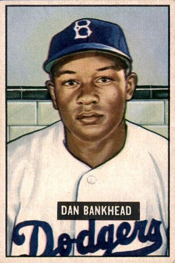
In the same year Jackie Robinson integrated the big leagues, Dan Bankhead became the first black pitcher in the majors.

In August 1947, Bankhead debuted for the Dodgers against the Pirates. His second appearance came against the Cardinals.
Unlike Robinson, Bankhead didn’t have a Hall of Fame career. He pitched in three seasons for the Dodgers and had a 9-5 record. Versus the Cardinals, he was 2-0, including his lone shutout.

Talent search

During the 1947 season, while the front-running Dodgers tried to fend off the Cardinals in the National League pennant race, Dodgers executive Branch Rickey launched a nationwide search for pitching help. Two of his scouts, Hall of Famer George Sisler and Wid Matthews, recommended Bankhead, a right-hander with the Memphis Red Sox of the Negro American League.

Bankhead was 20 when he began his pro baseball career in 1940 with the Birmingham Black Barons of the Negro American League. According to the New York Times, he served three years (1942-45) in the Marine Corps at Camp Lejeune in North Carolina.

After his discharge, Bankhead joined the Memphis Red Sox and his baseball career soared. B.B. Martin, a dentist who owned the Memphis club and had been involved in Negro League baseball for many years, called Bankhead “one of the great pitchers I have ever seen,” the Associated Press reported.

On July 27, 1947, Bankhead was the winning pitcher in the Negro League All-Star Game before 48,112 spectators, including Dodgers scouts, at Comiskey Park in Chicago. About the same time, Rickey began his search to bolster a Dodgers pitching staff led by 21-year-old ace Ralph Branca and closer Hugh Casey.

“I’ve flown all over the country trying to find the best possible solution to a problem that I consider desperate,” Rickey told the Brooklyn Daily Eagle.

Rickey eventually focused his attention on Bankhead. In August, he saw him pitch a five-hitter and strike out 11 in a win against Birmingham. Rickey was as impressed with Bankhead’s poise and confidence as he was with his fastball. For the season, Bankhead was 11-5 with more strikeouts than innings pitched.

Rickey, who told the Brooklyn Daily Eagle, “In the last three weeks, I’ve looked at more pitchers than any man in North America,” became convinced Bankhead, 27, could help the Dodgers immediately.

Dan or Diz?

On Aug. 24, 1947, the Dodgers purchased Bankhead’s contract from Memphis for $15,000. He became the second black player in the National League, joining Dodgers teammate Jackie Robinson, who integrated baseball four months earlier.

As the first black pitcher in the big leagues, Bankhead’s arrival in Brooklyn received much attention. Rickey upped the ante when he told the Brooklyn Daily Eagle, “If he were a couple of inches taller and if he had better command of that change of pace, his style would strongly suggest that of Dizzy Dean.”

Rickey added, “He wouldn’t be here if we didn’t think he had extraordinary ability, but, at the same time, I regret the necessity of rushing him right into the National League.”

On Aug. 26, two days after he signed with the Dodgers, Bankhead made his debut at Ebbets Field in Brooklyn. About one-third of the crowd of 24,069 were blacks, according to the Associated Press. As the game began, Bankhead walked to the bullpen “to the tune of welcoming applause,” the New York Times reported.

Pitching in relief of starter Hal Gregg, Bankhead gave up eight runs in 3.1 innings. His highlight came in his first plate appearance in the big leagues: a two-run home run into the left field seats against the Pirates’ 39-year-old Fritz Ostermueller. Boxscore

Dodgers manager Burt Shotton suggested Bankhead was tipping his pitches, inadvertently letting the Pirates know what was coming.

“I admit the boy didn’t look good,” Shotton said to the Associated Press, “but he certainly showed me he knows how to pitch. He has speed, a good curve and control. His delivery could be improved. The boys were calling all his pitches before they were made. His motion is too slow with men on bases.”

Noting that at Memphis he made three starts a week and often relieved on other days, Bankhead told the Associated Press, “I’m quite a bit overworked,” but added, “This is no alibi … They (the Pirates) smoked back every pitch faster than I threw it.”

Another test

Bankhead didn’t pitch again until two weeks later, Sept. 12, at St. Louis.

The Cardinals were an especially difficult test. Before facing Jackie Robinson for the first time in May, some of the Cardinals’ players reportedly threatened to boycott the game in protest of having a black player on the field. Three months later, Cardinals baserunner Enos Slaughter spiked Robinson on the foot. Some thought it was intentional.

Naturally, the first Cardinals batter to face a black pitcher was Slaughter.

Entering in relief of Casey with two outs and a runner on third in the seventh, Bankhead got Slaughter to ground out. Boxscore

(It would take seven more years, 1954, before the Cardinals had a black pitcher, Bill Greason, play for them.)

Bankhead pitched in four games, earning one save, for the 1947 Dodgers, who won the pennant. His roommate on the road, Jackie Robinson, won the Rookie of the Year Award.

In the book “We Played the Game,” another black pitcher, Don Newcombe, who was with the Dodgers’ farm team in Nashua, N.H., in 1947, said Bankhead “was a pretty good pitcher who struck out a lot of batters, but I think he was brought in mostly as a companion for Jackie.”

Sign of the times

Bankhead spent the next two years in the minors, achieving 20 wins in each season.

With nothing more to prove in the minors, Bankhead seemed ready for a return to the Dodgers in 1950, but there was a catch. According to the New York Daily News, Branch Rickey Jr., the Dodgers’ farm director and son of Branch Rickey Sr., candidly called it the “saturation point.” The 1950 Dodgers already had three blacks _ Roy Campanella, Don Newcombe and Jackie Robinson _ and the ignorant consensus of the time was that a ballclub wasn’t ready for more.

Branch Rickey Sr. “worked hard” to sell Bankhead’s contract to the White Sox, but was unsuccessful, The Sporting News reported. The Braves wanted Bankhead but the cost was deemed too steep.

“Rickey made it clear his price for Bankhead ran in the six figures,” The Sporting News reported.

Right stuff

Unable to trade Bankhead, the Dodgers opened the season with him and he won his first four decisions.

On June 18 at Brooklyn, Bankhead shut out a Cardinals lineup that included Stan Musial, Red Schoendienst and Enos Slaughter.

“Bankhead smothered each scoring chance as he poured across his fastball and snapped off his curve,” the St. Louis Globe-Democrat reported.

Bankhead also had three hits and scored a run. Boxscore

The New York Daily News described him as “the tremendous triple threat man who is the pleasant surprise of the season. Dan can pitch, he can hit and he can run.”

Moved to the bullpen, Bankhead was 3-0 with two saves for the Dodgers in September. He finished the 1950 season at 9-4 and was hailed by The Sporting News as “a competitor of high quality. He has the stuff and the brass.”

Border crossings

In 1951, Dan’s brother, Sam Bankhead, became the first black manager “in organized baseball” when he signed to lead the Farnham club of the Class C Provincial League in Canada, United Press reported. As player-manager of the Homestead Grays of the Negro National League, Sam had led them to pennants in 1949 and 1950.

The 1951 season didn’t go so well for Dan Bankhead. He began the year with the Dodgers, went 0-1 in seven games and never again pitched in the majors.

“Dan and I were roommates for a while,” Don Newcombe told author Danny Peary. “He was a good pitcher, but didn’t have that much desire to play in the majors. Dan preferred playing in the wintertime because he had fallen in love with a woman in Mexico.”

Bankhead pitched in the Mexican League until 1966 when he was 42. He also became a manager there.

Read Full Post »

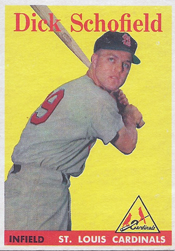
For a player labeled a utility man, Dick Schofield left a prominent mark.

He helped the Pirates, Dodgers and Cardinals win National League pennants. He played 19 seasons in the majors. He was the second of four generations in his family to play pro baseball.

An infielder who reached the majors with the Cardinals at 18, Schofield had three stints with them in three different decades.

All in the family

Dick Schofield’s father, John Schofield, played in the minor leagues for 10 seasons and was nicknamed Ducky. At home in Springfield, Ill., John taught baseball to his son. “We’d go out and he’d hit nine million ground balls to me,” Dick told author Danny Peary for the book “We Played the Game.”

When Dick was 8, his father showed him how to bat from both sides of the plate and Dick, a natural right-hander, remained a switch-hitter in the pros.

John Schofield also took Dick on trips to St. Louis to see the Red Sox play the Browns because Ted Williams was Dick’s favorite player. Dick became a Red Sox fan, he told the St. Louis Post-Dispatch.

During his senior baseball season in high school, Dick Schofield drew the interest of most big-league teams. A shortstop, he hoped to sign with the Red Sox, but the highest offers came from the Cardinals and White Sox.

Big bonus

On June 3, 1953, Schofield signed with the Cardinals, even though, as he told Danny Peary, they were a team “I had always rooted against.”

The $40,000 he received was then the largest bonus paid by the Cardinals. “He’s got a great arm,” Cardinals manager Eddie Stanky told the Post-Dispatch after seeing Schofield work out with the team. “His hands are extremely quick.”

Under the rules then, an amateur player signing for more than $6,000 was required to spend his first two seasons with the big-league team.

Schofield, 18 and looking younger, joined the Cardinals in New York. “I was scared to death,” he recalled to Peary. “The team was playing Brooklyn and I checked into the Commodore Hotel in Manhattan. Then I rode to the ballpark with Stan Musial and Red Schoendienst. They asked me to come along. Imagine that!”

Schofield was assigned to room on the road with the Cardinals’ backup catcher, Ferrell Anderson, 35. “He was like my dad and took good care of me,” Schofield told Peary. “He made it easier for me.”

Learning curve

Schofield was called Ducky by Cardinals players after they were introduced to his father and learned it had been his nickname.

He didn’t get into a game during his first month with the Cardinals, and spent his days being mentored by Stanky and shortstop Solly Hemus.

Stanky “knew baseball better than anybody I ever met,” Schofield told Peary. “Stanky and Hemus helped me learn to play shortstop in the majors, especially turning the double play.”

On June 25, in a game at St. Louis, Stanky complained that Giants pitcher Jim Hearn wasn’t coming to a stop in his delivery. After losing his argument with umpire Augie Donatelli, Stanky threw a towel from the dugout and got a warning from the ump, the Post-Dispatch reported.

Not wanting to back down, but not wanting to get ejected, Stanky turned to Schofield. Knowing the rookie wouldn’t get into the game, Stanky told him to toss a towel, according to the Society for American Baseball Research. Schofield obeyed, and Donatelli ejected him from a game before he’d ever played in one. Boxscore

Hello and goodbye

When Schofield made his big-league debut, on July 3, 1953, against the Cubs at Chicago, it was as a pinch-runner. Boxscore

His first hit came two weeks later, a single versus Johnny Podres at Brooklyn. Boxscore 

Used primarily as a pinch-runner, Schofield hit .179 for the Cardinals in 1953 and .143 in 1954.

With the two mandatory seasons on the big-league club completed, Schofield spent most of the 1955 and 1956 seasons playing for manager Johnny Keane at minor-league Omaha.

(Schofield married his wife Donna in Omaha in 1956. Tyrone Power and Kim Novak, in town to promote their movie, “The Eddy Duchin Story,” sent them a cake, the Post-Dispatch reported, and that’s why the Schofields’ first child, a daughter, was named Kim.)

A backup to Cardinals shortstop Al Dark in 1957, Schofield was a reserve again in 1958 when he was traded to the Pirates in June for infielders Gene Freese and Johnny O’Brien.

“I was totally surprised,” Schofield said to Peary. “I thought the world had come to an end. Nobody wanted to play on the Pirates then. They were a last-place team and Forbes Field was a tough park.”

(According to Schofield, Freese’s reaction to the deal was: “They traded two hamburgers for a hot dog.”)

Key contribution

Schofield, strictly a shortstop with the Cardinals, also was used at second and third by Pirates manager Danny Murtaugh. With Bill Mazeroski at second and Dick Groat at short, Schofield got few starts, but grew to like the Pirates.

On Sept. 6, 1960, with the Pirates contending for a National League pennant, Groat suffered a broken left wrist when hit by a pitch from the Braves’ Lew Burdette. Schofield, hitless since May, was Murtaugh’s choice to replace Groat.

Steady on defense, Schofield surprised with the bat. He hit .375 in September and his on-base percentage for the month was .459.

“He was as fine a utility infielder that ever played this game,” Groat said to Peary. “He could give you two or three weeks of great play at any one of those positions.”

The Pirates won the pennant, but Groat was reinserted at shortstop for the World Series against the Yankees. In Game 2, a Yankees rout, Schofield entered in the sixth and got a single and a walk versus Bob Turley. Boxscore

Helping hand

Groat was traded to the Cardinals after the 1962 season and Schofield, at last, became a starting shortstop. He was the Pirates’ starter in 1963 and 1964. When rookie Gene Alley was deemed ready to take over in 1965, Schofield was dealt to the Giants in May and started for them that season.

Another rookie, Tito Fuentes, became the Giants shortstop in 1966 and Schofield was shipped to the Yankees in May.

On Sept. 10, 1966, the Dodgers acquired Schofield to help them in their pennant drive. He took over for Jim Gilliam and John Kennedy at third base, and stabilized the position, helping the Dodgers win the pennant.

According to The Pittsburgh Press, Dodgers pitcher Don Drysdale said, “He’s been making the big play for us ever since we got him. If it isn’t his glove, it’s his bat. If it isn’t his bat, it’s his base running.”

Because Schofield joined the Dodgers after Sept. 1, he wasn’t eligible to play in the World Series. He watched on TV as the Dodgers got swept by the Orioles.

“The Dodgers couldn’t have won the league flag without him, and they collapsed in the World Series because he wasn’t eligible,” Los Angeles Times columnist Sid Ziff wrote.

Long, winding road

Released by the Dodgers after the 1967 season, Schofield, 33, was signed by the reigning World Series champion Cardinals to be a backup to Dal Maxvill at shortstop and Julian Javier at second base.

Fifteen years after he accompanied Schofield on his ride to the ballpark on the rookie’s first day in the big leagues, Red Schoendienst, manager of the 1968 Cardinals, told the Post-Dispatch, “Schofield is the finest all-round utility infielder we’ve got on the club.”

Schofield made 17 starts at second base and 13 starts at shortstop for the 1968 Cardinals, who repeated as National League champions. On May 4, he contributed four hits and three RBI against the Giants. Boxscore

Schofield got into two games of the 1968 World Series against the Tigers but didn’t have a plate appearance.

Two months later, the Cardinals traded Schofield to the team he rooted for as a boy, the Red Sox. Schofield spent two seasons with the Red Sox and was dealt back to the Cardinals in October 1970.

In July 1971, the Cardinals traded Schofield, 36, for the third and last time, packaging him with Jose Cardenal and Bob Reynolds to the Brewers for Ted Kubiak and a prospect.

A son, also Dick Schofield, played 14 seasons as an infielder in the majors, and a grandson, Jayson Werth (Kim’s son), was a big-league outfielder for 15 seasons.

Read Full Post »

« Newer Posts - Older Posts »