Feeds:
Posts
Comments

Archive for the ‘Records’ Category

Though it is a franchise that has benefitted from hitters the likes of Stan Musial, Rogers Hornsby, Albert Pujols, Lou Brock and Enos Slaughter, the Cardinals have had only one player achieve 20 doubles, 20 triples and 20 home runs in a season: Jim Bottomley.
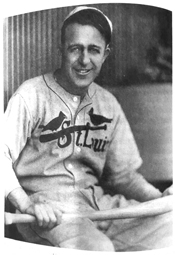
A left-handed batter whose stroke regularly produced highly elevated line drives, Bottomley totaled 42 doubles, 20 triples and 31 home runs in 1928, the year he earned the National League Most Valuable Player Award and helped the Cardinals win their second pennant.

Bottomley is one of seven players in the 20-20-20 club. The others are Frank Schulte (1911 Cubs), Jeff Heath (1941 Indians), Willie Mays (1957 Giants), George Brett (1979 Royals), Curtis Granderson (2007 Tigers) and Jimmy Rollins (2007 Phillies). Schulte, Mays, Granderson and Rollins also had 20 stolen bases in the seasons in which they produced 20 doubles, 20 triples and 20 home runs.

Finding his footing

In 1916, when Bottomley was 16, he quit high school in Nokomis (Ill.) and worked as a truck driver, grocery clerk, railroad clerk and blacksmith’s apprentice while also playing semipro baseball, according to the Associated Press. His father and brother were coal miners. The brother was killed in a mine accident.

“I know how hard that kind of work was on my father and how much my mother worried about it,” Bottomley later told The Sporting News. “When I went into baseball, it was a choice of making good at that or returning to the mines. It hardly was any choice at all.”

A policeman saw Bottomley hit two home runs and three triples in a local game and told Cardinals manager Branch Rickey he should give Bottomley a look. In the meantime, Bottomley wrote to Rickey and asked for a tryout. Cardinals scout Charley Barrett was sent to watch Bottomley play and was impressed.

In early fall of 1919, Bottomley, 19, was summoned to St. Louis so that Rickey could see him perform. Rickey sought prospects for the farm system he was starting to build.

Bottomley’s introduction to the big city was expensive. Unsure how to get to Robison Field, he hailed a taxi when he arrived at the bus station. The driver charged him more than $4 to go to the ballpark, according to the Brooklyn Eagle.

When Bottomley reported to the field, Rickey hardly could believe what he saw. The first baseman wore shoes half a dozen sizes too large for him. The shoes curled up at the toes and had spikes nailed to the front. The Brooklyn Eagle described them as Charlie Chaplin clown shoes. Bottomley tripped over the bag, falling on his face and then on his back.

“I told Charley Barrett this fellow could never do it because his feet were too big,” Rickey recalled to the Brooklyn newspaper, “but Barrett declared his feet were all right. It was that pair of shoes.”

In the book “The Spirit of St. Louis,” Rickey said, “Bottomley, properly shod, had the grace and reflexes of a great performer.”

The Cardinals signed Bottomley for $150 a month and arranged for him to report to the minors in 1920.

Man of the people

Bottomley gave the Cardinals a big return on their modest investment. Called up to the majors in August 1922, he became their first baseman. He hit .371 in 1923 and the next year drove in 12 runs in a game against the Dodgers. Boxscore

Using a choked grip on a heavy bat, Bottomley drove in more than 110 runs six seasons in a row (1924-29), and hit better than .300 in nine of his 11 years with the Cardinals. (In the other two years, he hit .299 and .296.)

When he was Cardinals manager, Rogers Hornsby told United Press, “I’d rather see Jim Bottomley at the plate when a run is badly needed than any other player I could name.”

Bottomley “was the best clutch hitter I ever saw,” Hall of Famer Frankie Frisch said to the New York Times.

Nicknamed Sunny Jim _ “He has a disposition that refuses to see the gray outside of the clouds of life,” Harold Burr of the Brooklyn Eagle noted _ Bottomley was a fan favorite, especially with the Knothole Gang kids and the Ladies Day crowds.

“Cap perched jauntily over his left eye, the smiling Bottomley walked with a slow swagger that was as much a trademark as his heavy hitting,” Bob Broeg of the St. Louis Post-Dispatch noted.

Bottomley was a bachelor during his playing days with the Cardinals. (In 1933, he married Betty Brawner, who operated a beauty salon in the Missouri Theater building in St. Louis.) Cardinals bachelors stayed at a hotel in the West End of St. Louis during Bottomley’s time. According to The Sporting News, “There every night you could see Jim and his cohorts seated in chairs out in front of the hotel, holding court with the fans.”

Gold standard

Of Bottomley’s 187 hits in 1928, roughly half (93) were for extra bases. His 362 total bases led the league.

Dodgers pitcher Rube Ehrhardt told the Brooklyn Eagle, “Bottomley is a great slugger … He pulls a ball to right field by a combination of strength, wrist snap and perfect timing.”

By June 1928, Bottomley had his 20th double of the season, and his 20th homer came the next month. All he needed were 20 triples to become baseball’s second 20-20-20 player. Entering September with 14 triples, Bottomley made his run for the mark.

He hit a triple at Cincinnati on Sept. 2, then got triples in three consecutive home games _ Sept. 9 versus the Pirates and Sept. 10-11 against the Reds. His 19th triple came Sept. 22 at the Polo Grounds versus the Giants.

On Sept. 29 at Boston, the Cardinals went into the next-to-last game of the season with a 94-58 record, two games ahead of the Giants (92-60). A win would clinch the pennant.

Leading off the game for the Cardinals, Taylor Douthit hit a slow roller to second. Braves player-manager Rogers Hornsby tried to scoop it, but the ball trickled between his legs and into right field for a two-base error. After a Frankie Frisch single scored Douthit, Bottomley drove a pitch from ex-Cardinals teammate Art Delaney into right-center. Eddie Brown, the center fielder, reached for it, but the ball caromed off his glove and hit the bleacher wall. Frisch scored and Bottomley streaked into third with his 20th triple. Chick Hafey followed with a sacrifice fly, scoring Bottomley, and the Cardinals went on to a 3-1 pennant-clinching win. Boxscore

For the season, Bottomley hit .325, scored 123 runs and drove in 136. He had a .402 on-base mark and a .628 slugging percentage. Bottomley batted .359 with runners in scoring position.

“Bottomley is the Lou Gehrig type _ a hustler, carefree, great in the pinches,” Yankees pitcher Waite Hoyt told North American Newspaper Alliance.

(Bottomley clouted a home run versus Hoyt in Game 1 of the 1928 World Series at Yankee Stadium. He also was credited with a triple in Game 3 at St. Louis when Yankees center fielder Cedric Durst took several steps toward the ball, then futilely tried to turn back as it sailed over his head. Boxscore)

For being named National League MVP by the Baseball Writers Association of America, league president John Heydler awarded Bottomley $1,000 in gold.

The league and the Cardinals arranged for the prize to be given before a game against the Phillies at St. Louis on June 8, 1929. Because of Bottomley’s popularity with youngsters, Cardinals owner Sam Breadon invited girls and boys of school age to attend the Saturday afternoon game for free.

A total of 12,806 youths _ 9,643 boys and 3,163 girls _ attended. “They packed the upper and lower decks of the left wing of the grandstand and overflowed into the bleachers and pavilion,” the Post-Dispatch reported. Paid attendance was 7,000, putting the total number of spectators at 19,806.

Before the game, Bottomley tossed many baseballs to youngsters in the stands. Then, in a ceremony at home plate, Heydler gave Bottomley $1,000 worth of $5 gold coins in a canvas sack.

During the game, “all available paper was made into schoolroom airplanes and sailed out into the field” by the urchins, the Post-Dispatch noted. Bottomley produced two hits, including a triple, and the Cardinals beat Phillies starter Phil Collins like a drum, winning, 7-2. Boxscore
Read Full Post »

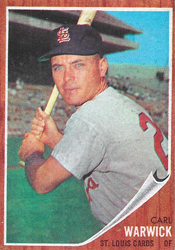
Carl Warwick seemed an unlikely candidate to shine for the Cardinals in the 1964 World Series.

A week before the season ended, Warwick suffered a fractured cheekbone when he was struck by a line drive during pregame drills. He underwent surgery the next day.
After the Cardinals clinched the National League pennant in the season finale, manager Johnny Keane opted to put Warwick on the World Series roster as a pinch-hitter, even though he hadn’t swung a bat in a game in almost two weeks.

Warwick delivered, with three pinch-hit singles, two of which contributed to wins against the Yankees, and helped the Cardinals become World Series champions.

An outfielder who played for the Dodgers (1961), Cardinals (1961-62, 1964-65), Colt .45s (1962-63), Orioles (1965) and Cubs (1966), Warwick was 88 when he died on April 5, 2025.

Left and right

After leading Texas Christian University in hitting (.361) as a junior in 1957, Warwick got married and planned to start a family. So when Dodgers scout Hugh Alexander offered a contract in excess of $30,000, Warwick signed in December 1957, opting to skip his senior season. “I figured one year in pro ball would be worth more than a final year in college,” Warwick told the Austin American.

(Warwick earned a business administration degree from Texas Christian in 1961.)

He was the rare ballplayer who threw left and batted right. “I’m a natural southpaw,” Warwick said to the Los Angeles Mirror, “but as long as I can remember I’ve always picked up a bat with my right hand and hit right-handed.”

(Before Warwick, big-leaguers who threw left and batted right included outfielders Rube Bressler and Johnny Cooney, and first baseman Hal Chase.)

Though listed as 5-foot-10 and 170 pounds, Warwick looked shorter and lighter. As Joe Heiling of the Austin American noted, “Carl didn’t fill the popular image of a slugger. His shoulders weren’t broad as the side of a barn.”

In college, Warwick hit drives straightaway and to the gaps. To hit with power in the pros, he’d need to learn to pull the ball, said Danny Ozark, his manager at Class A Macon (Ga.). Taught by Ozark how to get out in front of pitches with his swing, Warwick walloped 22 home runs for Macon in 1958.

Moved up to Class AA Victoria (Texas) in 1959, Warwick roomed with future American League home run champion Frank Howard and tore up the Texas League, hitting .331 with 35 homers and scoring 129 runs. Victoria manager Pete Reiser, the St. Louis native and former Dodgers outfielder, rated Warwick a better all-around prospect than Howard.

“Carl can play there (in the majors) sooner than Howard,” Reiser told the Austin American. “Carl has a better knowledge of the strike zone than Howard and he’s starting to hit the curveball. To me, that’s a sign that a hitter is coming into his own. You won’t find any better than Carl. Defensively, there’s not too many better than him in the minors or big leagues. He can go get the ball.”

Climbing another notch to Class AAA in 1960, Warwick was a standout for St. Paul (Minn.), with 104 runs scored and double digits in doubles (27), triples (11) and homers (19).

Seeking a chance

Warwick, 24, opened the 1961 season with the Dodgers, who were loaded with outfielders. A couple were veterans (Wally Moon, Duke Snider); most, like Warwick, hadn’t reached their primes (Tommy Davis, Willie Davis, Don Demeter, Ron Fairly, Frank Howard). In May, the Dodgers sent Warwick and Bob Lillis to the Cardinals for Daryl Spencer. According to the St. Louis Globe-Democrat, Cardinals manager Solly Hemus called Warwick the “key man for us” in the deal and named him the center fielder, replacing Curt Flood. “Warwick fits into our future plans very well,” Hemus told the Los Angeles Mirror.

Warwick’s first hit for the Cardinals was a home run he pulled over the fence in left against Bob Buhl of the Braves at Milwaukee. Of his first 12 hits for St. Louis, seven were for extra bases _ four doubles, one triple, two homers. Boxscore

Harry Walker, the Cardinals’ hitting coach, didn’t want Warwick swinging for the fences, though, and suggested he alter his approach.

“He said I didn’t have the power to hit the ball out,” Warwick told the Austin American. “He said I wasn’t strong enough. He wanted me to punch the ball to right field. After you’ve been hitting a certain way so long, it’s hard to change. He made me go to a heavier bat with a thicker handle.”

Out of sync, Warwick said he tried hitting one way in batting practice, then another in games. On July 4, his season average for the Cardinals dropped to .217. Two days later, Solly Hemus was fired and replaced by Johnny Keane, who reinstated Flood in center. Warwick was dispatched to the minors. “We’re sending him out so that he’ll have a chance to play every day the rest of the season,” Keane told the Globe-Democrat.

Houston calling

The next year, Warwick figured to stay busy with the 1962 Cardinals subbing for their geriatric outfielders, Minnie Minoso in left and Stan Musial in right. (“Our outfield has Old Taylor and Ancient Age with a little Squirt for a chaser,” Flood quipped to the St. Louis Post-Dispatch.)

However, when an expansion club, the Houston Colt .45s, offered the Cardinals a pitcher they’d long coveted, Bobby Shantz, they couldn’t resist. On May 7, 1962, the Cardinals swapped Warwick and John Anderson for Shantz.

The trade was ill-timed for the Cardinals. Four days later, Minoso fractured his skull and right wrist when he crashed into a wall trying to snare a drive.

Warwick became Houston’s center fielder. In his first appearance in St. Louis after the trade, he produced four hits and a walk, including four RBI against Bob Gibson with a two-run double and a two-run homer. (For his career, Warwick hit .333 versus Gibson.) Boxscore

In addition to Gibson, Warwick also homered against Don Drysdale, Sandy Koufax and Juan Marichal that season.

When Cardinals general manager Bing Devine had a chance to reacquire Warwick, he swapped Jim Beauchamp and Chuck Taylor for him on Feb. 17, 1964.

Shifting roles

On Opening Day in 1964 against the Dodgers’ Sandy Koufax, Warwick was the Cardinals’ right fielder, with Flood in center and Charlie James in left. Boxscore

After two months, the club determined an outfield overhaul was needed. Flood remained, but Lou Brock was acquired from the Cubs in June to replace James and Mike Shannon was promoted from the minors in July to take over in right. Warwick primarily became a pinch-hitter.

He went to Cardinals coach Red Schoendienst and pinch-hitter deluxe Jerry Lynch of the Pirates for advice on how to perform the role. “Both of them agree you’ve got to be ready to attack the ball,” Warwick told Newsday.

On Sept. 27, 1964, before a game at Pittsburgh, Warwick was walking to the sidelines from the outfield during warmup drills when a line drive from a fungo bat swung by pitcher Ron Taylor struck him in the face, fracturing his right cheekbone. The next day, in St. Louis, Cardinals surgeon Dr. I.C. Middleman and plastic surgeon Dr. Francis Paletta performed an operation to repair the damage.

When the World Series began on Oct. 7 in St. Louis, Warwick was on the Cardinals’ roster, even though he hadn’t played in a game since Sept. 23. He also hadn’t produced a RBI since Aug. 2 or a home run since May 8.

However, as Keane explained to columnist Bob Broeg, “Pinch-hitting, Carl is extremely aggressive.”

Big hits

With the score tied at 4-4 in the sixth inning of World Series Game 1 at St. Louis, the Cardinals had Tim McCarver on second, two outs, when Warwick was sent to bat for pitcher Ray Sadecki. As Warwick stepped to the plate against the Yankees’ Al Downing, “my head was aching and my (scarred) cheek was hurting,” he later told United Press International.

Warwick whacked Downing’s first pitch past shortstop Phil Linz for a single, scoring McCarver and putting the Cardinals ahead to stay. St. Louis won, 9-5. Video, Boxscore

“I went up there with the idea of swinging at the first one if it was anywhere close,” Warwick told the Post-Dispatch. “I was looking for a fastball and I got one.”

In Game 2, Warwick, batting for second baseman Dal Maxvill in the eighth, singled and scored against Mel Stottlemyre. Batting again for Maxvill in Game 3, Warwick was walked by Jim Bouton.

The Cardinals, though, were in trouble. The Yankees won two of the first three and led, 3-0, in Game 4 at Yankee Stadium as Downing limited the Cardinals to one hit through five innings.

Needing a spark, Warwick provided one. Sent to bat for pitcher Roger Craig leading off the sixth, Warwick stroked a single on Downing’s second pitch to him.

“I seem to carry a different attitude up there coming cold off the bench,” Warwick told Joe Donnelly of Newsday. “I wouldn’t call it confidence. I come up there swinging. You’ve only got three swings. I don’t want to pass up an opportunity.”

The Cardinals loaded the bases with two outs before Ken Boyer clouted a Downing changeup for a grand slam and a 4-3 triumph. Video, Boxscore

Warwick’s three hits as a pinch-hitter tied a World Series record. The Yankees’ Bobby Brown (1947) and the Giants’ Dusty Rhodes (1954) also produced three pinch-hits in one World Series. Since then, Gonzalo Marquez of the Athletics (1972) and Ken Boswell of the Mets (1973) matched the mark.

(Allen Craig of the Cardinals had four career World Series pinch-hits _ two in 2011 and two more in 2013 _ but not three in one World Series.)

With a chance for a record fourth pinch-hit, Warwick batted for Maxvill in Game 6 but Bouton got him to pop out to third baseman Clete Boyer.

The Cardinals clinched the championship in Game 7, but for Warwick the good vibes didn’t last long. Bob Howsam, who replaced Bing Devine as Cardinals general manager, sent Warwick a contract calling for a $1,000 pay cut. “An insult,” Warwick told the Associated Press.

The magic of 1964 was gone in 1965. Warwick had one hit in April, one more in May and entered June with an .077 batting average. In July, the Cardinals shipped him to the Orioles, who traded him to the Cubs the following spring.

Bing Devine, who as Cardinals general manager twice traded for Warwick, became Mets general manager and acquired him again. Warwick, 29, was invited to try out at 1967 spring training for a reserve spot with the Mets but declined, opting to embark on a real estate career.

Read Full Post »

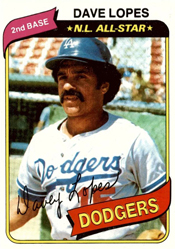
Imagine accomplishing a rare feat and doing it in the presence of the master of the craft. Davey Lopes knew the feeling.

On Aug. 24, 1974, Lopes had five stolen bases for the Dodgers against the Cardinals. Watching him perform was the National League’s all-time best base stealer, the Cardinals’ Lou Brock.

Lopes became the first National League player to swipe five bases in a game since Dan McGann did it for the Giants against Brooklyn on May 27, 1904. Boxscore

Though he holds the record for most career stolen bases (938) in the National League, Brock never swiped five in a game. Neither did other prominent base stealers such as Ty Cobb, Tim Raines, Vince Coleman, Max Carey, Honus Wagner and Maury Wills.

Lopes remains the only player with five steals in a game versus the Cardinals.

Tough part of town

Lopes was born and raised in East Providence, Rhode Island, a town of Irish, Portuguese and Cape Verdean immigrants who came looking for jobs in the factories and along the waterfront.

One of 12 children, Lopes was a toddler when his father died, according to the Los Angeles Times. A stepfather abandoned the family. Lopes’ mother, Mary Rose, worked as a domestic when she could.

Residing in a tenement, Lopes described the neighborhood to Times columnist Jim Murray as “roaches, rats, poor living conditions, drugs as prevalent as candy.”

“If it hadn’t been for sports, there’s no telling what I’d be or where I’d be,” Lopes said to the Times in 1973. “All I had to do is step off the porch to a choice of all the things you associate with a ghetto … It’s an easy step off the porch.”

Before he learned to steal bases in ball games, Lopes said he resorted to shoplifting. “I never stole anything major, just clothes and baseballs and bats,” he told Jim Murray.

Lopes also said to the Times, “When you don’t have money and can’t have what the other kids have, you get it any way you can. You live on the street. You steal.”

Though, as Jim Murray put it, “even by Rhode Island standards, Davey was little,” he excelled in high school baseball and basketball. Among those who admired Lopes’ play was an opposing coach, Mike Sarkesian. A son of an Armenian immigrant who worked in steel foundries, Sarkesian grew up in a Providence tenement house, but went on to graduate from the University of Rhode Island with dual degrees in biology and physical education.

In the same year Lopes graduated from high school, Sarkesian was named head basketball coach and athletic director at Iowa Wesleyan College. He recruited Lopes, offering him a college education and providing an escape from East Providence. After two years at Iowa Wesleyan, Sarkesian became athletic director at Washburn University in Topeka, Kansas. Lopes went with him, arriving shortly after a tornado left the campus in shambles.

An outfielder, Lopes did so well in baseball that he got selected by the Giants in the eighth round of the 1967 amateur draft but opted to stay in college. The Dodgers drafted him in the second round in 1968 and Lopes signed for $10,000. He gave most of the money to his mother, according to the Times.

Though he played in the minors in the summers of 1968 and 1969, Lopes skipped spring training both years so that he could complete his studies at Washburn. He graduated in 1969 with a degree in elementary education and taught sixth grade one winter.

(Lopes also got married in July 1968 but continued to contribute to the education of brothers and sisters still in school. “I try and send home as much as I can, even when it hurts my own wallet,” he told the Times in 1973.)

On the run

Lopes wanted to be a center fielder, but Tommy Lasorda, who managed him for three seasons (1970-72) in the minors, suggested his best path to the big leagues was as an infielder. Lopes learned to play second base. He was 5-foot-9 and tough. “A Billy Martin with more talent and speed,” noted San Francisco Examiner columnist Art Spander.

Leigh Montville of the Boston Globe described Lopes as “a dirty uniform ballplayer” whose “game is motion, as much motion as he can create.”

After hitting .317 with 48 stolen bases for Lasorda with Albuquerque in 1972, Lopes, 27, was called up to the Dodgers that September. The next year, he replaced Lee Lacy as the Dodgers’ second baseman and took off running, igniting the offense from the leadoff spot.

“He sets our mood,” Dodgers manager Walter Alston said to the Los Angeles Times. “I will give him a red light in certain situations, but otherwise he can run whenever he wants.”

Lopes told the newspaper, “The steals are something to talk about, but when they turn into runs, that’s what is important.”

Right conditions

The Dodgers became National League champions in 1974. Lopes’ special blend of speed and power were highlighted that August. He had four stolen bases against the Astros on Aug. 4, becoming the first Dodger since Maury Wills in 1962 to swipe that many in a game. On Aug. 20, Lopes clouted three home runs and totaled five hits versus the Cubs at Wrigley Field. Boxscore and Boxscore

Four nights later, he had his five-steal game against the Cardinals’ battery of pitcher John Curtis and catcher Ted Simmons. The Dodgers totaled a club-record eight steals in the game and won, 3-0, with Don Sutton pitching the shutout.

Lopes, who reached base on three hits, a walk and an error, swiped second three times and third twice. He also was thrown out twice by Simmons _ at third with Curtis pitching and at second with Al Hrabosky on the mound.

“All five steals were my fault,” Curtis told the St. Louis Post-Dispatch. “I was having trouble getting the ball over the plate.”

Curtis’ teammate, Lou Brock, said to the Los Angeles Times, “His delivery is systematic and easy (for a runner) to pick up.”

Brock also told the newspaper it was a myth that left-handers, such as Curtis, were more difficult to steal against. “Even though he’s looking right at you, you’re looking right at him, too,” Brock noted. “You can pick up so many keys to run from because they’re all there in front of you. Against a right-hander, all you see is his back and rear end. He can hide his motion better.”

Elite stealers

Brock also had a stolen base, his 88th of the season, in the game, and was headed for 118, breaking Wills’ record of 104.

In remarks to the Los Angeles Herald-Examiner, Lopes, 29, said of Brock, 35, “The first thing about him that amazes you is how he can steal all those bases at his age. The next thing is his ability to steal with the short lead he takes. Runners such as Joe Morgan, Cesar Cedeno, Bobby Bonds and myself take leads of at least seven to eight feet. Without that, we’d never get to second on time. Brock takes only five feet, mainly because of the speed he’s able to generate in a hurry.

“He picks up all those steals while only rarely attempting to take third. The other team knows he’s going to try for second. They get ready for him, but they seldom get him.”

Regarding Lopes’ five steals versus the Cardinals, Brock said to the Los Angeles Times, “So many conditions have to be exactly right. First, it has to be something a player wants very badly. He also has to defy a lot of things such as the unwritten rule that says you shouldn’t try to steal third with two outs … Also, it’s unusual for somebody to get that many opportunities _ that is, the number of pitches to the man batting behind him (Bill Russell).” Boxscore

The record for most steals in a game by one player is seven. George Gore did it for the Cubs in 1881 and Billy Hamilton matched the feat for the Phillies in 1894.

Those with six steals in a game: Eddie Collins for the Athletics twice in 1912, Otis Nixon of the 1991 Braves, Eric Young of the 1996 Rockies and Carl Crawford of the 2009 Rays.

Rickey Henderson, career leader in steals (1,406), had five in a game for the 1989 Athletics. The only Cardinals player with five steals in a game is Lonnie Smith, who did it Sept. 4, 1982, versus the Giants. Boxscore

Decades of service

Lopes finished the 1974 season with 59 steals. The next year, he swiped 38 in a row from June to August and led the league (with 77), ending Brock’s reign of four consecutive years. Lopes was the league leader again in 1976 (with 63 steals).

One of his best seasons was 1979 when he was successful on 44 of 48 steal attempts (his 91.67 percent success rate led the league) and slugged 28 home runs. His 28th homer was a walk-off grand slam against the Cubs’ Bruce Sutter. Boxscore

Lopes also was the league leader in stolen base percentage in 1985, swiping 47 in 51 tries (92.1 percent). For his career, he had a stolen base percentage of 83 percent, better than that of Henderson (80.7), Brock (75.3) and Wills (73.8).

In four World Series with the Dodgers, Lopes had 10 stolen bases in 12 tries.

His 16 years in the majors were with the Dodgers (1972-81), Athletics (1982-84), Cubs (1984-86) and Astros (1986-87), totaling 1,671 hits and 557 steals.

Lopes also managed the Brewers (2000-02) and coached for 27 years with the Rangers (1988-91), Orioles (1992-94), Padres (1995-99 and 2003-05), Nationals (2006 and 2016-17), Phillies (2007-10) and Dodgers (2011-15).

Read Full Post »

There are many frustrating ways to lose a baseball game but perhaps none more so than this:

On Aug. 20, 1954, the Cardinals turned six double plays, tying a National League record, and still were beaten, 3-2, at home against the Reds.

Though they totaled 12 hits and eight walks, putting a runner on base in every inning, the Reds didn’t do much damage. They had two triples and a double, but none produced a run. The Reds scored one run on a double play and another on a wild pitch.

Meanwhile, the Cardinals ran into outs. They had four runners thrown out on the base paths, including two at home plate. The game ended when a Cardinals runner was nailed trying to score from second on a single.

Twists and turns

The Friday night game featured starting pitchers Joe Nuxhall, on his way to his first winning season with the Reds, against winless Cardinals rookie Ralph Beard, a Cincinnati native.

The first inning set the tone. For the Reds, Ted Kluszewski’s single scored Roy McMillan from second but Jim Greengrass ended the threat by grounding into a double play. For the Cardinals, Wally Moon was thrown out at second attempting to steal.

In the second, the Cardinals nearly turned a triple play. After Johnny Temple and Wally Post opened with singles, Hobie Landrith lined to second baseman Red Schoendienst. He tossed to shortstop Alex Grammas, who made the out on Temple at second, but Post beat Grammas’ peg to first “by a whisker,” the Dayton Daily News reported.

(Schoendienst started four of the double plays; Grammas started the other two.)

The Cardinals made another out on the base paths in the bottom half of the inning. With Rip Repulski on third and one out, Nuxhall snared Joe Cunningham’s grounder and then trapped Repulski, who had broken for home, in a rundown before tagging him out.

More buffoonery in the third: With two outs, Beard uncorked a wild pitch, enabling Bobby Adams to score and extending the Reds’ lead to 2-0.

The Reds scored the decisive run in the fourth. With runners on the corners, none out, Nuxhall rolled into a 4-6-3 double play, but Post came home from third, making the score 3-0.

St. Louis turned its fourth double play in the fifth on Gus Bell’s grounder.

Hits, runs, errors

The Cardinals scored twice in the sixth. With two outs, Stan Musial was on second and Ray Jablonski on first, when Bill Sarni singled to center. Musial scored, and when center fielder Gus Bell let the ball roll between his legs for an error, Jablonski streaked home from first with the second run. Sarni kept running, too, trying to take third, but left fielder Jim Greengrass, who retrieved the ball, fired to third baseman Bobby Adams in time to tag the runner, ending the inning.

The Reds got leadoff triples from Temple in the sixth and Post in the eighth, but failed to score. Kluszewski grounded into double plays in the seventh and ninth.

With two outs and none on in the St. Louis eighth, Reds manager Birdie Tebbetts used a four-man outfield, removing the shortstop, against Musial for the second time that season. Tebbetts wanted to prevent Musial from getting an extra-base hit that would put him in scoring position.

When Musial saw the defensive alignment, he called time and met with Cardinals manager Eddie Stanky. “I told Stan to get on base any way he could,” Stanky said to the St. Louis Post-Dispatch.

Attempting to hit the ball into the vacated shortstop spot for a single, Musial instead grounded out to third, ending the inning.

Hit and run

Clinging to the 3-2 lead, Nuxhall walked the leadoff batter, Ray Jablonski, in the ninth. Dick Schofield, 19, ran for Jablonski and advanced to second on Rip Repulski’s sacrifice bunt. Frank Smith, who threw sidearm, relieved Nuxhall.

Bill Sarni bounced out to Smith, with Schofield holding second. Then Joe Cunningham drilled a low line single to right. Wally Post charged the ball, gloved it and threw a strike to catcher Andy Seminick, nailing Schofield easily for the final out. Boxscore

(Note: The box score, which shows Schofield was on third when Cunningham singled, is wrong. Multiple newspaper accounts of the game report that Schofield was on second when Cunningham got his hit. None report him being on third.)

Asked about third-base coach Johnny Riddle’s decision to wave Schofield to the plate, Stanky said to the Post-Dispatch, “If he hadn’t sent the kid with two outs, I’d have shot him.”

The dramatic finish almost overshadowed the six double plays. It was the seventh time a National League team turned that many double plays in a game, and the third time the team achieving that fielding feat lost, The Cincinnati Post reported.

The Yankees of the American League established the big-league record by turning seven double plays in a win versus the Athletics on Aug. 14, 1942. Boxscore

Since then, the Astros equaled the Yankees’ mark, turning seven double plays in a 3-1 victory against the Giants at the Astrodome on May 4, 1969. Boxscore

Read Full Post »

Willie Mays was the first right-handed batter to hit 400 home runs in the National League. The milestone homer came against a familiar foe, Curt Simmons of the Cardinals, and was witnessed by another 400-homer hitter, Stan Musial.

On Aug. 27, 1963, at Candlestick Park in San Francisco, Mays capped a two-month hot streak with his 400th career home run for the Giants.

At the time, nine others had achieved the feat: Babe Ruth (714), Jimmie Foxx (534), Ted Williams (521), Mel Ott (511), Lou Gehrig (493), Stan Musial (472), Eddie Mathews (419), Mickey Mantle (415) and Duke Snider (403).

(Musial, Mathews, Mantle and Snider still were active. Musial would finish with 475, Mathews 512, Mantle 536 and Snider 407.)

The only right-handed batter in the 400-homer group besides Mays was Foxx. (Of his 534 home runs, Foxx hit 524 as an American Leaguer and 10 as a National Leaguer.) All the others, except Mantle (a switch-hitter), batted from the left side.

Mays, 32, was considered the best bet to break the National League career home run mark of 511 held by Mel Ott.

On a roll

After leading the National League in home runs (49) and total bases (382) and powering the Giants to a pennant in 1962, Mays got baseball’s highest salary in 1963 _ $105,000.

He had a substandard start to the season, hitting .233 in April and .257 in May. At the urging of the Giants, Mays got his eyes examined “and was told they were fine,” according to his biographer James S. Hirsch.

He found a groove after the all-star break and nearly was unstoppable. Mays hit .322 in July, .387 in August and .378 in September.

From July 28 through Aug. 27, Mays hit safely in 27 of 28 games. In that stretch, he raised his 1963 season batting average from .274 to .308.

His only hitless game in that period came on Aug. 13 when Jim Maloney of the Reds shut out the Giants on a two-hitter.

(The game was noteworthy for another reason. It was the first time Mays played a position other than center field in the majors. In the eighth inning, after Norm Larker batted for shortstop Ernie Bowman, manager Al Dark put Larker at first base, moved Orlando Cepeda from first to left, Harvey Kuenn from left to right, Felipe Alou from right to center and Mays from center to shortstop. Mays had no fielding chances in his one inning at short, but he told the Associated Press, “Man, that’s too close to the plate.” Boxscore)

Numbers game

On Aug. 25, 1963, facing the Reds’ Joe Nuxhall at Candlestick Park, Mays hit his 399th home run. Later , with Joey Jay pitching, Mays drove a pitch to deep left. “If Frank Robinson hadn’t caught the ball a scant foot from the top railing, Willie would have had his 400th major-league homer,” The Sporting News reported.

The next day, Aug. 26, the Cardinals opened a series at San Francisco. Mays got two singles, but no home run, against Ernie Broglio. Curt Simmons provided another opportunity on Aug. 27.

Mays had a history of success against Simmons. In 1961, for instance, Mays had a .692 on-base percentage versus the Cardinals left-hander, reaching base nine times (six hits, two walks, one hit by pitch) in 13 plate appearances. For his career, Mays finished with a .423 on-base percentage (39 hits, 22 walks, two hit by pitches) versus Simmons.

In the Aug. 27 game, with the Giants ahead, 3-0, Mays led off the third inning and lined a 2-and-1 pitch from Simmons the opposite way to right. The ball carried over the outstretched glove of George Altman, struck a railing and went over the fence for home run No. 400.

Orlando Cepeda followed with another homer against Simmons, who then was lifted for Barney Schultz. The first batter he faced, Felipe Alou, hit the Giants’ third consecutive home run of the inning. Boxscore

“I stay in good shape and I think I can hit a lot more,” Mays said to United Press International. “I may be able to reach the 500 mark.”

Stan Musial, stationed in left field when Mays hit his 400th homer, told The Sporting News, “He has an excellent chance to beat Mel Ott’s National League mark of 511 before he decides to call it quits.”

Asked about Musial, who had declared two weeks earlier that he would retire after the 1963 season, Mays said to Si Burick of the Dayton Daily News, “Nicest man I ever knew. When I was a kid coming up, I never thought a star on another team would help you, but he talked to me a lot about hitting. He even let me use his lighter bat a couple times when I was in a slump.”

(The kindness shown by Musial was paid forward by Mays. A week after Mays’ 400th home run, Cardinals pitcher Bob Gibson hit a 400-foot homer against the Pirates’ Don Schwall with a bat Mays had given him, The Sporting News reported. At 34 ounces, it was two ounces heavier than Gibson’s bat. Boxscore)

Join the club

On the same day Mays hit his 400th home run, Hank Aaron of the Braves slugged his 333rd (against Don Nottebart of the Houston Colt .45s). Three years later, on April 20, 1966, Aaron achieved home run No. 400 versus the Phillies’ Bo Belinsky.

Aaron went on to hit 755 home runs and Mays finished with 660.

In his book, “I Had a Hammer,” Aaron said, “I considered Mays a rival, certainly, but a friendly rival. At the same time, I would never accept the position as second best (to him). I’ve never seen a better all-around ballplayer than Willie Mays, but I will say this: Willie was not as good a hitter as I was. No way.”

In August 2023, 60 years after Mays became the 10th player to reach 400 career home runs, the total number of players achieving the feat had risen to 58.

Read Full Post »

Not even a dugout full of four-leaf clovers would have been enough to help Patsy Donovan turn the 1903 Cardinals into winners.

What Donovan needed more than the luck of the Irish was a dugout full of run producers and premium pitchers.

As player-manager of the 1903 Cardinals, Donovan (pictured here) did all he could. He was a crafty hitter and a smart manager _ and he also had a rookie pitcher who would become a Hall of Famer _ but that was not enough to compete in the National League.

The 1903 Cardinals finished in last place in the eight-team league at 43-94. Their .314 winning percentage is the lowest in Cardinals franchise history, and the 43 wins are the fewest by a Cardinals club in a season not shortened by labor strife or pandemic.

Popular lad

Born in County Cork, Ireland, Patsy Donovan immigrated to the United States with his family when he was a boy and settled in Massachusetts.

An outfielder and left-handed batter, Donovan reached the big leagues in 1890 and replaced Connie Mack as player-manager of the Pirates in 1896. “As a field general, Patsy ranks with the best in the business,” The Pittsburgh Press noted.

After the 1899 season, the Pirates had an ownership change and Donovan’s contract was sold to the Cardinals. Playing right field for them in 1900, Donovan hit .316 with 45 stolen bases, but the team finished 65-75.

Donovan became Cardinals player-manager in 1901 and led them to a 76-64 record. He hit .303 with 73 RBI and 28 steals. The St. Louis Post-Dispatch declared that “Donovan comes very near to being the best-versed man in the inside workings of the game.”

Many eyes, Irish or otherwise, were smiling on Donovan, whose “classic features (unlike those of some roughhouse ballplayers) don’t look as if they had been chiseled out with a crowbar,” the Post-Dispatch observed.

As the newspaper noted, “The ladies turned out in full force to see the old favorite of the fair fans, Patsy Donovan.”

Shuffling the Cards

Any hopes the Cardinals had of continuing a rise in the National League standings in 1902 were dashed when the fledgling American League made a raid on their roster. Five of their eight starting position players (first baseman Dan McGann, second baseman Dick Padden, shortstop Bobby Wallace, left fielder Jesse Burkett and center fielder Emmet Heidrick) and three top starting pitchers (Jack Harper, Jack Powell and Willie Sudhoff) were enticed to jump to the American League. Most went to the St. Louis Browns.

Donovan hit .315 with 34 steals in 1902, but with so much of his supporting cast departed, the Cardinals fell to 56-78.

Discouraged, Donovan resigned and planned to quit baseball. “He had no money (from the Cardinals) with which to build up a team,” the Post-Dispatch reported in November 1902. “With the prospect of going through another season like the one closed, Donovan concluded he wanted to change.”

Cardinals owners Frank and Stanley Robison convinced Donovan to change his mind and come back for the 1903 season. To help appease him, they acquired a third baseman, Jimmy Burke, from the Pirates and purchased the contract of a minor-league pitcher, Mordecai Brown.

Helping hands

A son of Irish immigrant parents, Jimmy Burke was born and raised in Old North St. Louis. Playing for the Shamrocks, an amateur sandlot team, Burke developed a reputation as a scrappy competitor. As The Sporting News noted, “He made up in hustle and fight what he may have lacked in exceptional ability.”

Mordecai Brown hailed from Nyesville, Ind., 30 miles northeast of Terre Haute. He was a youth when he mangled his right hand in a corn chopper accident, the Chicago Tribune reported. Soon after, he fell while chasing an animal on the family farm and did more damage to the hand.

As a teen, Brown worked in a coal mine and played baseball. Because of the unusual way he was forced to grip the ball in his deformed hand, Brown’s pitches had an unorthodox spin that often baffled batters, the Chicago Tribune noted.

Brown was 24 when he entered professional baseball with a minor-league team in Terre Haute in 1901. After posting 27 wins for Omaha in 1902, he was signed by the Cardinals, and by then he had a nickname _ Mordecai “Three Finger” Brown.

On the skids

Donovan began to feel optimistic about his 1903 team. In February, he told The Pittsburgh Press, “The Cardinals will be much stronger than they were last year.”

The good vibes continued when the Cardinals won their season opener, beating the Cubs, 2-1, on a five-hitter by Clarence Currie. Boxscore

“Three Finger” Brown made his big-league debut against the Cubs and pitched a one-hit shutout for the win in a game shortened to five innings because of rain. Boxscore

Before Brown’s next start, against Pittsburgh, “Patsy Donovan warned the Pirates that they would be surprised when they saw his find in the person of a pitcher with only three (usable) digits on his throwing hand,” The Pittsburgh Press reported. “The (Pirates) laughed, but their laughs turned to weeping when the battle was on.”

Brown gave up five runs in the fourth inning, held the Pirates scoreless for the other eight innings, and got the win. Boxscore

The good times faded fast. After a 6-7 record in April, the Cardinals were 4-23 in May. They collapsed over the last two months, losing 38 of 48 games. Their 43-94 mark for the season put them 46.5 games behind the National League champion Pirates (91-49).

The Cardinals gave up the most runs (787) in the league and scored the fewest (505). Their top home run slugger, Homer Smoot, hit four.

Patsy Donovan, 38, was the club’s leading hitter (.327) and also had 25 stolen bases. Jimmy Burke hit .285 with 28 steals.

“Three Finger” Brown led the pitching staff in ERA (2.60) and strikeouts (83), and tied Chappie McFarland for the team high in wins (nine).

On the move

After the season, the Cardinals made matters worse, trading “Three Finger” Brown and catcher Jack O’Neill to the Cubs for pitcher Jack Taylor and catcher Larry McLean. Patsy Donovan left to manage the Washington Senators.

Brown went on to help the Cubs win four National League pennants and two World Series titles. He was elected to the Baseball Hall of Fame.

Donovan finished with 2,256 hits and a .301 batting average. He managed the Senators, Dodgers and Red Sox after leaving the Cardinals.

In 1914, when he was a Red Sox scout, Donovan was sent to Baltimore to check out a pitching prospect, Dave Danforth. The player who got his attention was Babe Ruth. Donovan told the Red Sox to sign Ruth immediately and, acting on his recommendation, they did, The Sporting News reported.

According to the Associated Press, Donovan’s acquaintance with one of the Xavierian brothers who coached Ruth at a Baltimore orphanage helped get The Babe to sign with the Red Sox.

Described by The Sporting News as “a great developer of young players,” Donovan was hired to manage the minor-league Buffalo Bisons in 1915. He encouraged one of their infielders, Joe McCarthy, “to study the strategy of the game,” The Sporting News reported.

McCarthy followed Donovan’s advice and embarked on a managing career with the Cubs, Yankees and Red Sox that led to his election to the Baseball Hall of Fame.

Read Full Post »

Older Posts »