Feeds:
Posts
Comments

Archive for the ‘Records’ Category

(Updated June 29, 2019)

Joe Cunningham hit for average, not for power, so the three home runs he slugged in his first two big-league games with the 1954 Cardinals were surprising.
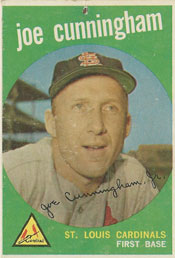
joe_cunninghamA left-handed batter and first baseman, Cunningham, 22, began the 1954 season at Class AAA Rochester. On June 28, 1954, the Cardinals came to Rochester to play an exhibition game versus the Red Wings. Cardinals manager Eddie Stanky said the prospect he was most interested in seeing was Cunningham.

Cunningham had two singles and walked twice in four plate appearances against the Cardinals.

Impressed, the Cardinals decided to promote Cunningham. On June 29, 1954, before the Red Wings played a doubleheader against Havana at Rochester, Cunningham was told he would be joining the Cardinals in Cincinnati the next day.

Cunningham was replacing rookie first baseman Tom Alston. In 66 games, Alston, the Cardinals’ first black player, hit .246 with four home runs and 34 RBI, but he slumped in June (.181 batting average for the month).

Whirlwind journey

Cunningham planned to catch an overnight train from Rochester to Cincinnati after playing both games of the doubleheader against Havana, but because of the length of the games, he missed the train.

A member of the Rochester publicity staff agreed to drive Cunningham from Rochester to the Buffalo airport the next morning. Cunningham took a flight from Buffalo to Cincinnati, arrived in the afternoon and went to the ballpark.

Cunningham barely had time “to bolt down a meal, sign a contract and learn the club’s signs,” the St. Louis Post-Dispatch reported.

Stanky put Cunningham in the starting lineup, batting him fifth against the Reds that night.

St. Louis slugger

In his debut game on June 30, 1954, Cunningham produced five RBI.

In the fifth inning, facing Art Fowler, a 32-year-old rookie, Cunningham hit a three-run home run for his first big-league hit, “a towering drive that landed well up into the right-field bleachers,” according to the Cincinnati Enquirer.

Cunningham followed with a two-run single off Harry Perkowski in the seventh, helping the Cardinals to an 11-3 victory. Boxscore

Immediately afterward, the Cardinals traveled to Milwaukee for a game the next day, July 1, 1954, against the Braves and their ace, Warren Spahn.

Cunningham hit two home runs off Spahn. The first was a 390-foot solo shot to right in the second inning. In the fifth, he connected for a three-run home run that landed just inside the right-field foul pole. The Cardinals won, 9-2. Boxscore

Dream come true

“This is just like a dream,” Cunningham said to the Associated Press. “I always wanted to be a big leaguer, but I had no idea it would come so soon.

“I left the minors in such a hurry I only brought along one pair of trousers,” Cunningham said. “I guess I’m still in a sort of shock. I had all my stuff at the cleaners and the only pants I’ve got are the ones I’ve been wearing.”

The next day, July 2, 1954, playing in his third game in his third city in three days, Cunningham was 1-for-3 with a single and a walk against the Cubs at Chicago. Boxscore

Cunningham finished the 1954 season with a .284 batting average, 11 home runs and 50 RBI in 85 games for the Cardinals.

In 12 big-league seasons, seven with the Cardinals, Cunningham hit .291 with 64 home runs. His single-season high in home runs was 12 for the 1958 Cardinals.
 

Read Full Post »

(Updated Oct. 23, 2017)

An overachiever with a team-oriented attitude, Joe McEwing was Tony La Russa’s kind of Cardinals player.

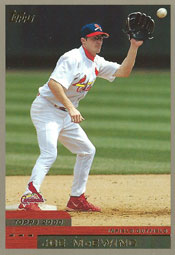
joe_mcewingMcEwing played for the Cardinals in 1998 and 1999 when La Russa was their manager. Called up from the minors in September 1998, McEwing, 25, made his big-league debut with the Cardinals and played in 10 games that month.

Ticketed for a utility role with the 1999 Cardinals, McEwing earned the second base job over Placido Polanco.

McEwing achieved a 25-game hitting streak from June 8-July 4. He broke the Cardinals rookie record held by Johnny Mize (22-game streak in 1936). McEwing’s streak was the longest by a Cardinals player since Lou Brock (26 consecutive games) in 1971.

“I appreciate Cardinal history,” McEwing said to columnist Bernie Miklasz of the St. Louis Post-Dispatch during the streak. “I’m a big fan of the game and to be mentioned in the same sentence with Johnny Mize, Lou Brock, Hall of Famers. You couldn’t ask for anything more.”

Asked whether he thought of the streak when he awoke each morning, McEwing replied to Miklasz, “When I get up, I worry about getting my coffee and doughnuts.”

Super streak

The streak began with a pair of singles against Royals starter Chris Fussell on June 8 at Kansas City. Boxscore

It reached 25 games in a row on July 4 with a home run off Diamondbacks starter Andy Benes, a former Cardinal. Boxscore

“He plays each game like it’s the seventh game of the World Series,” La Russa said of McEwing during the streak. “He is never different.”

Willie McGee, who had a 22-game streak for the 1990 Cardinals, said McEwing “deserves it. He works hard … He’s an outstanding person and an outstanding player.”

Beaten by the best

McEwing’s streak was snapped by Diamondbacks left-hander Randy Johnson on July 5. McEwing was 0-for-4 against Johnson, who won the National League ERA title and the second of his five Cy Young awards in 1999. In his last at-bat, McEwing lined out to left in the seventh with the bases loaded and two outs. Boxscore

“I told him he just got beat by a Hall of Famer,” La Russa said.

Added McEwing: “It was a good run and I enjoyed it.”

McEwing hit .318 during the streak, with 13 runs scored.

McEwing finished the 1999 season with a .275 batting average and 141 hits, including 28 doubles, in 152 games. He paced the Cardinals with 16 infield hits. McEwing made 85 starts at second base, 18 in center field, 16 in left and eight in right.

After the season, the Cardinals acquired second baseman Fernando Vina from the Brewers. During spring training in March 2000, the Cardinals traded McEwing to the Mets for reliever Jesse Orosco. McEwing helped the Mets win their first pennant in 14 years, eliminating the Cardinals in the National League Championship Series.

In eight big-league seasons with the Cardinals, Mets, Royals and Astros, McEwing batted .251 with 443 hits.

Read Full Post »

(Updated Sept. 1, 2024)

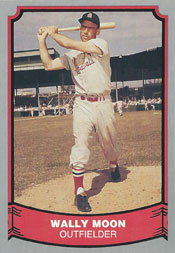
In 1954, outfielder Wally Moon became the first Cardinals rookie to reach double figures in home runs (12) and stolen bases (18) in a season.

wally_moon2Moon’s style of play reminded many of outfielder Enos Slaughter, who in 13 seasons with the Cardinals had a .305 batting average, with 2,064 hits in 1,820 games, and an on-base percentage of .384.

The Cardinals, confident in Moon’s talent, traded Slaughter to the Yankees two days before the start of the 1954 season.

In a YouTube video interview, Moon recalled the trade of Slaughter “really shocked the whole team; it shocked the city of St. Louis.”

On the eve of the 1954 season, The Sporting News reported Moon “can run, throw, field and _ presumably _ hit with the kind of balanced ability and hungry attitude the Cardinals used to have, the kind of combination of skills that gave rise to an old expression: a Cardinals-type ballplayer.”

Moon fulfilled expectations, batting .304 with 193 hits, 106 runs and an on-base percentage of .371 as a rookie. He earned the National League Rookie of the Year Award, outdistancing candidates such as Hank Aaron and Ernie Banks.

In a 1999 interview with Cardinals Yearbook, Moon said, “I usually batted leadoff. I had Red Schoendienst and Stan Musial hitting behind me. They ran my little legs off. I credit Red and Stan with helping me a great deal, on and off the field. They helped (teach) me how to control my emotions, that it was a long season, and how to grind it out day after day.”

Moon’s rookie season was highlighted by a pair of noteworthy performances.

Moon shot

In his first major-league at-bat, in the first inning of the Cardinals’ opener against the Cubs at St. Louis on April 13, 1954, Moon got a rude welcome from fans who missed Slaughter.

“I’m coming to bat in the bottom half of the first,” Moon recalled, “and they announce my name and the crowd starts chanting, ‘We want Eno. We want Eno.’ They were unhappy and I certainly could hear that.”

The first two pitches to Moon from Paul Minner were balls. The next pitch was a fastball “down the heart of the plate,” Moon said.

“I hit it and I hit it hard and I hit it high and I hit it long,” Moon said. “I hit it out of the ballpark, over the pavilion roof and onto Grand Avenue. I think somewhere I got a shot of adrenaline, a great surge of power. It’s probably one of the longest home runs I ever hit.

“About the time I got to second base with my home run trot _ it was more than a trot; I was running those bases _ those boos and chants had changed to a great roar of applause. It lifted a burden off my shoulders. I thank the Lord for giving me the strength on that particular day. It was exhilarating.” Boxscore

Moon became the second Cardinals player to hit a home run in his first time at-bat in the big leagues. The other was Eddie Morgan in 1936. “I don’t think I hit any farther than that one that season,” Moon recalled to Cardinals Yearbook.

Running wild

About a month later, on May 25, again against the Cubs at St. Louis, Moon had four steals, one short of the National League single-game record established by Dan McGann of the 1904 Giants.

All four stolen bases came against catcher Walker Cooper, 39, the former Cardinal.

“Moon gave Walker Cooper one of the most miserable days of the veteran catcher’s 15 seasons in the majors,” The Sporting News reported.

Moon swiped second base in the first inning with Johnny Klippstein pitching and he stole second again in the fourth with Jim Brosnan pitching.

In the fifth, after Moon singled off Brosnan, the Cubs brought in Jim Willis to pitch to Alex Grammas.

Moon stole second.

Then he stole third.

Rattled, Willis threw a wild pitch and Moon scored.

Angry, Willis plunked Grammas with his next delivery.

A Cardinals publicist sent word to manager Eddie Stanky that Moon needed one more steal to tie the record, but Moon flied out to left in his last at-bat.

“I would have given Moon every chance to get that fifth steal,” Stanky said. “He’s a nervy youngster.” Boxscore


Read Full Post »

(Updated Aug. 16, 2019)

In the season that produced his highest hits total, Cardinals center fielder Curt Flood had his best day as a hitter.

curt_flood6On Aug. 16, 1964, Flood got hits in eight consecutive at-bats in a doubleheader against the Dodgers at Los Angeles. Four of those hits came against Sandy Koufax.

Flood had a chance to tie the big-league record for consecutive hits in a doubleheader, but he made his only out of the day in his final at-bat.

“I’m mighty happy to have gotten eight hits, even though I couldn’t get that last one,” Flood said to United Press International.

Flood became the first National League player with eight hits in a doubleheader since Pirates shortstop Stan Rojek did it against the Dodgers at Pittsburgh in 1948.

Joe Kelley, a left fielder for the Orioles, established the record of nine consecutive hits in a doubleheader on Sept. 3, 1894, against Cleveland.

Entering the day with a .291 batting average, Flood was at .302 after his 8-for-9 performance. He would finish the season with a .311 batting average and a career-best 211 hits, tying him with Roberto Clemente of the Pirates as the 1964 National League hits leader.

With his wife, four children and parents in attendance, Flood batted leadoff in each game of the doubleheader.

Dandy vs. Sandy

In the opener, the Dodgers started Koufax, who that season would lead the National League in ERA (1.74) and winning percentage (.792 with a 19-5 record).

Koufax was dominant against everyone except Flood that day. The left-hander struck out 13 and shut out the Cardinals on seven hits. Flood, though, went 4-for-4 against him. Flood, a right-handed batter, hit .296 (32-for-108) in his career against Koufax.

Here’s what Flood did in Game 1:

_ First inning. Flood led off the game with a double down the left-field line. He was stranded at second when Koufax struck out Lou Brock and retired Dick Groat on a fly out and Ken Boyer on a pop out.

_ Third inning. With two outs and none on, Flood doubled to left, a shot just inside the third-base line. Koufax followed with a strikeout of Brock.

_ Fifth inning. Flood looped a single to right with two outs and none on.

_ Seventh inning. With Julian Javier on first and two outs, Flood lined a single to center, sending Javier to third. Koufax struck out Brock for the third time, ending the threat.

Koufax told the Los Angeles Times, “Flood always is tough … He was hitting good pitches.”

The Dodgers won, 3-0. Boxscore

Igniting the offense

In Game 2, Flood sparked the Cardinals against Larry Miller, a rookie left-hander. Here’s what Flood did in that game:

_ First inning. Flood laced a triple into the right-field corner and scored on Groat’s sacrifice fly.

_ Third inning. With one out and none on, Flood lined a single to center.

_ Fourth inning. With two outs, the bases loaded and Flood at the plate, Dodgers manager Walter Alston replaced Larry Miller with Bob Miller, a former Cardinals right-hander. Flood singled to right, driving in two runs and giving the Cardinals a 4-0 lead.

_ Sixth inning. Flood stroked his eighth consecutive hit, a two-out single to left off right-hander Phil Ortega.

_ Ninth inning. With the Dodger Stadium crowd cheering for him, Flood waited in the on-deck circle to face left-hander Ron Perranoski. According to the Los Angeles Times, “teammate Bill White helpfully threw a broom into the circle, and Bob Gibson needled his buddy by waving a fungo bat.” The attempt to lighten the mood didn’t work. Perranoski struck out Flood.

“Perranoski threw me some sinkers and I missed them,” Flood said to The Sporting News.

The Cardinals won, 4-0, behind the 4-for-5 effort by Flood and the pitching of Curt Simmons. Boxscore

When reporters gathered around Flood’s locker after the game, catcher Tim McCarver, Flood’s friend and teammate, put on an ape mask, grabbed a pencil and pad and joined the throng.

McCarver: “How do you explain how you make monkeys out of the Dodgers pitchers?”

Flood laughed and replied: “I am sore and tired. I should have saved that triple in the first inning of the second game. That ruined me.”

Previously: Sandy Koufax: ‘I still don’t know how to pitch to Curt Flood’

Read Full Post »

(Updated July 17, 2020)

For Bob Gibson, a win was more important than a record.

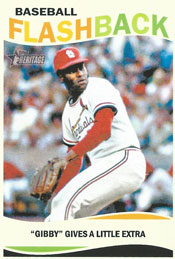
bob_gibson17Gibson became the first National League pitcher to achieve 3,000 career strikeouts. On July 17, 1974, the Cardinals ace struck out the Reds’ Cesar Geronimo to become the second big-league pitcher to strike out 3,000 batters.

Walter Johnson of the American League Senators struck out 3,509 from 1907-1927.

Gibson, 38, achieved his milestone by getting Geronimo to strike out on a high fastball to end the second inning. The crowd of 28,743 at Busch Stadium in St. Louis gave Gibson a lengthy standing ovation. As he neared the Cardinals dugout, he doffed his cap to the appreciative fans.

Before the game, quite aware Gibson was approaching the milestone, Reds first baseman Tony Perez ranked which teammates would be most likely to be Gibson’s 3,000th strikeout victim and he correctly predicted it would Geronimo, according to Bob Hertzel of the Cincinnati Enquirer.

With Tim McCarver catching on that Wednesday night, Gibson recorded three more strikeouts, including Johnny Bench and Geronimo again, before being lifted for pinch-hitter Luis Melendez in the seventh with the score tied at 4-4. The Reds won, 6-4, in 12 innings.

Pensive occasion

Afterward, reporters discovered Gibson departed the clubhouse quickly and wasn’t available to talk about his achievement.

In his book “Stranger to the Game,” Gibson said, “It wasn’t a grand occasion. I was taken out in the (seventh) for a pinch-hitter and we lost the game.”

Gibson yielded four runs and 10 hits, walking two.

“I thought he was getting a little tired,” Cardinals manager Red Schoendienst said to the Associated Press in explaining why he removed Gibson. “He was also leading off the (seventh) inning and I thought we might get a run.” Boxscore

Adding to a pensive atmosphere, despite the milestone strikeout, was the news Dizzy Dean, 64, had died that day. The Hall of Fame pitcher held the Cardinals’ record for career strikeouts (1,095) until Gibson surpassed the mark. Gibson finished his Cardinals career with a franchise-leading 3,117 strikeouts.

Geronimo struck out nine times in 21 career at-bats versus Gibson.

Big-name victims

The players who struck out the most against Gibson:

_ Willie Stargell, 41 strikeouts

_ Donn Clendenon, 37 strikeouts

_ Ron Santo, 35 strikeouts

_ Hank Aaron, 32 strikeouts

_ Roberto Clemente, 32 strikeouts

_ Tony Taylor, 32 strikeouts

The first big-league batter Gibson struck out was Willie “Puddin’ Head” Jones of the Reds on July 30, 1959. Boxscore

Jim Pagliaroni of the Pirates was the 1,000th batter to strike out against Gibson and Clemente was the 2,000th batter to do so.


Read Full Post »

Ozzie Smith and Matt Adams, opposites in size, shared at least one common trait: Both were able to drive in key runs for the Cardinals over a stretch of games.

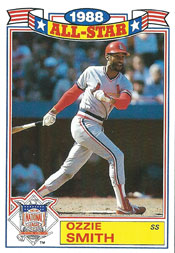
ozzie_smith8Adams in 2014 became the first Cardinals player to deliver game-winning RBI in four consecutive games since Smith did so in 1988, according to the Elias Sports Bureau.

A 6-foot-3, 260-pound first baseman, Adams primarily utilized power to produce his game winners in a stretch from June 13-16, 2014.

In three consecutive Cardinals wins over the Nationals at St. Louis from June 13-15, Adams hit a home run for the winning RBI in each game. The home runs were hit off Jordan Zimmerman, Stephen Strasburg and Doug Fister. The Cardinals won, 1-0, on June 13 Boxscore; 4-1 on June 14 Boxscore; and 5-2 on June 15. Boxscore

Adams snapped a 1-1 tie with a RBI-single off Jacob deGrom for the game-winning hit on June 16 in a 6-2 Cardinals victory over the Mets at St. Louis. Boxscore

Twenty-six years earlier, Smith used a very different combination of productive at-bats for his four consecutive game-winning RBI. A 5-foot-11, 150-pound shortstop, Smith had a bunt, but no home runs, among his game winners in a stretch from Sept. 8-11, 1988. Here’s what he did:

Cardinals 1, Phillies 0, at St. Louis, Sept. 8, 1988

The Cardinals had the bases loaded with two outs in the fifth inning when Smith came to bat against Phillies starter Kevin Gross. With the count at 3-and-2, Smith checked his swing and walked, forcing in Tony Pena from third base with the run. The Phillies appealed, saying Smith had swung and missed at strike three, but third-base umpire Steve Rippley upheld the call of home-plate umpire Fred Brocklander.

Phillies manager Lee Elia said Rippley blew the call.

Cardinals manager Whitey Herzog conceded to the St. Louis Post-Dispatch, “A lot of guys would have punched (Smith) out.” Boxscore

Cardinals 6, Cubs 2, at St. Louis, Sept. 9, 1988

With the Cubs ahead, 1-0, the Cardinals loaded the bases with one out in the sixth. Facing starter Calvin Schiraldi, Smith said he was trying for a sacrifice fly. Instead, he doubled off the right-field wall, driving in Jose Oquendo and Greg Mathews and giving the Cardinals a 2-1 lead.

Deflecting attention away from himself, Smith credited Pedro Guerrero, whom the Cardinals acquired from the Dodgers on Aug. 16, with boosting the offense. Guerrero had three RBI in the game.

“We’re a different team now,” Smith said. “We’re doing a lot more things with our pitching and a lot more with our offense. The addition of one person (Guerrero) has stabilized our offense.” Boxscore

Cardinals 9, Cubs 3, at St. Louis, Sept. 10, 1988

With the score tied at 2-2, Tom Pagnozzi at second and two outs, Smith doubled to center off starter Rick Sutcliffe, giving the Cardinals a 3-2 lead.

“What you’re seeing now is something that didn’t happen in spring training,” Smith said. “We never jelled offensively. We’re settling in now.” Boxscore

Cardinals 3, Cubs 2, at St. Louis, Sept. 11, 1988

In the seventh inning, with the score tied at 2-2, Curt Ford was on third with one out. With Smith at the plate, Herzog called for the squeeze play. Smith executed, dropping a bunt to the right side of the infield. Ford dashed home with the go-ahead run. The only play for pitcher Mike Harkey, who fielded the ball, was to toss to second baseman Ryne Sandberg, covering first, to retire Smith.

“You just hope you get a decent pitch and you can put it in play,” Smith said of the bunt.

Asked about the four consecutive game-winning RBI, Smith told the Post-Dispatch, “It’s good to be in a position to say you got the record game-winning RBI, but the important thing is we won the game.” Boxscore

Smith finished the 1988 season with 51 RBI and was tied with Pena for third on the team, behind Tom Brunansky (79) and Terry Pendleton (53). The Cardinals ranked 11th in the 12-team National League in both RBI (536) and runs (578).

Previously: Intimidation: Ozzie Smith, Will Clark and the Battle at Busch

Read Full Post »

« Newer Posts - Older Posts »