Feeds:
Posts
Comments

Archive for the ‘Records’ Category

Entering the 2003 season, some were concerned Woody Williams no longer was effective. The Cardinals pitcher was 36, his spring training ERA was 14.54 and he had been limited to 17 starts in 2002 because of two stints on the disabled list.
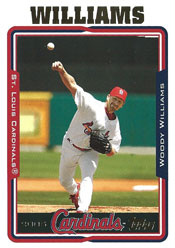
woody_williams3In the St. Louis Post-Dispatch, Joe Strauss asked whether an aging, fragile Williams would be treated by the Cardinals like “a pricey piece of red-and-white pitching porcelain.”

Instead, Williams opened 2003 like a staff pillar, posting three wins without allowing a run in his first three starts.

Here’s what Williams achieved:

_ Cardinals 7, Brewers 0, April 2, 2003, at St. Louis: Williams held Milwaukee to two hits in 6.2 innings. The Brewers were hitless until Eric Young tripled with two outs in the sixth. Milwaukee’s only other hit off Williams was a single by Jeffrey Hammonds in the seventh.

“I picture doing that every game,” Williams said. “That’s what I strive to do _ not a no-hitter, but every inning I pitch I want to get a zero.”

Mike Matheny backed Williams’ effort with a three-hit, two-RBI performance. Boxscore

_ Cardinals 3, Astros 0, April 12, 2003, at Houston: After skipping his second scheduled start at Colorado because of neck stiffness, Williams showed no signs of a problem against the Astros, pitching six scoreless innings and extending his streak to 12.2.

A Houston native, Williams improved his career record versus the Astros to 6-2. “I worked ahead and threw good pitches when I needed to,” Williams said.

In the first inning, Houston threatened when Geoff Blum singled and Jeff Bagwell doubled. Lance Berkman followed with a groundball to first baseman Tino Martinez, who threw to the plate to nail Blum. “That’s a veteran Gold Glove play to come up with that throw,” Cardinals manager Tony La Russa said.

“The play Tino made was huge,” said Williams. “It stopped the momentum.”

_ Cardinals 6, Diamondbacks 3, April 18, 2003, at St. Louis: Williams yielded three hits in seven scoreless innings. Arizona was hitless until Lyle Overbay singled with one out in the fifth. The Diamondbacks scored their runs in the ninth off Russ Springer.

Williams’ scoreless innings streak was at 19.2. “If he ever comes out there and doesn’t have real good stuff and real good location, we’re all going to pass out,” La Russa said. Boxscore

_ Braves 4, Cardinals 3, April 24, 2003, at Atlanta: Williams kept the Braves scoreless for 5.1 innings before the streak ended at 25 when Julio Franco scored from third on a Johnny Estrada single. Boxscore

Williams rewarded the 2003 Cardinals by producing 18 wins in 220.2 innings, both single-season career highs for him.

Previously: Deal for Woody Williams sparked 2001 Cardinals

Read Full Post »

From the very first game, Mark McGwire signaled that 1998 would be a special season for him.

mark_mcgwire3McGwire hit home runs in each of the Cardinals’ first four games of 1998, joining Willie Mays of the 1971 Giants as the only major-league players to begin a season in that manner. Since then, two others have done it: Nelson Cruz of the 2011 Rangers and Chris Davis of the 2013 Orioles, according to the Elias Sports Bureau.

The season-opening streak sparked McGwire to a record 70 home runs that year. Though tainted by subsequent revelations that McGwire used performance-enhancing drugs, the slugging feats remain official in the big-league record books.

McGwire’s home runs in the first four games of 1998 accounted for 12 RBI and lifted the Cardinals to three victories. Here is how it happened:

_ Cardinals 6, Dodgers 0, March 31, 1998, at St. Louis: Playing a regular-season game in March for the first time, the Cardinals’ opener was scoreless in the fifth inning when McGwire launched a grand slam off a floating change-up from Dodgers starter Ramon Martinez. Boxscore

The high drive carried 364 feet into the left-center stands at Busch Stadium II.

“You’re not going to see too many people hit a ball that high and have it leave the ballpark,” Dodgers left fielder Todd Hollandsworth said to the St. Louis Post-Dispatch.

Said McGwire to writer Rick Hummel: “It sort of surprised me the way it carried. I knew I hit it high enough. It was just a matter of far enough.

“I was juiced up. I don’t know my own strength. I hope I don’t hurt anybody.”

Speculation already was rampant that McGwire might challenge the single-season homer record of 61 by the Yankees’ Roger Maris. Under a headline of “McGwire’s Slam Drives Cards _ Countdown to 61 Begins,” Mike Eisenbath of the Post-Dispatch wrote in the lead paragraph of his game story, “Mark McGwire took what might be a first step toward immortality.”

_ Cardinals 8, Dodgers 5, April 2, 1998, at St. Louis: With two out in the 12th, McGwire hit a three-run walkoff home run off a curve from rookie reliever Frank Lankford. Boxscore

“You know anything is possible with him _ is that amazing?” said Cardinals manager Tony La Russa.

_ Padres 13, Cardinals 5, April 3, 1998, at St. Louis: McGwire’s two-run homer off Padres starter Mark Langston in the fifth was the highlight for St. Louis. Boxscore

_ Cardinals 8, Padres 6, April 4, 1998, at St. Louis: With the Cardinals clinging to a 3-2 lead in the sixth, McGwire provided a cushion with a three-run homer off reliever Don Wengert.

Counting the home runs he hit for St. Louis in the last two games of 1997, McGwire extended his long ball streak to six consecutive games over two seasons. Boxscore

“It’s unbelievable,” said Cardinals catcher Tom Lampkin. “(McGwire) has a chance to hit the ball out of the ballpark every time he walks up to the plate.”

McGwire’s streak ended on April 5, 1998, when he was limited to a single and a walk in five plate appearances against Padres starter Kevin Brown and reliever Trevor Hoffman. Boxscore

The Cardinals blew a 7-3 ninth-inning lead in that game and lost, 8-7. Wrote columnist Bernie Miklasz: “We have finally discovered Mark McGwire’s weakness: he can’t pitch.”

Previously: Willie McCovey and his legendary St. Louis home run

Read Full Post »

(Updated April 7, 2016)

In 1963, Cardinals starters opened the season by pitching shutouts in the team’s first three games.

curt_simmons2The 1963 Cardinals and 2016 Dodgers are the only major-league teams to start a season with three consecutive shutouts, according to the Elias Sports Bureau.

The Cardinals opened with wins of 7-0 and 4-0 over the Mets and 7-0 against the Phillies. Surprisingly, Bob Gibson didn’t pitch any of those games.

The Cardinals’ consecutive trio of shutouts were pitched by Ernie Broglio, Ray Washburn and Curt Simmons. Gibson, the Cardinals’ ace, had fractured his ankle in September 1962 and was being given extra time by manager Johnny Keane before making his first 1963 start. (Gibson’s 1963 debut came in the Cardinals’ sixth game.)

In previewing the 1963 season, The Sporting News had predicted success for the Cardinals’ rotation:

Keane does seem to have a fine front line of pitchers. (Ernie) Broglio, Bob Gibson and Ray Washburn are good enough to be named now among the National League hurlers likely to win 20 games in 1963. All have pitched brilliantly in exhibition games. Broglio is throwing with the smoothness that marked his work in 1960 and Gibson has given no indication that the fractured ankle will bother him at all. Washburn profited greatly by his two months in the winter instructional league.

Here’s how the 1963 Cardinals opened their season:

_ Cardinals 7, Mets 0, April 9, 1963, at New York: Broglio limited the Mets to two hits, both by second baseman and leadoff batter Larry Burright. Broglio retired 20 in a row from the second inning to the ninth. He walked two and struck out eight.

Burright led off the first with a single and Broglio held the Mets hitless until Burright led off the ninth with a double.

Broglio preserved the shutout by striking out catcher Choo Choo Coleman and retiring outfielders Ed Kranepool and Duke Snider on groundouts after Burright’s double. Boxscore

“We had trouble hitting, which is going to be a big problem all year,” Mets manager Casey Stengel said to the Associated Press after the game.

_ Cardinals 4, Mets 0, April 10, 1963, at New York: Washburn held the Mets to four singles (two by Kranepool and one each by Coleman and first baseman Tim Harkness) and retired 17 in a row from the second inning to the eighth. He walked one and struck out five. Boxscore

Wrote The Sporting News: Washburn’s route-going performance was especially eye-popping because he went all the way in only two of his 25 starts in his rookie campaign a year ago.

“I had good stuff and kept it all the way,” Washburn said. “I made some real good pitches on (slugger) Frank Thomas. He used to bother me quite a bit.”

Cardinals catcher Gene Oliver said Washburn’s successful outing was “mostly a matter of confidence and experience, knowing that he can throw any kind of pitch in a given situation instead of coming in with a fastball or slider most of the time.”

_ Cardinals 7, Phillies 0, April 13, 1963, at St. Louis: After a two-day break, the Cardinals won their home debut. Simmons pitched a five-hitter, walked two and struck out four. No Phillies baserunner reached third base. Boxscore

It was Simmons’ 10th win in 11 decisions against the Phillies since he signed with the Cardinals after his release by Philadelphia in May 1960.

Simmons set the tone in the first inning when Don Hoak, the Phillies’ third baseman and No. 2 batter, dropped to the ground to avoid being struck by a high and tight pitch. Hoak subsequently struck out.

“He (Simmons) has been doing that to me for years and I’ve taken all I’m going to,” Hoak said to The Sporting News. “The next time, I’m going after him.”

Unfazed, Simmons responded, “He’s not a good enough hitter to bother throwing at.”

Previously: Kyle Lohse effort is similar to Ernie Broglio classic in 1963

Read Full Post »

(Updated Dec. 27, 2024)

In 2003, Cardinals shortstop Edgar Renteria won both a Gold Glove Award and a Silver Slugger Award for the second season in a row.

edgar_renteria4The cumulative production numbers put up by Renteria in 2003 were unprecedented for a Cardinals shortstop: .330 batting average, 194 hits, 47 doubles, 13 home runs, 100 RBI and 34 stolen bases. The hits, doubles and RBI were single-season career highs for Renteria, who spent 16 years in the major leagues.

He was the first National League shortstop with 100 RBI since Hubie Brooks of the 1985 Expos.

“It’s not easy for a guy who is not a power hitter to get 100 RBI _ and I’m not a power hitter,” Renteria said to the St. Louis Post-Dispatch in September 2003.

Renteria came within six hits of joining Honus Wagner as the only National League shortstops to achieve 200 hits and 100 RBI in a season. Wagner had 201 hits and 109 RBI for the 1908 Pirates.

“To hit .330 with 100 RBI, a bunch of stolen bases and great defense _ what a year he’s had,” Cardinals manager Tony La Russa said to the Post-Dispatch in the final weekend of the 2003 season.

On Sept. 27, 2003, in the Cardinals’ next-to-last game of the season, Renteria got his 100th RBI when his fielder’s choice grounder to short scored Albert Pujols from third with the deciding run in St. Louis’ 3-2 victory over the Diamondbacks at Phoenix. Boxscore

Renteria twice drove in five runs in a game in 2003.

On April 13, in the Cardinals’ 11-8 victory over the Astros at Houston, Renteria hit a pair of home runs against Roy Oswalt and had five RBI. Boxscore

On Sept. 18, Renteria was 4-for-4 with two doubles and five RBI in the Cardinals’ 13-0 victory over the Brewers at St. Louis. Boxscore

Renteria hit .492 (30-for-61) with 17 RBI against the Brewers in 2003.

In his report card on the Cardinals’ 2003 season, Joe Strauss of the Post-Dispatch wrote, “Edgar Renteria compiled one of the best offensive seasons of the last 20 years by a National League shortstop while committing fewer errors (16) than during last year’s Gold Glove season (19).”

Looking back on his time with the Cardinals, pitcher Woody Williams said to Stan McNeal of Cardinals Magazine in 2024, “Edgar Renteria … had such a desire to win. He wasn’t a big talker, but I appreciated the way he carried himself and loved being around him. He was a pro all the time.”

Read Full Post »

(Updated Oct. 9, 2022)

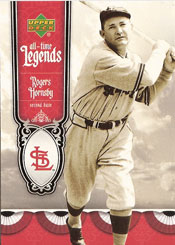
On Jan. 5, 1963, Rogers Hornsby, 66, died in a Chicago hospital from heart problems.

rogers_hornsby4Hornsby had entered the hospital Dec. 9, 1962, for cataract surgery. Five days later, he suffered a stroke. Hornsby appeared to be recovering until blood clots developed in his left leg and left arm. He died because the blood supply was cut off to his heart muscles.
In an obituary, The Sporting News called Hornsby “the game’s most formidable right-handed hitter.”

Stan Musial, when preparing for his 22nd and last Cardinals season in 1963, was quoted by United Press International as calling Hornsby the “greatest hitter of all time.”

The late Giants manager John McGraw had said Hornsby was “the best pivotman I have ever seen on a double play (and) a better hitter than Babe Ruth.”

Hornsby, a second baseman, played 13 years (1915-26 and 1933) for the Cardinals. He also played for the Giants, Braves, Cubs and Browns in a career that lasted until 1937. With the Cardinals, Hornsby batted .359 with 2,110 hits, 1,072 RBI, 3,342 total bases and a .427 on-base percentage. As player-manager, he led them to their first National League pennant and first World Series title in 1926.

Some of the records established by Hornsby as a Cardinal still exist today:

_ He’s the only National League player to twice (1922 and 1925) win the Triple Crown for leading the league in batting average, home runs and RBI.

_ His .424 batting average for the 1924 Cardinals is the highest single-season mark in the big leagues since 1901.

_ His slugging percentage of .756 for the 1925 Cardinals is the highest single-season mark for a right-handed batter in major-league history.

_ His on-base percentage of .507 for the 1924 Cardinals is the highest single-season mark for a right-handed batter in major-league history.

_ His 450 total bases for the 1922 Cardinals are the most for a right-handed batter in the big leagues and the most for a National League batter. Only Ruth had more, with 457 total bases in 1921.

_ From 1921 through 1925 with the Cardinals, Hornsby had a combined batting average of .402, the highest for a five-year stretch in major-league history.

_ His 250 hits for the 1922 Cardinals rate as the franchise’s single-season record.

_ His 102 extra-base hits in 1922 are the single-season high for a Cardinals right-handed batter. Musial had 103 in 1948.

A .358 career hitter (second only to Ty Cobb’s .367), Hornsby won seven National League batting championships, including six in a row with the Cardinals: .370 in 1920, .397 in 1921, .401 in 1922, .384 in 1923, .424 in 1924 and .403 in 1925. Hornsby also led the National League in on-base percentage and slugging percentage in each of those six years.

“If Rogers Hornsby, for at least the peak of his career, wasn’t the best hitter in baseball history, he’ll do until the real thing comes along,” Bob Broeg wrote in The Sporting News in 1973.

Some might say Albert Pujols was “the real thing” who came along for the Cardinals. Though Pujols was a better slugger than Hornsby (469 home runs as a Cardinal to 193 for “The Rajah”), Hornsby was the better hitter.

“My eyes are as good as they ever were,” Hornsby said when he turned 50 in 1946. “If my legs were OK, I could still hit .350.”

Read Full Post »

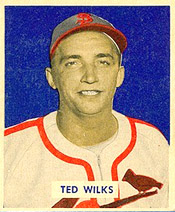
Ted Wilks was a right-handed pitcher who suffered from ulcers and had trouble controling his weight.

He also had an amazing knack for winning games for the Cardinals.

When Kyle Lohse built a 14-2 record for the 2012 Cardinals, he established the second-best mark in team history to begin a season. Only Wilks did better, according to the Cardinals.

A 28-year-old rookie, Wilks was 14-1 and eventually 15-2 in 1944. He split his final four decisions, finishing the regular season at 17-4 with a 2.64 ERA.

Manager Billy Southworth used Wilks, 5 feet 9 and 180 pounds, as a spot starter and reliever for the first part of the 1944 season. When George Munger went into the Army after posting an 11-3 record and 1.34 ERA, Wilks replaced him in the Cardinals’ rotation as the season entered July.

From July 2 through Aug. 29, Wilks won 11 consecutive decisions. During that stretch, he survived getting struck in the head by a line drive hit so hard that Southworth feared for Wilks’ life. The smash by Reds third baseman Steve Mesner during an Aug. 6 game at Cincinnati bounced high off Wilks’ skull and knocked out the pitcher. Boxscore

“Ted got out of that quite luckily,” Southworth told The Sporting News. “In my long experience in baseball, I’ve never seen anything quite like it.”

After striking Wilks, Southworth said, “the ball went about 40 feet into the air before (Whitey) Kurowski caught it at his regular third-base position. Wilks was knocked out and I’ll admit we were all pretty scared … Hit an inch lower, that drive could have been fatal.”

Said Wilks: “That ball came at me so fast I didn’t have time to duck.”

He recovered to pitch complete-game three-hitters in consecutive starts _ a 2-1 victory over the Cubs on Aug. 24 Boxscore and a 3-0 victory over the Reds on Aug. 29 that boosted Wilks’ record to 14-1. Boxscore

The son of a Polish immigrant who changed the family named from Wilzcek to Wilks when naturalized, Ted Wilks was born in Fulton, N.Y., about 20 miles from Syracuse. He joined the Cardinals’ organization as an amateur free agent in 1938 and spent six seasons in their minor-league system.

Because of ulcers, Wilks was classified 4-F and didn’t serve in the military during World War II. He was prone to gain weight, and headline writers poked fun at his waistline even while praising his pitching. Some examples from The Sporting News:

_ “Wilks Fills Out as Cardinals’ Fill-In”

_ “Chunky Ted Proves Winner”

_ “Chubby Righthander Rates Best of Majors’ Rookie Crop”

Frederick G. Lieb, a veteran baseball reporter, wrote: Ted is a husky young gent and needs to exercise to keep down to his best pitching weight of 175 pounds.

Regardless, Wilks was an effective pitcher. In 36 games (21 starts) for the 1944 Cardinals, Wilks had 16 complete games and four shutouts, helping them win the National League pennant.

In the 1944 World Series, Wilks started Game 3 but yielded four runs in 2.2 innings and got the loss in the Browns’ 6-2 victory. It was suspected that ulcers hampered Wilks in that start. Boxscore

Three games later, Wilks got another chance _ and delivered one of the greatest relief stints in Cardinals history.

In Game 6, Wilks relieved starter Max Lanier with one out and two on in the sixth. He retired all 11 batters he faced and preserved the Cardinals’ Series-clinching 3-1 victory. Boxscore

Converted to a reliever in 1946, Wilks thrived. He was 8-0 for the pennant-winning 1946 Cardinals, 4-0 for the 1947 Cardinals and 2-0 for the 1950 Cardinals.

In a 10-year major-league career with the Cardinals, Pirates and Indians, Wilks was 59-30.

Previously: Cardinals were victims of historic homers by Gil Hodges

Read Full Post »

« Newer Posts - Older Posts »