Feeds:
Posts
Comments

Archive for the ‘Records’ Category

(Updated Feb. 19, 2023)

In a classic example of the adage “if you can’t beat ’em, join ’em,” the pitcher who posted the worst career record against the Cardinals got traded to them and enjoyed the best stretch of his big-league tenure.
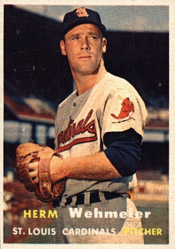
In 31 appearances against the Cardinals for the Reds and Phillies from 1949-1956, Herm Wehmeier was 0-14 with a 4.89 ERA.

(Yovani Gallardo has the second-worst career mark versus the Cardinals. In 19 starts against the Cardinals, Gallardo was 1-11 with a 6.45 ERA.)

Wehmeier’s 14th loss to St. Louis occurred May 9, 1956, in the Cardinals’ 3-0 victory over the Phillies. Boxscore

Two days later, on May 11, 1956, the Cardinals traded pitchers Harvey Haddix, Stu Miller and Ben Flowers to Philadelphia for Wehmeier and pitcher Murry Dickson. The deal was unpopular with many Cardinals fans. Haddix won 20 in 1953 and 18 in 1954. Though his record in 1955 fell to 12-16, many saw him as a pillar of St. Louis’ rotation.

Cardinals coach Terry Moore, who was the Phillies’ manager when Philadelphia acquired Wehmeier from the Reds in 1954, recommended Wehmeier to St. Louis general manager Frank Lane. According to The Sporting News, Lane said he sought Wehmeier “because he can be depended upon to trouble Brooklyn and Milwaukee, teams the Cards must stop to win.”

Cardinals pitching coach Bill Posedel was successful in working with Wehmeier. Reporting for The Sporting News, Bob Broeg wrote, “Wehmeier began to work with a high leg kick, similar to Paul Derringer’s, and … he concentrated on letting up on his fastball and curve when the opposition would expect the Wehmeier of old to try to bust his fastball by ’em.”

The results were impressive. Wehmeier won eight of nine decisions for the 1956 Cardinals from July 21 to Sept. 11. He saved his best for his last start of the year.

On the morning of Saturday, Sept. 29, the next-to-last day of the 1956 season, the Braves held first place in the National League, a half-game ahead of the Dodgers.

That day, the Dodgers swept a doubleheader against the Pirates. The Braves entered their night game at St. Louis knowing they needed to win to keep a share of first place. Milwaukee started its ace, Warren Spahn, against Wehmeier.

(In his autobiography, “I Had a Hammer,” Hank Aaron called Wehmeier “my worst nightmare,” because in 1955 he batted .105 against him, with two singles in 19 at-bats.)

Spahn and Wehmeier dueled into the 12th inning with the score tied 1-1. In the bottom of the 12th, Rip Repulski lashed a double against Spahn, scoring Stan Musial from second and giving the Cardinals a 2-1 victory. Boxscore

In Aaron’s book, Spahn said, “Beyond a doubt, that Saturday game in St. Louis was the most heartbreaking moment I had in 21 years of baseball.”

The loss dropped the Braves a game behind the Dodgers, who clinched the pennant the next day. The win capped a successful season for Wehmeier. The right-hander finished 12-9 with a 3.69 ERA for St. Louis. It would be the most single-season wins he’d post in his big-league career.

Wehmeier was named the Cardinals’ 1957 Opening Day pitcher by manager Fred Hutchinson. The assignment was especially important for Wehmeier because he would be facing the Reds in Cincinnati.

A Cincinnati native, Wehmeier had been an outstanding athlete at Western Hills High School. When he signed with the Reds at age 18, he was billed as a hometown hero. Instead, plagued by wildness and high expectations, Wehmeier was a bust. In nine seasons with the Reds, Wehmeier was 49-69. He issued more walks (591) than strikeouts (478) and became a target of fan hostility.

“He was one of the greatest natural athletes we ever had in Cincinnati,” Reds general manager Gabe Paul said. “But never in my long baseball experience have I heard a man booed as bitterly as was Wehmeier. Nothing he could do was right. Even when he won, they booed him.”

Wrote Broeg: “One of Wehmeier’s troubles as a Red was that the former Cincinnati high school hero tried too hard. The more red-necked he became and the harder he tried to throw, the wilder he became, either walking himself into trouble or getting the ball up where power hitters and others could swing for the fences.”

When Wehmeier took the mound in the Cardinals’ 1957 opener, his mother, father, sister and brother were in the stands. What they witnessed must have stunned many Reds fans. Wehmeier pitched a complete game and got the win in the Cardinals’ 13-4 victory. Boxscore

Wehmeier was winless in May and June, but recovered to win five consecutive decisions from Aug. 24 to Sept. 15. He finished the 1957 season at 10-7 with a 4.31 ERA.

In May 1958, Wehmeier was sent to the Tigers in a waiver deal. He suffered an elbow injury soon after and, at 31, his playing career was done. His big-league record: 92-108. For St. Louis, Wehmeier was 22-17.

Wehmeier scouted for the Reds for three years (he recommended they sign another phenom from Western Hills High School, Pete Rose) and then left baseball. He worked for a trucking company in Texas.

In May 1973, Wehmeier, 46, was testifying during a theft trial in federal court in Dallas when he suffered a fatal heart attack. In an obituary, The Sporting News reported, “Wehmeier was on the witness stand testifying for the government when he collapsed. The case involved theft of merchandise from a shipping company of which Wehmeier was an official.”

Previously: An interview with former Cardinals pitcher Al Jackson

Read Full Post »

(Updated Sept. 25, 2016)

Barry Larkin played shortstop with distinction for the Reds from 1986-2004, but for most of the first half of his career he was overshadowed by the Cardinals’ Ozzie Smith.

In a classy twist, Smith witnessed and cheered Larkin’s greatest individual feat on a baseball field.
Smith won the Gold Glove Award among National League shortstops in each of Larkin’s first seven seasons in the major leagues, including 1990, when Larkin helped lead Cincinnati to its most recent World Series championship.

Larkin didn’t win the first of his three Gold Glove awards until 1994, the year Smith turned 40. Smith, who won the Gold Glove Award 13 times, was inducted into the National Baseball Hall of Fame in 2002.

In 2012, it was Larkin’s turn.

Larkin, 1995 winner of the NL MVP Award, had 2,340 hits and a .295 career batting average.

Larkin had several memorable performances against the Cardinals, including a pinch-hit grand slam off reliever Steve Kline in St. Louis’ 11-10 victory over the Reds on July 28, 2004, at Cincinnati. Boxscore

Larkin’s greatest moment against the Cardinals occurred in the first game of a Sunday afternoon doubleheader on Sept. 22, 1996, at Cincinnati.

In the fifth inning, with St. Louis ahead 3-1, Larkin launched a home run, his 30th of the season, over the left-field wall against starter Donovan Osborne. With that solo shot, Larkin became the first shortstop in major-league history to achieve 30 homers and 30 stolen bases in a season.

As he rounded first base, Larkin thrust both fists in the air in jubilation. Smith, positioned at shortstop for the Cardinals, hollered his congratulations as Larkin trotted past him.

Asked afterward to assess Larkin’s feat, Smith told the Associated Press, “It gives him his own spot in history. It’s a great accomplishment.”

Larkin became the 17th player in big-league history to achieve 30 homers and 30 steals in a season. Fifteen were outfielders and the other, Howard Johnson of the Mets, was a third baseman.

Larkin finished the 1996 season with 33 homers and 36 steals. He would achieve the steals standard again (with 30 in 1999, his fifth season of 30 or more steals), but he never came close to matching 30 homers.

Previously: Ken Boyer belongs in Hall of Fame

Read Full Post »

The Astrodome opened in Houston in 1965 and was billed “the eighth wonder of the world.” To the Cardinals, there was nothing wonderful about it.

The Cardinals lost the first five games they played at the Astrodome, scoring a total of eight runs. They were swept by the Astros in a three-game series in May, losing by scores of 6-1, 3-2 and 4-3, and were swept again, in a two-game series, in July, losing by scores of 2-0 and 3-2.

When the Cardinals returned to Houston Sept. 30 to close the 1965 regular season with a four-game series against the Astros, they were in seventh place in the National League at 77-80 and the Astros were ninth at 64-94.

Based on how the Cardinals produced in their first two trips to the Astrodome _ and with regulars such as third baseman Ken Boyer, first baseman Bill White and shortstop Dick Groat out of the lineup as manager Red Schoendienst took a look at younger players _ there was no way to anticipate the breakout performance St. Louis was about to unleash.

The Cardinals produced 19 RBI in defeating Houston, 19-8, before a Sept. 30 Thursday night gathering of 7,494.

The 19 RBI are the third-highest total in Cardinals history. Others that surpassed or matched it:

_ 25 RBI for St. Louis in the Cardinals’ 28-6 victory over the Phillies on July 6, 1929. Boxscore

_ 20 RBI for St. Louis in the Cardinals’ 21-5 victory over the Giants on Aug. 2, 1948. Boxscore

_ 19 RBI for St. Louis in the Cardinals’ 20-2 victory over the Dodgers on July 24, 1937. Boxscore

Against Houston, the Cardinals started a lineup that included right fielder Mike Shannon batting cleanup, rookie George Kernek (.143 batting average) playing first base, and Jerry Buchek (.227) at shortstop, Phil Gagliano (.241) at third base and Dal Maxvill (.135) at second base.

All nine Cardinals starters produced at least one RBI in the game. Starting pitcher Nelson Briles had two. His two-run single highlighted a six-run first that chased Astros starter Jim Ray.

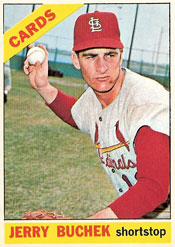
The Cardinals scored in every inning except the second and the third. Buchek, batting seventh, had a game-high five RBI. He had a two-run home run against Dave Giusti in the fifth, a RBI-groundout in the seventh and a two-run double in the ninth.

Gagliano and Maxvill each had three RBI. Left fielder Lou Brock and center fielder Curt Flood had four hits apiece. Brock singled twice in the first.

The Cardinals led 16-2 in the seventh. When the game finished in a relatively snappy 2:49, the Cardinals had 19 runs on 19 hits and seven walks. Boxscore

Part Three: Forsch vs. Forsch: Bob had edge in brotherly matchup

Part One: Cardinals first visit to Houston

Read Full Post »

When the Houston Colt .45s began play in the National League in 1962, one of the most anticipated homestands was the one with the Cardinals.

Houston had been a Cardinals minor-league affiliate from 1921-35 and from 1946-58. Many in the region were Cardinals fans.
The 1962 Cardinals had several close connections to Houston. Cardinals manager Johnny Keane and pitching coach Howie Pollet were Houston residents. Keane had played for Houston (1934-37) and also had managed the club (1946-48). Pollet had pitched for Houston (1939-41).

Also, Cardinals coach Harry Walker had been the last Houston manager (1956-58) while it was a Cardinals affiliate. Top 1962 Cardinals players, such as third baseman Ken Boyer and pitcher Larry Jackson, had played for the Houston farm club.

St. Louis made its first visit to Houston for the second homestand in Colt .45s history (the franchise changed its name to Astros in 1965). The Cardinals and Colt .45s were scheduled for three midweek night games April 24-26.

The Cardinals won one, lost one and tied another. Two games each were decided by a run and the other ended in a tie after 17 innings.

According to Clark Nealon of the Houston Post in a story for The Sporting News, Houston “waited years for the first National League series with the St. Louis Cardinals and when it came it was tremendous.”

Houston 4, Cardinals 3, April 24, 1962

In pre-game ceremonies, The Sporting News reported, each member of the Cardinals was “introduced individually to ringing applause.”

At the end, the cheers were for Houston starter Hal Woodeshick, who pitched a six-hitter.

Houston left fielder Don Taussig, who had played for the Cardinals in 1961, hit a solo home run off Jackson in the sixth.

With one on and two outs in the ninth, Bill White ripped a sinking liner that Houston right fielder Johnny Weekly snared at his shoetops.

Attendance was 19,335 _ impressive for a weeknight at a ballpark that seated about 25,000. Boxscore

Cardinals 5, Houston 5, 17 innings, April 25, 1962

In the afternoon, Keane was honored at a Chamber of Commerce luncheon and presented with a replica of a Colt .45 gun. He told the audience, “We’re a lot better club than we showed you on April 24.”

The Cardinals’ manager again was honored in ceremonies before the game. Among his gifts was a king-sized pass to “the first World Series game in Houston.” (It would be 2005 before Houston made its first World Series appearance.)

The game began at 8:02 p.m. It was halted at 1:15 a.m. because of a local curfew in Houston that forbid starting an inning after 12:50 a.m. The game was replayed on another date but all the statistics counted.

Boyer’s RBI-single to left in the ninth off Turk Farrell scored Julian Javier from second, tying the score 5-5.

Ed Bauta pitched eight scoreless innings for the Cardinals after entering in the 10th.

The Cardinals had runners on first and second with no outs in the top of the 17th, but Doug Clemens struck out and Red Schoendienst hit into a double play.

Six Houston pitchers struck out 18 Cardinals, including Boyer three times. Houston left 16 runners on base and the Cardinals stranded 15. Boxscore

Cardinals 3, Houston 2, April 26, 1962

The Cardinals were spared embarrassment by salvaging a victory in the series. Bob Gibson pitched a two-hitter for his first win of the season and Stan Musial drove in the deciding run with a two-out single in the eighth, scoring Curt Flood from third base. Boxscore

Part Two: Cardinals broke Astrodome hex with 19 RBI in one game

Part Three: Forsch vs. Forsch: Bob had edge in brotherly matchup

Read Full Post »

(Updated Dec. 21, 2024)

Lost amid the historical splendor of Albert Pujols’ performance in Game 3 of the 2011 World Series was the achievement of Yadier Molina.

Though it paled in comparison to the hitting of Pujols (the first Cardinals player with three home runs, five hits and six RBI in a World Series game), Molina also accomplished a franchise standard in Game 3.
Molina became the first Cardinals catcher with four RBI in a World Series game.

Molina produced a two-run double in the fifth inning off Scott Feldman, a sacrifice fly in the sixth off Mike Gonzalez and a RBI-double in the eighth off Mark Lowe in the Cardinals’ 16-7 victory over the Rangers Oct. 22. Boxscore

The performance by Molina continued a remarkable year for him at the plate. In the regular season, Molina hit a team-best .305, with 32 doubles, 14 home runs and 65 RBI.

Asked about his hitting approach, Molina said to Stan McNeal of Cardinals Yearbook in 2019, “One thing my dad told me was never strike out. Try to hit the ball. That’s something that has stayed with me. When I get two strikes, I just try to hit the ball.

“Right now, players want to hit the ball so hard, but they’re striking out too many times. Why? If you hit the ball 100 mph but strike out more than 100 times, why don’t you hit the ball 95, 90 mph and get base hits? They’re trying to hit the ball 450 feet, but you can hit it 380 and still get a home run.”

Recalling how Yadier learned to hit as a youth in Puerto Rico, his brother Bengie Molina, who also played in the majors, said in an article he did for the 2019 Cardinals Yearbook, “Our game was tape ball. We’d get a newspaper and scrunch it into the shape of a ball, then wrap it with electrical tape. For hitting, we’d cut a broomstick down to the length of a bat.

“We also learned to hit by doing a really challenging drill with my dad. He would sit in a chair and flip corn kernels or dried beans to us, which we tried to hit with a broomstick … The more we practiced that drill, the better our hand-eye coordination got. I believe that’s one reason Yadi has never struck out much.”

Until Game 3 of the 2011 World Series, Molina had played in 10 World Series games over three years (2004, 2006 and 2011) and had produced one RBI. That came on a double in Game 4 of the 2006 World Series against the Tigers. Boxscore

Tim McCarver and Joe Garagiola had held the club record for most RBI by a catcher in a World Series game, with three. McCarver did it twice. As a broadcaster on the telecast of the Cardinals-Rangers Game 3, McCarver witnessed Molina’s performance.

Here’s a look at the three-RBI games by McCarver and Garagiola:

TIM McCARVER

In each World Series game in which McCarver drove in three runs, one swing produced the RBI each time.

In Game 5 of the 1964 World Series, McCarver hit a three-run home run off Yankees reliever Pete Mikkelsen in the 10th inning, snapping a 2-2 tie and carrying the Cardinals to a 5-2 victory. Boxscore

Four years later, McCarver launched a three-run, fifth-inning home run off reliever Pat Dobson in the Cardinals’ 7-3 Game 3 victory over the Tigers in the 1968 World Series. Boxscore

JOE GARAGIOLA

One of three Cardinals in the game to get four hits (Whitey Kurowski and Enos Slaughter were the others), Garagiola drove in his three runs off three relievers in St. Louis’ 12-3 victory over the Red Sox in Game 4 of the 1946 World Series. Boxscore

Garagiola had a RBI-single off Jim Bagby in the third inning, a RBI-double off Bill Zuber in the seventh and a RBI-single off Mace Brown in the ninth.

Read Full Post »

(Updated July 2, 2014)

When it comes to double plays, the Cardinals, more than any other National League franchise, have experienced the extremes.

The 2011 Cardinals set the NL single-season record for grounding into the most double plays, with 169. The 1958 Cardinals had held the NL mark of 166. The single-season major-league record for double plays is 174 by the 1990 Red Sox.

A Cardinals team also holds the NL and major-league single-season record for grounding into the fewest double plays. The 1945 Cardinals hit into 75.

Because of military service during World War II, the 1945 Cardinals were without top hitters such as Stan Musial, Enos Slaughter, Harry Walker, Terry Moore, Walker Cooper and Danny Litwhiler.

The lineup was short on sluggers but loaded with contact hitters who ran the bases exceptionally well.

In its Sept. 6, 1945, edition, The Sporting News wrote of the Cardinals:

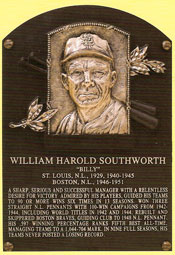
Despite the fact the Redbirds have gained a nationwide reputation as speedboys in winning their last three pennants, (manager) Billy Southworth’s scheme of attack is based more on the hit-and-run, and taking that extra base on a hit, than trying to steal his way around.

The 1945 Cardinals ranked first in the NL in hits (1,498) and second in runs (756) and sacrifice hits (138).

Third baseman Whitey Kurowski was the lone Cardinal to reach double figures in hitting into double plays (10).

Reserve outfielder Augie Bergamo had 304 at-bats and never hit into a double play.

Among the regulars, rookie left fielder Red Schoendienst had 565 at-bats, 157 hits and grounded into just six double plays. Center fielder Buster Adams slugged 20 home runs and 26 doubles in 578 at-bats, with just eight double plays. Second baseman Emil Verban struck out only 15 times in 597 at-bats and hit into just nine double plays.

To put that into perspective, Pirates first baseman Babe Dahlgren hit into 23 double plays in 1945 and Reds first baseman Frank McCormick hit into 20. Each was one of four players on his team to reach double figures in hitting into double plays.

Even though Kurowski, Schoendienst, shortstop Marty Marion, first baseman Ray Sanders, outfielder Johnny Hopp and catcher Ken O’Dea all missed games because of injuries, Billy Southworth had the 1945 Cardinals playing fundamentally sound baseball. St. Louis posted a 95-59 record and finished in second place, three games behind the Cubs.

In the Oct. 4, 1945, edition of The Sporting News, Frederick G. Lieb wrote:

Nothing but praise can be bestowed on Billy Southworth for his grand job in keeping the Cards in the race until next to the last day of the season. Everyone votes it Billy’s greatest managerial job … There was scarcely a day that he had his regular lineup in the field.

Read Full Post »

« Newer Posts - Older Posts »