Feeds:
Posts
Comments

Archive for the ‘Records’ Category

(Updated May 4, 2018)

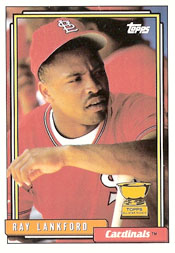
In a sport noted for great center fielders, the Cardinals’ Ray Lankford established a production standard for the position that largely hasn’t received the attention it deserves.

In 1992, Lankford became the first center fielder in major-league history to achieve at least 40 doubles, 20 home runs and 30 steals in a season.
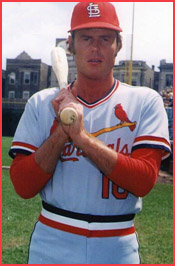
Since then, two others have accomplished the feat: Carlos Beltran of the 2002 Royals (44 doubles, 29 homers, 35 steals) and Jacoby Ellsbury of the 2011 Red Sox (46 doubles, 32 homers, 39 steals), according to MLB.com.

Lankford (40 doubles, 20 homers, 42 steals) remains the only National League center fielder to meet the standard.

Four others who came close to achieving those numbers were Willie Mays of the 1959 Giants, Vada Pinson of the 1959 Reds, Andre Dawson of the 1980 Expos and Mike Trout of the 2013 Angels.

Mays (43 doubles, 34 homers, 27 steals) missed by three stolen bases; Pinson (47 doubles, 20 homers, 21 steals) missed by nine stolen bases; Dawson (41 doubles, 17 homers, 34 steals) missed by three home runs; and Trout (39 doubles, 27 homers, 33 steals) missed by one double.

Hall of Fame center fielders such as Ty Cobb, Tris Speaker, Joe DiMaggio, Mickey Mantle and Duke Snider never came close. Same with other top center fielders such as Ken Griffey Jr. (he missed by 12 steals in 1991, the only season he had a chance to match Lankford), Jim Edmonds, Bernie Williams, Kirby Puckett, Andruw Jones, Dale Murphy and Torii Hunter.

Lankford did it in dramatic fashion: his last two hits of 1992 were a double and a home run, putting him exactly at the 40 and 20 totals for those categories.

On Oct. 2, 1992, in the opener of a season-ending three-game series with the Phillies at St. Louis, Lankford hit a two-out, sixth-inning double to right off Curt Schilling. (The Cardinals won, 2-1, even though Schilling pitched a four-hitter). Boxscore

After going 0-for-4 the next day, Lankford went into the season finale on Sunday, Oct. 4, needing a home run to reach 20. He got it in the first inning _ a two-run blast to right-center off Tommy Greene, giving the Cardinals a 2-0 lead in a game they won, 6-3. Boxscore

The home run also enabled Lankford to become the first Cardinals player to achieve 20 homers and 20 steals in a season since Lou Brock in 1967.

Although Lankford struck out a NL-leading 147 times, the 1992 season was a breakthrough for him. Thanks, in large part, to the work of first-year hitting coach Don Baylor, Lankford led the Cardinals in 13 offensive categories. After hitting .251 with nine homers and 69 RBI in 1991, Lankford batted .293 with 20 homers and 86 RBI in 1992.

When Baylor resigned after the 1992 season to become manager of the Rockies, St. Louis general manager Dal Maxvill told The Sporting News, “His importance to the Cardinals was demonstrated by the development of our young hitters last season, especially Lankford.”

After 1992, Lankford hit 20 or more homers five times and topped 30 steals once more, but he never again achieved 40 doubles in a season.

Read Full Post »

(Updated April 9, 2019)

Dave Campbell’s brief career with the Cardinals was most notable for what he didn’t do.

In 21 at-bats for the 1973 Cardinals, Campbell failed to get a hit.

Campbell went 45 consecutive at-bats without a hit in 1973. His streak occurred while playing for three teams.

In 2019, Chris Davis of the Orioles set a major-league record for a position player by extending his hitless streak to 47 consecutive at-bats.

Campbell, an ESPN baseball broadcaster from 1999-2010, began his seventh big-league season in 1973 as an infielder for the Padres. He went hitless in his last 17 at-bats for San Diego before he was traded to the Cardinals for infielder Dwain Anderson on June 7, 1973.

In 24 plate appearances in 13 games for St. Louis, the best Campbell could achieve was a walk, a sacrifice bunt and a sacrifice fly.

Campbell’s lone batting highlight as a Cardinal came on July 10, 1973, against the Dodgers at Los Angeles. In the top of the seventh, with the Dodgers ahead 2-1, the Cardinals had Jose Cruz on third, Mike Tyson on first and one out when manager Red Schoendienst called on Campbell to pinch-hit for pitcher Tom Murphy.

Facing Dodgers starter Claude Osteen, Campbell hit a sacrifice fly to center, scoring Cruz with the tying run. The Cardinals went on to a 5-4 victory. Boxscore

Campbell’s final at-bat as a Cardinal came on Aug. 17, 1973, at St. Louis against the Padres. After San Diego scored twice in the 13th inning, snapping a 2-2 tie, the Cardinals had Ted Simmons on second and Hector Cruz on first with two out. Schoendienst chose Campbell to pinch-hit for pitcher Diego Segui. Campbell popped out to second base, ending the game. Boxscore

The next day, the Cardinals traded Campbell to the Astros for outfielder Tommie Agee. St. Louis, in first place in the National League East, was seeking to bolster its bench for a pennant push.

“It’s tough to leave a club that is in first place and has a shot at the big money,” Campbell told The Sporting News. “But due to my past association with (Astros coach) Preston Gomez it could be a break for me. Preston was the manager at San Diego when I was a regular there for four years. So he knows what I can do.”

After a 17 at-bat hitless streak for the Padres and a 21 at-bat hitless streak for the Cardinals, Campbell went hitless in his first seven at-bats for the Astros, tying the major-league mark of 45 consecutive hitless at-bats by a non-pitcher.

On Sept. 19, 1973, in the opener of a doubleheader against the Padres at Houston, Campbell hit a two-run double against Clay Kirby in the first inning, breaking his drought. Boxscore  Campbell had four hits in the doubleheader: two in each game.

In an eight-year big-league career, Campbell batted .213.

Read Full Post »

(Updated May 5, 2018)

On July 29, 2011, Albert Pujols became the first right-handed batter in 85 years to achieve 2,000 hits as a Cardinal. Pujols got his 2,000th hit, a double, against Cubs reliever Carlos Marmol.

Pujols became the fifth player to collect 2,000 hits as a Cardinal. Pujols finished his Cardinals career with 2,073 hits before becoming a free agent and joining the Angels after the 2011 World Series.

Stan Musial (3,630), Lou Brock (2,713), Rogers Hornsby (2,110) and Enos Slaughter (2,064) also achieved 2,000 hits as Cardinals. Of those four, only Musial played his entire big-league career with St. Louis. The career hit totals of the others: Brock (3,023), Hornsby (2,930) and Slaughter (2,383). Pujols achieved his 3,000th career hit on May 4, 2018.

Here is a look at the 2,000th Cardinals hit for each of the four who achieved the feat before Pujols did:

ROGERS HORNSBY

At age 30, Hornsby became both the youngest and the first to reach 2,000 hits as a Cardinal.

The player-manager achieved the milestone with a single against Don Songer of the Pirates on June 23, 1926, at St. Louis.

Hornsby, playing second base and batting third, received greater attention for his 2,001st hit _ a grand slam off Songer in the seventh inning, lifting St. Louis to a 6-2 victory. Boxscore

The Cardinals, who entered the game in third place, went on to win the pennant and their first World Series title that year.

STAN MUSIAL

With a fourth-inning single against the Phillies’ Curt Simmons on Sept. 9, 1952, at Philadelphia, Musial became the first of three left-handed batters to achieve 2,000 hits as a Cardinal.

Batting third and playing first base, it was Musial’s only hit in five at-bats that Tuesday night, but it extended his hitting streak to 14 games. The Cardinals overcame a 4-2 deficit with a five-run ninth inning, winning 7-4. Boxscore

Musial, 31, went on to earn his sixth National League batting championship (.336) that season.

ENOS SLAUGHTER

In his last season with St. Louis, Slaughter, 37, still was a productive everyday player.

Batting cleanup and playing right field, Slaughter’s 2,000th hit as a Cardinal was a RBI-single that scored Red Schoendienst from second, snapped a 2-2 tie in the third and knocked out Dodgers starter Russ Meyer on July 18, 1953, at Brooklyn. The Dodgers erupted for nine runs in the fourth and won, 14-6. Boxscore

The loss was the sixth in a row for the Cardinals, who fell eight games behind the first-place Dodgers. Slaughter was traded to the Yankees the following April.

LOU BROCK

In 1974, Brock, 35, seemed to set a record a day for the Cardinals.

On July 28, 1974, his leadoff single in the seventh inning against Cubs reliever Oscar Zamora gave the left fielder his 2,000 hit as a Cardinal. St. Louis scored a run in the eighth to tie and another in the ninth to win, 5-4, at Chicago. Boxscore

The next day, Brock stole his 700th career base in a game the Cardinals won, 11-4, against the Cubs. Boxscore

Watching Brock excel had to be torment for Chicago. Brock began his big-league career with the Cubs in 1961 and had 310 hits for them before being traded to St. Louis in June 1964.

Brock achieved his 2,000th major-league hit _ a single against Larry Gura of the Cubs to lead off the 15th inning _ on Sept. 30, 1972, at Chicago. The Cardinals won, 2-1, in 16. Boxscore

As a Cardinal, Brock batted a career-best .334 against the Cubs, with 342 hits and 103 RBI.

Read Full Post »

(Updated July 12, 2020)

With one swing of the bat, the Cardinals’ Stan Musial won the 1955 All-Star Game for the National League.

In 2011, MLB.com asked fans to vote for the best All-Star Game moment. Musial’s 12th-inning walkoff home run at Milwaukee on July 12, 1955, was voted the best.

It was Musial’s fourth All-Star Game homer. He would hit two more All-Star Game home runs, giving him six for his career. That remains the record. The runners-up are Ted Williams and Fred Lynn, each with four.

Warming up

In batting practice before the 1955 game, the National League players were told they would get just one swing each the last time around. “Tell you what let’s do,” Duke Snider of the Dodgers told Musial and Ted Kluszewski of the Reds. “Let’s swing from the heels and go for the distance.”

According to The Sporting News, Musial went first and and sent a shot into the right-field bleachers, near where he would later hit his game-winning homer. Kluszewski sent an even deeper blast over the fence. When Snider stepped in, he took a mighty swing _ and missed. “Serves me right,” Snider said.

Wild swings

Musial wasn’t named an all-star starter in 1955. He entered in the fourth inning as a replacement for Del Ennis in left field and wasn’t much of a factor for most of the game. Musial struck out in the fourth against Early Wynn, grounded into a double play in the sixth against the same pitcher, and tapped to second baseman Bobby Avila in the eighth with Whitey Ford on the mound. In the ninth, Musial drew a walk from Frank Sullivan of the Red Sox.

In the dugout, all-star teammate Frank Thomas told Musial, “You’ve been pulling your head, trying to kill the ball,” the St. Louis Post-Dispatch reported.

Musial admitted to the St. Louis Globe-Democrat, “I was going for the bundle the two previous times up.”

Just meet the ball

With the score tied at 5-5, Musial was the first to bat for the National League in the bottom of the 12th. “This time, I was just trying to get on base,” Musial told the Globe-Democrat.

As Musial approached the batter’s box, American League catcher Yogi Berra, who had been bantering happily with him throughout the game, was grumbling.

“What’s the matter, Yogi?” Musial asked.

“It’s these extra innings,” Berra replied. “Tough on a guy catching every day.”

As Musial dug in at the plate, he said, “Yeah, I’m getting tired, too.”

Sullivan’s first pitch to Musial was a fastball just above the waist. Musial uncoiled and met the pitch squarely. “The moment Musial connected, everyone in the park, including Sullivan, knew that the ballgame was over,” The Sporting News reported.

The home run gave the National League a 6-5 victory. Boxscore and Video

After Musial crossed the plate, his teammates wanted to carry him off the field, but Musial resisted the gesture.

Obliging every media request for a picture or interview, Musial was one of the last players to leave the locker room. Most of the National League stars were waiting aboard the team bus when Musial emerged from the clubhouse and got surrounded by adoring fans.

“It took a squad of police to disperse the happy crowd and hustle Musial to the waiting bus,” The Sporting News reported. “For the final run of about 100 feet from the point where the crowd had Stan pinned against a wall to the (bus), five police officers formed a wedge with Musial in the middle and forced their way through the throng. They had the most difficulty with a middle-aged matron who was intent upon kissing Musial.”

Read Full Post »

(Updated April 23, 2026)

In 1948, Stan Musial became the first Cardinals player to hit walkoff home runs in consecutive games.

No Cardinal matched the feat until Albert Pujols did it June 4 and June 5 in 2011 against the Cubs, according to the Elias Sports Bureau.

On Aug. 26, 1948, in the second game of a doubleheader against the Giants at St. Louis, Musial batted in the ninth inning with a runner on first, one out and the score tied at 5-5.

Facing Ken Trinkle, a right-handed reliever, Musial launched a home run, giving the Cardinals a 7-5 walkoff victory. Boxscore

In the next game, Aug. 28 against the Giants at St. Louis, Musial batted in the 12th with one out, the bases empty and the score tied at 4-4. Facing starter Monty Kennedy, a left-hander, Musial cracked a home run, giving the Cardinals a 5-4 victory. Boxscore

In his autobiography, “Stan Musial: The Man’s Own Story,” Musial indicated the Cardinals turned up their intensity when playing the Giants because of the presence of manager Leo Durocher, a relentless antagonist. In July 1948, in a move that shocked the baseball world, Durocher left the Dodgers and became manager of the Giants, replacing Mel Ott.

The 1948 Cardinals were 11-1 against the Giants after Durocher joined them.

“Leo liked to play the game rough, liked to make it a game of intimidation,” Musial said in his autobiography. “His tactics turned us from tabbies into tigers.”

For the book “Voices From Cooperstown,” Musial told author Anthony J. Connor, “Durocher tried to intimidate the other team with this kind of rough stuff, but I think it backfired on him more than not. He was just stirring up a nest of hornets. When Durocher came to town, I was so charged up before the game, man, I could go out there and climb six fences. I wasn’t the only one. Our whole team was up.”

(In the book “Oh, Baby, I Love It,” Cardinals catcher Tim McCarver recalled how mild-mannered Musial got angry when Durocher, then a Dodgers coach, taunted the Cardinals during a game. According to McCarver, Musial went to the top step of the dugout, pointed a finger at Durocher and yelled, “You’re up and strutting now, but just you wait. We’ll get you, you prick.”)

The game-winner on Aug. 28 was Musial’s 33rd home run of the season. Since arriving in the big leagues in 1941, Musial never had hit as many as 20 homers in a season. In 1948, he would finish with a career-best 39. It began a 10-year stretch in which Musial hit 20 or more home runs each season, including six years with 30 or more.

“The power surge felt good, mighty good,” Musial said.

In his book “Musial: From Stash to Stan the Man,” author James N. Giglio wrote of Musial’s home run production: “Always able to smack outside pitches to left field, Musial nevertheless became a smarter and more confident hitter in 1948. His greater sensitivity to the strike zone made him even more dangerous with two strikes. Instead of trying to protect the plate, he bore down harder and took his customary swing.”

Musial won the National League Most Valuable Player Award in 1948. He hit .376 with 131 RBI, 230 hits and 135 runs scored. His slugging percentage (.702) was the first above .700 in the NL since Hack Wilson (.723) of the Cubs in 1930, and his 103 extra-base hits were four shy of the NL record established by Chuck Klein of the Phillies in 1930.

Read Full Post »

Cardinals shortstop Garry Templeton experienced a first-half funk during the 1978 season.

Templeton was booed by Cardinals fans for poor shortstop play that contributed to St. Louis’ dismal first three months of the season.

Jim Russo, a Baltimore Orioles scout based in St. Louis, said the Cardinals should demote Templeton to the minors “until he gets his head screwed on.”

Templeton, 22, made eight errors during a stretch in which the Cardinals lost 16 of 17 games from May 12 to May 29. As the Cardinals entered the all-star break on July 10, Templeton had committed 27 errors. He would finish the season with 40, a team record for a shortstop.

Templeton reached rock bottom on July 9 in the Cardinals’ last game before the break.

Playing in St. Louis against the Pirates, the Cardinals took a 1-0 lead into the seventh inning. Pittsburgh loaded the bases with one out against Bob Forsch, who induced Ken Macha to hit a routine grounder to Templeton for what appeared to be an inning-ending double play. Templeton booted the ball for an error and two runs scored, opening the door to a six-run inning for Pittsburgh. The Pirates won, 6-1. Boxscore

“It’s frustrating to get an effort like that from Forsch and then kiss it away,” Cardinals manager Ken Boyer told The Sporting News. “One play turned the whole game around.”

After receiving advice from his father, Templeton improved in the season’s second half, though he still made 13 errors. In early August, Boyer said, “For the last three weeks, (Templeton) has played shortstop better than I’ve seen it played. After making that bad play behind Bob Forsch a few weeks ago, he began to realize he had to play good defense if his pitcher was to win.”

In October, Boyer hired Dal Maxvill, the shortstop on the Cardinals’ pennant winners of 1967 and 1968, to join St. Louis’ coaching staff and instruct Templeton.

“When you’re young, you’re inclined to hurry throws or throw too hard,” Maxvill said. “Often, you’re not concentrating on who’s the batter or who’s coming up next. Garry is bound to become a superstar _ it’s just a matter of experience with him.”

Said Boyer, after the Cardinals finished 69-93 in 1978: “The one thing that will make this a better ballclub is to take Garry Templeton and make him think defense first … I don’t think he’s fully got the impact of how important a shortstop is to a team.”

Though displaying brilliant stretches of play during his six seasons with St. Louis, Templeton remained error-prone, only once making fewer than 20 errors in a season:

YEAR               GAMES AT SHORTSTOP           ERRORS

1976                 53                                                     24

1977                 151                                                   32

1978                 155                                                   40

1979                 151                                                   34

1980                 115                                                   29

1981                 76                                                     18


Read Full Post »

« Newer Posts - Older Posts »