Feeds:
Posts
Comments

Archive for the ‘Records’ Category

If hindsight is 20-20, we should have known in advance that the Cardinals would win National League championships in 1928, 1946, 1964 and 1982.

In researching Cardinals history, I found an item in the Jan. 10, 1970, edition of The Sporting News that stunned and amazed.

In an article by Neal Russo in that 1970 magazine, Cardinals fans Sam and Mike Antonacci predicted the Cardinals would win the pennant in 1982.

They based their prediction on a rare combination of numbers in the 20th century calendar.

According to the Antonaccis, only four times in the 20th century do the sums of even-numbered years add up to 20: 1928, 1946, 1964 and 1982.

The first two numbers in each of those years (1 and 9) equal 10. The last two numbers in each of those years (2 and 8, 4 and 6, 6 and 4, and 8 and 2) also equal 10. The four numbers combined add up to 20.

Because the Cardinals had won pennants in 1928, 1946 and 1964, the Antonaccis guaranteed the Cardinals would win another pennant in 1982.

They were right.

Twelve years after their prediction, the Cardinals in 1982 won their first pennant since … 1964.

Indeed, there was magic for the Cardinals in the number 20 in the 20th century.

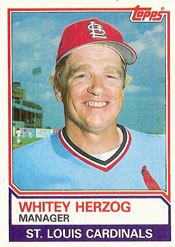
Led by manager Whitey Herzog, the Cardinals clinched their final World Series championship of the 20th century on 10-20-1982.

Read Full Post »

(Updated Jan. 4, 2025)

Duke Snider had one of the most productive performances of his career in the same game Stan Musial achieved a slugging milestone.

On June 3, 1955, Snider went 4-for-5 with five RBI and two runs scored in the Dodgers’ 12-5 victory over the Cardinals at Ebbets Field in Brooklyn.

Snider clouted a three-run home run, a RBI-double and two singles, one of which was a squeeze bunt that scored Pee Wee Reese from third.

In the same game, Musial hit his 300th career homer _ a three-run shot off Johnny Podres in the fifth. Musial became the 13th player with 300 homers.

Snider’s big performance against the Cardinals was part of a three-game tear in which he totaled five homers and 13 RBI. Dubbing him “The Duke of Destruction,” Bill Corum of International News Service wrote, “I’ve never seen a hitter quite as dangerous as Duke Snider.” Boxscore

Special talent

A center fielder, Snider hit .300 in his career against the Cardinals, with 60 homers and 189 RBI.

In his book “Stan Musial: The Man’s Own Story,” Musial said, “After he learned the strike zone in the majors, the Duke became one of the great sluggers of our era. He couldn’t hit the high and tight pitch early, but he learned to lay off it. He had great power … He was a fine outfielder with a good arm and good speed.”

In choosing his all-time National League all-star team, Musial selected Willie Mays, Hank Aaron and Snider as the outfielders. Musial said with Snider in center, Carl Furillo in right and Andy Pafko in left “the Dodgers had the best-throwing outfield I ever saw.”

In the 1950s, the three center fielders in New York were Mickey Mantle of the Yankees, Mays of the New York Giants and Snider with the Brooklyn Dodgers.

In the book, “We Would Have Played For Nothing,” pitcher Ralph Branca, Snider’s Dodgers teammate, told former baseball commissioner Fay Vincent, “I think Duke was the best outfielder of the three of them. Duke got a great jump on the ball, charged the ground ball, and had the best arm of all three. Not only was he stronger, but he was more accurate.”

Snider wore No. 4 with the Dodgers in tribute to his boyhood favorite, Yankees first baseman Lou Gehrig. In the book “Voices from Cooperstown,” Snider said to author Anthony J. Connor, “When that movie ‘Pride of the Yankees’ came out with Gary Cooper playing Lou Gehrig, I saw it maybe 15 times … I still get tears in my eyes watching that show.”

Playing rough

In 1961, Snider was involved in two rough-and-tumble incidents involving Cardinals pitchers Larry Jackson and Bob Gibson.

While facing the Cardinals in a spring training exhibition game, Snider shattered his bat on a pitch from Jackson. The ball struck Jackson on the hip and the bat hit him in the jaw.

In his book “The Duke of Flatbush,” Snider said, “I reached first base, but Jackson was still on the ground, seriously injured. His jaw was broken … I felt awful about it, but that’s one of the occupational hazards of pitching.”

A few weeks later, April 17, 1961, in a game between the Cardinals and Dodgers in Los Angeles, Snider hit a two-run home run against Gibson in the third inning. Boxscore

“I knew what would happen next … Word was already around the league that he had that mean streak that so many good pitchers have,” Snider said.

When Snider came to bat in the fifth, a Gibson fastball struck him in the elbow. Snider told Fay Vincent, “He threw a 95 mph fastball right at my ribs. I put my right elbow down to protect my ribs and it hit me right on the bone.”

When he tried to bat again in the seventh, Snider felt a sharp pain in that right elbow and was lifted for a pinch-hitter.

The elbow was fractured and Snider was sidelined for a month.

“It’s the only time I was ever on the disabled list,” Snider said to Fay Vincent. “I know that Bob Gibson has told people he never threw at a player on purpose. Bob Gibson is a nice guy, but he stretches the truth a little bit once in a while.”

Read Full Post »

(Updated March 4, 2019)

Leron Lee, who once hit so poorly he lost the starting right field job with the Cardinals, recovered to become the career batting leader in Japan.

Lee has held the Japanese career batting average record (.320) for players with a minimum of 4,000 at-bats.

The statistics help round out the story of how Lee revived his career after stumbling with the Cardinals.

Support from Sparky

Lee, a left-handed-hitting outfielder, was the first-round choice of the Cardinals in the 1966 draft. He began his professional career in 1967 with the Cardinals’ Class A Modesto team, managed by Sparky Anderson. After a terrible start, Lee finished the season with a .297 batting average and 22 home runs.

In a story in the April 18, 1970, edition of The Sporting News, Lee told how Anderson never lost confidence in him.

“Sparky kept me in the lineup and pitched extra batting pratice to me himself,” Lee said.

Lee progressed through the Cardinals’ system. After he hit .303 with 30 doubles, 17 home runs, 96 RBI and 14 steals for manager Warren Spahn’s Tulsa Oilers in 1969, Lee went to spring training in 1970 with a chance to make the Cardinals’ Opening Day roster.

He took advantage of the opportunity, hitting .308 with a team-best 12 RBI in spring training. Joe Medwick, the Hall of Fame outfielder and Cardinals minor-league batting instructor, said Lee hit the ball so hard “he made it wave,” The Sporting News reported.

“Lee has been learning how to pick his pitches,” said Cardinals batting coach Dick Sisler. “He hasn’t been swinging at too many bad pitches. He’s standing back, waiting for the pitch instead of jumping at it.”

Cardinals manager Red Schoendienst said Lee was “100 percent improved over last year at this time,” according to the St. Louis Post-Dispatch.

“What has helped me most was just playing a lot,” Lee said.

Outfield starter

When the Cardinals opened the 1970 season on April 8 at Montreal, Lee started in right field and went 1-for-5 with a run scored in St. Louis’ 7-2 victory. Boxscore

Lee was the starting right fielder in the Cardinals’ first 21 games of 1970 (Lou Brock was in left; Jose Cardenal in center) and hit .272 in that stretch.

Lee appeared in more games (76) in right field than any other Cardinal in 1970, but he eventually split time with Carl Taylor and Joe Hague as his hitting declined. In 121 games, Lee batted .227 with six home runs, 23 RBI and a .290 on-base percentage.

“I like Leron,” said Schoendienst. “He’s like a young bird dog _ Sometimes they come around all of a sudden.”

In 1971, the Cardinals moved Cardenal to right field and went with Matty Alou and Jose Cruz in center. Lee was relegated to pinch hitting. With his batting average at .171, Lee and pitcher Fred Norman were traded to the Padres on June 11, 1971, for pitcher Al Santorini.

“You take a kid like Leron and use him as little as we did and what can he show you?” said Cardinals general manager Bing Devine. “Leron wanted to play.”

Lee’s career statistics as a Cardinal: .222 batting average, .291 on-base percentage, seven home runs and 25 RBI.

On the rise

Lee played for the Padres, Indians and Dodgers before getting released by the Dodgers on Nov. 2, 1976.

Lee, 28, signed with the Lotte Orions of Japan’s Pacific League and fulfilled his potential.

Lee batted .317 for Lotte in 1977 and led Japan’s Pacific League in home runs (34) and RBI (109). He played 11 years with Lotte. He led the Pacific League in batting (.358) in 1980 and twice led the league in total bases (286 in 1977 and 310 in 1980).

A year-by-year look at Lee’s career with the Lotte Orions:

1977: .317 batting average, 34 homers, 109 RBI

1978: .317 batting average, 30 homers, 88 RBI

1979: .333 batting average, 28 homers, 95 RBI

1980: .358 batting average, 33 homers, 90 RBI

1981: .302 batting average, 19 homers, 71 RBI

1982: .326 batting average, 15 homers, 60 RBI

1983: .317 batting average, 25 homers, 82 RBI

1984: .309 batting average, 31 homers, 88 RBI

1985: .328 batting average, 28 homers, 94 RBI

1986: .331 batting average, 31 homers, 94 RBI

1987: .272 batting average, 9 homers, 41 RBI

In the book “Remembering Japanese Baseball: An Oral History of the Game” by Robert K. Fitts, Lee said the spring training regiment of the Orions helped him.

“I did a lot of (batting practice) when I was in the States _ a couple of hundred balls a day. But in Japan we were hitting 500 to 700 balls a day,” Lee said. “… Over the years, all the practice turned out to be a blessing. It made me a more consistent hitter because my swing was fixed. As the years went by, I realized that kind of spring training was exactly what I should have been doing here in the States.”

Read Full Post »

(Updated April 6, 2026)

Joe Garagiola of the Cardinals was the first rookie to produce four hits and three RBI in a World Series game.

Garagiola was 4-for-5 with three RBI in the Cardinals’ 12-3 Game 4 win against the Red Sox in the 1946 World Series.

According to the Elias Sports Bureau, before Garagiola, the only other rookie with four hits and at least two RBI in a World Series game was third baseman Freddie Lindstrom of the Giants. Lindstrom was 4-for-5 with two RBI in Game 5 of the 1924 World Series against Walter Johnson of the Senators. Boxscore

Garagiola, best known as a broadcaster and humorist, was a 20-year-old rookie catcher for the Cardinals in 1946. He joined the Cardinals in May after completing service with the Army in the Philippines. He hit .237 in 74 regular-season games for a St. Louis team that won the National League pennant.

In Game 4 of the World Series at Boston, Garagiola had three singles and a double. Boxscore

His RBI-single to center in the third scored Stan Musial. He singled again in the fifth. In the seventh, Garagiola drove a double to left, scoring Enos Slaughter. In the ninth, Slaughter scored again on a Garagiola single to right.

The 1946 World Series, won by the Cardinals in seven games, was Garagiola’s only World Series appearance. He hit .316 (6-for-19) in five games, and did almost all of his damage at Fenway Park. Garagiola hit .417 at Boston in that Series (5-for-12) and .143 (1-for-7) at St. Louis.

In its recap of the 1946 World Series, The Sporting News wrote that St. Louis native Garagiola “was extremely popular with fellow players who frequently were his guests at spaghetti dinners cooked by Mom.”

The report concluded that “Joe is destined to become one of the game’s catching greats, in the opinion of (manager Eddie) Dyer and others.”

Read Full Post »

(Updated July 30, 2024)

Stan Musial hit 12 walkoff home runs during his career with the Cardinals.

Musial hit his first walkoff home run for them at age 21 and his last 20 years later at 41.

Musial’s first walkoff home run was a two-run shot in the 11th inning off Dick Errickson of the Braves, lifting the Cardinals to a 7-5 win on July 14, 1942, at St. Louis.  Boxscore

On June 5, 1962, Musial hit his last game-ending home run, a solo blast with one out in the 11th against Dave Sisler for a 10-9 Cardinals win over the Reds at St. Louis. Boxscore

“I can pick up a bat right away and tell you whether it weighs 33 ounces or 34 ounces,” Musial said to Roger Kahn of Sport magazine. “Every bat has its own kind of feel to it.

“I got a special model,” Musial said. “The handle comes from one they made for Mel Ott. I haven’t got real big hands and I guess Ott didn’t either. But the barrel is big. I took that from one they made for Jimmie Foxx.”

As Kahn noted, Musial “can use a pipe stem handle safe in the knowledge that he will hit the ball with the dynamic part of the bat.”

A snapshot of Musial’s 12 walkoff home runs:

DATE………..FOE………LOSING PITCHER………….FINAL SCORE

7-14-42…….Braves……Dick Errickson……………..7-5 in 11

7-14-46…….Dodgers….Vic Lombardi………………2-1 in 12

8-22-46…….Phillies……Andy Karl…………………..7-6 in 12

8-26-48…….Giants……..Ken Trinkle…………………7-5 in 9

8-28-48……..Giants…….Monty Kennedy…………..5-4 in 12

9-6-50……….Cubs………Paul Minner………………..5-4 in 10

6-17-51………Phillies…..Russ Meyer…………………5-4 in 10

7-6-52………..Pirates…..Murry Dickson…………….6-5 in 9

5-7-59………..Cubs………Don Elston…………………4-3 in 9

8-7-59………..Phillies…..Ruben Gomez……………..3-1 in 9

8-27-60………Pirates……Roy Face…………………..5-4 in 9

6-5-62…………Reds………Dave Sisler………………..10-9 in 11

Read Full Post »

(Updated Nov. 30, 2024)

Stan Musial and Albert Pujols are the only players to hit 400 home runs as Cardinals. Musial hit 475 home runs in 22 seasons (1941-1944 and 1946-1963) with the Cardinals. Pujols hit 469 home runs in 12 seasons (2001-2011 and 2022) with St. Louis.

Pujols was 30 when he hit his 400th home run on Aug. 26, 2010 _ a solo shot against Jordan Zimmerman of the Nationals at Washington.

Musial was 38 when he slugged No. 400 _ and he did it in dramatic fashion.

On May 7, 1959, at St. Louis, the Cubs and Cardinals were deadlocked, 3-3, heading into the bottom of the ninth inning.

Don Elston, a veteran right-hander, was beginning his second inning in relief of Cubs starter Moe Drabowsky. Leading off the ninth for St. Louis was Musial.

Musial had gotten off to a slow start that season. He was hitting .268 with one home run.

Elston was a hard thrower and one of the best relievers in the National League _ he would be named to the all-star team in 1959 _ but Musial was ready. He lined a 1-and-0 fastball over the 400-foot mark in right-center field for a walkoff home run, giving the Cardinals a 4-3 win. His second homer of the season was No. 400 in his career. Boxscore

After the ball cleared the wall, it caromed back onto the field. Center fielder George Altman, unaware of the historic significance of the home run, retrieved the ball and tossed it back among the fans, the Chicago Tribune reported. “We wanted to send that one to the Hall of Fame,” said Cardinals publicist Jim Toomey.

No. 400 put Musial sixth all-time in career home runs. The top five at the time were Babe Ruth (714), Jimmie Foxx (534), Mel Ott (511), Lou Gehrig (493) and Ted Williams (482).

In the book “Voices From Cooperstown,” Musial told author Anthony J. Connor, “That homer swing was something I learned with experience. When I was young, I used to punch the ball around to left and left-center and not try to pull.

“As years passed, I gained confidence and learned to pull the ball when I wanted to go for power. Ralph Kiner came up in the late 1940s and started to hit home runs, more than anyone else, and pretty soon he was getting more money than anyone else. Well, that got me thinking. After 1947, 1948, I started swinging for the fences.”

Read Full Post »

« Newer Posts - Older Posts »