Feeds:
Posts
Comments

Archive for the ‘Records’ Category

The Cardinals collected a club-record 13 doubles in a game against the Cubs, but were aided by unusual circumstances.
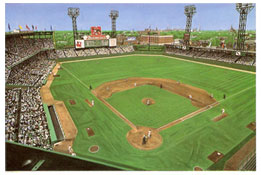
On July 12, 1931, the first-place Cardinals played the Cubs in a Sunday doubleheader at Sportsman’s Park in St. Louis. The Cubs’ player-manager was former Cardinals standout Rogers Hornsby.

“The park, with fewer than 35,000 seats, was inadequate to accommodate all who wanted to see the struggle,” The Sporting News reported, “and shortly after daybreak the eager customers began to arrive at the park. The gates were opened at 9 o’clock and long before noon every unreserved seat in the park was occupied and the spectators were standing in the aisles.”

With insufficient security to manage the growing wave of arrivals, ballpark and team officials lost control of the situation and spectators pressed toward the outfield gates in confusion.

“When the gates in the bleacher and pavilion walls were opened, the customers avalanched out into the field like invading hordes,” The Sporting News reported. “There were no police or guards to herd them into position and they spilled all over the field. An attempt was made to herd the fans back to the walls, but it was hopeless.”

According to the Associated Press, “Umpires appealed to the crowd to move back. Finally, a police detail arrived and aided in the work.”

The opener of the doubleheader began with thousands of people standing in the outfield. The overflow, according to The Sporting News, was deepest in right field “about 70 feet beyond first base and extending through center field, not more than 150 feet back of second base and across over (to) the left foul line, perhaps 100 feet beyond third base.”

Official attendance was 45,715. That exceeded by 7,419 the previous regular-season record crowd for a Cardinals home date (against the Giants on May 20, 1928).

The doubleheader was played, The Sporting News opined, “under unspeakable conditions.”

Uncatchable balls hit into the outfield crowd were declared ground-rule doubles.

The Cubs won the opener, 7-5, overcoming a 3-2 Cardinals lead by scoring five runs in the seventh, three on Hack Wilson’s home run off Bill Hallahan. The Cubs hit five doubles; the Cardinals, four.

“Conditions for that first game were bad enough, but they were excellent compared to those that prevailed during the second contest,” The Sporting News reported.

The Cardinals and Cubs combined for 23 doubles in the second game, and the Cardinals won, 17-13.

All of the doubles were official, though most were tainted.

“Pop flies that good infielders could have caught dropped in the crowd for doubles and the two games were more like county fair exhibitions than major league contests,” The Sporting News reported. “In the two games, there were 32 doubles and perhaps six of the two-baggers were legitimate.”

Seven players accounted for the Cardinals’ 13 doubles in Game 2. Rip Collins and Gus Mancuso hit three apiece. Chick Hafey and Frankie Frisch each hit two. George Watkins, Andy High and Ernie Orsatti contributed one each.

The Cubs got doubles from Woody English and Gabby Hartnett (each with three), Footsie Blair (two) and Rogers Hornsby and Les Bell (one apiece). Boxscore

The 1931 Cardinals finished as the major-league leaders in doubles, with 353. The Cubs were second at 340.

Previously: Rip Collins was one-of-a-kind hitter for Cardinals
Read Full Post »

A record-setting hitting performance by the Braves knocked the 1936 Cardinals out of first place. Seventy-six years later, the 2012 Cardinals matched the Braves’ feat of hitting seven doubles in an inning.

On July 21, 2012, six Cardinals collected seven doubles in a 12-run seventh inning of a 12-0 victory over the Cubs at St. Louis. Allen Craig, who appeared as a pinch-hitter in the inning, hit a pair of doubles. Carlos Beltran, Jon Jay, David Freese, Skip Schumaker and Matt Holliday hit one double apiece. The seven doubles were hit against three Cubs relievers, James Russell, Manny Corpas and Rafael Dolis. Boxscore

The 1936 Braves were unlikely candidates to establish the standard of seven doubles in an inning. They would finish the season with the lowest batting average in the National League and would rank last among the eight teams in doubles.

On the morning of Aug. 25, 1936, the Cardinals and Giants were tied for first place in the NL, each with a 72-46 record. The Cardinals had a doubleheader against the Braves that Tuesday afternoon at St. Louis. The Giants were facing the Reds.

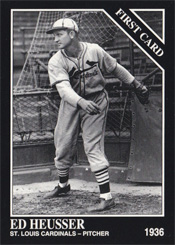
In the opener, the Cardinals started Si Johnson, who had been acquired from the Reds on Aug. 6. The Braves pounded Johnson for eight runs, seven hits and a walk in the first inning. He recorded only two outs before being lifted for Ed Heusser, the Cardinals’ top reliever in 1936.

Three Braves _ Gene Moore, Buck Jordan and Tony Cuccinello _ hit two doubles apiece in the first inning. Shortstop Rabbit Warstler accounted for the other.

With Boston ahead 11-0 after a half inning, Cardinals manager Frankie Frisch decided to stay with Heusser. Nicknamed “The Wild Elk of the Wasatch” for the mountain range in his native Utah, Heusser gave up 12 runs on 18 hits and four walks in 8.1 innings. Moore and Jordan each had five hits and five RBI in the Braves’ 20-3 victory. Boxscore

In the second game, St. Louis, behind ace Dizzy Dean, led 4-1 through five innings, but the Braves rallied and tied the score. In the ninth, Si Johnson, the Game 1 starter, relieved Dean. He yielded a RBI-single to Jordan and the Braves won, 5-4. Johnson was the losing pitcher in both games.

Coupled with the Giants’ 13th win in a row, a 6-5 victory over the Reds, St. Louis fell 1.5 games behind New York. The Giants went on to win the pennant, finishing five games ahead of the Cardinals and Cubs, who tied for second place.

Johnson and Heusser both recovered from their thumpings by the Braves.

Four days after losing both games of the doubleheader, Johnson pitched a complete-game shutout against the Phillies. Boxscore He finished 5-3 with a 4.38 ERA for the 1936 Cardinals.

Heusser was 7-3 with a 5.43 ERA in 42 appearances for the 1936 Cardinals. Eight years later, as a starter for the Reds, his 2.38 ERA led the NL.

Previously: Baseball and romance: Cardinals’ Cuban adventures

Read Full Post »

(Updated Nov. 13, 2017)

Carlos Beltran had a chance in 2012 to break one of the longest-lasting records in Cardinals history.

Beltran was a threat to top the Cardinals’ single-season record for home runs by a switch-hitter, a mark established by Rip Collins, with 35, for the 1934 World Series championship team.

Beltran finished the 2012 season with 32 home runs, three shy of tying Collins’ mark.

Cardinal with clout

James “Rip” Collins, a 5-foot-9 first baseman, played for the Cardinals from 1931-36 before being traded to the Cubs. He hit better than .300 in four of his nine big-league seasons and played in three World Series (for the Cardinals in 1931 and 1934 and for the Cubs in 1938.)

Collins was the first switch-hitter to top the 30-homer mark in the big leagues. His 35 home runs in 1934 tied him with Mel Ott of the Giants for the National League lead. Collins remains the only Cardinals switch-hitter to lead the NL in homers in a season.

After Collins, no other NL switch-hitter achieved a 30-homer season until the Dodgers’ Reggie Smith hit 32 in 1977. It took 53 years for a NL switch-hitter to break Collins’ league record of 35 homers in a season. Howard Johnson of the Mets did it with 36 homers in 1987. (Johnson also hit 36 in 1989 and 38 in 1991 for the Mets.)

The home run barrage was part of a career year for Collins in 1934. His 128 RBI were second in the NL to Ott’s 135. His .333 batting average tied for fourth in the NL. Collins led the league in both slugging percentage (.615) and total bases (369.) He collected 200 hits, including 40 doubles and 12 triples.

Collins was described by Bob Broeg of the St. Louis Post-Dispatch as a “choked-grip longball batter (who) hit for more distance left-handed but he stroked the ball better and for higher average right-handed.”

Batting left-handed, Collins hit 30 of his 35 homers in 1934 against right-handers.

One of three starters on the 1934 Cardinals who switch-hit (second baseman Frank Frisch and right fielder Jack Rothrock were the others,) Collins primarily batted fifth in the order (behind cleanup batter and left fielder Joe Medwick.)

Included in his top performances that year:

_ On June 2, 1934, in the first game of a doubleheader at Pittsburgh, Collins had a triple, two home runs and seven RBI in the Cardinals’ 13-4 victory over the Pirates. Boxscore

_ Collins went 5-for-5 against the Giants on July 23, 1934, in the Cardinals’ 6-5 victory at New York. Boxscore

_ In the 1934 World Series, Collins hit .367 (11-for-30) in helping the Cardinals defeat the Tigers in seven games.

Merry prankster

Clever, with a devilish sense of humor, Collins fit in well with the Gashouse Gang Cardinals of the 1930s. A 1975 article in Baseball Digest detailed one incident:

“A carefree refugee from the Pennsylvania coal mines, Rip Collins was reportedly the instigator of one unforgettable prank pulled off by the Cardinals at a hotel in Philadelphia where the club stayed.

“The Ripper had noticed ladders, paint buckets, white overalls and other paraphernalia of painters in a corner of the service area of the hotel. He rounded up Dizzy Dean, Heinie Schuble and Billy DeLancey. They donned the overalls, took the equipment into a busy dining room and began painting the walls and ceiling, splattering paint on the customers, shouting instructions to one another ala the Marx brothers and promoting general chaos.

“It took all of general manager Branch Rickey’s persuasive powers to prevent the hotel management from evicting the entire ballclub immediately.”

Collins said, “It was great until the cops showed up.”


Read Full Post »

When the Cardinals played in Dodger Stadium for the first time the weekend of May 18-20, 1962, they felt right at home. The Cardinals swept the three-game series, receiving complete-game wins from each of their starting pitchers, and Stan Musial stroked a single, surpassing Honus Wagner to become the National League all-time hits leader.

Moved from Brooklyn to Los Angeles after the 1957 season, the Dodgers played four years at the Coliseum while Dodger Stadium was being built. On April 10, 1962, in the first regular-season game at Dodger Stadium, the Reds defeated the Dodgers, 6-3. Boxscore
As the Cardinals-Dodgers series opened May 18, the Dodgers were in second place, three games behind the Giants, at 23-12. The Dodgers had won four in a row and eight of their last nine. The Cardinals were in third place at 18-13 and had lost five of their last seven.

The Cardinals’ arrival brought out the entertainment crowd. While the Cardinals were warming up before the first game, comedian Milton Berle, seated near the dugout, performed card tricks for Musial, Red Schoendienst and Ernie Broglio, the Los Angeles Times reported.

The opener matched Johnny Podres against Larry Jackson. In the first inning, Ken Boyer smashed a drive that struck Podres in the left forearm. Podres threw three pitches out of the strike zone to the next batter, Gene Oliver, and walked off the field, unable to pitch. X-rays revealed a severe bruise, no fracture.

Bill White drove in three runs, Charlie James scored three runs and knocked in two, and Jackson went the distance as the Cardinals won, 8-3, before 38,951. Boxscore

“I had a pretty good curve and fastball,” Jackson told the St. Louis Post-Dispatch.

The story the next night, May 19, normally would have been the pitching of Cardinals left-hander Ray Sadecki. The Dodgers had defeated six consecutive left-handers and Sadecki was 0-3 in his career against them, but Sadecki changed the script, pitching his first complete game of the season and got the win in the Cardinals’ 8-1 triumph before 44,559. Boxscore

The headlines, however, went to Musial, the 41-year-old left fielder. His single to right field in the ninth inning off a curve from Ron Perranoski gave Musial his 3,431st hit and moved him ahead of Wagner for No. 1 on the NL career list, breaking a mark that had been held for 45 years. Dodgers first baseman Wally Moon, a former Cardinals teammate, fielded the throw from right fielder Frank Howard and handed the ball to Musial, who received a standing ovation.

“Stan hit a good curveball,” Perranoski told The Sporting News.

Said Musial: “I never worked so hard for two hits.”

(Musial had hit the record-tying single off Juan Marichal in San Francisco on May 16, ending a string of 15 hitless at-bats. He went hitless in nine more after that until he connected on the 0-and-1 pitch from Perranoski.)

“At least I got it in a beautiful new park and against the Dodgers, who have been good to me over the years,” Musial said.

Only Ty Cobb (4,191) and Tris Speaker (3,515) had more career hits than Musial at that time.

After the game, Musial and teammates Boyer and Schoendienst went to the Stadium Club at the ballpark. Musial enjoyed a steak sandwich and French fries. As Neal Russo reported in The Sporting News, few tables had a trio with more hits _ a total surpassing 7,000.

Exhausted by the strain to break the record, “I just about wilted when I got to first base with the record hit,” Musial said.

While Musial sat out the series finale on Sunday afternoon, May 20, Schoendienst, 39, started at second base for the fifth consecutive game. He was filling in for Julian Javier, who was sidelined because of a torn fingernail on his right index finger.

Curt Simmons yielded three runs, none earned, and got the complete-game win in the Cardinals’ 4-3 victory before 38,474. Boxscore

The Cardinals had swept a series in Los Angeles for the first time since the Dodgers left Brooklyn. They moved into a second-place tie with the Dodgers and got within 4.5 games of the Giants.

Previously: How Stan Musial turned in a great comeback year at 41

Read Full Post »

(Updated Feb. 19, 2023)

In a classic example of the adage “if you can’t beat ’em, join ’em,” the pitcher who posted the worst career record against the Cardinals got traded to them and enjoyed the best stretch of his big-league tenure.

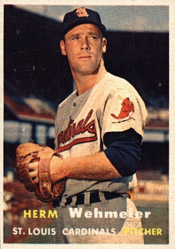
In 31 appearances against the Cardinals for the Reds and Phillies from 1949-1956, Herm Wehmeier was 0-14 with a 4.89 ERA.

(Yovani Gallardo has the second-worst career mark versus the Cardinals. In 19 starts against the Cardinals, Gallardo was 1-11 with a 6.45 ERA.)

Wehmeier’s 14th loss to St. Louis occurred May 9, 1956, in the Cardinals’ 3-0 victory over the Phillies. Boxscore

Two days later, on May 11, 1956, the Cardinals traded pitchers Harvey Haddix, Stu Miller and Ben Flowers to Philadelphia for Wehmeier and pitcher Murry Dickson. The deal was unpopular with many Cardinals fans. Haddix won 20 in 1953 and 18 in 1954. Though his record in 1955 fell to 12-16, many saw him as a pillar of St. Louis’ rotation.

Cardinals coach Terry Moore, who was the Phillies’ manager when Philadelphia acquired Wehmeier from the Reds in 1954, recommended Wehmeier to St. Louis general manager Frank Lane. According to The Sporting News, Lane said he sought Wehmeier “because he can be depended upon to trouble Brooklyn and Milwaukee, teams the Cards must stop to win.”

Cardinals pitching coach Bill Posedel was successful in working with Wehmeier. Reporting for The Sporting News, Bob Broeg wrote, “Wehmeier began to work with a high leg kick, similar to Paul Derringer’s, and … he concentrated on letting up on his fastball and curve when the opposition would expect the Wehmeier of old to try to bust his fastball by ’em.”

The results were impressive. Wehmeier won eight of nine decisions for the 1956 Cardinals from July 21 to Sept. 11. He saved his best for his last start of the year.

On the morning of Saturday, Sept. 29, the next-to-last day of the 1956 season, the Braves held first place in the National League, a half-game ahead of the Dodgers.

That day, the Dodgers swept a doubleheader against the Pirates. The Braves entered their night game at St. Louis knowing they needed to win to keep a share of first place. Milwaukee started its ace, Warren Spahn, against Wehmeier.

(In his autobiography, “I Had a Hammer,” Hank Aaron called Wehmeier “my worst nightmare,” because in 1955 he batted .105 against him, with two singles in 19 at-bats.)

Spahn and Wehmeier dueled into the 12th inning with the score tied 1-1. In the bottom of the 12th, Rip Repulski lashed a double against Spahn, scoring Stan Musial from second and giving the Cardinals a 2-1 victory. Boxscore

In Aaron’s book, Spahn said, “Beyond a doubt, that Saturday game in St. Louis was the most heartbreaking moment I had in 21 years of baseball.”

The loss dropped the Braves a game behind the Dodgers, who clinched the pennant the next day. The win capped a successful season for Wehmeier. The right-hander finished 12-9 with a 3.69 ERA for St. Louis. It would be the most single-season wins he’d post in his big-league career.

Wehmeier was named the Cardinals’ 1957 Opening Day pitcher by manager Fred Hutchinson. The assignment was especially important for Wehmeier because he would be facing the Reds in Cincinnati.

A Cincinnati native, Wehmeier had been an outstanding athlete at Western Hills High School. When he signed with the Reds at age 18, he was billed as a hometown hero. Instead, plagued by wildness and high expectations, Wehmeier was a bust. In nine seasons with the Reds, Wehmeier was 49-69. He issued more walks (591) than strikeouts (478) and became a target of fan hostility.

“He was one of the greatest natural athletes we ever had in Cincinnati,” Reds general manager Gabe Paul said. “But never in my long baseball experience have I heard a man booed as bitterly as was Wehmeier. Nothing he could do was right. Even when he won, they booed him.”

Wrote Broeg: “One of Wehmeier’s troubles as a Red was that the former Cincinnati high school hero tried too hard. The more red-necked he became and the harder he tried to throw, the wilder he became, either walking himself into trouble or getting the ball up where power hitters and others could swing for the fences.”

When Wehmeier took the mound in the Cardinals’ 1957 opener, his mother, father, sister and brother were in the stands. What they witnessed must have stunned many Reds fans. Wehmeier pitched a complete game and got the win in the Cardinals’ 13-4 victory. Boxscore

Wehmeier was winless in May and June, but recovered to win five consecutive decisions from Aug. 24 to Sept. 15. He finished the 1957 season at 10-7 with a 4.31 ERA.

In May 1958, Wehmeier was sent to the Tigers in a waiver deal. He suffered an elbow injury soon after and, at 31, his playing career was done. His big-league record: 92-108. For St. Louis, Wehmeier was 22-17.

Wehmeier scouted for the Reds for three years (he recommended they sign another phenom from Western Hills High School, Pete Rose) and then left baseball. He worked for a trucking company in Texas.

In May 1973, Wehmeier, 46, was testifying during a theft trial in federal court in Dallas when he suffered a fatal heart attack. In an obituary, The Sporting News reported, “Wehmeier was on the witness stand testifying for the government when he collapsed. The case involved theft of merchandise from a shipping company of which Wehmeier was an official.”

Previously: An interview with former Cardinals pitcher Al Jackson

Read Full Post »

(Updated Sept. 25, 2016)

Barry Larkin played shortstop with distinction for the Reds from 1986-2004, but for most of the first half of his career he was overshadowed by the Cardinals’ Ozzie Smith.

In a classy twist, Smith witnessed and cheered Larkin’s greatest individual feat on a baseball field.

Smith won the Gold Glove Award among National League shortstops in each of Larkin’s first seven seasons in the major leagues, including 1990, when Larkin helped lead Cincinnati to its most recent World Series championship.

Larkin didn’t win the first of his three Gold Glove awards until 1994, the year Smith turned 40. Smith, who won the Gold Glove Award 13 times, was inducted into the National Baseball Hall of Fame in 2002.

In 2012, it was Larkin’s turn.

Larkin, 1995 winner of the NL MVP Award, had 2,340 hits and a .295 career batting average.

Larkin had several memorable performances against the Cardinals, including a pinch-hit grand slam off reliever Steve Kline in St. Louis’ 11-10 victory over the Reds on July 28, 2004, at Cincinnati. Boxscore

Larkin’s greatest moment against the Cardinals occurred in the first game of a Sunday afternoon doubleheader on Sept. 22, 1996, at Cincinnati.

In the fifth inning, with St. Louis ahead 3-1, Larkin launched a home run, his 30th of the season, over the left-field wall against starter Donovan Osborne. With that solo shot, Larkin became the first shortstop in major-league history to achieve 30 homers and 30 stolen bases in a season.

As he rounded first base, Larkin thrust both fists in the air in jubilation. Smith, positioned at shortstop for the Cardinals, hollered his congratulations as Larkin trotted past him.

Asked afterward to assess Larkin’s feat, Smith told the Associated Press, “It gives him his own spot in history. It’s a great accomplishment.”

Larkin became the 17th player in big-league history to achieve 30 homers and 30 steals in a season. Fifteen were outfielders and the other, Howard Johnson of the Mets, was a third baseman.

Larkin finished the 1996 season with 33 homers and 36 steals. He would achieve the steals standard again (with 30 in 1999, his fifth season of 30 or more steals), but he never came close to matching 30 homers.

Previously: Ken Boyer belongs in Hall of Fame

Read Full Post »

« Newer Posts - Older Posts »