Feeds:
Posts
Comments

Archive for the ‘Trades’ Category

The Cardinals acquired the player who might have helped them win a division title in 1973, but gave him away before he played a game for them.

On Oct. 26, 1972, the Cardinals got outfielder Larry Hisle from the Dodgers for pitchers Rudy Arroyo and Greg Milliken.

Hisle might have been a fit to join a Cardinals outfield with Lou Brock and either Jose Cruz or Bake McBride.

Instead, on Nov. 29, 1972, a month after acquiring him, the Cardinals traded Hisle to the Twins for reliever Wayne Granger.

Hisle fulfilled his potential with the Twins and later with the Brewers. Granger, in his second stint with St. Louis, was a disappointment.

The 1973 Cardinals, who ranked last in the National League in home runs, finished 1.5 games behind the division champion Mets. Hisle’s 15 home runs for the 1973 Twins would have made him the team leader on the 1973 Cardinals.

Prized prospect

Born in Portsmouth, Ohio, Larry Hisle was named by his mother, a baseball fan, in honor of Larry Doby, who became the first black player in the American League, according to the Society for American Baseball Research (SABR). Hisle’s parents died when he was a youth and he was adopted by Orville and Kathleen Ferguson, “two of the finest people in the world,” Hisle told United Press International.

Hisle played youth baseball with two other future big-leaguers, Al Oliver and Gene Tenace, according to SABR, but he also was a standout prep basketball player. When Oscar Robertson, recruiting for the University of Cincinnati, called, “I almost dropped the phone,” Hisle told The Sporting News.

After agreeing to play basketball at Ohio State, Hisle was picked by the Phillies in the second round of the 1965 baseball draft and signed with them. A right-handed batter, he played two seasons at the Class A level in the minors, then reported in 1968 to Phillies spring training camp, where he roomed with Bill White.

In choosing Hisle, 20, to be the Phillies’ 1968 Opening Day center fielder, manager Gene Mauch told The Sporting News, “Hisle is the best center fielder I’ve ever had.”

The experiment didn’t last long. Though he hit .364 in 11 at-bats for the 1968 Phillies, Hisle was sent to the minors before the end of April.

Rookie season

The Phillies named Hisle their center fielder for 1969, but he had a shaky start. He hit .159 in April and removed himself from a game because of what the team physician described to The Sporting News as “acute anxiety.”

“We’re all aware he’s a very intense, high-strung young man who is going to take a little longer to adjust up here,” Phillies manager Bob Skinner said to The Sporting News.

Hisle did better in May, producing four hits, two RBI, two runs and two stolen bases in a game against the Cardinals. Boxscore

Before a game in Philadelphia, the Giants’ Willie Mays chatted with Hisle and told him, “Open your stance, take it easy and concentrate on just meeting the ball,” The Sporting News reported. Hisle responded with four hits and two RBI that day. Boxscore

Phillies teammate Dick Allen aided Hisle, too, and became a mentor. “I’ll never forget how much he helped me,” Hisle told the Philadelphia Inquirer.

Hisle hit .266 with 20 home runs and 18 stolen bases for the 1969 Phillies.

Too far, too fast

Dick Allen was traded to the Cardinals after the 1969 season in a deal involving center fielder Curt Flood, who refused to report.

With neither Allen nor Flood, the Phillies needed Hisle to step up, but he didn’t, hitting .205 in 1970 and .197 in 1971.

“I put too much pressure on myself,” Hisle said to the Chicago Sun-Times. “I doubted my ability.”

In October 1971, the Phillies dealt Hisle to the Dodgers for Tommy Hutton.

Hisle “was built up as the potential superstar who would lead the Phillies out of the wilderness, and he wasn’t ready to handle the role,” Philadelphia Inquirer columnist Frank Dolson wrote. “The enormous pressures beat him down, sent his batting average plummeting, and turned the fans who had cheered him as a rookie into a booing mob that virtually chased him out of town.”

Mind games

At spring training in 1972, Hisle was the last player cut by the Dodgers, according to the Albuquerque Journal. Rather than go to the minors, Hisle said he considered quitting baseball. He was attending Ohio University in the off-seasons, studying math and physical education, “and has thought of teaching and social work,” the Los Angeles Times reported.

A voracious reader of authors as diverse as B.F. Skinner and James Joyce, Hisle “dabbles in analytic geometry, and worries about what happened to his hitting,” the Los Angeles Times noted. “He may be, he says, too much of a thinker for his own good.”

The Dodgers assigned Hisle to Albuquerque, hoping the manager there, Tommy Lasorda, would help him overcome self-doubts.

Playing for Lasorda, “I learned that the most important thing a person can say about himself is, ‘I believe in myself,’ ” Hisle told the Philadelphia Inquirer.

Hisle hit .325 with 23 home runs and 91 RBI for Albuquerque in 1972.

The Twins tried to acquire him after the season, but the Dodgers wanted pitcher Steve Luebber in return. Luebber was rated the best pitching prospect in the Twins’ system and they didn’t want to trade him, so the Dodgers dealt Hisle, 25, to the Cardinals.

Coming and going

“Hisle could play a big part in the youth movement of the Cardinals,” the St. Louis Post-Dispatch declared. 

The Cardinals brought Hisle to St. Louis and told him “they were hoping I could help the outfield defense,” Hisle told the Minneapolis Star Tribune. “From what I heard, it needed help. I was really happy to join the Cardinals.”

General manager Bing Devine also was seeking help for the bullpen, and approached the Twins about Wayne Granger, a former Cardinal. Granger’s 19 saves for the 1972 Twins were six more than Cardinals pitchers totaled that year.

“We had talked with the Twins about Granger shortly after the season ended, but they wanted a hitter in return and we didn’t have anyone available,” Devine told The Sporting News. “After we got Hisle, they expressed a strong interest in him.”

The Twins hardly could believe their good luck. Granger “had not endeared himself to the front office with charges that the Twins weren’t a first-class organization,” The Sporting News reported, and they were eager to trade him.

“It was fortunate for us that Bing Devine was interested in Wayne Granger,” Twins owner Calvin Griffith told columnist Sid Hartman. “We talked to Devine about Hisle. He was reluctant to give him up, but he wanted Granger.”

Devine said to The Sporting News, “We really had figured on Hisle as an extra man on the club because he can do so many things.”

Nothing personal

Hisle was at home when the Cardinals called, informing him of the trade to the Twins. “I was disappointed and hurt,” he told the Minneapolis Star Tribune.

According to the newspaper, “Hisle later received a handwritten note from Bing Devine. Devine apologized for the quick trade to Minnesota, explaining it was not intentional nor a snub at Hisle, but merely something which Devine felt could help the Cardinals. Hisle appreciated the letter, and still has it.”

The Twins made Hisle feel at home, naming him their center fielder. “I’m getting a chance to play regular here,” he told the Minneapolis newspaper. “I don’t know if I would have played every day for the Cardinals.”

Hisle scored 88 runs and drove in 64 for the 1973 Twins. His 230 total bases ranked third on the team, behind only Rod Carew and Tony Oliva.

Granger was 2-4 with five saves and a 4.24 ERA for the 1973 Cardinals before he was traded to the Yankees in August.

Hisle had big seasons for the Twins in 1976 (96 RBI, 31 stolen bases) and 1977 (28 home runs, 119 RBI). Granted free agency, he signed with the Brewers and had 34 home runs, 115 RBI and 96 runs scored for them in 1978.

A two-time all-star, Hisle played 14 seasons in the majors. He was the hitting coach for the World Series champion Blue Jays in 1992 and 1993.

Read Full Post »

Two years before they acquired Lou Brock, the Cardinals made a blockbuster trade with the Cubs for an outfielder they hoped would ignite their offense.

On Oct. 17, 1962, the Cardinals acquired outfielder George Altman, pitcher Don Cardwell and catcher Moe Thacker from the Cubs for pitchers Larry Jackson and Lindy McDaniel and catcher Jimmie Schaffer.
Altman was the key to the deal for the Cardinals. A left-handed batter, he was a National League all-star who hit for power and average.

The Cardinals thought they were getting a run generator who would propel them to their first championship since 1946. Instead, Altman lasted one season with the Cardinals, who contended but fell short in their bid for a title. It wasn’t until June 1964, when they made another big trade with the Cubs to get Brock, that the Cardinals got the catalyst they needed to become World Series champions.

From hoops to hardball

Born and raised in Goldsboro, N.C., Altman was a standout high school athlete in multiple sports, including baseball. Tennessee State University recruited him to play basketball.

A 6-foot-4 forward, Altman had hopes of pursuing a professional basketball career, but a knee ailment his junior season made him reconsider. When Tennessee State started a baseball program his junior year, Altman made the team. Though he continued to play college basketball, he began thinking his future was in baseball.

After graduating in 1955, Altman got a tryout with the Kansas City Monarchs of the Negro American League and impressed manager Buck O’Neil, who signed him and became his mentor.

(Altman’s Monarchs teammate was pitcher Satchel Paige, 49. In his autobiography, “George Altman: My Baseball Journey From the Negro Leagues to the Majors and Beyond,” Altman recalled, “I’m not 100 percent sure that Satchel knew all of our names. He definitely called me ‘Young Blood.’ We didn’t talk to him that much because he didn’t travel with us most of the time. He had his own Cadillac and he followed the bus.”)

After the season, O’Neil joined the Cubs as a scout and recommended Altman. The Cubs signed him, and in 1959, Altman, 26, made his big-league debut as their Opening Day center fielder. In his first at-bat, Don Drysdale hit him in the thigh with a pitch. “I don’t know if he hit me on purpose,” Altman said in his autobiography, “but I would say he was trying to intimidate me.”

Unfazed, Altman singled twice in the game against the future Hall of Famer. Boxscore

Let’s make a deal

In 1961, the Cubs had four future Hall of Famers in their lineup (Richie Ashburn, Ernie Banks, Ron Santo, Billy Williams) but Altman was their batting leader (.303). He produced a league-leading 12 triples, 27 home runs and 96 RBI.

The Cubs also had four future Hall of Famers in their 1962 lineup (Banks, rookie Lou Brock, Santo, Williams) but Altman again was their top hitter (.318). He clubbed 22 homers, had 19 stolen bases, ranked fourth in the league in on-base percentage (.393) and was named an all-star for the second year in a row.

To improve on their 1962 record (59-103), the Cubs determined they needed pitching and a corner outfield spot for Brock.

Brock was the Cubs’ center fielder in 1962 but was better suited for left or right. With Billy Williams entrenched in left, the Cubs opted to shop Altman for pitching and to open a spot in right for Brock.

The Cardinals, who, as St. Louis Globe-Democrat columnist Bob Burnes noted, “spent much of the summer in a state of frustrated anguish because they couldn’t come up with the big hit when they needed it,” sought a run-producing right fielder after Charlie James totaled eight home runs in 1962. When they suggested swapping their 1962 leaders in wins (Larry Jackson with 16) and saves (Lindy McDaniel with 14) for Altman, “the Cubs had to jump at the offer,” Burnes wrote.

High hopes

With Altman, the Cardinals had three of the top six finishers in the 1962 National League batting race: Stan Musial (third at .330), Bill White (fourth at .324) and Altman (sixth at .318).

General manager Bing Devine told the Globe-Democrat the Cardinals’ starting outfield in 1963 would be Musial in left, Curt Flood in center and Altman in right.

Altman “figures to be of particular value in Busch Stadium, where the close right field pavilion is an inviting home run target for left-handed swingers,” the Chicago Tribune observed.

According to the Post-Dispatch, the shortest distance from home plate to the right field wall at Busch Stadium was a mere 310 feet.

“With the short right field fence in St. Louis, I have to like the park,” Altman told the Post-Dispatch. “I’d like to top all my season highs. I’ll settle for 100 runs batted in, but I’d like to go for 150. I want to hit more than 27 home runs and bat higher than .318.”

Vision problems

In the winter months after the trade, Altman stayed in Chicago and studied to earn a stockbroker license. Altman said he believed the studying he did in the dim lighting of his basement hurt his eyesight.

Driving from Chicago to the Cardinals’ spring training site in Florida, “I had trouble seeing the road signs and the lane lines” at night, Altman said in his autobiography. “I stopped in Nashville to have my eyes examined. The doctor said, ‘Son, you need glasses and should get them as soon as possible.’ “

At spring training, Altman’s vision improved sufficiently enough that he opted not to wear eyeglasses.

He began the 1963 regular season with great promise _ eight hits in his first 16 at-bats _ but went into an 0-for-27 slump in May. Altman, 30, didn’t hit his first home run until May 10, a two-out shot in the ninth inning off the Pirates’ Bob Friend that carried the Cardinals to a 1-0 victory. Boxscore

In June, Altman produced a 17-game hitting streak, but wasn’t hitting many home runs. Cardinals consultant Branch Rickey wanted Altman to pull with power to right field and convinced Bing Devine to deliver that message to Altman.

Altman, who preferred hitting for contact to all fields, tried pulling the ball regularly, but struggled, hitting .226 in July. “I tried to pull entirely too much,” he said to The Sporting News. “It fouled me up.”

Desperate, he wore eyeglasses for a game against the Reds and went 0-for-4, bringing a quick end to the experiment. “They weren’t worth the discomfort,” Altman said to The Sporting News. Boxscore

In his autobiography, Altman said the eyeglasses “steamed up in the humid summer air. I did better without them.”

Altman gave up trying to pull the ball and did better the last two months, hitting .291 in August and .273 in September. For the season, he batted .274 with nine home runs and 47 RBI. The Cardinals, who finished six games behind the champion Dodgers, “felt that if he had performed this year as expected, the team would have won the pennant,’ syndicated columnist Red Smith wrote.

Altman said in his autobiography the causes for his drop in production were tension “with me wanting to make good and make a good first impression with the Cardinals” and his eyesight. “There were times my vision was weak enough that when I looked out everything was fuzzy,” Altman said.

In November 1963, Altman and pitcher Bill Wakefield were traded to the Mets for pitcher Roger Craig.

After an injury-plagued season with the Mets, Altman was dealt back to the Cubs. The trade was made by Bing Devine, who joined the Mets after being fired by the Cardinals. Thus, Devine was involved in three Altman trades, acquiring him for the Cardinals from the Cubs, swapping him from the Cardinals to the Mets, and then trading him from the Mets to the Cubs.

Altman went to Japan in 1968 and revived his career there. In eight seasons in Japan, Altman hit 205 home runs, including 34 in 1968 and 39 in 1971.

Read Full Post »

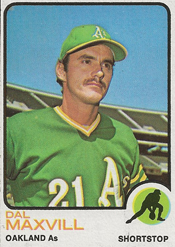
A season that began with Dal Maxvill in a batting slump, resulting in his benching, ended for him with a World Series championship.

On Aug. 30, 1972, the Cardinals traded Maxvill to the Athletics for minor-league third baseman Joe Lindsey and a player to be named (minor-league catcher Gene Dusan).

A gifted fielder, Maxvill was a winner, and he brought those qualities with him to the Athletics.

Maxvill was a member of seven World Series clubs _ five as a player (Cardinals of 1964, 1967, 1968 and Athletics of 1972 and 1974) and two as a general manager (Cardinals of 1985 and 1987). Four of those (1964 and 1967 Cardinals and 1972 and 1974 Athletics) won World Series titles.

Getting it done

A graduate of Washington University in St. Louis with a degree in electrical engineering, Maxvill signed with the Cardinals in 1960 and made his mark with them when he started at second base in all seven games of the 1964 World Series as a replacement for injured Julian Javier.

After fending off a challenge from Jerry Buchek, Maxvill became the Cardinals’ shortstop in 1966. A light hitter with little power, Maxvill earned the job because of his glove. He was their shortstop on the 1967 and 1968 World Series teams. The 1968 season was Maxvill’s best: He hit .253 and earned a Gold Glove Award.

Maxvill, 33, was the Opening Day shortstop for the Cardinals in 1972, but he went hitless in his first 21 at-bats and was replaced by Ed Crosby.

Though Crosby lacked Maxvill’s fielding skills, the Cardinals were willing to play him if he hit. After batting .324 in April, Crosby hit .217 in May and Maxvill returned to the starting lineup.

Rejuvenated, Maxvill hit .280 in June and .253 in July. To his delight, he hit for a higher average in those months than his road roommate, Joe Torre, the reigning National League batting champion, did. Torre hit .250 in June and .252 in July.

Maxvill drove in four runs against the Phillies on July 2 Boxscore and hit his last big-league home run, an inside-the-park poke against the Astros’ Larry Dierker, on July 9. Boxscore

“He’s being more aggressive at the plate,” Cardinals hitting coach Ken Boyer told The Sporting News. “He’s not taking so many good pitches.”

Cardinals manager Red Schoendienst said Maxvill also was fielding better “than any other infielder in the National League.”

The Cardinals, though, fell out of contention, and general manager Bing Devine was looking to trade for prospects.

Change of scene

With their record at 58-61, the Cardinals traded outfielder and first baseman Matty Alou to the Athletics on Aug. 27. Three days later, Maxvill was dealt.

The Maxvill trade was the fifth involving the Athletics and Cardinals in 1972. Describing Athletics owner Charlie Finley as “an aggressive guy,” Devine told The Sporting News, “He calls every day and does not seem to worry about a player’s age or salary.”

On the day they acquired Maxvill, the Athletics were in first place, a half game ahead of the White Sox, in the American League West Division.

Maxvill’s departure left Lou Brock and Bob Gibson as the only Cardinals players from the 1967 and 1968 pennant-winning teams.

“The future is more important than the present now,” Devine said to the St. Louis Post-Dispatch.

Maxvill told the newspaper he hadn’t expected to be traded but was grateful the Cardinals sent him to a contender.

Fitting in

The Athletics got Maxvill to play second base. Their shortstop, Bert Campaneris, led the American League in stolen bases for the sixth time in 1972 and he also led the league’s shortstops in putouts that season.

Dick Green, the Athletics’ Opening Day second baseman, suffered a herniated disc in April and needed back surgery. His replacement, Larry Brown, suffered the same injury in June.

Maxvill was one of 11 players used at second base by the Athletics in 1972.

In his Athletics debut, on Sept. 1 against the Tigers, Maxvill started at second and contributed two hits and a sacrifice bunt. Boxscore

Maxvill made 21 September starts at second for the 1972 Athletics, but manager Dick Williams often lifted him for a pinch-hitter early in the games. During one stretch, he made five starts without getting a plate appearance.

Key contributor

On Sept. 20, Maxvill contributed two defensive gems to help the Athletics beat the second-place White Sox and move five games ahead of them with two weeks left to play. In the clubhouse after the game, a grateful Dick Williams greeted Maxvill “with a big kiss on the cheek,” The Sporting News reported. Boxscore

“I like this ballclub,” Maxvill told the Oakland Tribune. “This is the type of ballclub we had in St. Louis five or six years ago when we won pennants.”

A week later, on Sept. 28, Maxvill drove in the winning run in the division title clincher against the Twins.

With the score tied at 7-7, Sal Bando led off the bottom of the ninth and was hit by a pitch from Dave LaRoche. Williams ordered the next batter, Maxvill, to attempt a sacrifice bunt. Squaring to bunt, Maxvill watched the first three pitches sail wide, then took a called strike.

Given the green light by Williams to swing at the 3-and-1 pitch, Maxvill drove a double into left-center, scoring Bando with the winning run and giving the Athletics the division title. Boxscore

Maxvill told the Oakland Tribune, “This was one of the most important hits I’ve ever had. The most important.”

It turned out to be his only RBI for the 1972 Athletics.

Helping hand

Dick Green was back for the American League Championship Series against the Tigers, so he started at second base and Maxvill was a reserve.

In Game 2, shortstop Bert Campaneris was ejected in the seventh inning for flinging his bat toward the mound after being hit in the ankle by a Lerrin LaGrow pitch. Video Maxvill replaced Campaneris at short. Boxscore

American League president Joe Cronin suspended Campaneris for the remainder of the series. Maxvill started at shortstop in each of the following three games and fielded flawlessly, helping the Athletics clinch their first pennant since 1931. Game 5 video clips

Baseball commissioner Bowie Kuhn allowed Campaneris to play in the 1972 World Series but extended the suspension to the first five games of the 1973 regular season.

Maxvill was on the World Series roster but didn’t appear in a game of the classic won by the Athletics against the Reds.

Because of Campaneris’ suspension, Maxvill was the Opening Day shortstop for the reigning champions in 1973. The Cardinals’ Opening Day shortstop, Ray Busse, was a bust and eventually got replaced by Mike Tyson.

In July 1973, Maxvill’s contract was purchased by the Pirates. Released in April 1974 after starting at shortstop on Opening Day for the Pirates, he was reacquired by the Athletics and helped them win another World Series title.

Maxvill played two innings in the 1974 World Series against the Dodgers. For his career, he played in 179 World Series innings (120 at shortstop and 59 at second base) and committed no errors.

Maxvill, 36, began the 1975 season as a coach on the staff of Athletics manager Al Dark. Activated in August, Maxvill contributed to their division title run.

After stints as a coach with the Mets, Cardinals and Braves, Maxvill became the Cardinals’ general manager in 1985 and remained in that role until 1994.

Read Full Post »

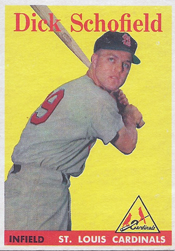
For a player labeled a utility man, Dick Schofield left a prominent mark.

He helped the Pirates, Dodgers and Cardinals win National League pennants. He played 19 seasons in the majors. He was the second of four generations in his family to play pro baseball.
An infielder who reached the majors with the Cardinals at 18, Schofield had three stints with them in three different decades.

All in the family

Dick Schofield’s father, John Schofield, played in the minor leagues for 10 seasons and was nicknamed Ducky. At home in Springfield, Ill., John taught baseball to his son. “We’d go out and he’d hit nine million ground balls to me,” Dick told author Danny Peary for the book “We Played the Game.”

When Dick was 8, his father showed him how to bat from both sides of the plate and Dick, a natural right-hander, remained a switch-hitter in the pros.

John Schofield also took Dick on trips to St. Louis to see the Red Sox play the Browns because Ted Williams was Dick’s favorite player. Dick became a Red Sox fan, he told the St. Louis Post-Dispatch.

During his senior baseball season in high school, Dick Schofield drew the interest of most big-league teams. A shortstop, he hoped to sign with the Red Sox, but the highest offers came from the Cardinals and White Sox.

Big bonus

On June 3, 1953, Schofield signed with the Cardinals, even though, as he told Danny Peary, they were a team “I had always rooted against.”

The $40,000 he received was then the largest bonus paid by the Cardinals. “He’s got a great arm,” Cardinals manager Eddie Stanky told the Post-Dispatch after seeing Schofield work out with the team. “His hands are extremely quick.”

Under the rules then, an amateur player signing for more than $6,000 was required to spend his first two seasons with the big-league team.

Schofield, 18 and looking younger, joined the Cardinals in New York. “I was scared to death,” he recalled to Peary. “The team was playing Brooklyn and I checked into the Commodore Hotel in Manhattan. Then I rode to the ballpark with Stan Musial and Red Schoendienst. They asked me to come along. Imagine that!”

Schofield was assigned to room on the road with the Cardinals’ backup catcher, Ferrell Anderson, 35. “He was like my dad and took good care of me,” Schofield told Peary. “He made it easier for me.”

Learning curve

Schofield was called Ducky by Cardinals players after they were introduced to his father and learned it had been his nickname.

He didn’t get into a game during his first month with the Cardinals, and spent his days being mentored by Stanky and shortstop Solly Hemus.

Stanky “knew baseball better than anybody I ever met,” Schofield told Peary. “Stanky and Hemus helped me learn to play shortstop in the majors, especially turning the double play.”

On June 25, in a game at St. Louis, Stanky complained that Giants pitcher Jim Hearn wasn’t coming to a stop in his delivery. After losing his argument with umpire Augie Donatelli, Stanky threw a towel from the dugout and got a warning from the ump, the Post-Dispatch reported.

Not wanting to back down, but not wanting to get ejected, Stanky turned to Schofield. Knowing the rookie wouldn’t get into the game, Stanky told him to toss a towel, according to the Society for American Baseball Research. Schofield obeyed, and Donatelli ejected him from a game before he’d ever played in one. Boxscore

Hello and goodbye

When Schofield made his big-league debut, on July 3, 1953, against the Cubs at Chicago, it was as a pinch-runner. Boxscore

His first hit came two weeks later, a single versus Johnny Podres at Brooklyn. Boxscore 

Used primarily as a pinch-runner, Schofield hit .179 for the Cardinals in 1953 and .143 in 1954.

With the two mandatory seasons on the big-league club completed, Schofield spent most of the 1955 and 1956 seasons playing for manager Johnny Keane at minor-league Omaha.

(Schofield married his wife Donna in Omaha in 1956. Tyrone Power and Kim Novak, in town to promote their movie, “The Eddy Duchin Story,” sent them a cake, the Post-Dispatch reported, and that’s why the Schofields’ first child, a daughter, was named Kim.)

A backup to Cardinals shortstop Al Dark in 1957, Schofield was a reserve again in 1958 when he was traded to the Pirates in June for infielders Gene Freese and Johnny O’Brien.

“I was totally surprised,” Schofield said to Peary. “I thought the world had come to an end. Nobody wanted to play on the Pirates then. They were a last-place team and Forbes Field was a tough park.”

(According to Schofield, Freese’s reaction to the deal was: “They traded two hamburgers for a hot dog.”)

Key contribution

Schofield, strictly a shortstop with the Cardinals, also was used at second and third by Pirates manager Danny Murtaugh. With Bill Mazeroski at second and Dick Groat at short, Schofield got few starts, but grew to like the Pirates.

On Sept. 6, 1960, with the Pirates contending for a National League pennant, Groat suffered a broken left wrist when hit by a pitch from the Braves’ Lew Burdette. Schofield, hitless since May, was Murtaugh’s choice to replace Groat.

Steady on defense, Schofield surprised with the bat. He hit .375 in September and his on-base percentage for the month was .459.

“He was as fine a utility infielder that ever played this game,” Groat said to Peary. “He could give you two or three weeks of great play at any one of those positions.”

The Pirates won the pennant, but Groat was reinserted at shortstop for the World Series against the Yankees. In Game 2, a Yankees rout, Schofield entered in the sixth and got a single and a walk versus Bob Turley. Boxscore

Helping hand

Groat was traded to the Cardinals after the 1962 season and Schofield, at last, became a starting shortstop. He was the Pirates’ starter in 1963 and 1964. When rookie Gene Alley was deemed ready to take over in 1965, Schofield was dealt to the Giants in May and started for them that season.

Another rookie, Tito Fuentes, became the Giants shortstop in 1966 and Schofield was shipped to the Yankees in May.

On Sept. 10, 1966, the Dodgers acquired Schofield to help them in their pennant drive. He took over for Jim Gilliam and John Kennedy at third base, and stabilized the position, helping the Dodgers win the pennant.

According to The Pittsburgh Press, Dodgers pitcher Don Drysdale said, “He’s been making the big play for us ever since we got him. If it isn’t his glove, it’s his bat. If it isn’t his bat, it’s his base running.”

Because Schofield joined the Dodgers after Sept. 1, he wasn’t eligible to play in the World Series. He watched on TV as the Dodgers got swept by the Orioles.

“The Dodgers couldn’t have won the league flag without him, and they collapsed in the World Series because he wasn’t eligible,” Los Angeles Times columnist Sid Ziff wrote.

Long, winding road

Released by the Dodgers after the 1967 season, Schofield, 33, was signed by the reigning World Series champion Cardinals to be a backup to Dal Maxvill at shortstop and Julian Javier at second base.

Fifteen years after he accompanied Schofield on his ride to the ballpark on the rookie’s first day in the big leagues, Red Schoendienst, manager of the 1968 Cardinals, told the Post-Dispatch, “Schofield is the finest all-round utility infielder we’ve got on the club.”

Schofield made 17 starts at second base and 13 starts at shortstop for the 1968 Cardinals, who repeated as National League champions. On May 4, he contributed four hits and three RBI against the Giants. Boxscore

Schofield got into two games of the 1968 World Series against the Tigers but didn’t have a plate appearance.

Two months later, the Cardinals traded Schofield to the team he rooted for as a boy, the Red Sox. Schofield spent two seasons with the Red Sox and was dealt back to the Cardinals in October 1970.

In July 1971, the Cardinals traded Schofield, 36, for the third and last time, packaging him with Jose Cardenal and Bob Reynolds to the Brewers for Ted Kubiak and a prospect.

A son, also Dick Schofield, played 14 seasons as an infielder in the majors, and a grandson, Jayson Werth (Kim’s son), was a big-league outfielder for 15 seasons.

Read Full Post »

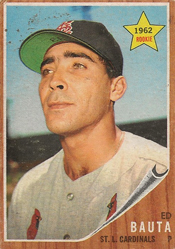
Ed Bauta overcame a difficult beginning to his big-league career with the Cardinals and gained the confidence of his manager.

A right-handed sinkerball specialist, Bauta was a Pirates prospect when the Cardinals acquired him and second baseman Julian Javier in 1960.

The Cardinals wanted Bauta, even though they knew his right knee was injured.

Frustrated by the slow healing process, Bauta nearly quit before pitching a game for the Cardinals. When he finally made his debut with them, it went badly.

Bolstered by the support of trainer Bob Bauman, Bauta persevered and went on to pitch in 80 games over four seasons with the Cardinals. 

Pitching prospect

Eduardo Bauta was raised on a family farm in central Cuba. Doing farm chores and cutting sugar cane as a youth enabled him to develop a strong work ethic, according to his obituary.

Bauta was a catcher as an amateur until a ball struck him in the throat. “I could take only liquids for 15 days,” he told the St. Louis Post-Dispatch.

Attending a Pirates tryout camp, he got a chance to pitch and impressed scout Howie Haak, who signed him. Bauta was 21 when he played his first season in the Pirates’ system at Clinton, Iowa.

In 1960, Bauta had an 0.95 ERA in 12 relief appearances for the Pirates’ Columbus (Ohio) affiliate. Eddie Stanky, special assistant to Cardinals general manager Bing Devine, scouted Bauta and recommended him.

Soon after, Bauta made a wager with a Columbus teammate that he could get a base hit during batting practice. Swinging mightily at a pitch and missing, Bauta fell and tore ligaments in his right knee, the Post-Dispatch reported.

The Cardinals had agreed to send pitcher Vinegar Bend Mizell and infielder Dick Gray to the Pirates for Julian Javier and a pitching prospect. Bauta was one of four pitchers the Pirates offered. Aware of his knee injury, the Cardinals chose him on the strength of Stanky’s scouting report.

Welcome to The Show

Bauta joined the Cardinals on June 12, 1960, and reported to trainer Bob Bauman for treatment of the damaged knee. Frustrated with being sidelined, Bauta said Bauman helped restore his confidence as well as strengthen his knee.

“Doc talked me out of quitting,” Bauta told the Post-Dispatch. “Doc spent a lot of time with me every day. He said, ‘Eddie, you’re not going to quit as long as I’m around here.’ “

On July 6, 1960, the Cubs were routing the Cardinals at Wrigley Field in Chicago when Bauta was called into the game to make his major-league debut. He hadn’t pitched in a game since injuring his knee in May.

Bauta gave up a three-run home run to George Altman in the seventh, and then another three-run home run to Altman in the eighth. Boxscore

“I got Altman out most of the time in the (Caribbean) winter league,” Bauta said to the Post-Dispatch, “but I couldn’t put the ball where I wanted it today.”

True grit

A month later, on Aug. 10, after three consecutive scoreless outings, Bauta was brought in to protect a one-run lead against the Phillies in the bottom of the 10th at Philadelphia.

He retired two batters, but gave up a single and walked two, loading the bases and prompting manager Solly Hemus to visit the mound.

“I had Ronnie Kline warmed up and I was thinking of making a move,” Hemus told the Post-Dispatch.

Hemus asked Bauta, “How do you feel?’ The rookie replied, “I can get them, Skip.”

“Go get them,” Hemus said before returning to the dugout.

Clay Dalrymple swung at Bauta’s first pitch and lofted a fly to center for the final out. Bauta had his first save in the majors. “He showed me something,” Hemus said to the Post-Dispatch. “Anyone who can do that can pitch for me.” Boxscore

Back and forth

Assigned to minor-league Portland (Ore.) in 1961, Bauta was 9-1 with a 1.95 ERA when he got called up to the Cardinals in July. He got his first big-league win on Aug. 23 against the Dodgers. Boxscore

In 13 relief appearances for the 1961 Cardinals, Bauta was 2-0 with five saves and a 1.40 ERA.

Based on that performance, Bauta was in the Cardinals’ plans for 1962. The season began promisingly for him. On April 25, he pitched eight scoreless innings of relief against the Houston Colt .45s. Boxscore

(The game ended in a tie after 17 innings because of a local curfew in Houston that forbid starting an inning after 12:50 a.m. The game was replayed on another date but all the statistics counted.)

After 11 relief appearances in 1962, Bauta had an 0.93 ERA, but then he had a terrible June. After he gave up two home runs to Smoky Burgess of the Pirates on June 30, the Cardinals demoted Bauta to their Atlanta farm club. Boxscore

On the road again

Bauta was back with the Cardinals in 1963. He was 3-4 with three saves when the Cardinals dealt him to the Mets on Aug. 5 for reliever Ken MacKenzie.

(MacKenzie was a Yale graduate. One time, when MacKenzie was brought in at a critical point in a game, Mets manager Casey Stengel said to him, “Make like those guys are the Harvards.”)

In four seasons (1960-63) with the Cardinals, Bauta was 6-4 with 10 saves.

When Bauta faced the Cardinals for the first time after the trade, he pitched 2.1 scoreless innings and struck out Stan Musial. Boxscore

With the Mets, Bauta pitched in the last game played at the Polo Grounds Boxscore and the first game played at Shea Stadium. Boxscore

The 1964 season was Bauta’s last in the majors, but he continued to play until 1974, primarily in the Mexican League. In 1973, Bauta, 38, was a starting pitcher for Petroleros de Poza Rica and was 23-5 with a 2.25 ERA.

Read Full Post »

A journeyman reliever developed into an integral contributor to two contending Cardinals clubs.

On July 31, 2012, the Cardinals acquired pitcher Edward Mujica from the Marlins for minor-league third baseman Zack Cox.

A right-hander with command of the strike zone, Mujica stabilized the Cardinals’ bullpen in 2012 and helped them reach the National League Championship Series. The next year, he filled a void in becoming their closer and helped position them to win a National League pennant.

Great Caesar’s Ghost…

Born and raised in Venezuela, Mujica was the son of a factory worker and a homemaker in the town of Yagua in the northwest part of the country.

He signed with the Cleveland Indians in October 2001 when he was 17, reached the majors with them in June 2006 and was traded to the Padres in April 2009.

Using a split-fingered pitch and a change-up, he developed a reputation for throwing strikes. In 59 games for the 2010 Padres, Mujica had 72 strikeouts and six walks, a ratio of 12 strikeouts for every walk issued.

In November 2010, the Padres traded him to the Marlins.

The Marlins changed managers in June 2011, replacing Edwin Rodriguez with an 80-year-old, Jack McKeon, who took a 1930s approach to player relations. It was McKeon who gave Mujica the nickname “The Chief.”

“He said to me one day, ‘I can’t say your name. Are you American Indian?’ ” Mujica recalled to the St. Louis Post-Dispatch. “I said, ‘No, I’m from Venezuela.’ He said, ‘It’s better for me to call you The Chief. You’re the last of the Mohicans.’ “

(When Mujica got traded to the Cardinals, he said he was surprised when their general manager, John Mozeliak, called him and said, “Chief, how are you doing?” Mujica told the Post-Dispatch, “I said, ‘What? How did you know that?'”)

Swashbuckler

In 67 relief appearances for the 2011 Marlins, Mujica was 9-6 with a 2.96 ERA and earned a reputation as a clubhouse comedian. “He’s the class clown,” teammate Heath Bell told the Miami Herald. “He loves to have fun.”

Another teammate, Steve Cishek, told the Palm Beach Post, “In the bullpen, he’s a swordsman. I’ll look over and all of a sudden he has a stake that he pulled out of the ground and he’s fighting an imaginary person. It’s hilarious.”

Cishek, who took fencing classes in college, rewarded Mujica with a fencing foil and mask. Mujica kept those above his locker.

“I’m a funny guy,” Mujica told the Miami Herald. “I just try to enjoy my time because this job only lasts 10 or 15 years, and you have to enjoy the moment.”

Mujica also was known to take naps in the bullpen during early innings of games. After a TV camera showed him napping at Wrigley Field, he came to the ballpark the next day with a hand-written sign: “Cameraman, Please Do Not Disturb.”

Helping hand

Happy to play for fellow Venezuelan Ozzie Guillen, who took over as Marlins manager in 2012, Mujica told the South Florida Sun Sentinel “it was a big surprise” to be traded to the Cardinals.

The Marlins made the deal to get Zack Cox “with the thought he could be our third baseman in the near future,” president of baseball operations Larry Beinfest told the Miami Herald. “We really like the bat.”

Cox was chosen by the Cardinals in the first round of the June 2010 amateur draft. Other 2010 first-round picks included Bryce Harper (Nationals), Manny Machado (Orioles), Christian Yelich (Marlins) and Nick Castellanos (Tigers).

(Cox never reached the majors.)

Noting that Mujica, 28, had an above-average split-fingered pitch, Cardinals pro scouts Mike Juhl and Mike Jorgensen recommended the club trade for him.

On the day of the deal, the Cardinals (55-48) were in third place, seven games behind the division-leading Reds, and their bullpen was in disarray. Relievers were making a mess of the seventh inning and that was creating chaos in the eighth and ninth, too.

Manager Mike Matheny designated Mujica to pitch the seventh. Pitching coach Derek Lilliquist and catcher Yadier Molina urged Mujica to feature his spit-fingered pitch instead of the slider, the Post-Dispatch reported.

The results were immediate and impressive. Mujica didn’t allow a run in his first 18 games pitched for the Cardinals. With Mujica locking down the seventh inning, Matheny was able to stick with Mitchell Boggs as a setup reliever in the eighth and Jason Motte as closer in the ninth.

The consistent combination of Mujica, Boggs and Motte stabilized the bullpen. In 29 games pitched for the 2012 Cardinals, Mujica had a 1.03 ERA, allowing three earned runs in 26.1 innings. He struck out 21 and walked three.

The Cardinals finished 88-74, second in their division and fifth overall in the National League, but in the watered-down system approved by team owners and the players’ union, fifth is good enough to qualify for the playoffs.

After dispatching the Braves and Nationals, the Cardinals were in the National League Championship Series against the Giants. Mujica was the winning pitcher in Game 1, striking out the side in a scoreless seventh. Boxscore

Mujica pitched four scoreless innings in the series, but the Giants prevailed, winning four of seven games to clinch the pennant.

Fun while it lasted

Near the end of spring training in 2013, Motte suffered an elbow injury. Matheny began the season with Boggs as the closer, but he faltered.

Mujica took over as closer and converted his first 21 consecutive save chances, earning a spot on the National League all-star team.

By August, fatigue set in. Mujica pitched three consecutive days six times in 2013. He pitched in six games in seven days from July 4-10.

Mujica strained his shoulder, causing numbness in his neck. He also had a groin injury. Unable to push off the mound the right way, his arm slowed down and so did his pitch speed, the Post-Dispatch reported.

In mid-September, with Mujica struggling, Trevor Rosenthal replaced him as closer. Mujica finished the season with 37 saves. He struck out 46 and walked five. The only Cardinals pitchers with more saves in a season are Rosenthal, Jason Isringhausen, Lee Smith, Bruce Sutter, Motte and Ryan Franklin.

The 2013 Cardinals, who posted the best record in the National League at 97-65, won the pennant, eliminating the Pirates and Dodgers in the playoffs, before falling to the Red Sox in the World Series.

Granted free agency after the World Series, Mujica signed with the Red. Sox. By 2016, he was back in the minors.

The Cardinals signed Mujica to a minor-league contract in 2018. At spring training, he earned a save with a scoreless inning against the Braves. “How about that? Blast from the past,” Matheny said to the Post-Dispatch.

Sent to Memphis, Mujica, 34, led the team in saves (13) and games pitched (48). He struck out 35 and walked six in 51.1 innings, but wasn’t called up to St. Louis.

Read Full Post »

« Newer Posts - Older Posts »