Feeds:
Posts
Comments

Archive for the ‘Trades’ Category

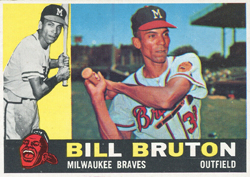
After giving Curt Flood a chance at the center field job, the Cardinals decided they needed an upgrade at the position. The player they wanted was Bill Bruton.

A left-handed batter, Bruton became the Braves’ center fielder in 1953 and helped transform them into National League champions in 1957 and 1958. 

In December 1960, the Cardinals made multiple offers for Bruton, including one that likely involved trading Bob Gibson.

Impact player

Bruton got his start in pro baseball when his father-in-law, future Hall of Fame third baseman Judy Johnson, put out the word about him, The Sporting News reported. Bruton was 24 when Braves scout Johnny Ogden signed him in 1950.

Bruton made an impact his first season in the minors, swiping 66 bases for Eau Claire. The next year, he had 27 triples for Denver.

“I’ve seen no player in baseball today who is as fast as Bruton,” Braves scout Walter Gautreau told The Sporting News.

With Class AAA Milwaukee in 1952, Bruton totaled 211 hits and scored 130 runs.

Before the 1953 season, the Braves relocated from Boston to Milwaukee and Bruton was named their Opening Day center fielder.

Splendid start

The Braves began the 1953 season at Cincinnati. Bruton, 27, had a dazzling debut. Batting leadoff, he had two hits, a stolen base and scored a run.

Described by the Cincinnati Enquirer as a “mercury-footed” outfielder who covered center “like the morning dew,” Bruton made six putouts, “two of them only short of sensational.”

“In the third inning, he leaped high in front of the center field seats to take what looked like a surefire double away from Willard Marshall,” the Enquirer reported. “He repeated the performance at the expense of Bobby Adams in the ninth.” Boxscore

The Braves took a flight to Milwaukee after the game and were greeted at the airport by 1,500 admirers, according to United Press.

Heroics at home

The next day, in their first regular-season home game since moving from Boston, the Braves played the Cardinals, and Bruton again was sensational.

In the eighth inning, with the score tied at 1-1, the Cardinals had two on and two outs when Stan Musial drove a Warren Spahn pitch into left-center. Bruton made a running catch, depriving Musial of a two-run double.

In the bottom half of the inning, the Braves had two outs and none on when Bruton, described by The Sporting News as the “Jesse Owens of the baselines,” hit an inside fastball from Gerry Staley over the head of right fielder Enos Slaughter for a triple. Sid Gordon’s single scored Bruton, giving the Braves a 2-1 lead.

The Cardinals tied the score in the ninth.

Batting with one out and none on in the 10th, Bruton got a knuckleball from Staley. “Man, it just hung there,” Bruton told the Associated Press.

Bruton drilled the pitch to deep right. According to the St. Louis Post-Dispatch, Slaughter “ran back to the waist-high wire fence, reached up and almost made the catch, but as his fingers began to close on the ball, his elbow struck sharp prongs protruding from the wire barrier.”

The impact jarred the ball loose and it dropped over the fence for a home run, Bruton’s first in the majors. It also turned out to be his only home run of the season and his only walkoff home run in 12 years in the big leagues. Boxscore

As Bob Broeg of the Post-Dispatch noted, Bruton’s dramatics made him “as popular in Milwaukee as beer and cheese.”

Multiple talents

Bruton was the Braves’ center fielder for eight years (1953-60). Hank Aaron, who joined the Braves in 1954, was his outfield teammate for seven of those seasons.

The Braves won the pennant in 1957 but Bruton sat out the World Series because of a knee injury. The next year, when the Braves repeated as National League champions, Bruton had a .545 on-base percentage in the World Series, reaching base 12 times (seven hits and five walks) in 22 plate appearances.

Bruton led the National League in stolen bases three times: 1953 (26), 1954 (34) and 1955 (25).

In 1960, Bruton, 34, had one of his best seasons, leading the league in runs scored (112), triples (13) and assists by a center fielder (11). He also ranked fourth in hits (180).

The Braves, though, had been searching for a second baseman ever since Red Schoendienst came down with tuberculosis, and general manager John McHale decided Bruton’s trade value would bring an experienced infielder.

Determined to deal

The Cardinals preferred Bruton to Flood.

In three seasons as Cardinals center fielder, Flood’s batting average and on-base percentage decreased every year: 1958 (.261 batting average, .317 on-base percentage), 1959 (.255 and .305) and 1960 (.237 and .303). He also had a mere two stolen bases in both 1958 and 1959, and none in 1960.

“We’ve been interested in Bruton for some time,” Cardinals general manager Bing Devine told the Post-Dispatch.

According to The Sporting News, the Cardinals offered their shortstop, Daryl Spencer, for Bruton. Spencer had been a second baseman with the Giants.

When the Braves reacted unenthusiastically, the Cardinals approached the Phillies about making a three-way trade with the Braves.

According to the Associated Press, the Braves were interested in Phillies second baseman Tony Taylor and reliever Turk Farrell. In exchange, the Phillies wanted outfielder Wes Covington from the Braves, and first baseman Joe Cunningham and pitcher Bob Gibson from the Cardinals, the Philadelphia Daily News reported. Bruton would go to the Cardinals.

(Later that month, the Cardinals offered Gibson to the Senators for Bobby Shantz.)

According to The Sporting News, the three-way deal “went down the drain” when the Phillies “stepped up their demands.”

“We wanted to make a deal,” Cardinals manager Solly Hemus said, “but it wound up with the Phillies wanting too many of our established players. We would have had to give up four or five, and would have gotten one or two.”

The Cardinals tried again to interest the Braves in a swap of Spencer for Bruton. “The Braves began to warm up to his possibilities,” The Sporting News reported, but then the Tigers entered the picture.

Flood is the answer

When the Tigers proposed dealing second baseman Frank Bolling to the Braves for Bruton, talks with the Cardinals ceased. Braves general manager John McHale had been general manager of the Tigers and he was an admirer of Bolling.

“When I was at Detroit, I thought Bolling was just as valuable to the club as Harvey Kuenn or Al Kaline,” McHale told The Sporting News.

To ensure the Tigers didn’t waver, McHale sweetened the deal. On Dec. 7, 1960, the Braves traded Bruton, catcher Dick Brown, infielder Chuck Cottier and pitcher Terry Fox for Bolling and a player to be named, outfielder Neil Chrisley.

According to the Sporting News, Hemus contacted Tigers manager Bob Scheffing and asked whether the Tigers would flip Bruton to the Cardinals, but was told no.

Don Landrum, acquired from the Phillies in September 1960, opened the 1961 season as the Cardinals’ center fielder. The Cardinals also tried Don Taussig and Carl Warwick there.

In July, Hemus was fired and replaced by Johnny Keane, who committed to Flood in center. Flood rewarded Keane’s confidence by hitting .324 in July, .330 in August and .355 in September. He went on to be the center fielder on Cardinals clubs that won three league championships and two World Series titles.

Read Full Post »

Great expectations followed David Green from Nicaragua to the United States, creating golden opportunities along with a multitude of pressures.

Green had successes, but his drinking held him back, and his recklessness had devastating consequences.
Dad’s influence

Green’s father, Eduardo Green, was an outfielder on the Nicaraguan national teams in the 1940s and 1950s. Nicknamed “The Black Gazelle,” Eduardo was described by sportswriter Edgard Tijerino as having “the soul of a ballet dancer” and “the reflexes of a panther,” according to the Society for American Baseball Research.

In 1951, Eduardo joined the Dodgers at their minor-league spring training camp in Daytona Beach, but left because of the racism he encountered in Florida.

Eduardo and Bertha Green had 10 children. One of their five sons, David, was born in Managua, Nicaragua, and named in honor of his paternal grandfather, a missionary who immigrated from Jamaica.

Like his father, David Green developed into an exceptional athlete. “Soccer was my best sport,” he told the San Francisco Examiner.

He played baseball, too, and Eduardo advised him to pursue a career in the sport.

Prime prospect

David Green was playing for the Nicaraguan national team in 1978 when he caught the attention of Ray Poitevint, the Brewers’ director of scouting and player development. “He’s got Willie Mays’ physical abilities,” Poitevint told the Milwaukee Journal Sentinel.

Green was 17 when he signed with the Brewers in September 1978.

“He has all the tools _ not only to be a big-league player, but a big-league star,” Poitevint said to The Sporting News. “If you were a betting man, you would have to bet on this kid.”

Eduardo Green died in September 1980. His son had just completed his second season in the Brewers’ farm system and was rated their top prospect.

Whitey Herzog, Cardinals manager and general manager, envisioned Green as a center fielder who could become the centerpiece of the team.

The Brewers wanted to make a trade, but were reluctant to give up Green. 

In the book “You’re Missin’ a Great Game,” Herzog said, “He was so good that some of the Brewers executives damn near came to blows over giving him up.”

Years later, Herzog told Rick Hummel of the St. Louis Post-Dispatch that he’d heard from a Brewers scout that Green had a drinking problem, but Herzog wanted him anyway.

In his book “White Rat: A Life in Baseball,” Herzog said, “He was absolutely the key to the deal.”

On Dec. 12, 1980, the Cardinals traded two future Hall of Famers, Ted Simmons and Rollie Fingers, and a future Cy Young Award winner, Pete Vuckovich, to the Brewers for Green, Dave LaPoint, Lary Sorensen and Sixto Lezcano.

“I had a little buyer’s remorse afterward,” Brewers general manager Harry Dalton told the Milwaukee Journal Sentinel. “I wondered if I had done the right thing.”

Ups and downs

Promoted to the Cardinals in September 1981, Green was the first National League player born in Nicaragua. The first in the American League was Orioles pitcher Dennis Martinez in 1976.

Green, 20, got his first big-league hit, a single, against the Pirates’ Luis Tiant, 40. Boxscore

At spring training in 1982, Green “probably was the Cardinals’ best player in camp,” The Sporting News reported, and he won the center field job.

“He had more raw ability than any young player I’ve ever managed,” Herzog said in “White Rat.” Video

Green, 21, began the 1982 season with a flourish, hitting .381 in April. His batting mark was at .316 on May 7 when he tore a hamstring.

While Green was on the disabled list, Willie McGee took over in center. McGee did so well he kept the job when Green returned.

The Cardinals sent Green to the minors for two months so that he could play every day. He was back with the Cardinals for their pennant push.

In the pivotal Game 2 of the National League Championship Series against the Braves, Green led off the ninth inning with a single, moved to second on a bunt and scored the winning run on Ken Oberkfell’s hit. Boxscore

Facing the Brewers in the World Series, Green had two hits, a double and a triple, in Game 5 versus Mike Caldwell. Boxscore

Dealing with change

At spring training in 1983, Herzog told The Sporting News, “We’ve got to find a place for Green. It’s almost a must.”

Toward the end of spring training, McGee separated a shoulder and began the season on the disabled list, opening a starting spot for Green in the outfield.

In June, after first baseman Keith Hernandez was traded, Herzog moved right fielder George Hendrick to first and Green took over in right.

Two months later, Green told the Post-Dispatch that an older brother, Edward, was jailed in Nicaragua. In September, Green’s mother, Bertha, and a younger brother, Enrique, joined him in the U.S.

Green led the 1983 Cardinals in triples (10) and had 34 stolen bases.

Wrong direction

Just before the start of spring training in 1984, Green’s mother died. That is when “Green’s downfall began,” the Post-Dispatch noted.

Herzog moved Hendrick back to right field and started Green at first base. In May, Green went into a funk. “He’s really gone downhill the last two or three weeks,” Herzog told The Sporting News. “His reactions were not good. Balls (thrown to him) were hitting him on the wrist.”

The Cardinals suspected Green’s drinking was to blame and convinced him to enter a rehabilitation center in St. Louis.

In “White Rat,” Herzog said, “The young man developed a real problem with alcohol. Everybody on the club knew it. He’d show up late, hung over real bad … His tolerance for booze was about zero.”

Green spent three weeks in the rehabilitation center. He told the Post-Dispatch, “I didn’t need to go, but I went anyway because somebody had to do it.”

Herzog told the Post-Dispatch, “He didn’t give himself much of a chance. You spend only 10 or 12 days there and you’re not going to be cured.”

In “You’re Missin’ a Great Game,” Herzog recalled an incident that occurred soon after Green completed his rehabilitation stint.

“I’m driving home from the ballpark and I end up a couple of car lengths behind him on the highway,” Herzog said. “He doesn’t see me. I’m keeping a safe distance. Pretty soon, here come the beer cans flying out of the car. One right after the other, every five minutes. We drove past the hospital where he did rehab. More cans!

“When they get hooked on this stuff, they turn into con artists. They’re conning themselves, and they expect you to swallow their bull, too.”

Moving on

In February 1985, in a deal that put them back on the championship track, the Cardinals traded Green, Dave LaPoint, Jose Uribe and Gary Rajsich for Jack Clark.

“Of all the players I’ve had the opportunity to manage, David Green has more ability than anyone as far as hitting, hitting with power, speed and throwing arm,” Herzog told The Sporting News after the deal. “Garry Templeton and George Brett are in that category, but Green has more power than either, he runs better than either, and he throws better than George.”

Asked about his time with the Cardinals, Green told the San Francisco Examiner, “They were expecting too much of me and then they didn’t play me. Sometimes they called me the franchise, then they played Andy Van Slyke. I think I did great in the outfield, then they moved me to first base.”

The Giants started Green at first base but he had a dreadful beginning to the 1985 season. His batting average on May 11 was .080.

“It’s a matter of concentration,” Giants hitting coach Tom McCraw told the Examiner. “I tell him something in the dugout, and he says, ‘Yeah,’ and by the time he gets to the plate he’s forgotten it.”

The Giants traded Green to the Brewers after the season, but he was released at the end of spring training in 1986.

Comeback try

After playing in Japan and Mexico, Green contacted the Cardinals and asked for a tryout with the Class AAA Louisville club.

Green signed in July 1987, hit .356 for Louisville and was called up to the Cardinals, who were contending for a division crown, in September.

The Cardinals projected him to compete for an outfield spot in 1988.

“This is my last chance,” Green told The Sporting News, “and I’m trying to take advantage of it.”

He was only 27 when he arrived at spring training in 1988, though speculation had swirled for years that his December 1960 birthdate was inaccurate.

In the book “Whitey’s Boys,” Herzog said, “David might have been a couple of years older than we thought he was. I don’t know anybody who has ever seen his birth certificate from Nicaragua.”

Cardinals general manager Dal Maxvill said to the Post-Dispatch, “He might be anywhere between 28 and 32, but I don’t care if he is 32, if he does the job.”

Green’s bid to make the Opening Day roster failed. Sent back to Louisville, he hit .216, clashed with manager Mike Jorgensen and was waived in June 1988.

Fatal accident

Seven years later, in January 1995, Green was arrested on suspicion of drunk driving in a car accident in suburban Country Club Hills, Mo. 

According to the Post-Dispatch, a passenger in the car Green struck, Gladys Yount, 85, of Jennings, Mo., suffered a fractured pelvis in the accident and died of a heart attack two hours later.

Green was charged with involuntary manslaughter and served six months in jail, the Post-Dispatch reported.

He went on to help operate a dog grooming business in south St. Louis and was a youth baseball instructor.

Read Full Post »

In the span of eight months, Bob Cain was the starting and winning pitcher in two of the most unusual baseball games _ one against the St. Louis Browns and the other for them.

On Feb. 14, 1952, Cain was acquired by the Browns in a trade with the Tigers.

Six months earlier, when baseball’s greatest showman, Browns owner Bill Veeck, devised the stunt of sending 3-foot-7 Eddie Gaedel to bat in a game versus the Tigers, Cain was the pitcher who stood on the mound in disbelief.

The following spring, as a member of Veeck’s Browns, Cain used artistry instead of antics to make a mark, prevailing against Bob Feller in a duel of one-hitters.

Cain is able

Born in Longford, Kansas, Cain was a youth when his family moved 35 miles south to Salina, Kansas, the heart of wheat country. His father operated a taxicab company. Cain impressed in amateur baseball and was 18 when he signed with the Giants.

A left-handed pitcher, Cain played one season of minor-league ball at the Class D level in 1943 before serving two years (1944-45) in the military. When he returned, the Giants kept him in their farm system until he was traded to the White Sox in June 1949.

Called up by the White Sox in September 1949, Cain, 24, made his debut with three scoreless innings of relief against the Red Sox. He struck out Ted Williams the first time he faced him. In the book “We Played the Game,” Cain recalled, “He was surprised a rookie would throw a 3-and-2 curveball.” Williams would hit .200 in 10 career at-bats versus Cain. Boxscore

In May 1951, Cain was traded to the Tigers. A month later, he pitched a shutout against a Yankees lineup featuring Mickey Mantle, Joe DiMaggio and Yogi Berra. It was the first time the Yankees failed to score that season. Boxscore

Two weeks later, Cain held the Indians to two runs, but was a hard-luck loser. The opposing starter, Bob Feller, pitched a no-hitter. Boxscore

Then came the encounter with Eddie Gaedel.

Show time

Cain was the Tigers’ starter against the Browns in the second game of a doubleheader on Aug. 19, 1951, at Sportsman’s Park in St. Louis.

The Browns posted a lineup with rookie Frank Saucier as the leadoff batter, but, when it came time for him to bat in the first inning, Bill Veeck, always eager to upstage the buttoned-down Cardinals, sprung his surprise with Eddie Gaedel.

Wearing a uniform with the fraction one-eighth as his number and holding a toy bat, Gaedel, 26, who worked in Chicago as a courier for a livestock business journal, approached the plate with strict instructions from Veeck to not swing at any pitches.

When plate umpire Ed Hurley saw Gaedel in the Browns uniform of 9-year-old Bill DeWitt Jr. (the current Cardinals owner who was the son of Browns general manager Bill DeWitt Sr.), he went toward the Browns’ dugout and demanded an explanation from manager Zack Taylor. After Taylor showed Hurley the paperwork proving Gaedel had signed a Browns contract that was sent to the American League office, Hurley permitted Gaedel to bat.

“You should have seen the look on the face of Bob Cain,” Gaedel told The Sporting News. “His jaw dropped and his eyes almost popped out of his head.”

Cain called out to his catcher, Bob Swift, “Got any idea what to do with this fellow?”

Swift, who, like Cain, hailed from Salina, Kan., went to the mound for a conference with his pitcher.

When Swift went back behind the plate, he stretched out on his stomach to give Cain a low target, but Hurley told him to get up. So Swift knelt on both knees.

Gaedel crouched in the batter’s box, making the strike zone microscopic. Standing in against Cain was a risk for any batter. He finished second in the league that year in most batters hit by pitches (14).

In “We Played the Game,” Cain said, “I didn’t know whether to throw the ball underhanded or overhanded to Gaedel. I just wanted to be careful not to hit him. Dizzy Trout told me later that if he’d been the pitcher he’d have thrown the ball right between his eyes.”

While Swift was urging him to get the ball lower, Cain threw four overhanded pitches, all high, and Gaedel was awarded first base.

“The balls I threw to him, they were over his head, even though they’d have been strikes on normal batters,” Cain told the Salina Journal. “He was bending over to where the strike zone was only about an inch.”

In “We Played the Game,” the left-hander said, “I’d have given my right arm just to have gotten one strike on him.”

Gaedel later told Bob Broeg of the St. Louis Post-Dispatch that as he made his way to first, “For a minute, I felt like Babe Ruth.”

Gaedel was lifted for pinch-runner Jim Delsing and Cain settled down. He allowed no earned runs in 8.1 innings and got the win in the Tigers’ 6-2 victory. Boxscore

Cain was 11-10 for the 1951 Tigers. He ranked second on the club in wins, but his ERA was 4.70 and he totaled more walks (82) than strikeouts (58).

Pair of aces

Looking to shake up the roster after finishing 73-81 in 1951, the Tigers traded Cain, pitcher Gene Bearden and first baseman Dick Kryhoski to the Browns in February 1952 for pitcher Dick Littlefield, first baseman Ben Taylor, outfielder Cliff Mapes and catcher Matt Batts.

“Cain was the most valuable parcel the Tigers gave up in the deal,” the Detroit Free Press declared.

The last-place Browns (52-102) were happy to get a pitcher of Cain’s caliber. Veeck told The Sporting News, “He’s a bona fide starter. Just what we need.”

Cain liked the Browns because Veeck gave him the salary he wanted. In “We Played the Game,” Cain said, “Veeck was one of the nicest, most honest men in baseball, a great guy to play for.”

Cain’s first regular-season start for the Browns came against his former team, the Tigers, at Detroit. He yielded one run in nine innings and got the win. Boxscore

A week later, Cain was matched in a start versus Bob Feller for the first time since Feller pitched his no-hitter against him the year before.

Cain pitched a one-hitter. So did Feller.

The win went to Cain, who pitched a shutout in a 1-0 Browns victory at St. Louis.

“I owed this one to Feller,” Cain told The Sporting News. “It was just my turn to get the good break.”

It was the second time two pitchers achieved one-hitters in the same game in the majors. In 1906, the Cubs’ Mordecai Brown and the Pirates’ Lefty Leifield did it in a 1-0 Cubs triumph. Boxscore

The Browns got their run against Feller in the first inning. Bobby Young led off with a triple over the head of left fielder Jim Fridley. Marty Marion followed with a hard grounder to third baseman Al Rosen, who bobbled the ball for an error, enabling Young to score. Boxscore

It was the 11th of Feller’s 12 one-hitters in the majors, and the only one he lost. Feller also pitched three no-hitters.

The Indians’ lone hit was a single by Luke Easter in the fifth inning. Easter tormented Cain, hitting .368 with five home runs against him in his career.

In “We Played the Game,” Cain said, “I’d like people to remember how I pitched against Bob Feller. Being able to pitch against someone I knew would be a Hall of Famer gave me inspiration.”

Cain finished the 1952 season with a 12-10 record for the Browns. He and Satchel Paige, 48, tied for the team lead in wins.

The next year, his last in the majors and the last for the Browns in St. Louis, Cain was 4-10 with a 6.23 ERA.

After his playing career, Cain worked for Kraft Foods.

In June 1961, when Eddie Gaedel died at 36, Cain and his wife drove from their home near Cleveland to attend the funeral in Chicago. Veeck was ill and unable to be there. Cain was the only baseball person who went.

“I never even met him,” Cain said, “but I felt obligated to go.”

Read Full Post »

During the Great Depression, the Cardinals played the baseball trade market like bond investors.

On Dec. 9, 1931, the reigning World Series champion Cardinals acquired outfielder Hack Wilson and pitcher Bud Treachout from the Cubs for pitcher Burleigh Grimes.
Wilson and Grimes, a pair of future Hall of Famers, were the principals. A year earlier, in 1930, Wilson established a major-league record for RBI in a season (191) and a National League mark for home runs (56). Grimes earned 17 wins for the 1931 Cardinals, then was the winning pitcher in Games 3 and 7 of the World Series versus the Athletics.

The Cardinals made the trade as much for financial, rather than baseball, reasons. In dealing Grimes, the Cardinals removed from the payroll their highest-paid pitcher. In acquiring Wilson, they got an asset whom they were able to swap a month later for a substantial amount of cash.

Big production

Listed at 5 feet 6 and 200 pounds, Lewis Wilson was nicknamed “Stouts” in the minor leagues and then became known as “Hack” because his short, broad build reminded some of wrestler George Hackenschmidt, the St. Louis Globe-Democrat reported.

Wilson began his professional baseball career as a catcher in the minors. With Martinsburg, W.Va., in 1921, he broke a leg on Opening Day. When he recovered, he couldn’t squat in a catcher’s position, and was converted into an outfielder.

Wilson was called up to the Giants in September 1923 and played for them in 1924 and 1925 before being sent to the Toledo Mud Hens farm team in August 1925. Left off the Giants’ roster, Wilson was drafted by the Cubs.

Playing for Cubs manager Joe McCarthy, Wilson led the National League in home runs four times _ 1926 (21), 1927 (30), 1928 (31) and 1930 (56) _ and twice was the league’s RBI leader: 1929 (159) and 1930 (191).

The good times for Wilson changed when the former Cardinal, Rogers Hornsby, became the Cubs’ manager, replacing McCarthy, who left for the Yankees in 1931.

Big trouble

Hornsby and Wilson were a toxic match. Described by the United Press wire service as the “roly-poly playboy of the majors,” Wilson enjoyed the nightlife. Hornsby objected to Wilson’s carousing and inattention to conditioning, and after Wilson slumped early in the 1931 season (no home runs in April and two in May) Hornsby often benched him.

“His usefulness had been greatly impaired by what club officials said was a lack of training and a lack of respect for the more righteous social pursuits,” the Chicago Tribune noted.

Wilson sulked when Hornsby kept him out of the lineup. The slugger also was miffed because Hornsby ordered him not to swing at pitches when the count was 2-and-0 or 3-and-1.

“They took that bat right out of my hands,” Wilson said to the Chicago Tribune.

Tensions reached a boiling point on Sept. 5, 1931, when the Cubs boarded a train for Chicago after a loss in Cincinnati. Wilson confronted three newspaper reporters in the vestibule of the train and complained about their coverage. Pitcher Pat Malone joined them and, goaded by Wilson, slugged two of the newspapermen, according to the Chicago Tribune.

The Cubs suspended Wilson without pay for the rest of the season, and club owner William Wrigley said Wilson never would play for the Cubs again.

“He can be as good a player as he wants to be, but he’ll have to change his conduct and his habits,” Hornsby told The Sporting News.

Wilson produced a mere 13 home runs and 61 RBI for the 1931 Cubs after his 1930 output of 56 homers and 191 RBI. “An all-America bust,” The Sporting News declared.

The Chicago Tribune concluded, “Wilson rose to the heights among the greatest in the game, then through the medium of self-neglect, he plumbed the depths, experiencing his most disappointing year.”

Change of mind

Asked whether they were interested in trading for Wilson, the Cardinals repeatedly said no.

“We don’t want Wilson,” Cardinals owner Sam Breadon informed the St. Louis Star-Times.

Cardinals vice-president Branch Rickey told the St. Louis Post-Dispatch, “We’re not making any offer for Wilson and we’re not in the bidding for him.”

The Cardinals’ stance changed when they got to the baseball winter meetings in December 1931 and found three clubs _ Braves, Dodgers and Reds _ vying for Wilson. Seeing there was a competitive market for him, the Cardinals sensed an opportunity and entered the bidding at the 11th hour.

“Properly handled, an investment in Wilson could be made a profitable one,” Rickey told the Post-Dispatch.

The Cubs offered Wilson and cash for outfielders George Watkins and Ernie Orsatti, but the Cardinals said no, the Associated Press reported.

According to the Chicago Tribune, the Cardinals countered by offering the Cubs their choice of one of three players: Watkins, Orsatti or Burleigh Grimes. The Cubs pounced at the chance to get Grimes, who was 5-0 against them in 1931.

Wheel and deal

Because Grimes was a World Series hero and because Breadon and Rickey had said Wilson wasn’t a player they wanted, the trade was “unexpected,” the St. Louis Star-Times reported. The Post-Dispatch called it “a big surprise.”

The Cardinals’ reasons for trading Grimes were:

_ Breadon said Grimes was the highest-paid pitcher on the team “and we had to cut down on our expenses,” the Globe-Democrat reported. Grimes was paid $20,000 in 1931.

_ Grimes was 38 and the Cardinals suspected he was approaching the downside of his career.

_ Pitching prospects Dizzy Dean and Tex Carleton were deemed ready to come up from the minors and join the Cardinals’ starting rotation in 1932.

Within hours of acquiring Wilson, the Cardinals tried to trade him.

“Our buying of Wilson is like the purchase of a good bond,” Rickey said to the Post-Dispatch. “The market is always good for a player like Wilson, the same as the stock market is for a good bond.”

As the Globe-Democrat put it, Wilson, 31, “will be used as bait.”

Sales tactics

When the Cardinals shopped Wilson to the Braves, Dodgers and Reds, the proposed return wasn’t what they’d hoped. Wilson’s value “is at an absolute lowest low on the market,” the Post-Dispatch reported.

The Cardinals worked to change that. They had Wilson take an eye exam and made a show of heralding the results, which rated his vision as excellent. Then Breadon and Rickey told the newspapers they might keep Wilson on the team.

Sid Keener of the Star-Times called their bluff. “It is my opinion that Breadon and Rickey are employing salesmanship methods on spreading this ballyhoo,” Keener wrote. “They are trying to increase his value in trade negotiations by publicly admitting they intend retaining the outfielder.”

The Braves offered $15,000 for Wilson, the Post-Dispatch reported, but the Cardinals figured they could do better.

The Cardinals sent Wilson a contract for $7,500. Wilson, who was given a salary of $37,500 by the Cubs in 1931, returned the contract unsigned. Wilson told the Post-Dispatch he expected to take a salary cut, perhaps as much as 50 percent, but nothing like the amount the Cardinals offered.

Published speculation was the Cardinals made the low offer because they had no intention of signing Wilson, but by offering him a contract it showed prospective suitors they were serious about keeping him.

Pay day

The Dodgers, who had been rebuffing the Cardinals’ offers of Wilson for either pitcher Watty Clark or Dazzy Vance, came back with a cash proposal.

On Jan. 23, 1932, the Cardinals sent Wilson to the Dodgers for $45,000 and a minor-league first baseman, Bob Parham.

“I expected it all along,” Wilson told the Associated Press. “That move to the Cards was nothing more than a stopover.”

For the Cardinals, it was a bonanza.

According to the U.S. Bureau of Labor Statistics, $45,000 in January 1932 was the equivalent of $857,000 in December 2021. The $20,000 the Cardinals saved by moving Burleigh Grimes was the equivalent of $381,000 in 2021.

Thus, by dealing Grimes and Wilson, the Cardinals improved their Depression Era bottom line by $65,000, or the equivalent of about $1.2 million in 2021 value.

Rickey had a personal incentive to trade players for cash because his contract called for him to get a percentage of the sale.

Wilson, who got a contract of $16,500 from the Dodgers, had his last big season for them, hitting .297 with 23 home runs and 123 RBI in 1932.

Burleigh Grimes was 6-11, including 1-3 versus the Cardinals, in 1932, but the Cubs won the National League pennant. Released by the Cubs in July 1933, Grimes came back to the Cardinals.

Read Full Post »

When the Cardinals got Tom Lampkin, it was not with the expectation he would be their Opening Day catcher in each of the next two seasons.

On Dec. 19, 1996, the Cardinals acquired Lampkin from the Giants for a player to be named. Two months later, the Giants chose pitcher Rene Arocha from a list of four players offered by the Cardinals, completing the deal.

Lampkin was projected to be a backup, but when starter Tom Pagnozzi got injured in 1997 and 1998, Lampkin was in the Cardinals’ Opening Day lineup both years.

Supporting role

After graduating from the University of Portland with a degree in marketing and management, Lampkin reached the major leagues in September 1988 with the Cleveland Indians. The next year, he was traded to the Padres.

In 1991, Lampkin began a season on a major-league roster for the first time, serving as backup to Padres catcher Benito Santiago. The Padres traded Lampkin to the Brewers in 1993. The Giants signed him after the season when he became a free agent.

Lampkin spent a full season in the majors for the first time in 1995 when he was backup to Kirt Manwaring. After the Giants traded Manwaring to the Astros in July 1996, Lampkin became the starter.

“He’s done a good job with the young (pitchers), especially Shawn Estes and William VanLandingham,” Giants manager Dusty Baker told the San Francisco Examiner.

Lampkin nailed 17 of 33 runners attempting to steal (51.5 percent, best in the National League) in 1996 and didn’t allow a passed ball, but he became expendable when the Giants deemed Rick Wilkins and Marcus Jensen to be their catchers in 1997.

Good fit

The Cardinals had a three-time Gold Glove Award winner, Tom Pagnozzi, as their catcher, with Danny Sheaffer as the backup, but both were right-handed batters. Lampkin appealed to the Cardinals because he batted from the left side.

“This creates a little competition,” Cardinals general manager Walt Jocketty told the St. Louis Post-Dispatch after he acquired Lampkin.

Manager Tony La Russa said Lampkin “comes with really good endorsements from pitchers whom he’s caught and managers he’s played for. He’s a good thrower, has good hands and he’s a left-handed hitter who’s a dangerous out. I think this really adds balance to our catching corps.”

With the Giants in 1996, Lampkin had batted .264 versus right-handers and had one of his best games in May when he produced three hits and a walk and scored four times against the Cardinals. Boxscore

After joining St. Louis, Lampkin told the Post-Dispatch, “I don’t intend to be named the starting catcher, but I’m not going to lay down … I know La Russa. He’s the kind of manager who likes to keep all his players ready. Hopefully I’ll get to see some playing time.”

Stepping in

Lampkin’s value increased late in spring training of 1997 when Pagnozzi, 34, went on the disabled list because of a strained calf muscle.

The Cardinals began the regular season with Lampkin, 33, and Sheaffer, 35, as the catchers. Lampkin was the Opening Day starter against the Expos at Montreal Boxscore and in the Cardinals’ home opener. Boxscore

Pagnozzi missed the first 19 games of the season, returned and soon suffered a torn hip flexor, sidelining him until August.

The Cardinals called up Mike Difelice, 27, from Class AA and demoted Sheaffer. A defensive specialist, Difelice platooned with Lampkin.

Lampkin hit seven home runs, including a game-winner versus LaTroy Hawkins of the Twins on July 1. Boxscore

He batted .245 in 108 games for the 1997 Cardinals, but a mere .209 with runners in scoring position. He also disappointed as a pinch-hitter (.171).

Lampkin wasn’t as good on defense for the 1997 Cardinals as he was the year before with the Giants. He threw out 22 of 77 runners attempting to steal against him (29 percent) and was charged with six passed balls.

The Cardinals had five catchers make starts for them in 1997: Difelice (81), Lampkin (56), Eli Marrero (13), Pagnozzi (11) and Sheaffer (one). A right-handed batter, Marrero hit .273 with 20 home runs in the minors in 1997 and was considered the heir apparent to Pagnozzi

Helping hand

After the 1997 season, Difelice was selected by the Tampa Bay Rays in the expansion draft, leaving the Cardinals with a catching corps of Pagnozzi, Lampkin and Marrero.

What seemed a team strength turned into a weakness during 1998 spring training. Marrero, 24, had a cancerous thyroid gland removed in March. Pagnozzi became sidelined because of a shoulder problem.

When the Cardinals opened the 1998 regular season, Lampkin was their starting catcher. Boxscore  “I prepared myself every spring to play every day,” Lampkin told the Post-Dispatch. “Now it’s paid off because it’s actually happening.”

Lampkin eventually split time with Marrero and Pagnozzi when they got healthy enough to return.

Noting Lampkin’s intensity, La Russa said, “He’s too gung-ho, too Marine-like to play every day. He’s a good player and there’s no question he’d do anything to try to win for this team.”

Lampkin hit .231 in 93 games for the 1998 Cardinals. He hit .246 with runners in scoring position and .304 as a pinch-hitter.

Lampkin also caught 13 of 43 runners attempting to steal against him (30 percent) and allowed four passed balls.

Marrero made 67 starts at catcher for the 1998 Cardinals. Lampkin had 54 starts and Pagnozzi made the rest.

Lampkin became a free agent after the 1998 season and was considered “most likely to return” to the Cardinals, the Post-Dispatch reported, but he opted to sign with the Mariners.

He spent three seasons with the Mariners as backup to Dan Wilson before finishing his playing career as the primary catcher for the 2002 Padres.

In his last eight seasons (1995-2002), Lampkin played for four managers who were among the game’s most successful: Dusty Baker, Tony La Russa, Lou Piniella and Bruce Bochy.

Read Full Post »

A recommendation from a manager in their farm system prompted the Cardinals to acquire a player who would become the top rookie in the National League.

Bill Virdon was an outfielder with the Yankees’ minor-league American Association club in Kansas City in 1953. Johnny Keane, managing the Cardinals’ Columbus, Ohio, club in the American Association, was impressed by Virdon’s defense, speed and throwing, and rated him ready for the big leagues.

Acting on Keane’s advice, the Cardinals acquired Virdon and two other prospects from the Yankees for outfielder Enos Slaughter in April 1954. Virdon became the Cardinals’ center fielder in 1955 and won the National League Rookie of the Year Award. He went on to play 12 years in the majors before becoming a coach and manager.

Eyeing opportunity

Virdon was born in Hazel Park, Mich., near Detroit. His parents moved there from Missouri to find work in the auto industry. Virdon’s father was a machinist in an auto plant, according to the St. Louis Post-Dispatch.

When Virdon was 12, the family relocated to West Plains, Mo., about 20 miles from the Arkansas border. West Plains was the birthplace of actor Dick Van Dyke and country singer Porter Wagoner. Virdon later became a West Plains neighbor of Preacher Roe, who operated a grocery store there on the corner of Broadway and Porter Wagoner Boulevard after finishing his big-league pitching career.

Signed by the Yankees, Virdon entered their farm system in 1950.

“He credits his powerful forearms and biceps to gymnastics and summer jobs of toting full 24-bottle cases _ one to each hand _ for a soft-drink company in West Plains,” the Post-Dispatch reported.

In 1953, while with the Yankees’ Class AAA affiliate in Kansas City, Virdon struggled to hit, puzzling manager Harry Craft.

“Virdon was barely hitting over .200,” a teammate, pitcher Bob Wiesler, told The Sporting News, “and one day he was reading the paper in the hotel lobby when Craft walked in. Craft nearly fell over when he saw Virdon wearing glasses.

“He asked Bill if it was something new, but Bill told him he always used them for reading. Because he wasn’t hitting, Craft suggested he wear them on the field, too.”

Said Virdon, “The way I wasn’t hitting, he knew I had nothing to lose.”

Tests revealed Virdon had astigmatism in his right eye, the Post-Dispatch reported. A left-handed hitter, Virdon’s right eye was the one closest to the pitcher when he batted.

Virdon began wearing steel-rimmed spectacles on the field. The Yankees sent him to Birmingham, Ala., and Virdon hit .317 for the Class AA team.

“Virdon credits his improved hitting to the use of glasses after an eye test proved his vision in one eye was 50 percent impaired,” The Sporting News reported.

Prized prospect

Early in 1954, the Pirates offered pitchers Vern Law and Max Surkont to the Yankees for Virdon, The Sporting News reported. The Yankees were more interested in obtaining Enos Slaughter from the Cardinals. When the Yankees agreed to package Virdon with two other minor-leaguers, outfielder Emil Tellinger and pitcher Mel Wright, the deal was done.

“It was Johnny Keane’s report and recommendation on Bill Virdon that was the big factor in his being included in the deal,” Cardinals farm director Walter Shannon told The Sporting News.

Virdon was assigned to the Cardinals’ Class AAA Rochester, N.Y., farm team in 1954. Playing for manager Harry Walker, Virdon was the International League batting champion (.333) and led the club in home runs (22) and RBI (98). He also “continues to cover the outfield like a tarpaulin, and none take liberties with his arm,” The Sporting News noted.

“Virdon undoubtedly is the best player I’ve ever managed,” Walker said after the season. “He excels in every phase of the game.”

With prospects such as Virdon, Ken Boyer and Don Blasingame in their system, “for the first time I can see a future without Stan Musial and Red Schoendienst,” Cardinals vice-president Bill Walsingham told The Sporting News.

After Rochester’s season ended, Virdon played winter baseball in Cuba and led the Havana Reds in hitting (.340).

Cardinals scout Gus Mancuso, who watched Virdon in Cuba, called him “one of the best young stars I’ve come across in a long time.”

Rookie sensation

The Cardinals’ center fielder in 1954 had been Wally Moon, who won the National League Rookie of the Year Award that season. To make room for Virdon in center in 1955, Cardinals manager Eddie Stanky shifted Moon to a corner outfield spot. The other corner outfielder was Rip Repulski. Stanky moved Stan Musial from the outfield to first base.

Virdon was given uniform No. 9, the same Enos Slaughter wore with the Cardinals.

Though Virdon got off to a good start, the Cardinals didn’t. Stanky was fired in May and replaced by Harry Walker.

Virdon hit .281 with 17 home runs for the 1955 Cardinals and fielded impressively. Virdon “can go get them as well as Willie Mays,” Cardinals infielder Solly Hemus said to The Sporting News.

In balloting for the Rookie of the Year Award, Virdon got 15 of the 24 votes from the Baseball Writers Association of America.

When Virdon struggled to hit early in the 1956 season, Cardinals general manager Frank Lane suspected it was because of an eye problem and traded him to the Pirates for outfielder Bobby Del Greco and pitcher Dick Littlefield.

Virdon spent the rest of his playing career with the Pirates. He was part of their 1960 World Series championship team and won a Gold Glove Award in 1962. Virdon three times led National League center fielders in fielding percentage and finished with 1,596 hits.

Leader and teacher

In 1966 and 1967, Virdon was a manager in the Mets’ farm system. The Mets’ director of player development was Whitey Herzog. He and Virdon had become friends when both were outfield prospects with the Yankees.

Virdon went on to manage in the big leagues with the Pirates, Yankees, Astros and Expos. He also coached for the Pirates and Astros. He had four stints as a Pirates coach, including two with manager Jim Leyland.

“I can’t think of anybody I respect in baseball more than Bill Virdon,” Leyland told Scripps Howard News Service in 1992.

In 1985, Whitey Herzog arranged for Virdon to spend the season as the Cardinals’ minor-league hitting instructor.

‘I think Whitey’s basic theory is to drive the ball and not worry about home runs,” Virdon told the Post-Dispatch. “If my thinking was a great deal different than Whitey’s, I wouldn’t be doing this.”

Read Full Post »

« Newer Posts - Older Posts »