Feeds:
Posts
Comments

Archive for the ‘Trades’ Category

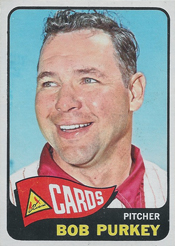
The Cardinals acquired right-hander Bob Purkey to be their fifth starter. It turned out they got a whole lot more from him.

On Dec. 14, 1964, the Cardinals traded Roger Craig and Charlie James to the Reds for Purkey, projecting him to join a rotation with Bob Gibson, Ray Sadecki, Curt Simmons and Tracy Stallard.

Purkey, 35, delivered 10 wins for the 1965 Cardinals, and also provided a bonus. Gibson credited Purkey with making him a better pitcher.

In his autobiography “Stranger to the Game,” Gibson said, “Purkey knew how to pitch and win. I learned more about pitching from Purkey in one season as his teammate than I did from any pitching coach I ever had.”

Pitching lessons

Gibson, 29, was the Cardinals’ ace, winning 19 in 1964 and then two more in the World Series, including Game 7, but Purkey helped him improve.

In his autobiography, Gibson said, “Purkey taught me a way to take advantage of my bad curveball. I seldom threw my curve because I was afraid of hanging it, but Purkey convinced me that a hanging curve can oddly enough be an effective pitch to left-handed hitters, who dive into (it) expecting the ball to break. So I’d leave the curveball hanging inside now and then to left-handed hitters.

“Another pitch Purkey added to my repertoire was the backup slider _ a slider that doesn’t break away from a right-handed hitter but holds its course and maybe even bends back a little like a screwball,” Gibson said in his autobiography. “Purkey explained that, especially in day games, hitters will recognize the spin on a pitch, and when they identify a slider they will instinctively lean out in anticipation of the ball breaking away from them. A quick backup slider, consequently, ought to result in broken bats and balls hit weakly off the fists.”

Gibson told Purkey he sometimes accidently threw sliders that backed up but didn’t know how to deliver the pitch on purpose.

In the book “Sixty Feet, Six Inches,” Gibson said Purkey “showed me how to do it purposely by raising your arm a little too high and then throwing it like mad, as hard as you can.”

As Gibson noted in his autobiography, “So I started deliberately overthrowing the slider on occasion, and just like that I had a nasty new pitch.”

The Tigers’ Willie Horton told Cardinals Magazine it was a backup slider Gibson threw him for his 17th strikeout to finish Game 1 of the 1968 World Series. Gibson said to Cardinals Yearbook he was trying to pitch a slider, but “I overthrew it and didn’t get it where I wanted. Instead of breaking outside, it went right at him. He flinched and it broke over the plate for strike three. I had missed by a big margin, but it was a good place to miss.”

In “Sixty Feet, Six Inches,” Gibson said of the backup slider, “Purkey had it perfected, but it takes a lot of guts to throw something that stays over the plate and doesn’t really do much. The vast majority of the time, I wasn’t that courageous. It’s not a pitch that children should try at home.”

Learning the craft

Born in Pittsburgh, Purkey grew up in the Mount Washington neighborhood across the river from downtown. He didn’t play for a baseball team until he was 13. Purkey took up pitching because his favorite player was the Cardinals’ Harry Brecheen. “I’d go to Forbes Field whenever (Brecheen) was pitching,” Purkey recalled to the St. Louis Post-Dispatch. “I admired his style, his guts.”

Purkey, 18, signed with the hometown Pirates in 1948 for $150 a month. After four years in the minors and two in the Army, he reached the majors with the Pirates in 1954 when Branch Rickey was general manager. In his first start, Purkey beat the Cardinals and held Stan Musial hitless. Boxscore

At spring training in 1955, Purkey was given special instruction to learn an extra pitch. “Rickey himself took charge and showed some of us how to throw the knuckleball,” Purkey told the Post-Dispatch.

Purkey added the knuckler to an arsenal that included a sinker and slider. “He used to throw you everything but the kitchen sink,” the Dodgers’ Ron Fairly said, according to the Post-Dispatch. “Now he throws the sink, too.”

Joe Brown replaced Rickey as general manager in 1956 and a year later he dealt Purkey to the Reds for reliever Don Gross. “The worst trade I ever made,” Brown later told the Pittsburgh Post-Gazette.

The Reds were managed by former catcher Birdie Tebbetts, and he and Purkey clicked. Purkey, who never had a winning season with the Pirates, was 17-11 for the 1958 Reds.

“I didn’t become a pitcher until I joined Birdie Tebbetts,” Purkey explained to the Post-Dispatch. “Birdie told me I’d been a defensive pitcher, meaning I nibbled too much at the corners and fell behind too much on the ball-and-strike count. He knew I could get the ball over. ‘Be aggressive,’ he told me. ‘Get that first pitch over with good stuff on it and challenge the hitter.’ “

Under control

With the Reds, Purkey began using the knuckleball more frequently. “It took five years to develop the knuckler where I could throw it effectively in a game,” he told the Post-Dispatch.

The Cardinals’ Ken Boyer said to The Cincinnati Post, “When he gets ahead of you (with the sinker), he throws you that knuckler _ and he has a good one.”

In a September 1961 win against the Cardinals, Purkey threw five consecutive knuckleballs to Stan Musial and struck him out looking. (As usual, Musial adjusted and hit .323 with three home runs versus Purkey for his career). Boxscore

“Of all the knuckleball pitchers I’ve seen, I’d have to rate Purkey’s second only to Hoyt Wilhelm’s,” Darrell Johnson, who caught in the majors for six years, told the Post-Dispatch.

Unlike many other knuckleballers, Purkey was a control pitcher. He walked 49 in 250 innings in 1958; 43 in 218 innings in 1959.

Because batters knew he threw strikes, Purkey made sure they didn’t get too comfortable at the plate. He eight times ranked among the top 10 in the league in hitting batters with pitches. He plunked 14 in 1962. A favorite target was the Cardinals’ Curt Flood, who got struck by Purkey pitches five times in his career.

“He’d brush back his own grandma if she crowded home plate and took too firm a toehold in the batter’s box,” Bob Broeg wrote in the Post-Dispatch.

Purkey said to Broeg, “Willie Mays must have thought I was the meanest man in the league. I’d brush him back, pitch him tight, brush him back, pitch him tight.”

Highs and lows

After being fired by the Cardinals, Fred Hutchinson became Reds manager and led them to a National League pennant in 1961. Purkey, who won 16 that season, got the start in Game 3 of the World Series versus the Yankees.

Ahead 2-1, Purkey got a slider too high to Johnny Blanchard, who tied the score with a home run in the eighth, and then a slider too low to Roger Maris, who won it for New York with a home run in the ninth. Regarding the Maris homer, Purkey said to the Dayton Daily News, “It looked to me, when he hit it, like a guy swinging at a golf ball with his No. 9 iron.” Boxscore

Everything came together for Purkey the next season. He had the best winning percentage (.821) in the league, with a 23-5 record for the 1962 Reds. Purkey won his first seven decisions and was 13-1 after beating Sandy Koufax and the Dodgers on June 22. Boxscore

Purkey tore a muscle in his right shoulder at spring training in 1963. He rebounded in 1964, winning eight of his last 11 decisions and finishing at 11-9.

Wrapping it up

Starting against the Reds in the 1965 Cardinals’ home opener, Purkey’s knucklers rolled toward the plate like beach balls. Vada Pinson hit one for a three-run homer and Gordy Coleman clouted another for a grand slam. After allowing nine runs in six innings, Purkey told the Post-Dispatch, “I just did a lousy job of pitching and I had the daylights kicked out of me.” Boxscore

With a 9.00 ERA after his first four starts, the Cardinals sent him to the bullpen for a month. When he returned to the rotation, he gradually got better. For the month of July, Purkey was 3-1 with a 1.76 ERA in four starts.

A week after he turned 36, Purkey pitched well against the Astros, but lost, 3-2, to 18-year-old Larry Dierker. In his next start, Purkey shut out the Giants and beat 44-year-old Warren Spahn. Boxscore and Boxscore

In April 1966, the Cardinals sold Purkey’s contract to the Pirates and he played his final season with them. His career record: 129-115, including 103-76 with the Reds. Purkey was 17-11 against the Cardinals.

Though he experienced tragedy in 1973 when his son, Bob Jr., died of a heart ailment at 18, Purkey had a long and successful second career operating an insurance agency in the Pittsburgh suburb of Bethel Park.

Read Full Post »

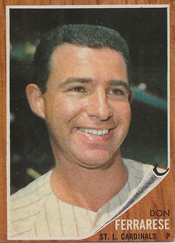
As a high school all-star, Don Ferrarese impressed Babe Ruth, who, like the California teen, knew what it was like to be a left-handed pitcher with stuff. Later, when Ferrarese was in the majors, he hit like Ruth, too, at least for one game _ cracking three consecutive doubles.

In his first big-league start, Ferrarese struck out 13. In his first win, he held the Yankees hitless for eight innings, then completed the shutout by retiring Mickey Mantle with the potential tying run in scoring position.

For Stan Musial and Ted Williams, Ferrarese was as hard to hit as it was to say his name correctly.

Ferrarese (pronounced “Fer-ar-ess-ee,” with the emphasis on the “ess”) ended his playing career as a Cardinals reliever and was especially effective against left-handed batters. He also pitched for the Orioles (1955-57), Indians (1958-59), White Sox (1960) and Phillies (1961-62).

Meeting Babe

Born in Oakland, Don Ferrarese was the son of Italian immigrants, Hugo and Bruna Ferrarese. (“I am a rare Italian that cannot sing a note,” Don told the Victorville, Calif., Daily Press.) The family moved to Lafayette, Calif., and that’s where Don attended high school while working in his parents’ produce business.

(Ferrarese went to Acalanes High School, also the alma mater of Hall of Fame quarterback Norm Van Brocklin.)

As a prep freshman, Ferrarese was a left-handed second baseman. A math teacher suggested he try pitching, the Oakland Tribune reported.

Though he was short and slight, Ferrarese’s pitches had speed and movement. After his senior season, he was chosen for an August 1947 prep all-star game sponsored by Hearst newspapers at the Polo Grounds in New York. Other future big-leaguers invited to play included Gino Cimoli, Dick Groat and Bill Skowron.

Babe Didrikson Zaharias performed a golf and baseball skills exhibition as part of the entertainment before the game, which drew 31,232 customers.

Starting for the U.S. all-stars, Ferrarese pitched three scoreless innings and lined a double to the wall in left against the Metropolitan all-stars. Named most valuable player of the game, Ferrarese was presented a trophy by Eleanor Gehrig, widow of Lou Gehrig. A spectator was the game’s honorary chairman, Babe Ruth.

“Babe Ruth asked to meet me,” Ferrarese told Newspaper Enterprise Association. “He was in the front row of box seats, all hunched over and wearing a camel’s hair beanie. Ruth had throat cancer, so it was hard to hear him.”

(Ruth died a year later at 53.)

Ferrarese enrolled at Saint Mary’s College in California, pitched well as a freshman and caught the attention of Jimmy Hole, a scout for the 1948 Oakland Oaks of the Pacific Coast League. The Oaks’ manager was Casey Stengel. Ferrarese signed with them for $4,000 in June 1948, three days before he turned 19, and was sent to Stockton of the California League.

The little left-hander was effective _ when he got the ball over the plate, which wasn’t often enough. In his first three seasons in the minors, he walked 48 in 32 innings with Stockton, 184 in 188 innings with Albuquerque, and 209 in 185 innings with Wenatchee (Wash.).

The best experience Ferrarese had at Wenatchee was he met Betty Jean Olsen, “who ate lunch at the same restaurant where he ate breakfast at noon,” according to the St. Louis Post-Dispatch.

The couple married and Ferrarese did a two-year hitch in the Army. After his discharge, he pitched poorly (6.28 ERA) for the 1953 Oakland Oaks.

Then he got the break his career needed.

True grit

After the Dodgers fired manager Chuck Dressen, who led them to two National League pennants in three seasons, he went to Oakland to manage the 1954 Oaks. Ferrarese won 18 that season and struck out 184.

“It was Chuck Dressen who helped me most,” Ferrarese said to the New York Daily News. “Chuck taught me how to throw my curve and helped me with my control.” He also told Newspaper Enterprise Association, “I was strictly a thrower before Dressen got hold of me in Oakland.”

Dressen said to the Baltimore Sun, “He’s got a great curve, and can really fire that ball when he relaxes and doesn’t try to aim it.”

The Oaks capitalized, selling Ferrarese’s contract to the White Sox for $30,000 in December 1954. The White Sox then packaged him in a trade with the Orioles.

Ferrarese, 5-foot-9, 170 pounds, opened the 1955 season with the Orioles, made six relief appearances and was sent down to the San Antonio Missions. In 12 games for them, including nine starts, he was 9-0 with a 1.48 ERA.

Sticking with the Orioles in 1956, Ferrarese’s first start came against the Indians, who won, 2-1, though Ferrarese struck out 13. “When you’ve got a curve like he has and don’t have to be afraid to throw it when you’re behind, you’re a tough man,” Indians pitching Mel Harder said of Ferrarese to the Baltimore Sun. Boxscore

Ferrarese’s next start was another nail-biter. Displaying what the Sun called “170 pounds of grit and heart,” he entered the ninth at Yankee Stadium with a 1-0 lead (Ferrarese’s single drove in the run) and a chance for a no-hitter. First up in the inning was Andy Carey, who, like Ferrarese, had attended Saint Mary’s College.

Carey swung down on a pitch. The ball struck near home plate and bounced high over the mound _ a classic Baltimore chop. Ferrarese pedaled backward, peering for the ball in the afternoon glare, while Carey raced toward first. “I lost it in the sun as it was coming down,” Ferrarese told the Baltimore newspaper.

As the ball plopped into Ferrarese’s glove, he stumbled slightly, then bounced a hurried throw to first _ too late to nab Carey, who reached base with the first hit.

After Billy Martin struck out, Hank Bauer blooped a single off the bat handle into short left, moving Carey to second. Pitcher Don Larsen, pinch-hitting for second baseman Bobby Richardson, popped out to the catcher. Mickey Mantle, leading the American League in hitting, was next.

According to the Baltimore Sun, Mantle “swung viciously” at a Ferrarese curve and lofted a gentle fly to center for the final out. Boxscore

“That near no-hitter Ferrarese pitched ranks as one of my big thrills,” Orioles manager Paul Richards told the Sun. “It really was something to watch him battle them inning after inning and finish up strong after Carey got that first hit.”

Yankees manager Casey Stengel said to the newspaper, “I thought he deserved a no-hitter. Neither hit was a good one.”

On the move

The magic didn’t last. Two weeks later, Ferrarese faced the Yankees again and gave up seven runs in two innings. He finished the 1956 season at 4-10.

The next year, demoted to Vancouver and instructed to develop a slider, Ferrarese became “almost discouraged enough to quit,” the St. Louis Post-Dispatch reported. A teammate, former Cardinals outfielder Joe Frazier, showed him how to throw the pitch. “I’ve had a good slider ever since,” Ferrarese said.

Traded to the Indians for Dick Williams in April 1958, Ferrarese started against the Orioles four months later, pitched 11 scoreless innings, then walked Williams with the bases loaded in the 12th and lost, 1-0. Boxscore

In 1959, Ferrarese won four of his first six decisions for the Indians. A highlight came on May 26 when he smacked three doubles versus the White Sox’s Dick Donovan and pitched 6.1 scoreless innings for the 3-0 win at Chicago’s Comiskey Park. Ferrarese drove in two of the runs and scored the other. “There was nothing fluky about Ferrarese’s hits: all were hard smashes into right-center,” the Akron Beacon Journal reported. Boxscore

A month later, inflammation spread throughout Ferrarese’s left shoulder. After the season, he was dealt to the White Sox, who sent him to the minors. Eventually, his shoulder healed and the Phillies acquired him in April 1961. He didn’t throw as hard, but his control was better.

Appearing in 42 games, including 14 starts, for the 1961 Phillies, Ferrarese had the best ERA (3.76) for a team that lost 107 games, including 23 in a row.

Lefty specialist

Early in the 1962 season, the Cardinals acquired two left-handed relievers _ Ferrarese from the Phillies (for Bobby Locke) and Bobby Shantz from Houston.

Between May 13 and June 12, Ferrarese made nine relief appearances totaling 12.2 innings for the Cardinals, didn’t allow a run and got a win against the Phillies at St. Louis. Boxscore

In his first appearance at Philadelphia since the trade, he clouted the lone home run of his big-league career, a two-run shot versus Jim Owens. Boxscore

Ferrarese earned a save for the Cardinals against the Reds, striking out Vada Pinson to end the game with the potential tying run on second. Boxscore

As a Cardinal, left-handed batters hit .195 against Ferrarese. For his career, he limited them to a .214 batting average. Stan Musial hit .091 (1 for 11) versus Ferrarese and Ted Williams was at .143 (1 for 7).

(A right-handed batter, the Cardinals’ Julian Javier, who had a career .299 batting mark against left-handers, was hitless in 15 at-bats versus Ferrarese.)

In February 1963, the Cardinals dealt Ferrarese to Houston for pitcher Bobby Tiefenauer, but Ferrarese opted to go home and help his parents run Hugo’s Deli in Apple Valley, Calif.

After his folks retired in 1974, Ferrarese owned and operated Ferrarese’s Ristorante in Victorville, Calif., and then another restaurant, Hugo’s, in Apple Valley. He also ran a commercial real estate company.

A charitable foundation created by Ferrarese provided college scholarships to students based on how much they’d done to help their communities.

Read Full Post »

Seeking a right fielder to complete a lineup counted on to contend for a championship, the Cardinals made a bold move and acquired a good one.

On Nov. 17, 2014, the Cardinals obtained outfielder Jason Heyward and reliever Jordan Walden from the Braves for pitchers Shelby Miller and Tyrell Jenkins. The Cardinals needed a right fielder to replace Oscar Taveras, who died in an auto accident three weeks earlier on Oct. 26.

As St. Louis Post-Dispatch columnist Bernie Miklasz presciently noted when the deal was made, Heyward was “an elite defender, the best right fielder in baseball (and) should do an effective job of getting on base and energizing the Cardinals’ speed on the bases.”

Nurturing talent

Heyward moved from New Jersey to suburban Atlanta with his family when he was 2. His parents, Eugene and Laura, graduated from Dartmouth. Eugene became an electrical engineer for ITT Technologies, designing electronic warfare systems for Robins Air Force Base, and Laura was an insurance underwriter for Life of Georgia before joining Georgia Power, according to the Atlanta Constitution.

Laura helped Jason develop a love of writing. “He did a writing project on the Negro baseball league in high school,” Laura told the Atlanta newspaper, “and I could see he really had a talent for writing. I thought maybe he could be a sports writer, because you never know if it’s going to work out with baseball. I wanted him to be well-rounded.”

Though his father played basketball at Dartmouth, baseball became Jason’s favorite sport. He began playing the game when he was 5.

Two decades later, when asked by Bernie Miklasz why he preferred baseball to other sports, Heyward said, “It’s the tradition that it holds. It’s the history. It’s timeless … For me growing up, it was just easy to fall in love with it. There’s all the thought that goes into it. The strategy, the cat and mouse games. It’s also a humbling game, because you will fail more times than you succeed and then it becomes all about how you handle it going forward.”

Heyward became a fan of the Braves, who won five National League pennants and a World Series title in the 1990s when he was a youth. After a stellar high school playing career, the Braves made Heyward the first outfielder taken in the opening round of the 2007 amateur draft.

Dazzling debut

A left-handed batter, Heyward was 6-foot-5, 240 pounds and had all the tools. After three seasons in the minors, Baseball America magazine named him the best prospect in the game.

He had a storybook start to his major-league career.

On April 5, 2010, the Braves opened against the Cubs at Atlanta. Heyward was tabbed by manager Bobby Cox to debut in right field and bat seventh.

Braves icon Hank Aaron was there to throw the ceremonial first pitch and Heyward was given the honor of catching the toss.

After delivering the pitch, Aaron offered advice to the rookie. “He said, ‘Have fun. You’re ready to do this,’ ” Heyward told the Atlanta Constitution.

In the opening inning, with the score tied at 3-3, the Braves had two runners on base against Carlos Zambrano, an imposing right-hander.

Zambrano’s first two deliveries to Heyward missed the strike zone and Heyward didn’t bite at either. On the 2-and-0 pitch, Zambrano threw a sinking fastball toward the inner part of the plate. Heyward sent a drive deep into the right-field stands for a three-run home run. Boxscore and Video

Heyward, 20, became the youngest player to hit a homer in his first big-league plate appearance since Ted Tappe, 19, of the Reds did it in 1950. Boxscore

Heyward followed the Opening Day drama with a strong season (.393 on-base percentage and 83 runs scored) and placed second to Giants catcher Buster Posey, whom he competed against in high school, in National League Rookie of the Year Award balloting.

Good as gold

In his first plate appearance on Opening Day in 2011, Heyward again slammed a home run. He joined Kaz Matsui of the (2004-05) Mets as the only other player to hit a homer on Opening Day in his first at-bat in each of his first two seasons. Boxscore

The next year, Heyward slugged 27 homers for the 2012 Braves, scored 93 runs and earned the first of five Gold Glove awards. In a playoff game, he made a leaping grab above the wall in right to deprive the Cardinals’ Yadier Molina. Video and Boxscore

In 2013, Heyward suffered a fractured jaw after being struck by a pitch from Mets left-hander Jon Niese. The next year, Heyward batted .169 versus left-handers and later admitted he wasn’t swinging aggressively against them. His fielding remained spectacular, though. Heyward had the highest number of total chances (375) among National League right fielders and committed one error.

Mix and match

Like Heyward had been for the Braves, the Cardinals had their own highly touted right field prospect, Oscar Taveras, who debuted with them in 2014 and helped bring a division title. Cardinals general manager John Mozeliak said Taveras, 22, would have been the right fielder in 2015. Taveras’ death in an alcohol-related car crash in the Dominican Republic changed that plan.

With Heyward eligible to become a free agent after the 2015 season, the Braves were willing to trade him, and when the Cardinals offered to part with Shelby Miller, 24, who had 15 wins for them in 2013 and 10 in 2014, the deal was made.

Though there was a risk Heyward could leave the Cardinals after one season, Mozeliak told the Post-Dispatch, “We had to look at a way to add an impact player to our club … We’ve said all along we’re focused on 2015.”

Knowing Heyward wore uniform No. 22 with the Braves, Cardinals manager Mike Matheny, who also wore that number, gave it to his new right fielder. When he’d debuted with the Braves, Heyward chose No. 22 in memory of a former high school teammate, Andrew Wilmot, who was killed in a car accident.

Switching sides

On Opening Day for the 2015 Cardinals, Heyward produced three hits, including two doubles, in a win against the Cubs at Wrigley Field. Boxscore

After a slow April (.217 batting mark), he produced consistently well, achieving career highs in hits (160), doubles (33), stolen bases (23) and batting average (.293) and winning a Gold Glove Award. He was successful on 88 percent of his steal attempts (23 of 26). Video

As Heyward’s 2015 season neared its end, Derrick Goold of the Post-Dispatch wrote, “He’s the best defensive right fielder in the majors … He’s exceptional with his glove, precise with fundamentals and takes extra bases.”

The 2015 Cardinals finished with the best record (100-62) in the majors. Their reward: a matchup in the fall tournament with the third-place finisher in their division _ the Cubs. Heyward batted .357 in the series, but the Cubs prevailed. Then they stung the Cardinals again, signing Heyward to an eight-year $184 million contract.

In explaining why he went to the Cubs, even though the Cardinals’ offer was greater in guaranteed value and more overall money, Heyward said he saw Chicago as more of the up-and-coming franchise.

“You have to look at age, you have to look at how fast the (Cardinals) team is changing and how soon those changes may come about,” Heyward told the Chicago Tribune. “You have Yadier (Molina), who is going to be done in two years, maybe. You have Matt Holliday, who is probably going to be done soon … (Adam) Wainwright is probably going to be done in three or four years … I felt like if I was to look up in three years and see a completely different (Cardinals) team, that would kind of be difficult. Chicago really offers an opportunity to come into the culture and be introduced to the culture by a young group of guys.”

The Cubs further strengthened themselves, while weakening the Cardinals, by signing free-agent pitcher John Lackey, who won 13 for St. Louis in 2015. Reacting to the defections of two prominent Cardinals to the Cubs, Tribune columnist David Haugh wrote, “What’s next, a Mike Shannon Grill in Wrigleyville?”

Heyward was correct about the Cubs being on the rise. In 2016, his first season with them, the Cubs became World Series champions for the first time since 1908.

Heyward won another Gold Glove Award with the 2016 Cubs but he batted .230 with a mere seven home runs. In the World Series versus Cleveland, he had no RBI, scored no runs and batted .150.

In seven seasons with Chicago, Heyward batted .245. The Cubs released him in November 2022. According to the Tribune, the Cubs were on the hook to pay him $22 million for 2023, the final year of the eight-year contract. Heyward also was to get four $5 million installments from 2024 through 2027 as part of his initial signing bonus with Chicago.

Read Full Post »

Looking to strengthen a starting rotation that already included 30-game winner Dizzy Dean, Branch Rickey, the Cardinals’ teetotaling general manager, acquired the Cubs’ Pat Malone, who drank highballs as fervently as he threw high fastballs.

Three weeks after the Cardinals beat the Tigers in World Series Game 7, Rickey traded catcher Ken O’Dea for Malone and cash on Oct. 26, 1934.

A husky right-hander, Malone, 32, was a two-time 20-game winner who twice helped the Cubs earn National League pennants (1929 and 1932), dethroning the Cardinals each time.

A fierce competitor, Malone had a reputation as a baseball bad boy off the field. “Pat was a problem child,” the Minneapolis Star noted. “He loved his firewater.” According to Sec Taylor of the Des Moines Register, “He just couldn’t leave the bottle alone.”

As the St. Louis Post-Dispatch put it, Malone could be found “where the lights are bright and the glasses tinkling.”

On the urging of manager Frankie Frisch, Rickey took a chance on the hurler.

Malone “ought to win 15 games for us,” Frisch said to the Post-Dispatch.

Rickey predicted to the St. Louis Star-Times, “I believe he’ll win 20 games for us.”

As it turned out, Malone never pitched in a regular-season game for the Cardinals.

Rough and tumble

Born in Altoona, Pa., Perce Leigh Malone was named in honor of a family friend, Perce Lay, a brakeman on the Pennsylvania Railroad, but he preferred to be called Pat. As The Sporting News noted, “Nobody called him Perce from the day he was able to put his hands up, and Pat was handy with his dukes.”

Malone went to work for the railroad as a fireman when he was 16. A year later, he joined the Army as a cavalry soldier. After his military service, Malone went back to railroading and also played sandlot baseball. His first year as a professional pitcher was 1921 with Knoxville.

He spent seven seasons in the minors. When he got to the Cubs in 1928, Malone lost his first five decisions. Manager Joe McCarthy stuck with him and the grateful rookie finished the season with 18 wins. “He thought McCarthy was the greatest guy in the world and McCarthy, who liked his spirit, thought right well of him, too,” New York Sun columnist Frank Graham observed.

According to the Minneapolis Star, “McCarthy never questioned (Malone’s) conduct off the field so long as he produced on it.”

Catching Malone’s blazing fastball took a toll on Gabby Hartnett, whose hand “often was puffed to three times its normal size,” The Sporting News noted.

The Cubs became National League champions in 1929 and Malone was a major factor. He led the league in wins (22), shutouts (five) and strikeouts (166). His record that season against the defending champion Cardinals was 5-0.

Malone won 20 again in 1930, but McCarthy was fired near the end of the season and replaced by Rogers Hornsby.

In the book “The Man in the Dugout,” Cubs second baseman Billy Herman told author Donald Honig, “Hornsby tried to have discipline on the club, but he had some bad actors and couldn’t control them _ fellows like Pat Malone and (outfielder) Hack Wilson. They’d get drunk and get into fights.”

As Si Burick of the Dayton Daily News noted, Malone “was mixed up in several unpleasantries as a direct result of his convivial escapades.” In one of those incidents, Malone assaulted two Cincinnati sports reporters.

Behavior clause

Charlie Grimm took over for Hornsby during the 1932 season and guided the Cubs to a pennant, but he and Malone had a falling out in 1934. Malone won eight of his last 10 decisions, raising his 1934 season record to 14-7, but Grimm yanked him from the starting rotation after Aug. 24. Malone said the Cubs had promised to give him a $500 bonus for each win above 15 and that’s why Grimm stopped starting him, the Star-Times reported.

Malone wanted out. During the 1934 World Series, he met with Frankie Frisch, who asked Rickey to arrange a trade, the Star-Times reported.

As the Post-Dispatch noted, “Malone is not exactly the kind of player Branch Rickey would choose.” To close the deal, the Cubs gave the Cardinals “considerable cash,” according to the Star-Times.

Rickey “practically clinched the 1935 National League championship for the Cardinals” when he got Malone to join a starting rotation with Dizzy Dean, Paul Dean, Bill Walker and Bill Hallahan, the Star-Times proclaimed.

The good vibes evaporated, though, when Rickey mailed a contract to Malone offering a 1935 salary of $5,000, a 50 percent cut from his pay with the Cubs in 1934. Malone sent back the document, unsigned, with a note: “Haven’t you made a mistake and sent me the batboy’s contract?”

According to the St. Louis Globe-Democrat, Rickey said the low offer was his way of emphasizing to Malone that the Cardinals didn’t consider him of much value unless he agreed to curb his drinking. Rickey said he didn’t plan to keep Malone unless he expressed “a strong determination to be a very, very well-behaved boy,” the Post-Dispatch reported.

Malone came to St. Louis, met with Rickey for more than two hours, promised he’d behave, and emerged with a signed contract. According to the Post-Dispatch, the contract had “a provision for a bonus if he refrained from tasting liquor during the training and league seasons, and for heavy fines if he wandered from the straight and non-intoxication path.”

Both appeared satisfied. Rickey said to the Post-Dispatch, “I expected to find horns on this man, Malone, but he hasn’t any.”

Malone told the newspaper, “Rickey isn’t the big, bad wolf I expected to meet.”

Math problem

A portly Malone lumbered into Cardinals spring training headquarters at Bradenton, Fla., in 1935. “There isn’t a uniform in camp big enough to give Malone arm freedom,” the Star-Times noted.

Following a morning of workouts early in camp, Malone accepted an invitation from Dizzy Dean to play golf that afternoon. After six holes, Malone “broke down. He sent his caddy back to the clubhouse with his sticks, called for a taxicab and went to the club’s hotel,” the Post-Dispatch reported. “Straight to his room he went, without bothering about food, and he was snoring before 6 o’clock.”

The next morning he told the newspaper, “I can barely move one leg after another. I never knew what work was until I came to this Cardinals camp.”

Determined to show the Cardinals he could contribute, Malone became “one of the hardest workers on the field,” the Post-Dispatch reported. “He showed the zest of a rookie.”

According to the Globe-Democrat, “Pat has given every indication of his willingness, nay, his eagerness, to cooperate to the fullest to become a regular and reliable starting pitcher when the season opens.”

Branch Rickey saw it differently. On March 26, 1935, he sold Malone’s contract to the Yankees, who were managed by Joe McCarthy, for a reported $15,000. According to the Post-Dispatch, Malone said to Rickey, “If you had kept me, I’d have shown you something. I’d have worked my head off and won for you.”

Describing the trade as a “surprise,” the Post-Dispatch added that Malone’s conduct “on and off the field during the training season has been all that anyone could have asked.”

While offering no specific reasons for the deal, Rickey said to the Star-Times, “I feel relieved considerably now that Malone is off our ballclub … After surveying conditions here for a week, I realized Malone was not the type I desired on a world championship team or a team that is going to try to win another pennant.”

Rickey told the Post-Dispatch, “There are four phases of arithmetic: addition, multiplication, division and subtraction. Applied to baseball, subtraction is the most important … I have subtracted Malone from the Cardinals’ roster. He cannot lose any games. He cannot lead any of our little boys astray. Ergo, the Cardinals are stronger.”

End of the line

Used primarily by McCarthy as a reliever, Malone was 19-13 with 18 saves in three seasons with the Yankees, helping them to two American League pennants (1936 and 1937).

Released in 1938, Malone joined the minor-league Minneapolis Millers at spring training in Daytona Beach, Fla., and was fitted for a uniform. “He stood there, a Coca-Cola in one hand and a cigarette in the other, while two men plied his Ruthian form with tape measures,” the Minneapolis Star reported.

Trouble soon followed. Manager Donie Bush told the newspaper, “Malone began drinking while the team was at Daytona Beach and we had several arguments about it then.”

Bristling against discipline by a minor-league club, Malone rebelled and twice was suspended within a week early in the season for getting drunk. He pitched for two more minor-league teams in 1938, his final year in professional baseball, before returning home to Altoona.

In October 1939, the Yankees were headed to Cincinnati for the World Series when the train stopped in Altoona for about 10 minutes. Malone climbed onboard, spent time with Joe McCarthy and went through the cars, saying hello to the players, according to columnist Frank Graham.

When it came time for the train to depart, Malone said to McCarthy, “Well, Joe, I wish to hell I was going with you.” McCarthy replied, “I wish you were, too, Pat.”

According to Harold C. Burr of the Brooklyn Eagle, Malone “stood on the station platform and watched the lighted windows of the Pullmans go streaking past. It was Malone’s wistful farewell to baseball.”

Read Full Post »

(Updated Dec. 14, 2024)

Cubs rookie catcher Steve Swisher took the blame for a passed ball that cost the Cardinals a chance to reach the playoffs, but it might not have been his fault. Swisher may have been crossed up by his pitcher.

On Oct. 2, 1974, the Pirates’ Bob Robertson swung and missed at strike three, a strikeout that should have ended the game. A Cubs win would have kept alive the Cardinals’ division title hopes.

Instead, the ball got away from Swisher, who retrieved it but couldn’t throw out Robertson at first as the tying run streaked home from third. The Pirates went on to win in extra innings, clinching the division crown.

Swisher’s misplay made him a villain to some, but he may have been the fall guy. A gifted receiver, it’s suspected the ball eluded him because he wasn’t expecting his pitcher, Rick Reuschel, to throw a spitter.

Change in plans

Shortstop was the position Swisher played best in high school at Parkersburg, W.Va., but when he got to Ohio University, the team had a shortstop, junior Mike Schmidt (the future Hall of Fame third baseman). Swisher shifted to catcher, a position he hadn’t played, and he learned it well.

Impressed by his catching and what The Sporting News described as “a howitzer arm,” the White Sox selected Swisher in the first round of the June 1973 amateur draft and sent him to the minors.

(Nearly 30 years later, Swisher’s son, Nick, an outfielder, was a first-round choice of the Athletics in the 2002 draft. The Swishers joined Tom and Ben Grieve, and Jeff and Sean Burroughs, as father and son first-rounders at that time.)

Six months after they drafted Swisher, the White Sox reluctantly dealt him to the crosstown Cubs. Ron Santo, the Cubs’ iconic third baseman, triggered the trade.

Second City swap

On Dec. 5, 1973, Cubs general manager John Holland asked Santo if he’d consent to a trade to the Angels, The Sporting News reported. Santo said no and told the Cubs he wanted to stay in Chicago. Two days later, the White Sox got involved.

Swisher wasn’t part of the White Sox’s initial offer, but the Cubs refused to make a deal unless he was included. The White Sox relented, swapping Swisher, pitchers Steve Stone and Ken Frailing and a player to be named (pitcher Jim Kremmel) for Santo. “Swisher apparently was the key,” The Sporting News reported.

At 1974 spring training, the Cubs assigned Swisher to their Wichita farm club, managed by ex-catcher and future Cardinals pitching coach Mike Roarke, “with the intention of keeping him there all season,” according to The Sporting News.

The timetable got moved up in June 1974 when Cubs catcher George Mitterwald injured a knee and his backup, Tom Lundstedt, also had chronic knee pain.

Batting a mere .196 at Wichita, Swisher, 22, got called to the Cubs and was put in the starting lineup. Cubs coach Pete Reiser said to The Sporting News, “He’s going to be another Johnny Bench.”

Umpire John McSherry told the publication, “He’s a beautiful catcher defensively.”

Though Swisher struggled to hit (.214) in the National League, the rookie turned into Gabby Hartnett against the 1974 Cardinals (.343, including a grand slam against Barry Lersch. Boxscore)

Tuning in 

On Oct. 1, 1974, Mike Jorgensen stunned the Cardinals, belting a two-run home run with two outs in the eighth inning against Bob Gibson to erase a 2-1 deficit and carry the Expos to a 3-2 victory. Boxscore

The loss put the Cardinals (86-75) a game behind the Pirates (87-74) entering the final day of the regular season.

At Montreal on Oct. 2, the Cardinals’ game with the Expos was rained out. The Pirates played that night at home against the Cubs. If the Pirates lost, the Cardinals would play the Expos on Oct. 3 with a chance for a win that would put them in a tie with the Pirates atop the standings. If that happened, the Cardinals and Pirates would face off in a one-game playoff at Pittsburgh on Oct. 4 to decide the division champion.

In the lobby of the Queen Elizabeth Hotel in Montreal, the Cardinals gathered around TV broadcaster Jay Randolph as he listened by telephone to an account of the Cubs-Pirates game relayed to him by colleague Ron Jacober from the station in St. Louis. Tension soared with each pitch.

The Cubs took a 4-2 lead into the bottom of the ninth. After scoring a run to make it 4-3, the Pirates had a runner, Manny Sanguillen, on third with two outs and pinch-hitter Bob Robertson, batting on his 28th birthday, at the plate against starter Rick Reuschel.

Reuschel’s first three pitches to Robertson were out of the strike zone. Then Robertson took two called strikes before fouling off a pitch.

Swisher said he then signaled for a curve.

All wet

Whatever Reuschel threw on the 3-and-2 pitch, no one was quite sure.

The Pittsburgh Press called it a sharp slider.

Robertson said to the Pittsburgh Post-Gazette, “It was the best sinking fastball I’ve seen all this year.”

Swisher told the St. Louis Post-Dispatch, “His curve had been breaking away from right-handed hitters all night, but, for some reason, this one broke down.”

Robertson said to the Chicago Tribune, “It sure came in strange.”

Angels scout Grover Resinger said to reporter Neal Russo, “I’m convinced that the pitch by Reuschel was a spitball, and Reuschel failed to let the kid catcher know it was coming.”

Resinger said he scouted Reuschel a week earlier and saw him throw five spitters. “They fell right off the table,” Resinger said to the Post-Dispatch.

Dave Nightengale of the Chicago Daily News wrote that the pitch Reuschel threw to Robertson was a spitter. According to The Sporting News, a spitball dips down and in to a right-handed batter.

Miracle workers

Robertson swung at the mystery pitch and missed for strike three. (“I’m not sure it was a strike, but I couldn’t afford to take it,” Robertson told the Post-Gazette.)

Swisher said to the Post-Dispatch, “It hit the bottom of my glove and it just bounced away. I missed it. It was my fault. I have no excuses.”

As Swisher chased after the ball, Manny Sanguillen steamed toward the plate from third with the tying run, and Robertson, facing knee surgery after the season, hobbled toward first.

According to the Post-Gazette, “Swisher had trouble picking up the ball about 20 feet behind the plate. When he did throw toward first, he had a good chance to nab Robertson.”

The Pirates’ Al Oliver said to The Pittsburgh Press, “There’s no doubt he would have been out with a good throw.”

Swisher’s throw was strong but it tailed toward Robertson, hitting him in the left shoulder and bounding into right field.

Swisher was charged with a passed ball and an error.

According to the Post-Dispatch, when word of Swisher’s blunder that enabled the Pirates to tie the score reached the Cardinals in Montreal, rookie first baseman Keith Hernandez said, “How could they make a bonehead play like that?”

In the Pirates’ 10th, Al Oliver tripled versus Ken Frailing and Sanguillen then topped a slow roller toward third. Bill Madlock charged in but couldn’t make a barehand grab, and Oliver scored the winning run on the weak single. Boxscore

The Pirates’ victory meant the Cardinals couldn’t catch them, making it unnecessary to play the rained out finale with the Expos. The Cardinals immediately took a flight home.

In his memoir, Keith Hernandez recalled, “On the plane back to St. Louis, Anheuser-Busch products were aplenty as well as hard liquor. Most of the guys opted for the latter … and most everyone was getting a bit boxed _ especially Reitzie (Ken Reitz), who was ranting that Swisher had let the ball get by him on purpose. He kept getting madder and madder, saying he was going to go after Swisher the first time the Cardinals and Cubs met next April.”

Back in Pittsburgh, Robertson told the Post-Dispatch, “I didn’t want that playoff game with the Cardinals. They’re a tremendous team.”

Switching sides

Swisher rebounded from the Pittsburgh mess. He was the Cubs’ Opening Day catcher from 1975 to 1977. National League manager Sparky Anderson put him on the all-star team as a backup to Johnny Bench in 1976.

In St. Louis during that time, Swisher’s appearances with the Cubs “were greeted with boos,” the Post-Dispatch reported.

So it was a quirk of fate when on Dec. 8, 1977, Swisher was traded with Jerry Morales to the Cardinals for Hector Cruz and Dave Rader. Asked whether he was concerned about lingering hard feelings, Swisher said to the Post-Dispatch, “I think that’s water over the dam.”

Swisher understood he was acquired to back up Ted Simmons. He said to the Decatur (Ill.) Daily Review, “I consider playing behind Ted Simmons a compliment. He’s unbelievable. He doesn’t receive enough credit.”

Though he didn’t play often in his three seasons (1978-80) with St. Louis, Swisher was respected. After Pete Vuckovich got a win versus the Expos, he said to the Post-Dispatch, “Swisher carried me. He called a hell of a game … His input is registering in my mind at various times of the game.”

In December 1980, Swisher was sent to the Padres as part of the trade that brought Rollie Fingers, Gene Tenace and Bob Shirley to the Cardinals.

After his playing career, Swisher was a manager in the farm systems of the Indians, Mets, Astros and Phillies. As manager at Tidewater in 1991, his catcher was Todd Hundley, son of former Cubs catcher Randy Hundley. Swisher also was a Mets coach from 1994 to 1996.

Read Full Post »

(Updated Nov. 25, 2024)

Ron Hunt, best known for getting hit by pitches, made his biggest contribution to the Cardinals just by standing still at the plate and watching a ball zip into the catcher’s mitt.

On Sept. 5, 1974, the Cardinals acquired Hunt, a second baseman, after the Expos placed him on waivers. Born and raised in St. Louis, Hunt got to close out his playing career in his hometown with the 1974 Cardinals.

Adept at reaching base, Hunt was obtained to be a pinch-hitter who might ignite a spark for the Cardinals, contending for a division title.

Hunt did the job _ in eight plate appearances as a Cardinals pinch-hitter, he got on base five times (a .625 percentage), with two hits, two walks and one hit by pitch. Better yet, his patience at the plate enabled Lou Brock to break Maury Wills’ single-season stolen base record before the hometown fans.

Meet the Mets

Growing up in northeast St. Louis, Hunt considered himself a city kid before he moved with his mother and grandparents to nearby Overland. “My parents broke up when I was little,” Hunt said to Newsday. “My grandparents took care of me most of the time … They loved me so much they’d do anything for me.”

At Ritenour High School, Hunt was a third baseman and pitcher. He signed with the reigning National League champion Milwaukee Braves after graduating in June 1959. (Hunt’s favorite player, second baseman Red Schoendienst, helped the Braves win consecutive pennants in 1957-58.)

Assigned to play third base for the Class D team in McCook, Nebraska, Hunt, 18, was a teammate of pitchers Phil Niekro, 20, and Pat Jordan, 18. (Niekro went on to a Hall of Fame career and Jordan became a writer.)

Switched to second base in 1960, Hunt played three consecutive seasons in the minors for former Cardinals second baseman Jimmy Brown as his manager.

Late in the 1962 season, the Mets, on their way to losing 120 games, dispatched their coach, former Cardinals infielder and manager Solly Hemus, to scout prospects. After watching Hunt (.381 on-base percentage) play for Class AA Austin in the Texas League, Hemus recommended him to the Mets.

“I talked to Jimmy Brown about him,” Hemus told the New York Daily News. “He said he thought the kid could make the major leagues.”

In October 1962, the Mets purchased Hunt’s contract on a conditional basis. They had until May 9, one month after the start of the 1963 season, to decide whether to keep him or send him back to the Braves.

Gesundheit

Hunt appeared a longshot to make the leap from Class AA to the majors, but at 1963 spring training his rough and tumble style of play impressed manager Casey Stengel. “There’s a soft spot in the old man’s heart for his second baseman,” Newsday’s Joe Donnelly noted. “When he was a player, there must have been a bit of Ron Hunt in him.”

The 1963 Mets lost their first eight games before beating the Braves on Hunt’s two-run double in the ninth. Boxscore

Club owner Joan Payson showed her gratitude by sending a bouquet of roses to Hunt’s wife, Jackie, a gesture that prompted Hunt to run for a box of Kleenex.

“Ron is allergic to flowers,” Jackie told the St. Louis Post-Dispatch.

When he was a teen, “I went to an allergist,” Hunt said to the Los Angeles Times. “I found out I was allergic to just about everything.”

Hunt had asthma and, in addition to flowers, was allergic to two of the constant companions of an infielder _ grass and dust.

As St. Louis journalist Bob Broeg noted, Hunt “spends more time in the dirt than a grubworm.” Mets broadcaster Lindsey Nelson told Broeg, “My favorite recollection is of Ron sliding into second in a cloud of dust, coming up sneezing and borrowing umpire Augie Donatelli’s handkerchief to blow his nose.”

Hunt’s asthma and allergies required special attention. Mets trainer Gus Mauch kept under refrigeration a vial of medicine supplied by Hunt’s physician and administered the shots, the New York Daily News reported.

Neither his health issues nor the challenges of the big leagues deterred him. Hunt played with the same hustle, toughness and aggressiveness of another 1963 National League rookie second baseman, Pete Rose.

Bob Broeg described Hunt as “a back alley ballplayer.” Newsday’s George Vecsey observed that Hunt “slid hard with his spikes high and applied liberal dosages of knees to any runner who tried the same thing with him.”

“If anybody wants to get tough, I can get tougher than anybody else,” Hunt said to the Montreal Gazette.

On Aug. 6, 1963, the Cardinals’ Tim McCarver slid high and hard into Hunt at second base. McCarver’s spikes dug deep into Hunt’s thigh, causing two wounds. Hunt, hobbling, stayed in the game. Boxscore

Hunt led the 1963 Mets in total bases (211), hits (145), runs (64), doubles (28), batting average (.272) and most times hit by a pitch (13). He finished second to Rose in balloting for the National League Rookie of the Year Award.

Hit and run

In 1964, Hunt became the first Met to make the starting lineup for an All-Star Game. In voting by players, managers and coaches, Hunt was named the National League second baseman. He singled against Dean Chance in the game at New York’s Shea Stadium. Boxscore

(Hunt played in one other All-Star Game, in 1966 at St. Louis. His sacrifice bunt in the 10th inning moved Tim McCarver into position to score the winning run. Boxscore)

Hunt was sidelined for a chunk of the 1965 season because of a play involving the Cardinals’ Phil Gagliano. On May 11, with the bases loaded and one out, Lou Brock hit a slow grounder. Just as Hunt crouched for the ball, Gagliano, trying to advance from first to second, barreled into him. As Dick Young wrote in the lede to his story in the New York Daily News, “Ron Hunt was run over by an Italian sports car named Phil Gagliano.”

The impact separated Hunt’s left shoulder. He underwent an operation in which two metal pins were placed in the shoulder and was sidelined until August. Boxscore

In November 1966, Mets executive Bing Devine traded Hunt and Jim Hickman to the Dodgers for two-time National League batting champion Tommy Davis and Derrell Griffith. Hunt spent one season with the Dodgers, then went to the Giants (1968-70) and Expos (1971-74).

Black and blue

It was when he got to the Giants that Hunt began getting hit by pitches at an accelerated rate. He was the National League leader in most times getting plunked for seven consecutive seasons (1968-74).

Los Angeles Times columnist Jim Murray wrote, “Most batters dream of a pitcher they can hit. Hunt dreams of a pitcher who can hit him.”

Choking the bat up to the label, Hunt “couldn’t reach the ball unless two-thirds of his body was in the strike zone,” Jim Murray noted. Hunt told him, “I don’t stand close to the plate. I sit right on it.”

Hunt’s most remarkable seasons were with the Expos in 1971 (.402 on-base percentage, 145 hits, 58 walks, 50 hit by pitches) and 1973 (.418 on-base percentage, 124 hits, 52 walks, 24 hit by pitches).

On Sept. 29, 1971, when Hunt was plunked for the 50th time that season, the pitcher was the Cubs’ Milt Pappas, who told the Montreal Gazette, “He not only didn’t try to get out of the way, he actually leaned into the ball.” Pappas’ teammate, Ken Holtzman, said to the newspaper, “The pitch was a strike.” Boxscore

Hughie Jennings of the 1896 Baltimore Orioles holds the single-season record for most times hit by a pitch, with 51. Jim Murray wrote, “Hunt himself seems to go back to 1896. Crewcut, leather-faced, tobacco-chewing, his slight scarecrow appearance makes him look like something sitting with a squirrel gun and pointed black hat in front of an Ozark cabin.”

The pitcher who hit Hunt the most times with pitches was Bob Gibson (six). Tom Seaver and Nolan Ryan each plunked Hunt five times. In 1969, a Seaver fastball conked Hunt on the back of the batting helmet, knocking him out. The ball bounced high off his helmet and Seaver caught it near first base, according to the San Francisco Examiner. Taken off in a stretcher, Hunt was back in the lineup three days later. Boxscore

(As for Gibson, in a 2018 interview with Joe Schuster of Cardinals Yearbook, Hunt recalled, “When I was traded to the Cardinals, one day I was pitching batting practice to the pitchers and I must have thrown at Gibson 10 times, but as much as I tried, I couldn’t hit him once since he was jumping all over the place.”)

Helping hand

After the Cardinals acquired Hunt, their manager, Red Schoendienst, said to the Post-Dispatch, “He can help you win.”

Soon after, the Cardinals’ second baseman, Ted Sizemore, got injured when his spikes caught in a seam of the artificial turf while chasing a grounder. Hunt replaced him in the starting lineup.

Sizemore batted in the No. 2 spot, behind Lou Brock, and his patience in taking pitches enabled Brock to get a lot of stolen base attempts.

On Sept. 10, 1974, against the Phillies at St. Louis, Hunt, batting second, was at the plate when Brock stole two bases. The first was his 104th of the season, tying Maury Wills’ major-league mark. The second broke the record. Boxscore

Hunt, 34, went to spring training with the 1975 Cardinals, looking to earn a utility job. In the batting cage against the Iron Mike pitching machine, he got struck by pitches six times. Hunt “actually practiced getting hit by pitches,” Ira Berkow of the New York Times reported.

He didn’t do enough to get base hits, though, batting .194 in 12 spring training games, and was cut from the roster before the season began.

In 12 big-league seasons, Hunt had 1,429 hits, got plunked 243 times (Hughie Jennings is the leader with 287) and produced a .368 on-base percentage.

From his ranch in Wentzville, Mo., Hunt started a baseball program for youths ages 15 through 18. More than 100 of his players received college scholarships.

Read Full Post »

« Newer Posts - Older Posts »