Feeds:
Posts
Comments

Archive for the ‘Trades’ Category

At 43, Enos Slaughter, the oldest active player in the big leagues in 1959, still had the skills to be considered a difference maker to a team in a pennant race.
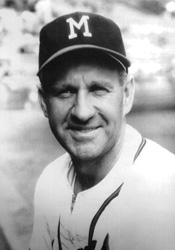
Slaughter, who began his big-league career with the Cardinals in 1938 and became one of their all-time best, played his last game in the majors for the Braves in 1959.

The Braves acquired Slaughter from the Yankees on Sept. 11, 1959, because they thought he could provide an edge in their pursuit of a third consecutive National League championship.

Though the Braves barely missed out, tying for first place before losing to the Dodgers in a playoff, Slaughter helped them win a pivotal regular-season game.

On Oct. 13, 1959, the Braves released Slaughter, ending a prolific major-league career. Slaughter, who batted .300 with 2,383 hits, 1,304 RBI and a .382 on-base percentage, was elected to the National Baseball Hall of Fame.

That’s a winner

An outfielder who batted left-handed, Slaughter developed a reputation for his all-out hustle. His daring dash from first base to home plate on a hit by Harry Walker provided the winning run for the Cardinals in Game 7 of the 1946 World Series against the Red Sox.

Slaughter played for the Cardinals from 1938 to 1942, spent three years in military service during World War II and returned to play for the Cardinals from 1946-53. He batted .305 with 2,064 hits in his 13 seasons with St. Louis.

In 1954, the Cardinals wanted to open an outfield spot for rookie Wally Moon. In spring training, shortly before his 38th birthday, Slaughter was traded by the Cardinals to the Yankees. In two stints with the Yankees, before and after being sent to the Athletics, Slaughter became a valuable role player and trusted favorite of manager Casey Stengel.

“Slaughter is really one of the most remarkable ballplayers I’ve ever known,” Stengel said to The Sporting News.

After playing in two World Series (1942 and 1946) for the Cardinals, Slaughter played in three World Series (1956, 1957 and 1958) for the Yankees.

Pitchers, beware

Considering his age, some were surprised the Yankees brought back Slaughter in 1959, but Stengel said, “Enos was my best pinch-hitter last year. We’re not carrying him for charity. He earns his pay.”

On May 16, 1959, in a game against the White Sox, Slaughter had a stolen base, becoming one of the oldest players to achieve the feat. Boxscore

Six of his first 11 hits for the season were home runs. On July 4, 1959, Slaughter, after pinch-running for a gimpy Mickey Mantle, hit a three-run home run against Pedro Ramos of the Senators. Boxscore Two weeks later, on July 19, 1959, he hit a pair of two-run home runs, one against Barry Latman and the other off Ray Moore, versus the White Sox. Latman was not quite 2 years old when Slaughter debuted with the 1938 Cardinals. Boxscore.

The Yankees, who won nine of 10 American League pennants between 1949 and 1958, had an off year in 1959. Trailing the first-place White Sox by 16.5 games after play on Sept. 10, 1959, the Yankees were ready to shake up the roster. Slaughter, batting .172, was placed on waivers and claimed by the Braves.

Slaughter displayed “a black scowl” as he packed his gear before departing Yankee Stadium for Milwaukee, according to New York Herald Tribune columnist Red Smith.

“This is an unusual fellow, a professional and a tough one,” Smith wrote. “He eats tobacco and he spits and he wants pitchers dead.”

The Hustler

In joining the Braves, Slaughter was reunited with a former Cardinals teammate, second baseman Red Schoendienst.

“I feel that my eyes are as good as ever and my legs are good,” Slaughter said. “I’ll keep on playing as long as they’ll let me.”

In his Braves debut on Sept. 13, 1959, his first National League game since 1953 with the Cardinals, Slaughter batted for infielder Felix Mantilla and singled to center against the Reds’ Bob Purkey. Boxscore

Three days later, on Sept. 16, 1959, the Braves opened a key series against the Giants at San Francisco. The Giants were in first place, two games ahead of the Braves and Dodgers.

Braves manager Fred Haney gave Slaughter the start in left field and batted him fifth in a lineup featuring fellow future Hall of Famers Hank Aaron and Eddie Mathews.

The Braves won, 2-0, behind the pitching of Lew Burdette. Slaughter figured in both runs.

In the fourth, with one on and one out, Slaughter coaxed a walk from Sam Jones, advancing Joe Adcock to second base. After Bobby Avila struck out, Del Crandall singled, scoring Adcock. In the eighth, Slaughter’s two-out single scored Aaron from second. Boxscore

“We hoped he would win just one game for us and he did,” Braves executive Birdie Tebbetts said. “Unfortunately, one wasn’t quite enough.”

The Braves and Dodgers finished the regular-season schedule tied for first place with 86-68 records. In a subsequent best-of-three playoff, the Dodgers won the first two games and advanced to the World Series.

On Nov. 9, 1959, a month after the Braves released him, Slaughter was named player-manager of the Houston Buffs, a farm club of the Cubs.

Buffs president Marty Marion, Slaughter’s former Cardinals teammate, said, “The Chicago Cubs thought it was tremendous. They are happy to have their young players in Slaughter’s hands.”

The Associated Press referred to Slaughter as “baseball’s ageless country boy.”

“I’ll never be too old to learn,” Slaughter said. “I’ll listen to the rawest rookie about things that might help him or me.”

The top prospects on the Cubs’ Houston farm club were a pair of future Hall of Famers, third baseman Ron Santo and outfielder Billy Williams.

Slaughter managed Houston to an 83-71 record in 1960. He managed the Raleigh Capitals, a farm club of the fledgling Mets, in 1961.

In December 1961, a 20-year-old Reds prospect, Pete Rose, impressed observers with his aggressive approach in the Florida Instructional League. Asked how he developed his style of play, Rose, who would come to be known as “Charlie Hustle,” said, “I remember seeing Enos Slaughter play against the Reds on television. He ran to first after getting a walk. I’ve been doing it ever since.”
Read Full Post »

(Updated June 18, 2020)

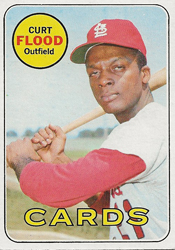
Center fielder Curt Flood wasn’t bluffing when he said he’d rather quit playing than accept a trade.

In October 1969, the Cardinals dealt Flood, catcher Tim McCarver, pitcher Joe Hoerner and outfielder Byron Browne to the Phillies for first baseman Richie Allen, pitcher Jerry Johnson and infielder Cookie Rojas.
“I wasn’t surprised to see Richie go to St. Louis,” Cardinals first baseman Bill White told the Philadelphia Inquirer, “but I was very surprised to see Flood leave St. Louis.”

When informed of the trade on the morning of Oct. 8, 1969, Flood, who had been with the Cardinals since 1957, turned to a companion and said, “There ain’t no way I’m going to pack up and move 12 years of my life away from here. No way at all.”

In his 1971 book, “The Way It is,” Flood said, “I took it personally. I felt unjustly cast out.”

Flood issued a statement to the media, saying he would retire and focus on being a portrait artist and operating a photo studio in St. Louis.

Baseball’s establishment didn’t take Flood’s intentions seriously, figuring the retirement plan was a ploy to get the Phillies to offer him an increase on his $90,000 yearly salary. Orioles scout Frank Lane, the former Cardinals general manager, told the Philadelphia Inquirer, “Unless Curt Flood is better than Rembrandt, he’ll be playing for Philadelphia.”

Flood, though, was offended by baseball’s reserve clause, which bound a player to a team and deprived him of the right to determine where to work. He said baseball officials “were entirely incapable of understanding that a basic principle of human life was involved.”

Two months after the trade, Flood announced he would challenge the reserve clause in court. He lost his case, but his legal fight led to an arbitrator’s 1976 ruling establishing free agency.

Shakeup in St. Louis

Flood and McCarver were core players for the 1960s Cardinals, who won three National League pennants and two World Series titles. In October 1969, they were deemed expendable for different reasons.

Flood created hard feelings with Cardinals owner Gussie Busch in contract negotiations before the 1969 season. Flood wanted a $100,000 salary. “I would not consider taking even $99,999,” Flood told The Sporting News, and Busch viewed the ultimatum as disrespect. (Flood got $90,000 instead.) During spring training, the Cardinals offered to trade Flood and Orlando Cepeda to the Braves for Felipe Alou and Joe Torre, the Atlanta Constitution reported, but the Braves wouldn’t part with Alou and the clubs settled for a swap of Cepeda for Torre.

Though Flood hit .285 with 31 doubles in 1969 and won his seventh consecutive Gold Glove Award, the rift between he and Busch remained.

McCarver, who debuted with the Cardinals at age 17 in 1959, batted .260 with 27 doubles in 1969, but had trouble throwing out runners. McCarver allowed the most stolen bases, 64, of any National League catcher in 1969.

“There is nothing wrong with my arm,” McCarver said. “My technique got fouled up this season because I was pressing.”

St. Louis Post-Dispatch sports editor Bob Broeg noted, “If he can cut down wasted motion behind the plate and get the ball away more quickly, he might reduce the high rate of stolen bases charged against him.”

With catching prospect Ted Simmons waiting for playing time, the Cardinals were willing to part with McCarver.

In his 1994 book “Stranger to the Game,” Cardinals pitcher Bob Gibson said, “I was sickened by the thought of Flood and McCarver leaving us. Those two guys struck right at the heart of what the Cardinals had been all about for the past decade. I loved the Cardinals, was proud to be one, and recognized that Curt Flood and Tim McCarver were two of the biggest reasons why. With them gone, being a Cardinal would never mean quite the same thing.”

Power outage

The 1969 Cardinals ranked 10th in the 12-team National League in runs scored _ ahead of only the expansion clubs, the Expos and Padres _ and last in home runs.

General manager Bing Devine was determined to acquire a run producer and targeted Allen, 27, who hit 32 home runs in 118 games for the 1969 Phillies.

The risk was Allen had a reputation as a malcontent. The Phillies suspended him for 29 games in 1969 after he failed to show for a June doubleheader.

Allen said Phillies officials “treat you like cattle” and he wanted out of Philadelphia.

In an editorial, the Philadelphia Inquirer was glad to see him go, saying, “If Richie Allen had been traded for the St. Louis bat boy, it would have been a fair exchange.”

Unfazed, Devine said, “We acquired him for hitting and power. The image of our club needed changing in that respect. We wanted someone who could help with runs and power production. Allen was the best available hitter of this type.”

Said Allen: “I’m not going to worry about hitting home runs. I won’t have to. All I can see right now is Lou Brock standing on second base after stealing about 60 or 70 bases.”

Right or wrong

Devine’s first trade after he became Cardinals general manager in 1957 was to acquire Flood from the Reds. Flood was 19 then and the notion of challenging baseball’s reserve clause “did not even occur to me,” he said in his book. “If it had, I would not have dared to act on it.”

Twelve years later, he was better positioned to oppose a trade.

“I refused to accept it,” Flood said. “It violated the logic and integrity of my existence. I was not a consignment of goods. I was a man, the rightful proprietor of my own person and my own talents.”

After Flood announced his intention to retire, he traveled to Denmark. Phillies general manager John Quinn contacted him by phone and got Flood to agree to defer a final decision until they had a chance to meet.

Phillies manager Frank Lucchesi said, “I’m sure once he gets over the shock of being traded, he’ll want to play.”

Flood and Quinn met in St. Louis and again in New York. Flood said the Phillies offered him a $100,000 salary for 1970, but he told Quinn, “It may be time for me to make my break with baseball.”

Changes in attitudes

On Dec. 24, 1969, Flood sent a letter to baseball commissioner Bowie Kuhn, informing him he wanted to be declared free to negotiate with any team. Kuhn rejected the proposal, citing the reserve clause.

With the support of the players’ union, Flood announced on Dec. 29, 1969, he would file a lawsuit, challenging the reserve clause.

To make up for the loss of Flood, the Cardinals likely planned to send third baseman Mike Shannon to the Phillies to complete the deal. When a kidney ailment put Shannon’s playing career in jeopardy, the Phillies agreed instead to accept two prospects, Willie Montanez and Jim Browning.

Flood attempted a comeback with the Senators in 1971 but gave up after appearing in 13 regular-season games.

Years later, Flood said of his challenge to the reserve clause, “I look back on what I did as a contribution.”

Devine was among those whose perspectives were changed.

“The players had no control over their careers,” Devine said. “It’s opposed to what the Constitution stands for _ freedom.”

Flood “was a good person with strong beliefs and the character to act on them,” Devine concluded.

Read Full Post »

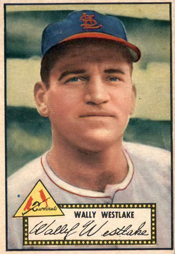
When the Cardinals acquired Wally Westlake from the Pirates, he seemed to be the ideal hitter to put pop into the cleanup spot, but it didn’t work out the way they expected.

Westlake played in the major leagues for 10 years, primarily with the Pirates. In a stretch between 1949-51, he was one of the top hitters in the National League.

On June 15, 1951, the Cardinals traded five players _ pitchers Howie Pollet and Ted Wilks, catcher Joe Garagiola, outfielder Bill Howerton and infielder Dick Cole _ to the Pirates for Westlake and pitcher Cliff Chambers.

The surprise deal was big news because Westlake, 30, was among the National League leaders in home runs and RBI, and his departure upset many Pirates fans.

Westlake was acquired to be the Cardinals’ center fielder and to bat No. 4 in the order between future Hall of Famers Stan Musial and Enos Slaughter.

“Baseball men believe the Cardinals got the best of the deal,” the Pittsburgh Post-Gazette reported.

Said Pollet: “The Cards have been looking for a hard right-handed hitter and now they’ve got one.”

Position change

Westlake debuted in the majors with the Pirates in 1947. He had his first big season two years later when he hit .282 with 23 home runs and 104 RBI for the 1949 Pirates. In 1950, he had similar numbers: .285, 24 home runs, 95 RBI.

In 1951, Westlake began the season in left field. In the Pirates’ home opener, his home run was the decisive run in a 5-4 victory over the Cardinals. Boxscore

On May 8, 1951, Pirates manager Billy Meyer, acting on instructions from club executive Branch Rickey, moved Westlake to third base, a position he last played 10 years earlier in the minors. The move was made as part of an overall infield shift to add hitting to the lineup.

Westlake responded well, producing 34 RBI in 34 games as the third baseman.

Looking to deal

The 1951 Cardinals were struggling to score. Musial and Slaughter were productive left-handed hitters, but the club lacked a consistent power threat from the right side.

From June 1 through June 14, the Cardinals lost 10 of 14 games and scored two runs or less in eight of those defeats.

“Musial is the greatest player in the game today _ he’s always on base _ but he can’t do it all himself,” Cardinals manager Marty Marion said to the St. Louis Post-Dispatch.

The Cardinals made an offer for Andy Pafko, a right-handed hitter who played center field for the Cubs, but he was dealt to the Dodgers.

“The strange thing is we offered the Cubs considerably more for Pafko than the Dodgers did, but the deal was turned down as not enough,” Cardinals owner Fred Saigh said.

According to The Sporting News, the Cubs wanted second baseman Red Schoendienst for Pafko, but the Cardinals refused.

Good fit

With Pafko out of the picture, the Cardinals went after Westlake. The Pirates were in last place in the National League and Rickey was looking for a package of players to upgrade several positions.

At the time of the trade, Westlake was second in the league to Gil Hodges in home runs and second to Duke Snider in RBI.

According to the Pittsburgh Press, the Cardinals demanded Westlake “or it was no deal.”

The inclusion of Chambers in the trade also was appealing to the Cardinals. Chambers, a left-hander, pitched a no-hitter against the Braves on May 6, 1951. Though he lost his next four decisions, the Pittsburgh Post-Gazette reported he still was considered “a dandy southpaw when his arm is right.”

Loss of appetite

Westlake, teammate Ralph Kiner and Pirates broadcaster Bob Prince were having lunch at Dutch Henry’s restaurant on Diamond Street in downtown Pittsburgh when Prince took a call from a secretary informing him Westlake had been traded to the Cardinals.

When Prince returned to the table, he said, “Wally, you’re going to St. Louis.”

Westlake was “stunned” and took the news “very hard,” the Pittsburgh Press reported.

Westlake liked Pittsburgh. The reason he, Kiner and Prince were at the restaurant is they were negotiating to buy it, The Sporting News reported.

The Pittsburgh Press called the decision to deal Westlake “a shocking surprise.” The Pittsburgh Post-Gazette added, “A shocker to say the least.”

“Next to Ralph Kiner, the most popular Pittsburgh player was Westlake,” the Pittsburgh Press reported.

Westlake was batting .282 with 16 home runs and 45 RBI in 50 games for the 1951 Pirates. Chambers was 3-6 with a 5.58 ERA.

“I won’t have to worry about pitching to Stan Musial anymore,” Chambers said.

Tough to adjust

Westlake arrived at the St. Louis airport on June 16, 1951, and went directly to Sportsman’s Park for the Saturday night game between the Phillies and Cardinals. Marion put him in the lineup as the center fielder, batting fourth.

In a storybook start to his Cardinals career, Westlake lined a three-run home run to left in the eighth inning against relief ace Jim Konstanty, breaking a 3-3 tie and carrying the Cardinals to a 6-5 victory. Boxscore

Westlake totaled five hits and five RBI in his first three Cardinals games, but his production faded as the season unfolded. Westlake hit .255 with six home runs and 39 RBI in 73 games for the 1951 Cardinals. He batted .180 against left-handers.

One factor in Westlake’s struggles could have been the dimensions of Sportsman’s Park. It was 351 feet from home plate to left field, 20 feet more than at Pittsburgh’s Forbes Field, where the fence had been moved in to create Greenberg Gardens, a cushy landing spot for the shots hit by right-handed sluggers Hank Greenberg, Kiner and Westlake.

For Westlake, drives which hit or cleared the left-field wall in Pittsburgh were outs in St. Louis.

Chambers gave the Cardinals the better value from the deal. He was 11-6 with a 3.83 ERA for them in 1951.

Westlake’s woes continued the next season. He batted .216 with no home runs in 21 games for the Cardinals. On May 13, 1952, the Cardinals traded Westlake and third baseman Eddie Kazak to the Reds for first baseman Dick Sisler and shortstop Virgil Stallcup.

Westlake played in the majors until 1956, including a stint with the Indians, whom he helped to an American League pennant in 1954, but he never replicated the power numbers he produced for the Pirates.

Read Full Post »

Johnny Mize barely missed out on being part of the Cardinals’ championship run of the early 1940s, but his timing was right with the Yankees.

On Aug. 22, 1949, the Giants sold Mize’s contract to the Yankees for $40,000.
The slugging first baseman played for the Yankees for five seasons, 1949-53, and they were World Series champions in each of those years.

Mize, one of the National League’s most feared sluggers when he played for the Cardinals and Giants, became a valued role player with the Yankees, platooning at first base and excelling as a pinch-hitter.

Cardinals clouter

In 1936, two years after the Gashouse Gang Cardinals won a World Series title against the Tigers, Mize made his major-league debut and replaced Rip Collins as the first baseman.

A left-handed batter nicknamed “The Big Cat,” Mize hit with consistent power. He was the first Cardinals player to hit three home runs in a game four times.

Mize had 100 or more RBI in five of his six St. Louis seasons. He established the Cardinals’ single-season home run record with 43 in 1940. The mark held until Mark McGwire, using performance-enhancing drugs, hit 70 in 1998.

Mize batted .336 with 1,048 hits in 854 games as a Cardinal, but the club never won a pennant in any of his seasons with them.

On Dec. 11, 1941, the Cardinals traded Mize, 28, to the Giants for pitcher Bill Lohrman, first baseman Johnny McCarthy, catcher Ken O’Dea and $50,000.

The Cardinals went to the World Series in each of the next three years, winning championships in 1942 and 1944.

Differences with Durocher

After one season with the Giants, Mize joined the Navy and served for three years (1943-45) during World War II. He returned to the Giants in 1946 and twice led the league in home runs, hitting 51 in 1947 and 40 in 1948.

Leo Durocher became Giants manager in July 1948 and he was tough on his former Cardinals teammate. Mize’s “slowness afoot displeased Durocher,” the Associated Press reported, and, according to The Sporting News, Durocher tried to get Mize “to change his stance in order to pull outside pitches instead of poking them into left field.”

Mize “rebelled quietly at the harshness” of Durocher, the New York Daily News reported.

During spring training in 1949, the Dodgers inquired about Mize but lost interest when the Giants asked for $200,000 in return, the Associated Press reported.

The Tigers made a bid for Mize in July 1949, but it didn’t work out. According to the New York Daily News, the Tigers determined Mize, 36, was “too old and slow.”

Good move

In August 1949, the Giants placed Mize on waivers and none of the other seven National League teams put in a claim for him.

The Cardinals had first basemen Nippy Jones and Rocky Nelson, and club owner Fred Saigh said, “We’re in good shape at first base and didn’t need any more help.”

Said Phillies owner Bob Carpenter: “The fact all the clubs waived on him speaks for itself.”

Though past his prime, Mize still was an effective run producer, with 18 home runs and 62 RBI for the 1949 Giants.

By clearing waivers, Mize could be dealt to an American League team.

The first-place Yankees thought their closest pursuers, the Red Sox, “would take Mize if they didn’t,” the New York Daily News reported, and offered the most money for him. Acquiring Mize also enabled the Yankees to return Tommy Henrich, who was playing first base, to the outfield, his most natural position.

In five seasons with the Giants, Mize hit .299 with a .389 on-base percentage, but, like with the Cardinals, never played in a World Series for them.

Puffing on a cigar, Mize told United Press, “I wouldn’t say I’m glad to get away from the Giants. I got along all right with Leo Durocher, although I didn’t always agree with him.”

The Yankees were credited with making a shrewd move.

“Mize may turn out to be the longball-hitting first sacker the Yankees have been seeking ever since the immortal Lou Gehrig retired,” the Associated Press declared.

Sid Keener of the St. Louis Star-Times wrote, “The Yankees are playing table stakes with blue chips in their effort to bring the 1949 pennant to New York.”

Mize’s mother, Emma, immediately recognized the potential benefits for her son, telling United Press, “All my life I’ve wanted to see him in the World Series. Maybe he’ll make it at last.”

A lot left

In his second game for the Yankees, Mize hit a two-run home run against Bob Feller, sparking them to a victory. Boxscore

The 1949 Yankees went on to win the pennant and Mize got to play against the Dodgers in his first World Series.

In 1950, Mize produced 25 home runs and 72 RBI in just 90 regular-season games for the Yankees.

He was a standout of the 1952 World Series when he batted .400 and slugged three home runs against the Dodgers. He would have had a fourth home run, but Dodgers outfielder Carl Furillo “leaped high, leaned back and robbed” Mize, catching a drive headed for the bleacher seats, The Sporting News reported.

Mize appeared in 18 World Series games for the Yankees and hit .286 with nine RBI.

In 1953, his final season, Mize, 40, was at his best as a pinch-hitter, batting .311 (19-for-61) in the role.

When Mize completed his career in the majors, his 359 home runs ranked sixth all-time. He finished with 2,011 hits, 1,337 RBI and a career batting average of .312.

Mize hit 20 or more home runs nine times and never struck out more than 57 times in any of those seasons. When he hit his career-high 51 home runs for the 1947 Giants, he struck out only 42 times.

Read Full Post »

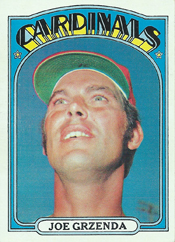
Before Al Hrabosky became prominent, another pitcher with a double-consonant start to his name, Joe Grzenda, was the Cardinals’ top left-handed reliever.

Grzenda pitched eight seasons in the major leagues for the Tigers (1961), Athletics (1964 and 1966), Mets (1967), Twins (1969), Senators (1970-71) and Cardinals (1972).
The Cardinals, seeking a reliever who could get out left-handed batters, acquired Grzenda from the Senators for infielder Ted Kubiak on Nov. 3, 1971, but it didn’t work out the way they’d hoped.

Nervous energy

Grzenda was born in Scranton, Pa. His father was a coal miner. Grzenda signed with the Tigers when he was 18 in 1955. He injured his arm in the minor leagues and developed a sidearm delivery, relying on a sinker.

After making his major-league debut with the Tigers in 1961, Grzenda was released in 1963 and joined the Athletics. According to Hardball Times, when Grzenda was in the Athletics’ farm system in 1964, his teammates “quickly took note of his habit of drinking two pots of coffee each day. They also noticed his chain-smoking, as he plowed through three packs of Lucky Strikes in a typical day. Sometimes Grzenda would light a cigarette and start smoking, leave it on the bench, and then work so quickly on the mound that he could return to the dugout and finish off the cigarette. A bundle of nervous energy fueled by cigarettes and coffee, he was in constant motion.”

In 1967, with Dave Duncan as his primary catcher, Grzenda was 6-0 with a 1.20 ERA in 52 appearances for the Birmingham club in the Athletics’ farm system. Mets president Bing Devine was impressed and purchased Grzenda’s contract on Aug. 14, 1967. Grzenda made 11 appearances with the 1967 Mets and had a 2.16 ERA.

Grzenda had his biggest successes in the major leagues with the 1969 Twins and 1971 Senators.

Playing for manager Billy Martin, Grzenda was 4-1 with three saves for the Twins, who won the 1969 American League West title.

In March 1970, the Twins traded Grzenda to the Senators, who were managed by Ted Williams.

In the book “Kiss It Goodbye,” Senators radio voice and author Shelby Whitfield noted, “Williams was the only one who saw potential in Grzenda.”

Getting a grip

During the 1970 season, Senators catchers told Grzenda “he was throwing the slider with more velocity than his fastball,” The Sporting News reported.

Seeking a remedy, Grzenda went to Senators pitching coach Sid Hudson, who suggested a grip change. Grzenda tried it and his fastball developed the action of a slip pitch. Bob Broeg of the St. Louis Post-Dispatch described the slip pitch as “a delivery that fades and falls like a screwball.”

“It serves not only as a changeup,” Broeg wrote, “but also as a good double-play pitch for right-handed hitters who try to pull it.”

Many pitchers can’t control a slip pitch, but for Grzenda it “was love at first sight,” according to Broeg.

Hudson said, “Now he has more confidence in what he is doing because he has more velocity and is throwing pitches with different speeds.”

Grzenda was 5-2 with five saves and a 1.92 ERA in 46 relief appearances for the 1971 Senators. He limited batters to 17 walks in 70.1 innings. Left-handed batters hit .226 against him.

Filling a need

Cardinals scout Joe Monahan was impressed and said Grzenda has “a good curve, his fastball is alive and he has excellent control. His fastball sinks and has the effect of a screwball against right-handed batters.”

After the 1971 season, the Senators moved from Washington, D.C., to Texas and were renamed the Rangers. The club was seeking a second baseman and Williams viewed Kubiak, a Cardinals utility infielder, as an ideal candidate.

“Ted Williams has been interested in Kubiak for a couple of years,” Rangers owner Bob Short told The Sporting News.

Williams contacted the Cardinals to inquire about Kubiak’s availability. Monahan “highly recommended” the Cardinals ask for Grzenda in exchange. Devine, who had left the Mets and was in his second stint as Cardinals general manager, was willing to acquire Grzenda a second time.

“We needed an experienced left-handed reliever so badly,” Devine said.

Devine figured Grzenda and Don Shaw would give the 1972 Cardinals a pair of quality left-handers in the bullpen. Shaw was 7-2 with a 2.65 ERA for the Cardinals in 1971 and left-handed batters hit .171 against him.

Slippery slope

The plan unraveled early in the 1972 season.

Shaw developed a shoulder ailment, made eight appearances for the Cardinals and was traded to the Athletics in May.

Grzenda’s slip pitch no longer was effective. He had a 6.75 ERA in April and an 8.59 ERA in May.

Grzenda and his road roommate, Moe Drabowsky, made unwanted headlines during a series in Houston in May when it was discovered their hotel room was extensively damaged. Devine described the damage as “pretty bad.” According to the Post-Dispatch, light bulbs and drinking glasses were smashed and a bed headboard was “sighted sailing down a corridor” of the hotel.

In June, when he turned 35, Grzenda had a turnaround. He didn’t allow an earned run in 6.1 innings over five appearances for the month. He also got a win with 1.1 innings of scoreless relief against the Giants on June 17. Boxscore

After that, the highlights were few. Grzenda had a 6.75 ERA in August and a 12.46 ERA in September.

The Cardinals, out of contention and headed for a 75-81 finish, used the last few weeks of the season to look at some prospects, including Hrabosky.

Grzenda made the most appearances (30) of any left-hander on the 1972 Cardinals and was 1-0 with a 5.66 ERA. He gave up 46 hits in 35 innings and walked more batters (17) than he struck out (15). Left-handed batters hit .436 against him.

The 1972 season was Grzenda’s last in the big leagues. His career mark in the majors: 14-13 with 14 saves and a 4.00 ERA.

Hrabosky, who had brief stints with the Cardinals from 1970-72, pitched in 44 games for them in 1973 and went on to become their top left-handed reliever from 1974-77 while developing a persona as the self-psyching “Mad Hungarian.”

Read Full Post »

(Updated Dec. 23, 2019)

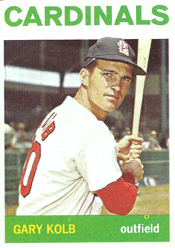
Gary Kolb impressed Branch Rickey, stepped in for Stan Musial and got traded for Bob Uecker.

Kolb played seven major-league seasons with the Cardinals (1960, 1962-63), Braves (1964-65), Mets (1965) and Pirates (1968-69).

A left-handed batter with speed, Kolb primarily was an outfielder who also experimented with catching and playing infield in the hope his versatility would enhance his value to the Cardinals.

Rickey, the former general manager who came back to the club as a consultant, liked Kolb, and so did Musial, who tabbed Kolb and Mike Shannon as potential outfield successors.

Top prospect

Kolb was a standout in baseball, basketball, football and track at Rock Falls High School in Illinois. He enrolled at the University of Illinois and played on the freshman football, basketball and baseball teams.

As a college sophomore, Kolb, 6 feet and 190 pounds, gave up basketball, but played varsity football and baseball. He signed a professional contract with the Cardinals in the spring of 1960 after completing his sophomore baseball season.

“I thought I’d better get out of football before I got hurt,” Kolb said to the St. Louis Post-Dispatch.

Kolb, 20, played for two Cardinals farm clubs in the summer of 1960, produced 15 triples and was called up to the big-league club in September. He made his Cardinals debut on Sept. 7, 1960, as a pinch-runner. Kolb appeared in nine games, eight as a pinch-runner, for the 1960 Cardinals.

Kolb spent the next two seasons in the minors before getting another September call-up to the Cardinals in 1962. He hit .357 for them in 14 at-bats.

A month later, in October 1962, the Cardinals hired Rickey, 80, as a consultant and one of his first assignments was to assess their players in the winter Florida Instructional League. Kolb was there, playing shortstop, and he caught the attention of Rickey.

Rickey “indicated he considered Kolb one of the best prospects in the camp,” the Post-Dispatch reported.

Batter up

In February 1963, shortly before the Cardinals opened spring training at St. Petersburg, Fla., they arranged for six prospects, including Kolb, to attend a special five-day hitting session. Joining Kolb were Jerry Buchek, Duke Carmel, Doug Clemens, Phil Gagliano and Dal Maxvill.

Rickey proposed the extra workouts after he observed the players at the Florida Instructional League.

“All are good athletes with good reflexes and baseball instinct,” the Post-Dispatch reported, “but all have been disappointing at swinging a bat against major-league pitching.”

Cardinals manager Johnny Keane, coach Vern Benson and Rickey were the instructors for the sessions.

Rickey “had a special batting cage built in the center field corner of the Redbirds’ spring training park,” the Post-Dispatch observed. “Behind the batting cage is a platform about five feet above the ground from which Rickey watches the batters hit against a pitching machine.”

Rickey told the assembled prospects, “You’ll hit until you are weary. You’ll get blisters on your hands before we’re through, unless you wear the golf gloves we have here for you, gloves for both hands. You’ll swing as hard as you can and you’ll bunt. You’ll bunt for the sacrifice and you’ll bunt for base hits.”

On the rise

The extra work apparently helped Kolb because he had a good spring training camp with the 1963 Cardinals. Eddie Stanky, the Cardinals’ director of player development, said Kolb is “a bulldog and a versatile athlete whose ability to play both infield and outfield will help him make the big-league club.”

Near the end of spring training, Kolb, at Rickey’s urging, “strapped on the pads” and worked out as a catcher “to lend value to his versatile efforts,” the Post-Dispatch reported.

When the Cardinals sold the contract of outfielder Minnie Minoso to the Senators, it opened a spot for Kolb on the Opening Day roster as a reserve outfielder.

The Cardinals returned Kolb to the minors in May 1963, but he hit .318 for Tulsa and was brought back to the big-league club in July.

Keane gave Kolb a start in right field against the Braves on July 12, 1963, and he produced two hits, including his first major-league home run, against Tony Cloninger. The two-run homer carried onto the pavilion roof at Busch Stadium. Boxscore

Kolb was back in the starting lineup again the next day, July 13, 1963, and went 3-for-4 with two singles and another home run against the Braves’ Hank Fischer. Boxscore

Kolb made 19 starts in right field, mostly in July, for the 1963 Cardinals. He batted .327 with 18 hits and 12 walks in 19 July games.

Kind words

In September 1963, with the Cardinals challenging the Dodgers for the pennant, Kolb was used primarily as a pinch-runner, most often for Musial, who was 42 and in his last season. Kolb appeared nine times as a pinch-runner for Musial in 1963.

On Sept. 29, 1963, Musial was in the Busch Stadium clubhouse, preparing to play his final game, when Kolb and Shannon walked by his locker.

“Wait a minute,” Musial said, putting an arm around each of them.

As photographers and reporters closed in, Musial said, “These are my proteges. They’re going to take over for me, aren’t you?”

Kolb and Shannon blushed, according to the Post-Dispatch.

After Musial stroked a RBI-single in the sixth, Keane sent in Kolb to run. Kolb told his hometown news organization, Saukvalley.com of Sterling, Ill., that as Musial departed first base for the final time to a thunderous ovation, he turned to him and said, “They love you, kid.” Boxscore

Moving on

Kolb batted .271 in 119 plate appearances for the 1963 Cardinals. He generated 26 hits, including five triples, and 22 walks for a .403 on-base percentage.

Kolb hit .328 for the Cardinals versus right-handers in 1963 and overall he batted .500 (9-for-18) against the Braves.

After trading George Altman to the Mets, Cardinals general manager Bing Devine said in November 1963 he viewed Kolb, Shannon, Clemens and Johnny Lewis as candidates to start in right field in 1964.

The scenario changed in February 1964 when the Cardinals acquired outfielder Carl Warwick from the Houston Colt .45s. Warwick and Lewis performed best in spring training and Kolb became expendable.

On April 9, 1964, the Cardinals traded Kolb and catcher Jimmie Coker to the Braves for Uecker, who was viewed as a defensive upgrade as a backup to starting catcher Tim McCarver.

Rickey opposed the deal made by Devine. According to the book, “October 1964,” when Uecker introduced himself to Rickey in the Cardinals’ clubhouse, Rickey replied, “I didn’t want you. I wouldn’t trade a hundred Bob Ueckers for one Gary Kolb.”

Kolb spent his final three seasons (1971-73) with the Pirates’ Class AAA farm club in Charleston, W.Va., and settled there after his playing career. His cousin, Dan Kolb, was a big-league relief pitcher from 1999-2007.

Read Full Post »

« Newer Posts - Older Posts »