Feeds:
Posts
Comments

Archive for the ‘Trades’ Category

Needing a proven right-handed hitter to balance and bolster their lineup, the Cardinals appeared to make the right move when they acquired the player who had been the Cubs’ most consistent run producer of the mid-1970s.

The timing, however, turned out to be terrible.

Jerry Morales, an all-star outfielder with the 1977 Cubs, was a bust with the 1978 Cardinals.

On Dec. 8, 1977, the Cardinals got Morales and catcher Steve Swisher from the Cubs in a trade for outfielder Hector Cruz and catcher Dave Rader.

At the time, the Cardinals’ best batters either were switch-hitters (Ted Simmons and Garry Templeton) or left-handed (Lou Brock and Keith Hernandez).

Cardinals right-handed batters collectively hit .217 versus right-handed pitching in 1977.

At the baseball winter meetings in December 1977, Cardinals general manager Bing Devine went shopping for a productive right-handed bat.

Chicago hit man

Morales debuted in the major leagues at age 20 with the 1969 Padres. After five seasons with San Diego, he was traded to the Cubs in November 1973.

Morales became one of the Cubs’ premier players. He led them in RBI in 1974 (82) and 1975 (91) and hit a career-high 16 home runs in 1976.

“He has that knack of driving in the tough runs,” Cubs pitcher Rick Reuschel said.

Morales hit .331 in the first half of 1977 and was selected to the all-star team. “Morales has an unmistakable batting stance,” The Sporting News observed. “He keeps his feet wide apart and holds the bat over his head … This unusual stance, he insists, enables him to wait longer on the pitch.”

Batting in the All-Star Game against Sparky Lyle, Morales was hit on the knee by a pitch.

The knee became sore and bothered Morales the remainder of the season. He also wrenched his back and broke a finger. The injuries took a toll. Morales hit .218 in the second half of the season.

Though his overall batting average that year was a career-best .290, Morales called 1977 “the most disappointing season of my career” because he tailed off so badly after a stellar start.

Mix and match

After the 1977 season, the Cubs signed free-agent slugger Dave Kingman, making Morales expendable.

The Cubs needed a starting catcher. Their general manager, Bob Kennedy, began a “relentless search” for one, according to the Chicago Tribune.

Kennedy, who had been the Cardinals’ director of player development before becoming general manager of the Cubs in November 1976, made Rader his “main target,” the Tribune reported.

With workhorse Ted Simmons at catcher for St. Louis, Rader seldom played and he had asked the Cardinals to trade him.

Cruz also appealed to the Cubs. Though Cruz had flopped as the Cardinals’ right fielder in 1977 (.236 batting average, six home runs, 42 RBI), Kennedy liked him. In 1975, when Kennedy ran the Cardinals’ farm system, Cruz was named Minor League Player of the Year by The Sporting News.

When Kennedy asked the Cardinals for Rader and Cruz, Devine demanded Morales. “We had been trying to get Morales for two or three years,” Devine said.

Said Kennedy: “We didn’t want to give up Morales, but he’s the only guy who had enough value for us to get the catcher we wanted.”

Cardinals nemesis

In its report on the trade, The Sporting News called Morales the Cubs’ “most consistent hitter the last four seasons” and “a good all-round player.”

With the Cubs, Morales had batting averages against the Cardinals of .352 in 1975, .300 in 1976 and .313 in 1977.

“He’s an altogether different kind of hitter in a tight game with a runner on second or third base,” Simmons said. “He’s been one of the five or 10 hitters I’ve least wanted to see up there at bat (against the Cardinals) when it counts.”

Cardinals manager Vern Rapp envisioned an outfield of Morales in right, Brock in left and Tony Scott in center.

When the Cardinals began the 1978 season, the top five in their batting order were Brock, Templeton, Morales, Simmons and Hernandez. In the April 7 season opener against the Phillies, Morales had three singles against Steve Carlton and scored a run in a 5-1 Cardinals victory.

That turned out to be one of his few Cardinals highlights.

Morales had a miserable May, batting .194, and struggled to recover.

In July, The Sporting News reported, “Morales, who was counted on as a big RBI man, had been trying extra hard, as witness a 30-minute extra batting practice session one day and 10 minutes extra before the next game, but continued to be disappointing.”

Morales finished the season with a .239 batting average, four home runs and 46 RBI. He hit .205 against right-handers.

Traveling man

The Cardinals finished 69-93 in 1978. Devine was fired and replaced by former Red Sox assistant general manager John Claiborne. Morales asked to be traded, according to the St. Louis Post-Dispatch. Claiborne was happy to oblige.

“He hit a lot of 385-foot outs at Busch Stadium, but they were still outs,” Claiborne said.

The Cardinals talked with the Red Sox about a trade of Morales for pitcher Bill Lee, who was feuding with manager Don Zimmer, The Sporting News reported.

However, the Tigers, who had been trying to acquire Morales for more than a year, were the most aggressive pursuers.

In Claiborne’s first trade as general manager, the Cardinals sent Morales and pitcher Aurelio Lopez to the Tigers for pitchers Bob Sykes and Jack Murphy.

Morales hit .211 for the 1979 Tigers and was dealt to the Mets. He spent his last three seasons (1981-1983) with the Cubs.

Morales played a lot better against the Cardinals than he did for them. In 115 career games versus St. Louis, Morales hit .327.

From 2002-2004, Morales was a coach on the staff of Expos manager Frank Robinson. He coached again in 2007 and 2008 on the staff of Nationals manager Manny Acta.

Previously: Cardinals made mistake giving up on Jose Cruz

Read Full Post »

(Updated Oct. 30, 2022)

The Cardinals took a chance on Jeff Brantley and lost.

Needing a closer, the Cardinals traded a prime prospect, Dmitri Young, to the Reds for Brantley, even though the pitcher had spent most of the previous season on the disabled list.
Cardinals general manager Walt Jocketty made the deal on Nov. 10, 1997, when he got assurances Brantley had recovered fully from surgery to repair injuries to his right shoulder and rotator cuff.

The Cardinals, though, should have been as skeptical as columnist Bernie Miklasz, who, at the time of the trade, wrote in the St. Louis Post-Dispatch, “The Jeff Brantley trade makes me nervous; a 34-year-old pitcher coming off shoulder surgery?”

Brantley flopped with the 1998 Cardinals. Claiming his arm hurt, Brantley pitched poorly, clashed with pitching coach Dave Duncan, was removed from the closer’s role and got traded after the season.

The Cardinals’ misjudgment of Brantley set back the organization in significant ways. The Cardinals had to continue to scramble to find a closer and they had to do so without one of their strongest trade chips. Young, a productive hitter, was given away to a division rival without St. Louis getting full value in return.

Price is right

When closer Dennis Eckerlsey opted for free agency after the 1997 season, the Cardinals went in search of a replacement.

Wanting to avoid getting involved in bidding for free agents, Jocketty looked to make a trade. He was willing to part with Young, a first baseman and outfielder, because the Cardinals had talent at those positions. Mark McGwire was the first baseman and Ron Gant, Ray Lankford and Brian Jordan were the outfielders.

Though Brantley, 34, had not pitched since May 19, 1997, the Cardinals thought he could pitch again like he did when he earned 44 saves for the 1996 Reds.

“We knew we had to act quickly because other clubs were interested in him,” Jocketty said to Rick Hummel of the Post-Dispatch.

Given orders by ownership to cut player payroll, Reds general manager Jim Bowden was eager to deal Brantley, who was under contract for salaries of $2.8 million over each of the next two years.

The Reds had another capable closer, Jeff Shaw, on their roster and he was paid less than Brantley.

The $5.6 million owed Brantley over 1998 and 1999 didn’t dissuade the Cardinals from pursuing a deal for him. “Guys who might be available in free agency would have cost twice as much,” Jocketty said.

Special hitter

When Jocketty offered Young, 24, to the Reds, Bowden accepted.

“This deal was made for financial reasons,” Bowden said to the Associated Press, “and is consistent with our commitment to get younger and cheaper.”

Asked by Jeff Horrigan of The Cincinnati Post about Young, Reds manager Jack McKeon replied, “He has a great attitude and a great upside … We might have something special here.”

Young, a switch hitter, was the top pick of the Cardinals in the 1991 amateur draft. He led the Class AAA American Association in batting average (.333) in 1996, producing 153 hits in 122 games.

Young debuted with the Cardinals in August 1996 and hit a key triple for them that fall in Game 4 of the National League Championship Series against the Braves. In 1997, Young hit .258 in 110 games for St. Louis.

Projecting Young to be best-suited as a designated hitter, Jocketty said, “Dmitri is going to be a very good hitter. He’d be a good American League player.”

Regarding Young’s potential role with the 1998 Cardinals, manager Tony La Russa said, “There was a way to wedge him onto the team, but it was not a good fit.”

The acquisition of McGwire by St. Louis in July 1997 “kind of put a damper” on the Cardinals’ plans for him, Young told Mike Bass of The Cincinnati Post. “I didn’t have a clue what the Cardinals were going to do with me,” Young admitted.

Not the same

Before the deal became official, the Cardinals sent Brantley to Birmingham, Ala., for an examination by Dr. James Andrews. With Cardinals trainer Barry Weinberg witnessing the exam, Andrews declared Brantley physically fit to pitch.

“I didn’t have any doubts that it wouldn’t be a problem,” Brantley told the Post-Dispatch. “I’ve been throwing for over two months.”

Brantley told The Cincinnati Post that Andrews “gave me a 100 percent clean bill of health.”

Brantley was effective at the start of the 1998 season for the Cardinals. On May 11, he had six saves and a 1.93 ERA.

Then danger signs developed.

On May 12, St. Louis led the Brewers, 5-3, in the ninth when Brantley entered and gave up a two-run home run to Jeff Cirillo. Boxscore

On May 22, with the Cardinals ahead of the Giants, 3-1, in the ninth, Brantley yielded a two-run homer to Bill Mueller. Boxscore

Brantley remained the closer _ and it proved costly to the Cardinals.

On the morning of May 30, the Cardinals had a 28-24 record. St. Louis lost nine of its next 10 and 12 of 17. Included in that stretch:

_ May 30, Padres 3, Cardinals 2: Brantley entered in the ninth with the score 2-2. Quilvio Veras beat him with a one-out RBI-single. Boxscore

_ June 4, Dodgers 3, Cardinals 2: Different game, same outcome. Brantley entered in the ninth with the score 2-2. Charles Johnson beat him with a one-out RBI-single. Boxscore

_ June 13, Diamondbacks 7, Cardinals 4: St. Louis led 4-3 with two outs in the eighth when Brantley entered with a runner on third. After Jay Bell walked, Travis Lee slammed a three-run home run and Matt Williams followed with a solo shot. Boxscore

_ June 17, Astros 6, Cardinals 5: After Brantley was handed a 5-2 ninth-inning lead, Craig Biggio was hit by a pitch, Bill Spiers reached on a bunt single, Biggio scored on a sacrifice fly and Jeff Bagwell belted a two-run home run, tying the score. When Carl Everett singled, Brantley was lifted for Curtis King. After a walk, Brad Ausmus’ single scored Everett. Boxscore

Brantley eventually was replaced as closer by Rich Croushore and then by Juan Acevedo. Brantley recorded one save after July 10 and finished the 1998 season with an 0-5 record, 4.44 ERA and 14 saves in 48 appearances. Booed by Cardinals fans, Brantley was especially bad in home games: a 6.38 ERA in 24 appearances at Busch Stadium.

After the season, Brantley was traded to the Phillies in a deal that brought the Cardinals another erratic closer _ Ricky Bottalico.

Read Full Post »

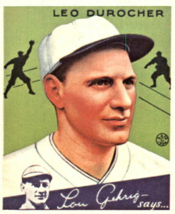
Leo Durocher, combative shortstop of the Cardinals’ Gashouse Gang teams of the mid-1930s, fell out of favor with manager Frankie Frisch.

Their relationship deteriorated so badly Frisch issued an ultimatum to Cardinals executive Branch Rickey: Either Durocher goes or I go.
On Oct. 5, 1937, the Cardinals dealt Durocher to the Dodgers for third baseman Joe Stripp, second baseman Jim Bucher, outfielder Johnny Cooney and pitcher Roy Henshaw.

The trade, it turned out, created a career-boosting opportunity for Durocher. After a season as the Dodgers’ starting shortstop, he became their player-manager in 1939. Durocher went on to a successful, sometimes stormy, managerial career that earned him election to the National Baseball Hall of Fame.

Meanwhile, none of the players acquired by the Cardinals for Durocher contributed much. Frisch, who had been player-manager since 1933, was fired in September 1938 near the end of the Cardinals’ first losing season in six years.

Battle of wills

Durocher had come to the Cardinals from the Reds in a May 1933 trade. As their starting shortstop, Durocher helped the Cardinals to a World Series title in 1934. He led National League shortstops in fielding percentage in 1936.

Complaining of a kidney ailment and bad back, Durocher had a poor start to the 1937 season. After going hitless in a May 4 game at Boston against the Braves, Durocher’s batting average was at .132.

After the game, Durocher asked Frisch for permission to stay out of the hotel past the manager-mandated midnight curfew. The request upset Frisch, who accused Durocher, the team captain, of being focused more on fun than on performance.

The next day, May 5, Frisch benched Durocher and started Jimmy Brown at shortstop against the Braves.

After an off day on May 6, the Cardinals opened a series against the Giants at New York. Brown started at shortstop in the May 7 game.

When Frisch posted a lineup with Brown at shortstop again on May 8 against the Giants, Durocher declined to take batting or fielding practice at the Polo Grounds.

Durocher’s defiance was intolerable to Frisch.

“Nobody on my team _ even you _ can show such a lack of spirit,” Frisch said to Durocher.

When Durocher spoke up for himself, saying he had played earlier despite being ill and in pain, Frisch barked, “Get a train and go back to St. Louis. Get out of here.”

Durocher didn’t depart, but he didn’t get back into the starting lineup until May 12 against the Phillies at Philadelphia.

Big deal

Durocher, 32, played out the rest of the season as the Cardinals’ primary shortstop. He batted .203 in 135 games and grounded into a team-high 17 double plays.

In summarizing Durocher’s season, the St. Louis Star-Times wrote, “He was off stride at the very start, complained of illness and injuries, and was anything but the brilliant defensive player he had been. Durocher gained weight and was unable to handle the important shortstop position with his old-time finesse. Batted balls to his left and to his right became base hits.”

On Oct. 5, two days after the completion of the Cardinals’ season, Rickey was in New York to attend the World Series between the Giants and Yankees when he made the trade with the Dodgers.

Dick Farrington, in a column for The Sporting News, declared, “Leo Durocher’s passing from the Cards to the Dodgers was a case of ‘It’s Durocher or me’ with Frankie Frisch.”

A headline in The Sporting News blared, “Frisch Responsible For Durocher Going.”

The key players in the deal for the Cardinals were Stripp and Bucher. Stripp _ “Generally regarded as one of the best third sackers in the major leagues,” according to the Post-Dispatch _ long had been coveted by Frisch. Rickey liked Bucher, who had started his career in the Cardinals’ system before being drafted by the Dodgers.

“Bucher, alone, is a better ballplayer than Durocher,” Giants manager Bill Terry told International News Service in rating the deal a steal for St. Louis.

According to The Sporting News, “The first impulse of Brooklyn fans was heavily against the switch” because they thought four players were too high a price for Durocher.

However, Pie Traynor, Pirates manager, said, “The Dodgers got a great shortstop and they didn’t give up anybody who could help them.”

Dodgers benefit

The 1938 season was a failure for Frisch and the Cardinals.

Stripp squabbled with management over his contract and got a late start to the season. He batted .286 in 54 games but was sent to the Braves on Aug. 1.

Bucher, who spent most of the year in the minors, hit .228 in 17 Cardinals games.

Henshaw had a 5-11 record and 4.02 ERA for the Cardinals.

Cooney was released on the eve of the season opener.

On Sept. 11, with the Cardinals’ record at 63-72, Frisch was fired and replaced by a coach, Mike Gonzalez, for the rest of the season.

Durocher in 1938 led National League shortstops in fielding percentage and was named to the all-star team.

Previously: Rift with Branch Rickey led Cards to oust Frankie Frisch

Read Full Post »

(Updated on July 31, 2018)

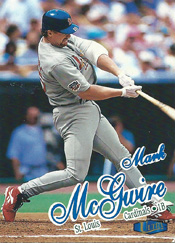
Unwilling to part with Manny Aybar, the Cardinals almost didn’t make the trade for Mark McGwire.

In July 1997, the Cardinals went in search of a power hitter. They had discussions with the Blue Jays about Joe Carter and with the Tigers about Travis Fryman. The slugger they wanted most was McGwire.

For the Cardinals to get him, the Athletics demanded a package that included Aybar, a top pitching prospect.

With the trade deadline of midnight July 31 fast approaching, the Cardinals held firm in their refusal to part with Aybar. As late as 6:30 p.m. on July 31, Cardinals general manager Walt Jocketty said he thought the deal wouldn’t happen.

When the Athletics relented and settled instead for Eric Ludwick, the trade was made. The Cardinals got McGwire for three pitchers: T.J. Mathews, Blake Stein and Ludwick.

Thumbs up

On July 25, after losing to the Marlins at St. Louis, the Cardinals fell to 48-53, six games behind the first-place Astros in the National League Central Division.

Unwilling to concede, the Cardinals determined what they needed most was another run producer in a lineup that included Ray Lankford, Ron Gant and Gary Gaetti.

Two days later, on July 27, McGwire told reporters he strongly would consider a trade to the Cardinals.

McGwire was eligible to become a free agent after the 1997 season, so the Athletics were open to trading him if they could get a good return. Because McGwire was a 10-year veteran who had played five consecutive seasons with his current team, the Athletics needed his approval before they could deal him. That’s why it was significant when McGwire went public with his consent of a possible trade to St. Louis.

Art of the deal

Initially, the Athletics inquired about the availability of two of the Cardinals’ most promising starting pitchers, Alan Benes and Matt Morris.

When Jocketty made it clear neither would be traded, the Athletics set their sights on two prospects in the Cardinals’ minor-league system: Aybar and catcher Eli Marrero.

Jocketty didn’t want to trade them either.

On July 29, Jocketty rated the Cardinals’ chances of acquiring McGwire as 50-50, according to the St. Louis Post-Dispatch.

Looking to keep options open, Jocketty spoke with the Blue Jays about Carter, but they wanted outfielder John Mabry. Jocketty said no.

The Tigers were willing to deal Fryman, but they wanted starting pitcher Todd Stottlemyre. Again, Jocketty said no.

McGwire remained the best option.

The Angels also had pursued McGwire, but when they dropped out of the bidding it left the Cardinals as the lone suitor and gave Jocketty leverage.

Holding firm

With their negotiating hand weakened, the Athletics ended their demand for Marrero _ they also had asked about two other prospects, pitcher Braden Looper and infielder Brent Butler _ but still insisted on Aybar being in the deal. Jocketty wouldn’t budge. “We couldn’t give up Aybar and Mathews,” he said.

Athletics general manager Sandy Alderson indicated to Jocketty the deal could be dead. “At one point,” Jocketty said, “I thought we weren’t going to be able to get it done.”

Faced with the likely prospect of getting nothing in return for McGwire if he departed as a free agent after the season, Alderson relented and took Ludwick instead of Aybar when he realized Jocketty wouldn’t change his stance.

“Sometimes free agency forces your decisions,” Alderson said.

On July 31, 1997, four days after talks began, the deal for McGwire was completed.

It takes a village

“We were determined to get a quality bat in the middle of our lineup and I think we got the best hitter we could,” Jocketty said.

McGwire twice led the American League in home runs and three times was the league leader in slugging percentage.

“He’s probably the greatest power hitter of his time,” said Stottlemyre.

Tony La Russa, who managed McGwire with the Athletics before joining the Cardinals after the 1995 season, was happy to have the slugger on his team again, but cautioned that McGwire alone couldn’t lift the Cardinals into first place.

“The quality of everything else we do has to raise itself a couple of levels for us to win a lot of games,” La Russa said.

For McGwire to be most effective, La Russa said, “we have to get on base in front of (him).”

Bernie Miklasz, Post-Dispatch columnist, acknowledged McGwire “will provide entertainment” and “will be a menacing presence” in the lineup, but expressed concern McGwire would depart as a free agent after the season. The Cardinals would have done better to trade for an emerging talent such as Jose Cruz, 23, of the Mariners, Miklasz wrote.

Slugging and scandal

Asked why he approved the trade, McGwire said, “I decided to do this because I needed a change and I needed a challenge.”

On Aug. 1, McGwire traveled from California to Philadelphia and joined the Cardinals 90 minutes before their game that night with the Phillies.

Put into the cleanup spot between Phil Plantier and Gant, McGwire was 0-for-3 with a walk against Garrett Stephenson and Ricky Bottalico.

On Sept. 16, 1997, the Cardinals signed McGwire to a three-year contract extension through 2000 worth $28.5 million. The deal included an option for a fourth year at $11 million. McGwire went on to hit 24 home runs with 42 RBI in 51 games for the 1997 Cardinals, but they finished 73-89.

McGwire hit 70 home runs with 147 RBI in 1998 and 65 home runs with 147 RBI in 1999, but the Cardinals failed to qualify for the postseason both years.

McGwire and the Cardinals got into the postseason in 2000 and 2001 but didn’t reach the World Series.

In five years with St. Louis, McGwire had 220 home runs and 473 RBI, but the achievements were tainted by his subsequent admission of using banned performance-enhancing drugs.

Previously: Mark McGwire had hot start to 1998 Cardinals season

Read Full Post »

Seeking to bolster their rotation and add a role model to mentor their young starting pitchers, the Cardinals wanted to bring back Matt Morris.

Confident in the offer they made to the Giants for Morris, the Cardinals were astonished when he was traded instead to the Pirates.

At the trading deadline on July 31, 2007, the Cardinals did acquire a starting pitcher, Joel Pineiro, from the Red Sox. At that time, though, Pineiro was in the minor leagues and his career appeared to be trending downward. Morris would have been a more prominent acquisition.

As it turned out, Pineiro became a productive starter for the Cardinals. Morris was out of the big leagues less than a year after the Cardinals tried to re-acquire him.

Learning to lead

The Cardinals, 2006 World Series champions, had a 49-53 record at the trade deadline on July 31, 2007. They were in third place in the National League Central, six games behind the front-running Brewers, but were determined they might make a run for the division title if they could improve their starting rotation.

Morris, who would turn 33 in August 2007, was their primary target.

He had pitched eight years for the Cardinals, posting a 101-62 record, before signing with the Giants as a free agent after the 2005 season.

Morris’ record with the 2007 Giants was 7-7 with a 4.35 ERA. The Cardinals saw him as someone who still could pitch effectively and help in the development of starters such as Adam Wainwright and Anthony Reyes.

“With us, he learned from guys like Darryl Kile about how to be a leader on a pitching staff,” Cardinals general manager Walt Jocketty said to the Pittsburgh Post-Gazette. “He was always a guy we felt was good with young pitchers and led on the mound and off the mound. He was a guy who would provide whatever assistance and advice he could with young pitchers.”

Caught by surprise

The Giants, in last place in the NL West, were willing to deal Morris. The Cardinals and Mariners were the most aggressive suitors.

Jocketty told the St. Louis Post-Dispatch the Cardinals had agreed to send two minor-league players to the Giants and would absorb most of Morris’ contract. “From our standpoint, money was never an issue,” Jocketty said.

On the afternoon of the trade deadline, Jocketty said, he was confident the Cardinals and Giants had a deal. At the 11th hour, though, the Pirates contacted the Giants and offered to take on Morris’ entire contract. With bonuses, Morris had $13.8 million remaining on his total package.

“Pittsburgh stepped up to take the player as is, with the contract,” said Giants general manager Brian Sabean.

The Giants sent Morris to the Pirates for outfielder Rajai Davis and a player to be named (minor-league pitcher Steve MacFarland).

When Sabean “called back to say he had moved Morris, Jocketty was stunned,” the Post-Dispatch reported.

Said Jocketty: “We were never told we had to take the whole contract.”

Oquendo approves

The consolation prize for the Cardinals was Pineiro. The Cardinals sent Sean Danielson, a minor-league outfielder, to the Red Sox for him.

Pineiro, 28, made 31 relief appearances for the 2007 Red Sox, posting a 1-1 record and 5.03 ERA, before he was sent to the minors. At Class AAA Pawtucket, he made two starts and had a 2.25 ERA before he was acquired by the Cardinals.

Before joining the 2007 Red Sox, Pineiro had been a starter for the Mariners. He was 14-7 in 2002 and 16-11 in 2003, but had losing records for the Mariners in each of the next three seasons.

At the World Baseball Classic in 2006, Pineiro pitched for Team Puerto Rico. His manager was Jose Oquendo, a Cardinals coach, and his catcher was Yadier Molina. Oquendo recommended Pineiro to the Cardinals.

“He has a good arm,” Oquendo said. “What he probably needs is a philosophy about pitching.”

Dave Duncan, Cardinals pitching coach, figured to be an ideal candidate to help Pineiro develop that philosophy.

“I think this is a good situation for him,” Duncan said. “I’m expecting to see good things … Yadi will be catching him and I think that works in his favor, too.”

Pineiro produces

In his second start for St. Louis, Pineiro pitched seven shutout innings and got the win against the Padres. That was the game Rick Ankiel returned to the Cardinals as an outfielder and hit a three-run home run.

Pineiro was 6-4 with a 3.96 ERA in 11 starts for the 2007 Cardinals. He was 7-7 with a 5.15 ERA in 2008 and 15-12 with a 3.49 ERA in helping the Cardinals win a division title in 2009.

After that, Pineiro became a free agent and signed with the Angels. In three seasons with the Cardinals, Pineiro was 28-23 with a 4.14 ERA.

Meanwhile, Morris struggled with the Pirates. He was 3-4 with a 6.10 ERA in 2007 and 0-4 with a 9.67 ERA the next season before he was released in April 2008.


Read Full Post »

After a shaky first impression, Jack Lamabe had a flawless month for the Cardinals and helped strengthen their hold on first place in the National League.

In a trade made by general managers Stan Musial of the Cardinals and Bing Devine of the Mets, Lamabe, a right-handed reliever, was sent to St. Louis on July 16, 1967.

In exchange, the Mets received a player to be named, pitcher Al Jackson.

Lamabe, 30, had a rough beginning to his Cardinals career. He was the losing pitcher in three of his first four appearances. His ERA in seven July games for St. Louis was 6.75.

The next month, Lamabe was untouchable. He was 3-0 with a save in August and his ERA for the month was 0.00. Lamabe didn’t allow a run in 25 innings over nine August appearances, including a start.

Lamabe’s splendid month helped stabilize a pitching staff that was missing its ace, Bob Gibson, who was sidelined with a broken leg. The first-place Cardinals, who entered August with a 4.5-game lead, went 21-11 for the month and entered September with a 10-game advantage over the second-place Reds.

Switching sides

Lamabe played college baseball for Vermont head coach Ralph LaPointe, who had been an infielder for the 1948 Cardinals.

Lamabe made his major-league debut with the 1962 Pirates. He also pitched for the Red Sox (1963-65), Astros (1965) and White Sox (1966). He primarily was a reliever, though he made 25 starts for the 1964 Red Sox and 17 starts for the 1966 White Sox.

After three appearances for the 1967 White Sox, Lamabe was sent to the Mets on April 26. He went 0-3 with a 3.98 ERA in 16 games with the Mets, but he held right-handed batters to a .174 average.

On July 15, Gibson was injured when struck by a line drive off the bat of the Pirates’ Roberto Clemente. With Nelson Briles moving into the starting rotation as Gibson’s replacement, the Cardinals needed a reliever to fill the void left by Briles’ departure from the bullpen.

The Mets had arrived in St. Louis for a July 16 doubleheader with the Cardinals. When Lamabe got to Busch Stadium, he was told to report to the home team clubhouse: He had been traded.

The Mets won the opener, 2-1. When Cardinals starter Jim Cosman struggled in Game 2, manager Red Schoendienst replaced him with Lamabe in the third inning.

Facing batters who had been his teammates earlier that day, Lamabe yielded five runs, including Ed Kranepool’s two-run home run, in two innings and took the loss. “He’s not my friend anymore,” Kranepool said to the St. Louis Post-Dispatch. Boxscore

Take that

A month later, on Aug. 28, the Mets and Cardinals again had a doubleheader in St. Louis. Lamabe started Game 2 and pitched a six-hit shutout. A double by Ed Charles was the lone extra-base hit Lamabe allowed in a 6-0 Cardinals victory.

“That 6-0 lead (after five innings) helped me a lot,” Lamabe said. “When I had the lead, I just challenged the hitters with something on the ball.” Boxscore

Lamabe finished the regular season with a 3-4 record, four saves and a 2.83 ERA for the pennant-winning Cardinals.

He made three relief appearances against the Red Sox in the 1967 World Series and was the losing pitcher in Game 6 at Boston. Entering in the seventh inning with the score tied at 4-4, Lamabe got Elston Howard to ground out, but yielded a single to Dalton Jones and a RBI-double to Joe Foy. The Red Sox won, 8-4. Boxscore

Moving on

Lamabe went to spring training with the 1968 Cardinals. As camp was closing, he was cut from the roster and sent to Class AAA Tulsa. Devine, who had replaced Musial as Cardinals general manager, promised Lamabe he’d try to trade him to a team that would keep him in the big leagues.

Lamabe started the Pacific Coast League season opener for Tulsa on April 19 and pitched a five-hit shutout against San Diego.

Three days later, the Cardinals dealt Lamabe and pitcher Ron Piche to the Cubs for pitchers Pete Mikkelsen and Dave Dowling.

Lamabe ended his big-league career with the 1968 Cubs, posting a 3-2 mark with two saves and a 4.30 ERA.

With a master’s degree in physical education from Springfield College, Lamabe went on to become head baseball coach at Jacksonville University (1974-78) and at Louisiana State University (1979-83). After that, he was a minor-league pitching instructor for the Padres and Rockies.


Read Full Post »

« Newer Posts - Older Posts »