Feeds:
Posts
Comments

Archive for the ‘Trades’ Category

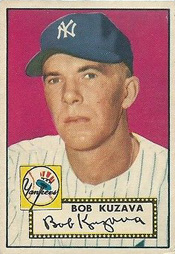
Seeking a left-handed reliever to help their pennant push, the Cardinals got Bob Kuzava, a proven producer under postseason pressure. The price, though, was steep: To open a roster spot for Kuzava, the Cardinals cut loose a future Hall of Fame pitcher.

With nine games left in the 1957 season, the second-place Cardinals, in pursuit of the Braves, were without a left-hander in their bullpen. On Sept. 19, general manager Frank Lane filled the need, acquiring the contract of Kuzava, 34, from the Pirates.
With their roster at the limit, the Cardinals needed to remove a player to create a spot for Kuzava. They opted to send Hoyt Wilhelm to the Indians for the waiver price.

Wilhelm went on to pitch in 1,070 big-league games and became the first reliever to be inducted into the National Baseball Hall of Fame.

Kuzava pitched in three games for the 1957 Cardinals, who lost six of their last nine and finished eight behind the pennant-winning Braves.

A World Series standout with the Yankees, Kuzava never got a chance to pitch in the postseason for the Cardinals.

Series star

Kuzava made his major-league debut with the 1946 Indians and also pitched for the White Sox and Senators before being dealt to the Yankees in June 1951.

In Game 6 of the 1951 World Series, the Yankees led the Giants, 4-1, entering the ninth inning at Yankee Stadium. Johnny Sain, in his second inning in relief of starter Vic Raschi, yielded singles to the first three Giants batters. Yankees manager Casey Stengel called on Kuzava to end the threat.

Kuzava retired all three batters he faced, earning the save in the Yankees’ 4-3 championship clincher. Boxscore

A year later, Kuzava did it again. In Game 7 of the 1952 World Series at Brooklyn, the Yankees led, 4-2, but the Dodgers loaded the bases with one out in the seventh. Stengel brought in Kuzava to relieve Raschi. Kuzava got Duke Snider to pop out to third and Jackie Robinson to pop out to second. Kuzava held the Dodgers scoreless in the eighth and ninth, sealing the championship for the Yankees. Boxscore

Placed on waivers by the Yankees in August 1954, Kuzava went on to pitch for the Orioles and Phillies. He opened the 1957 season with the Pirates, but was sent to their Class AAA farm club, the Columbus (Ohio) Jets, in May.

Comeback in Columbus

Used primarily as a starter, Kuzava won his first six decisions with Columbus. The highlight occurred on July 20 when he pitched a one-hitter against Richmond. Kuzava retired the first 17 batters before yielding a ground single by pitcher Marty Kutyna in the sixth.

In August, Kuzava was sidelined because of elbow trouble. Still, he won two of his last three decisions and finished the minor-league season with an 8-1 record and 3.41 ERA in 20 appearances.

Cardinals manager Fred Hutchinson wanted a left-handed reliever. The staff’s lone left-hander was starter Vinegar Bend Mizell.

“We’ve been unable to jockey against tough left-handed hitters who don’t like southpaws,” Hutchinson said to the St. Louis Post-Dispatch.

Columbus general manager Harold Cooper, who had been trying to interest the Reds in Kuzava, was glad to make a deal with the Cardinals.

(A day after acquiring Kuzava, the Cardinals obtained another left-handed reliever, Morrie Martin, from the Class AAA Vancouver Mounties, an Orioles farm club, for outfielder Eddie Miksis.)

Too little, too late

The Cardinals had three games remaining with each of three foes: Reds, Braves and Cubs. Figuring the Cardinals needed to win nearly all nine to have a chance to overtake the Braves, Hutchinson wanted left-handers to use against sluggers such as Ted Kluszewski of the Reds and Eddie Mathews and Wes Covington of the Braves.

The Cardinals won two of three against the Reds at Cincinnati and went to Milwaukee five games behind the Braves with six to play. The Braves clinched the pennant by beating the Cardinals in the series opener, 4-2, on Hank Aaron’s two-run home run off Billy Muffett in the 11th inning.

Kuzava appeared in three games _ one against the Reds and two versus the Cubs _ for the Cardinals and posted a 3.86 ERA in 2.1 innings pitched. Left-handed batters were 0-for-3 with a walk against him. Right-handed batters were 4-for-8 with a walk.

After the season, the Cardinals assigned Kuzava to the minors, but promised he would be given a chance to make the St. Louis staff in spring training.

Kuzava got his chance, but pitched poorly for the Cardinals in spring training in 1958.

On March 11, he yielded four runs in three innings against the Athletics. On March 25, he gave up six runs to the Dodgers in the ninth inning. “It was dangerous all over the field the way they were bombarding Kuzava,” the Post-Dispatch reported.

Kuzava, 35, spent the 1958 season with the Cardinals’ Class AAA Rochester Red Wings club on a staff that included 22-year-old Bob Gibson. Kuzava was 5-3 with a 3.31 ERA in 25 games.

Kuzava finished his playing career in the White Sox farm system in 1959 and 1960.

Previously: How Hoyt Wilhelm got traded to Cardinals

Read Full Post »

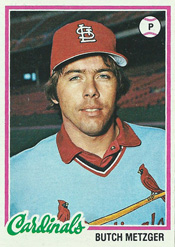
When the Cardinals acquired Butch Metzger from the Padres, they hardly could believe their good fortune. Metzger, a relief pitcher, was just turning 25, not yet at his prime, and a few months earlier he had won the National League Rookie of the Year Award.

To many, it appeared the Cardinals had secured their closer for the next several years.
What the Cardinals didn’t know was that Metzger’s pitching career had peaked and was headed toward a rapid decline.

On May 17, 1977, the Cardinals traded pitcher John D’Acquisto and minor-league infielder Pat Scanlon to the Padres for Metzger.

“We felt we needed another man, a right-hander, in the bullpen and this is the type fellow we’ve been trying to acquire,” Cardinals manager Vern Rapp said to the St. Louis Post-Dispatch.

Hot streak

Metzger had won his first 12 major-league decisions. He earned a win with the 1974 Giants and a win with the 1975 Padres, but still had his rookie status with the 1976 Padres.

Under first-year pitching coach Roger Craig, who had played for the 1964 World Series champion Cardinals, Metzger became the Padres closer in 1976. He won his first 10 decisions and finished with an 11-4 record, 16 saves and a 2.92 ERA. He made 77 appearances and pitched 123.1 innings.

Metzger and Reds pitcher Pat Zachry were named co-winners of the 1976 NL Rookie of the Year Award. Each received 11 votes in balloting by the Baseball Writers Association of America, resulting in a tie for the first time in the 25-year history of the award.

“I felt I could pitch in the big leagues if I got the chance,” Metzger told The Sporting News. “I honestly didn’t expect to do as well as I did.”

Still, when Rollie Fingers, the closer who helped the Athletics to three consecutive World Series championships (1972-74), became a free agent after the 1976 season, the Padres signed him.

Opportunity knocks

Fingers figured to be the Padres’ closer in 1977, but Metzger erased any suspense with a poor spring training record, yielding 20 earned runs in 15.2 innings.

Meanwhile, the 1977 Cardinals were looking to upgrade their bullpen. Their closer, Al Hrabosky, was clashing with Rapp and their top right-handed reliever, Clay Carroll, had turned 36.

The Cardinals had approached the Padres about Metzger during the winter meetings in December 1976 and they continued their pursuit in 1977.

“Since they have Rollie Fingers now, we thought this might be a time they could spare him,” Cardinals general manager Bing Devine said of Metzger.

When Metzger got off to a poor start in 1977 _ four saves but a 5.56 ERA _ the Padres relented, dealing him five days before his 25th birthday.

“He’s been in and out, good outings and bad outings,” said Padres manager John McNamara. “We’ve had a hard time putting our finger on anything. There’s nothing wrong with his arm.”

Said Metzger: “Maybe I didn’t have things in my head right because I knew they’d gotten Fingers and he was one of the best.”

Steady work

After a good May with the Cardinals (1-0, 2.00 ERA in five appearances), Metzger had an inconsistent June (3.75 ERA, no saves in 16 games).

He found his groove late in July. In a stretch from July 25 to Aug. 13, Metzger was 3-0 with six saves and lowered his Cardinals ERA from 3.06 to 2.32.

“Now he’s showing good velocity,” Cardinals catcher Ted Simmons said. “Now I can see how he won 11 games in relief last year.”

Said Metzger: “I finally got my live, high fastball going again.”

Metzger finished with a 4-2 record, seven saves and a 3.11 ERA in 58 games for the 1977 Cardinals.

Overall, Metzger appeared in 75 games and pitched 115.1 innings combined for the Padres and Cardinals in 1977.

Foul ending

The 1978 Cardinals headed to spring training with a revamped bullpen. Hrabosky and Carroll had been traded. Rawly Eastwick, acquired a month after the Cardinals got Metzger, became a free agent and departed. The Cardinals picked up relievers Mark Littell, Dave Hamilton and Aurelio Lopez. The prime bullpen holdovers were Metzger and Buddy Schultz.

Metzger appeared headed for a right-handed setup role _ with Littell the closer _ but a poor spring training (0-2 and 6.35 ERA in eight appearances) altered the outlook.

On April 5, two days before the Cardinals opened the 1978 regular season, Metzger was placed on waivers and claimed by the Mets.

“I smelled something fishy a couple of days ago when I wasn’t pitching,” Metzger said. “Sometimes in spring training they judge you on one or two innings, which is ridiculous.”

Said Cardinals pitching coach Claude Osteen: “He just never seemed to make any adjustment with us. He had a good arm, but he just never showed any consistency.”

In 25 games for the 1978 Mets, Metzger was 1-3 with a 6.51 ERA. He was sent to the Phillies in July and never appeared in the major leagues again.

Previously: How Buddy Schultz found a home with Cardinals

Read Full Post »

(Updated April 18, 2020)

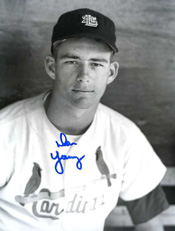
Don Young began his professional baseball career in the Cardinals system, played for George Kissell, departed and was brought back by Stan Musial.

Though he had two stints in the Cardinals organization, Young never played for St. Louis.
Instead, he played for the Cubs, made his debut in a legendary game and became a central character in one of their most notorious defeats.

Teen hopeful

Young was 17 when he signed with the Cardinals as an amateur free agent out of Aurora High School in Colorado in June 1963.

An outfielder, he was assigned to a Class A club in Brunswick, Ga., managed by Kissell, the respected instructor. Young batted .280 in 16 games for Brunswick and was sent to another Cardinals Class A team in Billings, Mont., where he hit .257 in 58 games.

After spring training in 1964, Young was placed on waivers, claimed by the Cubs and began to re-establish himself. In 1965, Young batted .273 with 25 doubles and 16 home runs for the Class AA Dallas-Fort Worth Spurs.

At 19, he was rewarded with a promotion to the Cubs in September 1965.

Big-league welcome

Young made his major-league debut as the starting center fielder and leadoff batter for the Cubs in Los Angeles against the Dodgers on Sept. 9.

The Dodgers pitcher that night: Sandy Koufax.

The result: a perfect game.

Koufax retired 27 batters in a row and struck out 14. Young popped out twice and struck out. The Dodgers, held to one hit by Cubs starter Bob Hendley, won, 1-0. Boxscore

The next night, in San Francisco, Young, described by the Chicago Tribune as “perhaps the Cubs’ top outfield farm prospect,” got his first big-league hit, a solo home run off the Giants’ Ron Herbel. Boxscore

Lou Klein, Cubs manager and former Cardinals infielder, started Young in five games versus the Dodgers and Giants, drawing criticism from Braves manager Bobby Bragan for using a rookie in the pennant stretch against contenders.

Overmatched, Young batted .057 (2-for-35) in his September stint with the Cubs.

Musial maneuvers

Young was back in the minor leagues in 1966 and 1967.

Meanwhile, the Cardinals were trying to figure out what to do with Ted Savage.

Savage, acquired by the Cardinals from the Pirates after the 1964 season, spent most of the next two years in the minor leagues.

After Musial became Cardinals general manager in January 1967, he promised Savage he would try to keep him in the major leagues.

Savage earned a spot as a utility player on the Opening Day roster of the 1967 Cardinals, but seldom played. In May, Savage was ticketed for a return to the minors, but indicated he wouldn’t report, according to the St. Louis Post-Dispatch.

Determined to fulfill his vow, Musial looked for a big-league team for Savage.

Brief return

On May 13, 1967, the Cardinals traded Savage and outfielder John Kindl to the Cubs for Young and catcher Jim Procopio.

The Chicago Tribune noted Young was “once rated a potential Cubs center fielder” but “still was struggling in the minors.”

The Cardinals assigned Young to their Class AAA Tulsa team. Young played in 12 games for manager Warren Spahn, batted .147 and was sent back to the Cubs on Aug. 1, 1967.

Young spent the 1968 season with the Lodi (Calif.) Crushers, a Class A club.

Though he wasn’t on their 40-man roster, the Cubs invited Young, 23, to attend their 1969 spring training camp. It was there he received an unexpected opportunity.

Rebuilding project

Adolfo Phillips, projected to be the starting center fielder for the 1969 Cubs, broke his hand at spring training. Cubs manager Leo Durocher considered giving the job to a prospect, Oscar Gamble, but the 19-year-old had only a year of minor-league experience.

With his options limited, Durocher turned to Young.

Young “conceivably could be ready for the big time,” Jerome Holtzman of The Sporting News wrote.

“He hasn’t been a strong hitter,” Holtzman opined. “He is, however, a beautiful center fielder … and could very well become a Gold Glove winner _ if he can hit enough to stay.”

Young worked with Klein, his former manager who had become a batting instructor, and Cubs coach Pete Reiser on his hitting. Durocher also wanted Young to become more aggressive.

“He could have a great future, but it’s up to him,” Durocher said. “I can’t do it for him. I don’t care what he hits. I want to see more enthusiasm from him.”

Blame game

Young was the Opening Day center fielder for the 1969 Cubs.

The Cubs won 11 of their first 12 games and Durocher stayed with Young. In June, Phillips was traded to the Expos, solidifying Young’s hold on the job.

On July 8, 1969, the first-place Cubs opened a key series with the second-place Mets at New York.

The Cubs led, 3-1, in the ninth inning of the opener, but the Mets rallied for a 4-3 victory when Young was unable to catch two fly balls that fell for doubles. Cubs third baseman Ron Santo blamed the loss on Young. Boxscore

“He was just thinking of himself,” Santo said. “He had a bad day at the bat, so he’s got his head down. He is worrying about his batting average and not the team … He can keep his head down and he can keep right on going, out of sight, for all I care.”

The next day, Santo apologized: “What I said about Donnie, I didn’t mean. I said it because I was upset.”

In his book, “Thanks for Listening,” Cubs broadcaster Jack Brickhouse said later in the day, “I was sitting on the team bus waiting to go to the park. I was sitting behind Young. Santo got on and sat on the armrest of Young’s seat and put his arm around the kid and apologized once more.”

The damage, though, was done. When the Cubs returned to Chicago, Santo was booed at Wrigley Field. The Mets eventually surged ahead of the crumbling Cubs, clinched the division title and went on to win the National League pennant and World Series crown.

“Let’s face it,” Brickhouse said in his book, “the Cubs were a ragtag team in the stretch, wandering aimlessly, with assorted regulars physically exhausted as the result of failure to get a day off here and there when their lead was commanding.”

“That had to be Leo’s responsibility,” Brickhouse said of Durocher, “and he added fuel to the fire with the tensions he created by nitpicking controversies with certain of his players and certain members of the media.”

Young finished the 1969 season, his last in the big leagues, with a .239 batting average in 101 games.

Read Full Post »

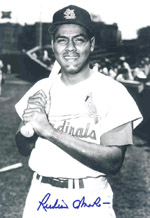
Desperate for a quality shortstop, the Cardinals turned to Ruben Amaro and gave him his first opportunity to play in the major leagues. Amaro fielded splendidly but didn’t hit well enough and the Cardinals quickly gave up on him.

Amaro played one season for the Cardinals. Traded to the Phillies after the 1958 season, he went on to have a long career as a player, coach and scout.

Though Amaro’s time with the Cardinals was relatively short, it covered a lot of ground, beginning in Mexico and ending in Japan.

Career choice

Born in Mexico in 1936, Amaro was the son of Santos Amaro, a powerful hitter who played baseball in Cuba in winter and in Mexico in summer.

As a teen-ager, Ruben Amaro caught the attention of the Cardinals when he played for the Mexican team in the Central American Games. The Cardinals offered him a contract in 1954.

At the time, Amaro, 18, was considering a career in engineering and his older brother, Mario, wanted to be a doctor, the St. Louis Post-Dispatch reported. Amaro saw baseball as a way to help pay for his brother’s education.

“All the time my father played baseball, he didn’t make much money,” Amaro told Jack Rice of the Post-Dispatch. “Maybe I can. I play baseball, Mario goes to medical school.”

The Cardinals sent Amaro to their Class C team in Mexicali, a city situated on the border of Mexico and the United States. Amaro played two seasons for the Mexicali Eagles, batting .285 in 1954 and .305 with 18 home runs in 1955.

Racial prejudice

Promoted to Class AA Houston in 1956, Amaro “arrived with the reputation of being one of the finest fielders in baseball. Possessing a great arm, sure hands and fine speed, Amaro has not disappointed,” The Sporting News reported.

Playing shortstop, Amaro batted .266 with 64 RBI in 1956.

The Cardinals assigned him to Houston again in 1957. When the club went to Shreveport, La., for a series in May, Amaro wasn’t allowed to play “because of the Louisiana racial law,” The Sporting News reported.

Humiliated, Amaro considered quitting but stuck with it after a talk with his father, according to a biography by the Society for American Baseball Research.

Climbing the ladder

Houston won the 1957 Texas League championship and faced Atlanta, the Southern Association champion, in the Dixie Series.

Though Amaro hit .222 during the season, he provided the key hit in the Dixie Series. His two-run home run off Don Nottebart in the seventh inning lifted Houston to a 3-1 series-clinching victory in Game 6.

In 1958, Amaro was assigned to the Class AAA Rochester Red Wings. St. Louis that season primarily started Eddie Kasko at shortstop. In July, when Kasko’s batting average dropped to .195, the Cardinals benched him and called up Amaro, even though he was batting .200 for Rochester.

Stan lends a hand

Amaro got to St. Louis on July 15 and was named a starter by manager Fred Hutchinson for that night’s game against the Braves. “His name was in the lineup card as soon as his foot was in the door,” the Post-Dispatch reported.

The newspaper cautioned that Amaro “is well known to the Cards as a strong fielder but a weak hitter. His batting is the sorrow of his father, Santos Amaro.”

Sports editor Bob Broeg suggested Amaro’s arrival to play shortstop “provides just another chapter in the club’s almost constant trouble at the key defensive position.” With the exception of Marty Marion in the 1940s, the Cardinals “rarely have known satisfaction at a post which ranks second to none in defensive importance,” Broeg wrote.

In his book “Stan Musial: An American Life,” author George Vecsey said the Cardinals issued Amaro a pair of uniform pants at least two sizes too big. When Musial saw the rookie looking awkward in the baggy uniform, he said to clubhouse attendant Butch Yatkeman, “Would you get this young man a pair of pants so he can play like a major leaguer?”

When Amaro stepped onto the Busch Stadium field for the first time, he timidly watched the Cardinals take batting practice. Musial called out to the players, “He’s playing today. Let him have some swings.”

Amaro was forever grateful to Musial for his kindness.

Good glove

At shortstop that night, Amaro went hitless in two at-bats against the Braves’ Joey Jay before being lifted for pinch-hitter Wally Moon, but his fielding impressed.

“After two easy fielding chances, his third was a hard-hit ball that made him range far toward third base and deeply,” the Post-Dispatch observed. “It is a testing place for a shortstop’s arm and he met the test well.” Boxscore

The next night, Amaro got his first big-league hit, a double off future Hall of Famer Warren Spahn. Boxscore

Amaro produced six hits in his first 18 at-bats (a .333 batting average) for the Cardinals, but struggled after that.

In 40 games, including 21 starts at shortstop, Amaro batted .224 for the 1958 Cardinals. He hit .364 (8-for-22) against left-handed pitchers and .167 (9-for-54) versus right-handers.

Strong resume

After the 1958 season, Amaro took part in a series of exhibition games the Cardinals played on a goodwill tour of Japan.

When the club returned home, Amaro was dealt to the Phillies for outfielder Chuck Essegian on Dec. 3, 1958. “I cried when they traded me,” Amaro said.

After a season in the minors, Amaro played for the Phillies from 1960-65. He won a NL Gold Glove Award in 1964. Amaro also played for the Yankees (1966-68) and Angels (1969).

After his playing career, Amaro was a scout, minor-league manager, executive and big-league coach.

His son, Ruben Amaro Jr., a Stanford University graduate, played in the big leagues for eight years (1991-98) as an outfielder with the Angels, Phillies and Indians. He was general manager of the Phillies from 2009-2015.

Read Full Post »

With his big-league career in decline, Lee Tunnell got an unexpected boost from a veteran scout and grabbed hold of an opportunity presented by the Cardinals. Six months later, Tunnell was pitching in the World Series.

During spring training in 1987, Cardinals scout Rube Walker was following the Pirates to assess whether catcher Tony Pena was a player St. Louis should acquire. While scouting Pena, Walker got to see Tunnell pitch.

Tunnell, a right-hander, was 11-6 with the Pirates in 1983, but skidded to 1-7 in 1984 and 4-10 in 1985. Tunnell spent the 1986 season in the minor leagues with Hawaii and was 4-11 with a 6.01 ERA.

“My career has been on a downhill slope, but (in 1986) it was pretty steep,” Tunnell said.

When he reported to spring training in 1987, the Pirates told Tunnell, 26, he no longer was in their plans and they would try to deal him. Tunnell handed the Pirates a list of places he’d like to pitch. St. Louis was one of those.

Scout’s honor

On April 1, 1987, the Pirates traded Pena to the Cardinals for outfielder Andy Van Slyke, catcher Mike LaValliere and pitcher Mike Dunne.

The Pirates also talked to the Cardinals about Tunnell. “We weren’t real interested in him because his record had been pretty weak,” Cardinals general manager Dal Maxvill said to the St. Louis Post-Dispatch.

Maxvill had a change of heart when he talked with Walker, a former pitching coach with the Mets and Braves. Walker told Maxvill that Tunnell had an effective fastball and breaking pitch. After reading Walker’s scouting report, Maxvill met with Lee Thomas, director of player development for the Cardinals. “We talked it over again and decided to go for him,” Maxvill said.

On April 6, 1987, the Cardinals purchased Tunnell’s contract from the Pirates and assigned him to their Class AAA minor-league affiliate at Louisville.

Rapid rise

Pitching for Louisville manager Mike Jorgensen, Tunnell regained his form and validated Walker’s endorsement. “This was just a time in my career where I needed a new start with somebody else,” said Tunnell. In six starts for Louisville, Tunnell was 4-1 with a 3.41 ERA.

On May 15, 1987, the Cardinals placed outfielder Jim Lindeman on the disabled list and called up Tunnell. Two days later, Tunnell got a start against the Reds in place of Joe Magrane, who had sprained an ankle.

The May 17 game between the Reds and Cardinals at St. Louis was a matchup of pitchers seeking to revive their careers. Starting for the Reds was Jerry Reuss, 37, a St. Louis native and former Cardinal who had joined the Reds after being released by the Dodgers.

Pitching in a big-league game for the first time in two years, Tunnell held the Reds to two runs in seven innings and got the win. Tunnell also singled and drove in a run in a 10-2 Cardinals victory. Reuss yielded 10 hits, two walks and seven runs in 4.2 innings. Boxscore

Tom Pagnozzi, who caught Tunnell’s gem and contributed a grand slam off reliever Guy Hoffman, said of the Cardinals starter, “His fastball was running in and out. He had a good slider and an outstanding curveball. He kept it down all game and they kept swinging and missing.”

Pena, watching from the Cardinals bench while on the disabled list, said of his former Pirates teammate: “He pitched today like he did in 1983. The Pirates lost confidence in him and then he lost his confidence. Sometimes it’s good to make a change. It was the right move and he’s excited about being here.”

Tunnell won three of his first four decisions with the Cardinals.

Big stage

In August 1987, he was placed on the 15-day disabled list because of a shoulder ailment. “Anytime I put effort into my fastball, it felt like my shoulder was coming out of its socket,” Tunnell said.

The rest enabled Tunnell to regain strength in the shoulder. On Aug. 29, he pitched effectively in a rehabilitation start for Class A Springfield, Ill. Three days later, he was reactivated by the Cardinals.

Utilized as a reliever, Tunnell pitched 8.2 scoreless innings in eight September appearances for the Cardinals, helping them clinch the National League East title.

His regular-season record: 4-4 with a 4.84 ERA.

For the NL Championship Series versus the Giants, Cardinals manager Whitey Herzog opted to keep eight pitchers on the postseason roster, leaving no room for Tunnell.

After the Cardinals won the pennant, Herzog determined injured first baseman Jack Clark wouldn’t be able to play in the World Series against the Twins, so he replaced Clark on the roster with Tunnell.

Tunnell appeared in relief in two World Series games, posting a 2.08 ERA in 4.1 innings.

In 1988, Tunnell spent the season at Louisville and was 6-8 with a 3.86 ERA. The Cardinals released him in October 1988.

Previously: Cardinals deal for Tony Pena not as lopsided as thought

Read Full Post »

The first trade made by Stan Musial as general manager brought the Cardinals the infield insurance they needed.

Seeking a player who could fill in for shortstop Dal Maxvill and provide late-inning defensive help at third base for converted outfielder Mike Shannon, Musial turned to a friend, Bing Devine.

Devine, president of the Mets, had been general manager of the Cardinals from 1957 until replaced by Bob Howsam in 1964. Musial succeeded Howsam in January 1967.

On April 1, 1967, the Cardinals acquired infielder Eddie Bressoud, outfielder Danny Napoleon and cash from the Mets for second baseman Jerry Buchek, pitcher Art Mahaffey and infielder Tony Martinez.

Bressoud capped his playing career by earning a World Series ring with the Cardinals.

Roster shuffles

The 1967 Cardinals entered spring training with no reliable backup at shortstop. The options were Buchek, Phil Gagliano and Jimy Williams.

Gagliano had big-league experience, but his best position was second base. Williams was a prospect but had played only 13 games in the majors.

Buchek had been the Opening Day shortstop for the 1966 Cardinals, but his fielding was erratic _ “He just doesn’t cover the ground, field cleanly enough or throw accurately at shortstop,” Bob Broeg wrote in the St. Louis Post-Dispatch _ and by June that year Maxvill regained the starting role.

Buchek seemed best equipped for second base, but the Cardinals had Gagliano to back up starter Julian Javier.

Meanwhile, the 1967 Mets entered spring training with a plan to platoon Bressoud and Chuck Hiller at second base. Bressoud started 110 games for the 1966 Mets: 73 starts at shortstop, 24 at third base, eight at second base and five at first base. “He’s one of the nicest gentlemen you’ll ever meet,” Mets manager Wes Westrum said to The Sporting News. “He’s done everything ever asked of him.”

Devine decided the Mets should have a starter younger than either Bressoud, 34, or Hiller, 32, at second base to pair with shortstop Bud Harrelson, 22.

Buchek, 24, seemed a promising candidate.

Betting on potential

Buchek, a graduate of McKinley High School in St. Louis, received a $65,000 bonus when he signed with the Cardinals as an amateur free agent in 1959. He had a breakout season as starting shortstop for the Cardinals’ Class AAA Atlanta Crackers in 1963, batting .287 with 33 doubles and 92 RBI.

However, in parts of five seasons (1961 and 1963-66) with the Cardinals, Buchek batted .221 and had more strikeouts (158) than hits (127). Devine thought a fresh start with another organization would help Buchek and he knew the Cardinals needed a player like Bressoud.

Bressoud debuted in the big leagues as a shortstop with the 1956 Giants and formed a keystone combination with their second baseman, Red Schoendienst. Two years later, in 1958, Bressoud’s wife Eleanor, 25, died of a brain tumor, leaving him with two sons ages 2 and 3. A year later, Bressoud remarried.

During the baseball off-seasons, Bressoud pursued his education. He earned a bachelor’s degree from UCLA and a master’s in physical education from San Jose State. He supplemented his income by teaching at high schools in the winter.

Acquired by the Red Sox in November 1961, Bressoud hit 40 doubles and 14 home runs for Boston in 1962, 20 home runs in 1963 and 41 doubles and 15 home runs in his lone all-star season, 1964.

With the 1966 Mets, Bressoud batted .225 in 133 games.

New homes

During a March 30, 1967, spring training game between the Mets and Cardinals, Musial and Devine sat together and discussed their rosters. Two days later, the trade was announced.

“Bressoud has a good arm and he gets rid of the ball well. He’s what we really needed, a proven utilityman who can fill in for Maxvill,” said Schoendienst, the Cardinals’ manager.

Buchek, happy to get a chance to be a Mets starter, said, “It would have been another wasted year with the Cardinals.”

With Maxvill providing steady play at shortstop and Shannon driving in runs as the third baseman, Bressoud didn’t play often for the 1967 Cardinals. He went hitless in his first 23 at-bats before getting a single off the Astros’ Larry Dierker.

“It’s been tough,” Bressoud said. “You replay every at-bat. You go home and punish yourself. You try to put up a false front, but if something like this doesn’t bother you, you don’t belong in the game.”

Bressoud hit his only Cardinals home run on Aug. 9 against Don Drysdale of the Dodgers.

Mostly, though, Bressoud served as a sort of player-coach.

“Eddie had some good ideas for me on playing shortstop _ and for playing second base, too,” Maxvill said. “Eddie knew how to play certain hitters and he had me make adjustments.”

Said Cardinals pitcher Bob Gibson: “Eddie Bressoud has a good arm and he’s quick. He gets in front of a lot of balls that other infielders don’t even get to, but he’s not sharp enough at times because he doesn’t play enough.”

Bressoud played in 52 regular-season games, making 18 starts at shortstop, for the 1967 Cardinals and batted .134 (9-for-67). He appeared in two World Series games as a defensive replacement.

In the book “The Original San Francisco Giants,” Bressoud said, ‘Even though I enjoy wearing my World Series championship ring, I don’t think of myself particularly as a Cardinal when I look back on my career.”

After the World Series, Bressoud retired as a player and became head baseball coach at De Anza College in Cupertino, Calif. He also was a scout for the Angels.

Previously: Mike Shannon and the spring training intrigue of 1967

Read Full Post »

« Newer Posts - Older Posts »