Feeds:
Posts
Comments

Archive for the ‘Trades’ Category

Looking to rebuild his reputation, Dave LaPoint returned to the organization where he felt the most comfortable and had enjoyed his greatest success.
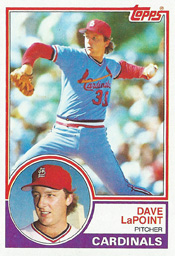
dave_lapointOn Jan. 19, 1987, LaPoint, a free agent, signed with the Cardinals, who expected him to compete for a spot in their starting rotation.

At 27, his career was at a crossroads.

Five years earlier, LaPoint, a left-hander, helped the Cardinals win the 1982 National League pennant and World Series championship.

After the Cardinals traded him in February 1985, LaPoint’s career spiraled. He pitched for three teams in two years, posting losing records at each stop, got traded twice and released once.

Out of shape and labeled a clubhouse jester, LaPoint said he was committed to rededicating himself to becoming a winner and was seeking a nurturing environment in which to attempt that comeback.

The 1987 Cardinals and manager Whitey Herzog provided the setting LaPoint sought.

Cards contributor

LaPoint’s tenure with the Cardinals began in December 1980 when he was acquired from the Brewers in a deal engineered by Herzog. The Cardinals traded Rollie Fingers, Ted Simmons and Pete Vuckovich for Sixto Lezcano, David Green, Lary Sorensen and LaPoint.

LaPoint’s breakthrough year was 1982. He began the season as a reliever and joined the starting rotation in May. LaPoint appeared in 42 games, including 21 as a starter, for the 1982 Cardinals and had a 9-3 record and 3.42 ERA. He started Game 4 of the 1982 World Series against the Brewers, yielded one earned run in 6.1 innings and got no decision in a 7-5 Milwaukee victory.

LaPoint earned 12 wins for the Cardinals in both 1983 and 1984.

When the Cardinals, seeking a run producer to replace George Hendrick, had a chance to get Jack Clark before the start of the 1985 season, they sent LaPoint, Green, Jose Uribe and Gary Rajsich to the Giants.

Rick Hummel of the St. Louis Post-Dispatch later reported the Cardinals parted with LaPoint because they “thought he might be influencing young players unduly.”

Hummel described LaPoint as a “leader in clubhouse revelry” and “a top consumer of the owner’s (Anheuser-Busch’s) product.”

Prodigal son

LaPoint had a 7-17 record for the 1985 Giants, who traded him to the Tigers after the season.

LaPoint and Tigers manager Sparky Anderson were a bad match. “I couldn’t get along with Sparky,” LaPoint said. After posting a 3-6 record and 5.72 ERA for the Tigers, LaPoint was traded to the Padres in July 1986. He was 1-4 for the Padres, who released him after the season.

LaPoint decided to make changes. Weighing between 230 and 240 pounds, he dropped to 220.

The Expos and Giants wanted to sign LaPoint, but he chose the Cardinals, whose offer of a base salary of $125,000 was a cut from his $550,000 contract in 1986.

“It feels finally that I’m back where I belong,” LaPoint said. “… In talking to Whitey, he said he would use me like he did in ’82. That’s fine with me. It got me a World Series ring.”

Asked his reaction to LaPoint rejoining the Cardinals, center fielder Willie McGee said, “I like him … He’s kind of a clown, but that’s Dave LaPoint.”

It’s a reputation LaPoint said he was determined to change.

“I used to mess around during drills and I don’t do that anymore,” LaPoint said after reporting to Cardinals camp. “… It was time to put a stop to it.”

Redbird reliever

LaPoint had a successful spring training. He was 2-0 with a 2.34 ERA in 15.1 innings pitched in Grapefruit League exhibition games.

The Cardinals opened the 1987 regular season with five left-handers: starters John Tudor and Greg Mathews and relievers Ricky Horton, Pat Perry and LaPoint. (Ken Dayley, another left-handed reliever, was on the disabled list.)

In his first appearance for the 1987 Cardinals, on April 10 against the Pirates at Pittsburgh, LaPoint took the loss when he yielded a RBI-double to Sid Bream in the bottom of the ninth. Boxscore

LaPoint was scheduled to make a start April 25, 1987, versus the Mets at New York, but that plan was scratched when the Cardinals called up Joe Magrane from the minors and put the rookie left-hander into the rotation.

LaPoint remained in the bullpen and largely was ineffective.

He got a win on April 18, 1987, against the Mets at St. Louis, but didn’t perform well. In the 10th, LaPoint threw a wild pitch, enabling Al Pedrique to score from third with the go-ahead run. LaPoint was rescued when the Cardinals scored five times off Jesse Orosco in the bottom half of the inning. Tom Pagnozzi’s RBI-single tied the score at 8-8 and Tommy Herr’s grand slam made LaPoint the winner. Boxscore

On the road again

With his ERA at 6.75 after four relief appearances, LaPoint was demoted to Louisville on April 27, 1987. LaPoint had the option of declaring himself a free agent, but agreed to return to the minor leagues for the first time since 1981.

Placed in the starting rotation by Louisville manager Dave Bialas, LaPoint lost his first three decisions, but found his groove. He completed four of his last five starts for Louisville and had a 5-5 record when he was recalled by the Cardinals on July 8, 1987.

“It was the best thing in the world for me,” LaPoint said of his stint in the minors. “… I’ve learned to pitch a little different style.”

LaPoint made two July starts for the Cardinals and got no decision in either.

On July 30, 1987, the Cardinals traded LaPoint to the White Sox for minor-league pitcher Bryce Hulstrom.

“LaPoint’s main problem has been control,” the Post-Dispatch reported. “If he gets the ball up, he gets hammered. It usually takes him a couple of innings to find the strike zone and by then the game usually is out of control.”

After posting a 1-1 record and 6.75 ERA for the 1987 Cardinals, LaPoint was 6-3 with a 2.94 ERA for the 1987 White Sox.

The Cardinals, helped by a combined 30 wins from left-handed starters Mathews, Tudor and Magrane, finished 95-67 and won the pennant.

Previously: Trade for Jack Clark shook Cards from their slumber

Read Full Post »

Three days after making his major-league debut with his hometown team, infielder Bob Sadowski was traded by the Cardinals for a player they thought could challenge Curt Flood for the center field job.

robert_sadowskiThe deal sent Sadowski on an odyssey during which he played for three big-league clubs in the next three years before returning to the minors, including a second stint in the Cardinals system.
Talented infielder

Born and raised in St. Louis, Sadowski played baseball at Webster Groves High School and with the Maplewood American Legion team. A teammate on both clubs was future Cardinals outfielder Charlie James.

In 1955, when Sadowski was 18, he impressed the Cardinals at a tryout camp and they signed him to a contract.

A left-handed batter who could play multiple positions, especially third base and second base, Sadowski established himself as a prime prospect with a strong season for the Billings Mustangs of the Class C Pioneer League in 1957. Sadowski batted .302 and produced 20 doubles, 13 triples and 15 home runs for Billings.

Sadowski caught the attention of the Cardinals again in 1959 when he batted .290 with 24 doubles and 12 triples for Omaha of the Class AAA American Association.

Omaha manager Joe Schultz tabbed Sadowski as a player with a bright future. The Sporting News declared him “a talented infielder.” After the 1959 season, the Cardinals put Sadowski on their big-league roster.

Cardinals call

At Cardinals spring training camp in 1960, Sadowski developed astigmatism, making objects at a distance appear blurry or wavy, and eyeglasses were prescribed for him, The Sporting News reported.

He opened the 1960 season with the Cardinals’ affiliate at Rochester in the Class AAA International League. Batting .223 after 51 games, Sadowski was loaned to the White Sox Class AAA farm club in San Diego. He revived his career with the Pacific Coast League team, batting .340 in 64 games.

Impressed, the Cardinals promoted Sadowski to the big leagues in September 1960.

Debut at home

On Sept. 16, 1960, a Friday night at Busch Stadium in St. Louis, Sadowski, 23, lived a dream by making his major-league debut for the Cardinals.

After five innings, in a game delayed an hour and 32 minutes by rain, the Giants led, 6-0. Cardinals manager Solly Hemus made several substitutions, including putting in Sadowski at second base to replace Julian Javier.

Sadowski led off the St. Louis half of the sixth against reliever Stu Miller, formerly of the Cardinals, and grounded out to third baseman Jim Davenport.

In the eighth, Orlando Cepeda reached on an error by Sadowski. In the Cardinals’ half of the inning, Sadowski reached on a walk. He was stranded when Miller struck out Bill White and got Stan Musial and Ken Boyer on pop-outs. Boxscore

That one game would be Sadowski’s lone appearance with the Cardinals.

Trade bait

With Javier at second and Boyer at third, the Cardinals were strong in the two positions Sadowski played best. What the Cardinals thought they needed was to bolster the center field position. Flood, the everyday center fielder, hit .237 for the 1960 Cardinals. Hemus was seeking better production from that position.

On Sept. 19, 1960, the Cardinals acquired center fielder Don Landrum from the Phillies for Sadowski and four players on their Rochester roster _ outfielder Jim Frey, second baseman Wally Shannon, infielder Billy Harrell and pitcher Dick Ricketts.

Landrum, 24, had spent the 1960 season with the Phillies’ Class AAA farm club at Buffalo, where he batted .292 and led the International League in hits (178), doubles (35) and runs scored (112).

The Sporting News praised Landrum as being “a capable fly chaser who can also swing the bat.”

On the day of the trade, Landrum joined the Cardinals in time for their game that night against the Dodgers at St. Louis. He produced three singles and a stolen base. Two nights later, Landrum hit a home run and a triple off the Dodgers’ Don Drysdale.

Versatile prospect

Like the Cardinals, the Phillies had an established starter at second base in Tony Taylor. Sadowski was acquired to be a backup.

Under the headline “Phils Bolster Infield, Land Keystone Kid,” The Sporting News reported: “Because of his versatility, it is possible Sadowski might land a utility infield spot” with the 1961 Phillies.

Sadowski batted .130 in 16 games for the 1961 Phillies. He was traded to the White Sox after the season and hit .231 with six home runs for them in 79 games in 1962. Selected by the Angels in the Rule 5 draft, Sadowski hit .250 in 88 games for them in 1963.

Back where he began

Sadowski spent the rest of his playing days in the minor leagues. After starting the 1968 season with the Syracuse Chiefs, Sadowski rejoined the Cardinals’ organization and was assigned to the Class AAA Tulsa Oilers of the Pacific Coast League.

Playing for manager Warren Spahn, Sadowski, 31, filled a utility role and helped Tulsa to the league championship. “Sadowski’s hitting perked up the Oilers, especially over short stretches,” The Sporting News noted.

In 1969, his last season in organized baseball, Sadowski returned to the Angels’ organization as an infielder for the Class AA El Paso Sun Kings, who were managed by former Cardinals catcher Del Rice.

The Cardinals reacquired Sadowski in June 1969 and he finished the season with Class AA Arkansas and Class A Cedar Rapids.


Read Full Post »

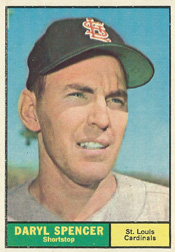
As a youth in Kansas, Daryl Spencer was a Cardinals fan. His favorite player was Marty Marion, the shortstop on four pennant-winning 1940s Cardinals teams.

daryl_spencerSpencer followed in the footsteps of his boyhood idol, becoming Cardinals shortstop in 1960. Unlike Marion, Spencer was a power hitter.
Though his tenure with the Cardinals was short _ he played all of the 1960 season and part of 1961 _ Spencer was a prominent member of a lineup that also had Stan Musial, Ken Boyer, Curt Flood and Bill White.

Joining Giants

Spencer hailed from Wichita, Kan. “I was a Cardinals fan growing up and we’d listen to them on the radio,” Spencer told the Society for American Baseball Research. “… My dad went to the World Series there in 1942 and had brought back some memorabilia for me that I really treasured.”

Inspired by Marion, who in 1944 became the first shortstop to win a National League Most Valuable Player Award, Spencer pursued a baseball career.

The Cardinals scouted Spencer, but it was the Giants who signed him after he’d had a successful season for the Pauls Valley Raiders, an independent team in the Class D Sooner State League in 1949.

Spencer made his big-league debut with the Giants in 1952 and hit 20 home runs for them in 1953. After two years (1954-55) in the military, Spencer was the Giants’ shortstop from 1956-58. He produced 17 home runs and 74 RBI for the 1958 Giants, but also committed the most errors (32) among NL shortstops.

In 1959, Spencer got shifted to second base, though he preferred shortstop.

Ready to deal

The 1959 Cardinals finished next-to-last in the NL at 71-83. They ranked seventh in runs scored (641) and sixth in home runs (118).

Determined to add power _ Boyer was the only 1959 Cardinals player to hit 20 home runs _ general manager Bing Devine offered second baseman Don Blasingame and pitcher Larry Jackson to the Giants for Spencer and pitcher Johnny Antonelli, according to multiple published reports.

Loaded with power hitters (Willie Mays, Orlando Cepeda, Willie McCovey and Willie Kirkland), the Giants were seeking defense and speed. Blasingame, who led the 1959 Cardinals in hits (178) and had 15 stolen bases, appealed to the Giants, but they were unwilling to trade Antonelli, who’d earned 19 wins in 1959.

Just when it appeared an agreement wouldn’t be reached _ “The deal somehow always moved away from us,” Giants owner Horace Stoneham said to The Sporting News _ Devine made a proposal that excluded Antonelli.

On Dec. 15, 1959, the Giants traded Spencer and outfielder Leon Wagner to the Cardinals for Blasingame.

Power source

“Blasingame will help the Giants at second base defensively and give them a leadoff man,” Cardinals manager Solly Hemus said to the St. Louis Post-Dispatch. “Spencer, bigger and stronger, will give us more punch.”

Hemus said he consulted with Musial and Boyer before the Cardinals made the trade. “They liked it,” Hemus said. “They felt we definitely were getting a plus. I respect their judgment.”

Hemus said Spencer would be the Cardinals’ starting shortstop in 1960 and Alex Grammas would shift from shortstop to second base.

Though Spencer, 31, was their primary target _ “Spencer is an aggressive guy whose desire to win won’t hurt,” Hemus said _ they were delighted to get Wagner.

Wagner, 25, hit 51 home runs for the minor-league Danville (Va.) Leafs in 1956 and combined for 30 home runs with Class AAA Phoenix (17) and the Giants (13) in 1958.

The Cardinals had attempted to acquire Wagner after the 1958 season, but he “was an untouchable,” Hemus told The Sporting News.

“We tried to get him instead of Bill White (whom the Cardinals acquired in March 1959 from the Giants),” Hemus said.

Key contributor

Spencer hit 16 home runs for the 1960 Cardinals. His on-base percentage (.365) ranked among the top 10 in the NL. He produced 131 hits and a team-high 81 walks in 148 games, but he also grounded into the most double plays (15) and committed 32 errors (31 at shortstop and one at second base).

The 1960 Cardinals finished in third place at 86-68, seven games ahead of the fifth-place Giants. The Cardinals _ even without much contribution from Wagner (four home runs) _ ranked third in the league in home runs (138), but scored two fewer runs (639) than they had in 1959.

Moving on

The next year, Spencer had a spectacular start to the season. In the Cardinals’ 1961 opener against the Braves at Milwaukee, Spencer hit a 10th-inning home run off starter Warren Spahn, carrying St. Louis to a 2-1 victory. Boxscore

The Cardinals, however, stumbled thereafter and looked to rebuild.

On May 30, 1961, with their record at 18-20, the Cardinals dealt Spencer to the Dodgers for infielder Bob Lillis and outfielder Carl Warwick.

Spencer generated 33 hits and 23 walks (a .366 on-base percentage) for the 1961 Cardinals, but his batting average with runners in scoring position was .214.

In 185 games with St. Louis, Spencer batted .257 with 20 home runs and 79 RBI. He had 164 hits, 104 walks and a .365 on-base percentage.

“I had a lot of friends on the Cardinals and I liked St. Louis, but L.A. is a good club to go to,” Spencer told the Post-Dispatch.

After stints with the Dodgers and Reds, Spencer continued his playing career in Japan. In seven seasons with the Hankyu Braves, Spencer batted .275 with 152 home runs and a .379 on-base percentage.

Read Full Post »

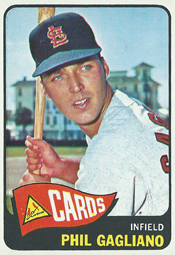
Phil Gagliano could have been involved in one of the most lopsided trades in favor of the Cardinals.

phil_gaglianoIn spring 1964, Cardinals general manager Bing Devine offered Gagliano, a second baseman, to the Cubs for outfielder Lou Brock. The Cubs were seeking a second baseman to replace Ken Hubbs, 22, who died in a plane crash in February 1964.
“The Cardinals tried to lure Brock away for Phil Gagliano,” The Sporting News reported.

Gagliano, 22, would have been a potential fit to replace Hubbs, who won the National League Rookie of the Year Award in 1962. Brock, meanwhile, had underachieved with the Cubs, but he appealed to the Cardinals, who were seeking to add speed to their lineup.

The Cubs turned down the Cardinals’ offer and instead acquired second baseman Joey Amalfitano, 30, from the Giants in a cash transaction in March 1964.

Three months later, in June 1964, the Cubs, needing pitching, agreed to deal Brock to the Cardinals for Ernie Broglio, an established starter.

The trade of Brock and pitchers Jack Spring and Paul Toth to the Cardinals for Broglio, reliever Bobby Shantz and outfielder Doug Clemens was considered a steal for the Cubs until Brock developed into a Hall of Fame player who sparked St. Louis to three National League pennants and two World Series titles.

Gagliano was a part of those Cardinals championship clubs as a utility player.

Gagliano played eight seasons (1963-70) with the Cardinals. Six years after offering Gagliano for Brock, Devine did deal him to the Cubs in May 1970.

Terrific tutors

Gagliano was a friend and teammate of Tim McCarver at Christian Brothers High School in Memphis. Scouted by former big-league player Buddy Lewis, Gagliano and McCarver signed with the Cardinals as amateur free agents in 1959.

McCarver made his big-league debut with St. Louis that year and established himself as the Cardinals’ catcher in 1963.

Gagliano debuted with the Cardinals in 1963. He could play all four infield positions and the corner outfield spots, but he fit best at second base and third base.

At the Cardinals’ Florida Instructional League camps in 1962 and 1963, Gagliano, a right-handed batter, caught the attention of instructors Joe Schultz, Eddie Stanky, Grover Resinger, Harry Walker and George Kissell.

“That’s where I learned to hit,” Gagliano told The Sporting News. “I learned to handle the bat in the Instructional League. I learned how to handle the outside pitch and I learned the strike zone there.”

Before the 1964 season, Gagliano was named by Cardinals writers as the hardest worker in spring training camp.

In May 1965, Cardinals scouting director George Silvey said, “Phil moved up faster than we expected because he always had so much poise.”

Red’s guy

Gagliano had his most productive season with the 1965 Cardinals. Filling in for starting second baseman Julian Javier, who broke his right hand in June when struck by a pitch from the Pirates’ Vern Law, Gagliano was batting .273 entering August before he tailed off. Overall, Gagliano batted .240 with eight home runs and 53 RBI in 122 games, including 48 starts at second base.

Red Schoendienst, the former second baseman who became Cardinals manager in 1965, liked Gagliano. “This kid is a tremendous player,” Schoendienst said.

Said Gagliano: “I like to hit the way Red Schoendienst wants me to. He says to go up and swing the bat _ don’t be a defensive hitter.”

New York calling

In spring 1967, Gagliano again almost was traded, and it was Devine who tried to acquire him.

The 1967 Mets were seeking a second baseman. Devine, who had been fired by the Cardinals in August 1964, was the Mets’ president. He contacted Cardinals general manager Stan Musial and inquired about Gagliano and infielder Jerry Buchek, according to The Sporting News.

“Gagliano is the man the Mets want,” The Sporting News reported. “The Cards, however, want to wait.”

On April 1, 1967, the Cardinals traded Buchek, pitcher Art Mahaffey and infielder Tony Martinez to the Mets for shortstop Eddie Bressoud, outfielder Danny Napoleon and cash.

Buchek became the Mets’ starting second baseman. Gagliano remained a valued backup to Javier at second base and to Mike Shannon at third.

Mentored by Schoendienst on fielding, Gagliano said, “I’ve been working mostly on the double play, getting my body in the proper position to throw. I had been throwing off balance too much. Red has worked hard with me and I feel I’ve improved a lot on the pivot.”

On April 11, in the Cardinals’ 1967 season opener against the Giants at St. Louis, Gagliano, replacing an ailing Shannon, hit a solo home run off Juan Marichal, supporting Bob Gibson’s shutout in a 6-0 triumph. Boxscore

Though Gagliano hit just 14 home runs _ all for St. Louis _ in 12 years in the majors, three of those came against future Hall of Famers: two off Marichal and one off Jim Bunning.

Devine intervention

Gagliano appeared in the 1967 and 1968 World Series for the Cardinals but was hitless in four at-bats.

On May 29, 1970, Devine, back for a second stint as Cardinals general manager, dealt Gagliano to the Cubs for Ted Abernathy, 37, a relief pitcher.

“It’s a shock … but I have no regrets,” Gagliano said to the St. Louis Post-Dispatch.

On May 30, 1970, Gagliano made his Cubs debut and got a two-run pinch-hit single off Dave Roberts, helping Chicago to an 8-7 victory over the Padres at Wrigley Field. Boxscore

Read Full Post »

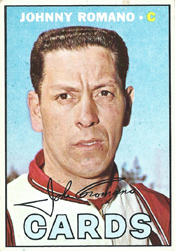
After leading American League catchers in home runs in 1966, Johnny Romano was a backup to Tim McCarver for the 1967 champion Cardinals.

johnny_romanoOn Dec. 14, 1966, the Cardinals traded pitcher Don Dennis and outfielder Walt Williams to the White Sox for Romano and pitcher Leland White.
Romano spent the entire 1967 season with the Cardinals, who won the National League pennant and World Series title, but he seldom played.

His most important contribution to the Cardinals occurred off the field: It was Romano who provided the tip that enabled Lou Brock, the Cardinals’ catalyst, to end a slump.

Catcher with clout

Romano debuted in the big leagues with the 1958 White Sox. He hit 15 or more home runs in six of seven seasons from 1960-66 with the Indians and White Sox. An American League all-star in 1961 and 1962, Romano achieved career highs in home runs (25) and RBI (81) with the 1962 Indians.

In 1966, Romano produced six home runs and 11 RBI during an eight-game White Sox winning streak from Aug. 3-12.

Asked by The Sporting News to explain his hot hitting, Romano said, “When you play every day, you feel more comfortable at the plate. Timing and confidence are the answers to batting success and you can’t have it if you don’t play.”

A right-handed batter, Romano, 32, finished the 1966 season with 15 home runs and a slugging percentage of .404. He also ranked third among American League catchers in fielding percentage at .993.

The White Sox made him available because they were grooming Duane Josephson, 24, to become their catcher. Romano also clashed with White Sox manager Eddie Stanky, who wanted him to hit behind the runner instead of swinging for the fences.

A proposed trade of Romano to the Red Sox was discussed, but the talks ended when the White Sox sought outfielder Carl Yastrzemski, The Sporting News reported.

New role

The Cardinals wanted a backup catcher who could reduce the workload of McCarver and generate offense against left-handed pitching.

McCarver, who caught in 148 games, had 19 doubles, 13 triples and 12 home runs for the 1966 Cardinals, but his batting average against left-handers (.238) was 50 points lower than against right-handers (.288). His backup, Pat Corrales, batted .181 overall and hit no home runs.

The Cardinals projected Romano as the answer to their need.

“Romano likes to hit against left-handers (.255 in 1966) and he will give McCarver a chance to rest once in a while,” Cardinals manager Red Schoendienst said.

Said Cardinals general manager Bob Howsam: “Romano should give us some right-handed power.”

Bob Broeg, in the St. Louis Post-Dispatch, concluded “the Cardinals appeared to help themselves … at no sacrifice” when they acquired Romano.

The Sporting News, however, noted Romano “understandably sounded upset when informed that he would be a No. 2 catcher.”

Tough task

At spring training in 1967, the combination of McCarver and Romano received praise.

Coach Joe Schultz said Cardinals catchers “could be the best in the league, offensively and defensively.”

Asked to rank the catching staffs in the National League, Astros manager Grady Hatton said, “I’d have to rate McCarver and Romano as No. 1.”

In its April 1, 1967, edition, The Sporting News again cautioned “Romano isn’t overly delighted with his second-fiddle rating,” but added, “It’s inconceivable that the sturdy right-handed swinger still doesn’t have some thunder left in his big bat.”

When the 1967 season got under way, Romano struggled to adapt to being a reserve. He produced two hits in his first 25 at-bats. “It’s tough when you don’t get to play often,” Romano said.

By June, Dave Ricketts took over as the primary backup catcher and Romano spent most of his time warming up pitchers in the bullpen.

Batting coach

In midseason, the Pirates offered to trade outfielder Manny Mota, catcher Jim Pagliaroni and pitcher Al McBean to the Cardinals for outfielder Curt Flood, pitcher Hal Woodeshick and Romano, but the Cardinals declined, The Sporting News reported.

In July, Brock, the Cardinals’ leadoff batter, went into a hitting funk. As the slump continued, Brock became more rigid at the plate and Romano detected the flaw. “I noticed Lou was locking his elbows before he swung and he was fouling off a lot of good pitches to left field,” Romano said. “I remind Lou every game about locking his elbows.”

Brock “applied Romano’s tip and went on a long-awaited surge,” The Sporting News reported. “Starting July 24, he went on a 24-for-56 binge, a .429 clip, and he hit safely in 13 straight games through Aug. 6.”

With Brock igniting the offense _ he generated 113 runs, 206 hits and 52 stolen bases _ the Cardinals cruised to a championship.

Romano, who batted .121 (7-for-58) with no home runs and two RBI for the 1967 Cardinals, was left off their World Series roster, but he was voted a full World Series share of $8,314.81, according to The Sporting News.

On Oct. 20, 1967, the Cardinals released Romano and he retired.

Read Full Post »

(Updated Sept. 12, 2025)

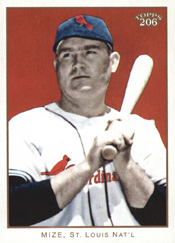
Johnny Mize, the franchise’s all-time best left-handed power hitter, practically was given away by the Cardinals after he ran afoul of management.

johnny_mize6On Dec. 11, 1941, the Cardinals traded Mize, a first baseman, to the Giants for pitcher Bill Lohrman, catcher Ken O’Dea, first baseman Johnny McCarthy and $50,000.

Though the Cardinals didn’t receive fair value for Mize _ McCarthy never played for the Cardinals, Lohrman earned one win for them and O’Dea primarily was a backup _ the deal didn’t hurt them. Buoyed by the emergence of their all-time best player, outfielder Stan Musial, the Cardinals won three consecutive National League pennants and two World Series titles from 1942-44. Meanwhile, Mize missed three prime seasons (1943-45) while serving in the Navy during World War II.

Still, trading a player who set the franchise standard for slugging by a left-handed batter and who would earn election to the National Baseball Hall of Fame remains one of the most lopsided and controversial in Cardinals lore.

Pace setter

In six years (1936-41) with the Cardinals, Mize produced a .336 batting average and a .419 on-base percentage, but what made him extra special was his power.

Mize remains the Cardinals career leader for:

_ Highest career slugging percentage (.600) by a left-handed batter. Among Cardinals, only right-handed batters Mark McGwire (.683) and Albert Pujols (.617) are ahead of him.

_ Most home runs (43) in a season by a left-handed batter. Only McGwire (70 in 1998 and 65 in 1999) and Pujols (49 in 2006, 47 in 2009 and 46 in 2004) hit more than 43 as Cardinals.

With the Cardinals, Mize also won a NL batting title (.349 in 1939), a NL RBI title (137 in 1940), two NL home run titles (28 in 1939 and 43 in 1940) and three times led the NL in slugging percentage, total bases and extra-base hits.

In the book “Few and Chosen,” seven-time National League home run champion Ralph Kiner said, “The hitter Mize most reminded me of is Stan Musial. I think of him and Musial alike, great (batting) average hitters who used the whole field.”

Bad vibes

After the 1940 season, Mize got crossways with club owner Sam Breadon and general manager Branch Rickey when he held out in a failed effort for a substantial increase to his annual salary of $16,000.

“When you hold out a couple of times against the Cardinals, you know you’re finished with the organization,” Mize told the St. Louis Star-Times. “I sensed the change in attitude toward me during the (1941) season. I was pretty certain I wouldn’t be with the club in 1942.”

Also, with the Cardinals battling the Dodgers in the pennant stretch, Mize was out of the lineup for the final 10 games of the 1941 season because of an arm injury. During his recovery, Mize watched Cardinals games from the grandstand instead of from the dugout. That disappointed Cardinals manager Billy Southworth, who wanted Mize in uniform and on the bench in case needed as a pinch-hitter, according to The Sporting News.

Though Mize still was producing at a high level _ he hit .317 with 39 doubles, 16 home runs and 100 RBI in 126 games for the 1941 Cardinals _ and, at 28, just entering his prime, the Cardinals made it known he was available.

The Cardinals were confident Johnny Hopp or Ray Sanders, both 25, could take over for Mize at first base. Hopp hit .270 for the 1941 Cardinals. Sanders had 40 doubles and 120 RBI for the Cardinals’ Columbus (Ohio) farm team in 1941.

Double dealing

The Dodgers, who won the 1941 pennant and finished 2.5 games ahead of the Cardinals, appeared poised to acquire Mize at the baseball winter meetings.

What the Cardinals wanted most for Mize was cash and a catcher.

Dodgers executive Larry MacPhail offered to deal first baseman Dolph Camilli and catcher Herman Franks for Mize, with the understanding the Cardinals would send Camilli to the Braves for cash, The Sporting News reported.

According to the St. Louis Post-Dispatch, MacPhail “thought he had the Mize situation well in hand.”

However, as the winter meetings neared an end, a hitch developed in the proposed deal and talks stalled. Breadon told Rickey “to waste no further time dickering and to take any fair offer for (Mize),” according to the Post-Dispatch.

The Giants had been trying to get the Cardinals to trade Hopp to them, The Sporting News reported. When Rickey dangled Mize and the Giants agreed to include $50,000, the deal was done.

“Larry MacPhail probably was the most surprised person … when it was announced that Mize had been traded to the Giants,” wrote the Post-Dispatch.

Young and affordable

In response to criticism of the trade, Breadon told the Star-Times, “We haven’t weakened our club at all.”

“It has always been our policy to move up young men and we feel that either Hopp or Sanders will do a fine job,” Breadon said.

Noting that the Mize deal followed the 1930s trades of two other hard-hitting St. Louis first basemen, Jim Bottomley and Rip Collins, the Post-Dispatch opined, “Mize was disposed of by the Cardinals in accordance with their policy of getting rid of veterans when young and promising replacements are available.”

Mize batted .305 with 26 home runs and 110 RBI for the 1942 Giants, who finished at 85-67 and 20 games behind the champion Cardinals (106-48).

Though neither Hopp (.258 batting average, three homers, 37 RBI) nor Sanders (.252, five homers, 39 RBI) produced exceptional numbers, the 1942 Cardinals were boosted by superb pitching and the excellence of Musial (.315 batting average, 32 doubles, 10 triples, 10 homers) in his first full season with the club.

Read Full Post »

« Newer Posts - Older Posts »