Feeds:
Posts
Comments

Archive for the ‘Trades’ Category

(Updated Nov. 22, 2019)

Larry Dierker was a popular, personable and productive Astros pitcher, as smooth a fit for Houston as oil, aerospace and barbecue. His trade to the Cardinals caused shockwaves in Texas.

larry_dierkerThe Cardinals acquired Dierker and infielder Jerry DaVanon from the Astros for catcher Joe Ferguson and outfielder Bob Detherage on Nov. 23, 1976.

It appeared to be a masterful move by Cardinals general manager Bing Devine.

Dierker, 30, had produced nine seasons with double-digit win totals for the Astros, including 1969 when he became the first Houston pitcher to earn 20 and 1976 when he had a no-hitter versus the Expos among his 13 wins.

When he joined the Cardinals, Dierker ranked fifth among active National League pitchers in career NL wins, according to the St. Louis Post-Dispatch. The four ahead of him were future Hall of Famers Tom Seaver, Don Sutton, Steve Carlton and Phil Niekro.

“Every good pitching staff needs a stabilizer and I think he’ll help our staff,” Cardinals manager Vern Rapp said.

Dierker’s stay with the Cardinals, though, turned out to be short and unsatisfying.

Youth movements

Planning to enter the 1977 season with four starting pitchers 27 or younger _ Bob Forsch, John Denny, Eric Rasmussen and Pete Falcone _ the Cardinals sought a veteran to anchor the rotation.

The Astros, flush with young starting pitchers such as Joaquin Andujar and Floyd Bannister, needed a reliable catcher and a power hitter. Ferguson could be both.

Though Ferguson had been a bust with the Cardinals, batting .201 with four home runs in 71 games in 1976, he displayed power with the Dodgers, hitting 25 home runs in 1973 and 16 in 1974.

With other teams inquiring about Ferguson, the Astros offered Dierker to enhance their chances of making a deal.

“We feel he’s the best of all possible available acquisitions,” Astros general manager Tal Smith said to the Associated Press. “There were at least nine clubs in the market for a top-notch catcher and we feel fortunate to get him.”

Smith said he regretted having to deal Dierker, but told United Press International, “If we were going to fill a void, we had to satisfy the other club. In this case, the price was a real quality pitcher.”

Astros ace

Dierker made his big-league debut with Houston on Sept. 22, 1964, his 18th birthday. Facing the Giants, he struck out Willie Mays in the first inning.

In 13 years (1964-76) with Houston, Dierker had a 137-117 record and 3.28 ERA.

Dierker accepted his trade to the Cardinals, saying, “It seems kind of like a new beginning.”

“I’m still confident I can pitch and I’m not going to be afraid for my job until I know I can’t compete with the youngsters anymore,” Dierker said to The Sporting News. “… I like to feel the Cardinals are getting a pretty good pitcher.”

Injury woes

The high expectations for Dierker were set back on March 3, 1977, when he broke his left ankle while running wind sprints in the outfield at the Cardinals’ spring training camp. He opened the 1977 season on the disabled list.

On May 22, 1977, Dierker made his Cardinals debut with a start against the Giants at St. Louis. He worked five innings, yielded two runs and took the loss. Boxscore

In June, Dierker developed right shoulder problems.

The Cardinals asked Dierker to go to the minor leagues to work his arm into shape, but he turned down the request, according to The Sporting News.

After missing a start on July 12 at Philadelphia because of shoulder woes, Dierker was shelled in a start on July 16 at Montreal, yielding three runs and being lifted before completing the first inning. He didn’t appear in another game for the Cardinals until working an inning of relief on Oct. 1.

New careers

In an assessment of the 1977 Cardinals, The Sporting News declared Dierker “was useless most of the season.”

Rapp said Dierker was someone “you figured would win 15.”

Instead, Dierker had a 2-6 record and 4.58 ERA in 11 appearances for the 1977 Cardinals.

Dierker went to spring training with the 1978 Cardinals and said he “was feeling great,” but he struggled with command of his pitches. In 17 exhibition game innings, Dierker yielded 21 hits and eight walks and posted a 4.76 ERA.

At the end of spring training, the Cardinals released Dierker, “a development he expected and accepted with grace,” according to The Sporting News.

In February 1979, Dierker joined the Astros’ front office as director of community relations and ticket sales. He was an Astros broadcaster from 1979-96. In 1997, Dierker replaced Terry Collins as Astros manager and led the club to four division titles in five seasons.

Previously: From the start, Cards vs. Houston rivalry was special

Read Full Post »

In a bid to bolster their offense, the Cardinals acquired one of the top run producers of the 1950s. The move helped them become contenders again.

del_ennisOn Nov. 20, 1956, the Cardinals got outfielder Del Ennis from the Phillies for outfielder Rip Repulski and infielder Bobby Morgan.

At the time, the only active major leaguers with more career RBI than Ennis were Ted Williams, Stan Musial, Mickey Vernon and Enos Slaughter, Cardinals general manager Frank Lane said.

The deal was a steal for the Cardinals.

Placed in a batting order with Musial and Ken Boyer, Ennis hit .286 with 24 home runs and 105 RBI for the 1957 Cardinals.

St. Louis, which had finished in fourth place in the National League at 76-78 in 1956, placed second at 87-67 in 1957. It was the Cardinals’ first finish of second or higher since 1949 and their first winning season since 1953.

Ennis had a lot to do with that turnaround.

High expectations

A Philadelphia native, Ennis played 11 seasons (1946-56) with the Phillies, batting .286 and producing 1,812 hits and 1,124 RBI. He six times had seasons of 100 or more RBI with the Phillies. In 1950, when the Phillies won the pennant, Ennis led the NL in RBI with 126, eight ahead of the Pirates’ Ralph Kiner.

The Cardinals had interest in Ennis for several years. In 1949, Cardinals owner Fred Saigh offered Phillies owner Bob Carpenter $200,000 for Ennis, according to Ed Pollock of the Philadelphia Bulletin.

“We have the fellow you want, but we won’t take money for him,” Carpenter said to Saigh. “You can have Ennis and we’ll take Musial.”

That ended the discussion.

Even with his success, Ennis was “a favorite target of abuse for the Phillies’ bleacher fans,” who expected more from the hometown player, The Sporting News reported.

Ennis told Bob Broeg of the St. Louis Post-Dispatch, “I don’t think I’ve been helped either by the boos back there (in Philadelphia) because, though I’ve tried to accept them and shrug them off, I believe maybe I’ve tried too hard.”

Ennis added, “I’ll confess there were times I would have liked to have gone into the stands to get a particularly vicious heckler.”

Younger model

During the 1956 World Series, Lane met with Phillies general manager Roy Hamey to discuss a trade. The Phillies wanted Repulski, 28, who they saw as a younger version of Ennis, 31.

Repulski’s best season with the Cardinals was 1954 when he produced 175 hits, 39 doubles, 19 home runs and 79 RBI. In 1955, he had 23 home runs and 73 RBI. In 1956, slowed by a hairline wrist fracture, Repulski was limited to 112 games, producing 11 home runs and 55 RBI.

To sweeten the deal, Lane included Morgan, whom the Phillies had dealt to the Cardinals in May 1956 for infielder Solly Hemus. Lane knew the Phillies liked Morgan as a utility player.

The 1956 Cardinals had ranked fourth in the NL in runs (678) and sixth in home runs (124).

Said Lane: “Our crying need has been for power … and we feel Ennis ought to help provide the punch … Ennis is a good whacker.”

Some were surprised the Cardinals were able to acquire Ennis.

“I don’t think Repulski is going to drive in as many runs as Ennis,” Dodgers catcher Roy Campanella said to The Sporting News. “That guy drives them in pretty good every year and he’s been doing it for a long time.”

Del delivers

Ennis started slowly for the 1957 Cardinals. He was batting .225 at the end of May. He heated up with the summer, hitting .317 in June, .308 in July and .357 in September. Overall, Ennis hit .299 with runners in scoring position.

His 105 RBI for the 1957 Cardinals ranked second in the NL, trailing only Hank Aaron of the Braves at 132. Musial had 102 RBI. Ennis and Musial became the first Cardinals teammates to produce 100 or more RBI in a season since Musial (126) and Ray Jablonski (104) in 1954.

Musial (29), Ennis (24) and Wally Moon (24) also gave the 1957 Cardinals three players with 20 or more home runs in a season for the first time since Musial (30), Steve Bilko (21) and Jablonski (21) in 1953.

The 1957 Cardinals ranked third in the NL in runs with 737 _ 59 more than they’d scored in 1956.

Repulski had 20 home runs and 68 RBI for the 1957 Phillies, who finished in fifth place at 77-77.

In 1958, Ennis’ production tailed off. He hit .261 with three home runs and 47 RBI for the Cardinals. He was traded to the Reds after the season.

Previously: Frank Lane and his tumultuous stint as Cardinals GM

Read Full Post »

As a utility player with the Cardinals, Tito Francona was thinking about his future. The idea of becoming a manager appealed to him.

tito_franconaIn 1966, Francona said “he had learned a lot on the sidelines that should help him in his hoped for career as a manager,” The Sporting News noted.

Francona, who played 15 seasons in the majors, including two (1965 and 1966) with the Cardinals, never did get to fulfill his dream of becoming a manager. After 1970, his final season as a player, Francona became a Pennsylvania parks and recreation director, according to a biography by the Society for American Baseball Research.

It was Francona’s son, Terry, who would become a manager, winning World Series titles with the Red Sox in 2004 and 2007 and an American League pennant with the Indians in 2016.

Like his father, Terry also was a big-league player, primarily a first baseman and outfielder, who spent 10 years (1981-90) in the majors, mostly with the Expos.

Terry was 5 years old when his father was acquired by the Cardinals from the Indians in a cash transaction on Dec. 15, 1964, two months after St. Louis had won the World Series championship.

Bound for Browns

John Francona was born in Aliquippa, Pa., about 25 miles north of Pittsburgh, in 1933 and was nicknamed Tito _ which, in Italian, means Giant _ by his father.

In 1952, at 18, Francona signed with the St. Louis Browns. “They were at the bottom (of the American League) and I figured I’d have a better chance of moving up fast with them,” Francona told The Sporting News in 1964.

Francona never made it to St. Louis with the Browns. The franchise relocated to Baltimore in 1954 and became the Orioles. Francona made his big-league debut with the 1956 Orioles.

In 1959, Francona had his best big-league season, batting .363 with 145 hits in 122 games for the Indians. In 1961, his lone season as an all-star, Francona batted .301 and had career highs of 178 hits and 85 RBI for the Indians.

A left-handed batter, Francona sprayed the ball to all fields. The Indians, though, were seeking more power from a corner outfielder. After the 1964 season, in which he hit .248 in 111 games, Francona was put on the trading block.

The Indians offered to trade Francona, catcher Johnny Romano and pitcher Gary Bell to the Twins for catcher Earl Battey, pitcher Dick Stigman and outfielder Jimmie Hall, The Sporting News reported, but the proposal was rejected. The Indians also talked with the Cubs about a deal involving Francona and others for outfielder Billy Williams, but that also fell through.

Unable to package Francona in a major trade, the Indians sold his contract to the Cardinals for cash. After nine seasons in the American League, Francona would be playing in the National League for the first time.

Quality move

The Cardinals envisioned Francona, 31, as a pinch-hitter and backup to Mike Shannon in right field and to Bill White at first base. His acquisition generally was seen as a shrewd move by general manager Bob Howsam.

“Tito’s not too old and the St. Louis ballpark was made for good left-handed hitters,” Phillies pitcher Jim Bunning said to The Sporting News.

Phillies first baseman Roy Sievers added, “Tito can do a lot of things well … He can do a good job in the outfield and he’s an excellent backup man for Bill White at first base … The short porch in right field at Busch Stadium will help him a lot.”

Francona batted .259 in 81 games for the 1965 Cardinals, including .265 as a pinch-hitter. On July 9, 1965, with the score tied at 1-1 in the eighth inning at Wrigley Field, Francona smacked a three-run home run against ex-Cardinal Lindy McDaniel, propelling St. Louis to a 7-3 victory versus the Cubs. Boxscore

Used in the same role by the Cardinals in 1966, Francona slumped to .212 in 83 games, including .171 as a pinch-hitter.

Goodbye to good guy

In spring training 1967, Bobby Tolan, 21, beat out Francona, 33, for the role of left-handed pinch-hitter and backup outfielder and first baseman.

On April 10, a day before the Cardinals opened the 1967 regular season, Stan Musial, in one of his first transactions as general manager, sold Francona’s contract to the Phillies.

Noting that the Cardinals received an amount greater than the $20,000 waiver price in the deal, the St. Louis Post-Dispatch reported, “The indication is that the Cardinals felt Francona had to play regularly to be of help with his bat and the Redbirds have several younger ballplayers to move in at first or the outfield.”

In 1969 and 1970, Francona played for an Athletics team that included infielder Tony La Russa and catcher Dave Duncan. In 2004, La Russa was manager and Duncan was pitching coach of a Cardinals team that played in the World Series against manager Terry Francona’s Red Sox.

La Russa told the Post-Dispatch then that he and Tito Francona had roomed together on road trips with the Athletics.

“Some guys treated me like I shouldn’t be there … but not Tito,” said La Russa, who was a light-hitting reserve infielder. “He was just a terrific roommate and a very, very helpful guy.”


Read Full Post »

Initially perceived as a marginal player in an unimportant trade, Tony Scott replaced Bake McBride in center field for the Cardinals and was their most prominent starter at that position until Willie McGee claimed the role.
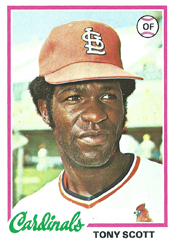
tony_scottThough Scott got his chance with the Cardinals because of his connections to Vern Rapp, it was under another manager, Ken Boyer, with whom Scott had his best St. Louis season.

On Nov. 8, 1976, the Cardinals traded pitchers Bill Grief and Angel Torres and outfielder Sam Mejias to the Expos for pitcher Steve Dunning, infielder Pat Scanlon and Scott.

Underwhelmed by the transaction, Dick Kaegel of the St. Louis Post-Dispatch wrote, “On the surface, it looks like one of those meaningless exchanges of baseball bodies, a deal that could hurt both clubs.”

Rapp’s guys

Dunning, Scanlon and Scott all had played in 1976 for Rapp, who managed Denver, the Class AAA club of the Expos.

In comments to The Sporting News, Scott said of Rapp, “He handles players right. He always gives people a fair shot. He made a winner out of everybody. It was a great experience to play for him.”

After the 1976 season, Rapp was chosen by the Cardinals to replace Red Schoendienst as manager.

On Rapp’s recommendation, Cardinals general manager Bing Devine made the trade for Dunning, Scanlon and Scott.

Devine said the key player for St. Louis was Dunning, a right-handed reliever who had been a first-round choice of the Indians in the 1970 draft. Dunning, 27, split the 1976 season between the Expos (2-6, 414 ERA) and Denver (3-0, 2.74 ERA).

The Cardinals hoped Scanlon could provide pop as a pinch-hitter. Scanlon, 24, hit .308 with 18 home runs for Denver in 1976.

Odd fit

Scott, 25, seemed the least likely to fit in with the 1977 Cardinals, who were flush with outfielders such as McBride, Lou Brock, Hector Cruz, Jerry Mumphrey and Mike Anderson.

McBride, who won the National League Rookie of the Year Award in 1974, had been limited to 64 starts in center field for the 1976 Cardinals because of knee surgery, but he was expected to be recovered in 1977.

Scott, a switch-hitter, had batted .182 with the 1975 Expos after having spent parts of the 1973 and 1974 seasons with them. At Denver in 1976, Scott batted .311 with 21 doubles, 18 stolen bases and an on-base percentage of .361.

Regarding Scott’s play in center, Rapp said, “Denver has one of the larger fields in baseball. Tony had a lot of room to run and he did a good job.”

Unimpressed, Ian MacDonald of The Sporting News wrote, “The Expos were in the market for a good defensive outfielder and they feel that they may have their man in Mejias.”

Job won

Scott played in the Puerto Rican Winter League after his trade to the Cardinals and established a single-season record with 25 stolen bases, including three steals of home.

After a strong spring training, Scott opened the 1977 season as a Cardinals reserve outfielder. The starters were Brock in left, McBride in center and Cruz in right.

Neither Dunning nor Scanlon would play for the Cardinals.

Scott sizzled from the start. He batted .357 (10-for-28) in April and .355 (27-for-76) in May.

Meanwhile, McBride, hampered by a shoulder injury, was feuding with Rapp, who had banned his players from growing long hair or facial hair.

In The Sporting News, Neal Russo wrote, “Rapp was not on the greatest of terms with McBride. It was Bake who became the first to defy the new manager on his hair code.”

On June 15, 1977, the Cardinals traded McBride to the Phillies and made Scott the center field starter. McBride, who had hit .300 or better in each of his first four seasons (1973-76) with the Cardinals, was batting .262 when traded. Scott had a .331 batting average.

Redbird regular

Scott finished the 1977 season with a .291 batting mark, 16 doubles and 13 stolen bases in 95 games.

Scott opened the 1978 season as the Cardinals’ starting center fielder. In April, Rapp was fired and replaced by Boyer. A month later, the Cardinals acquired George Hendrick from the Padres and made him their everyday center fielder. Scott hit .228 in 96 games.

In 1979, Boyer moved Hendrick to right field and reinserted Scott at center field. Scott responded with a solid season: .259 batting average, 152 hits in 153 games, 22 doubles, 10 triples, 68 RBI (including eight sacrifice flies) and 37 stolen bases. Scott also ranked first among NL center fielders in assists (13) and third in putouts (398).

Scott again was the Cardinals’ starting center fielder in 1980 _ he ranked first among NL center fielders in fielding percentage at .997 _ and at the beginning of 1981.

On June 7, 1981, the Cardinals traded Scott to the Astros for pitcher Joaquin Andujar. The following year, McGee emerged as the Cardinals’ everyday center fielder. McGee and Andujar played prominent roles in helping the 1982 Cardinals to a World Series championship.

In five seasons (1977-81) with the Cardinals, Scott batted .255.
Read Full Post »

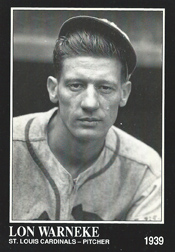
Less than two weeks after they finished the 1936 season tied for second place in the National League, the Cardinals and Cubs determined each had what the other needed in order to win a pennant.

lou_warnekeThe Cardinals, whose team ERA of 4.47 ranked seventh in the eight-team league in 1936, needed a reliable starting pitcher to pair with their ace, Dizzy Dean.

The Cubs, whose 76 home runs ranked fifth in the league, wanted a slugger.

On Oct. 8, 1936, the Cubs traded a premier pitcher, Lon Warneke, to the Cardinals for power-hitting first baseman Rip Collins and pitcher Roy Parmelee.

The blockbuster deal between the rivals rocked the baseball world.

Cubs clout

The Cardinals and Cubs each finished the 1936 season at 87-67, five games behind the champion Giants.

Cubs owner Phil Wrigley directed manager Charlie Grimm to make any trade necessary to improve the club’s chances of winning the 1937 pennant.

Grimm wanted more production from his first baseman. Phil Cavarretta hit nine home runs as the first baseman for the 1936 Cubs. Grimm wanted to move Cavarretta to center field in 1937.

Collins, the Cardinals’ first baseman from 1932-35, hit 35 home runs _ a franchise record for a switch hitter _ in 1934. He became expendable when Johnny Mize took over the position for St. Louis in 1936.

Collins, 32, batted .307 for the Cardinals from 1931-36. His best season was 1934 when he led the league in slugging percentage (.615), extra-base hits (87) and total bases (369). He batted .333 with 200 hits for the National League champions that season. In the 1934 World Series versus the Tigers, Collins batted .367 (11-for-30) with four runs scored.

According to the Associated Press, Grimm told Wrigley “he offered the Cardinals … every other hurler on the staff. The Cardinals, however, insisted on Warneke. Grimm, determined to get Collins, yielded.”

Said Collins to the St. Louis Post-Dispatch: “It’s a great break for me … The front office at St. Louis might have traded me to a second-division club, but they didn’t.”

Great addition

Warneke, 27, a right-hander, earned 100 wins for the Cubs from 1931-36. At the time of the trade, The Sporting News described him as “one of the few great pitchers in the league.”

Warneke compiled 20 wins or more for the Cubs three times between 1932-35. He was 16-13 with a 3.45 ERA in 1936.

“With Dizzy Dean and Warneke, the Cardinals assured themselves of a nucleus for what may be the best pitching staff in the major leagues,” the Associated Press reported.

Grimm said he “hated like hell to part with Warneke” and praised him as a “great pitcher and a loyal, faithful player.”

The Sporting News concluded the Cubs had “given up a lot in Warneke,” adding that “with the Cardinals, he should be even better. He’ll be pitching for a team able to give him some runs, a pleasure he seldom experienced as a Cub.”

The third player in the deal, Parmelee, 29, posted an 11-11 record and 4.56 ERA in his lone season with the Cardinals after being acquired the year before from the Giants.

Coming up short

Even though Warneke and Collins delivered, the trade didn’t bring the results in the standings either team wanted.

The 1937 Giants repeated as National League champions at 95-57. The Cubs placed second at 93-61 and the Cardinals were fourth at 81-73.

Warneke had a stellar season, leading the 1937 Cardinals in wins with an 18-11 record. He would play six seasons (1937-42) with the Cardinals, posting an 83-49 record.

Collins batted .274 with 16 home runs and 71 RBI for the 1937 Cubs. In two seasons with Chicago, Collins totaled 29 home runs and 132 RBI.

Parmelee was 7-8 with a 5.13 ERA in 1937, his lone season with the Cubs.

Previously: Rip Collins was one-of-a-kind hitter for Cardinals

Read Full Post »

(Updated July 5, 2020)

To many, Jeff Weaver looked like a washed-up pitcher when he was with the 2006 Angels. To the Cardinals, Weaver looked like the answer to a need.

weaver_brothersOn July 5, 2006, the Cardinals got Weaver from the Angels for minor-league outfielder Terry Evans. The Angels also paid $2.5 million of the remaining $4 million owed Weaver on his 2006 contract, the Los Angeles Times reported.
After a shaky start to his Cardinals career, Weaver became an effective starter in the 2006 postseason and was integral to St. Louis winning a World Series championship.

“Without him, we don’t win,” Cardinals center fielder Jim Edmonds told Fox Sports Midwest.

Available assets

Entering the majors in 1999, Weaver pitched for the Tigers, Yankees and Dodgers before becoming a free agent and joining the 2006 Angels. He had 13 wins with the 2004 Dodgers and 14 wins with the 2005 Dodgers.

With the 2006 Angels, Weaver was 3-10 with a 6.29 ERA in 16 starts. Opponents hit .309 against him. His younger brother, rookie Jered Weaver, replaced him in the Angels’ rotation.

The Cardinals, looking to replace Sidney Ponson in their rotation, had dispatched two scouts to evaluate Jeff Weaver. Dave Duncan, the Cardinals’ pitching coach, watched video of the Angels’ right-hander and determined he could help the club.

On June 30, 2006, Weaver, 29, was designated for assignment by the Angels, meaning he needed to be traded or released. The Cardinals were one of eight teams to make the Angels an offer for him.

“We’ve seen the guy pitch a few times … and still feel he has the assets he’s had in the past,” Cardinals general manager Walt Jocketty told Rick Hummel of the St. Louis Post-Dispatch. “Maybe he hasn’t been using them as best he could be.

“One of the scouts who saw him thought he was using his breaking ball too much and wasn’t using his fastball. He’s got a pretty good fastball and there might be a chance we can make a change that makes him better.”

In an interview with Joe Strauss of the Post-Dispatch, Weaver said, “Maybe I was throwing too many strikes. I was getting hurt quite a bit on 0-and-2 pitches. I could probably do a better job of expanding the strike zone.”

Championship caliber

Post-Dispatch columnist Bernie Miklasz liked the acquisition. “Dave Duncan’s overall success rate with fading veterans is superb,” Miklasz wrote. “That’s why we expect to see Jeff Weaver improve in St. Louis.”

In a 2016 interview with Dan McLaughlin of Fox Sports Midwest, Weaver recalled when he arrived in St. Louis he met with Cardinals manager Tony La Russa, who told him, “We just want you to go out there and compete.”

Said Weaver: “I knew how to do that.”

Weaver’s first Cardinals appearance was a start against the Braves at St. Louis on July 17, 2006. He didn’t impress. In four innings, Weaver yielded six runs, including a Brian McCann grand slam, and took the loss. Boxscore

“It took a little while to get in a groove,” Weaver said.

Weaver made 15 regular-season starts for the 2006 Cardinals and was 5-4 with a 5.18 ERA. However, he won his last three decisions, including a Sept. 29 triumph against the Brewers that extended the Cardinals’ lead over the second-place Astros from a half-game to 1.5 games with two to play. Boxscore

Noting that Weaver had been “all but left on the shoulder of a Southern California freeway by the Angels,” Miklasz wrote of the gritty win over the Brewers, “The quality of Weaver’s determination was superior to the numbers on his final pitching line. He deserved the standing ovation that came his way as he departed the mound. In this critical final month, Weaver is 3-1 with a 4.15 ERA. He’s no longer a junker.”

Said La Russa after that game: “Weaver was outstanding. The way he competed, you could see him working hard to get the outs. That’s one of the reasons why we like him. He’s a terrific competitor. He really did a good job for us. He did exactly what we needed.”

Weaver carried that effort into the 2006 postseason. He was 1-0 vs. the Padres in the National League Division Series and 1-1 against the Mets in the NL Championship Series.

In the World Series, Weaver got the clinching win in Game 5, holding the Tigers to two runs in eight innings and striking out nine.

After that, Weaver became a free agent and signed with the Mariners.

Read Full Post »

« Newer Posts - Older Posts »