Feeds:
Posts
Comments

Archive for the ‘Trades’ Category

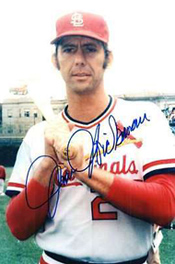
The Cardinals were a significant part of the baseball career of Jim Hickman. He signed his first professional contract with the Cardinals, played in their farm system for six seasons and ended his big-league playing days with them. Also, Hickman’s two best games in the major leagues came against the Cardinals.

jim_hickmanHickman was an outfielder and first baseman for 13 years in the majors. Best known as a member of the original 1962 Mets and for an all-star season with the 1970 Cubs, Hickman grew up a Cardinals fan and was 18 when he signed with St. Louis in 1956.
“As a kid, I didn’t know there was any other club except the Cardinals,” Hickman told The Sporting News.

Helped by expansion

Displaying power but failing to hit for average, Hickman played in the Cardinals’ system from 1956-61 without getting a call to the big-league club. His best seasons in the Cardinals organization were 1957 when he produced 26 home runs and 113 RBI for Class D Albany (Ga.) and 1959 when he had 22 home runs and 81 RBI for Class AA Tulsa.

“The closest he ever got to the big club was a couple of early spring training camps,” The Sporting News reported. “They gave Jim big uniform numbers reserved for no names … and he didn’t get much of a look.”

After Hickman hit 11 home runs with 57 RBI for Class AAA Portland (Ore.) in 1961, the Cardinals made him available in the National League expansion draft. According to The Sporting News, the Cardinals lost interest in Hickman when they received a scouting report that said he lacked aggressiveness.

Said Hickman: “I know people say I’m not aggressive … I give it all I got.”

Hickman was drafted by the expansion Mets and made his big-league debut with them in 1962. He became one of their everyday outfielders, batting .245 with 13 home runs in 140 games.

Cycle in sequence

In July 1963, Mets manager Casey Stengel experimented with converting Hickman into a third baseman. Hickman was batting .223 entering the Aug. 7, 1963, game between the Cardinals and Mets at the Polo Grounds.

Batting leadoff and playing third base, Hickman became the first Mets player to hit for the cycle. He was 4-for-5 with two RBI and two runs scored in the Mets’ 7-3 victory.

Hickman, a right-handed batter, got his first three hits off starter Ernie Broglio: a single in the first, a double in the second and a RBI-triple in the fourth. In the sixth, Hickman hit a solo home run off Barney Schultz to complete the cycle.

“If this fellow can learn to cut down on his strikeouts, he could be one of the top hitters around,” Stengel said. “He has all the power he needs, but by now he should know that you can’t hit a ball with the bat on your shoulder. You have to swing.” Boxscore

Trio of homers

Two years later, on Sept. 3, 1965, Hickman became the first Mets batter to hit three home runs in a game. He did it against Cardinals starter Ray Sadecki, leading the Mets to a 6-3 triumph at St. Louis.

Batting sixth and playing first base, Hickman, who entered the game with a .212 batting average, was 4-for-4 with four RBI and three runs scored.

A look at his three home runs off Sadecki:

_ Home run #1: Swinging at the first pitch, a high, outside fastball, Hickman hit it 403 feet the opposite way, clipping the pavilion roof in right-center.

_ Home run #2: The count was 3-and-0 when Hickman looked toward third-base coach Don Heffner and was surprised to see he was being given the freedom to swing away.

According to The Sporting News, “Hickman, knowing the Mets have an automatic $10 fine for a missed sign, stepped out of the batter’s box and looked again.”

Heffner shouted to him, “Go ahead. It won’t cost you 10 bucks.”

Sadecki threw a fastball and Hickman pulled it over the left-field wall.

_ Home run #3: On a 1-and-2 count, Hickman swung at a slider down in the zone and golfed it into the left-field bleachers.

When Hickman batted for a fourth time in the game, Nelson Briles was pitching in relief. Asked later whether he was trying for a fourth home run, Hickman replied, “You bet.”

Instead, he produced a single on a groundball that took a bad hop and eluded third baseman Ken Boyer. Boxscore

Nostalgia tour

In 1970, Hickman was named an all-star for the only time. Playing for the Cubs, he produced 32 home runs and 115 RBI and was named NL Comeback Player of the Year by The Sporting News.

On March 23, 1974, the Cubs traded Hickman to the Cardinals for pitcher Scipio Spinks. Eighteen years after he had signed with St. Louis, Hickman finally was getting his chance to play for the Cardinals.

“I’m 36, but I know I still can hit a baseball,” Hickman said. “And I still can half-catch a baseball.”

Used primarily as a pinch-hitter and backup to Joe Torre at first base, Hickman hit .267 with the 1974 Cardinals. He hit two pinch-hit home runs _ off George Stone of the Mets and Danny Frisella of the Braves _ but his batting average as a pinch hitter was .182.

On July 16, 1974, four months after they acquired him, the Cardinals released Hickman, who made it clear he would retire rather than seek a chance with another club.

“This is it,” Hickman said. “So what if I hooked up with another club for the last two months? It would be the same thing after the season ended.”

In a big-league career from 1962-74 with the Mets, Dodgers, Cubs and Cardinals, Hickman batted .252. He had a .242 career mark with 20 home runs in 153 games versus the Cardinals.

Previously: Bob Gibson nearly was unbeatable against Mets

Read Full Post »

Two years after they joined Bob Gibson in forming the foundation of the World Series champion Cardinals’ starting rotation, left-handers Curt Simmons and Ray Sadecki were St. Louis outcasts.

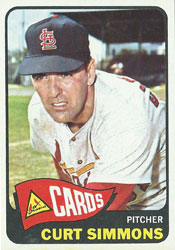
curt_simmons3At least the Cardinals got a significant return, first baseman Orlando Cepeda, for Sadecki, 25, when they traded him to the Giants on May 8, 1966. All the Cardinals got for Simmons was cash.
On June 22, 1966, Simmons, 37, was purchased by the Cubs from the Cardinals for $20,000.

Simmons, unhappy with the way he was being utilized by the Cardinals, looked forward to joining the Cubs’ starting rotation.

The Cardinals, who had tried to get a player in return for Simmons, were willing to move him to open room in their rotation for a pair of promising left-handers, Larry Jaster, 22, and Steve Carlton, 21.

Arm for hire

In 1964, when they won their first World Series title in 18 years, the Cardinals’ top three starters were Gibson (19 wins), Sadecki (20 wins) and Simmons (18 wins). The next year, Gibson won 20, but the win totals of Sadecki (6) and Simmons (9) declined significantly.

During 1966 spring training, the Cardinals tried to trade Simmons.

Initially, Simmons “was available at a modest price in players or cash,” The Sporting News reported.

When Simmons sparkled in spring training, yielding no walks in 25 innings, the Cardinals increased the price for him.

The Orioles showed interest, but “the Cardinals want a promising, young player in return and the Orioles are reluctant to give up anything more precious than cash,” The Sporting News reported.

Seeking starts

The 1966 Cardinals entered the season with more starters than spots in the rotation. Joining Gibson, Sadecki and Simmons were left-handers Jaster and Al Jackson and right-handers Ray Washburn, Tracy Stallard, Art Mahaffey and Nelson Briles.

Sadecki got three starts before he was traded. Simmons also was used sparingly.

Simmons got his first 1966 start on April 13 against the Phillies at St. Louis.

He didn’t get another start until more than a month later, May 17, at Philadelphia. In that game, Simmons yielded three runs and was lifted after three innings. “I had nothing out there,” Simmons said. “You’ve got to pitch guys in rotation. You can’t play checkers with pitchers.”

Simmons waited nearly three more weeks before getting his third start of the season on June 4 versus the Braves.

“It’s frustrating,” Simmons said of the limited number of starts he and other veterans were getting with the Cardinals. “We’re rusting and our market value is going down. If they’re going with the young guys, they ought to hurry up and make up their minds and let us go.”

Referring to Cardinals general manager Bob Howsam, Simmons said, “He’s burying too many good pitchers.”

Few suitors

A St. Louis newspaper reported the Braves were discussing the possibility of trading outfielder Rico Carty to the Cardinals for Simmons. Braves manager Bobby Bragan nixed the deal, telling The Sporting News he was concerned about Simmons’ long-term effectiveness.

In 10 appearances, including five starts, for the 1966 Cardinals, Simmons was 1-1 with a 4.59 ERA. As Simmons had predicted, his market value was diminishing.

With their options dwindling, the Cardinals sent Simmons to the last-place Cubs, who put him in a rotation with Dick Ellsworth, Ken Holtzman and Bill Hands.

In seven years (1960-66) with the Cardinals, Simmons posted a 69-58 record, 3.25 ERA and 16 shutouts.

On June 26, four days after he was acquired, Simmons made his Cubs debut and pitched a five-hit shutout against the Mets at Chicago. Boxscore

Two weeks later, still desperate for pitching, the Cubs signed Robin Roberts, 39, who first had become a teammate of Simmons with the 1948 Phillies, and put him in the starting rotation as well.

Simmons was 4-7 with a 4.07 ERA for the 1966 Cubs. He spent the next season with the Cubs and Angels before retiring as a player.

Previously: Cardinals rolled out welcome mat for Orlando Cepeda

Previously: Art Mahaffey and his short, shaky stint with Cardinals

Previously: Final home opener at Busch I was bust for Cardinals

Read Full Post »

(Updated Aug. 15, 2026)

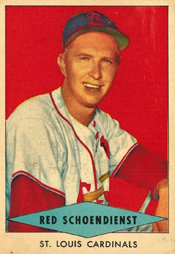
On June 14, 1956, soon after Red Schoendienst had driven off in his car, the phone rang at his house. Mary Schoendienst, Red’s wife, answered. The caller was a secretary for Cardinals general manager Frank Lane. She told Mary that Red had been traded to the Giants.

red_schoendienst10As Red was driving, he turned on his car radio. When the news came on, he learned of the deal.
In his 1998 book “Red: A Baseball Life,” Schoendienst said, “I didn’t appreciate getting the news that way.”

Said Mary: “I was shocked. The secretary called and said, ‘Mary, I have very sad news for you. Red has just been traded to New York.’ I just about fell over. I sat down on the couch in the living room. I couldn’t believe it. It was very hard.”

The Cardinals traded Schoendienst, outfielder Jackie Brandt, catcher Bill Sarni, pitcher Dick Littlefield and two players to be named (shortstop Bob Stephenson and pitcher Gordon Jones) to the Giants for shortstop Alvin Dark, catcher Ray Katt, pitcher Don Liddle, outfielder Whitey Lockman and cash.

“We let Schoendienst go with great reluctance, naturally, but to get a star like Dark you’ve got to give a star,” Lane told the St. Louis Post-Dispatch.

Sad day

Schoendienst, 33, a second baseman, was in his 12th season with the Cardinals. He had been named a National League all-star nine times with them.

Said Schoendienst of Lane: “(He) never understood how important baseball tradition was in St. Louis.”

Asked by the Associated Press to comment on the trade, Stan Musial, Schoendienst’s friend and road roommate, offered a rare “No comment.”

Said Schoendienst: “Stan says it was his saddest day in baseball.”

In his book “Stan Musial: The Man’s Own Story,” Musial said, “I was sick over the loss of my roommate and good friend.”

(Musial and Schoendienst had been road roommates since 1947, according to the Irv Goodman book “Stan The Man Musial.”)

Many Cardinals fans shared Musial’s sentiments.

“Newspaper switchboards were swamped with calls after the deal was announced,” the Associated Press reported.

In the book “Redbirds Revisited,” Schoendienst said the trade “was a shock to me. That was the biggest disappointment I’ve ever had … I was established here in St. Louis. I wanted to finish my career here.”

Infield shift

The 1956 Cardinals were starting two infielders _ rookie shortstop Don Blasingame and first baseman Wally Moon _ out of position. “We couldn’t win with our infield,” Lane said.

Blasingame was better suited to play second base. That prompted Lane to trade for a shortstop. After the Cardinals got Dark, Blasingame was moved to second. Moon and Musial swapped spots, with Musial moving from right field to first base.

“We’re stronger now,” said Cardinals manager Fred Hutchinson.

Cardinals owner Gussie Busch told the St. Louis Globe-Democrat the trade had his approval. “It was the considered judgment of Lane and Hutchinson that this deal would work for the betterment of the ballclub,” Busch said, “and I am thoroughly in agreement with them.”

Top prospect

Though Schoendienst and Dark were central players in the deal, Brandt, a rookie, was a key. In 1955 with minor-league Rochester, Brandt batted .305 with 179 hits in 151 games and had 24 stolen bases. He hit .286 with a .362 on-base percentage in 27 games for the 1956 Cardinals.

“We’re very excited about getting Brandt,” Giants executive Chub Feeney told United Press. “We wouldn’t have made the deal without him. He can run, he can throw and he can hit … Frankly, we were surprised the Cards would let him go.”

Said Schoendienst: “I thought trading Brandt was a mistake.”

Musial said Brandt “had speed, defensive skill and some power. The Cardinals could have used him.”

Said Lane: “Brandt could come back to haunt us, but we’re thinking of ’56, not next year.”

Brandt became the left fielder for the 1956 Giants. To accommodate Schoendienst, the Giants moved Daryl Spencer from second base to shortstop. Schoendienst joined first baseman Bill White in forming the right side of the Giants’ infield.

Also-rans

Though Schoendienst, Brandt and Dark played well for their new teams, the deal didn’t make either club a winner.

The 1956 Giants finished in sixth place at 67-87. The 1956 Cardinals placed fourth at 76-78.

Schoendienst hit .296 in 92 games for the 1956 Giants. A year later, he was traded to the Braves.

Brandt batted .299 in 98 games for the 1956 Giants. He won a Gold Glove Award with them in 1959, but was dealt after that season to the Orioles.

In 100 games for the 1956 Cardinals, Dark hit .286. Two years later, he was traded to the Cubs.

Schoendienst and Dark eventually became successful big-league managers. Each won two pennants _ Schoendienst with the 1967 and 1968 Cardinals; Dark with the 1962 Giants and 1974 Athletics _ and a World Series title.


Read Full Post »

(Updated Dec. 26, 2024)

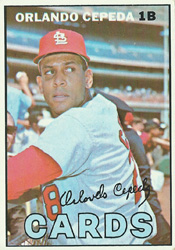
Feeling rejected and unappreciated by the Giants, Orlando Cepeda was traded to the Cardinals, who saw him as an asset rather than an outcast.

orlando_cepedaCepeda responded by providing the run production the Cardinals needed.

On May 8, 1966, the Giants sent Cepeda, 28, a first baseman recovering from knee surgery, to the Cardinals for Ray Sadecki, 25, a left-handed starting pitcher.

Cepeda was informed of the deal immediately after contributing two RBI to the Giants’ 10-5 victory over the Cardinals in the final game played at the original Busch Stadium in St. Louis.

In his book “Baby Bull,” Cepeda said, “In the clubhouse after the final game, I was as pleased as I could be. I was in the groove. That’s when I saw (Giants manager) Herman Franks walking toward me. I thought he was going to congratulate me … Instead, he told me I was traded to the St. Louis Cardinals. Just like that. No explanation … It came as a total shock.

“Initially, I was crushed,” Cepeda said. “So were my wife and my mother. At times, I had hoped a trade might happen, but it still hurt … The day I was traded I sat by my locker alone and cried. Jim Davenport (a third baseman) was the only non-Latin player to bid me goodbye and wish me well.”

After gathering his belongings, Cepeda went into the Cardinals clubhouse. He was welcomed warmly, describing his new teammates as “an incredible group of guys.”

“Stan Musial (team vice president) came down to see me and to tell me how happy he was to have me with the club,” Cepeda said. “Bob Bauman, the Cardinals’ trainer, made his position clear as well. ‘I’ll take care of your leg,’ he said. ‘You take care of the hits.’ ”

Cepeda called Cardinals catcher Tim McCarver “a special guy,” adding, “Tim never turned his back on me. He showed a strength of character and an unwavering friendship that I have not forgotten.”

On the morning after the trade, Cepeda had breakfast with manager Red Schoendienst and was presented with a contract that increased his yearly salary from $40,000 to $53,000. “Red told me I was going to play first base and hit cleanup,” Cepeda said.

Fitting the needs

The deal had been speculated for a week. The Cardinals needed a first baseman who could hit with power. Rookie George Kernek, who took over at first base in 1966 after Bill White was traded, struggled, with no home runs and three RBI in 20 games. The Giants wanted a left-hander for a rotation with right-handers Juan Marichal and Gaylord Perry.

Cepeda and Sadecki fit the needs.

Sadecki earned 20 wins for the 1964 Cardinals and was the winning pitcher in Game 1 of the World Series that year. He slumped to a 6-15 record and 5.21 ERA in 1965. He was 2-1 with a 2.22 ERA for the 1966 Cardinals.

Cepeda won the National League Rookie of the Year Award in 1958 and followed that with a string of successful seasons, including 1961 when he led the NL in home runs (46) and RBI (142) and 1962 when he produced 35 home runs and 114 RBI for the pennant-winning Giants. After undergoing surgery to remove cartilage from a knee in December 1964, Cepeda was limited to 34 at-bats in 1965, hitting .176. He batted .286 with 15 RBI in 19 games for the 1966 Giants.

A three-game series between the Cardinals and Giants at San Francisco in April 1966 heightened interest in a trade.

In the series opener April 29, Sadecki impressed the Giants, pitching a five-hitter against them in a 5-1 Cardinals victory. Boxscore

The Giants won the next two games, 6-1 and 2-0, highlighting the Cardinals’ lack of punch.

On May 1, 1966, the Oakland Tribune reported a deal of Cepeda-for-Sadecki was in the works.

Seeing is believing

Five days later, the Giants were in St. Louis for a three-game series. The Giants won the opener, 4-2. In the second game, Cepeda hit a grand slam off Art Mahaffey in a 15-2 Giants triumph. According to The Sporting News, Bauman and Cardinals surgeon Dr. I.C. Middleman checked Cepeda’s surgically repaired right knee that night. Middleman determined Cepeda’s knee was in good condition.

In the 1998 book “The Original San Francisco Giants,” Cepeda claimed he tricked Middleman. “The Cardinals team doctor checked my knee,” Cepeda told author Steve Bitker. “The funny thing is I gave him the left knee … Instead of giving him the bad knee, I gave him the good knee. He said, ‘You’re in great shape, man.’ ”

The next day, May 8, Cepeda hit a two-run double off Cardinals starter Larry Jaster in the first inning.

Convinced Cepeda was healthy and productive, Cardinals general manager Bob Howsam huddled with his counterpart, Chub Feeney of the Giants. In the fifth inning, Howsam and Feeney “completed the deal on the old Busch Stadium roof next to the press box,” the Oakland Tribune reported.

“Seeing the Baby Bull circle the bases must have convinced the Cardinals bosses that the Giants weren’t trying to unload a broken-down player,” wrote Tribune columnist Ed Levitt.

The deal was announced after the game.

Sadecki still was in the Cardinals locker room, talking with reporters about the trade, when pitcher Bob Gibson approached and, alluding to a league crackdown on fraternizing, said to him, “Get out of our clubhouse or they’ll fine us $25 for talking to you.”

Opinions vary

Cepeda’s presence was expected to take pressure off Cardinals batters.

Stan Musial told the San Francisco Examiner, “Cepeda is a great power hitter … You’ve got to be an aggressive hitter to be outstanding, and that’s what he is. I don’t know anybody outside of (Willie) Mays with the sheer power Cepeda has.”

Said Cardinals pitcher Hal Woodeshick: “He (Cepeda) ought to drive in 100 runs hitting behind (Curt) Flood and (Lou) Brock.”

As for Sadecki, Bob Stevens of The Sporting News wrote the deal “could mean a pennant to the Giants. Ray was what they needed and wanted.”

Schoendienst told United Press International that Sadecki “should win 20 games this season with all the Giants’ hitting power.”

Ed Levitt of the Oakland Tribune, though, expressed doubt, writing, “It grieves us to see (the Giants) turn loose a consistent slugger for an inconsistent pitcher … We question the value given for the value received.”

NL MVP

The deal worked out better for the Cardinals than it did the Giants.

Sadecki was 3-7 with a 5.40 ERA for the 1966 Giants. He twice had 12-win seasons for the Giants: 1967 and 1968. The Giants placed second to the champion Cardinals in both seasons.

Cepeda hit .303 with 17 home runs, 24 doubles and 58 RBI in 123 games for the 1966 Cardinals.

In 1967, Cepeda won the NL Most Valuable Player Award and helped the Cardinals to a World Series championship. He hit .325 with 25 home runs, 37 doubles and a NL-best 111 RBI.

Looking back on the deal, Howsam told The Sporting News in 1967, “I didn’t want to give up Sadecki, but we needed to rebuild and Cepeda was a pretty good start.”

Though the Cardinals repeated as NL champions in 1968, Cepeda faltered, hitting .248 with 16 home runs, 26 doubles and 73 RBI. In March 1969, he was traded by the Cardinals to the Braves for Joe Torre.


Read Full Post »

(Updated Dec. 16, 2025)

Jose Cardenal faced two daunting challenges with the 1970 Cardinals: (1) replace Curt Flood as the center fielder and (2) defend himself against comments from anonymous teammates who accused him of being selfish and lackadaisical.

jose_cardenalCardenal contributed significantly to a 1970 Cardinals lineup that included Lou Brock, Joe Torre and Dick Allen, but some teammates questioned his desire. Whether the criticism had merit or was based on stereotype is conjecture.

Traded for Pinson

On Nov. 21, 1969, the Cardinals traded right fielder Vada Pinson to the Indians for Cardenal. The Cardinals were seeking a center fielder to replace Flood, who a month earlier had been dealt to the Phillies.

In 12 years with the Cardinals, Flood batted .293, played on two World Series championship clubs and three National League pennant winners and earned seven consecutive Gold Glove awards.

Cardenal, 26, five years younger than Flood and Pinson, hit .257 with 26 doubles and 36 stolen bases for the 1969 Indians. The Cardinals became his fourth club following stints with the Giants, Angels and Indians. Cardenal had been in professional baseball since 1961 when he joined a Giants farm club at age 17 after leaving his home in Cuba.

According to Russell Schneider, who covered the Indians for The Sporting News, “Cardenal, who can be an outstanding fielder and better-than-average hitter when he wants, was a disappointment through most of 1969 … Jose has a tendency toward moodiness when things aren’t going well.”

Neal Russo, who covered the Cardinals, echoed that sentiment, writing that “Cardenal, a brilliant fielder, has a reputation for pouting because of such things as the manager shouting at him.”

Team player

Cardinals general manager Bing Devine sent scout Chase Riddle and assistant player development director John Claiborne to Puerto Rico to watch Cardenal in the winter league.

“Riddle and Claiborne said Cardenal had been doing a good job in the field and had been hitting the ball consistently to right field behind the runner,” Devine said. “He makes contact well. He’s good on the hit-and-run and he looks like he’ll be a good No. 2 man in the batting order.”

Said Cardenal: “I read where I would bat second behind a fast man like Brock. I thought I might be able to help him, my club and myself if I could hit the ball on the ground to the right side.”

Bob Broeg of the St. Louis Post-Dispatch described Cardenal as “a little center fielder with ants in his pants and with a throwing arm that could really skip a ball as fast as he’ll run on the new synthetic surface” at Busch Memorial Stadium.

Cardenal opened the season batting between Brock and Allen. He hit .353 in April and .366 in June.

Said Cardinals manager Red Schoendienst: “He can do everything. He’s one of the best players we have.”

Nasty talk

On July 13, 1970, Bob Broeg wrote in his Post-Dispatch column, “The Cardinals’ image isn’t helped when … a player like Jose Cardenal loafs or lopes to first base … The failure to go all-out with the ball in play has such a deadening effect.”

Asked about his reputation for moodiness, Cardenal told Post-Dispatch reporter Ed Wilks, “If you talk, they say you are … cocky, you talk too much. If you don’t talk, they say you are moody and you don’t want to talk. If I trust you, I talk … The best thing I can do is just smile and be quiet.”

Regarding being a Cardinal, he said, “I love it … It’s a first-class organization.”

In early September, the St. Louis Globe-Democrat reported Cardenal would be traded and quoted anonymous Cardinals players who called him a bad teammate.

Cardenal called a press conference to address the matter and said the accusations “broke my heart because they were so nasty.”

“Cardenal denied the charges that he played only when he felt like it, that he played for himself rather than for the team and that he did not hustle in the outfield or on the bases.” The Sporting News reported.

At a speaking engagement in Peoria on Oct. 31, 1970, Cardinals player Joe Hague criticized Cardenal and Allen for not being “winning types,” The Sporting News reported. Hague said Cardenal was “just not the type who will help make us a team in every sense of the word,” the Post-Dispatch reported.

Winning numbers

Based on statistics, Cardenal had a successful 1970 season. He batted .293 with 162 hits in 148 games, led the Cardinals in doubles (32), placed second in stolen bases (26) behind Brock (51) and was third in RBI (74) behind Allen (101) and Torre (100). Cardenal hit .342 with runners in scoring position.

After the season, the Cardinals acquired Matty Alou from the Pirates and projected him to play center field, with Cardenal moving to right.

Sent packing

Cardenal didn’t perform as well in 1971 as he did in 1970. Eager to give a starting spot to rookie outfielder Jose Cruz, the Cardinals deemed Cardenal expendable.

On July 29, 1971, Cardenal was batting .243 when the Cardinals traded him, infielder Dick Schofield and pitcher Bob Reynolds to the Brewers for infielder Ted Kubiak and minor-league pitcher Chuck Loseth.

“When they traded me, I was hurt and embarrassed,” Cardenal said. “They told me they wouldn’t trade me after the All-Star Game.”

Nearly a quarter-century later, Cardenal returned to the Cardinals as a coach on the staff of their manager, Torre, in 1994 and 1995.


Read Full Post »

(Updated April 29, 2022)

Late in his career, Hank Sauer transformed from a popular Cubs slugger into a Cardinals reserve who roomed on the road with Stan Musial, overcame a terrifying injury and turned into a productive singles hitter.

hank_sauerOn March 30, 1956, the Cardinals traded outfielder Pete Whisenant and $10,000 in cash to the Cubs for Sauer.

Though the Cardinals knew Sauer, 39, no longer was an everyday left fielder _ “It’s a move to strengthen our bench. It’s no earth-shaker of a deal,” St. Louis general manager Frank Lane told United Press _ Sauer still had star status.

Four years earlier, in 1952, Sauer won the National League Most Valuable Player Award, hitting 37 home runs with 121 RBI for the Cubs.

At the time of the trade, Sauer ranked third all-time in home runs among Cubs. He had 198. Only Gabby Hartnett (231) and Bill Nicholson (205) had hit more. In his book, “Thanks for Listening,” Cubs broadcaster Jack Brickhouse recalled, “When I think of Hank Sauer, I think of home runs and chewing tobacco, but not necessarily in that order.”

A right-handed pull hitter, Sauer faced defensive shifts that stacked the left side of the infield.

In his book “Stan Musial: The Man’s Own Story,” Musial said of Sauer, “Against a packed shift toward third base, he seldom could hit to right field, but he could hit over the shift if not through it.”

Changes in style

After producing 41 home runs and 103 RBI for the 1954 Cubs, Sauer slumped to 12 home runs and 28 RBI for the 1955 Cubs.

He reported early to Cubs spring training camp at Mesa, Ariz., in 1956. Russ Meyer, a pitcher acquired from the Dodgers, provided a tip that prompted Sauer to change his batting style.

Usually, when he took his stance in the batter’s box, Sauer would “swish his bat back and forth with rhythmic cadence,” The Sporting News reported. Meyer told Sauer pitchers had learned to time their pitches “so as to catch him between swings.”

“I just couldn’t get back to get around on the ball,” Sauer said.

Acting on Meyer’s suggestion, Sauer swung the bat just once after taking his stance while awaiting a pitch.

“Now I’m cocking the bat behind my shoulder and holding it steady,” Sauer said.

The adjustment resulted in more “Sauer clout” drives, The Sporting News observed.

Still, the Cubs asked Sauer to open the season with Los Angeles in the Pacific Coast League. When Sauer declined, the Cubs traded him to St. Louis.

On Musial’s advice, Sauer switched to a lighter bat.

Said Musial: “It’s just common sense, as a player gets older and his reflexes slower, to try to compensate for nature’s toll by going to a more easily handled bat.”

Opening drama

In the Cardinals’ 1956 season opener at Cincinnati, manager Fred Hutchinson started an outfield of Sauer in left, Musial in right and Bill Virdon in center. Hutchinson placed Musial third in the batting order and Sauer in the cleanup spot.

With the score tied at 2-2, Reds starter Joe Nuxhall retired the first two batters in the top of the ninth before Red Schoendienst reached on an infield single.

Musial followed with a two-run home run, giving the Cardinals a 4-2 victory.

Asked whether he thought Nuxhall should have pitched around Musial, Hutchinson replied, “Not when there is a dangerous man like Hank Sauer coming up … That’s the big value of a power man like Hank. He’ll make ’em pitch to Stan more now.” Boxscore

Freak tragedy

Two weeks later, on May 2, Sauer suffered a scary setback.

After Sauer completed batting practice, he was standing nearby when a bat slipped from the grasp of Walker Cooper, propelled over the batting cage and struck Sauer “flush on the left side of his face,” The Sporting News reported.

The Associated Press called it “a one-in-a-million accident.”

Diagnosed with “a severe concussion,” Sauer needed 12 stitches for a cut above his lip and 50 stitches for a wound in his ear, “the lower part of which was nearly severed by the blow,” according to The Sporting News.

At the hospital, Sauer said, “I was lucky I wasn’t killed.”

Sauer listened to a radio broadcast of the game that night. Cooper delivered a RBI-single in the 10th, tying the score, and the Cardinals beat the Pirates, 10-9. Boxscore

Quick comeback

Five nights after the accident, Sauer took batting practice. “You can’t hurt a Dutchman by hitting him in the head,” Sauer told columnist Dick Young.

On May 12, Sauer made his first appearance at Chicago’s Wrigley Field since leaving the Cubs and received a “tremendous ovation,” according to The Sporting News.

(Whisenant, the player acquired for Sauer, hit two home runs and a double in that game, leading the Cubs to a 14-10 victory. Boxscore)

Fine diners

Sauer roomed with Musial on road trips and they dined together at restaurants often chosen by Musial.

In the book “Stan Musial: An American Life,” Sauer said, “Musial really knows food. He can always tell the good cuts of meat from the bad ones.”

According to the book “Musial: From Stash to Stan the Man,” Musial used money he received from appearing on postgame radio shows to take Sauer and others to dinner.

“You get to know a fellow when you room with him and he was one of the nicest guys in the world,” Sauer said of Musial in the book “The Original San Francisco Giants.”

Solid hitter

A highlight for Sauer during his 1956 season occurred on Sept. 26 when he produced four singles and a walk against the Cubs at Wrigley Field. Boxscore

In 75 games with the 1956 Cardinals, Sauer batted .298 and had an on-base percentage of .403. Of his 45 hits, 36 were singles. He hit five home runs and had 24 RBI. Sauer batted .380 with runners on base.

After the season, Sauer was released and he signed with the Giants. In 1957, at age 40, he hit 26 home runs for them, including six against the Cardinals.

After the Giants moved from New York to San Francisco, Sauer was a role player for two more years before becoming a hitting instructor.

A younger brother, Ed Sauer, also played in the majors, including 24 games for the 1949 Cardinals.

Read Full Post »

« Newer Posts - Older Posts »