Feeds:
Posts
Comments

Archive for the ‘Trades’ Category

(Updated Dec. 16, 2025)

Jose Cardenal faced two daunting challenges with the 1970 Cardinals: (1) replace Curt Flood as the center fielder and (2) defend himself against comments from anonymous teammates who accused him of being selfish and lackadaisical.
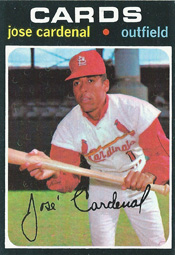
jose_cardenalCardenal contributed significantly to a 1970 Cardinals lineup that included Lou Brock, Joe Torre and Dick Allen, but some teammates questioned his desire. Whether the criticism had merit or was based on stereotype is conjecture.

Traded for Pinson

On Nov. 21, 1969, the Cardinals traded right fielder Vada Pinson to the Indians for Cardenal. The Cardinals were seeking a center fielder to replace Flood, who a month earlier had been dealt to the Phillies.

In 12 years with the Cardinals, Flood batted .293, played on two World Series championship clubs and three National League pennant winners and earned seven consecutive Gold Glove awards.

Cardenal, 26, five years younger than Flood and Pinson, hit .257 with 26 doubles and 36 stolen bases for the 1969 Indians. The Cardinals became his fourth club following stints with the Giants, Angels and Indians. Cardenal had been in professional baseball since 1961 when he joined a Giants farm club at age 17 after leaving his home in Cuba.

According to Russell Schneider, who covered the Indians for The Sporting News, “Cardenal, who can be an outstanding fielder and better-than-average hitter when he wants, was a disappointment through most of 1969 … Jose has a tendency toward moodiness when things aren’t going well.”

Neal Russo, who covered the Cardinals, echoed that sentiment, writing that “Cardenal, a brilliant fielder, has a reputation for pouting because of such things as the manager shouting at him.”

Team player

Cardinals general manager Bing Devine sent scout Chase Riddle and assistant player development director John Claiborne to Puerto Rico to watch Cardenal in the winter league.

“Riddle and Claiborne said Cardenal had been doing a good job in the field and had been hitting the ball consistently to right field behind the runner,” Devine said. “He makes contact well. He’s good on the hit-and-run and he looks like he’ll be a good No. 2 man in the batting order.”

Said Cardenal: “I read where I would bat second behind a fast man like Brock. I thought I might be able to help him, my club and myself if I could hit the ball on the ground to the right side.”

Bob Broeg of the St. Louis Post-Dispatch described Cardenal as “a little center fielder with ants in his pants and with a throwing arm that could really skip a ball as fast as he’ll run on the new synthetic surface” at Busch Memorial Stadium.

Cardenal opened the season batting between Brock and Allen. He hit .353 in April and .366 in June.

Said Cardinals manager Red Schoendienst: “He can do everything. He’s one of the best players we have.”

Nasty talk

On July 13, 1970, Bob Broeg wrote in his Post-Dispatch column, “The Cardinals’ image isn’t helped when … a player like Jose Cardenal loafs or lopes to first base … The failure to go all-out with the ball in play has such a deadening effect.”

Asked about his reputation for moodiness, Cardenal told Post-Dispatch reporter Ed Wilks, “If you talk, they say you are … cocky, you talk too much. If you don’t talk, they say you are moody and you don’t want to talk. If I trust you, I talk … The best thing I can do is just smile and be quiet.”

Regarding being a Cardinal, he said, “I love it … It’s a first-class organization.”

In early September, the St. Louis Globe-Democrat reported Cardenal would be traded and quoted anonymous Cardinals players who called him a bad teammate.

Cardenal called a press conference to address the matter and said the accusations “broke my heart because they were so nasty.”

“Cardenal denied the charges that he played only when he felt like it, that he played for himself rather than for the team and that he did not hustle in the outfield or on the bases.” The Sporting News reported.

At a speaking engagement in Peoria on Oct. 31, 1970, Cardinals player Joe Hague criticized Cardenal and Allen for not being “winning types,” The Sporting News reported. Hague said Cardenal was “just not the type who will help make us a team in every sense of the word,” the Post-Dispatch reported.

Winning numbers

Based on statistics, Cardenal had a successful 1970 season. He batted .293 with 162 hits in 148 games, led the Cardinals in doubles (32), placed second in stolen bases (26) behind Brock (51) and was third in RBI (74) behind Allen (101) and Torre (100). Cardenal hit .342 with runners in scoring position.

After the season, the Cardinals acquired Matty Alou from the Pirates and projected him to play center field, with Cardenal moving to right.

Sent packing

Cardenal didn’t perform as well in 1971 as he did in 1970. Eager to give a starting spot to rookie outfielder Jose Cruz, the Cardinals deemed Cardenal expendable.

On July 29, 1971, Cardenal was batting .243 when the Cardinals traded him, infielder Dick Schofield and pitcher Bob Reynolds to the Brewers for infielder Ted Kubiak and minor-league pitcher Chuck Loseth.

“When they traded me, I was hurt and embarrassed,” Cardenal said. “They told me they wouldn’t trade me after the All-Star Game.”

Nearly a quarter-century later, Cardenal returned to the Cardinals as a coach on the staff of their manager, Torre, in 1994 and 1995.


Read Full Post »

(Updated April 29, 2022)

Late in his career, Hank Sauer transformed from a popular Cubs slugger into a Cardinals reserve who roomed on the road with Stan Musial, overcame a terrifying injury and turned into a productive singles hitter.

hank_sauerOn March 30, 1956, the Cardinals traded outfielder Pete Whisenant and $10,000 in cash to the Cubs for Sauer.
Though the Cardinals knew Sauer, 39, no longer was an everyday left fielder _ “It’s a move to strengthen our bench. It’s no earth-shaker of a deal,” St. Louis general manager Frank Lane told United Press _ Sauer still had star status.

Four years earlier, in 1952, Sauer won the National League Most Valuable Player Award, hitting 37 home runs with 121 RBI for the Cubs.

At the time of the trade, Sauer ranked third all-time in home runs among Cubs. He had 198. Only Gabby Hartnett (231) and Bill Nicholson (205) had hit more. In his book, “Thanks for Listening,” Cubs broadcaster Jack Brickhouse recalled, “When I think of Hank Sauer, I think of home runs and chewing tobacco, but not necessarily in that order.”

A right-handed pull hitter, Sauer faced defensive shifts that stacked the left side of the infield.

In his book “Stan Musial: The Man’s Own Story,” Musial said of Sauer, “Against a packed shift toward third base, he seldom could hit to right field, but he could hit over the shift if not through it.”

Changes in style

After producing 41 home runs and 103 RBI for the 1954 Cubs, Sauer slumped to 12 home runs and 28 RBI for the 1955 Cubs.

He reported early to Cubs spring training camp at Mesa, Ariz., in 1956. Russ Meyer, a pitcher acquired from the Dodgers, provided a tip that prompted Sauer to change his batting style.

Usually, when he took his stance in the batter’s box, Sauer would “swish his bat back and forth with rhythmic cadence,” The Sporting News reported. Meyer told Sauer pitchers had learned to time their pitches “so as to catch him between swings.”

“I just couldn’t get back to get around on the ball,” Sauer said.

Acting on Meyer’s suggestion, Sauer swung the bat just once after taking his stance while awaiting a pitch.

“Now I’m cocking the bat behind my shoulder and holding it steady,” Sauer said.

The adjustment resulted in more “Sauer clout” drives, The Sporting News observed.

Still, the Cubs asked Sauer to open the season with Los Angeles in the Pacific Coast League. When Sauer declined, the Cubs traded him to St. Louis.

On Musial’s advice, Sauer switched to a lighter bat.

Said Musial: “It’s just common sense, as a player gets older and his reflexes slower, to try to compensate for nature’s toll by going to a more easily handled bat.”

Opening drama

In the Cardinals’ 1956 season opener at Cincinnati, manager Fred Hutchinson started an outfield of Sauer in left, Musial in right and Bill Virdon in center. Hutchinson placed Musial third in the batting order and Sauer in the cleanup spot.

With the score tied at 2-2, Reds starter Joe Nuxhall retired the first two batters in the top of the ninth before Red Schoendienst reached on an infield single.

Musial followed with a two-run home run, giving the Cardinals a 4-2 victory.

Asked whether he thought Nuxhall should have pitched around Musial, Hutchinson replied, “Not when there is a dangerous man like Hank Sauer coming up … That’s the big value of a power man like Hank. He’ll make ’em pitch to Stan more now.” Boxscore

Freak tragedy

Two weeks later, on May 2, Sauer suffered a scary setback.

After Sauer completed batting practice, he was standing nearby when a bat slipped from the grasp of Walker Cooper, propelled over the batting cage and struck Sauer “flush on the left side of his face,” The Sporting News reported.

The Associated Press called it “a one-in-a-million accident.”

Diagnosed with “a severe concussion,” Sauer needed 12 stitches for a cut above his lip and 50 stitches for a wound in his ear, “the lower part of which was nearly severed by the blow,” according to The Sporting News.

At the hospital, Sauer said, “I was lucky I wasn’t killed.”

Sauer listened to a radio broadcast of the game that night. Cooper delivered a RBI-single in the 10th, tying the score, and the Cardinals beat the Pirates, 10-9. Boxscore

Quick comeback

Five nights after the accident, Sauer took batting practice. “You can’t hurt a Dutchman by hitting him in the head,” Sauer told columnist Dick Young.

On May 12, Sauer made his first appearance at Chicago’s Wrigley Field since leaving the Cubs and received a “tremendous ovation,” according to The Sporting News.

(Whisenant, the player acquired for Sauer, hit two home runs and a double in that game, leading the Cubs to a 14-10 victory. Boxscore)

Fine diners

Sauer roomed with Musial on road trips and they dined together at restaurants often chosen by Musial.

In the book “Stan Musial: An American Life,” Sauer said, “Musial really knows food. He can always tell the good cuts of meat from the bad ones.”

According to the book “Musial: From Stash to Stan the Man,” Musial used money he received from appearing on postgame radio shows to take Sauer and others to dinner.

“You get to know a fellow when you room with him and he was one of the nicest guys in the world,” Sauer said of Musial in the book “The Original San Francisco Giants.”

Solid hitter

A highlight for Sauer during his 1956 season occurred on Sept. 26 when he produced four singles and a walk against the Cubs at Wrigley Field. Boxscore

In 75 games with the 1956 Cardinals, Sauer batted .298 and had an on-base percentage of .403. Of his 45 hits, 36 were singles. He hit five home runs and had 24 RBI. Sauer batted .380 with runners on base.

After the season, Sauer was released and he signed with the Giants. In 1957, at age 40, he hit 26 home runs for them, including six against the Cardinals.

After the Giants moved from New York to San Francisco, Sauer was a role player for two more years before becoming a hitting instructor.

A younger brother, Ed Sauer, also played in the majors, including 24 games for the 1949 Cardinals.

Read Full Post »

(Updated Jan. 13, 2025)

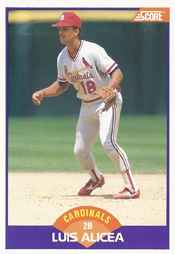
One of the first issues Walt Jocketty faced as Cardinals general manager in 1994 involved who to keep at second base. The leading candidates were Geronimo Pena and Luis Alicea. Jocketty picked Pena, trading Alicea to the Red Sox.

luis_aliceaFifteen months later, Jocketty reacquired Alicea to be the second baseman for the 1996 Cardinals.
On March 17, 1996, the Cardinals signed Alicea, who was waived by the Red Sox, to a one-year contract for $500,000.

The 1996 Cardinals, in their first season with Tony La Russa as manager, tried to attract a free-agent second baseman. They pursued Craig Biggio and Tony Phillips, but couldn’t land either.

They arrived at spring training with Pena, Jose Oquendo, Mike Gallego and David Bell as candidates for the second base job, but their options soon dwindled.

Pena (knee) and Gallego (hamstring) got injured. Oquendo no longer was effective. Bell wasn’t ready to be a starter.

The Cardinals caught a break when Alicea became available.

Turnover in Boston

Alicea started at second base for the 1995 division champion Red Sox. He batted .270, produced a .367 on-base percentage and led American League second basemen in turning the most double plays (103). In the Division Series versus the Indians, Alicea batted .600 (6-for-10).

After the 1995 postseason, the Red Sox acquired Wil Cordero from the Expos and projected him to be their second baseman in 1996.

“I asked to be traded,” Alicea told Rick Hummel of the St. Louis Post-Dispatch, “but it didn’t happen.”

Instead, Alicea went to spring training with the Red Sox in 1996. They determined he was too expensive to keep as a utility player and placed him on waivers.

The Cardinals were grateful.

First time around

Alicea was a first-round draft choice of St. Louis in 1986. Cardinals scouting director Fred McAlister recalled to Cardinals Yearbook in 1988, “I knew we were going to take him the first day I saw him. He can run, throw, fields good and I think he’s going to hit … He’s a smart little player.”

He became the Cardinals’ second baseman in April 1988 after Tommy Herr was traded but Alicea wasn’t ready, hitting .212 in 93 games.

Alicea spent the 1989 and 1990 seasons in the minors and Jose Oquendo took over as the Cardinals’ second baseman from 1989-91.

In 1992 and 1993, Alicea reclaimed the role as the Cardinals’ primary second baseman. He had his best Cardinals season in 1993 when he batted .279 and produced a .362 on-base percentage for manager Joe Torre.

Geronimo Pena (54 starts) and Alicea (48 starts) shared the second base job with the Cardinals in 1994. After that strike-shortened season, Jocketty replaced Dal Maxvill as general manager and asked Cardinals talent evaluators to assess the second base situation.

“At that time, the consensus was that Pena was the better guy,” Jocketty said.

On Dec. 7, 1994, the Cardinals traded Alicea to the Red Sox for pitcher Nate Minchey and outfielder Jeff McNeely.

With Alicea gone, Pena went into the 1995 season as the projected starter at second, but he was a bust. Pena went on the disabled list three times in 1995 and was limited to 25 starts. Oquendo got the most starts at second base for the 1995 Cardinals and batted .204.

Looking for help

Before starting spring training in 1996, the Cardinals signed Mike Gallego, who had become a free agent after playing for Tony La Russa with the Athletics. The Cardinals figured some combination of Pena, Gallego, Oquendo and Bell would be adequate at second base.

However, midway through spring training, Oquendo was released. According to Hummel, Oquendo “saw there was no job for him this year,” so he and the Cardinals “mutually agreed to part ways.”

Pena also was offered his release, but opted to stay with the organization and accept an assignment to Class AAA Louisville.

Said La Russa: “I feel bad for Pena … If he stays healthy, he’s a good player.”

With Gallego headed to the disabled list, the Cardinals were left only with Bell _ until Alicea became available.

Alicea got the most starts (104) at second base for the 1996 Cardinals, who won a division title and advanced to the National League Championship Series.

Alicea had a career-best 26 doubles for the 1996 Cardinals, hitting .258 and producing a .350 on-base percentage, but his 24 errors were the most committed by a NL second baseman that season.

After the season, the Cardinals signed a free agent, Delino DeShields, to be their second baseman in 1997. Alicea became a free agent and joined the Angels.

In two stints over six seasons with the Cardinals, Alicea batted .252.

Read Full Post »

(Updated March 2, 2019)

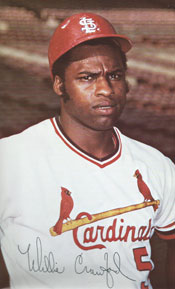
Willie Crawford was acquired by the Cardinals from the Dodgers to strengthen the bench, but he exceeded expectations and became their starting right fielder, giving a good performance for a bad team.

willie_crawfordOn March 2, 1976, the Cardinals traded second baseman Ted Sizemore for Crawford. The deal accommodated Sizemore, who was being displaced as the starting second baseman and wanted to play close to his home in California.

Crawford, who spent 12 seasons as a role player with the Dodgers, wanted to play regularly, but with Lou Brock in left, Bake McBride in center and Reggie Smith in right the 1976 Cardinals were set with starting outfielders.

Platoon player

In 1964, Crawford, a high school standout in Los Angeles, was signed by Dodgers scout Tommy Lasorda, the future Hall of Fame manager.

A left-handed batter, Crawford played in two World Series (1965 and 1974) for the Dodgers. He and Sizemore were teammates for two years. Sizemore won the National League Rookie of the Year Award in 1969, but was dealt to the Cardinals for slugger Dick Allen after the 1970 season.

No. 2 man

Sizemore was the Cardinals’ starting second baseman from 1971-75. Batting primarily in the No. 2 spot, he led the National League in sacrifice bunts (25) in 1973 and was second (with 21) in 1975.

In 1974, when Lou Brock had 118 stolen bases, he said, “You have to have the right man batting behind you. I do: Ted Sizemore.”

Sizemore said to the Los Angeles Times, “To bat behind a base stealer, you have to be patient, willing to take pitches and sacrifice your average, be able to make contact with two strikes, be adept in the subtle ways of hindering a catcher, and be satisfied that by helping to get that man to second base, you are doing what your team must do to win.”

By 1976, Sizemore was expendable because the Cardinals planned to shift Mike Tyson from shortstop to second base and play Don Kessinger at shortstop until Garry Templeton was ready to take over the position.

Anatomy of a deal

Sizemore told Cardinals general manager Bing Devine he intended to go to spring training in 1976 and beat out Tyson for the starting second base spot, but then changed his mind, “expressing his desire to be traded to Los Angeles if such a deal could be made,” Devine told United Press International.

Devine said he approached Dodgers executive Al Campanis and proposed a trade of Sizemore for Crawford. Because the Dodgers had Davey Lopes at second base and Bill Russell at shortstop, they projected Sizemore, 30, as a utility player.

The Cardinals and Dodgers also discussed a deal of Reggie Smith for Bill Russell, Campanis confirmed to the Los Angeles Times. The newspaper noted such a swap would give Crawford a chance to claim the Cardinals’ right field job and enable the Dodgers to move Davey Lopes to shortstop, opening up second base for Sizemore.

However, Campanis said the Cardinals opted “to stand pat (with Smith) until later in the spring,” the Los Angeles Times reported. “The Cardinals also expressed the opinion the Dodgers would have to part with more than Russell” for Smith.

(Three months later, in June 1976, the Cardinals sent Reggie Smith to the Dodgers for catcher Joe Ferguson and two minor-leaguers.)

Crawford, 29, told the Los Angeles Times he “never had the type of communications” with Dodgers manager Walter Alston “that I should have, but I don’t leave with ill feelings. I simply feel there was a need for a change of scenery. I was in a rut.”

Times columnist Jim Murray wrote, “Willie’s is a classic case of arrested athletic development. A big-muscled, powerful young man … Willie Crawford … has the body and configuration that must be used every day to stay at peak efficiency.”

Hot hitter

Crawford quickly fit in with the 1976 Cardinals. During spring training, The Sporting News reported, Crawford took over retired pitcher Bob Gibson’s role of “clubhouse and on-field needler.”

Over the first two weeks of the 1976 regular season, Crawford was used exclusively as a pinch-hitter by manager Red Schoendienst. On April 25, Schoendienst moved Reggie Smith to third base, replacing struggling rookie Hector Cruz, and put Crawford in right field. Crawford responded by batting .438 in April and .326 in May. After the Cardinals traded Smith to the Dodgers, Crawford got the most starts in right.

Strong season

Crawford completed the 1976 season with a .304 batting mark and .360 on-base percentage. His batting average against right-handers was .313.

Crawford hit nine home runs and produced 50 RBI, but consistent run production was a weakness. Crawford hit .225 with runners in scoring position, according to baseball-reference.com.

After the 1976 Cardinals finished 72-90, Schoendienst was fired and the club looked to make other changes.

Planning to move Cruz to right field in 1977, the Cardinals traded Crawford, pitcher John Curtis and utility player Vic Harris to the Giants for pitchers Mike Caldwell and John D’Acquisto and catcher Dave Rader in October 1976.

Read Full Post »

(Updated Oct. 26, 2024)

Needing a closer, the 1996 Cardinals wanted Dennis Eckersley. What they didn’t want was the obligation to pay his entire salary.

dennis_eckersley3When the Athletics agreed to pay part of the sum and Eckersley agreed to defer much of the rest, the Cardinals agreed to a deal.
On Feb. 13, 1996, the Cardinals got Eckersley from the Athletics for reliever Steve Montgomery.

Eckerlsey, 41, was under contract to receive $2.2 million in 1996.

To make the trade, all sides agreed to this arrangement: The Athletics would pay him $700,000, the Cardinals would pay him $500,000 and Eckersley would defer $1 million to another year, the St. Louis Post-Dispatch reported.

Sticking together

Looking to rebuild after finishing in last place in 1995, the Athletics were eager to grant Eckersley’s request to be traded to St. Louis. Eckersley sought to be reunited with manager Tony La Russa and pitching coach Dave Duncan.

Eckersley was transformed from a starter to a closer by La Russa and Duncan after he was traded to the Athletics by the Cubs in April 1987. With Eckersley reliably sealing wins, the Athletics won three consecutive American League pennants and a World Series title from 1988-90.

Asked about La Russa by Chicago Tribune columnist Jerome Holtzman, Eckersley said, “I respect everything about him.”

Because he had pitched in the big leagues for at least 10 years, including the last five in a row with one club, Eckersley could veto a trade.

“If he goes elsewhere, it’ll be St. Louis,” Athletics general manager Sandy Alderson told The Sporting News. “It won’t be anywhere else.”

Experience wanted

La Russa, who left the Athletics after the 1995 season to become manager of the Cardinals, told Rick Hummel of the Post-Dispatch he was “hoping” Eckersley could be acquired by the time training camp opened at St. Petersburg, Fla. Acknowledging that negotiations were held up, La Russa added, “I don’t know if it can happen.”

Eckersley had one of his worst seasons in 1995. Though he earned 29 saves in 38 chances, Eckersley had a 4.83 ERA in 52 appearances. It was his third consecutive season with an ERA above 4.00. From 1988 through 1992, Eckersley posted ERAs below 3.00 each year.

“Eck has got plenty left physically,” La Russa said. “Mentally and emotionally, he’s still at the top of his game.”

Tom Henke, who had 36 saves and a 1.82 ERA for the 1995 Cardinals, had retired, leaving St. Louis without an established closer.

The Cardinals envisioned Eckersley as a fit for the role while a pair of potential successors, T.J. Mathews and John Frascatore, continued to develop.

Oakland connections

After the deal was made, La Russa said, “We’re getting a guy who will be anywhere from good to great as a closer this year.”

Said Eckersley: “To be an effective closer, you have to have a manager who knows how to use you.”

It also helped that Dave Duncan was there, too. Eckersley described Duncan to Stan McNeal of Cardinals Magazine this way: “He was analytics before analytics.”

“I had been in the big leagues a long time, but when Duncan said something, I listened,” Eckersley told McNeal. “He was a calming force. You know how it is when you trust somebody implicitly? That was me with Duncan.”

The Athletics reportedly wanted Mathews _ who would be dealt to Oakland a year later for slugger Mark McGwire _ but settled for Montgomery, 25, a prospect who earned 36 saves for manager Mike Ramsey at Class AA Arkansas in 1995.

“This was more to accommodate Dennis than acquire Steve,” Alderson told the San Francisco Chronicle. “… This is what Dennis wanted and, given where we are, this is probably best for us, too.”

Eckersley joined Rick Honeycutt, Mike Gallego and Todd Stottlemyre as former Athletics the Cardinals acquired since La Russa became their manager.

“I was 41 when I was traded to the Cardinals, but Tony and Duncan still trusted me,” Eckersley told Cardinals Magazine. “I can’t imagine having gone to another regime and trying to make my mark at that point in my career.”

Eckersley pitched two seasons for the Cardinals. He had 30 saves in 38 chances (0-6 record, 3.30 ERA) in 1996. He followed that with 36 saves in 44 chances (1-5 record, 3.91 ERA) in 1997.

In two years with the Athletics, Montgomery was a combined 1-1 with a 9.45 ERA. He also pitched for the 1999 Phillies and 2000 Padres.

Read Full Post »

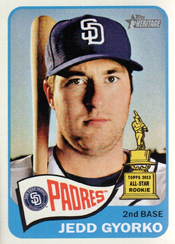
If Jedd Gyorko hits as well for the Cardinals as he did against them, St. Louis will have added a productive batter to its lineup.

jedd_gyorkoAcquired by the Cardinals from the Padres in a trade for outfielder Jon Jay on Dec. 8, 2015, Gyorko entered the 2016 season as a versatile infielder who can perform at second base, shortstop and third base.

His career batting average versus the Cardinals is .342 (25-for-73), with five home runs and 16 RBI in 20 games.

Two of Gyorko’s best games came against the Cardinals in 2014.

Here is a look at those performances:

Sweet swing

Batting sixth and playing second base, Gyorko was 3-for-5 with four RBI and two runs scored against the Cardinals in a 12-1 Padres victory at San Diego on July 30, 2014.

He got a hit apiece off three pitchers.

Gyorko began his barrage with a solo home run in the fourth inning off starter Joe Kelly.

“Pitches were up that should have been down,” Kelly told the Associated Press.

In the sixth, Gyorko singled off Carlos Martinez. An inning later, with the bases loaded and one out, Gyorko hit a three-run double off Seth Maness, giving San Diego a 9-1 lead.

‘It was probably our ugliest loss of the year,” said Cardinals manager Mike Matheny.

Gyorko had been activated two days earlier after a 44-day stint on the disabled list because of foot problems.

“It obviously feels good to swing the bat the way I wanted to,” Gyorko said. “It feels a lot like how I was swinging it there at the end of the year last year. It’s something to build on, but I still have a long way to go.” Boxscore

Grand game

Two weeks later, on Aug. 16, 2014, at St. Louis, Gyorko hit a grand slam, lifting the Padres to a 9-5 victory over the Cardinals.

Batting fifth and playing second base, Gyorko was 2-for-3 with five RBI, two runs scored and two walks.

In the third, Gyorko’s two-out, RBI-single off Shelby Miller scored Abraham Almonte from third base, sparking a four-run Padres inning and tying the score at 4-4.

Said Miller: “Unacceptable. Obviously, it doesn’t sit well with me. I should have done a better job of making pitches.”

The Cardinals led, 5-4, entering the seventh. With one out and the bases loaded, Gyorko connected on a 94-mph fastball from reliever Kevin Siegrist, launching a grand slam over the left field wall and giving the Padres an 8-5 lead.

“It was a fastball down and in,” Gyorko said. “It probably wasn’t a bad pitch. I just put a good swing on it.”

The home run was the 31st of Gyorko’s big-league career, moving him past Mark Loretta as the Padres’ all-time home run leader as a second baseman.

“That’s a credit to the guys hitting in front of me,” Gyorko told the San Diego Union-Tribune. “Really, they are doing a great job of getting on base. I just have to capitalize more like tonight.”

The grand slam was the third of Gyorko’s big-league career and the only one yielded by Siegrist with the Cardinals. Boxscore

Afterward, Siegrist was demoted to the minor leagues and Martinez was recalled from Class AAA Memphis to replace him.

Said Matheny of Siegrist: “He feels physically strong, but there’s just something that’s a click off.”

Previously: Cards steals leader Jon Jay plays similar to Wally Moon

Previously: Jon Jay matched Curt Flood as flawless in center

Read Full Post »

« Newer Posts - Older Posts »