Feeds:
Posts
Comments

Archive for the ‘Trades’ Category

(Updated April 14, 2025)

Having achieved personal success while falling short of the team goal, Joe Torre’s six-year stay with the Cardinals came to an unsatisfying end.
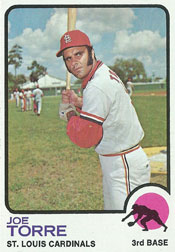
joe_torre5On Oct. 13, 1974, Torre was dealt to the Mets for pitchers Ray Sadecki and Tommy Moore.

Popular and productive, Torre hit .308 with 1,062 hits in 918 games for the Cardinals from 1969-74. His on-base percentage in that time was .382, nearly 20 points better than his career mark.

Though a multi-time all-star who regularly ranked among baseball’s top hitters, Torre exceeded all expectations in 1971 when he led the National League in hits (230), RBI (137) and batting average (.363) and was awarded the NL Most Valuable Player honor over Willie Stargell of the World Series champion Pirates.

Time for change

After the 1974 season, the Cardinals were ready to make Keith Hernandez, 21, their first baseman. In an interview with United Press International, Cardinals manager Red Schoendienst said of Hernandez, “He looks like a tremendous prospect. We had to make room for him.”

Though Torre also played third base and catcher, the Cardinals were set at those positions with Ken Reitz and Ted Simmons.

At 34 and with a yearly salary of $150,000, Torre was deemed expendable.

“His ample salary and his age may have been factors in arranging the deal,” the Associated Press reported. “He was one of a half dozen Cardinals players earning more than $100,000.”

Torre, too, was expecting a departure. In his book “Chasing the Dream,” Torre said, “I knew I wasn’t going to be back with the Cardinals. They had brought up a young first baseman from the minor leagues named Keith Hernandez and made him eligible for the playoffs if we won the East.”

Falling short

The Cardinals, though, finished in second place in the National League East Division in 1974 for the second consecutive year and for the third time in four seasons. They never qualified for the postseason during Torre’s time with the club.

Torre in 1974 hit .312 for the Cardinals in July and .320 in August before he slumped to a .200 batting mark with 22 strikeouts in September. After the season, The Sporting News reported Torre had played the last month of the season with a cracked thumb.

When Torre was acquired by the Cardinals from the Braves for Orlando Cepeda in March 1969, the Cardinals were a premier team, the two-time defending National League champions. “Torre did a heck of a job for us,” Cardinals general manager Bing Devine said. “I’m sincere when I say he took me off the spot by doing so well for us after we traded Cepeda for him.”

Meet the Mets

The Braves almost dealt Torre to the Mets instead of to the Cardinals. “The Mets thought they had him before the 1969 season and Gil Hodges, who was then their manager, went so far as to tell Torre during spring training that, ‘You’ll be with us in a couple of days.’ But that deal fell through because the Mets refused to part with Amos Otis, then a red-hot prospect to play center field for New York,” United Press International reported.

Six years later, the Mets finally got their man. It was the first trade for Mets general manager Joe McDonald, who would become general manager of the Cardinals from 1982-84.

“We’ve needed another right-handed hitter in our lineup and Torre gives us that,” Mets manager Yogi Berra said.

Said Torre, a Brooklyn native: “If I had to be traded anywhere, I’m glad I’m going to New York.”

Devine said Torre didn’t want to be a Cardinals reserve and his first choice among teams to be dealt to was the Mets.

In his book, Torre revealed, “I was going to a team whose season had just ended with 91 losses. That was a very fragile time for me. On top of being unhappy with my marriage, I hit rock bottom in the big leagues with a losing team. And to make matters worse, I became a part-time player. I hated it _ and it showed.”

Aftermath of the deal

Though Torre was the Mets’ starting third baseman on Opening Day in 1975, he eventually was platooned at first base with Ed Kranepool and at third base with Wayne Garrett. Torre hit .247 in 114 games for the 1975 Mets.

“In 1975, for the first time in my life, I dreaded going to the ballpark,” Torre said. “Baseball felt like work. I thought maybe it was time to quit.”

Torre became Mets player-manager in 1977 after he rejected a trade to the Yankees. As Torre recalled to Cardinals Yearbook in 2014, “In 1976, I was approached by Mets general manager Joe McDonald and he said, ‘How would you like to be traded to the Yankees?’ I didn’t jump at it … I said, ‘Not if it’s going to affect my chances of managing this team at some point.’ ”

Torre would manage the Mets, Braves, Cardinals, Yankees and Dodgers, winning four World Series titles with the Yankees and earning induction into the National Baseball Hall of Fame in 2014.

The pitchers the Cardinals got from the Mets for Torre had short stays.

Moore, 26, was 0-0 with a 3.86 ERA in 10 relief appearances for the Cardinals before he was traded in June 1975 with shortstop Ed Brinkman to the Rangers for outfielder Willie Davis.

Sadecki, 34, was in his second stint with St. Louis. He’d been a 20-game winner for the 1964 Cardinals and got the win in Game 1 of the World Series that year. In 1975, Sadecki was 1-0 with a 3.27 ERA in eight relief appearances for the Cardinals before being traded in May with pitcher Elias Sosa to the Braves for pitcher Ron Reed and outfielder Wayne Nordhagen.

Nine years earlier, in 1966, the Cardinals had sent Sadecki to the Giants for Cepeda. In proving the adage “what goes around, comes around,” the Cardinals dealt Sadecki for Cepeda, who later was traded to the Braves for Torre, who eventually was traded to the Mets for Sadecki.


Read Full Post »

(Updated Sept. 10, 2025)

Being discarded by the Cardinals was tough on Tim McCarver the first time it happened. The second time was worse.

tim_mccarver4On Sept. 1, 1974, the Cardinals sold the contract of McCarver to the Red Sox.

At the time of the transaction, the Cardinals were in second place in the National League East, 2.5 games behind the Pirates.

It hurt McCarver that the Cardinals saw him as a liability rather than an asset in their late-season bid for a division championship.

McCarver, 32, was in his second stint with the Cardinals in 1974. He debuted with them as a teen catcher in 1959. A two-time all-star who finished runner-up to teammate Orlando Cepeda in voting for the 1967 Most Valuable Player Award, McCarver was an integral part of a Cardinals club that won three National League pennants and two World Series titles in the 1960s. His leadership skills and special bond with pitching ace Bob Gibson also were important.

Feeling the hurt

In October 1969, the Cardinals dealt McCarver, Curt Flood, Joe Hoerner and Byron Browne to the Phillies for Dick Allen, Cookie Rojas and Jerry Johnson. In his book “Oh, Baby, I Love It,” McCarver said, “When general manager Bing Devine broke the news to me about my going to Philly, he said it hurt him to do it. That’s like a father dangling a razor strap in front of his 4-year-old son and saying, ‘This is going to hurt me more than it’ll hurt you.’ Bull. Since St. Louis had been my baseball home since my rookie year, it had to hurt me more than a little, too.”

Reacquired by St. Louis in a November 1972 trade with the Expos for Jorge Roque, McCarver hit .266 with 49 RBI as a utility player for the 1973 Cardinals.

In 1974, McCarver’s role was to be the Cardinals’ top pinch-hitter, although he also filled in at catcher and at first base. He struggled, hitting .179 (7-for-39) as a pinch-hitter and .217 (23-for-106) overall. He produced one extra-base hit.

Bound for Beantown

On Aug. 29, as the Cardinals left San Diego to open a series in San Francisco, Bob Kennedy, Cardinals player personnel director, informed McCarver he likely would be dealt to the Athletics, who were atop the American League West and headed to their third consecutive World Series championship. The Athletics were seeking a veteran backup to catcher Ray Fosse.

“I thought I was being traded to Oakland,” McCarver said in his book. “When the Cards took a flight to San Francisco, I went with them, fully expecting to transfer across the bay.”

After arriving at San Francisco, McCarver called his wife, Anne, at their home in Memphis and said, “I need you.”

Said McCarver: “I was pretty depressed about leaving the Cards, who had a shot at the pennant that year. Anne flew from Memphis to San Francisco and we had dinner that night. The next morning, I got word that I was heading to (Boston).”

The Red Sox, who led the American League East, were seeking help for catcher Bob Montgomery, who was filling in for an injured Carlton Fisk.

“When the Red Sox picked me up, I hadn’t the slightest notion they had any interest in me,” McCarver said.

Trust issues

The transaction caught many by surprise. In The Sporting News, Peter Gammons reported this exchange with Red Sox manager Darrell Johnson: “On Aug. 30, Johnson was asked if the Sox were interested in Tim McCarver. ‘No,’ he answered, but McCarver was bought the next day.”

Wrote St. Louis reporter Neal Russo: “It’s usually the custom to add a few veterans for a club’s final push, but the Cardinals dropped one.”

With McCarver gone, the Cardinals called up prospects Marc Hill to back up catcher Ted Simmons and Keith Hernandez to back up first baseman Joe Torre.

In the end, neither the Cardinals nor the Red Sox qualified for the postseason. The Cardinals finished in second place, 1.5 games behind the Pirates, and Boston placed third, seven behind the first-place Orioles.

The Red Sox released McCarver in June 1975, but he signed with the Phillies. From 1975-79, one of his roles with the Phillies was being the personal catcher for Steve Carlton.

In the 2003 book “Few and Chosen,” Carlton said McCarver “was always thinking.”

“Tim’s a great bridge player,” Carlton noted, “and that’s a game where you have to remember what cards have been played. Tim brought that ability to the field as a catcher. He remembered the sequences of pitches we used to get a hitter out. He had great instincts. There was a synchronicity between us. He was uncanny. He has such a good mind, and he was a great strategist … I always thought Tim would have made a good manager.”

Read Full Post »

(Updated June 4, 2024)

Larry Walker wasn’t looking to leave the Rockies, but the Cardinals convinced him to give them a chance.

larry_walker2On Aug. 6, 2004, Cardinals general manager Walt Jocketty performed a heist, acquiring Walker, 37, from the Rockies for three prospects.

Walker, a three-time National League batting champion and seven-time Gold Glove Award winner, joined an outfield of Jim Edmonds and Reggie Sanders and helped the Cardinals win their first pennant in 17 years.

On Jan. 21, 2020, 16 years after the Cardinals acquired him, Walker was elected to the Baseball Hall of Fame with 76.6 percent of the votes from the Baseball Writers Association of America.

The Rockies had approached Walker about trading him to the Rangers or Marlins. Because Walker was a 10-year veteran who had spent five of those years with the same team, his approval was needed before a deal could be made. He rejected the proposed trades to Texas and Florida.

Players make pitch

The Cardinals appealed to Walker’s competitive spirit. In a bid to seal the deal, Edmonds and teammate Scott Rolen called Walker, urging him to help them get to the World Series by accepting a trade.

Rolen offered to drop a spot in the batting order in case manager Tony La Russa wanted to bat Walker in the cleanup position Rolen held.

Inspired, Walker gave his OK to the Rockies to complete a trade with St. Louis.

“I think there were some people in Colorado who weren’t certain he would come,” Jocketty said to the St. Louis Post-Dispatch. “He weighed everything and it didn’t take him long. I think he’ll be energized to come here and play with us and I think he’ll energize our club.”

In a July 2018 interview with Cardinals broadcaster Dan McLaughlin, Walker recalled, “It was really a no-brainer. It didn’t take me but a couple of minutes to say yes.”

The Rockies, looking to free payroll in order to rebuild around players such as rookie outfielder Matt Holliday, agreed to a package of minor leaguers: pitchers Jason Burch, Luis Martinez and Chris Narveson. None would play in a big-league game for the Rockies.

MVP caliber

Walker joined Edmonds, Rolen, Edgar Renteria and Mike Matheny in giving the 2004 Cardinals Gold Glove winners at five of the nine fielding positions.

“We put an MVP in the lineup … This was a real impact move,” Rolen said.

Said Sanders: “You look at this lineup and you wonder, ‘How can it get any better?’ And it did.”

The Cardinals were in first place in the National League Central, 10.5 games ahead of the Cubs, on the day of the trade.

La Russa said, “I love the message that the people on top are sending to the players. I think they recognize how hard we’ve been playing and we have the chance to do something really special.”

What a welcome

Walker arrived in St. Louis during the Cardinals’ game with the Mets on Aug. 7, 2004. In the seventh inning, with two runners on base, one out and the score tied at 1-1, La Russa sent Walker to bat for Matheny against Mets starter Kris Benson. Cardinals fans welcomed Walker with a standing ovation and chanted his name.

“One of the most nervous at-bats I’ve had in my career,” Walker said.

On the Cardinals’ telecast, broadcaster Mike Shannon marveled, “Look how excited these people are … They smell World Series.”

Walker struck out, but as he returned to the dugout he received another standing ovation. Video

“I didn’t know what to do,” Walker said. “I thought maybe I should go back and ask if I could have another strike.” Boxscore

Primarily batting in the No. 2 spot in the order _ “I love it,” Walker told Cardinals Magazine. “I didn’t have to worry about driving people in all the time.” _ Walker hit .280 with 11 home runs and 27 RBI in 44 games for the 2004 Cardinals, who won the division title by 13 games over the runner-up Astros.

In the postseason, Walker hit six home runs _ two each in the Division Series, League Championship Series and World Series. Playing in the only World Series of his career, Walker hit .357 but the Cardinals were swept by the 2004 Red Sox. “No excuses,” Walker told Cardinals Magazine. “We got outperformed and we underachieved.”

Walker returned to the Cardinals in 2005, his final big-league season, and hit .289 with 15 home runs and 52 RBI in 100 games.

In a September 2017 interview with McLaughlin, Rolen said, “Larry Walker is the best player I ever played with. There’s nothing he couldn’t do out there. He knew how to run the bases and he knew running the bases was an offensive weapon. You’re on base to score runs.

“He played an unbelievable Gold Glove outfield. Threw the ball and never missed a cutoff. Hit the ball as hard as anybody and moved the ball around.”

In an interview with the Baseball Hall of Fame magazine, “Memories and Dreams,” La Russa said of Walker, “I think he would probably be in the top three of just about every category: Base running, defense, handling the bat.”

Read Full Post »

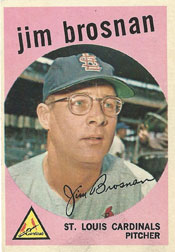
After the Cardinals acquired Jim Brosnan from the Cubs in 1958, he became a premier reliever and an accomplished author.

jim_brosnanBrosnan pitched for the Cardinals in 1958 and 1959 and wrote baseball books such as “The Long Season,” “Pennant Race” and “The Ted Simmons Story.”

“The Long Season” chronicled Brosnan’s 1959 season with the Cardinals and Reds. “Pennant Race” was a diary about Brosnan’s season with the 1961 National League champion Reds. Both books rank among the best and most influential written about baseball. Brosnan, nicknamed “Professor” during his playing days, wrote with sly wit and intelligence.

“The Ted Simmons Story,” written while the Hall of Fame catcher was at the height of his Cardinals career, was a perfect pairing of author and subject. Brosnan and Simmons were two of the smartest, original thinkers to play the game.

Scholar joins St. Louis

Acquired from the Cubs for shortstop Alvin Dark on May 20, 1958, Brosnan was a starting pitcher before being converted into a reliever by Cardinals manager Fred Hutchinson. In 12 starts for the 1958 Cardinals, Brosnan was 4-3 with a 4.50 ERA. In 21 relief appearances, he was 4-1 with seven saves and a 1.67 ERA. His overall numbers for the 1958 Cardinals: 8-4, 3.44 ERA in 33 games.

Oscar Kahan of The Sporting News wrote, “The scholarly, bespectacled right-hander … developed into one of the sharpest bullpen men in the National League.”

After the 1958 season, the Cardinals went on an exhibition tour of Japan. Brosnan filed articles about the trip for the St. Louis Post-Dispatch. In describing their arrival during a stopover in Hawaii, Brosnan wrote the team was greeted “by girls with leis who did their celebrated walk forward, placed the garlands around each blushing player’s neck and whispered ‘Aloha’ while nuzzling the right cheek.”

Aloha, Brosnan informed his St. Louis readers, “is used to say hello, to say goodbye and even just to be friendly when having nothing else to say.”

In “The Long Season,” Brosnan described how Cardinals teammates Don Blasingame and Joe Cunningham were out to “see everything and do everything” during the Japan trip.

“The Japanese bath is an unusual custom for an Occidental to enjoy, but it is an easy habit to get into,” Brosnan wrote. “If it’s not the first thing to do after you land in Japan, it may well be the last before you leave … Cunningham and Blasingame, in their anxiety to do the right thing by the Japanese as well as themselves, absorbed a maximum of Oriental culture on the last day and night of our stay in Tokyo. The rising sun found them padding quietly and contentedly through the lobby of the Imperial Hotel. Sleepless, perhaps, but loose as a goose, like they say.”

Columnist Red Smith described Brosnan the author as “provocative, blunt and highly entertaining. He writes well enough so he doesn’t have to rely on obscenity and scatology as a substitute for an ear for dialogue.”

St. Louis stumble

In 1959, Brosnan experienced a disastrous Opening Day against the Giants at St. Louis. With the Cardinals ahead, 4-3, manager Solly Hemus lifted starter Larry Jackson after seven innings and brought in Brosnan. The Giants scored twice against him in the eighth for a 5-4 lead.

In the bottom half of the inning, Alex Grammas had a RBI-single, tying the score at 5-5. Hemus could have removed Brosnan for a pinch-hitter, but allowed him to remain in the game to pitch the ninth.

Brosnan walked the leadoff batter and, one out later, Jackie Brandt hit a RBI-double. The Giants won, 6-5. Brosnan got the loss and was booed. Boxscore

In “The Long Season,” Brosnan wrote, “It doesn’t take very long, really, to lose your confidence. To embarrass yourself, jeopardize your position, maybe lose your job. Hemus went a long way with me. He could have taken me out. He should have taken me out.”

Heading to hometown

Brosnan allowed eight runs in six relief appearances from May 1 to May 10, 1959. In The Sporting News, Ralph Ray wrote, “From one of the best relief men in the NL a year ago … Brosnan turned into a dud as a fireman.”

Hoping a change in routine would help, Hemus gave Brosnan a start against the Phillies on June 7, 1959, at Philadelphia. It was a bust. Brosnan gave up four runs before he was yanked with one out in the first. The Phillies won, 11-9. Boxscore

The next day, back in St. Louis, Brosnan and his wife dined at Stan Musial’s restaurant. When they returned to the George Washington Hotel, where Brosnan resided during the season, a desk clerk called to Brosnan as he crossed the lobby.

“Solly Hemus was here just a while ago, Mr. Brosnan,” the clerk said. “He left this letter.”

Brosnan waited to open the envelope until he got to his room. The letter, from general manager Bing Devine, informed Brosnan he’d been traded to the Reds for pitcher Hal Jeffcoat. The date was June 8, 1959.

“I sat back on the couch, half-breathing as I waited for the indignation to flush good red blood to my head,” Brosnan wrote. “Nothing happened. I took a deep breath, then exhaled slowly. It’s true. The second time you’re sold you don’t feel a thing.”

Brosnan was 1-3 with two saves and a 4.91 ERA in 20 games for the 1959 Cardinals.

Born and raised in Cincinnati, he regained his form with the Reds and was reunited with Hutchinson, who became the Reds manager in July 1959. Brosnan was 10-4 with 16 saves and a 3.04 ERA in 53 appearances for the 1961 National League champion Reds.

In a nine-year major-league career with the Cubs, Cardinals, Reds and White Sox, Brosnan was 55-47 with 67 saves and a 3.54 ERA.

Read Full Post »

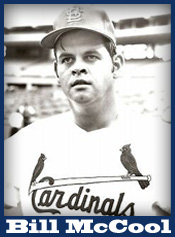
His name, perfect for a young, hard thrower, seemed the kind a novelist or screenwriter would conjure, but Billy McCool was real, a left-hander who broke into the majors with the Reds as a teenager and for two years was among the top relievers in the National League.

bill_mccoolThe Cardinals found McCool nearly untouchable in 1966, when he was a National League all-star.

McCool battled the Cardinals for six seasons, 1964-69. He pitched more innings and had more strikeouts versus the Cardinals than he did against any other big-league opponent.

In 1970, the Cardinals acquired McCool, 26, from the Padres, but his career had peaked. In 18 appearances for the 1970 Cardinals, he was 0-3 with a 6.23 ERA and a save.

Reds rookie

A standout athlete at Lawrenceburg, Ind., McCool was signed by the Reds as an amateur free agent in 1963. McCool, 19, made his big-league debut with the 1964 Reds and was a prominent pitcher for a club in the thick of a pennant race with the Cardinals and Phillies through the final day of the season.

McCool posted six wins and seven saves with a 2.42 ERA for the 1964 Reds. The Sporting News named him its National League Rookie Pitcher of the Year.

Against the Cardinals that season, McCool was 0-2 with a save in six appearances. On Sept. 19, the Reds beat Bob Gibson and the Cardinals in the first game of a doubleheader at Cincinnati. McCool got his first big-league start in the second game. Matched against Ray Sadecki, McCool was good, yielding two runs, striking out seven and issuing no walks in eight innings. Sadecki was better. He pitched eight scoreless innings and combined with Barney Schultz for the shutout in a 2-0 triumph for the Cardinals. Boxscore

After the season, McCool and his brother-in-law, a pharmacist, bought a drugstore in Lawrenceburg. Wrote The Sporting News: “Billy McCool not only throws aspirin tablets, he sells them.”

Billy the Kid

McCool sought a pay raise from the Reds for 1965. According to The Sporting News, contract talks between McCool and assistant general manager Phil Seghi included this exchange:

Seghi: “Billy, you’re just a kid yet. You’re asking for too much money.”

McCool: “If I’m only a kid, why do they give me a man’s job to do?”

Appearing in 62 games, including two starts, in 1965, McCool compiled nine wins and 21 saves for the Reds. He ranked second in the league in saves, behind the Cubs’ Ted Abernathy. McCool was 1-1 with four saves versus the Cardinals that season.

Used exclusively in relief in 1966, McCool had eight wins, 18 saves and a 2.48 ERA. He again ranked second in the league in saves, behind the Dodgers’ Phil Regan. In seven games against the 1966 Cardinals, McCool was 2-1 with three saves and a 1.04 ERA. He struck out 23 Cardinals in 17.1 innings and yielded two earned runs.

In the July 2, 1966, edition of The Sporting News, Mets second baseman Chuck Hiller said of McCool’s fastball, “It looks about the size of a Ping-Pong ball when it comes up to the plate.”

Said Mets third baseman and former Cardinals standout Ken Boyer: “That slider he’s throwing now is the best I’ve ever seen a left-hander have.”

McCool made 11 starts in 31 appearances in 1967 and four starts in 30 appearances in 1968.

Battles with Brock

He had two significant games against the 1968 Cardinals.

On April 23, 1968, the Reds led the Cardinals, 2-0, through eight innings at St. Louis. In the ninth, the Cardinals scored twice off starter George Culver, tying the score. In the 10th, Lou Brock hit a two-run walkoff home run against McCool, giving the Cardinals a 4-2 victory. Boxscore

Two months later, on June 14, McCool got a start at St. Louis. He held the Cardinals scoreless in six innings and limited them to two hits _ singles by Julian Javier and Tim McCarver _ and got the win in a 7-0 Reds triumph. Boxscore It was McCool’s last major-league win as a starter.

Brock hit .147, 5-for-34, with 12 strikeouts against McCool in his career. Another Cardinals hitter who struggled versus McCool was Mike Shannon. He hit .100, 2-for-20, with seven strikeouts. The Cardinals who hit McCool best: Javier at .400, 8-for-20, and Curt Flood at .292, 7-for-24.

The Reds made McCool, 24, available in the expansion draft after the 1968 season and he was selected by the Padres. In four appearances for the Padres against the 1969 Cardinals, McCool was 2-1 with a 4.15 ERA.

On Aug. 6, 1969, at San Diego, McCool relieved Clay Kirby in the ninth with the score tied at 2-2 and retired the Cardinals in order. When ex-Cardinal Ed Spiezio opened the Padres’ ninth with a home run off Steve Carlton, lifting San Diego to a 3-2 victory, McCool got the win, his last in the big leagues. Boxscore

Save for St. Louis

In April 1970, the Cardinals acquired McCool from the Padres for infielder Steve Huntz. After a stint at Class AAA Tulsa, McCool was promoted to the Cardinals in May.

In his third appearance, May 15, 1970, McCool earned a save with two scoreless innings in relief of Mike Torrez in a 1-0 victory over the Cubs at St. Louis. McCool retired Don Kessinger, Glenn Beckert and Billy Williams on ground balls in the eighth. In the ninth, after getting groundouts from Jim Hickman and Johnny Callison, McCool walked Ron Santo before retiring Cleo James on a fly ball. Boxscore

That was McCool’s highlight as a Cardinal. In July, he was demoted to Tulsa. After the season, the Cardinals traded him to the Red Sox for pitcher Bill Landis. McCool never returned to the major leagues.

In seven big-league seasons, he posted a 32-42 record with 58 saves and a 3.59 ERA. In 33 games against the Cardinals, McCool was 6-6 with eight saves, a 3.26 ERA and 68 strikeouts in 66.1 innings.

Previously: Cardinals vs. Reds: rich tradition of July 4 showdowns

Read Full Post »

(Updated April 2, 2021)

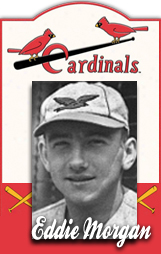
Eddie Morgan of the Cardinals hit a home run on the first pitch he saw in the majors.

eddie_morganHe did it on Opening Day, April 14, 1936, against the Cubs at Sportsman’s Park in St. Louis.

Even before Morgan began his big-league career with a home run, Dodgers manager Casey Stengel had interest in acquiring the rookie after seeing him in spring training games.

Good outfield group

The 1936 Cardinals opened the season with a stellar starting outfield of Joe Medwick in left, Terry Moore in center and Pepper Martin in right. They also had three rookie outfielders _ Lynn King, Lou Scoffic and Morgan _ on the Opening Day roster.

“One thing I don’t have to worry about is my outfield,” Cardinals manager Frankie Frisch said to The Sporting News. “I’ve really got three fine-looking kids in Lou Scoffic, Lynn King and Ed Morgan. The only difficult thing about the outfield situation will be to decide which one of the three we’ll send back to the minors. That’s how good they all are.”

Cardinals ace Dizzy Dean got raked for nine runs in six innings in the season opener against the defending National League champion Cubs at Sportsman’s Park in St. Louis. With the Cubs ahead, 12-3, in the seventh, Frisch tabbed Morgan, 21, to make his big-league debut as a pinch-hitter for reliever Bill McGee.

A left-handed batter, Morgan swung at the first pitch he saw from starter Lon Warneke and hit a drive into the pavilion in right-center for a two-run home run. Boxscore

Soon after, Stengel and the Dodgers approached Cardinals general manager Branch Rickey about a proposed trade. The Cardinals wanted third baseman Joe Stripp. When Stengel asked for Morgan, Rickey declined and the talks ended without a deal.

Morgan, 5 feet 10, 160 pounds, appeared in eight games for the Cardinals, hitting .278 (5-for-18, with four singles and the home run). Unlikely to get much playing time with St. Louis, Morgan was sent to Class AA Columbus (Ohio) on May 9.

In his first at-bat for Columbus on May 10, Morgan hit a home run off Milwaukee’s Joe Heving.

Let’s make a deal

By July, the Cardinals were seeking pitching. The Dodgers still wanted Morgan. When the Dodgers offered George Earnshaw, 36, a right-hander in his last season in the majors, the Cardinals accepted, with both clubs agreeing that Morgan would report to the Dodgers after the conclusion of the Columbus season.

In reporting the trade, The Sporting News called Morgan a “hard-hitting farmhand” and “a left-handed pull hitter of the type the Dodgers need to caress that short right-field wall at Ebbets Field.”

Throughout the summer, Stengel spoke enthusiastically about his plans to play Morgan in September games with the Dodgers, who were out of contention and heading for a seventh-place finish.

Morgan hit .299 in 118 games for Columbus, but, just before the minor-league season ended, he fractured a bone in his lower leg, preventing him from joining the Dodgers in September.

After the 1936 season, Stengel was replaced as manager by Burleigh Grimes, the former Cardinals spitball pitcher. Grimes managed Morgan with the 1935 Bloomington (Ill.) Bloomers. Morgan hit .347 in 112 games for that Cardinals Class B minor-league club.

Expectations were for Morgan to compete for a starting outfield job with the 1937 Dodgers, but he hit .188 in 39 games for them and was returned to the minors in July. He never played in the big leagues again. His lone major-league home run was the one he hit in his first at-bat.

Morgan played in the minor leagues until 1950. In 17 minor-league seasons, he had a .313 batting average and hit 172 home runs.

Read Full Post »

« Newer Posts - Older Posts »