Feeds:
Posts
Comments

Archive for the ‘Trades’ Category

(Updated June 26, 2020)

The Cardinals paid $75,000 and gave up a trio of players for a pitcher who netted them two outs.

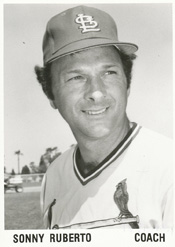
memo_lunaGuillermo Romero “Memo” Luna pitched in one game for the Cardinals in 1954, failed to complete an inning and never played in the majors again.

A left-hander, Luna was the first Mexican-born player to appear in a game for the Cardinals.

On April 20, 1954, he got the start in his Cardinals debut against the Reds at St. Louis, even though his arm was hurting. In the clubhouse before the game, the St. Louis Globe-Democrat reported, “Luna smiled his usual pleasant fashion and said his arm felt fine and indicated by widening the grin and slapping his glove that he was ready to go out and do a little pitching.”

The confidence gave way to a shelling.

In the first inning, Luna yielded two runs on two doubles, two walks and a sacrifice fly. He was lifted with two outs. One of the outs came on a fly ball caught by Stan Musial with his back against the wall. Boxscore

“He was pounded so hard … that manager Eddie Stanky would hardly be justified in another such risky trial,” the St. Louis Post-Dispatch observed.

The Globe-Democrat declared Luna had “a hard time throwing a nickel’s worth” of the price the club paid to acquire him.

A few days later, the Cardinals sent Luna to their farm club in Rochester, N.Y.

Though he continued to pitch in the minor leagues and in Mexico until 1961, Memo Luna never returned to the majors.

His big-league career totals: 0-1 record, 27.00 ERA, 0.2 innings, 2 hits, 2 runs, 2 walks, 6 batters faced.

Super southpaw

In 1951, after he was 26-13 for Tijuana of the Southwest International League, Luna was pursued by the St. Louis Browns, but the San Diego club in the Pacific Coast League had a working agreement with Tijuana and acquired him. In addition to his pitching, Luna was a sketch artist. Asked what he sketched, Luna told the Globe-Democrat, “Everything in life.”

On Sept. 23, 1953, the Cardinals acquired Luna from San Diego for $75,000 and players to be named. They eventually sent pitchers Cliff Chambers and John Romonosky and outfielder Harry Elliott to San Diego, completing the deal.

At the time, Luna, 23, seemed worth the price. He had a 17-12 record and a league-best 2.67 ERA with 16 complete games for San Diego in 1953. Jack Bliss, a catcher for the 1908-1912 Cardinals, watched Luna at San Diego and told Cardinals manager Eddie Stanky, “He’s got exceptional control and a good curve.”

Cardinals scout Joe Mathes checked him out and was impressed. Luna is “a great control pitcher with other skills,” Mathes told the Post-Dispatch. “His knuckleball and curve are very good, he has tremendous poise on the mound and is outstanding in fielding his position and holding runners on base.”

That fall, Luna pitched in the Cuban League for Almendares and manager Bobby Bragan. The Cardinals granted permission with the understanding Luna would quit around Dec. 1, The Sporting News reported.

Luna posted a 4-1 record in his first five decisions for Almendares. The Sporting News wrote Luna “has shown remarkable poise and control, plus a fine knuckler.”

After Luna lost his next two decisions as the Dec. 1 deadline loomed, the Cardinals suggested he leave Cuba and rest his arm before reporting to spring training in February. Luna obliged and went to St. Louis, where he passed a physical examination.

While in St. Louis, Luna told the Cardinals that a day in his honor was being planned in Mexico City and he was being asked to pitch, the Globe-Democrat reported. The Cardinals misunderstood, thinking the game was in December, not February, and agreed to let Luna pitch, the Globe-Democrat reported.

Luna went home to Mexico, believing he had the Cardinals’ approval to pitch on Memo Luna Day.

Worn down

On Feb. 19, 1954, pitching for the Mexico City Reds against Aztecas, Luna struck out a batter in the third inning and grabbed his left elbow in pain.

According to The Sporting News, Luna stayed in the game until its completion, yielding five runs and nine hits in nine innings, and “was throwing with only half speed after the injury.” It was the second farewell game he pitched since returning to Mexico. The Cardinals’ front office had approved him to pitch only one, the Post-Dispatch reported.

Luna reported late to Cardinals spring training camp in Florida, complaining of a sore arm.

“We asked Luna to quit pitching Dec. 1, but we have no way of controlling what a man does back in his home country,” said Stanky.

In spring training, Luna failed to impress. He gave up three runs in two innings to the Phillies and surrendered a two-run, game-winning home run to the Reds’ Gus Bell. The Post-Dispatch described his exhibition game efforts as “a sorry spring.”

Having paid a high price for him, the Cardinals put Luna on the Opening Day roster. He got the start in the Cardinals’ sixth game of the season _ and never got another chance with them again.

“Luna, in Spanish, means moon, but only the English version, outfielder Wally Moon, has resembled a star in the making,” the Post-Dispatch concluded.

After Luna’s demotion to Rochester, Bob Burnes of the Globe-Democrat wrote, “Whether he hurt his arm before he started for spring training or whether it was something else, like maybe getting and feeling a little lost in the hustle and bustle of major league work, no one can say except Luna and he apparently can’t explain it himself. If he regains his control and confidence, both of which he must have to win, the Cardinals probably will accommodate him with a second look. If he doesn’t, they’ll probably leave him at Rochester.”

In late June 1954, when asked whether Luna would be a candidate to return to the Cardinals, Rochester manager Harry Walker told the Post-Dispatch, “Frankly, I’d have to consider him doubtful.”

Luna told the Rochester Democrat and Chronicle, “Could I pitch for the Cardinals? Without the fastball, no. If my arm was not hurt anymore, I can pitch for the Cardinals.”

Said Walker: “His changeup and his curveball are his strong points, but his control has to be sharp or he’s in trouble.”

Luna was 9-11 with a 3.50 ERA for Rochester in 1954.

Used primarily in relief, Luna pitched for manager Johnny Keane with the Cardinals’ farm club in Omaha in 1955 and was 4-4 with a 5.43 ERA. Luna spent a season in the Orioles’ farm system and played the rest of his career in Mexico.
 

Read Full Post »

(Updated April 11, 2020)

Uncertain whether outfielder Enos Slaughter could adjust to being a role player, the Cardinals decided to trade him.

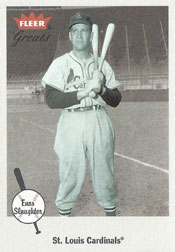
enos_slaughter3Caught off-guard, Slaughter and teammate Stan Musial broke into tears.

On April 11, 1954, the Cardinals sent Slaughter to the Yankees for three prospects: outfielders Bill Virdon and Emil Tellinger and pitcher Mel Wright.

The trade occurred two weeks before Slaughter turned 38. He was the Cardinals team captain, a 10-time all-star who held the team record for games played (1,820) and RBI (1,148). Slaughter joined the Cardinals in 1938 and helped them to a World Series championship in 1942. After three years in the service, he returned to the Cardinals in 1946 and led them to another World Series title, scoring the winning run with his mad dash from first to home in Game 7.

In 13 seasons with the Cardinals, Slaughter batted .305 with 2,064 hits and an on-base percentage of .384. Known for his all-out hustle, he twice led the National League in triples (17 in 1942 and 13 in 1949). In 1942, he was the league leader in hits (188) and total bases (292). He also led the league in RBI (130) in 1946 and doubles (52) in 1939.

Slaughter showed no signs of slowing. In 143 games for the 1953 Cardinals, he produced 143 hits, 34 doubles, 89 RBI, a .291 batting average and .395 on-base percentage as the right fielder.

Youth movement

Slaughter went to spring training camp in St. Petersburg, Fla., in 1954 expecting to be a regular again in an outfield with Musial and Rip Repulski. He was surprised when, late in spring training, Cardinals manager Eddie Stanky told The Sporting News, “I’ll be satisfied if we can get 75 to 90 games out of the captain.”

Slaughter groused about the possibility of becoming a role player. Whether that was the normal grumbling of a proud veteran who didn’t want to concede playing time, or a tone of dark dissent that threatened to divide the team isn’t certain.

The Cardinals weren’t taking any chances. They wanted rookie Wally Moon to be the starting center fielder, moving Musial from left to right and Repulski from center to left.

Moon “is the best young prospect I’ve seen here in three years outside of Repulski,” Stanky told the St. Louis Post-Dispatch.

Informed of the trade by general manager Dick Meyer and Stanky after an exhibition game, Slaughter sobbed.

Slaughter called the trade “the greatest shock I ever had in my life.”

“You give everything you’ve got for an organization and then you get stepped on,” Slaughter said to the St. Louis Globe-Democrat.

Crying game

In his book “Stan Musial: The Man’s Own Story,” Musial said, “In the clubhouse, when the rest of us got the word, we were stunned. Dressing even more slowly than usual, I was the last one out. At the lot where I parked my car … I found Slaughter, still wiping his eyes. We looked at each other _ and both burst into tears.”

In justifying the trade, Stanky said, “A player like Slaughter just can’t stand sitting on a bench.”

“We are building this club with young talent,” Stanky said, “I’m sold on the way Wally Moon performed for us. If we kept Slaughter, it would mean Moon would go back to the minors.”

Said Slaughter: “I’ll be around when a lot of these guys are gone. I’m not finished. I’ll prove it to them.”

According to newspaper reports, the trade was the most unpopular with Cardinals fans since the club dealt Rogers Hornsby to the Giants after winning the 1926 World Series championship.

St. Louis writers reflected the mood of their readers. Among the tributes to Slaughter:

_ Bob Broeg in The Sporting News: “There never was a more determined competitor or hustler than the last of the old Gashouse Gang _ a hard runner, brilliant outfielder, clutch hitter.”

_ Bob Burnes in the Globe-Democrat: “Slaughter was more than a ballplayer, as any Cardinals fan could tell you. He was an institution _ not only among the fans but among the players as well.”

_ J. Roy Stockton in the Post-Dispatch: “Enos was the best competitor the club had. He still was a standout for batting skill and hustle.”

Desperate move?

The Yankees, who had an outfield of Gene Woodling in left, Mickey Mantle in center and Hank Bauer in right, were delighted with the deal for Slaughter. “We gave up practically nothing for him, so why not take him?” Yankees co-owner Del Webb said.

Other baseball executives saw Slaughter as a fading talent. The Sporting News polled the seven National League general managers besides Meyer and each said he wasn’t interested in pursuing a deal with the Cardinals for Slaughter.

Buzzy Bavasi of the Dodgers, who were planning to put rookie Sandy Amoros into an outfield with Duke Snider and Carl Furillo, said, “Personally, I wouldn’t take Slaughter over Amoros, would you?”

In response to the Yankees, Frank Lane, general manager of the American League White Sox, scoffed, “You can’t pack Old Man Time on your back and still be a great ballplayer … It was a desperate move by them.”

Actually, it was a good move for the Cardinals and Yankees.

Moon hit a home run in his first at-bat for the Cardinals on Opening Day and went on to win the 1954 National League Rookie of the Year Award, generating 193 hits, 106 runs, 18 steals, a .304 batting average and a .371 on-base percentage.

The next year, Virdon came up to the Cardinals and won the 1955 National League Rookie of the Year Award.

Slaughter adjusted well to being a role player with the Yankees. He hit .355 with 12 walks as a pinch-hitter for the 1954 Yankees. He played in the major leagues until 1959, appeared in three World Series (1956, 1957 and 1958) for the Yankees and was elected to the National Baseball Hall of Fame.


Read Full Post »

Their given names were John and George.

Their baseball names were Sonny and Sparky.

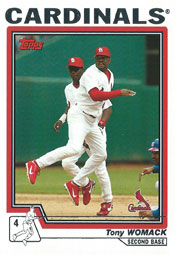
sonny_rubertoTogether, they contributed to a standard of teaching that became a hallmark of the Cardinals.
Sonny Ruberto, mentored by Sparky Anderson in the Cardinals’ system, influenced St. Louis players and prospects from 1977-81 as a big-league coach and minor-league manager.

Two of his pupils in the Cardinals system, Jim Riggleman and John Stuper, carried on with reputations as first-rate instructors. Riggleman managed five big-league teams. Stuper, who started and won Game 6 of the 1982 World Series for the Cardinals, coached the Yale University baseball team.

George “Sparky” Anderson, who built a Hall of Fame career as manager of the Reds and Tigers, was 30 when he began his managerial career with Class AAA Toronto in 1964. A year later, he became a manager in the Cardinals system.

John “Sonny” Ruberto was 24 when he began his managerial career with the Padres’ Class A Lodi club in 1970. At 31, he became the youngest coach in the major leagues when he joined the staff of first-year Cardinals manager Vern Rapp in 1977.

Cardinals prospect

A standout catcher at Curtis High School in Staten Island, N.Y., where he played with other future major leaguers such as Terry Crowley and Frank Fernandez, Ruberto signed with the Cardinals as an amateur free agent in 1964. Two years later, he was on a Class A St. Petersburg team managed by Anderson.

In a 1966 game that began on June 14 and ended at 2:30 a.m. on June 15, the visiting Miami Marlins beat St. Petersburg, 4-3, in 29 innings. “It was the darndest thing I’ve ever seen,” Anderson told The Sporting News.

Ruberto played all 29 innings _ the first nine as catcher and the last 20 at shortstop. He had two hits in 10 at-bats and scored a run.

Ruberto hit .283 in 88 games for St. Petersburg. The next year, he played for the Cardinals’ Class A Modesto club, managed by Anderson.

On May 22, 1969, the Cardinals traded Ruberto and second baseman John Sipin to the Padres for infielder Jerry DaVanon and first baseman Bill Davis. Ruberto made his big-league debut as a player with the Padres that month.

Big Red Machine

After a season managing Lodi, Ruberto in 1971 joined the Reds organization, where he was reunited with two key figures from his Cardinals days: Anderson (the Reds’ manager) and Bob Howsam, the former Cardinals general manager who took over the same role with Cincinnati.

Ruberto resumed his playing career and was sent to Class AAA Indianapolis. His manager there for the next five years, 1971 through 1975, was Rapp. As catcher, Ruberto was credited with helping the progress of several Reds pitching prospects, including Joaquin Andujar, Ross Grimsley, Tom Hume, Milt Wilcox and Pat Zachry.

“I feel I had something to do with their development,” Ruberto told The Sporting News.

When Rapp was named Cardinals manager, replacing Red Schoendienst, for the 1977 season, he selected Ruberto to be the first-base coach.

Wrote The Sporting News: “Like Rapp, Ruberto had been a career Triple-A catcher highly regarded for his ability to handle pitchers. Ruberto even has some ideas on helping Ted Simmons improve his backstopping duties.”

Rapp was brought to the Cardinals to instill discipline. At spring training in 1977, The Sporting News reported, “Rapp sized up his charges to make sure that the regulation baseball uniforms were worn properly. He had coach Sonny Ruberto demonstrate how he wanted the uniforms worn.”

At the helm

Rapp was fired in April 1978 and replaced by Ken Boyer. After the season, two of the coaches Boyer had inherited, Ruberto and Mo Mazzali, were replaced by Schoendienst and Dal Maxvill.

The Cardinals, though, kept Ruberto in the organization, naming him manager of the 1979 St. Petersburg club, succeeding Hal Lanier, who was promoted to Class AAA Springfield.

“What kind of manager will I be?” Ruberto said in response to a question from the St. Petersburg Times. “Well, a little of Vern Rapp, a little of Sparky Anderson, a little of Billy Martin and a lot of Sonny Ruberto.”

St. Petersburg finished 64-71, but the Cardinals were pleased with how their prospects, such as Stuper and fellow starting pitcher Andy Rincon, developed under Ruberto.

In 1980, Ruberto managed the Cardinals’ Class AA Arkansas team to an 81-55 record and a Texas League championship. Stuper had a 7-2 record for Arkansas. Riggleman, a third baseman, hit .295 with 21 home runs and 90 RBI in 127 games.

Ruberto managed the Cardinals’ Class A Erie team to a 44-30 record in 1981.

He operated a photography business in St. Louis and resided there with his family for 26 years.

Read Full Post »

A minor move for a one-time heartbreaker paid off in a major way for the 2004 Cardinals.

tony_womackDesperate for a second baseman late in spring training, the Cardinals acquired Tony Womack from the Red Sox for reliever Matt Duff on March 21, 2004.

The Cardinals weren’t sure Womack was even healthy enough to play.

He turned out to be the catalyst for a club that won the National League pennant.

Womack, 34, had undergone ligament replacement surgery on his right elbow in October 2003.

The Cardinals, unwilling to enter the 2004 season with either Marlon Anderson or Bo Hart as their everyday second baseman, took a chance on Womack, even though they were told he still was a month away from being able to field and throw.

After Womack reported to the Cardinals’ spring training camp in Jupiter, Fla., pulling into the players’ parking lot in a purple Lamborghini, he declared, “I’m ready to go now. I’ve been ready for a while,” the St. Louis Post-Dispatch reported.

The Cardinals immediately put him into minor-league games on the back fields of the training complex and, sure enough, Womack proved fit. His elbow had healed far ahead of schedule.

An impressed and grateful Cardinals management team, seeking a replacement for departed free-agent second baseman Fernando Vina, quickly made plans to get him into the starting lineup and atop the batting order in big-league games.

Forgive us our trespasses

Three years earlier, Womack was a Cardinals nemesis. Playing shortstop for the Diamondbacks, Womack delivered the game-winning hit that eliminated the Cardinals in the fifth and deciding game of the National League Division Series.

On Oct. 14, 2001, at Phoenix, Womack came to bat in the bottom of the ninth inning of Game 5 against reliever Steve Kline with the score tied at 1-1, two outs and a runner at second. Womack’s single to left drove in pinch-runner Danny Bautista, giving the Diamondbacks a 2-1 victory and enabling them to advance on the path toward their first World Series championship. Boxscore

Reminded of that hit after he joined the Cardinals, Womack told Joe Strauss of the Post-Dispatch, “I’m sorry. I didn’t mean to break their hearts, but better their heart than mine.”

In response, Cardinals manager Tony La Russa, chuckling, told Rick Hummel of the Post-Dispatch, “I’ve forgiven (Womack). I haven’t forgiven Kline. I’ve got to make sure Kline doesn’t throw batting practice to Womack.”

Said Kline of Womack: “I like the guy. Now he doesn’t have to get a hit off me.”

Spark plug

After Womack singled twice and stole two bases against Tigers catcher Ivan Rodriguez in his first Cardinals spring training game, La Russa gushed, “He looked like what I thought he’d be, a guy with a lot of energy who can be very disruptive. Impressive.”

Two weeks after he was acquired, Womack was the 2004 Cardinals’ Opening Day second baseman. Batting leadoff against the Brewers at St. Louis, Womack was 1-for-3 with two walks and a run scored. Boxscore

He had a strong April (.351 batting average with seven steals and a .415 on-base percentage) and, except for a slump in May, was consistently productive all season.

Womack hit especially well against some of St. Louis’ Central Division foes: . 382 (26-for-68) vs. the Reds; .373 (25-for-67) vs. the Cubs; .357 (25-for-70) vs. the Pirates; and .333 (15-for-45) vs. the Brewers.

In 145 regular-season games for the 2004 Cardinals, Womack had 170 hits, scored 91 runs and had 26 stolen bases. He batted .307 and had an on-base percentage of .349. Both figures were far better than his career marks in those categories. (In 13 major-league seasons, Womack had a .273 batting average and .317 on-base percentage.) He fielded adequately, with 15 errors in 1,113 innings at second base for St. Louis.

In the 2004 World Series, Womack batted .182, 2-for-11, in the four games against the Red Sox, but fielded flawlessly. He then became a free agent and signed with the Yankees. He eventually bounced to the Reds and the Cubs. Two years after leaving the Cardinals, his playing career was finished.

In 2005, the Cardinals replaced Womack with another free agent, Mark Grudzielanek.

Previously: Tino Martinez, Mike Matheny and the Cardinals’ Easter brawl

Read Full Post »

(Updated July 14, 2019)

In dealing Brett Wallace, the Cardinals acquired one of the cornerstones of their batting order, left fielder Matt Holliday, and cleared the way for David Freese to become their third baseman.

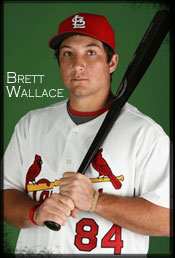
brett_wallaceHolliday and Freese became key players for Cardinals teams that won a World Series championship and two National League pennants.

Heavy hitter

Wallace, a left-handed batter, was chosen by the Cardinals with the 13th pick in the first round of the June 2008 amateur draft. At Arizona State University, he twice led the Pacific-10 Conference in batting average, home runs and RBI.

Though the Cardinals hoped Wallace could handle third base, scout Chuck Fick said, “His position is hitting.”

“It’s too difficult to walk away from a guy who has this kind of chance to hit … He’s a dangerous hitter,” Fick said to the St. Louis Post-Dispatch.

Said Jeff Luhnow, the Cardinals’ vice-president of player development: “He knows, as do we, his value is what he does at the plate.”

Wallace was listed at 6 feet 1 and between 230 and 245 pounds. The Cardinals’ other 2008 first-round pick, awarded for the loss of free-agent reliever Troy Percival, was pitcher Lance Lynn.

Derrick Goold of the Post-Dispatch wrote, “Lynn, like Wallace, has a bulky frame and the Cardinals acknowledge both players will have to watch their weight to reach the potential that got them drafted.”

After receiving an estimated bonus of $1.8 million from the Cardinals, Wallace reported to the minor leagues in July 2008. In 54 games combined for Class A Quad Cities and Class AA Springfield, Wallace had 68 hits and a .337 batting average.

Big deal

Wallace was playing third base and batting .293 (65 hits in 62 games) for Class AAA Memphis in 2009 when he was traded on July 24 to the Athletics with two other prospects, pitcher Clayton Mortensen and outfielder Shane Peterson, for Holliday.

Wallace was the “keystone of the deal,” said Cardinals general manager John Mozeliak, who added that his counterpart, Billy Beane of the Athletics, insisted on Wallace being involved in any trade talks.

“He’s a guy we’ve always sort of longed for,” Beane told the San Francisco Chronicle.

The Cardinals were bullish on Wallace’s offense _ Mozeliak said Wallace “is not the type of hitter you’re going to replace easily” _ but didn’t see him fitting a position. With Albert Pujols at first base, the Cardinals saw third base as the best option for Wallace.

“There was debate within the Cardinals’ front office whether he could be an everyday third baseman in the majors,” the Post-Dispatch reported. “Uncertainty about that made him available in the right trade.”

Post-Dispatch columnist Bernie Miklasz endorsed the trade: “Wallace represents tomorrow, but you don’t worry about tomorrow when Albert Pujols is batting third in your lineup today. Make the most of it.”

Steal for St. Louis

Freese, who was at Springfield, replaced Wallace as Memphis’ third baseman. He became the Cardinals’ starter the next year and was a World Series hero in 2011.

Holliday immediately boosted the 2009 Cardinals’ production. He batted .353 (83 hits in 63 games) with 55 RBI, helping the Cardinals win the Central Division title.

Wallace never played in a big-league game for the Athletics. He was traded to the Blue Jays and was stuck in their minor-league system until he joined the Astros, where he eventually was reunited with Luhnow, who became their general manager in December 2011.

In six major-league seasons with the Astros (2010-13) and Padres (2015-16), primarily as a first baseman, Wallace batted .238 and had more strikeouts (432) than hits (305).

Previously: Fernando Salas: Cool Hand Luke of 2011 Cardinals

Read Full Post »

(Updated July 1, 2024)

Desperate for pitching, the 1954 Cardinals settled on a simple solution: Raid the Yankees, winners of five consecutive World Series titles.

vic_raschiThe strategy backfired, but the Cardinals at least succeeded in electrifying the fan base and creating buzz throughout the major leagues.

On Feb. 23, 1954, the Cardinals made bids to pry two right-handed aces, Vic Raschi and Allie Reynolds, from the Yankees. They got Raschi but failed to land Reynolds.

The acquisition of Raschi, one of the top pitchers in the American League, was considered a bold move by the Cardinals. Though some were skeptical about why the Yankees were willing to part with Raschi, many believed the deal vaulted the Cardinals from also-rans to National League pennant contenders.

Raschi, 35, had a regular-season record of 120-50 in eight years with the Yankees. He was 5-3 with a 2.24 ERA in six World Series (1947 and 1949-53) for New York. Reynolds, 37, was 118-56 from 1947-53 with the Yankees. He was 7-2 with a 2.79 ERA in six World Series for them.

Big spenders

In 1954, the Cardinals and Yankees both trained in St. Petersburg, Fla. While there, Cardinals owner Gussie Busch saw Dan Topping, a co-owner of the Yankees, and asked whether the Yankees could spare “any kind of right-hander with a fair chance,” The Sporting News reported.

Busch had deep pockets and a desire to spend. Meanwhile, several Yankees were feuding with general manager George Weiss over contract offers for the 1954 season. The Yankees were willing to dump some of their aging, high-priced talent.

According to The Sporting News, Busch “was astonished” when he found the Yankees willing to deal. Busch offered $85,000 for Raschi and $100,000 for Reynolds, according to John Carmichael of the Chicago Tribune.

First, both pitchers needed to clear waivers through the American League in order for the transactions to be completed with the Cardinals. Raschi went unclaimed; Reynolds didn’t. When the Indians claimed him, the Yankees pulled Reynolds off the waiver list and kept him for the 1954 season.

Surprise shake-up

Raschi was at the beach when Bill Greene, a photographer for the New York World-Telegram and Sun, found him and informed him of the trade.

Greene: “You’ve been sold to the Cardinals.”

Raschi: “No, you’re kidding.”

Raschi, who was 13-6 for the 1953 Yankees, wanted a salary for the 1954 season of $40,000, the same amount he was paid in 1951 (when he won 21 for the third season in a row) and in 1952 (when he won 16). Weiss offered $34,000.

“This club is complacent … Raschi’s attitude was like so many other attitudes on this club,” Weiss said.

Almost no one saw the deal coming. Wrote The Sporting News: “Imagine the amazement of the writers when (it was) announced the New York club had sold Raschi to the Cardinals.”

Frank Lane, general manager of the White Sox, thought Raschi was in decline. “As short as the Yankees are on pitchers, don’t you think they would have kept him if he possibly could have helped them? Guys the Yankees get rid of usually are through,” Lane said.

Most, though, thought the Cardinals helped themselves. The 1953 Cardinals had finished at 83-71 _ 22 games behind the National League champion Dodgers.

_ Steve O’Neill, Phillies manager: “Before this deal, we figured we had only Brooklyn and Milwaukee to beat. But now we have the Cards as well.”

_ Leo Durocher, Giants manager: “This tightens up our race some more. I know Raschi is a great competitor.”

_ Casey Stengel, Yankees manager: “(Raschi) certainly wasn’t sold for anything he did on the field. They must have been awfully sore at him in the front office.”

_ Bob Broeg, St. Louis writer: “The acquisition of Vic Raschi was hailed from ballpark front office to tavern backroom … Raschi considerably strengthened the club’s pennant chances.”

_ The Sporting News: “If Raschi wins for the Cards, and the Bombers fail, there will be a storm over the Bronx which will rock (Yankee) Stadium to its very foundations.”

In his autobiography, “The Mick,” Yankees slugger Mickey Mantle said, “They called Raschi the Springfield Rifle. He was a battler, always pushing himself to the limit of his abilities and probably beyond, playing the bulk of his career on damaged knees.”

Ace folds

Raschi heightened expectations, saying, “I expect to have three or four more seasons of top-flight pitching … I’ll be disappointed if I don’t win 20 games.”

Cardinals manager Eddie Stanky said he’d be pleased if Raschi matched the 13 wins he had in 1953. “I’m sure he can do that, at least,” Stanky said.

Raschi won his first five decisions for the 1954 Cardinals, including a shutout of the Giants on May 19 at New York. Raschi held the Giants to five singles, two by Willie Mays, in a 3-0 Cardinals triumph. Boxscore The win gave Raschi a career mark of 125-50, a .714 winning percentage.

When Raschi shut out the Giants again, on a three-hitter on July 29 Boxscore, his record was 8-5, but an assortment of ailments, including back pain, plagued Raschi in the final two months. He lost his last four decisions and finished the 1954 season at 8-9 with a 4.73 ERA in 30 games.

Raschi ranked second on the 1954 Cardinals in starts (29), innings pitched (179) and strikeouts (73). He was 3-0 with 1.85 ERA against the Giants, who won the pennant that season, but Raschi didn’t deliver at the level he and the Cardinals expected. St. Louis led the league in batting (.281) but was seventh in pitching (4.50 ERA). The Cardinals slumped to 72-82 _ 25 games behind the Giants.

At Cardinals spring training in 1955, Raschi was limited to five innings pitched. He made one start in the regular season, got shelled by the Reds and was released the next day.

“I always admired Vic as a great competitor,” Stanky told The Sporting News, “and he proved himself a man, a real man, the way he took this unfortunate news, but we’ve got to stake our chances on younger pitchers who have shown promise.”

Read Full Post »

« Newer Posts - Older Posts »
