Feeds:
Posts
Comments

Archive for the ‘Trades’ Category

(Updated May 24, 2025)

A central figure in an unpopular trade, Alvin Dark responded with a hitting display that endeared him to Cardinals fans and gained him satisfaction against his former team.

al_darkDark was a three-time all-star shortstop with the Giants and 1948 National League Rookie of the Year with the Braves. He played for 14 seasons in the major leagues and hit a combined .323 in 16 World Series games for the Braves (1948) and Giants (1951 and 1954). Dark also managed four big-league clubs, winning a pennant with the 1962 Giants and a World Series championship with the 1974 Athletics.

On June 14, 1956, Cardinals general manager Frank Lane traded second baseman Red Schoendienst, a nine-time all-star, to the Giants. The key player the Cardinals received in return was Dark.

The full trade was Schoendienst, outfielder Jackie Brandt, catcher Bill Sarni, pitcher Dick Littlefield and two players to be named (shortstop Bob Stephenson and pitcher Gordon Jones) to the Giants for Dark, outfielder Whitey Lockman, catcher Ray Katt, pitcher Don Liddle and cash.

Lane made the trade because he wanted to move Don Blasingame from shortstop to second base. He figured trading Schoendienst would land him a shortstop in return. Lane had been trying for months to get Dark.

“The Giants wanted a second baseman, the Cardinals a shortstop and everybody was pleased except the Cardinals fans, who, understandably, loved Red. He was the finest second baseman in the game,” Dark said in his book “When in Doubt, Fire the Manager.”

Said Lane to The Sporting News: “We let Schoendienst go with great reluctance, naturally, but to get a star like Dark you’ve got to give a star.”

Cardinals fans expressed their displeasure. “The switchboard at Busch Stadium lighted up like a Christmas tree and stayed that way for more than two hours June 14,” wrote The Sporting News.

Dark, 34, hit .366 in his first 28 game for the Cardinals.

On July 12, the Giants visited St. Louis for the first time since the trade. Dark had nine hits in 11 at-bats and seven RBI, sparking the Cardinals to a three-game sweep. Schoendienst had three hits in 11 at-bats and walked twice.

In the first game of the series, won by the Cardinals, 5-3, on July 12, Dark drove in the winning run with a sacrifice fly in the seventh. Boxscore

Dark drove in the winning run again in Game 2, a 7-5 Cardinals triumph on July 13. With the score tied at 5-5 in the eighth, he hit a two-run double against Hoyt Wilhelm. Boxscore

In the series finale on July 14, Dark was 3-for-3 with three RBI against starter Al Worthington in the Cardinals’ 5-2 triumph. Boxscore

Dark had seven hits in his last seven at-bats of the series.

“He’s a polished professional, a real leader who leads without being ostentatious,” Lane said.

Dark hit .286 in 100 games for the 1956 Cardinals. According to the 2004 Cardinals Yearbook, no one in the majors used a bat as light as Dark’s: 28 ounces.

In 1957, Dark batted .290. One of his best games occurred July 24 when he tripled twice _ against Sal Maglie and Sandy Koufax _ and scored twice in a 3-0 Cardinals victory over the Dodgers. Boxscore

By 1958, Dark, 36, had lost fielding range. The Cardinals had a replacement, shortstop Eddie Kasko, on the roster. Dark was traded to the Cubs on May 20, 1958, for pitcher Jim Brosnan.

Dark had 306 hits in 258 games over three seasons for the Cardinals and batted .289. He produced four hits in a game seven times.


Read Full Post »

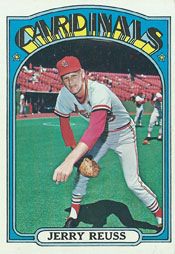
Jerry Reuss Banner

On Nov. 11, 2014, I visited the Dodgers Adult Baseball Camp at Historic Dodgertown in Vero Beach, Fla., to seek out Jerry Reuss for an interview about his time as a pitcher with the Cardinals.

Dressed in a home white Dodgers uniform, Reuss, 65, was patient, thoughtful, articulate and polite.

He debuted with the Cardinals in September 1969 and pitched for them in 1970 and 1971, posting an overall 22-22 record before he was traded to the Astros in April 1972.

In a 22-year major-league career, primarily with the Dodgers (nine years) and Pirates (six years), Reuss was 220-191 with a 3.64 ERA. In 2014, he published a book “Bring in the Right-hander,” a delightful retrospective on his career. You can order an autographed copy at his Web site www.jerryreuss.com.

jerry_reuss2Q.: Two months after the Cardinals traded Steve Carlton, they traded you. It was first reported you were traded because you were in a contract dispute with owner Gussie Busch. Later it comes out it was about your moustache. True?

Reuss: “It was about growing a moustache. Bob Broeg (a writer) had said something to that effect and I thought, ‘No, they wouldn’t be that concerned about that.’ I lived with that for 20 or 25 years.

“It wasn’t until the mid-90s when I was in St. Louis and I went to a ballgame and I saw Bing Devine, who was working as a scout. He had been the general manager of the Cardinals when I was traded. I said, ‘Bing, you got a minute?’ He said, ‘Yeah. Why don’t you sit down and we’ll talk.’ So I asked him about the deal. I figured enough time had passed that I could do that.

“He was more than happy to tell me. He said Mr. Busch at times would act on an impulse. This was one of those times. He insisted on me being traded because I had the moustache. Bing thought if given a little time he (Busch) would come to his senses and make a wise baseball decision rather than a personal decision.

“But he kept hammering about the moustache and would say, ‘Did you get rid of him yet? Why not?’ And the ultimatum was put like this: ‘If you don’t get rid of him, I’ll get rid of you and get somebody who will get rid of him.’ So when you’re faced with a situation like that, you do what has to be done.”

Q.: You still have a moustache and it has become something of a signature look for you…

Reuss: “Yeah. But when you look back about how that was the thinking in baseball in the early 70s and then just two or three years later baseball began to change with the times. Guys were coming in with long hair and beards. And you just wonder: What was the stink all about?

“So on the matter of just a little bit of facial hair _ you could barely see it _ people would ask, “Why didn’t you shave it?’ And I’d say, ‘There wasn’t a rule that the Cardinals had to be clean-shaven and be like a military situation. If it doesn’t bother anybody, if it’s not a rule, then what are we talking about here?’ ”

Q.: Your last year with the Cardinals, 1971, was the year your teammate, Joe Torre, led the National League in hitting and RBI and won the MVP Award. Could you see then the leadership qualities that later would make him a Hall of Fame manager with the Yankees?

Reuss: “Oh, sure. Lights out. At that early age, I just wondered whether there were guys like that on every team.

“He was managing the club on the field. Red (manager Schoendienst) just stepped back and said, ‘Joe, you have a grasp of it. You take care of it. When you’re on the field, you see things that I don’t.’ And Joe, being wise enough and knowing his boundaries, would go to Red and say, ‘Would you consider this or would you consider that?’

“Sometimes there was a lineup that was put out and Joe would go to Red and say, ‘This player won’t say it to you but he’ll say it to me. You might want to give him a day off.’ And Red would say, ‘All right. Let’s do that.’ He’d make the lineup change. Joe was able to get those things from players and he did it only because it helped the club. It wasn’t anything personal with the player.

“You could see the leadership. I’ve never come across another player who was like him. There were a couple that had some of those qualities _ I understand Cincinnati had a few. (Johnny) Bench was one of those guys _ that when he spoke, everybody just said, ‘Let’s reconsider this.’ Joe was that way all the time. Joe was more far-reaching. You knew he would be a manager.”

Q,: After leaving the Cardinals, you played for seven big-league teams. As a St. Louis native who began his career with the hometown team, did you ever hope to return to the Cardinals?

Reuss: “I never gave it a whole lot of thought. Once I got to Los Angeles (in 1979), I said, ‘This is home. This is where I want to be.’ It’s where I always wanted to play.

“Back in those days, it was one of the few grass fields. Lots of artificial turf then. My knees were feeling it. And then I became a ground ball pitcher and the infield I had behind me was particularly adept at playing at Dodger Stadium on the lawn.

“As a result, I had a good defensive ball club become a great defensive ball club. They got a lot of ground balls. That’s where my success was and that’s where I wanted to stay. When I was ready to change teams, I was past my prime. Rather than a lot of teams coming to me, I was going to them and just hoping for a chance.”

Q.: The player who had the most at-bats against you was

Reuss: “Pete Rose. Did you see what he hit against me?”

Q.: .244 in the regular season. (29-for-119).

Reuss: “I couldn’t believe that.”

Q.: What was your secret?

Reuss: “There was no secret. Pete hit me the same way he hit everybody else. It’s just that, when he hit the ball against me, more often it was right at somebody. Did you see the number of times he struck out against me? (9) He was making contact. He came up there swinging.”

Part 1: Jerry Reuss on Bob Gibson as a teammate: He was tough

Read Full Post »

Bing Devine thought he added the final piece to a championship contender when he acquired Gold Glove shortstop Ed Brinkman for the Cardinals. What the general manager didn’t know was he had dealt for a shortstop who did better playing on grass and dirt than on artificial turf.

ed_brinkmanFor the Cardinals, who played their home games on artificial turf at Busch Stadium, the deal was a dud.

On Nov. 18, 1974, the Cardinals, Tigers and Padres made a blockbuster trade. The Tigers sent Brinkman, outfielder Dick Sharon and pitcher Bob Strampe to the Padres for first baseman Nate Colbert. The Padres then swapped Brinkman and catcher Danny Breeden to the Cardinals for pitchers Sonny Siebert, Alan Foster and Rich Folkers.

Brinkman, who turned 33 three weeks after the deal, won a Gold Glove Award in 1972 with the Tigers when he led American League shortstops in fielding percentage (.990). Brinkman played 72 consecutive games without an error that season. He was named an American League all-star in 1973.

The Cardinals finished 1.5 games behind the first-place Pirates in the National League East in 1974 with a starting shortstop, Mike Tyson, who made 30 errors in 143 games. Tyson also struggled to stay trim. The Sporting News described him as being “built more like a catcher than a shortstop. Barrel-chested and with a belly to match.”

Moving Tyson to a utility role and adding Brinkman to a starting infield of Keith Hernandez at first, Ted Sizemore at second and Ken Reitz at third appeared to strengthen the Cardinals’ defense and give them the piece they needed to catch the Pirates in 1975.

Positive vibes

In a story headlined “Bing Beams Over Brinkman,” Devine told The Sporting News, “We now have eight solid men in our starting lineup.”

The Sporting News agreed, calling Brinkman “the experienced shortstop the Cardinals long had been seeking.”

Said Cardinals pitcher Bob Gibson: “We’re stronger at shortstop with Eddie Brinkman.”

Steady Eddie

Brinkman was a Cincinnati Western Hills High School teammate of Pete Rose. At 19, Brinkman debuted in the major leagues with the 1961 Senators. He joined the Tigers in October 1970 in the trade that sent pitcher Denny McLain to the Senators. With his steady defense, Brinkman helped Detroit win a division title in 1972.

Tigers general manager Jim Campbell called Brinkman “one of the finest professional players I’ve ever been around in my life.”

Detroit correspondent Jim Hawkins described Brinkman as “one of the best shortstops ever to wear a Detroit uniform.”

Good start

The early reviews about Brinkman with the Cardinals were encouraging. He asked for and was issued uniform No. 5 because he said it was the number closest to the No. 6 worn by two of his favorites, Stan Musial of the Cardinals and Al Kaline of the Tigers.

Brinkman hit .355 in spring training exhibition games for St. Louis. He produced RBI in five of six regular-season games from April 11 through April 18.

After 17 April games for the Cardinals, Brinkman was batting .283.

Plastic grass

Rather than solidify the shortstop position, though, Brinkman weakened it. Getting to balls on the lightning-quick artificial turf was far different than fielding on grass and dirt.

“The Cardinals quickly became disenchanted with Brinkman, who was accustomed to the real grass in the American League,” The Sporting News reported.

Brinkman started 24 games at shortstop for the 1975 Cardinals and committed six errors, five on artificial turf.

Cardinals manager Red Schoendienst reinstated Tyson as the starting shortstop on May 5. Later that month, Mario Guerrero, acquired in April from the Red Sox, became the starter. Brinkman, who made three errors in seven May games, was relegated to the bench.

Devine, admitting he had erred but noting there had been a robust market for the shortstop, said, “A lot of other people were fooled about Brinkman.”

Sent packing

On June 4, 1975, the Cardinals traded Brinkman and pitcher Tommy Moore to the Rangers for outfielder Willie Davis. Brinkman played one game for the Rangers and was dealt to the Yankees for cash. The Rangers needed the money to swing a deal with the Indians for pitcher Gaylord Perry.

The 1975 Cardinals tied for third in the National League East, 10.5 games behind the champion Pirates.

During spring training in 1976, the Yankees released Brinkman, ending his playing career.

Seven years later, in 1983, Brinkman became a coach under White Sox manager Tony La Russa, joining a staff that included Dave Duncan and Jim Leyland. Brinkman remained with the White Sox after Jim Fregosi replaced La Russa in June 1986. He coached until 1988, became a scout and worked for the White Sox until he retired in 2000.


Read Full Post »

(Updated Sept. 9, 2025)

Unable to supplant Lou Brock, Bake McBride or Reggie Smith, outfielder Jose Cruz left the Cardinals in 1974 and fulfilled his potential with the Astros.

jose_cruzThough he’d been a sensation in the minors and Puerto Rican winter league, Cruz, a left-handed batter, struggled with the Cardinals after debuting with them in 1970. His stock dropped so low that the Cardinals didn’t get anyone in return for him.

Instant upgrade

On Oct. 24, 1974, the Cardinals sent Cruz, 27, to the Astros in a cash transaction for $25,000.

A grateful Preston Gomez, the Astros’ manager, told The Sporting News, “This boy Cruz is better than anybody we had on the ballclub last year. He can hit with power, has better than average speed and he has a good arm.”

(Gomez had his eye on Cruz for several years. In 1971, as manager of the Padres, Gomez told the St. Louis Post-Dispatch he was impressed by Cruz and teammate Luis Melendez. “I like Cruz the best of the lot,” Gomez said of the Cardinals outfield prospects in April 1971. “Melendez is quite a ballplayer, too … I’d take either him or Cruz right now. I wish we had something to offer the Cardinals.”)

Cruz told the Houston Chronicle, “I can hit .300 if I play regularly.”

Cruz spent 13 seasons with the Astros, batting .292 with 1,937 hits in 1,870 games. He twice was named a National League all-star (1980 and 1985), won two Silver Sluggers awards (1983-84), led the league in hits (with 189 in 1983) and helped the Astros to the first three postseason appearances in franchise history.

Struggles in St. Louis

Though impressed by his range and arm, the Cardinals had found Cruz to be an undisciplined hitter, who regularly swung at bad pitches.

Cruz made 89 outfield starts for the 1972 Cardinals and batted .235. In 1973, he made 110 outfield starts for St. Louis and hit .227.

By 1974, Cruz was relegated primarily to being a pinch-hitter and late-inning defensive replacement. He made 25 outfield starts for the 1974 Cardinals and batted .261. He hit .217 as a pinch-hitter that season.

Forgotten man

“The Redbirds had been losing patience with Cruz, who seemed to be leaving too many hits in the winter leagues,” The Sporting News reported.

With Jerry Mumphrey, Jim Dwyer and Larry Herndon also vying for outfield playing time, the Cardinals deemed Cruz expendable. The Sporting News described Cruz as “a forgotten man” most of the 1974 season.

In five seasons with the Cardinals, Cruz batted .247 with 298 hits in 445 games, 26 home runs and 128 RBI.

With Bob Watson moving from the outfield to first base, Cruz was handed the Astros’ starting right field job in 1975. Gomez was fired that season _ he became a Cardinals coach for manager Red Schoendienst in 1976 _  but Cruz remained a starting outfielder for Houston every season through 1987.

Meanwhile, the Cardinals ended up with a void in right field. Reggie Smith was traded to the Dodgers in 1976. The Cardinals tried Hector Cruz, Jose’s brother, as the right fielder in 1977 and Jerry Morales in 1978. It wasn’t until 1979, when George Hendrick took over, that the position stabilized.

Recalling his Cardinals days, Cruz said to Bernie Miklasz of the Post-Dispatch in 1985, “I don’t know if I really had the chance here (in St. Louis), but … the Cardinals did me a favor by sending me to Houston. I got a chance there.”

In May 1988, Jack Clark, a slugger on two Cardinals pennant-winning clubs (1985 and 1987), told Kenny Hand of the Houston Post, “Jose Cruz never got the recognition he deserved. He swings the bat like George Brett. He has been one of the best hitters in the game. I consider myself a good hitter. Jose Cruz is a great hitter. He’s always looked so natural, used the whole field. I have power, but if I could do everything he can do I’d be a great hitter.”


Read Full Post »

(Updated April 14, 2025)

Having achieved personal success while falling short of the team goal, Joe Torre’s six-year stay with the Cardinals came to an unsatisfying end.

joe_torre5On Oct. 13, 1974, Torre was dealt to the Mets for pitchers Ray Sadecki and Tommy Moore.

Popular and productive, Torre hit .308 with 1,062 hits in 918 games for the Cardinals from 1969-74. His on-base percentage in that time was .382, nearly 20 points better than his career mark.

Though a multi-time all-star who regularly ranked among baseball’s top hitters, Torre exceeded all expectations in 1971 when he led the National League in hits (230), RBI (137) and batting average (.363) and was awarded the NL Most Valuable Player honor over Willie Stargell of the World Series champion Pirates.

Time for change

After the 1974 season, the Cardinals were ready to make Keith Hernandez, 21, their first baseman. In an interview with United Press International, Cardinals manager Red Schoendienst said of Hernandez, “He looks like a tremendous prospect. We had to make room for him.”

Though Torre also played third base and catcher, the Cardinals were set at those positions with Ken Reitz and Ted Simmons.

At 34 and with a yearly salary of $150,000, Torre was deemed expendable.

“His ample salary and his age may have been factors in arranging the deal,” the Associated Press reported. “He was one of a half dozen Cardinals players earning more than $100,000.”

Torre, too, was expecting a departure. In his book “Chasing the Dream,” Torre said, “I knew I wasn’t going to be back with the Cardinals. They had brought up a young first baseman from the minor leagues named Keith Hernandez and made him eligible for the playoffs if we won the East.”

Falling short

The Cardinals, though, finished in second place in the National League East Division in 1974 for the second consecutive year and for the third time in four seasons. They never qualified for the postseason during Torre’s time with the club.

Torre in 1974 hit .312 for the Cardinals in July and .320 in August before he slumped to a .200 batting mark with 22 strikeouts in September. After the season, The Sporting News reported Torre had played the last month of the season with a cracked thumb.

When Torre was acquired by the Cardinals from the Braves for Orlando Cepeda in March 1969, the Cardinals were a premier team, the two-time defending National League champions. “Torre did a heck of a job for us,” Cardinals general manager Bing Devine said. “I’m sincere when I say he took me off the spot by doing so well for us after we traded Cepeda for him.”

Meet the Mets

The Braves almost dealt Torre to the Mets instead of to the Cardinals. “The Mets thought they had him before the 1969 season and Gil Hodges, who was then their manager, went so far as to tell Torre during spring training that, ‘You’ll be with us in a couple of days.’ But that deal fell through because the Mets refused to part with Amos Otis, then a red-hot prospect to play center field for New York,” United Press International reported.

Six years later, the Mets finally got their man. It was the first trade for Mets general manager Joe McDonald, who would become general manager of the Cardinals from 1982-84.

“We’ve needed another right-handed hitter in our lineup and Torre gives us that,” Mets manager Yogi Berra said.

Said Torre, a Brooklyn native: “If I had to be traded anywhere, I’m glad I’m going to New York.”

Devine said Torre didn’t want to be a Cardinals reserve and his first choice among teams to be dealt to was the Mets.

In his book, Torre revealed, “I was going to a team whose season had just ended with 91 losses. That was a very fragile time for me. On top of being unhappy with my marriage, I hit rock bottom in the big leagues with a losing team. And to make matters worse, I became a part-time player. I hated it _ and it showed.”

Aftermath of the deal

Though Torre was the Mets’ starting third baseman on Opening Day in 1975, he eventually was platooned at first base with Ed Kranepool and at third base with Wayne Garrett. Torre hit .247 in 114 games for the 1975 Mets.

“In 1975, for the first time in my life, I dreaded going to the ballpark,” Torre said. “Baseball felt like work. I thought maybe it was time to quit.”

Torre became Mets player-manager in 1977 after he rejected a trade to the Yankees. As Torre recalled to Cardinals Yearbook in 2014, “In 1976, I was approached by Mets general manager Joe McDonald and he said, ‘How would you like to be traded to the Yankees?’ I didn’t jump at it … I said, ‘Not if it’s going to affect my chances of managing this team at some point.’ ”

Torre would manage the Mets, Braves, Cardinals, Yankees and Dodgers, winning four World Series titles with the Yankees and earning induction into the National Baseball Hall of Fame in 2014.

The pitchers the Cardinals got from the Mets for Torre had short stays.

Moore, 26, was 0-0 with a 3.86 ERA in 10 relief appearances for the Cardinals before he was traded in June 1975 with shortstop Ed Brinkman to the Rangers for outfielder Willie Davis.

Sadecki, 34, was in his second stint with St. Louis. He’d been a 20-game winner for the 1964 Cardinals and got the win in Game 1 of the World Series that year. In 1975, Sadecki was 1-0 with a 3.27 ERA in eight relief appearances for the Cardinals before being traded in May with pitcher Elias Sosa to the Braves for pitcher Ron Reed and outfielder Wayne Nordhagen.

Nine years earlier, in 1966, the Cardinals had sent Sadecki to the Giants for Cepeda. In proving the adage “what goes around, comes around,” the Cardinals dealt Sadecki for Cepeda, who later was traded to the Braves for Torre, who eventually was traded to the Mets for Sadecki.


Read Full Post »

(Updated Sept. 10, 2025)

Being discarded by the Cardinals was tough on Tim McCarver the first time it happened. The second time was worse.

tim_mccarver4On Sept. 1, 1974, the Cardinals sold the contract of McCarver to the Red Sox.

At the time of the transaction, the Cardinals were in second place in the National League East, 2.5 games behind the Pirates.

It hurt McCarver that the Cardinals saw him as a liability rather than an asset in their late-season bid for a division championship.

McCarver, 32, was in his second stint with the Cardinals in 1974. He debuted with them as a teen catcher in 1959. A two-time all-star who finished runner-up to teammate Orlando Cepeda in voting for the 1967 Most Valuable Player Award, McCarver was an integral part of a Cardinals club that won three National League pennants and two World Series titles in the 1960s. His leadership skills and special bond with pitching ace Bob Gibson also were important.

Feeling the hurt

In October 1969, the Cardinals dealt McCarver, Curt Flood, Joe Hoerner and Byron Browne to the Phillies for Dick Allen, Cookie Rojas and Jerry Johnson. In his book “Oh, Baby, I Love It,” McCarver said, “When general manager Bing Devine broke the news to me about my going to Philly, he said it hurt him to do it. That’s like a father dangling a razor strap in front of his 4-year-old son and saying, ‘This is going to hurt me more than it’ll hurt you.’ Bull. Since St. Louis had been my baseball home since my rookie year, it had to hurt me more than a little, too.”

Reacquired by St. Louis in a November 1972 trade with the Expos for Jorge Roque, McCarver hit .266 with 49 RBI as a utility player for the 1973 Cardinals.

In 1974, McCarver’s role was to be the Cardinals’ top pinch-hitter, although he also filled in at catcher and at first base. He struggled, hitting .179 (7-for-39) as a pinch-hitter and .217 (23-for-106) overall. He produced one extra-base hit.

Bound for Beantown

On Aug. 29, as the Cardinals left San Diego to open a series in San Francisco, Bob Kennedy, Cardinals player personnel director, informed McCarver he likely would be dealt to the Athletics, who were atop the American League West and headed to their third consecutive World Series championship. The Athletics were seeking a veteran backup to catcher Ray Fosse.

“I thought I was being traded to Oakland,” McCarver said in his book. “When the Cards took a flight to San Francisco, I went with them, fully expecting to transfer across the bay.”

After arriving at San Francisco, McCarver called his wife, Anne, at their home in Memphis and said, “I need you.”

Said McCarver: “I was pretty depressed about leaving the Cards, who had a shot at the pennant that year. Anne flew from Memphis to San Francisco and we had dinner that night. The next morning, I got word that I was heading to (Boston).”

The Red Sox, who led the American League East, were seeking help for catcher Bob Montgomery, who was filling in for an injured Carlton Fisk.

“When the Red Sox picked me up, I hadn’t the slightest notion they had any interest in me,” McCarver said.

Trust issues

The transaction caught many by surprise. In The Sporting News, Peter Gammons reported this exchange with Red Sox manager Darrell Johnson: “On Aug. 30, Johnson was asked if the Sox were interested in Tim McCarver. ‘No,’ he answered, but McCarver was bought the next day.”

Wrote St. Louis reporter Neal Russo: “It’s usually the custom to add a few veterans for a club’s final push, but the Cardinals dropped one.”

With McCarver gone, the Cardinals called up prospects Marc Hill to back up catcher Ted Simmons and Keith Hernandez to back up first baseman Joe Torre.

In the end, neither the Cardinals nor the Red Sox qualified for the postseason. The Cardinals finished in second place, 1.5 games behind the Pirates, and Boston placed third, seven behind the first-place Orioles.

The Red Sox released McCarver in June 1975, but he signed with the Phillies. From 1975-79, one of his roles with the Phillies was being the personal catcher for Steve Carlton.

In the 2003 book “Few and Chosen,” Carlton said McCarver “was always thinking.”

“Tim’s a great bridge player,” Carlton noted, “and that’s a game where you have to remember what cards have been played. Tim brought that ability to the field as a catcher. He remembered the sequences of pitches we used to get a hitter out. He had great instincts. There was a synchronicity between us. He was uncanny. He has such a good mind, and he was a great strategist … I always thought Tim would have made a good manager.”

Read Full Post »

« Newer Posts - Older Posts »