Feeds:
Posts
Comments

Archive for the ‘Trades’ Category

On Feb. 9, 1988, the Cardinals acquired a starter to complete what they hoped would be the premier pitching staff in the National League.

jose_deleon2The Cardinals got pitcher Jose DeLeon from the White Sox for pitcher Ricky Horton, outfielder Lance Johnson and $100,000. DeLeon, 27, was thought to be on the verge of transforming from underachiever to big winner. He long had been coveted by Cardinals manager Whitey Herzog.

With a starting rotation of DeLeon, John Tudor, Joe Magrane, Danny Cox and Greg Mathews, plus a bullpen of Todd Worrell, Ken Dayley, Bob Forsch, Scott Terry and Steve Peters, Herzog told Rick Hummel of the St. Louis Post-Dispatch “this has got a chance to be the best pitching staff I’ve ever had … Every day we go out there, we’ve got a chance to win.”

According to columnist Peter Pascarelli in The Sporting News, “Their pitching is now as deep as that of any club in the National League East.”

Unfortunately for the Cardinals, it didn’t turn out that way.

Cox (elbow) and Mathews (shoulder) had injuries and each was limited to 13 starts in 1988. Magrane spent two months on the disabled list that year because of a torn muscle in his right side. Tudor was dealt to the Dodgers in August 1988. National League champions the year before, the Cardinals finished 76-86 in 1988.

DeLeon had two good seasons for the Cardinals, then faded, losing more than twice as many as he won over his next three seasons with St. Louis.

When the trade was made, Herzog told Hummel that DeLeon is a “very good gamble for us. He gives us a right-handed pitcher who can scare some people.”

“With our ballpark, our defense and his maturity … if he’s ever going to blossom into an outstanding big-league pitcher, it should be now,” Herzog said.

Cardinals general manager Dal Maxvill said DeLeon is “a fine, young pitcher who … should be a starter for several years. There are not many pitchers out there who can throw 90 mph consistently.”

Maxvill and White Sox general manager Larry Himes had discussed a deal during the baseball winter meetings in December 1987. Himes wanted Horton, Johnson and catcher Tom Pagnozzi for DeLeon. “I didn’t want to make the deal with Pagnozzi in it,” Maxvill told Hummel.

When the White Sox settled instead for cash, the trade was made.

Johnson hit .333 with 42 stolen bases for Class AAA Louisville team in 1987, but the Cardinals already had a stellar center fielder, Willie McGee. If the Cardinals hadn’t signed free-agent first baseman Bob Horner to replace the departed Jack Clark, Johnson would have played center field for the 1988 Cardinals, with McGee moving to right field and Jim Lindeman shifting from right to first base, the Chicago Sun-Times reported.

Hummel wrote that Johnson didn’t fit as a backup outfielder because St. Louis already had Curt Ford and John Morris, both left-handed batters like Johnson.

Horton had been a versatile and effective starter and reliever for St. Louis. Herzog told Hummel, “I’m really sorry to trade Horton because Rick’s been a very good pitcher for us any way we used him.”

Said Horton (now a Cardinals broadcaster): “It would be a lot easier staying in St. Louis. I make my home here and I will continue to do so … but it might be the best thing for me to go to Chicago. The White Sox obviously are interested in my services and I feel I can do a job for them. Any time somebody wants you, it’s a positive thing.

“I have no bitterness toward the Cardinals … I hope Jose DeLeon wins 20 games for them and they go back to the World Series.”

Most observers thought the Cardinals made a good trade.

Columnist Moss Klein of The Sporting News: “DeLeon, loaded with ability, could become a consistent winner for the Cardinals if he improves his control.”

Pascarelli: “Jose DeLeon gives the Cardinals another starter capable of pitching 200 innings … It was a solid move by St. Louis.”

“All the people in the Cardinals organization have liked DeLeon for a number of years now,” Herzog said. “I know they think he’s got potential. I think he might be ready to come into his own.”

Said DeLeon to Hummel: “I’ve grown up as a man and everything is coming my way now.”

DeLeon was 13-10 for the 1988 Cardinals. His 208 strikeouts that season ranked third among National League pitchers.

In 1989, DeLeon had his best season with St. Louis. He was 16-12. He led the National League in strikeouts (201) and was second in games started (36) and third in innings pitched (244.7).

DeLeon was 29-22 in his first two seasons with the Cardinals; 14-35 in his last three years with them. He was 7-19 in 1990 (leading the league in losses), 5-9 in 1991 and 2-7 in 1992. The Cardinals released him Aug. 31, 1992, and he signed with the Phillies about a week later.

In five years with the Cardinals, DeLeon was 43-57 with a 3.59 ERA. He yielded just 778 hits in 917.2 innings, but wasn’t able to win consistently enough.

Read Full Post »

The Cardinals thought so highly of Gene Freese they offered to trade Ken Boyer for him.

Freese, an infielder, hit 14 home runs as a Pirates rookie in 1955 and batted .283 for them in 1957.
“I like that Freese … He’s my type of player,” Cardinals general manager Frank Lane told The Sporting News. “He’s aggressive and strong.”

In November 1957, Lane agreed to deal Boyer and another player (probably pitcher Willard Schmidt) to the Pirates for Freese and outfielder Frank Thomas, according to The Sporting News, but “Anheuser-Busch brass is understood to have frowned on the proposed deal.”

Soon after, Lane resigned to become general manager of the Cleveland Indians. Bing Devine replaced Lane in St. Louis and Freese appealed to him, too. On June 15, 1958, Devine acquired Freese and utility player Johnny O’Brien from the Pirates for shortstop Dick Schofield and cash.

The Cardinals projected Freese as a player who could back up Don Blasingame at second, Eddie Kasko at short or Boyer at third. In late July 1958, Blasingame was injured and Freese got his first stretch of starts for the Cardinals. After Blasingame returned to the lineup, manager Fred Hutchinson, unhappy with the weak hitting of Kasko and backup Ruben Amaro, installed Freese as the shortstop.

Though he lacked range, Freese provided pop. On Aug. 7, 1958, Freese, batting second, was 3-for-5 with a double and three runs scored in the Cardinals’ 12-1 victory over the Giants at St. Louis. Boxscore

Freese also was part of a power performance against the Dodgers at the Coliseum in Los Angeles. On Aug. 17, 1958, Curt Flood and Freese led off the game with back-to-back home runs to left field off Sandy Koufax. It was only the fifth time a National League team opened a game with consecutive homers. Boxscore Freese slugged three home runs in the four-game series.

Impressed, The Sporting News reported, “Since coming to the Redbirds, the 24-year-old Freese has been a life-saver. He’s filled in competently at both second base and shortstop … Neither the ex-Pirate nor the Cards’ high command has any illusions about his defensive talent. He doesn’t pretend to be a premier shortstop, but Hutchinson reluctantly sacrificed defense to get some hitting.”

Freese hit .257 with six home runs in 62 games for the 1958 Cardinals, but his on-base percentage was a poor .294. He committed eight errors in 28 games at shortstop and four errors in 14 games at second base.

On Sept. 29, a day after the 1958 season ended, the Cardinals traded Freese to the Phillies for infielder Solly Hemus, who became St. Louis’ player-manager, replacing Hutchinson.

Freese became the starting third baseman for the 1959 Phillies, hitting 23 home runs. His best season was 1961. As the third baseman for the National League champion Reds, managed by Hutchinson, Freese posted single-season career highs of 26 home runs and 87 RBI.

Read Full Post »

(Updated Feb. 19, 2023)

In a classic example of the adage “if you can’t beat ’em, join ’em,” the pitcher who posted the worst career record against the Cardinals got traded to them and enjoyed the best stretch of his big-league tenure.

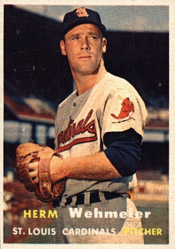
In 31 appearances against the Cardinals for the Reds and Phillies from 1949-1956, Herm Wehmeier was 0-14 with a 4.89 ERA.
(Yovani Gallardo has the second-worst career mark versus the Cardinals. In 19 starts against the Cardinals, Gallardo was 1-11 with a 6.45 ERA.)

Wehmeier’s 14th loss to St. Louis occurred May 9, 1956, in the Cardinals’ 3-0 victory over the Phillies. Boxscore

Two days later, on May 11, 1956, the Cardinals traded pitchers Harvey Haddix, Stu Miller and Ben Flowers to Philadelphia for Wehmeier and pitcher Murry Dickson. The deal was unpopular with many Cardinals fans. Haddix won 20 in 1953 and 18 in 1954. Though his record in 1955 fell to 12-16, many saw him as a pillar of St. Louis’ rotation.

Cardinals coach Terry Moore, who was the Phillies’ manager when Philadelphia acquired Wehmeier from the Reds in 1954, recommended Wehmeier to St. Louis general manager Frank Lane. According to The Sporting News, Lane said he sought Wehmeier “because he can be depended upon to trouble Brooklyn and Milwaukee, teams the Cards must stop to win.”

Cardinals pitching coach Bill Posedel was successful in working with Wehmeier. Reporting for The Sporting News, Bob Broeg wrote, “Wehmeier began to work with a high leg kick, similar to Paul Derringer’s, and … he concentrated on letting up on his fastball and curve when the opposition would expect the Wehmeier of old to try to bust his fastball by ’em.”

The results were impressive. Wehmeier won eight of nine decisions for the 1956 Cardinals from July 21 to Sept. 11. He saved his best for his last start of the year.

On the morning of Saturday, Sept. 29, the next-to-last day of the 1956 season, the Braves held first place in the National League, a half-game ahead of the Dodgers.

That day, the Dodgers swept a doubleheader against the Pirates. The Braves entered their night game at St. Louis knowing they needed to win to keep a share of first place. Milwaukee started its ace, Warren Spahn, against Wehmeier.

(In his autobiography, “I Had a Hammer,” Hank Aaron called Wehmeier “my worst nightmare,” because in 1955 he batted .105 against him, with two singles in 19 at-bats.)

Spahn and Wehmeier dueled into the 12th inning with the score tied 1-1. In the bottom of the 12th, Rip Repulski lashed a double against Spahn, scoring Stan Musial from second and giving the Cardinals a 2-1 victory. Boxscore

In Aaron’s book, Spahn said, “Beyond a doubt, that Saturday game in St. Louis was the most heartbreaking moment I had in 21 years of baseball.”

The loss dropped the Braves a game behind the Dodgers, who clinched the pennant the next day. The win capped a successful season for Wehmeier. The right-hander finished 12-9 with a 3.69 ERA for St. Louis. It would be the most single-season wins he’d post in his big-league career.

Wehmeier was named the Cardinals’ 1957 Opening Day pitcher by manager Fred Hutchinson. The assignment was especially important for Wehmeier because he would be facing the Reds in Cincinnati.

A Cincinnati native, Wehmeier had been an outstanding athlete at Western Hills High School. When he signed with the Reds at age 18, he was billed as a hometown hero. Instead, plagued by wildness and high expectations, Wehmeier was a bust. In nine seasons with the Reds, Wehmeier was 49-69. He issued more walks (591) than strikeouts (478) and became a target of fan hostility.

“He was one of the greatest natural athletes we ever had in Cincinnati,” Reds general manager Gabe Paul said. “But never in my long baseball experience have I heard a man booed as bitterly as was Wehmeier. Nothing he could do was right. Even when he won, they booed him.”

Wrote Broeg: “One of Wehmeier’s troubles as a Red was that the former Cincinnati high school hero tried too hard. The more red-necked he became and the harder he tried to throw, the wilder he became, either walking himself into trouble or getting the ball up where power hitters and others could swing for the fences.”

When Wehmeier took the mound in the Cardinals’ 1957 opener, his mother, father, sister and brother were in the stands. What they witnessed must have stunned many Reds fans. Wehmeier pitched a complete game and got the win in the Cardinals’ 13-4 victory. Boxscore

Wehmeier was winless in May and June, but recovered to win five consecutive decisions from Aug. 24 to Sept. 15. He finished the 1957 season at 10-7 with a 4.31 ERA.

In May 1958, Wehmeier was sent to the Tigers in a waiver deal. He suffered an elbow injury soon after and, at 31, his playing career was done. His big-league record: 92-108. For St. Louis, Wehmeier was 22-17.

Wehmeier scouted for the Reds for three years (he recommended they sign another phenom from Western Hills High School, Pete Rose) and then left baseball. He worked for a trucking company in Texas.

In May 1973, Wehmeier, 46, was testifying during a theft trial in federal court in Dallas when he suffered a fatal heart attack. In an obituary, The Sporting News reported, “Wehmeier was on the witness stand testifying for the government when he collapsed. The case involved theft of merchandise from a shipping company of which Wehmeier was an official.”

Previously: An interview with former Cardinals pitcher Al Jackson

Read Full Post »

(Updated March 24, 2019)

The second baseman who participated in one of the happiest periods in Cardinals history parted with the franchise in an unhappy manner.

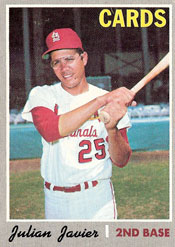
Only three players _ Frankie Frisch, Julian Javier and Tommy Herr _ have been the everyday second basemen on three Cardinals pennant winners. Javier started for the National League championship clubs of 1964, 1967 and 1968.

By 1972, Javier, 35, no longer was prominent in the Cardinals’ plans. Ted Sizemore had taken over as St. Louis’ second baseman and Ed Crosby was seen as a capable backup.

On March 24, 1972, the Cardinals traded Javier to the Reds for pitcher Tony Cloninger. Bob Howsam, who’d been Cardinals general manager before taking the same role with the Reds, acquired Javier to back up Joe Morgan at second base and Denis Menke at third.

After the deal was made, Javier indicated he was unhappy with general manager Bing Devine and manager Red Schoendienst for not getting the chance to play more in spring training and compete for a starting job.

“I feel too good, like 20, to be sitting around,” Javier said to the Associated Press.

During the off-season, Devine and Schoendienst had talked with Javier about his future and were of the impression Javier had agreed to a reserve role in 1972, the St. Louis Post-Dispatch reported. “I thought Bing and I had a perfect understanding with Hoolie,” Schoendienst said to The Sporting News.

At spring training, however, Javier asked the Cardinals for his release because he was upset Schoendienst was taking a look at other candidates for a reserve infield role, according to Post-Dispatch sports editor Bob Broeg.

Javier told Schoendienst, “I think I can play everyday for two more years,” the Dayton Journal Herald reported.

Javier’s complaints prompted an uncharacteristic blast from Schoendienst, a former all-star second baseman. “Hoolie wasn’t in shape, didn’t want to play and scarcely could get the ball from second base to first, yet he wants to say we didn’t use him,” Schoendienst told Broeg. “I’m tired of people who don’t want to play but say they do.”

In 12 seasons (1960-71) with the Cardinals, Javier twice was named an all-star (1963 and 1968), twice led National League second basemen in putouts (1963 and 1964) and collected 1,450 hits.

A right-handed batter, Javier hit .299 against left-handed pitching during his major-league career.

Javier’s role with the Cardinals changed after the 1970 season when the club acquired Sizemore from the Dodgers for first baseman Dick Allen.

Javier was found to owe back taxes to the U.S. government, leading to speculation the native of the Dominican Republic could become entangled in a legal case that might jeopardize his career. However, Javier worked out a settlement on his tax problems. When he reported to spring training in 1971, he was 10 pounds lighter (at 180) and performed more like the player he’d been on those championship teams.

Because of an injury to Dal Maxvill, Sizemore opened the 1971 season at shortstop and Javier remained the starter at second base. Javier batted .309 in the first two months of the season, slumped and entered July at .234. Maxvill returned to shortstop and Sizemore moved to second, replacing Javier.

At spring training in 1972, the Cardinals determined they were ready to move on without Javier. The trade to the Reds turned out to be a blessing for him. Javier had several key hits for the Reds and helped them win the 1972 NL pennant. Among the highlights:

_ Reds 11, Cardinals, 2, May 13, at Cincinnati: Facing Cloninger, the pitcher for whom he was traded, Javier delivered a RBI-single, scoring Johnny Bench. Boxscore

_ Reds 4, Giants 3, May 16, at San Francisco: Starting at third base, Javier hit a three-run home run against left-hander Ron Bryant. Boxscore

_ Reds 6, Phillies 5, June 3, at Philadelphia: Javier hit a two-run home run against left-hander Steve Carlton, a former Cardinals teammate. It was the 78th and last homer of Javier’s big-league career. Boxscore

_ Reds 8, Mets 2, June 17, at Cincinnati: Facing another former Cardinals teammate, left-hander Ray Sadecki, Javier hit a two-run single. Boxscore

Javier capped his career by appearing in four games for the Reds against the Athletics in the 1972 World Series.


Read Full Post »

(Updated Sept. 28, 2019)

At the time, the Cardinals’ game against the Mets on Sept. 28, 1971, seemed of little importance. In retrospect, it was a significantly historic matchup because of the starting pitchers involved and what happened to them after the season.

In the next-to-last game of the 1971 season for both teams, attendance that Tuesday afternoon at Shea Stadium was 3,338. The Cardinals were assured of finishing in second place in the National League East Division; the Mets were battling the Cubs for third.

The starting pitchers were Steve Carlton for the Cardinals and Nolan Ryan for the Mets. What no one knew was this would be the last game each would play for his team.

In trades each team long would regret, the Mets sent Ryan to the Angels in December 1971 and the Cardinals dealt Carlton to the Phillies in February 1972.

Each pitcher would go on to enjoy a spectacular career that earned enshrinement into the National Baseball Hall of Fame. Carlton finished with 329 wins, 4,136 strikeouts and four Cy Young awards. Ryan finished with 324 wins, 5,714 strikeouts and seven no-hitters.

Their pairing on Sept. 28, 1971, hardly was viewed as a matchup of baseball giants who should have been the cornerstones of their franchises for the next decade or more.

Instead, Carlton, 27, was seen by some as an underachiever. He had 19 losses the season before. Although he had experienced a turnaround in 1971, with 19 wins heading into the game against Ryan and the Mets, he’d lost two of his previous three decisions.

Like Carlton, Ryan, 24, clearly had talent but too often disappointed. He began the 1971 season with a big-league career record of 19-24. Entering the game against Carlton and the Cardinals, Ryan had won two of his last 13 starts and had a season record of 10-13.

Ryan’s lack of command hurt him immediately against the Cardinals. He walked the first four batters _ Lou Brock, Ted Sizemore, Matty Alou and Joe Torre, forcing in a run. When Ted Simmons followed with a single to right, scoring Sizemore and Alou, manager Gil Hodges lifted Ryan.

Ryan’s final appearance as a Met resulted in five batters faced, four walks and a hit without recording an out.

“It was the most distressing day of my life,” Ryan told the St. Louis Post-Dispatch. “I never was so embarrassed.”

Said Hodges: “It seemed he was just throwing the ball because it had to be thrown.”

The Cardinals scored twice in the second inning. Carlton ignited the offense with a leadoff single. Handed a 5-0 lead, Carlton clamped down on the Mets. He pitched a seven-hitter, striking out eight, as St. Louis won, 5-2, for its 90th victory of the season. Boxscore

Carlton (20-9) became a 20-game winner for the first time in the big leagues and the first Cardinals left-hander to achieve the feat since Ray Sadecki in 1964. The complete game was Carlton’s 18th in 36 starts that season.

“There was a lot of skepticism about me before the season,” Carlton said to The Sporting News. “A lot of people didn’t think I could bounce back after last year (and the 19 losses).”

Carlton credited an effective slider with enabling him to beat the Mets.

“The Mets are like the Giants and the Reds for me _ they all wait for my fastball,” said Carlton. “My slider was good when I was warming up, so I decided to go with it.”

Ryan (10-14) was the subject of trade speculation soon after the season ended, but in an Oct. 9, 1971, story in The Sporting News headlined, “Mets Swap Ryan? ‘No Way,’ Says Gil,” Hodges denied the Mets wanted to deal the pitcher.

“We never have given any consideration to trade Nolan Ryan,” Hodges said. “You cannot give up this easily on a guy who has as much talent as he has. You would hate to give up on him and then see him develop into what he can be with some other club.”

On Dec. 10, 1971, Mets general manager Bob Scheffing traded Ryan, outfielder Leroy Stanton, pitcher Don Rose and catcher Frank Estrada to the Angels for Jim Fregosi, a shortstop whom the Mets planned to move to third base.

After the deal was made, Hodges reiterated to The Sporting News his belief Ryan had all-star potential. “When or if or how he’s going to do it, I don’t know. But he’s got ability,” Hodges said.

Fregosi hit .232 for the Mets in 1972 and was dealt to the Rangers a year later. Ryan earned 19 wins with nine shutouts, 329 strikeouts and a 2.28 ERA for the 1972 Angels.

Two months after the Mets traded Ryan, Carlton made contract demands, angering Cardinals owner Gussie Busch, who ordered general manager Bing Devine to trade Carlton.

In his book, “The Memoirs of Bing Devine,” Devine said, “Mr. Busch had a meeting with me and Dick Meyer, his right-hand man at Anheuser-Busch. And the team brain trust, if that’s what you want to call it, decided we ought to trade Carlton because we didn’t have him signed and he wanted too much money. Basically, Mr. Busch wanted him gone. I don’t want to cop a plea here, but getting rid of Carlton was not a deal that I initiated or tried to talk anybody into. It was just the relationship between Carlton and Mr. Busch.”

The Cardinals sent Carlton to the Phillies for pitcher Rick Wise on Feb. 25, 1972. Wise was 16-16 for the 1972 Cardinals. Carlton, pitching for a last-place Phillies team, was 27-10 with a 1.97 ERA, 329 strikeouts, nine shutouts and 30 complete games.

Previously: Mets messed with Steve Carlton’s sub-2.00 ERA

Read Full Post »

In 1987, the Cardinals made a trade with the Pirates that stunned fans of both teams. Whether one believes the deal helped or hurt the Cardinals is a matter of perspective.

On April 1, 1987, the Pirates traded catcher Tony Pena, a four-time all-star, to the Cardinals for outfielder Andy Van Slyke, catcher Mike LaValliere and pitcher Mike Dunne.

The deal brought immediate results for the Cardinals. Though he had a subpar regular season, Pena helped the Cardinals win the 1987 National League East Division championship. Inspired by his first exposure to postseason baseball, Pena was a key part of St. Louis’ march to the pennant and a berth in the World Series.

After two more seasons with St. Louis, Pena became a free agent and signed with the Red Sox.

Van Slyke, LaValliere and Dunne all blossomed into top producers for the 1987 Pirates. Van Slyke and LaValliere played integral roles in helping Pittsburgh emerge from a last-place team in 1986 to win three consecutive NL East titles (1990-92).

Informed of the trade made by general managers Dal Maxvill of the Cardinals and Syd Thrift of the Pirates, Pena and Pirates manager Jim Leyland cried.

“My heart’s bleeding,” Pena said to the Associated Press. “I made my life with this ballclub.”

Said Leyland, who approved of the deal: “We’ve traded the best and most durable catcher in baseball.”

Pena, 29, was a three-time winner of the Gold Glove Award and popular with Pirates fans. In an editorial, the Pittsburgh Press wrote,

If Pirates fans could cast a mold of their prototype baseball player, it would come out looking a lot like Tony Pena. He plays baseball the way they like to see it played _ with zest, verve and abandon.

Reaction to the trade largely was negative in Pittsburgh. Wrote columnist Bruce Keidan of the Pittsburgh Post-Gazette,

Sorely in need of a starting pitcher, a first-rate shortstop and a right-handed power hitter, the Pirates conspired to give away an all-star catcher without obtaining any of the three.

Said Thrift: “How am I going to explain to my 82-year-old mother when the fans boo me?”

Adding to the despair of many Pirates fans was the reaction to the trade by the Cardinals.

“In Tony Pena, we are getting one of the premier players in the game,” Maxvill said to the Associated Press.

Added manager Whitey Herzog: “When you get a ballplayer of that caliber, you’ve done something. We are really happy. We paid a good price to get him, but it was worth it.”

The Cardinals had entered the 1986 season with Mike Heath as their starting catcher. He couldn’t hit (.205 in 65 games) and the Cardinals dealt him to the Tigers in August that season.

Herzog figured to utilize a platoon of LaValliere and Steve Lake at catcher in 1987, but the thought of having two slow-footed, light-hitting catchers concerned him. Thrift, looking to lift a team that had finished 64-98 in 1986, dangled Pena as trade bait.

“This is a move we believe will benefit the Pirates … Van Slyke has the capability and physical tools to become an outstanding, complete player,” Thrift told the Post-Gazette.

It soon became evident the trade may not have been as lopsided as initially thought.

Post-Gazette columnist John Steigerwald wrote,

Who got the better of the deal depends on which Tony Pena the Cardinals got … Chances are the Cardinals got the same two Tony Penas that have played here, the hot one and the cold one.

If you think the Pirates were robbed, it might make you feel better to know that longtime Cardinals announcer Jack Buck told me yesterday that he thinks Andy Van Slyke is the best defensive outfielder in the National League and that he is as exciting in right field as Pena is behind the plate.

In interviews immediately after the trade was made, Van Slyke and LaValliere provided insights into how they expected to contribute to the Pirates.

“I felt that this (1987) was my year to blossom,” Van Slyke told the Post-Gazette. “This was my year to do the things everybody anticipated me doing in St. Louis. But I can do it here. Sure I can.”

Said LaValliere: “I pride myself an awful lot on my defense … That’s probably my strongest point _ working with my pitchers … With the Cardinals, I knew who I had to kick in the butt and who I had to burp. I’ll have a crash course here.”

Pirates players bought into the trade. Said outfielder Mike Diaz: “The team isn’t made up of one player … We got two starters (Van Slyke and LaValliere) for the price of one.”

In retrospect, the Pirates got three starters for the price of one.

Dunne, 24, earned a spot in the rotation of the 1987 Pirates, posting a 13-6 record and 3.03 ERA in 23 games.

LaValliere, 27, earned a Gold Glove Award in 1987, finishing second in the NL in fielding among catchers, with a .992 percentage. He went on to a seven-year career with Pittsburgh.

Van Slyke, 27, opened the 1987 season in right field for Pittsburgh, with Barry Bonds in center and Bobby Bonilla in left. (During the season, Van Slyke was shifted to center, with Bonds moved to left and Bonilla to right). Van Slyke had the stellar season he expected in ’87, batting .293 with a .359 on-base percentage, 36 doubles, 11 triples, 21 home runs and 82 RBI.

In eight years with Pittsburgh, Van Slyke hit .283 with an on-base percentage of .353. He won a Gold Glove Award in five consecutive seasons (1988-92).

The Cardinals had made the deal, in part, because they believed rookie Jim Lindeman was ready to become an everyday right fielder, but he wasn’t as talented as Van Slyke. (A year later, to plug the gap in right field, the Cardinals traded their productive second baseman, Tom Herr, to the Twins for outfielder Tom Brunansky).

Pena batted .214 with 5 home runs and 44 RBI for St. Louis in 1987. He hit much better in the postseason (.381 in the NL Championship Series against the Giants, and .409 in the World Series against the Twins).

Pena was better in 1988 (.263, 10 homers, 51 RBI) and in 1989 (.259, 4 homers, 37 RBI, with an all-star berth) for St. Louis. He also ranked first in fielding among NL catchers in both seasons (.994 in ’88 and .997 in ’89).

Read Full Post »

« Newer Posts - Older Posts »