Feeds:
Posts
Comments

Archive for the ‘Trades’ Category

(Updated: Oct. 21, 2018)

Even in the immediate afterglow of their first World Series title in 15 years, the Cardinals and manager Whitey Herzog were willing to trade significant and popular starters in order to secure another all-star for the left side of the infield.

Less than two months after winning the 1982 World Series championship, the Cardinals came close to acquiring third baseman Buddy Bell from the Rangers.

Bell would have paired with Ozzie Smith to give the Cardinals a premier third base/shortstop combination.

To acquire Bell, Herzog was willing to trade right fielder George Hendrick, third baseman Ken Oberkfell and possibly pitcher Bob Forsch.

When trade negotiations collapsed in December 1982, Herzog expressed great disappointment.

In the Dec. 20, 1982, edition of The Sporting News, St. Louis writer Rick Hummel reported the Cardinals made “a strong pitch” for Bell, “but withdrew their offer after several days of negotiating.”

Texas writer Jim Reeves confirmed the Rangers “seriously considered” trading Bell and “were close with St. Louis and Baltimore.”

Hummel reported the Cardinals offered Hendrick, Oberkfell and pitcher Steve Mura for Bell. The Cardinals also were in serious negotiations with free-agent pitcher Floyd Bannister. Hummel reported the Cardinals would have substituted Forsch for Mura if they signed Bannister.

(Bannister spurned a $4.5 million, five-year offer from the Cardinals and signed a similar contract with the White Sox. A major reason he chose the White Sox was because Dave Duncan, Bannister’s pitching coach with the Mariners, had joined the White Sox to become pitching coach for manager Tony La Russa).

In offering Hendrick, Oberkfell and Mura or Forsch for Bell, the Cardinals were offering a lot to the Rangers:

_ Hendrick led the 1982 Cardinals in home runs (19), RBI (104) and slugging percentage (.450). He hit .321 in the 1982 World Series and drove in the go-ahead run in Game 7.

_ Oberkfell batted .289 for the 1982 Cardinals and ranked third among National League third basemen in assists.

_ Forsch had 15 wins in 1982, his sixth consecutive season of double-digit victories for the Cardinals. Mura posted 12 wins in 1982.

Herzog, who perhaps valued defense above all other skills, saw an opportunity to give the Cardinals a pair of Gold Glove winners on the same side of the infield.

Bell, 31, was in his prime. At that time, he had won four Gold Glove awards (Ozzie Smith had just won his third) and Bell had been a four-time American League all-star. Bell also batted .296 with an on-base percentage of .376 in 1982.

Bell had caught the attention of Hall of Fame third baseman Brooks Robinson, who told columnist Peter Gammons that winter, “It’s only recently that I’ve come to appreciate him. I never realized how much range he has or the plays he makes.”

Herzog seemed stunned Rangers general manager Joe Klein rejected his offer for Bell.

“It’s amazing that a team can lose 100 games (Texas lost 98 in 1982) and won’t make a deal,” Herzog told The Sporting News. “I feel sorry for people in baseball who have a million-dollar investment and don’t know what to do.”

In its Dec. 6, 1982, edition, Klein had told The Sporting News, “I won’t say I wouldn’t trade Bell, but I’d have to receive an offer that would knock my socks off.”

Texas reportedly had rejected offers from the Yankees (who refused to part with pitcher Dave Righetti), Reds (who may have offered a package that included pitcher Bruce Berenyi and infielder Ron Oester) and White Sox (who offered pitcher Britt Burns after they had signed Bannister).

Three years later, July 19, 1985, the Rangers traded Bell to the Reds for outfielder Duane Walker and pitcher Jeff Russell. By then, Terry Pendleton had replaced Oberkfell at third base and the Cardinals were headed to their second pennant-winning season under Herzog.

Buddy Bell never did play for the Cardinals, but his son did. David Bell was a Cardinals infielder from 1995-98 and in 2014 he became their assistant hitting coach. On Nov. 3, 2014, the Cardinals promoted David from assistant hitting coach to bench coach. After the 2017 season, he left the Cardinals for a front office position, vice president of player development, with the Giants. On Oct. 21, 2018, David Bell was chosen to be manager of the Reds.

Previously: How the Cardinals’ trade for Ozzie Smith almost collapsed

Read Full Post »

(Updated Sept. 12, 2025)

Ozzie Smith agreed to be traded to the Cardinals in what one writer called “one of the most bizarre transactions in recent baseball history.”

The deal propelled the Cardinals to three National League pennants and a World Series title and launched Smith toward a Hall of Fame career.

The trade, however, almost never happened.

On Dec. 10, 1981, at the baseball winter meetings in Hollywood, Fla., the Cardinals announced a trade of outfielder Sixto Lezcano to the Padres for pitcher Steve Mura.

Whitey Herzog, the Cardinals’ general manager and manager, acknowledged the deal also involved players to be named, but contract issues prevented him from revealing the identity of those players. Published reports made it clear the players were shortstop Garry Templeton and pitcher Luis DeLeon of the Cardinals and shortstop Ozzie Smith and pitcher Al Olmsted of the Padres.

The snag was Smith, 27, had a no-trade clause in his Padres contract. He wouldn’t agree to a trade to St. Louis unless the Cardinals either allowed him to keep the no-trade clause or compensated him for dropping it.

Tough talk

Herzog went to San Diego to meet with Smith and his agent, Ed Gottlieb. In January 1982, in a story headlined, “Ozzie’s Pay Demand May Cancel Trade,” The Sporting News reported the trade of Templeton for Smith “apparently is about to fall through.”

Herzog was quoted as saying Smith wanted more than twice the $300,000 salary he was paid in 1981.

“Ozzie would like to play for me, but it looks as if we’ll have to cancel the trade,” Herzog said. “Ozzie is a great fielder and baserunner. I’d like to have him, but if he doesn’t want to come to St. Louis, I don’t want him. No .220 hitter is worth what he’s asking.”

On Jan. 26, 1982, Smith said there would be no trade unless the Cardinals paid him $750,000 that year. The Sporting News reported the Cardinals offered a base salary of between $425,000 and $450,000, with incentives that could take the total package to $500,000.

Smith and his wife also wanted to visit St. Louis before making a decision. They arrived on a winter day.

“The chill index is 17 below,” Herzog recalled to Cardinals Magazine. “I’m sitting in the office and get a call: ‘Mr. and Mrs. Smith are here.’ So I went to the receptionist’s desk to get them and, holy moly, they were wearing long-length fur, I mean all the way down to their ankles. They had Daniel Boone hats on. I said there’s no way he’s going to come to St. Louis from San Diego where it’s 72.”

Working it out

Finally, on Feb. 11, 1982 _ two months after a Cardinals-Padres deal first was announced _ Smith agreed to the trade. His salary would be determined in arbitration before the season began and his Cardinals contract would not contain a no-trade clause, said Lou Susman, attorney for club owner Gussie Busch.

In his lead paragraph for The Sporting News, St. Louis reporter Rick Hummel wrote, “After 62 days, it was over. Ozzie Smith had become a St. Louis Cardinal in one of the most bizarre transactions in recent baseball history.”

Smith told the St. Louis Post-Dispatch, “I’m coming into this with a positive attitude. The Cardinals want my services. We won’t have any problems.”

In four seasons with the Padres, Smith twice won the Gold Glove Award, but he batted .231 with one home run and his on-base percentage was a paltry .295.

Herzog said he believed Smith’s offense would improve by playing home games on the AstroTurf in St. Louis rather than on natural grass in San Diego, but only if Smith focused on hitting balls on the ground.

When Smith came to Cardinals spring training camp at St. Petersburg, Fla., Herzog assigned coaches Chuck Hiller and Dave Ricketts to help him develop “a downward type of swing,” Hummel reported.

“Guys like Ozzie have to keep the ball out of the air,” Herzog said. “If he could hit .240 or .250, we’d be very happy because we know he’s the best defensive shortstop in the league and maybe baseball.”

Herzog later told Cardinals Magazine, “Ozzie was learning an awful lot about hitting. He worked on a daily basis with Chuck Hiller, trying to keep the ball out of the air. He went along with the program.”

To help Smith focus on hitting the ball on the ground, Herzog made a bet with him. “Every time I hit a fly ball, I had to give him a dollar,” Smith said to Cardinals Magazine. “Every time I hit a ground ball _ which enabled me to use my speed to get on base _ he gave me a dollar. It didn’t take long for him to realize that I got it. He decided, ‘OK, it’s time to call this bet off.’ ”

Just before the Cardinals opened the 1982 season at Houston, arbitrator Tom Roberts ruled for the Cardinals, awarding Smith a $450,000 salary rather than the $750,000 he requested.

Play like a champion

In the opener at the Astrodome, Smith went 2-for-5 with two RBI, including a single and RBI against Nolan Ryan, in the Cardinals’ 14-3 victory. Boxscore

It was a successful start to a magical season for the Cardinals, who went on to win their first World Series title in 15 years. Smith was a key contributor, winning a third Gold Glove Award and batting .248 with 24 doubles, 25 stolen bases and a .339 on-base percentage.

Teammate Keith Hernandez, in the book “Pure Baseball,” said Smith was “the best No. 8 hitter you ever saw in 1982 and 1983. Two outs, Ozzie needed to get on base to bring up the pitcher. He could do it … The No. 8 man in the National League will see some hittable pitches if he’s patient. Ozzie came through in this situation with regularity.”

In his book “White Rat: A Life In Baseball,” Herzog said, “Watching him every day, I’ve found out just how good he is. Of all the shortstops I’ve seen, and I’ve seen some good ones _ guys like Marty Marion, Mark Belanger and Luis Aparicio _ Ozzie is the best. I’ve never seen anyone do the things on a baseball field that he can do.”

Marion, shortstop on four Cardinals pennant winners in the 1940s, told Cardinals Yearbook in 1993, “I always admired Ozzie because he’s the first defensive player in my memory to make a lot of money. In our days, people didn’t appreciate a good fielder. You had to be a hitter to make money.”

Marion was manager of the White Sox when Aparicio joined the club in 1956. “Up until Ozzie, Luis was as good as anybody,” Marion said to Cardinals Yearbook. “The one thing that stands out about Ozzie is I never saw a shortstop dive for a ball and throw the man out until Ozzie came along.”

In the book “Few and Chosen,” broadcaster and former catcher Tim McCarver said, “A lot of infielders dive for a ball with no chance whatsoever of making the play. Ozzie dived and not only came up with the ball, but also got to his feet so quickly from a prone position that he usually got his man. His range was unbelievable. His speed and quickness were electric.”

Read Full Post »

(Updated Nov. 17, 2023)

Outfielder Minnie Minoso spent most of his 17-year big-league career with the White Sox and Indians. When Minoso was acquired by the Cardinals after the 1961 season, it was believed he could be the key component in making St. Louis a pennant contender in 1962. Instead, Minoso, injury plagued, was a flop.

The Cardinals traded Joe Cunningham, a first baseman and outfielder, to the White Sox for Minoso on Nov. 27, 1961 _ two days before Minoso’s birthday. Reports varied regarding Minoso’s age. The Associated Press reported Minoso would turn 39 on Nov. 29, 1961, but added “some insist he is at least 42.”

St. Louis had finished 80-74 in 1961, 13 games behind the National League champion Reds. Minoso hit .280 with 28 doubles, 14 home runs and 82 RBI for the 1961 White Sox. The Cardinals saw him as their left fielder, joining an outfield of Curt Flood in center and Stan Musial in right.

Joe Reichler, reporting the trade for the Associated Press, wrote, “Johnny Keane, manager of the Cardinals, was almost as pleased by the acquisition of Minoso as he was when his daughter presented him with his second grandchild last week … Minoso, despite his age, is still one of the fastest men in baseball and swings one of the biggest bats.”

In The Sporting News, Oscar Kahan wrote, “The Cuban Comet, aged as he may be, supplies so many plus factors to the picture that the Redbirds’ outlook has brightened considerably.”

Minoso was a “little bit shocked” by the trade, according to United Press International. The wire service reported Minoso had purchased a $40,000 house in Chicago in 1961 and moved his family there from Cuba. He had been working as a goodwill ambassador for the White Sox during the off-season, selling tickets and promoting the club.

“I don’t know whether I’ll go to the Cardinals,” Minoso said. “I consider myself a free agent. I have a few jobs in mind. I have a lot of friends in Chicago and there are other things I can do in Chicago.”

Minoso eventually relented and opened the 1962 season as the Cardinals’ left fielder. He started two games before pulling a rib muscle in batting practice. It was nearly two weeks before he recovered.

Batting primarily sixth in the order, Minoso struggled, but Keane stuck with him. On May 11, a Friday night in St. Louis, Minoso was in left field when the Cardinals faced the Dodgers. In the sixth inning, with the score 2-2 and the bases loaded, Duke Snider launched a line drive to deep left-center. Minoso chased after it, skidded on the warning track and crashed headfirst into the concrete wall. The ball bounced away for a three-run triple. Boxscore

The collision with the wall left Minoso unconscious. His right eye was completely closed and his head and face were swollen and bleeding, the Associated Press reported. Minoso was carried off on a stretcher and rushed to a hospital. Doctors determined Minoso had a fractured skull and a fractured right wrist. The skull fracture, according to the Associated Press, was three to four inches long above the right ear.

Cardinals center fielder Curt Flood told the Los Angeles Times, “By the time I got to him his right eye already was closing and he was bleeding. He was out cold and didn’t move a muscle. His breathing was labored and I was afraid he’d swallowed his tongue.”

According to The Sporting News, Minoso knew he was quite close to the wall, “but I don’t remember after that.”

Minoso was sidelined for two months before he returned on July 20 and struck out while batting for pitcher Bob Duliba. Boxscore

On Aug. 18, in the second game of a doubleheader against the Mets in New York, Minoso hit his only Cardinals home run, a solo shot off Ray Daviault in a 10-0 St. Louis victory. Boxscore

The next day, batting in the sixth inning, Minoso was hit on the left arm by a pitch from the Mets’ Craig Anderson and was lifted for a runner. Boxscore

Two days later, Aug. 21 at Milwaukee, Minoso appeared as a defensive replacement in left field in the eighth inning against the Braves, but his left arm became swollen. Doctors discovered Minoso had suffered a broken forearm when hit by the Anderson pitch. His season was finished.

In 39 games for St. Louis, Minoso hit .196 with one home run and 10 RBI.

In the book “We Played, the Game,” Cardinals catcher Tim McCarver recalled that Minoso “got so furious at himself after going 0-for-4 that he walked under a cold shower with all his clothes on, including his bat and his spikes. That was a sight.”

Minoso went to spring training with the Cardinals in 1963, hoping to earn a spot as a reserve, but on April 2, a week before the season opener, his contract was sold to the Senators for what The Sporting News reported as “in excess of the $20,000 waiver price.”

Read Full Post »

Matty Alou, one of baseball’s best hitters in the 1960s and 1970s, had one of the most productive seasons of his 15-year big-league career with the Cardinals.

Alou is best remembered for his years with his first major-league team, the Giants, and his time with the Pirates, with whom he won a National League batting crown, hitting .342 in 1966.

Often overlooked is Alou’s splendid 1971 season with the Cardinals. Alou had career highs of 74 RBI and seven home runs with the 1971 Cardinals and hit .315 in 149 games.

A left-handed batter, Alou was adept at hitting the ball to all fields.

“Matty and Stan Musial handle the bat better than anyone I’ve ever seen,” Cardinals hitting coach Ken Boyer told The Sporting News in August 1971. “Like Stan, Matty has a great level swing, and, like Stan, he can handle just about any kind of pitch.

“Alou uses bats of at least 10 different weights,” Boyer said. “He studies the pitchers and the defense as well as anybody because he’s always looking for some way to beat you.”

The Cardinals acquired Alou and pitcher George Brunet from the Pirates for pitcher Nelson Briles and outfielder Vic Davalillo on Jan. 29, 1971.

In announcing the deal, Cardinals general manager Bing Devine said he and manager Red Schoendienst agreed Alou, 33, would bat leadoff and play center field. Left fielder Lou Brock would move from the leadoff spot to bat No. 3 in the order and second baseman Ted Sizemore, acquired from the Dodgers, would bat between Alou and Brock.

“Guys like Alou and Sizemore make things happen,” Devine said. “They ought to help make the Cardinals a much more exciting team.”

Alou said his goal was to hit .335 for the 1971 Cardinals. “I like to hit in St. Louis. It’s a good park for hitters. The ball comes off the AstroTurf good and the ground in front of the plate is hard.”

The Cardinals batted Alou, Sizemore and Brock in the top three spots of the order for the first 14 games of the 1971 season and went 8-6 before Schoendienst returned Brock to the leadoff spot and moved Alou to the No. 2 position.

Alou was a free swinger and Brock’s ability to steal bases was compromised when Alou would foul off or hit, rather than take, pitches. It was when Schoendienst moved Sizemore to No. 2 in the batting order and Alou to No. 3 that the Cardinals’ offense clicked. Asked to explain why he had so many more RBI with the Cardinals than he had with the Pirates, Alou said, “It makes a lot of difference hitting behind Lou Brock instead of (Pirates catcher) Jerry May and the pitcher.”

Alou hit .332 in 78 games from the No. 2 spot and .294 in 46 games from the No. 3 position.

Though he began the 1971 season as St. Louis’ center fielder, Alou moved to right field after Jose Cardenal was traded to the Brewers, and took over first base for Joe Hague when the Cardinals inserted Luis Melendez as the right fielder.

Alou hit .313 in 73 games as the center fielder, .364 in 20 games as the right fielder and .305 in 58 games as the first baseman.

In 1972, Alou played first base and right field for the Cardinals and hit .314 in 108 games, but the Cardinals wanted to move Joe Torre from third base to first base. Out of contention for a postseason spot, the Cardinals traded Alou to the Athletics on Aug. 27, 1972, for outfielder Bill Voss and a minor leaguer.

Speaking to reporters about how he enjoyed his time with the Cardinals, Alou called Schoendienst the “best man I ever played for. He kept everybody loose.”

Alou was reacquired by the Cardinals for the stretch run on Sept. 6, 1973, in a cash deal with the Yankees. He hit .273 in 11 games. After the season, the Cardinals sold his contract to the Padres.

Alou’s career statistics as a Cardinal: .314 batting average, 322 hits in 268 games, 30 stolen bases.

Matty Alou and his brothers Felipe and Jesus all were big-league outfielders. Asked in October 1971 who was the best ballplayer of the three, Felipe told The Sporting News, “I have the most ability. Matty is the best hitter. He has more guts and confidence than Jesus (Alou) and I put together. But Jesus is the most professional of all three.”
Read Full Post »

(Updated May 25, 2019)

The history between the Cardinals and Rangers is highlighted by the seven-game World Series they played in 2011. Before then, their interactions were more quirky than rich.

Since the Washington Senators relocated to Texas and became the Rangers after the 1971 season, they have made some noteworthy trades with the Cardinals.
The Rangers also launched the managerial career of one of the Cardinals’ legends, Whitey Herzog, who was 47-91 with Texas in 1973.

Here’s a look at some of the deals between the Rangers and Cardinals:

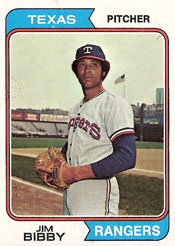
_ Cardinals send pitcher Jim Bibby to the Rangers for pitcher Mike Nagy and catcher John Wockenfuss, June 6, 1973: The trade was a bust for St. Louis. Bibby, seldom used by the Cardinals, became a 19-game winner for Texas in 1974. The right-hander recorded 111 wins in a 12-year big-league career.

Herzog had pushed for the Rangers to acquire Bibby. When Herzog was farm director of the Mets, Bibby was a prospect in New York’s minor league system.

At the time of the trade, Cardinals general manager Bing Devine told The Sporting News, “Whitey said Bibby has a better arm than half his pitchers.”

Nagy never won a game for the Cardinals and Wockenfuss (who became a reliable utility player for the Tigers) never played a regular-season game for St. Louis.

_ Cardinals send outfielder Tommy Cruz and cash to the Rangers for pitcher Sonny Siebert, Oct. 26, 1973: Cruz, the middle of the trio of outfielder brothers for St. Louis (Jose and Hector were the others), never played a regular-season game for Texas.

Siebert, a St. Mary, Mo., native who had success with the Indians and Red Sox, realized a lifelong dream by joining the Cardinals. He had been a high school basketball standout in suburban St. Louis and had been a baseball and basketball player at the University of Missouri.

Siebert, 37, opened the 1974 season in the Cardinals’ rotation. He was 6-3 with a 1.98 ERA on June 10. He finished the season 8-8 with a 3.84 ERA.

The right-hander’s most memorable win for St. Louis came on Sept. 11, 1974, at Shea Stadium in the Cardinals’ 4-3 25-inning victory over the Mets. Siebert pitched 2.1 innings of scoreless relief to earn the win, his last as a Cardinal. Boxscore

_ Cardinals send shortstop Eddie Brinkman and pitcher Tommy Moore to the Rangers for outfielder Willie Davis, June 4, 1975: St. Louis acquired the mercurial Davis with the hope his offense would spark them to a championship in 1975. Though the Cardinals fell short, Davis mostly delivered, filling in for injured outfielders Bake McBride and Reggie Smith.

Davis batted .291 with 50 RBI in 98 games. Brinkman, the Cardinals’ Opening Day shortstop, played one game for cash-strapped Texas before he was peddled to the Yankees. Moore never won a game for the Rangers.

Davis, 35, had clashed with Rangers manager Billy Martin. He staged a sitdown protest in center field when teammate Steve Hargan failed to hit a batter in retaliation after Davis was brushed back by an opponent’s pitch. Davis also irked Texas general manager Dan O’Brien by repeatedly asking for advances in his salary. “At some point, you’ve got to draw the line,” O’Brien told United Press International.

The trade was popular with Cardinals players. St. Louis second baseman Ted Sizemore, who had been Davis’ teammate with the Dodgers, told the Associated Press, “The man can play. He comes to play. He likes to play.”

Said Davis to The Sporting News: “With the Cardinals, I know I can play baseball again without being suppressed. I can be loose again.”

By September, though, Davis’ personal and financial problems caught up with him. He refused to play some games while his wife pursued an alimony case that threatened to restrict his wages. After the season, when he demanded a five-year contract for $1 million, the Cardinals traded him to the Padres.

_ Cardinals send shortstop Royce Clayton and pitcher Todd Stottlemyre to the Rangers for pitcher Darren Oliver, third baseman Fernando Tatis and outfielder Mark Little, July 31, 1998: Clayton and Stottlemyre were eligible to become free agents after the season and the Cardinals were uncertain they could re-sign them.

On the day of the trade, Texas was a game behind the first-place Angels in the American League West. The Cardinals were six games under .500 and 13.5 games behind the first-place Astros in the National League Central.

Clayton hit .285 for Texas in 1998 and Stottlemyre won five of 10 starts, helping the Rangers win the division title. St. Louis general manager Walt Jocketty, meanwhile, was positioning for the future.

“The guy we liked is Tatis,” Jocketty told The Sporting News when the trade was made. “We needed to find a third baseman and he was the best guy available.”

Tatis slugged 34 home runs for the Cardinals in 1999 and contributed to their division championship season in 2000.

Read Full Post »

(Updated Dec. 27, 2024)

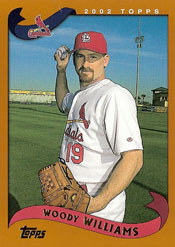
In August 2001, the Cardinals began a transformation from underachievers to postseason qualifiers when they acquired pitcher Woody Williams from the Padres for outfielder Ray Lankford.

After winning the National League Central championship in 2000, the Cardinals were expected to contend in 2001, but they entered August in third place at 53-51 _ 8.5 games behind the first-place Cubs and four behind the Astros.

With the emergence of rookie Albert Pujols, the Cardinals had a surplus of outfielders, including Jim Edmonds, J.D. Drew and Lankford. Complaining about a lack of respect, Lankford, 34, was falling out of favor with team management. It didn’t help that he was hitting .235 with 105 strikeouts in 264 at-bats. Lankford had missed on 36 percent of his swings.

On Aug. 2, 2001, the Cardinals sent Lankford (who agreed to waive his no-trade clause) and more than $2.8 million to the Padres for Williams. Andy Benes was struggling (7.06 ERA entering August) and the Cardinals needed a fifth starter to join a rotation of Matt Morris, Darryl Kile, Dustin Hermanson and Bud Smith.

“We’re extremely happy,” Cardinals general manager Walt Jocketty said to the St. Louis Post-Dispatch. “Woody Williams is a quality pitcher and a quality person.”

Williams, who would turn 35 Aug. 19, didn’t appear to be the obvious solution. He was 8-8 with a 4.97 ERA for the Padres, yielding 170 hits in 145 innings.

“I’m going to use this as a steppingstone that will allow me to get back to where I want to be,” Williams said.

Relying on a change of speeds and sharp location, Williams made his first Cardinals start on Aug. 4, 2001, against the Marlins at St. Louis and pitched six shutout innings. He left the game to a standing ovation from the crowd of 42,312. Luther Hackman and Gene Stechschulte combined to pitch three shutout innings in relief, preserving the win for Williams in a 3-0 victory. Boxscore

Starting with that game, the Cardinals went 38-16 the remainder of the season, finishing in a tie for first place with the Astros at 93-69 and qualifying for the playoffs for a second consecutive season.

The Cardinals couldn’t have done it without Williams, who was 7-1 with a 2.28 ERA for them, limiting batters to 54 hits in 75 innings.

Looking back on his Cardinals days, Williams told Stan McNeal of Cardinals Magazine in 2024, “When I got to St. Louis, I’d had a problem with giving up the long ball in my career … In St. Louis, my mentality became, ‘I’m going to attack the zone and keep the ball in the ballpark.’ I’ll be doggone if those guys behind me didn’t support me like crazy and make me look like a much better pitcher.”

Read Full Post »

« Newer Posts - Older Posts »