Feeds:
Posts
Comments

(Updated Sept. 23, 2022)

During a night when Steve Carlton pitched great, he wasn’t good enough to win.
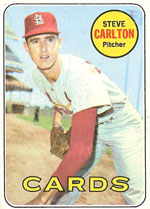
On Sept. 15, 1969, Carlton became the first pitcher in the majors to strike out 19 batters in nine innings, but it wasn’t enough to overcome the Amazin’ Mets.

Ron Swoboda hit a pair of two-run home runs against Carlton, giving the Mets a 4-3 victory over the Cardinals at Busch Memorial Stadium in St. Louis.

In addition to striking out 19 times, the Mets committed four errors, but they were a charmed club destined to become 1969 World Series champions.

In his game story for the New York Daily News, Dick Young wrote, “The Mets were absolutely no match” for Carlton, but their win “goes to prove how utterly amazin’ they really are.”

Said Mets manager Gil Hodges: “It’s great to win when you play badly.”

Getting better

Carlton, 24, wasn’t feeling well before the Monday night game with the Mets and wasn’t sure he could pitch.

“I had a fever all day and I felt so bad that I slept an extra hour and didn’t get to the ballpark until 7 o’clock, an hour before the game was to start,” Carlton told the St. Louis Post-Dispatch.

He said he took aspirins and got a rubdown from the team trainer.

The start of the game was delayed 26 minutes by rain and there was a 54-minute rain delay in the first inning.

Despite his aches and the damp conditions, Carlton struck out the sides in the first and second innings.

“I had a great fastball that kept rising and my curve was falling right off the table,” Carlton said to the Post-Dispatch.

Making mistakes

With the Cardinals ahead, 1-0, Donn Clendenon drew a walk, leading off the fourth for the Mets, and Swoboda batted next.

Carlton got ahead in the count 0-and-2 and “tried to burn another over without a waste pitch,” the New York Daily News reported.

The fastball was “right in his wheelhouse,” Carlton said, and Swoboda hit it deep into the left-field seats for a home run and a 2-1 Mets lead.

Carlton struck out the side in the fourth and the Cardinals scored twice in the fifth against Mets starter Gary Gentry, regaining the lead at 3-2.

In the middle innings, Carlton told the Post-Dispatch, “I became dizzy, tired and nauseated,” but he recovered and remained in the game.

In the eighth, Tommie Agee led off for the Mets with a single, Clendenon struck out and Swoboda came to the plate.

With the count 2-and-2, Carlton hung a slider _ “I didn’t get it inside enough,” he said _ and Swoboda lined it over the wall for a home run and a 4-3 Mets lead.

(In a January 2015 charity fundraising appearance in St. Louis, Carlton drew a laugh from the crowd when he jokingly blamed catcher Tim McCarver for the Swoboda home runs. “Tim put down the wrong fingers,” Carlton said.)

In the book “After the Miracle,” Swoboda told teammate Art Shamsky he got a batting tip before the game from Hall of Famer and Mets broadcaster Ralph Kiner.

“I went to Ralph and said, ‘I’m struggling a little. I’ve never done much against Carlton. Is there anything you might suggest?,’ ” Swoboda recalled. “So Kiner takes me down to a batting cage they had behind the left field fence. He fed me a bunch of balls off an old pitching machine and said, ‘Get your hands higher.’ I started hitting some balls real good. I went into that game with Carlton, who had extra-great stuff that night, and got some good swings off him.”

The two home runs gave Swoboda nine for the season. For his career, Swoboda batted .130 (6-for-46) versus Carlton with the two home runs.

“He’s primarily an inside fastball hitter,” Carlton said. “He has a tendency to swing through outside pitches and sometimes doesn’t reach them. If you go inside with him, you have to go way inside.”

Magic number

Carlton went into the ninth inning with 16 strikeouts and said he made up his mind to go for the record. Three pitchers had struck out 18 batters in nine innings. They were the Indians’ Bob Feller, the Dodgers Sandy Koufax (twice) and the Astros’ Don Wilson.

Carlton struck out Tug McGraw for No. 17 and Bud Harrelson for No. 18, tying the major-league mark. The 18 strikeouts also established a Cardinals club record, topping the 17 by Dizzy Dean versus the Cubs in a 1933 regular-season game and by Bob Gibson versus the Tigers in a 1968 World Series game.

The next Mets batter, rookie Amos Otis, already had struck out three times in the game.

“I was tense,” Carlton said, “but I knew Otis was tense, too, because nobody likes to go into the record book that way, as the No. 19 strikeout.”

For Otis to avoid becoming the 19th strikeout victim, Carlton said, “I thought he might bunt.”

When asked whether he considered bunting, Otis said, “If I’m going in the books, I’m going in right. I wasn’t doing any bunting.”

With the count 2-and-2, Otis swung and missed at a slider in the dirt. The ball eluded catcher Tim McCarver, who retrieved it and threw to first base in time to complete strikeout No. 19 for Carlton.

“I’m very elated to have done something no other pitcher had ever done,” Carlton said. Boxscore

Big numbers

According to the Post-Dispatch, Carlton threw 152 pitches, including 106 for strikes. He got 12 strikeouts on fastballs, five on sliders and two on curves.

Since then, four pitchers have struck out 20 batters in nine innings. They are Roger Clemens of the Red Sox (twice), the Cubs’ Kerry Wood, the Diamondbacks’ Randy Johnson and the Nationals’ Max Scherzer.

Carlton is one of four pitchers who have topped 4,000 career strikeouts. The four are Nolan Ryan (5,714), Randy Johnson (4,875), Clemens (4,672) and Carlton (4,136).

For many, it no longer paid to watch the Cardinals try to remain in the 1989 division title chase.

On Sept. 14, 1989, the paid attendance to see the Pirates play the Cardinals in a Thursday afternoon game at Busch Memorial Stadium in St. Louis was 1,519.

It was the lowest paid attendance total for a Cardinals game since the stadium opened in May 1966.

The Cardinals’ previous lowest paid attendance figure at Busch Memorial Stadium was 3,380 on Sept. 27, 1972, for a game against the Mets. The Wednesday afternoon game was the regular-season home finale for the Cardinals, who began the day 23 games out of first place at 71-79. Boxscore

In 1989, the Cardinals were supposed to have an off-day on Sept. 14, but a game hastily was scheduled to make up for the previous night when rain halted a scoreless standoff with the Pirates in the sixth inning.

Change of plans

The three-game series with the Pirates should have been a chance for the Cardinals to secure their position in the National League East Division race, but instead it turned out to be a continuation of a slide out of contention.

The Cardinals’ woes began a few days earlier at Wrigley Field in Chicago. The Cardinals (76-63) were 1.5 games behind the Cubs (78-62) entering the three-game weekend series. The Cubs won two of three and the Cardinals returned home to face the Pirates (63-79).

Held to a total of three runs, the Cardinals lost the first two games to the Pirates and went into the Sept. 13 series finale 4.5 games behind the Cubs.

The Wednesday night game matched starting pitchers Doug Drabek of the Pirates and Jose DeLeon of the Cardinals. They waged a scoreless duel before the game was called off because of rain with one out in the top of the sixth. Boxscore

The game, to be replayed entirely, was rescheduled for 12:35 p.m. Thursday, Sept. 14. With little notice of an unscheduled game for a day when many were at work or school, few bought tickets.

In addition to the 1,519 paid attendees, the Cardinals allowed those with ticket stubs from the previous night’s rain-halted game to get in free. The Cardinals said 2,015 people used the free vouchers, bringing the total number of spectators to 3,534.

Stranger things

The few fans were confined to the lower deck of the stadium. The sight of such a small gathering for a Cardinals home game was unsettling to both teams.

“It was almost like a 10 o’clock in the morning game in spring training,” Pirates manager Jim Leyland said to the Pittsburgh Post-Gazette.

Pirates outfielder Andy Van Slyke, a former Cardinal, told the Pittsburgh Press: “I’d have given you my paycheck if you told me I’d have played before 3,500 in Busch Stadium in September with the Cardinals four games out.”

Said Cardinals manager Whitey Herzog: “We’d have done better (in ticket sales) if we’d played the game in Pittsburgh.”

Adding to the weird vibe was the smoke wafting into the stadium from a fire at a burning warehouse nearby. Herzog told the St. Louis Post-Dispatch the scene looked to him “like a graveyard with lights.”

Post-Dispatch columnist Bernie Miklasz noted, “The Cardinals’ season is burning and you could smell it at Busch Stadium.”

Hitting the skids

The game matched pitchers Jeff Robinson, a converted reliever, for the Pirates versus Bob Tewksbury, making his first start as a Cardinal.

The Cardinals led, 2-1, before the Pirates scored three runs in the seventh against relievers Dan Quisenberry and Ken Dayley.

In the ninth, trailing 4-2, the Cardinals scored a run on consecutive doubles by Tim Jones and Ozzie Smith. With Smith on second and one out, Vince Coleman laced a liner, but it was snared by shortstop Jay Bell, who caught Smith venturing too far off second base and turned a game-ending double play. Boxscore

The sweep by the Pirates gave the Cardinals five losses in a row and pushed them 5.5 games behind the Cubs. The Cardinals scored a total of nine runs in those five defeats.

“It’s hard to say when the nail is in the coffin,” Dayley said, “but there isn’t much daylight getting in right now.”

Said Jones: “Luckily, with the way we played, there weren’t 30,000 people in the stands.”

The Cubs (93-69) went on to win the division crown. The Mets (87-75) finished second and the Cardinals (86-76) were third.

Chris Carpenter capped an unbeatable streak with a nearly unhittable performance.

On Sept. 7, 2009, Carpenter won his 11th consecutive decision, pitching a one-hitter in a 3-0 Cardinals triumph over the Brewers at Miller Park in Milwaukee.
The win gave Carpenter a season record of 16-3 with a 2.16 ERA.

It was the second one-hitter of Carpenter’s major-league career. The other occurred on June 14, 2005, against his former team, the Blue Jays, at Toronto.

Mow ’em down

The Labor Day game between the Cardinals and Brewers matched Carpenter against David Bush. who had lost his last six decisions.

In the first inning, Carpenter walked Felipe Lopez with two outs. He retired the next 11 batters before Jody Gerut hit a double to deep left field. A left-handed batter, Gerut told the St. Louis Post-Dispatch the hit was “dumb luck.”

Carpenter retired another 11 in a row before Craig Counsell led off the ninth with a walk. Corey Patterson batted next and grounded into a double play. Carpenter got Frank Catalanotto to ground out, ending the game.

Albert Pujols provided Carpenter with run support, hitting a two-run double against Bush in the fifth and scoring a run on Matt Holliday’s RBI-single against Mark DiFelice in the eighth. Boxscore

In command

Carpenter struck out 10 and was ahead in the count most of the time.

“I’m not wasting pitches,” Carpenter said to the Post-Dispatch. “I’m trying to get strike one, strike two, strike three as fast as I can, or get you to put the ball in play and let my guys work behind me.”

Said Brewers manager Ken Macha: “That was a clinic on how to move your fastball around, cutting it in, cutting it away, sinking it away from lefties and in on righties while mixing his curveball.”

Gerut, whose hit came on a first-pitch fastball, told the Associated Press, “You just hope you get a mistake because most of the time he puts it where he wants it.”

Carpenter, 34, completed the 2009 season with a 17-4 record and led the National League in ERA at 2.24.

(Updated Sept. 26, 2024)

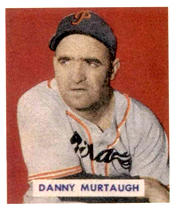
Enos Slaughter and the Cardinals tried to intimidate Danny Murtaugh and the Pirates, but the tactic backfired.

On Sept. 5, 1949, at Sportsman’s Park in St. Louis, Slaughter slashed Murtaugh in the chest with his spikes while sliding into second base in an unsuccessful effort to break up a double play.
Murtaugh, a former Cardinals prospect, considered the rough contact unnecessary because he had thrown the ball to the first baseman before Slaughter arrived at second.

Slaughter’s spikes-high slide shook the Pirates from a slumber.

Head hunters

On April 27, 1949, during a 7-1 Pirates victory at St. Louis, Cardinals pitchers twice hit leadoff batter Stan Rojek with pitches. The second one, by reliever Ken Johnson, beaned Rojek. The Pirates “thought it was deliberate,” according to The Pittsburgh Press. Boxscore

Rojek was sidelined for a week and the Pirates lost eight of their next nine.

Five months later, when they went to St. Louis for a Labor Day doubleheader, the Pirates (57-71) were 23.5 games behind the first-place Cardinals (81-48).

In the first game of the doubleheader, Slaughter produced a triple, home run and five RBI, carrying the Cardinals to a 9-1 triumph and handing the Pirates their eighth consecutive loss. Boxscore

Rough stuff

In the second inning of the second game, Nippy Jones led off with a single. Slaughter hit a grounder to the second baseman, Murtaugh, who fielded it cleanly but bobbled the ball as he started to throw. The error allowed Slaughter to reach first and moved Jones to third with none out.

Marty Marion batted next and hit a grounder to third baseman Eddie Bockman. As Jones held third, Bockman fired a throw to Murtaugh at second.

Murtaugh caught the ball on the bag for the forceout of Slaughter, pivoted and threw to first baseman Jack Phillips in time to complete the double play. Murtaugh’s throw “barely missed Enos’ head,” the St. Louis Star-Times reported.

Slaughter, who had gone into his slide, raised his feet high and crashed hard into Murtaugh, who was cut “across the right side of his chest,” drawing blood, The Pittsburgh Press reported.

Slaughter got up, dusted himself off, said nothing to Murtaugh and trotted into the Cardinals’ dugout along the third-base line.

Murtaugh “didn’t realize he was bleeding until he put his hands inside his shirt,” The Pittsburgh Press observed.

Sticks and stones

Incensed, Murtaugh shouted at Slaughter in words “too hot to handle or to take without retort,” according to the St. Louis Post-Dispatch.

Slaughter motioned for Murtaugh to come over and fight. Murtaugh tossed his glove aside and moved rapidly toward Slaughter, who advanced onto the field.

Nippy Jones alertly left the third-base bag and clamped his arms around Murtaugh to keep him from pursuing Slaughter. Members of the Cardinals stopped Slaughter from proceeding.

No one was ejected because “nothing more harmful than expressive nouns and adjectives” were exchanged, the St. Louis Star-Times noted.

Murtaugh was given first aid in the dugout and insisted on staying in the game.

The Pirates built a 4-0 lead before the Cardinals fought back, tied the score and forced extra innings.

Sweet revenge

With one out and none on in the 10th, Murtaugh lashed a double into right-center. Ed Fitz Gerald ran for him and scored when Rojek doubled with two outs, giving the Pirates a 5-4 lead.

In the bottom of the 10th, Slaughter led off, singled and moved to second on Marty Marion’s sacrifice bunt, but Vic Lombardi got the next two batters to ground out, sealing the win. Boxscore

Three weeks later, the first-place Cardinals held a 1.5-game lead over the Dodgers when they went to Pittsburgh for a two-game series with the Pirates.

Still steaming from the beaning of Rojek and the spiking of Murtaugh, the Pirates won both games, 6-4 on Sept. 27 and 7-2 on Sept. 29, knocking the Cardinals from first place.

The Cardinals went on to Chicago for a season-ending series with the Cubs, lost two of three and finished in second, a game behind the champion Dodgers.

Cardinals prospect

Murtaugh began his professional career in the Cardinals’ organization, but never played for their big-league club.

In the book “Baseball’s Best Managers,” author Harold Rosenthal wrote, “The beginnings for Danny Murtaugh in baseball were modest. He might just as easily have wound up as a foreman in some phase of shipbuilding had the Cardinals passed up Chester, Pa., in their extensive series of tryout camps. The offer wasn’t much, but the $200 a month looked positively brilliant to young Danny alongside the 34 cents an hour rate he was drawing as a passer in a rivet gang at the Chester shipyards. He had only two alternatives on that job _ catch the red-hot rivet in a cup or in his shirt if he missed.”

Murtaugh spent five seasons (1937-41) in the Cardinals’ farm system.

On June 28, 1941, the Cardinals sold Murtaugh’s contract to the Phillies. Five years later, the Cardinals reacquired Murtaugh, but sent him to their farm club at Rochester, where he batted .322. After the season, the Braves selected Murtaugh in the Rule 5 draft.

Murtaugh finished his big-league playing career with the Pirates. He hit .290 for them in 1948 and .294 in 1950.

In 1957, Murtaugh became the Pirates’ manager. He managed them for 15 seasons and led them to World Series championships in 1960 and 1971.

(Updated Sept. 7, 2024)

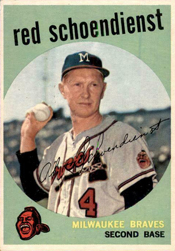
Red Schoendienst made a brave comeback from a serious illness.

On Sept. 2, 1959, Schoendienst appeared in a major-league game for the first time since being sidelined because of tuberculosis.

Schoendienst was diagnosed with tuberculosis in November 1958, shortly after he played in the World Series for the Braves, and it was expected he would sit out the entire 1959 season or perhaps never play again.

Schoendienst, who was confined to a sanitarium in St. Louis for several months and also underwent lung surgery, made a full recovery.

He returned to the Braves’ active roster sooner than expected, on Sept. 1, 1959, and was used as a defensive replacement and pinch-hitter in the last month of the season.

Feeling drained

Schoendienst had experience overcoming adversity. When he was 16, he was struck in the left eye by a staple while building a fence. Doctors wanted to remove the damaged eye, but Schoendienst wouldn’t let them, and his sight recovered.

A nine-time National League all-star as a second baseman for the Cardinals, Schoendienst was traded to the Giants on June 14, 1956. A year later, June 15, 1957, the Giants dealt him to the Braves. Schoendienst helped the Braves win National League pennants in 1957 and 1958. They were World Series champions in 1957.

In his book, “Eddie Mathews and the National Pastime,” Braves third baseman Eddie Mathews said of Schoendienst, “It would be hard to overstate how important he was in our winning the pennant in 1957. Leadership is hard to define. It involves clutch hitting, turning the key double play, a whole lot of things. Red did them all.”

Hank Aaron, in his autobiography, “I Had a Hammer,” said Schoendienst “was a master second baseman” who “made our team complete.”

Toward the end of the 1958 season, Schoendienst, 35, felt unusually tired. In his book, “Red: A Baseball Life,” Schoendienst said he told people he had a bad cold, “but in my own mind, I was scared.”

Schoendienst started at second base in all seven games of the 1958 World Series, batted .300, produced nine hits, including three doubles and a triple, and made one error in 63 innings, but he felt terrible.

In the 1964 book “The Quality of Courage,” Mickey Mantle, who played against Schoendienst in the 1958 World Series, recalled, “Seriously ill, he played up to the hilt for seven games. He never quit. More than that, he never stopped producing. He batted .300, fielded beautifully and literally ran his lungs out to stretch a hit into a triple.”

In an article she wrote for Parade magazine, Red’s wife, Mary Schoendienst, said her husband was so weak during the 1958 World Series “he spent nearly every hour away from the ballpark in bed.”

Said Red: “During the World Series when I was in the field, I couldn’t move. When I walked up to bat, I could hardly swing the bat. I saw the ball well, but I couldn’t react to it. There was no question I was sick.”

When he returned home to St. Louis, Schoendienst, coughing and having trouble breathing, was examined by his personal physician, who sent him to a hospital. Tests revealed Schoendienst had tuberculosis. Schoendienst’s condition was made public in November 1958. Dr. Ray Martin of St. Louis said Schoendienst would be confined to Mount St. Rose Sanitarium in St. Louis “for four to six months,” The Sporting News reported.

“Sometimes it takes as long as a year for a tubercular patient to return to even an ordinary job,” Dr. Martin said.

The Sporting News concluded, “The disclosure made it all but certain Schoendienst would be lost to the Braves for the entire 1959 season. Under the circumstances, there is grave doubt (he) will ever play again.”

Doctor’s orders

Schoendienst said he decided, “I was going to fight this disease as hard as I had played any game in my life. I had too much to live for to surrender without waging all-out war. I pledged to do whatever the doctor said, to become a model patient and listen to him as closely as I ever listened to any manager and coach.”

In February 1959, when doctors recommended surgery to remove part of an infected lung, Schoendienst replied, “Let’s do it.”

While he was in the sanitarium, Schoendienst was visited by Braves executives, who offered him a contract for 1959.

“The Braves’ owner, Lou Perini, knew I might not play a game in 1959, but he still wanted me to have that salary and I certainly appreciated it,” said Schoendienst. “Had the team not been willing to do that, I am certain it would have added a lot of mental stress to wonder how I would take care of my family. Giving me that contract allowed me to concentrate entirely on getting well.”

On March 24, 1959, Schoendienst was sent home, four months after he had entered the sanitarium. By July, he began preparing to return to baseball.

“I did bending exercises to get my legs in shape and arm exercises to strengthen my shoulders,” he said. “I started playing catch with some of the kids in the neighborhood and also my father-in-law. The doctors told me the only thing they didn’t want me doing was running.”

Schoendienst discreetly went with his brother Joe to local parks and began hitting baseballs again.

When the Braves came to St. Louis to play the Cardinals in mid-summer, Schoendienst went to the ballpark one morning and took batting practice. He also went to second base and fielded grounders and pop flies.

After the Braves left town, Schoendienst said the Cardinals allowed him to come to Busch Stadium each day and work out.

Doctors gave Schoendienst, 36, approval to resume playing before the season ended if he and the Braves “were willing to be cautious and not overdo things.”

United Press International reported, “Regular play could overtire him and that is still forbidden, according to doctors’ orders.”

Big moment

The Braves were home in Milwaukee for two games against the Phillies Sept. 1-2. Schoendienst was back in uniform for the first game but didn’t play. The next night, the Braves had a runner on second, two outs, in the seventh inning when manager Fred Haney told Schoendienst to bat for pitcher Juan Pizarro. The crowd of 18,047 at County Stadium roared and gave a standing ovation when Schoendienst emerged from the dugout.

“I had more butterflies than I ever had,” Schoendienst said to the Associated Press. “It was truly a big moment.”

In his book, Schoendienst said, “The cheers sent goosebumps down my back and I stepped out of the box a couple of extra moments to compose myself.”

Schoendienst hit a groundball to pitcher Robin Roberts, who fielded it and threw to first for the out. Boxscore

Schoendienst appeared in five games, mostly as a defensive replacement, for the 1959 Braves and was hitless in three at-bats, but he was healthy and ready to keep playing.

Schoendienst was the Opening Day second baseman for the 1960 Braves, but eventually was benched by manager Chuck Dressen. The Braves released him after the season and Schoendienst returned to the Cardinals after rejecting an offer from the Angels. He batted .300 in a utility role for the 1961 Cardinals and was a player-coach for them in 1962 and 1963.

After serving fulltime as a coach in 1964, Schoendienst became Cardinals manager for 1965, embarking on a successful second career.

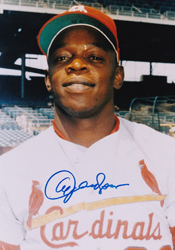
After losing 10 of 11 decisions against the Dodgers, Al Jackson persevered and outdueled Sandy Koufax.

A left-handed pitcher who relied on a sinker for groundball outs, Jackson made his major-league debut in 1959 with the Pirates, spent most of his career with the Mets and had two strong seasons with the Cardinals.

During his first stint with the Mets from 1962-65, Jackson was 1-9 versus the Dodgers. He lost eight consecutive decisions against them before spinning a three-hitter and outdueling Claude Osteen in a 1-0 Mets victory on June 21, 1965, at Dodger Stadium. Boxscore

Two months later, on Aug. 10, 1965, Koufax got his 20th win of the season, striking out 14 Mets and beating Jackson in a 4-3 Dodgers victory at Los Angeles. Boxscore

The Mets traded Jackson and third baseman Charlie Smith to the Cardinals for third baseman Ken Boyer after the 1965 season.

Tough luck

After opening the 1966 season as a reliever, Jackson was moved into the Cardinals’ starting rotation in May, replacing Ray Sadecki, who got traded to the Giants.

The first time Jackson faced the Dodgers as a Cardinal was June 1, 1966, at St. Louis. Although he pitched well, he again took the loss. Jackson held the Dodgers to three hits in seven innings, but Koufax pitched a shutout in a 1-0 Dodgers victory.

Jackson “deserved a better fate, but he was pitted against a master,” the Los Angeles Times observed.

The Dodgers scored an unearned run in the seventh. With one out and none on, Jackson “got a slider too high and too close” to Willie Davis, who hit the pitch into the right-field corner for a triple, the St. Louis Post-Dispatch reported. When right fielder Bobby Tolan’s throw eluded relay man Julian Javier, Davis raced to the plate on the error.

“I’m sure Jackson would like to have that pitch back,” Davis said. Boxscore

The loss dropped Jackson’s career record versus the Dodgers to 1-10.

Beating the best

One month later, on July 1, 1966, at Dodger Stadium, Jackson and Koufax again were matched against one another.

Koufax had a five-game winning streak versus the Cardinals. His season record was 14-2. Jackson had been given an extra day of rest since making his last start five days earlier against the Astros.

The two left-handers held their opponents scoreless through the first six innings. With one out in the seventh, Orlando Cepeda singled and Mike Shannon slugged a home run, giving the Cardinals a 2-0 lead.

Jackson did the rest, pitching a six-hit shutout. Only one Dodgers baserunner, Wes Parker in the first inning, reached second base. Jackson got the Dodgers to ground into three double plays and walked none.

“When I have a good day, I work my infielders pretty hard,” Jackson said.

The game was completed in 1 hour, 53 minutes.

Jackson said “my breaking ball wasn’t working so good” and his fastball initially was “too straight.” A word of advice from pitching coach Joe Becker helped.

Becker “told me to become a pitcher again, instead of a thrower, and I started keeping the ball down,” Jackson said.

In the ultimate compliment, Koufax said, “I had the best stuff I’ve had all year, but Al just pitched better.” Boxscore

Action Jackson

Jackson’s gem changed his luck against the Dodgers. Six of his last eight career decisions versus the Dodgers were wins. Jackson was 2-2 with an 0.92 ERA versus the Dodgers for the 1966 Cardinals and 3-0 against them for the 1967 Cardinals.

Jackson, who was traded back to the Mets after the Cardinals won the 1967 World Series title, finished with a career mark of 7-12 and a 3.41 ERA versus the Dodgers. He was 5-2 against them as a Cardinal; 2-10 as a Met.

Here is the breakdown of Jackson’s Dodgers decisions: 3-0 vs. Don Sutton, 1-0 vs. Claude Osteen, 1-0 vs. Jim Brewer, 1-2 vs. Don Drysdale, 1-5 vs. Koufax, 0-2 vs. Joe Moeller, 0-2 vs. Pete Richert and 0-1 vs. Bill Singer.

Jackson had an overall major-league record of 67-99 with a 3.98 ERA. In two seasons with St. Louis, he was 22-19 with a 2.97 ERA.

In 1966, when he was 13-15 with a 2.51 ERA, Jackson was second on the Cardinals in wins, games started (30), complete games (11) and innings pitched (232.2). He was 12-14 with a 2.61 ERA as a starter; 1-1 with an 0.73 ERA in six relief appearances.

Jackson was 9-4 with a 3.95 ERA in 39 appearances for the 1967 Cardinals. He was 5-3 with a 4.88 ERA in 11 starts; 4-1 with a 2.81 ERA as a reliever.