Feeds:
Posts
Comments

Over a span of five seasons, the Cardinals twice demoted Eduardo Perez to the minor leagues and once sent him to Japan, but he maintained a positive attitude and earned his way back each time.
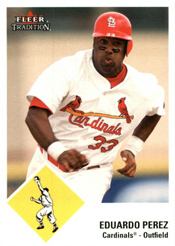
On Feb. 16, 1999, the Cardinals signed Perez, a free agent, with the hope he’d contribute as a utility player and pinch-hitter.

Eduardo was the son of Hall of Famer Tony Perez and, though not as skilled as his dad, he hit with power and provided “thunder off the bench,” Cardinals general manager Walt Jocketty said to the St. Louis Post-Dispatch.

Raised right

Eduardo Perez, who was born in Cincinnati and played college baseball at Florida State, was a first-round choice of the Angels in the 1991 amateur draft.

“When I was a kid, my mom (Pituka) really was the main person in my life,” Perez said. “My dad was gone a lot playing. My dad had a beautiful career. I’ve always been proud to be his son, but my mom was pretty much my father and mother figure. I am so grateful for all she did.”

Perez reached the big leagues with the Angels in 1993 and played for them in parts of 1994 and 1995. In 1996, he was traded to the Reds, the team for whom his father played for 16 seasons. Eduardo hit 16 home runs for the Reds in 1997 and was their Opening Day first baseman in 1998, but Sean Casey took over the position after being acquired from the Indians.

Keeping faith

The Reds released Perez after the 1998 season and he joined the Cardinals, who invited him to their major-league spring training camp in 1999. The Cardinals projected Perez, 29, for a reserve role on the Opening Day roster, but he hit .214 in spring training and was sent to the minors.

Perez batted .320 with 18 home runs and 82 RBI for Class AAA Memphis in 1999 and was called up to the Cardinals in September.

“I believed all year that I should be in the big leagues,” Perez said. “I never did stop believing.”

The Cardinals put Perez in the lineup and he produced three consecutive two-hit games against the Brewers.

On Sept. 27, 1999, against the Reds at Cincinnati, Perez hit a three-run home run off Brett Tomko. Perez said hitting a home run as an opposing player in his hometown was special. “I’m not going to say it wasn’t,” he said. Boxscore

Perez hit .344 in 21 games for the 1999 Cardinals, became a free agent and signed with St. Louis again in February 2000.

Grand slam

Perez hit well in spring training in 2000, but was the last player cut from the roster before Opening Day. He returned to Memphis, hit .289 with 19 home runs in three months and was promoted to the Cardinals.

On June 24, 2000, the day after his call-up, Perez started at third base, hit a double against Orel Hershiser and strained a hamstring running the bases. He was removed from the game and placed on the disabled list.

A month later, on July 14, 2000, a day after he was activated, Perez started at first base and hit the first grand slam of his major-league career 420 feet to center against Bob Howry of the White Sox at Chicago. Boxscore

“He’s a very intelligent hitter and he’s the kind of first-class person you want to have around,” said Cardinals manager Tony La Russa.

A week later, Perez got permission to leave the club to attend his father’s Hall of Fame induction ceremony at Cooperstown, N.Y., on July 23, 2000.

Perez hit .297 in 35 games for the 2000 Cardinals, but in December they sold his contract to the Hanshin Tigers of the Japan Central League.

Home and healthy

The Japan experience was a bust for Perez. He injured a knee and hit .222 with three home runs. After the 2001 season, Perez had knee surgery and Lasik eye surgery to treat a severe astigmatism.

On Feb. 8, 2002, the Cardinals purchased Perez’s contract from the Japanese team. At spring training, Perez credited his improved vision for his strong hitting. “It’s like night and day,” he said. “It makes a big difference when you’re not worried about something getting in your eye, which used to happen a lot with me.”

Perez earned a reserve role on the Cardinals’ 2002 Opening Day roster. On April 10, a week into the season, his walkoff home run in the 11th inning against Luis Vizcaino carried the Cardinals to victory over the Brewers. Explaining to the Associated Press his approach with the count at 2-and-2, Perez said, “I choked up and was just trying to put it in play.” Boxscore

In 96 regular-season games for the 2002 Cardinals, Perez hit .201 with 10 home runs. He also hit a home run against Jason Schmidt of the Giants in Game 2 of the 2002 National League Championship Series. Boxscore

Moving on

Perez, 33, spent the 2003 season with the Cardinals and hit .285 with 11 home runs. The right-handed batter was especially effective versus left-handed pitching, hitting .353.

He was granted free agency after the 2003 season and, unlike his other departures, left on his terms, signing with the Rays.

In four seasons with St. Louis, Perez hit .266 with 25 home runs.

After two years with the Rays, Perez concluded his big-league playing career with the Indians and Mariners in 2006.
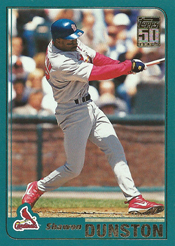
Shawon Dunston, who spent his prime as a shortstop with the Cubs, contributed to the Cardinals for two seasons as a utility player.

On Feb. 16, 1999, the Cardinals and Dunston, a free agent, agreed to a one-year contract with a base salary of $500,000.
Dunston, who would turn 36 a month later, went on to play every position except pitcher, catcher and second base for the Cardinals over the next two seasons.

Multiple skills

As a senior at Thomas Jefferson High School in Brooklyn, Dunston batted .790 and had 37 stolen bases in 37 attempts. The Cubs chose him with the No. 1 overall pick in the 1982 amateur draft.

Displaying a strong arm and wide fielding range at shortstop, Dunston made his major-league debut with the Cubs in 1985 and played for them through 1995 before becoming a free agent.

After a season with the Giants in 1996, Dunston split 1997 with the Cubs and Pirates. In 1998, no longer a premier shortstop, he adjusted to a utility role with the Indians and Giants.

A free agent again, Dunston had an attractive offer to stay with the Giants in 1999, but St. Louis manager Tony La Russa convinced him to join the Cardinals.

“Tony called me all the time, asking, ‘Are you motivated?’ He’d ask me over and over and over,” Dunston said to Bernie Miklasz of the St. Louis Post-Dispatch.

Seeing red

After the Cardinals announced the signing, Dunston told the Post-Dispatch, “I’m still a Cub at heart.”

Columnist Dan O’Neill responded, “It’s OK for Shawon Dunston to still feel like a Cub, as long as he doesn’t field like one.”

The Cardinals had a quality shortstop, Edgar Renteria, so La Russa envisioned Dunston would fill in at all three outfield positions as well as first base, third base and shortstop.

“Dunston isn’t getting older; he’s getting busier,” Miklasz observed.

In the Cardinals’ season opener on April 5, 1999, against the Brewers at St. Louis, Dunston started in left field, produced a double and two singles and scored twice. Boxscore

In May 1999, Dunston batted .370 and had 16 RBI in 22 games. His hot month was highlighted by a pair of performances against the Pirates at St. Louis.

On May 7, 1999, Dunston hit a two-run home run with two outs in the ninth against Rich Loiselle, carrying the Cardinals to a 4-2 walkoff victory. Boxscore

Two days later, on May 9, 1999, Dunston hit a grand slam off Jose Silva in the first inning and a RBI-triple against Silva in the fifth. Boxscore

“He delivers big hits, matches manager Tony La Russa’s blowtorch intensity and hustles as if his pension depended on it,” Miklasz wrote.

Encore effort

On July 31, 1999, the Cardinals, who were out of contention, thought they were doing Dunston a favor when they traded him to the Mets for utility player Craig Paquette. The Mets were on their way to 97 wins and a berth in the postseason and Dunston would be going back to his roots near Brooklyn.

However, Dunston didn’t want to leave the Cardinals and was stunned by the deal. “I thought I found a home here,” he said.

In 62 games for the 1999 Cardinals, Dunston hit .307 overall and .412 with runners in scoring position.

After the 1999 postseason, when Dunston became a free agent again, he returned to the Cardinals, agreeing to a $500,000 contract. “I’ll do anything to help this team win,” he said.

On May 30, 2000, at Phoenix, Dunston hit a grand slam against Omar Daal of the Diamondbacks in the sixth. Facing Mike Morgan in the eighth, Dunston tripled and was waved home by third-base coach Jose Oquendo, who thought Dunston could achieve an inside-the-park home run. Umpire Greg Gibson ruled Tony Womack’s relay throw was in time to nail Dunston, “even though television replays indicated Dunston might have been safe,” according to the Post-Dispatch. Dunston argued the call and was ejected. Boxscore

Dunston hit two home runs and a double for six RBI against the Giants on June 22, 2000, at St. Louis. After a two-run double off Shawn Estes in the fifth and a solo home run against Aaron Fultz in the seventh, Dunston hit a three-run homer versus Felix Rodriguez in the eighth.

“The ball traveled only 330 feet to left field and probably wouldn’t have made it over the fence if not for leaping Giants left fielder Barry Bonds, who knocked it over with his glove,” the Post-Dispatch reported.

Said Bonds: “Shawon should send me a thank-you letter, at least.” Boxscore

Dunston finished the 2000 season with 12 home runs and a .250 batting mark and played in the postseason for the Cardinals against the Braves and Mets.

Though a free agent again, Dunston, 37, wanted to stay with St. Louis and the Cardinals were interested, but the Giants made a better offer.

The Giants gave Dunton a one-year, $1 million deal for 2001 with an option for 2002. The Cardinals came up with one year at less than $1 million.

“I love Shawon,” said Cardinals general manager Walt Jocketty. “I wish we could have kept him.”

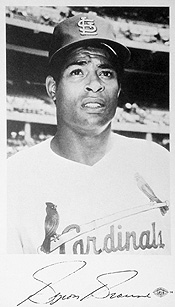
Byron Browne, who had thunder in his bat and holes in his swing, intrigued the Cardinals as a power-hitting prospect.

On Feb. 12, 1969, the Cardinals purchased the contract of Browne from the Astros and assigned him to their farm club at Tulsa.
Browne battered baseballs with his right-handed slugging stroke, but he struck out a lot. The Cardinals wanted to see him make more contact before giving him a chance to return to the big leagues.

Working with instructors Joe Medwick and Tom Burgess, Browne hit consistently well for Tulsa and earned a promotion to the Cardinals.

Big chance

Browne was born and raised in St. Joseph, Mo., a town known as the starting point for the Pony Express and the place where outlaw Jesse James was killed.

In September 1962, Browne, 19, signed as an amateur free agent with the Pirates. He played in their farm system before being chosen by the Cubs in the minor-league draft in December 1963.

On Sept. 9, 1965, Browne made his major-league debut for the Cubs, starting in left field, at Dodger Stadium on the night Sandy Koufax pitched a perfect game. Browne lined out to center, grounded out to short and struck out. It also was the debut game for Cubs center fielder Don Young. Boxscore.

At spring training in 1966, Browne impressed Cubs manager Leo Durocher, who told the Chicago Tribune, “I’m going to give this boy a good, long look in center field.”

On April 21, 1966, the Cubs acquired Adolfo Phillips from the Phillies. Scouts told Durocher the only center fielders better than Phillips were Willie Mays of the Giants and Curt Flood of the Cardinals.

Durocher put Phillips in center, moved Browne to left and kept Billy Williams in right. “I possibly may have the fastest outfield in the league,” Durocher said.

Tough on Cards

Three of Browne’s best games in 1966 were against the Cardinals.

On May 26, 1966, Browne hit a two-run home run against Bob Gibson “well up into the bleachers beneath Gussie Busch’s dancing beer sign” at Busch Memorial Stadium, the Tribune reported. Boxscore

Two months later, on July 18, 1966, Browne hit two home runs off Larry Jaster at St. Louis. His two-run home run in the second struck the yellow foul pole in left and his three-run homer in the eighth went into the seats in left-center. Boxscore

On Sept. 18, 1966, at Chicago, Browne had three hits, including a bloop double down the right-field line against Ron Piche to drive in the winning run and end the Cardinals’ seven-game winning streak. Boxscore

Browne batted .308 in 13 games against the Cardinals in 1966, but overall his season wasn’t nearly so good. He hit 16 home runs but batted .243 and struck out a league-high 143 times.

“He’s going to be a good one someday, but he’s going to have to work … and I mean work very hard,” Durocher said.

Lord Byron

Browne spent most of the 1967 season in the minors and on May 4, 1968, the Cubs traded him to the Astros for outfielder Aaron Pointer.

Browne hit .231 in 10 games for the Astros before being sent to the minors by manager Harry Walker, who wanted him to alter his hitting approach. “I’m just not a punch-and-judy hitter,” Browne said.

The Cardinals were set in the outfield for 1969 with Lou Brock in left, Flood in center and Vada Pinson in right, so when they acquired Browne from the Astros it was with the intent he open the season at Tulsa and position himself for a promotion if needed.

Browne responded to the instruction given by Medwick, who was a Hall of Fame slugger for the Gashouse Gang Cardinals of the 1930s. Medwick told him, “Get up to the plate. You’re standing too far back in the box.”

The results were immediate. Browne had two home runs, a double and five RBI in Tulsa’s season opener.

After 14 games, Browne was batting .416 with six home runs and 25 RBI.

“Browne is a big, strong guy and he can take those short, quick strokes and hit the ball out of the country,” said Tulsa manager Warren Spahn.

Browne batted .340 with 106 hits and 79 RBI in 84 games for Tulsa.

On July 12, 1969, the Cardinals traded utility player Bob Johnson to the Athletics and called up Browne, 26, to take his spot.

Clemente’s catch

Browne played his first game for the Cardinals on July 15, 1969, against the Phillies. Starting in left field in place of Brock, who had leg cramps, Browne had a hit, a run, a RBI and three walks. Boxscore

On Sept. 11, 1969, Browne was in the starting lineup for the Cardinals in a game at Pittsburgh. The Pirates started pitcher Bob Veale, who dated Browne’s sister when Veale attended Benedictine College in Atchison, Kan., across the Missouri River from Browne’s home in St. Joseph, Mo.

In his first three at-bats versus Veale, Browne struck out looking each time. According to the Pittsburgh Press, Veale set him up with fastballs and slipped sliders past him for the third strikes.

In the ninth, Veale was protecting a 3-2 lead when Browne came up with one out and a runner on first. “I tried to get cute,” Veale said. He changed his pattern, throwing a slider on the first pitch, and Browne lined it to deep right-center.

Right fielder Roberto Clemente raced toward the wall and caught the ball a step or two in front of an iron gate 435 feet from home plate.

“It would have been an inside-the-park home run because the ball would have hit the bottom of the iron gate if Clemente hadn’t made that great catch,” Cardinals manager Red Schoendienst said to the St. Louis Post-Dispatch.

Said Clemente: “I did not look at the ball at all. All I do is run to the spot where I think it will be because I know it is over my head from the sound. If I do not do that, I never catch it.” Boxscore

Big deal

Browne finished the 1969 season with a couple of highlights against the Expos. On Sept. 27, 1969, he hit a home run against Jerry Robertson, helping Jerry Reuss win his major-league debut. Boxscore. A day later, in the ninth inning of a scoreless game, Browne tripled against Bill Stoneman, scoring Gibson from second, and scored on Joe Torre’s single. Boxscore

In 22 games for the 1969 Cardinals, Browne batted .226 with 12 hits and 14 strikeouts.

On Oct. 7, 1969, the Cardinals traded Browne, Flood, Joe Hoerner and Tim McCarver to the Phillies for Richie Allen, Jerry Johnson and Cookie Rojas. When Flood refused to report, the Cardinals sent Willie Montanez and Jim Browning to complete the deal.

Browne had the only four-hit game of his major-league career for the Phillies against the Cardinals on June 27, 1970, at St. Louis. Boxscore

On Dec. 18, 1972, the Phillies traded Browne back to the Cardinals for outfielder Keith Lampard. Browne spent the 1973 season at Tulsa, batting .259, and played in Mexico in 1974 and 1975.

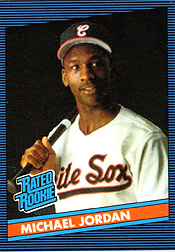
Michael Jordan sought to achieve with the White Sox what Brian Jordan was doing with the Cardinals.

On Feb. 7, 1994, Jordan agreed to a minor-league contract with the White Sox and was invited to spring training as an outfielder with the major league club.
Four months earlier, in October 1993, Jordan announced his retirement from the NBA Chicago Bulls. He surprised many when he decided in February 1994 to take up baseball.

Others, such as Brian Jordan with the NFL Atlanta Falcons and baseball Cardinals, were two-sport athletes in the pros, but most had done so before turning 30. Michael Jordan would turn 31 during spring training with the 1994 White Sox.

“I wish him all the luck in the world,” Brian Jordan said to the St. Louis Post-Dispatch. “It’s no easy task, but when you have the athletic ability he has … you tend to make adjustments quicker than the normal athlete.”

Chasing a dream

Michael Jordan hadn’t played baseball since high school. His father James had wanted him to try professional baseball and Jordan was motivated to honor the memory of his dad, who was murdered in 1993.

“I’ve never been afraid to fail,” Jordan said to the Associated Press. “That’s something you have to deal with in reality. I think I’m strong enough as a person to accept failing, but I can’t accept not trying.”

Said White Sox general manager Ron Schueler: “He’ll have to earn it. Nothing is going to be given to him.”

In its Feb. 8, 1994, edition, the Chicago Tribune reported Jordan’s venture under the headline “The Circus Begins.”

“It’s no gimmick,” Jordan said.

Tribune columnist Bob Verdi wrote, “If Jordan can’t chase the American dream, who can?”

A right-handed batter, the 6-foot-6 rookie wore No. 45 on his uniform when he appeared for his first public workout with the White Sox at spring training camp in Sarasota, Fla.

Varied opinions

The 1994 Cardinals trained in St. Petersburg, 37 miles north of Sarasota on Florida’s west coast. Among the Cardinals players who offered their reactions to the Post-Dispatch on Jordan’s bid to play baseball:

_ Ozzie Smith: “I think people are looking for Mike to have the same success he had in basketball. He won’t achieve that right away, but as far as playing this game and being fundamentally sound at it, there’s no reason he can’t do that.”

_ Todd Zeile: “I think for him to waltz in and start at the major-league level … that’s something a lot of guys can’t comprehend. He’s going to have to prove it on the field eventually.”

_ Brian Jordan: “When everyone is counting him out, that makes him more determined. I’ve been there. People counted me out.”

In interviews with the St. Petersburg Times, several baseball Hall of Famers were skeptical of Michael Jordan’s chances of succeeding:

_ Bob Feller: “Michael couldn’t hit a big-league curveball with an ironing board.”

_ Hal Newhouser: “His swing is too long. His strike zone too big … Good, inside fastballs will eat him up.”

_ Enos Slaughter: “Wait until he gets a 90 mph pitch under his chin, followed by a nasty curve over the outside corner, then a killer changeup. Jordan’s heart may be in it, but I’m not sure his body can hang with it.”

Among Jordan’s defenders was Athletics manager Tony La Russa, who told the San Francisco Examiner: “It’s unprofessional and immature to begrudge him the opportunity to be in camp.”

Tough start

Jordan went hitless in his first 14 at-bats in White Sox spring training games.

“He’s to the point where he’s overmatched right now,” Schueler said. “It looks like he’s afraid to make a mistake. He look tentative.”

Under the headline “Err Jordan,” Steve Wulf of Sports Illustrated wrote, “Michael Jordan has no more business patrolling right field in Comiskey Park than Minnie Minoso has bringing the ball upcourt for the Chicago Bulls.”

Jordan broke his skid with an infield single against Jeff Innis of the Twins on March 14, 1994. Teammates celebrated by showering him with beer in the clubhouse after the game.

Jordan got a line-drive single two days later in a game versus the Blue Jays. “I’m going to keep trying to build on it,” he said.

The Cardinals came to Sarasota for a game against the White Sox on March 18, but Jordan didn’t play. Jose Oquendo of the Cardinals made the headlines that afternoon with a grand slam against Dennis Cook.

Down on the farm

On March 21, 1994, the White Sox assigned Jordan to their minor-league camp after he produced three hits in 20 at-bats in 13 spring training games at the big-league level. He hit the ball out of the infield twice.

The Tribune reported the demotion under a headline, “Jordan’s Just a Bush-Leaguer Now.”

“He was overmatched some, but I don’t think he’s embarrassed himself,” said White Sox manager Gene Lamont.

Said Jordan: “It doesn’t bother me personally. I don’t think like I failed at anything.”

Agreeing to begin the regular season in the minors, Jordan said, “People tend to underestimate my general attitude toward the game. I’ve always truly loved the game of baseball. I didn’t set any expectations for myself except to enjoy the game.”

Jordan spent the 1994 season with the Class AA Birmingham Barons. Playing for manager Terry Francona, Jordan batted .202 with 88 hits in 127 games. He produced 51 RBI and 30 stolen bases. As an outfielder, Jordan committed 11 errors and had six assists.

Jordan abandoned his pursuit of a baseball career after the 1994 season and returned to the NBA as a player in March 1995.

Bill White, a leader on and off the field as a Cardinals player, was a natural to take those skills to the executive level.

On Feb. 3, 1989, White was named president of the National League, succeeding Bart Giamatti, who became commissioner of baseball.

Two years after Dodgers executive Al Campanis told a national television audience blacks lacked the necessities for management, White became the highest-ranking African-American sports official in the United States and the first black to head a major professional sports league.

White’s hiring came 42 years after Jackie Robinson integrated the major leagues as a player for the 1947 Dodgers. In 1989, White became leader of a league with no black managers and no black general managers. Frank Robinson of the American League Orioles was the only black manager in February 1989 and Hank Aaron, a vice president of the National League Braves, was the only black executive of a major-league club.

“I don’t think they could have found anyone more qualified than Bill White,” Aaron said to the Associated Press.

Success in St. Louis

White played 13 seasons in the National League for the Giants (1956 and 1958), Cardinals (1959-65 and 1969) and Phillies (1966-68). With the Cardinals, White hit 20 or more home runs in five consecutive seasons and had more than 100 RBI three years in a row. In 1964, when the Cardinals were World Series champions, White batted .303 with 191 hits. As a first baseman, he won the Gold Glove Award seven times, including six with St. Louis, and he was an all-star in five of his Cardinals seasons.

In 1961, White successfully led an effort to end segregation of players at spring training in Florida.

“When Bill was first with the Cardinals, blacks could not stay in the same hotel as whites,” teammate Tim McCarver said. “Bill spoke up and said it was wrong. The next season, blacks were in the same hotel as the whites.”

Cardinals general manager Bing Devine reacquired White from the Phillies in 1969 and wanted him to learn to be a manager. White, however, wasn’t interested. “I didn’t want to manage,” White told me in 2011. “I didn’t want to try to tell 25 other guys how to play the game. I’d rather do something where the success depends on me, not on other people.”

White became a Yankees broadcaster in 1971 and was in that role when he got a surprise call from Dodgers executive Peter O’Malley in 1988.

Courting a candidate

O’Malley told White a search committee wanted to interview him for the National League president job. White replied, “Thanks, but I’m not interested.”

A week later, O’Malley called again, White recalled in his 2011 book “Uppity,” and said the committee still wanted to interview him.

“I thought it wouldn’t hurt to meet with them, even though I still wasn’t interested in actually taking the job,” White said.

White was interviewed in New York by the committee of O’Malley, Giamatti, retired National League president Chub Feeney and executives William Bartholomay of the Braves and Fred Wilpon of the Mets.

“My first reaction was, ‘Are these people serious?’ ” White said. “In meeting the people, I found out they were dead serious. Once I found that out, we went forward.”

The finalists were White and Simon Gourdine, director of labor relations for the Metropolitan Transit Authority in New York and former NBA deputy commissioner.

The committee recommended White to the 12 National League team owners, who unanimously approved him and awarded a four-year contract.

White said he accepted because “it was a challenge, and throughout my life, a challenge has been something that is hard for me to resist.”

Stellar reputation

Reaction to White’s hiring was overwhelmingly positive.

Bob Broeg of the St. Louis Post-Dispatch said the National League would find White to be “a most responsible as well as respectable president.”

Frank Dolson of the Philadelphia Inquirer called White “a man of character, a man of conviction, a man of determination.”

“Some men have to grow into a job; in this case, the job will become bigger simply because of the man occupying the office,” Dolson wrote.

According to the Chicago Tribune, Al Campanis sent a congratulatory telegram to White and hailed him as “articulate, intelligent and a gentleman who has the capability to become an outstanding league president.”

Lou Brock, White’s teammate with the Cardinals, said, “This is a great step, almost equal to Jackie Robinson’s entry into baseball.”

Another Cardinals teammate, Bob Gibson, said, “There are a lot of Archie Bunkers in the world that never really have experienced just being in the same room with a (black) person. The more jobs that are gotten, acquired, the more you are going to be able to dispel the myths that have been going on for years.”

White fully understood the significance of being the first African-American to hold the position but he downplayed the racial aspect because he wanted to be judged on skills, not skin color.

“If I didn’t think I could do the job, I would have been foolish to take it out of some historic significance,” White said.

Red tape

White said he wanted to improve relations between players and umpires and between players and club owners.

Soon after he started, White had to deal with the Pete Rose betting scandal and later with Reds owner Marge Schott, who got suspended for making insensitive comments.

Among White’s successes were his role in guiding expansion of the league into Denver and Miami, keeping the Giants from leaving San Francisco and reestablishing authority of the league president over the umpires union.

White retired in 1994 after some of the team owners he’d supported failed to back his recommendations.

“I was tired of the politics, tired of the behind-the-scenes maneuverings, tired of the lies,” White said in “Uppity.”

In his 1994 book “Stranger to the Game,” Gibson said White confided to him the difficulties he faced as league president.

“White has been frustrated by his inability to push through change and otherwise get things done,” said Gibson. “When he was telling me this over drinks one night and explaining why he felt compelled to resign his position, I said, ‘Why don’t you just stay in it for the money?’ He replied that he couldn’t do that. I said, ‘Hell, I can. Give the job to me.’ In reality, though, I couldn’t work under those conditions any more than Bill could.”

The Pirates came close to convincing the Cardinals to send them Stan Musial, but settled instead for Murry Dickson.

On Jan. 29, 1949, the Cardinals sold the contract of Dickson, a starting pitcher, to the Pirates for $125,000.

The Pirates were willing to pay almost three times as much if the Cardinals included Musial in the deal. The purchase price would have been $310,000 _ $250,000 for Musial, the reigning National League batting champion, and $60,000 for Dickson, the Pittsburgh Post-Gazette reported.

One of the Cardinals’ owners was willing but the other wasn’t, so Musial remained with St. Louis.

Right stuff

Dickson was born in Tracy, Mo., a town along the Platte River in the western part of the state. He was 20 when he signed with the Cardinals in 1936.

A right-hander with a slight build, Dickson began his professional career with Grand Island of the Nebraska State League in 1937 and worked his way through the Cardinals’ system.

After posting a 22-15 record for Houston of the Texas League in 1939, Dickson was rewarded with a promotion to the Cardinals and made his major-league debut on Sept. 30, 1939, with 3.2 scoreless innings of relief against the Cubs at Chicago. Boxscore

Dickson made another September appearance with the Cardinals in 1940 after posting a 17-8 record for Columbus, Ohio. He spent all of 1941 in the minors and stuck with the Cardinals in 1942.

The Cardinals won National League pennants in 1942 and 1943. Dickson was 6-3 in 1942, 8-2 in 1943 and made a relief appearance in the World Series versus the Yankees before entering the Army.

Dickson was assigned to a reconnaissance unit in Europe during World War II, achieved the rank of sergeant and earned four battle stars. General George S. Patton wanted Dickson to be his driver, but Dickson asked to be assigned elsewhere, according to the Society for American Baseball Research.

After two years of military service, Dickson returned to the Cardinals in 1946, achieved a record of 15-6 with a 2.88 ERA and helped them win another pennant. In the 1946 World Series against the Red Sox, Dickson started Game 3 and Game 7. He was the losing pitcher in Game 3 and got no decision in Game 7, though the Cardinals won.

Pursuing a deal

In his book, “Stan Musial: The Man’s Own Story,” Musial said Dickson “liked to experiment with pitches. He had the widest assortment I ever saw _ fastball, curve, slider, knuckler, sinker, screwball _ and a remarkable arm.”

Dickson was 13-16 in 1947 and 12-16 in 1948, when he gave up 39 home runs, but Cardinals manager Eddie Dyer liked him and wanted him in the starting rotation.

The Pirates liked Dickson, too. He was 0-5 against them in 1948, but with a 2.17 ERA, and the Pirates were convinced he’d improve their starting staff.

After the 1948 season, the Pirates began a “relentless pursuit” of Dickson, according to The Pittsburgh Press.

Pirates majority owner and president Frank McKinney was a friend of Cardinals president Robert Hannegan, who co-owned the St. Louis club with Fred Saigh. McKinney and Hannegan were powerful figures in the national Democratic Party and confidantes of President Harry Truman.

While attending the 1948 World Series, McKinney met with Hannegan to discuss a deal for a pitcher. Hannegan offered a choice of four _ Dickson, Red Munger, Howie Pollet and Ted Wilks, The Pittsburgh Press reported.

“Dickson was the pitcher we wanted,” McKinney said.

McKinney said he and Hannegan continued to negotiate, including when they were in Washington, D.C., for Truman’s inauguration on Jan. 20, 1949.

“I worked on this deal for a long time,” McKinney said.

Wait a minute

At some point, the trade talks between McKinney and Hannegan focused on Musial.

In a column headlined “Bucs Almost Had Musial,” Post-Gazette sports editor Al Abrams reported McKinney “had just about convinced Robert Hannegan to sell him Musial and Murry Dickson in one package.”

While at Truman’s inauguration, Hannegan, who suffered from hypertension, said he was advised by his doctor to sell his share of the Cardinals because of the stress the job was causing him. Hannegan planned to sell his share to Saigh.

McKinney’s $310,000 bid for Musial and Dickson was appealing to Hannegan, who “wanted to get back the money he invested in Cardinals stock and get out of baseball because of ill health,” the Post-Gazette reported.

When Saigh was told of the proposed Pirates deal, he objected to Musial being included. “Saigh would have blown his top had such a deal gone through,” the Post-Gazette reported, “and no one could blame him. The move would have wrecked the St. Louis club.”

On Jan. 26, 1949, Hannegan called McKinney, told him Musial wasn’t available and the price for Dickson had gone up to $125,000. “(He) told me to make up my mind within an hour,” McKinney said to The Pittsburgh Press.

McKinney called Pirates manager Billy Meyer, who said, “Get Dickson.”

Hannegan and McKinney made the deal but agreed to keep it quiet because the next day, Jan. 27, 1949, Hannegan announced he sold his shares to Saigh, who gained control of the franchise.

Two days later, it was Saigh who announced Dickson’s contract was sold to the Pirates.

Pinpoint control

Dickson was 12-14 for the 1949 Pirates, but 5-3 versus the Cardinals, who finished a game behind the pennant-winning Dodgers.

Musial said Dickson liked to pitch from behind in the count and get overeager batters to chase pitches. “He had such great control that instead of coming in there with a fat one, he could catch a corner with a pitch that looked good, but wasn’t,” Musial said.

In five seasons with the Pirates, Dickson was 66-85. He went to the Phillies in 1954 and they traded him back to the Cardinals on May 11, 1956, with Herm Wehmeier for Harvey Haddix, Stu Miller and Ben Flowers.

Dickson was 13-8 for the Cardinals in 1956 and 5-3 in 1957 before he hurt his right shoulder and was released.

He pitched for the Athletics and Yankees in 1958, making two relief appearances for New York in the World Series against the Braves, and for the Athletics again in 1959 when he was 43.

Dickson’s career record in the big leagues was 172-181, including 72-54 for the Cardinals.