Feeds:
Posts
Comments

Ray Blades was a pitcher for an elementary school team when Branch Rickey first took notice of him and became impressed by his baseball skills.

Rickey kept tabs on Blades in the ensuing years, brought him into the Cardinals’ system as a player and groomed him for a leadership role.

On Nov. 6, 1938, Blades became manager of the Cardinals.

Cardinals owner Sam Breadon had the final say on naming a manager, but he was influenced by Rickey, the club’s vice president and general manager, who recommended Blades.

Attracting attention

Blades was born in Mount Vernon, Ill., and lived there for two years before his family moved to nearby McLeansboro, Ill.  In 1909, the family relocated to St. Louis and Blades enrolled at Franz Sigel School, a public elementary school.

In 1913, Blades, in his final year in grammar school, pitched in the championship final of the Public School League baseball tournament at Sportsman’s Park. Rickey, who was working for the St. Louis Browns, was the home plate umpire for the game and took note of the talented pitcher.

“I scouted the boy when he played on a public school team here,” Rickey told the St. Louis Star-Times. “I admired his aggressiveness.”

After graduating from elementary school, Blades attended McKinley High School in St. Louis for a year before the family went back to McLeansboro.

Blades graduated from high school in McLeansboro and went to work for an electrical company in St. Louis. In 1918, with World War I raging, Blades enlisted in the Army, served in France and was discharged in May 1919. When he returned home, he joined a semipro baseball team in Mount Vernon.

The Cardinals, managed by Rickey, came to Mount Vernon to play an exhibition game against the local club. Blades again impressed Rickey and signed with the Cardinals after the game.

Short fuse

Blades made his professional debut in the minor leagues in 1920 as a second baseman. After another year in the minors, Blades reached the big leagues with the Cardinals in 1922. The Cardinals’ best player, Rogers Hornsby, was the second baseman, so Blades was converted to an outfielder.

A fiery player, Blades sparked the Cardinals as a leadoff batter. He hit .311 with 21 doubles and 13 triples in 1924. The next year, he hit .342 with 37 doubles and eight triples.

“He was a dashing, courageous type, arguing with opposing players and umpires almost every afternoon,” the Star-Times reported.

According to the St. Louis Post-Dispatch, Blades had “a violent temper” and “when something makes him see red, he really goes to town.”

Blades “was strangely unpopular” with Cardinals fans, the Post-Dispatch reported, “and the men on the bench used to boil and swear when the fans would boo Ray.”

Managing up

On Aug. 17, 1926, Blades, batting .306, tore ligaments in a knee while chasing a fly ball. The injury caused him to sit out the final month of the regular season and the World Series.

Blades never regained full effectiveness. He was a reserve in 1927 and 1928 and got demoted to the minors in 1929. He returned to the Cardinals as a player-coach in 1930 and served in that role through the 1932 season. Blades played 10 seasons with the Cardinals and hit .301 with a .395 on-base percentage

Rickey, who was Blades’ manager from 1922-25, became head of baseball operations for the Cardinals and built their farm system. He chose Blades to manage the Cardinals’ Columbus (Ohio) affiliate in 1933.

Blades managed in the Cardinals’ system for six seasons _ three with Columbus (1933-35) and three with Rochester (1936-38). Rickey credited Blades with the development of several prospects, including pitcher Paul Dean and outfielder Terry Moore.

On Sept. 11, 1938, Breadon reluctantly fired Cardinals manager Frankie Frisch, who was feuding with Rickey. Breadon liked Frisch, but Rickey was getting overtures from the Cubs and Breadon feared Rickey would join the Cardinals’ rival if Frisch wasn’t ousted. Cardinals coach Mike Gonzalez replaced Frisch for the remainder of the season, becoming the first Cuban-born manager in the major leagues.

Big promotion

The top candidates to manage the Cardinals in 1939 were two of their minor-league managers, Blades and Burt Shotton, along with former Dodgers manager Burleigh Grimes and former Phillies manager Jimmie Wilson, the Star-Times reported. All four had played for the Cardinals. Shotton also had managed the Phillies and Reds, making Blades the only one of the candidates who didn’t have big-league managing experience.

Rickey, however, urged Breadon to select Blades, whom he called “one of my own products.”

“Pressure by Rickey is said to have been a strong factor in gaining the appointment” for Blades, the Star-Times reported.

“I put in all the good licks I could for Blades,” Rickey said. “I believe we’ll see the return of the Gashouse Gang spirit under Blades’ leadership.”

Blades, 42, got a one-year contract. “I naturally have always wanted this position, but never dared hope I would get it,” he said.

The hiring received a lukewarm reception from Cardinals fans, who were hoping for a manager with a higher profile.

“I realized I would be stepping into a fast one with the fans in St. Louis if I decided on Blades,” Breadon said. “I feel Blades merits more consideration than he has been given by baseball’s followers. He’s been a sharp student of the game and he has developed many young stars for us.”

Short stay

The Cardinals finished in second place with a 92-61 mark in Blades’ first season as manager in 1939, but they started poorly the next year and were 14-24 when Breadon, without consulting Rickey, fired Blades on June 7, 1940, and replaced him with Billy Southworth.

Southworth led the Cardinals to two World Series championships (1942 and 1944) and three consecutive National League pennants (1942-44).

Blades became a coach with the 1942 Reds. After Rickey joined the Dodgers, he hired Blades, who managed the Dodgers’ St. Paul affiliate from 1944-46. Blades was a Dodgers coach in 1947 and 1948.

In 1951, Blades returned to St. Louis as a coach on the staff of Cardinals manager Marty Marion. Blades also was a Cubs coach from 1953-56.

Benny Valenzuela, a pioneering Mexican-born ballplayer, emerged from a humble start in professional baseball and reached the majors, but the Cardinals were the wrong club for a rookie third baseman.

Valenzuela played briefly for the Cardinals in two stints with them in 1958. The Cardinals, though, were set at third base with a premier player, Ken Boyer, and that meant Valenzuela had little opportunity to play.

The Cardinals traded Valenzuela after the 1958 season and he never got back to the big leagues. He did, however, continue his playing career in the minors and he went on to have success as a manager for many years in the Mexican League.

Big break

Benjamin Beltran Valenzuela was born in Los Mochis, a city founded by Americans near the Gulf of California in northwestern Mexico. His nickname was Papelero because as a boy he sold newspapers to help his widowed mother.

Benny Valenzuela, no relation to fellow Mexican and former Cardinals pitcher Fernando Valenzuela, became a bat boy for a Los Mochis team managed by former Washington Senators pitcher Syd Cohen. In 1949, when Valenzuela was 16, Cohen became exasperated by a Los Mochis outfielder who couldn’t track fly balls in the sun. Cohen lifted the outfielder during a game and replaced him with the bat boy, Valenzuela, who’d showed an ability to play.

Three years later, in 1952, Cohen was manager of the Bisbee-Douglas Copper Kings of the Arizona-Texas League and he gave his former bat boy a spot on the team. Bisbee-Douglas was in the low levels of the minors, a remote Class C league with no affiliation to any franchise in the majors, but it was professional baseball in the United States and Valenzuela was grateful to Cohen to get the opportunity.

Valenzuela spent three seasons with Bisbee-Douglas, learning the craft, and produced batting averages of .352 in 1952, .347 in 1953 and .388 in 1954.

The Cardinals took notice and on Nov. 30, 1954, they selected Valenzuela, 21, in the minor-league draft.

Rising above

Valenzuela continued his strong hitting in the Cardinals’ system. He batted .354 for Fresno in 1955, .305 with 107 RBI for Omaha and Houston in 1956 and .286 with 24 home runs and 90 RBI for Houston in 1957.

At spring training with the Cardinals in 1958, Valenzuela impressed general manager Bing Devine and moved “to the front row among candidates for pinch-hitting jobs,” the St. Louis Post-Dispatch reported.

Valenzuela also had a strong arm and the Post-Dispatch reported he “gets a ball away more quickly than any infielder we can remember. He frequently gets the ball to the first baseman before the batter has reached the halfway mark to first base.”

Valenzuela was listed as being 5 feet 10, 175 pounds, but often was described in unflattering terms. The Sporting News called him “thick-legged” and “stubby.” The Post-Dispatch resorted to “chunky.”

“He resembles Yogi Berra,” The Sporting News decided.

Stereotyping was common. The Sporting News, for instance, labeled him “the peppery Mexican” and cited his “chili con carne English.”

Trailblazer

Valenzuela, 24, made the Opening Day roster of the 1958 Cardinals and became the 10th Mexican-born player to reach the major leagues, according to Frontera.info. He was the second Mexican-born player to join the Cardinals. The first was pitcher Memo Luna, whose big-league career with the Cardinals consisted of two-thirds of an inning in 1954.

Mel Almada, an outfielder with the 1933 Red Sox, was the first Mexican-born player in the big leagues.

Valenzuela made his Cardinals debut on April 27, 1958, when he batted for pitcher Larry Jackson and singled to right against Johnny Podres of the Dodgers. Boxscore

“He’s hitting 1.000, a heck of an average in any man’s language,” the Post-Dispatch declared.

On May 6, 1958, Valenzuela doubled against Bob Buhl of the Braves, but the Cardinals demoted him to Omaha on May 14 after he appeared in five games.

Moving on

On June 29, 1958, another Mexican-born player, shortstop Ruben Amaro, who’d been Valenzuela’s teammate for two seasons at Houston, made his major-league debut with the Cardinals.

Meanwhile, Valenzuela hit. 284 with 72 RBI for Omaha and was named the third baseman on the Parade Magazine Class AAA all-star team.

On Sept. 2, 1958, the Cardinals recalled Valenzuela to the big leagues and he appeared in five more games, producing a single against Bob Rush of the Braves on Sept. 18.

For the season, Valenzuela hit .214 (3-for-14) in 10 games for the Cardinals. Boyer, 27 and entrenched at third base, hit .307 and led the Cardinals in runs (101), hits (175), home runs (23) and RBI (90).

On Oct. 7, 1958, the Cardinals traded Valenzuela, pitcher Billy Muffett and catcher Hobie Landrith to the Giants for pitchers Ernie Broglio and Marv Grissom.

Valenzuela played three seasons (1959-61) in the Giants’ farm system before continuing his career as a player and manager in the Mexican League. Among the former major leaguers he managed in Mexico were ex-Cardinals pitchers Diego Segui and Pedro Borbon.

Valenzuela, Vinny Castilla and Aurelio Rodriguez are among the most prominent Mexican-born third basemen to reach the major leagues.

In 1986, Valenzuela and Amaro were inducted together into the Mexican Baseball Hall of Fame in Monterrey.

Jake Powell was an outfielder who spent 11 years in the major leagues and played in three World Series for the Yankees, but after his baseball career he got involved in unlawful behavior and it led to a stunning and tragic conclusion.

On Nov. 4, 1948, Powell was at police headquarters in Washington, D.C., being questioned on charges of writing bogus checks, when he pulled a gun from his pocket and killed himself. Powell’s suicide was a grisly close to a life filled with athletic achievement but marred by personal irresponsibility.
Reaching the top

Alvin Jacob Powell was born in Silver Spring, Md., in 1908, played sandlot baseball in Washington, D.C., and was signed by the hometown Senators.

Powell made his major-league debut with the Senators in 1930, spent the next three seasons in the minors and got back to the big leagues in 1934. United Press described him as “a player of outstanding ability who used rough-and-ready tactics on the field and frequently did not observe training rules to the letter.”

In a game against the Tigers, Powell hit a groundball, sprinted toward the bag and crashed into Hank Greenberg, breaking the first baseman’s wrist.

On June 14, 1936, the Senators traded Powell to the Yankees for outfielder Ben Chapman. Powell hit .302 for the 1936 Yankees and achieved his greatest success in the World Series that year against the Giants.

In Game 6, with the Giants ahead, 2-0, Powell hit a two-run home run against Freddie Fitzsimmons, tying the score. Powell was 3-for-5 with four RBI and three runs scored in the game, pacing the Yankees to a 13-5 championship-clinching victory. Boxscore

Playing in a World Series lineup with Bill Dickey, Joe DiMaggio, Lou Gehrig and Tony Lazzeri, Powell batted .455 with eight runs scored in six games. He produced a .538 on-base percentage with 10 hits and four walks in 26 plate appearances.

Powell also appeared in the 1937 and 1938 World Series for the Yankees.

In 1938, Powell was suspended 10 days by commissioner Kenesaw Mountain Landis for making a racist comment during a radio interview in Chicago.

Head case

On April 10, 1940, the Yankees were working their way north after spring training in Florida and stopped in Ashland, Ky., to play an exhibition game. Powell was pursuing a fly ball when he crashed into an iron light pole and suffered a head injury, most likely a concussion and possibly a fractured skull.

Powell was sidelined until July 15 and was limited to playing in 12 games for the 1940 Yankees. He spent the next two seasons (1941-42) in the minors before he returned to the big leagues with the Senators in 1943.

In July 1945, the Senators sent Powell to the Phillies. He had a hit and a RBI in each game of a doubleheader against the Cardinals on Sept. 16, 1945.

Comeback try

Powell was out of baseball in 1946 and 1947. He and his wife and daughter resided in Dayton, Ohio, and Powell worked as a factory guard. He wasted most of his baseball earnings “betting horses and on wine and song,” the Dayton Daily News reported, and “gambled away” his first World Series check.

“He became bitter and was subject to fits of brooding which led him to drink,” Los Angeles Examiner columnist Vincent X. Flaherty reported. “He faded rapidly after that and the downward path became increasingly tragic.”

In 1948, Powell, 40, attempted a baseball comeback in the Florida State League with the Gainesville G-Men, who were managed by his former Yankees teammate, Myril Hoag. Powell met Josephine Amber, 34, co-owner of a nightclub.

In late October 1948, Powell and Amber traveled to Washington, D.C., and checked into the Ambassador Hotel, registering as Mr. and Mrs. Powell. They stayed at the hotel for three days and Powell cashed about $300 in personal checks drawn on a bank in Dayton, according to the New York Daily News.

At the end of their hotel stay, Powell paid with a check. A hotel manager became suspicious and told another employee to follow the pair, the Baltimore Evening Sun reported. The manager called the Dayton bank and learned Powell had no account there. The hotel employee followed Powell and Amber to Union Station and police met them there as the couple waited to board a train to New York.

Powell was arrested on suspicion of writing bogus checks and taken to police headquarters. Amber went with them.

Deadly decision

At headquarters, police learned a warrant was issued a few weeks earlier charging Powell with passing a bogus check at a drugstore in Washington, D.C. Police also discovered Powell was wanted in Florida on bad check charges and Dayton police said Powell “had been in trouble numerous times in recent years on charges of passing bad checks.”

While being questioned about the charges, Powell asked to speak to Amber, “a tall blonde in a red dress,” according to the Baltimore newspaper.

The request was granted and Powell stepped a few paces away and outside the door, though two detectives stood nearby and kept watch with the door open, the Associated Press reported.

Amber suddenly shouted, “You’d better frisk him.”

“To hell with it,” Powell said. “I’m going to end it all.”

Powell took a .25-caliber revolver from his pocket, fired a shot in his chest and another in his right temple. He was pronounced dead 10 minutes later.

Police didn’t customarily search suspects arrested on bad check charges, the Dayton Daily News reported.

Wedding plans

Amber told police she and Powell had planned to get married in Washington that day, but canceled the plan and decided to go to New York and get married there, the Baltimore newspaper reported.

Powell’s wife, Elizabeth, told reporters she and Powell were not divorced and had been married since 1932.

Amber told police she’d known Powell for about four months and knew nothing about the charges against him.

After Powell’s death, New York Herald Tribune columnist Red Smith described him as “a guy who never knew fear and never knew what was good for him, a guy who always acted on impulse and was wrong more often than not.”

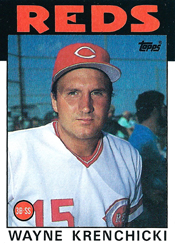
For Wayne Krenchicki, who usually didn’t do well against Cardinals pitching, a game-winning hit, even a crummy one, was a special achievement.

Krenchicki played eight years in the major leagues as an infielder for the Orioles (1979-81), Reds (1982-83 and 1984-85), Tigers (1983) and Expos (1986).

A left-handed hitter, he had a career batting average of .266, though he hit .169 lifetime against the Cardinals.

Right spot

On May 23, 1983, the reigning World Series champion Cardinals looked to end a three-game losing streak when they faced the Reds at Cincinnati. Cardinals starter Joaquin Andujar was matched against Joe Price. Krenchicki played third base and batted seventh.

In the sixth inning, with the Cardinals ahead, 1-0, Johnny Bench drew a one-out walk from Andujar and Ron Oester doubled to right, moving Bench to third. Cardinals manager Whitey Herzog ordered an intentional walk to Paul Householder, loading the bases for Krenchicki.

The Cardinals were hoping for an inning-ending double play from Krenchicki, who was batting .167 for the season. Krenchicki was seeking a sacrifice fly. “I wanted to hit in the air to the outfield,” Krenchicki said to the Cincinnati Enquirer. “All I wanted was the one run.”

Andujar got ahead in the count, 1-and-2, and threw a slider “right in on my fists,” Krenchicki told the Dayton Journal-Herald.

Krenchicki swung and looped a floater to the opposite field. The ball fell softly inside the left-field foul line, barely fair, for a bloop double, scoring Bench and Oester and giving the Reds the lead.

“It was just crummy enough that I knew nobody would catch it,” Krenchicki said to the St. Louis Post-Dispatch.

“Yeah, I’d agree with that,” Herzog said to United Press International. “It hit right in the middle of the chalk line.”

Andujar yelled at Krenchicki, “You throw the ball harder than you hit it.”

Bill Scherrer relieved Price, held the Cardinals hitless over the last three innings and the Reds won, 2-1. Boxscore

Cardinals connection

A month later, the Reds traded Krenchicki to the Tigers and reacquired him after the 1983 season. Krenchicki played two more years with the Reds before he was dealt to the Expos in March 1986 for pitcher Norm Charlton, who became one of the Nasty Boy relievers who helped give the Reds their swagger in their World Series championship season in 1990.

Krenchicki, a Trenton, N.J., native, was a standout shortstop at the University of Miami and played for the Hurricanes when they made their first appearance in the College World Series in 1974. Krenchicki, a first-round draft choice of the Orioles in January 1976, was inducted into the University of Miami Sports Hall of Fame in 1990.

Krenchicki’s last season as a professional player was 1988 when he played for three minor-league teams, including the Cardinals’ Class AAA affiliate, the Louisville Redbirds. Playing for manager Mike Jorgensen, Krenchicki hit .195 in 18 games for Louisville before he was released on June 17, 1988.

After his playing career, Krenchicki spent 20 years (1991-2010) as a minor-league manager, primarily with independent teams not affiliated with major-league organizations. He managed the Newark Bears to the Atlantic League championship in 2007.

Gussie Busch made a handshake agreement to hire Leo Durocher to manage the Cardinals, lied about it to the public and reneged on the commitment.

Busch’s mishandling of the Durocher deal was one of several missteps made by the meddling Cardinals owner during the 1964 season.
Despite Busch’s bumbling, the Cardinals rallied to win the National League pennant on the last day of the regular season and went on to clinch a World Series title against the Yankees.

Holy cow!

On Aug. 17, 1964, the Cardinals were nine games out of first place when Busch, figuring there was no hope for a pennant, fired general manager Bing Devine and replaced him with Bob Howsam, a colleague of consultant Branch Rickey.

Busch wanted to fire manager Johnny Keane, too, but decided to wait until after the season.

On Aug. 29, 1964, before a Saturday game between the Dodgers and Cardinals at St. Louis, Durocher was interviewed by broadcaster Harry Caray. Durocher, a shortstop for the Cardinals’ Gashouse Gang clubs in the 1930s before becoming a manager and leading the Dodgers (1941) and Giants (1951 and 1954) to pennants, was in his fourth season as a Dodgers coach in 1964 and Caray asked him whether he wanted to manage again.

If an offer was made, Durocher replied, “I just know I would accept if it was a good ballclub.”

Busch liked what he heard. He contacted Caray and said he wanted to meet with Durocher the next morning. Caray called Durocher at his hotel room that night and said he’d drive Durocher to Busch’s estate in the morning.

In his book “Nice Guys Finish Last,” Durocher said, “Harry was going to pick me up at 8 in the morning, not in front of the hotel but two blocks down on Lindell Boulevard where nobody would see us.”

It’s a deal

Caray took Durocher to Busch’s home and waited in the car as Durocher went inside. Busch and Durocher had breakfast before going into an office where they talked for about an hour. According to Durocher, Busch stuck out his hand and said, “You’re the manager of the ballclub. Don’t worry about the salary.”

Durocher returned to the car and told Caray what happened. “Harry was simply overjoyed,” Durocher said.

When the Dodgers got back to Los Angeles, Durocher informed club owner Walter O’Malley about his talk with Busch. O’Malley already knew, Durocher said, because Busch had phoned him. Durocher and O’Malley agreed Durocher would resign near the end of the season, clearing the way for the Cardinals to hire him.

Left hanging

On Sept. 22, 1964, three weeks after Busch and Durocher met, Milt Richman of United Press International reported Keane would be fired within two weeks and Durocher “most likely will succeed him.”

“The decision to fire Keane was reached some time ago” by Busch “who conferred with Durocher the last time the Dodgers were in St. Louis,” Richman reported.

Contacted by the St. Louis Post-Dispatch, Busch said he had “great admiration for Durocher,” but denied he had met with him.

Durocher told United Press International, “I haven’t approached anybody and nobody has approached me.”

Asked about Keane’s performance as manager, Busch declined comment.

Busch “left Johnny Keane hanging by his thumbs,” the Post-Dispatch concluded.

On the day Richman broke the story, the Cardinals, in New York to play the Mets, were six games behind the first-place Phillies. It later was learned Keane met that day with a “trusted emissary” for the Yankees about the club’s managerial job, according to the Associated Press. The Yankees planned to fire manager Yogi Berra after the season and contacted Busch to get permission to talk to Keane. Busch gave his approval, but soon came to regret it.

The plot thickens

On Oct. 1, 1964, Dodgers general manager Buzzie Bavasi announced Durocher would not return as coach “at his own request.”

Asked whether he was going to become Cardinals manager, Durocher told the Los Angeles Times, “My hands are tied. I just can’t say.” Bavasi said Durocher asked for his release so he could negotiate for a managerial job and he got the impression the Cardinals were the club.

Durocher’s timing was terrible because the Cardinals had surged while the Phillies had faltered. From Sept. 24 to Oct. 1, the Cardinals won eight in a row and moved into first place with three games remaining.

On Oct. 2, 1964, the day after Durocher resigned, Busch met Keane in the clubhouse and offered him a contract extension, but Keane said he preferred to wait until after the season to discuss an offer, the Post-Dispatch reported.

On Oct. 4, 1964, after the Cardinals clinched the pennant that day, Busch approached Keane at the team party and offered him “whatever you want,” but Keane said he wouldn’t talk terms until after the World Series.

October surprise

Busch’s attempts to sign Keane put Durocher in limbo. Durocher expected “to accept Busch’s offer to manage the Cardinals next season but when Leo pounced the cupboard was bare,” the Post-Dispatch reported.

On Oct. 9, 1964, the New York Journal-American reported Busch offered Durocher $100,000 to forget about their agreement. Durocher denied getting any payoff from Busch.

The Cardinals clinched the World Series title on Oct. 15, 1964. Busch scheduled a news conference for the next morning with the intention of announcing a contract extension for Keane, but when Keane arrived at the gathering he handed Busch a resignation letter. Keane cited Busch’s firing of Devine and flirtation with Durocher among the reasons for his decision.

A few hours later, the Yankees fired Berra.

With Keane’s departure, Busch could have hired Durocher, but he feared a backlash from a fan base who blamed the two conspirators for driving out Keane. “Although Durocher has the qualifications and credentials to do the job on the field, indications are that public pressure might make this choice unwise for the ballclub _ and the (Anheuser-Busch) brewery,” the Post-Dispatch reported.

Thanks, Leo

Busch called Durocher and “right from the beginning I didn’t like the way the conversation was going,” Durocher said. “All hemming and hawing and not a word about managing his ballclub.”

“I could understand the fix he was in,” Durocher said. “He had become the laughingstock of the country.”

As Busch dawdled, Durocher said to him, “Apparently what you’re trying to tell me is you can’t make me manager of your club. Is that what you’re trying to tell me?”

“Yeah,” said Busch, “in sort of a way.”

“It’s perfectly all right,” Durocher responded. “Forget the handshake. Forget you gave me the job.”

Busch replied, “Thanks very much, Leo. I knew you’d understand the predicament I was in” and hung up.

“There I sat, with the telephone in my hand,” Durocher said.

On Oct. 20, 1964, the Cardinals named coach Red Schoendienst to be the manager and the Yankees hired Keane to replace Berra.

Durocher did broadcasting for a year before becoming Cubs manager in 1966.

(Updated May 1, 2022)

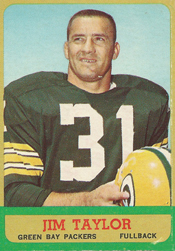
The punishing rushes of Green Bay Packers fullback Jim Taylor shredded a daring defense of the St. Louis football Cardinals.

Taylor was a bruising rusher for the championship Packers teams of the 1960s. Paired in a backfield with “Golden Boy” halfback Paul Hornung, Taylor was a powerful force who twice led the NFL in rushing touchdowns and was elected to the Pro Football Hall of Fame.

In 1962, Taylor topped the NFL in rushing yards with 1,474 in 14 games. He faced the St. Louis Cardinals for the first time that season and his rushing and pass-catching skills were key to enabling the Packers to overcome a challenging defensive scheme.

Game plan

The Cardinals and Packers each had 1-0 records entering their game on Sept. 23, 1962, at Milwaukee County Stadium. The Packers were the reigning NFL champions and the Cardinals were looking to establish themselves as contenders.

Cardinals head coach Wally Lemm and his staff devised a plan to apply pressure on Packers quarterback Bart Starr by having St. Louis defensive players use stunting maneuvers and blitzing schemes.

The stunting meant two or more Cardinals defenders would alter their usual paths to the quarterback in an effort to confuse the Packers’ offensive linemen.

The blitzing freed a defensive back or linebacker to leave his usual post and become an extra pass rusher. New York Giants linebacker Donald “Red Dog” Ettinger is credited with being the first to use the technique from 1948-50 and blitzes came to be known as “red dogging.” In 1960, Cardinals assistant coach Chuck Drulis designed a blitz using safety Larry Wilson and named it “wildcat.”

Pressuring Pack

The blitzing and stunting of Cardinals defenders confused the Packers in the first half of their 1962 game. Starr “was under considerable pressure from the Cardinals’ determined rush, including red-dogging defensive halfbacks,” the Green Bay Press-Gazette reported.

Packers offensive tackle Forrest Gregg said the Cardinals “were doing a lot of jumping around in there and we weren’t picking them up.”

Said Packers coach Vince Lombardi: “Their defense upset us in the beginning. We had a hell of a time trying to find them. They did a lot of stunting in there … It was new to us. We hadn’t seen it before this year.”

Lombardi and his staff tried to make adjustments during the first half, but were unsuccessful in communicating effectively during the helter-skelter pace of the game. The best the Packers could do was hold on until they could regroup in the locker room at halftime. “We had to put it on the (chalk) board,” Lombardi said.

The Packers’ defense, led by linemen Willie Davis and Henry Jordan, stopped the Cardinals, and Green Bay led, 3-0, at halftime on Hornung’s field goal.

Fast learners

Using the chalkboard to illustrate what needed to be done to counter the Cardinals’ aggressive blitzing and stunting, Lombardi and his staff instructed their offensive linemen to block in assigned areas rather than man against man, and they told Starr to turn Taylor loose to rumble and mix in short passes to Taylor and tight end Ron Kramer.

The adjustments worked. Taylor, 6 feet and 215 pounds, pounded the Cardinals with runs up the middle and put the Packers in position to score a pair of touchdowns.

“In three years, nobody has run through our middle as the Packers did,” defensive tackle Frank Fuller, who played for the Cardinals from 1960-62, told the St. Louis Post-Dispatch.

Taylor “turned the tide with his powerful smashes in the second half,” the Green Bay Press-Gazette reported. Taylor “punished the Cardinals’ defense with his hard hitting … His thrusts up the middle helped the (Packers) loosen up the Cardinals’ defense and thus make their passing work.”

Taylor finished with 122 yards rushing on 23 carries and also had four catches for 40 yards. Hornung had a three-yard touchdown run in the third quarter, Starr connected with Max McGee on a 19-yard scoring strike in the fourth quarter and the Packers won, 17-0. Boxscore

“We adjusted between halves,” Lombardi said. “In the second half, we zone blocked and area blocked. The boys picked them up real well.”

Said Taylor: “We just got to zone blocking in the second half and they changed their defense. They weren’t red-dogging so much and the red dogs were not real hard to pick up.”

One of a kind

Lemm praised the Packers as “the best-balanced team in football. Father Time is the only thing that’s going to beat the Packers.”

Regarding Taylor, Lemm said to the Post-Dispatch, “He has a great ability to slide out and get moving. He takes a pitchout quick with that sliding ability.”

Lemm added, “The blocks Hornung throws for Taylor are really something.”

The Cardinals totaled 16 yards rushing and their top receiver, Sonny Randle, had one catch for five yards. Halfback John David Crow had nine yards on nine carries.

“We don’t have a Taylor,” Lemm lamented.

The 1962 Packers repeated as NFL champions and Taylor also played for league champions in 1965 and 1966. The Cardinals finished 4-9-1 in 1962.

Taylor played two more regular-season games against the Cardinals in his career. On Oct. 20, 1963, he rushed for 67 yards and two touchdowns in a 30-7 Packers victory. On Dec. 12, 1967, in his final NFL season with the Saints, the former Louisiana State standout had 34 yards rushing in a game the Cardinals won, 31-20.