Feeds:
Posts
Comments

(Updated Jan. 10, 2025)

The Cardinals became a bridge for Sal Maglie, enabling him to transition from being a pitcher to a coach.
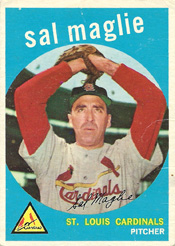
On June 14, 1958, the Cardinals acquired Maglie from the Yankees for minor-league pitcher Joe McClain and $20,000.

Maglie was nicknamed The Barber “for the close shaves he gave hitters with high and tight pitches designed to intimidate,” according to the St. Louis Post-Dispatch.

With a scowl and heavy, dark stubble, the sight of Maglie glaring at batters from the mound “resembles Jack Dempsey stepping into the ring,” Bob Broeg wrote.

“When I throw at a guy, I put it right here,” Maglie said, swiping his hand under his chin, “so he can’t hit it, but I never throw to hit a man.”

Maglie, 41, was past his prime when the Cardinals got him to be a spot starter, but he still was a prominent name and his acquisition attracted attention.

Traveling man

Maglie reached the major leagues in 1945 with the Giants and was mentored by pitching coach Dolf Luque. The next year, Maglie jumped to the Mexican League, even though it meant he would be banned from returning to the major leagues.

In Mexico, Maglie’s manager with the Puebla Parrots was Luque, who taught him a variety of curveballs. Described by Broeg as “chorus girl curves,” Maglie’s assortment ranged from slow and sweeping to sharp and darting.

After pitching in Mexico in 1946 and 1947, Maglie returned to the United States and played in 1948 for a barnstorming team of former major-leaguers against semipro clubs. In 1949, Maglie pitched in an independent pro league in Canada.

When baseball commissioner Happy Chandler lifted the ban on players who defected to the Mexican League, Maglie, 33, rejoined the Giants and thrived, compiling records of 18-4 in 1950, 23-6 in 1951 and 18-8 in 1952.

In the book “We Would Have Played For Nothing,” Dodgers pitcher Carl Erskine said, ‘I always admired Maglie … When he walked out on the mound, you knew who was in charge. No question … He had the sharpest, latest breaking curveball I ever saw. It would come right up under your arm, almost, and ‘shoom’ across the plate … He threw at hitters a lot to keep guys pushed back because he’s breaking the ball away all the time.”

Maglie pitched for the Giants (1945 and 1950-55), Indians (1955-56), Dodgers (1956-57) and Yankees (1957-58) before joining the Cardinals. He was the last player to appear with the Giants, Dodgers and Yankees while all three were based in New York.

(Don Drysdale, who was a rookie when Maglie joined the Dodgers in May 1956, told writer Roger Kahn, “I learned more from Sal than from any single individual.”)

Maglie pitched in three World Series and was the hard-luck Dodgers starter who opposed Don Larsen when he pitched a perfect game for the Yankees in 1956.

When the Cardinals acquired him, Maglie had a career record of 117-56 and his winning percentage of .678 was the best among active pitchers.

Good start

Maglie was 1-1 with a 4.63 ERA when Yankees manager Casey Stengel summoned him into his office and informed him he was being sent to St. Louis.

“I told him it was my fault because I didn’t produce for him when he gave me the chance,” Maglie told The Sporting News. “I’m the kind of fellow who has to work regularly to make the ball break the way I want it to and also to have control.”

Cardinals general manager Bing Devine said, “We expect to be able to give him more work than the Yankees could.”

Maglie was dealing with dental issues and an income tax problem when the trade was made. The Cardinals approved his request to resolve those situations and to drive his family from New York to their home in Niagara Falls before reporting to the team.

Maglie made his first appearance for the Cardinals in a June 22 start against the Braves at Milwaukee. He pitched seven innings and earned the win in a 2-1 Cardinals victory. Boxscore

In his second start, on June 28 at Philadelphia, Maglie won again, pitching a complete game against the Phillies in an 8-1 Cardinals triumph. Maglie had a shutout until Carl Sawatski hit a home run with one out in the ninth. Boxscore

Barber trimmed

Maglie left the Cardinals in July to be with his wife, who had surgery for cancer. When he returned, he wasn’t the same. After posting a 2-0 record and 1.12 ERA for the Cardinals in June, Maglie was 0-3 with a 6.48 ERA in July and 0-3 with a 6.20 ERA in August.

“First, my teeth bothered me. Then my wife became desperately ill,” Maglie said. “It wasn’t the physical or mental environment in which to win.”

Maglie finished with a 2-6 record and 4.75 ERA in 10 starts for the Cardinals.

“I feel I have another year of big-league pitching in me,” Maglie told columnist Dick Young.

Maglie reported to spring training with the Cardinals in 1959, hoping to impress manager Solly Hemus, but he yielded seven runs in the eighth inning of an exhibition game against the Phillies.

Maglie was released, but the Cardinals weren’t done with him.

Teaching role

On April 13, 1959, the Cardinals hired Maglie to be their minor-league pitching instructor. Asked which prospects impressed him, Maglie cited Bob Gibson. “All he needs is to improve his changeup to go with his speed,” Maglie said.

In June, Cal Browning, a minor-league left-hander, credited Maglie with correcting a flaw in his leg motion. In August, Bob Miller was called up to the Cardinals and said Maglie “helped me a lot with my breaking stuff.”

Reflecting on his season as Cardinals minor-league instructor, Maglie said, “I couldn’t concentrate on a player or a problem for more than three or four days at a time. No sooner would I get into a town than I’d have to leave for another. The kids did what I told them to do as long as I watched them, but slipped into their old ways as soon as I left.”

Maglie became Red Sox pitching coach in 1960 and was in that role in 1967 when Boston produced the American League Cy Young Award winner, Jim Lonborg, won the pennant and advanced to the World Series against the Cardinals. However, Maglie clashed with manager Dick Williams and was fired.

In 1969, Joe Schultz, who’d been a minor-league manager in the Cardinals system when Maglie was minor-league pitching instructor, became manager of the Seattle Pilots and hired Maglie to be pitching coach.
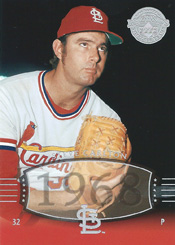
In the Year of the Pitcher, Steve Carlton showed he could hit as well as pitch for the Cardinals.

On June 13, 1968, Carlton hit his first home run in the major leagues, and allowed one run in eight innings, leading the Cardinals to a 3-1 victory over the Braves at Atlanta.

Carlton’s home run was the first by a Cardinals pitcher since Bob Gibson hit one against Jim Lonborg of the Red Sox in Game 7 of the 1967 World Series and the first by a St. Louis pitcher in the regular season since Larry Jaster accomplished the feat on Sept. 23, 1966, against Larry Jackson of the Phillies.

Mistake pitch

The 1968 season became known as the Year of the Pitcher because a mere six major-league players batted .300 or better and the sport was dominated by the likes of Gibson (1.12 ERA, 13 shutouts, 268 strikeouts), the Giants’ Juan Marichal (26 wins, 30 complete games), the Tigers’ Denny McLain (31 wins, 28 complete games) and the Indians’ Luis Tiant (1.60 ERA, nine shutouts).

Carlton, 23, was developing into a premier pitcher. The left-hander would finish the 1968 season with a 13-11 record, 2.99 ERA and five shutouts.

He also was showing an ability to handle the bat.

Carlton, a left-handed batter, had three hits in his last three at-bats entering his start against the Braves and his batting average was .233.

In the third inning, in his first at-bat of the game, Carlton hit an 0-and-2 fastball from Braves starter Ken Johnson over the wall in right-center.

“The pitch was right down the middle with nothing on it,” Johnson said to the St. Louis Post-Dispatch. “I tried to go inside with that pitch and I figured on coming back with a knuckleball. Carlton hit a pitch that my two sons, both pitchers, wouldn’t make in Little League.”

Carlton said he never hit a home run in the minor leagues, but hit some in winter league games.

Knuckle under

Carlton’s home run gave the Cardinals a 1-0 lead. The Braves tied the score in the sixth on Joe Torre’s RBI-single with two outs.

Carlton pitched eight innings, allowing four singles and a walk and striking out seven, and departed with the score tied at 1-1.

In the 12th inning, shortstop Dick Schofield led off for the Cardinals with a home run against Phil Niekro. “A lousy, lousy knuckler,” Niekro told the Atlanta Constitution.

Said Schofield: “It wasn’t one of Niekro’s better knucklers because nobody hits those.”

The home run was Schofield’s 17th in 16 major-league seasons and his only one in 1968.

Phil Gagliano, who batted after Schofield, walked and scored on Lou Brock’s double, extending the Cardinals’ lead to 3-1.

In the Braves’ half of the 12th, Wayne Granger struck out Torre, walked Deron Johnson and yielded a single to Tommie Aaron. Hal Gilson relieved and retired Clete Boyer and Marty Martinez on groundouts, stranding the runners and sealing the win. Boxscore

Power pitchers

Carlton hit two more home runs for the Cardinals _ on July 27, 1968, against the Pirates’ Bob Moose and on Sept. 1, 1969, against the Astros’ Don Wilson _ before he was traded to the Phillies after the 1971 season.

Carlton hit 13 regular-season home runs in his major-league career and one in the postseason. In Game 3 of the 1978 National League Championship Series, Carlton hit a three-run home run against the Dodgers’ Don Sutton.

Bob Gibson holds the Cardinals record for regular-season career home runs by a pitcher, with 24. Gibson also holds the club single-season mark for regular-season home runs by a pitcher, with five.

The all-time major-league leader for regular-season career home runs by a pitcher is Wes Ferrell. He hit 38 in a big-league career from 1927-41 with the Indians, Red Sox, Senators, Yankees, Dodgers and Braves.

After Ferrell, the next best in regular-season career home runs by a pitcher are Bob Lemon (37) and Warren Spahn (35).

(Updated April 19, 2019)

In his brief stint with the Cardinals, Mark Worrell provided a lasting impression with his hitting instead of his pitching.

On June 5, 2008, in the second game of a doubleheader between the Cardinals and Nationals in Washington, Worrell hit a three-run home run in his first major-league plate appearance.
Worrell, no relation to Cardinals reliever Todd Worrell, was regarded as a premier pitching prospect, but didn’t last long with St. Louis.

After four relief appearances for the 2008 Cardinals, Worrell was returned to the minors, got traded after the season and hurt his arm.

His place in franchise lore, though, was secured as one of 10 Cardinals to hit a home run in his first plate appearance in the major leagues.

The list:

_ Eddie Morgan, pinch-hitter, April 14, 1936, vs. Cubs.

_ Wally Moon, center fielder, April 13, 1954, vs. Cubs.

_ Keith McDonald, pinch-hitter, July 4, 2000, vs. Reds.

_ Chris Richard, left fielder, July 17, 2000, vs. Twins.

_ Gene Stechschulte, pinch-hitter, April 17, 2001, vs. Diamondbacks.

_ Hector Luna, second baseman, April 8, 2004, vs. Brewers.

_ Adam Wainwright, pitcher, May 24, 2006, vs. Giants.

_ Mark Worrell, pitcher, June 5, 2008, vs. Nationals.

_ Paul DeJong, pinch-hitter, May 28, 2017, vs. Rockies.

_ Lane Thomas, pinch-hitter, April 19, 2019, vs. Mets.

Climbing the ladder

Worrell, a starting pitcher at Florida International University, was selected by the Cardinals in the 12th round of the 2004 amateur baseball draft and established himself as a quality reliever. In 2005, Worrell played for Class A Palm Beach, led all minor leagues in saves with 35 and was named Cardinals minor-league pitcher of the year.

Worrell led the Texas League in saves, with 27 for Class AA Springfield in 2006, and he struck 66 batters in 67 innings for Class AAA Memphis in 2007.

In 21 games for Memphis in 2008, Worrell had a 1.88 ERA and 38 strikeouts in 24 innings before he was called up to the Cardinals.

Worrell had an unorthodox pitching motion. “As he begins his delivery, Worrell bends over and then springs up to throw sidearm while stepping almost toward first base,” the St. Louis Post-Dispatch reported.

“In the end, his success is the ball on the edge and not the middle of the plate,” said Cardinals manager Tony La Russa.

Power pitcher

Worrell made his major-league debut on June 3, 2008, in the Cardinals’ first visit to Nationals Park and pitched a scoreless ninth inning in a 6-1 St. Louis victory. Boxscore

Two nights. later, Worrell made his second appearance when he relieved rookie starter Mike Parisi in the fifth. Parisi allowed eight runs in four innings and also got his first major-league hit, a two-run double against Nationals starter Tim Redding.

After Worrell pitched a scoreless fifth, the Cardinals batted in the sixth against Redding, looking to chip away at an 8-3 deficit. With runners on first and third, two outs, Worrell made his first major-league plate appearance and hit a 3-and-2 fastball from Redding into the left field stands for a three-run home run.

“Look at these pitchers! That’s a home run,” Nationals television broadcaster Bob Carpenter exclaimed as the ball carried over the fence. Video

“I let two different pitchers drive in five runs and a guy that had never swung a bat in the big leagues hit a three-run homer off me,” Redding said to the Washington Times. “Other than those two outcomes, I felt good.”

Worrell pitched a scoreless sixth and exited with the Nationals ahead, 8-6. The Cardinals rallied with two runs in the ninth to tie the score at 8-8 and went ahead, 9-8, with a run in the 10th, but the Nationals got a two-run home run from Elijah Dukes against Ryan Franklin in the bottom half of the inning and won, 10-9. Boxscore

Arm ailment

Worrell made his third appearance for the Cardinals on June 12 against the Reds and was the losing pitcher, yielding two runs in two-thirds of an inning. Boxscore

After one more appearance, in which he gave up three runs to the Phillies, Worrell was sent back to Memphis. His record in four games with the Cardinals was 0-1 with a 7.94 ERA, but his slugging percentage was 2.000.

On Dec. 4, 2008, the Cardinals traded Worrell and a player to be named to the Padres for shortstop Khalil Greene. Three months later, the Cardinals sent the Padres pitcher Luke Gregerson to complete the deal.

At spring training with the Padres in 2009, Worrell injured his right elbow and needed reconstructive surgery, sidelining him for the season.

Two years later, Worrell returned to the major leagues with the 2011 Orioles and yielded eight earned runs in two innings over four appearances for a 36.00 ERA.

In his last big-league appearance, on July 24, 2011, Worrell gave up a three-run home run to Mike Trout, the first in the big leagues for the Angels rookie. Trout, 19, became the first teen to hit a home run in the major leagues since 2007, according to the Los Angeles Times. Boxscore

(updated April 10, 2026)

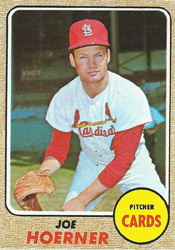
A closer for a rotation that often completed what it started, Joe Hoerner still served a valuable role for the 1968 National League champion Cardinals and supported the staff with a stellar season.

On June 1, 1968, Hoerner struck out six Mets in a row, tying the National League record for consecutive strikeouts by a reliever.

Hoerner went on to post an 8-2 record with 17 saves and a 1.47 ERA for the 1968 Cardinals. The left-hander ranked second in the National League in saves to the 25 by Phil Regan of the Cubs and his ERA was second on the club to the 1.12 achieved by Bob Gibson.

Led by Gibson’s 28, Cardinals starters pitched 63 complete games in 1968. Needed only for 49 innings, Hoerner usually was effective, allowing no earned runs in 40 of 47 appearances.

“Joe is almost as much of a machine out there as Bob Gibson,” Cardinals reliever Wayne Granger said to the St. Louis Post-Dispatch. “He just goes out there and does the job time after time.”

Overcoming adversity

Hoerner, son of an Iowa farmer, made his professional baseball debut in the White Sox minor-league system in 1957. A year later, Hoerner was diagnosed with muscle weakness near his heart. Because any strain on the muscle impaired Hoerner’s circulation, Hoerner was advised to change his pitching delivery from overhand to sidearm.

“I took four pills a day for a long time to strengthen the muscle, but I haven’t been bothered since then,” Hoerner told the Post-Dispatch in 1968.

Hoerner, 26, made his major-league debut in September 1963 with the Houston Colt .45s. The Cardinals acquired him in November 1965 and he pitched for them in 1966 (5-1 record, 13 saves,1.54 ERA) and 1967 (4-4, 14 saves, 2.59 ERA).

Hoerner’s team-high 14 saves for the 1967 league champion Cardinals included four against their closest pursuer, the Giants. He got an uncredited “save” that season for driving the team in a bus from the ballpark to the hotel after a game in Atlanta. Hoerner recalled the stunt in the book “Redbirds Revisited:”

“We were all walking through this tunnel toward where the team bus was parked, but there was no driver … I said, ‘I’ll drive this damn thing.’ The keys were there. I sat down and turned on the ignition. Some of the guys were laughing … They thought I was just horsing around … I knew nothing about driving a bus. Everybody was hollering, ‘Let’s go,’ and I put it in gear and off we went.

“A few of the guys decided they wanted off, but I thought, ‘What the hell. I’m this far. We’re going back to the hotel.’ So out the tunnel we go … We’re out on the street and we head back to the hotel … I had kind of forgotten how long the bus is when turning corners, and I turned a little too sharply coming into the Marriott parking lot … I was about to cream a big neon sign with the back end of the bus … A lot of glass fell (from the sign) and it was kind of noisy for a few seconds. I got the bus stopped and opened the door, and everybody just sort of disappeared like ants … I just left the bus parked out there.”

After the Cardinals won Game 7 of the 1967 World Series against the Red Sox, Hoerner was celebrating with his teammates in the locker room at Boston’s Fenway Park when a champagne bottle he was holding exploded, severing a tendon in the middle finger of his pitching hand.

“If we win many more pennants, my fingers won’t stand it,” Hoerner said.

Tough to hit

In “Redbirds Revisited,” Hoerner said, “From the middle of October (1967) until about Thanksgiving, I really didn’t know if I’d ever be able to bend that finger again … I was very, very worried that my baseball career was over.”

Hoerner recovered from the injury and yielded no runs in his first nine appearances in 1968.

“I was mainly a fastball, slider pitcher. Mostly fastball,” Hoerner told authors David Craft and Tom Owens. “I might pitch an inning or more and never throw anything but a fastball. I had excellent control and great velocity. I felt I could throw the ball pretty much where I wanted to.”

On June 1, the Cardinals played the Mets at Shea Stadium in New York. The Mets led, 4-1, before the Cardinals rallied for three runs in the seventh against Nolan Ryan, tying the score at 4-4.

Hoerner, the third Cardinals pitcher of the game, was brought in to pitch the seventh and retired the Mets in order. The Cardinals took the lead, 5-4, with a run in the eighth, but the Mets tied the score on Ed Charles’ pinch-hit home run in the bottom half of the inning.

In the ninth, Hoerner struck out Al Weis, Ron Swoboda and Don Bosch. After Mike Shannon hit a home run against Cal Koonce in the 10th, putting the Cardinals ahead, 6-5, Hoerner struck out Greg Goossen, Jerry Buchek and Jerry Grote, sealing the win. Boxscore

Hoerner’s six consecutive strikeouts came against right-handed batters.

Hoerner was effectively consistent during the 1968 season. He was 4-1 with a 1.05 ERA in home games and 4-1 with a 1.93 ERA in away games. Left-handed batters hit .189 against him and right-handed batters hit .194.

In the 1968 World Series against the Tigers, Hoerner earned a save in Game 3 with 3.2 scoreless innings in relief of Ray Washburn boxscore and was the losing pitcher in Game 5 when he faced four batters, retired none and was charged with two runs. Boxscore

Hoerner and Cardinals teammate Dal Maxvill owned a successful travel agency in St. Louis for several years.

(Updated April 11, 2026)

When the time came for Mike Shannon to choose a career path in either baseball or football, it put Bing Devine and Dan Devine at odds with one another.

On June 11, 1958, Shannon passed on a football future at the University of Missouri and signed a professional baseball contract with the Cardinals.
Missouri head coach Dan Devine was upset with the Cardinals and their general manager, Bing Devine, for taking a gifted quarterback away from college football.

“I’m bitterly disappointed and disillusioned by the mechanics of the signing for reasons I don’t want to discuss publicly,” Dan Devine said to the St. Louis Post-Dispatch.

The next day, Bing Devine called Dan Devine to discuss the matter and the conversation ended on “an amicable note,” according to the Post-Dispatch.

Cardinals courtship

Thomas Michael Shannon, called Mike, was born in St. Louis on July 15, 1939. His father, Tom, was a police officer who earned a law degree and became a prosecuting attorney for the city of St. Louis. In the book “Redbirds Revisited,” Mike Shannon said, “My dad would show me … how to improve certain aspects of my game. He worked with me.”

Mike Shannon was a multi-sport athlete at Christian Brothers College High School in St. Louis. He was the quarterback on the football team and his running back was Dick Musial, son of the Cardinals’ Stan Musial.

In 1957, Shannon accepted a football scholarship to the University of Missouri from head coach Frank Broyles. In “Redbirds Revisited,” Shannon said, “The reason I chose Missouri was Frank Broyles. He was a split-T (formation) coach and I was a split-T quarterback.”

At that time, freshmen weren’t eligible to play for the varsity. After the 1957 season, Broyles left Missouri for Arkansas, and Dan Devine replaced him.

Shannon played quarterback in Missouri’s intrasquad spring game in April 1958 and threw a 23-yard touchdown pass. Dan Devine had big plans for Shannon in his sophomore season.

When Shannon returned home to St. Louis for the summer, he joined a baseball team in the Ban Johnson League for top amateurs. The hometown Cardinals were well aware of Shannon since his high school days and kept track of him.

On June 8, 1958, a part-time Cardinals scout, George Hasser, watched Shannon in a game at Heman Park in St. Louis and filed a glowing report to full-time Cardinals scout Joe Monahan.

The next night, Monahan, Hasser and Cardinals farm director Walter Shannon (no relation) went to see Mike Shannon play in a game at Scott Air Base. He worked out for the Cardinals at Busch Stadium on June 10. The next day, Shannon signed a $50,000 contract with them.

Years later, Shannon told the Post-Dispatch, “Back then, there wasn’t any money in football. If there would have been, I would have stayed with football. I enjoyed it at Mizzou and I would have played three years there. I think I had a lot more ability as a football player than a baseball player.”

Special talent

Before the deal was announced, Bing Devine called Missouri athletic director Don Faurot to inform him Shannon wouldn’t be returning to school. “I told Don that I know Missouri can’t score touchdowns with our expressions of regret, but baseball is our business,” Bing Devine told the Post-Dispatch.

Missouri athletic staff were stung by baseball’s ability to lure athletes away from the school before their eligibility expired. Shannon was the second football player to leave Missouri and sign with the baseball Cardinals in 1958. Running back Charlie James was the other. Also, soon after Shannon turned pro, Missouri basketball player Sonny Siebert signed a baseball contract with the Indians.

Dan Devine said Shannon had “the greatest potential of any back we had on our squad … He showed me more ability in the spring than any kid I ever worked with … Potentially one of the greatest.”

Dan Devine and Bing Devine were not related, but Dan caustically referred to “cousin Bing” when talking to Missouri booster groups about how the Cardinals wooed Shannon.

St. Louis broadcaster Jay Randolph said years later he asked Frank Broyles about Shannon and the coach replied, “If he had stayed in school, he may have won the Heisman Trophy” as college football’s best player, the Post-Dispatch reported.

Shannon, who turned 19 a month after signing with the Cardinals, was assigned to their Class D minor-league team in Albany, Ga., in June 1958 and batted .322 with 54 RBI in 62 games as an outfielder.

In February 1959, Shannon married Judith Ann Bufe and they began a family.

Shannon spent four more seasons (1959-62) in the minor leagues until getting promoted to the Cardinals in September 1962. He was an outfielder and third baseman for them until a kidney ailment caused him to quit playing in August 1970. In 21 games in three World Series with the Cardinals, Shannon produced 19 hits, including three home runs.

In 1972, Shannon began a successful second career as a Cardinals broadcaster.

Two of Shannon’s sons, Tim Shannon and Michael Shannon, followed in their father Mike’s football footsteps. Tim played for the University of Southern California and Michael played for Indiana State.

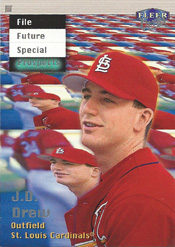
Confident in their ability to get a deal done, the Cardinals made a bold decision to pursue outfielder J.D. Drew.

On June 2, 1998, the Cardinals, with the fifth overall pick, chose Drew in the first round of baseball’s draft.

Drew was a top talent but his hardball contract demands made him a risky selection. The Phillies drafted him in 1997 with the second overall pick of the first round, but were unable to sign him.

The Cardinals, though, made him their prime draft target in 1998.

“He may be the best player to come out of the last two drafts,” Cardinals general manager Walt Jocketty said to the St. Louis Post-Dispatch. “He has a chance to be a franchise player.”

Phooey on Philly

While at Florida State in 1997, Drew won the Golden Spikes Award given to the nation’s best amateur baseball player. Drew became the third NCAA Division I player all-time to produce 100 hits, 100 RBI and 100 runs in a season.

After the Tigers chose pitcher Matt Anderson with the first pick of the 1997 June draft, the Phillies took Drew. Represented by agent Scott Boras, Drew wanted $10 million to sign. The Phillies offered $2.6 million. When the sides couldn’t reach a compromise, Drew signed with the St. Paul Saints, an independent team. Drew batted .341 in 44 games for St. Paul in 1997.

Drew’s rejection of the Phillies “made him about as popular locally as road construction on I-95,” wrote Paul Hagen of the Philadelphia Daily News.

In 1998, Drew returned to St. Paul. Because he hadn’t played for a team affiliated with organized baseball, Drew was able to re-enter the June draft. Giving no indication he’d concede on his contract demands, most teams determined using a high pick on Drew was a gamble.

The first four picks of the 1998 draft were outfielder Pat Burrell to the Phillies, pitcher Mark Mulder to the Athletics, outfielder Corey Patterson to the Cubs and pitcher Jeff Austin to the Royals.

Go for it

The Cardinals were delighted Drew was available when it became their turn to pick. Scouting director Ed Creech watched Drew play for St. Paul and recommended the Cardinals sign him.

“Drew was the No. 1 guy on our draft board,” Jocketty said. “We know he might be tough to sign, but we feel we’ve got a lot to sell here in St. Louis.”

Said manager Tony La Russa: “It’s an aggressive call.”

Unimpressed, Post-Dispatch columnist Bernie Miklasz wrote, “If the Cardinals don’t sign No. 1 draft choice J.D. Drew, that’s their problem, and their fault, and I’ll have no sympathy. The Cardinals know Drew’s holdout history. They know Drew’s financial demands. They know his agent, Scott Boras. Let the buyer beware.”

Boras was an infielder in the Cardinals’ minor-league system in the 1970s before becoming an agent for players. Among his clients was Rick Ankiel. In 1997, Ankiel was considered the best left-handed high school pitcher in the draft, but he wasn’t chosen in the first round because it was believed he wanted between $5 million and $10 million to sign. The Cardinals snatched him in the second round and negotiated with Boras on a deal Ankiel signed for $2.5 million.

The Cardinals and Boras had setbacks as well. In February 1998, Andy Benes, who wanted to stay in St. Louis, was declared a free agent and went to the Diamondbacks after Jocketty and Boras failed to reach a timely contract agreement for the pitcher.

Risk rewarded

On July 3, a month after he was drafted, Drew, 22, signed a four-year contract with the Cardinals for a guaranteed $7 million. The deal included incentive clauses that positioned Drew to net an additional $2 million.

“I believe this organization has unique insight on talent,” Boras said. “The decisions they make are not conventional, but you win in this game by being unconventional.”

Said Jocketty: “We take risks because we have a high regard for talent.”

In Philadelphia, Drew’s signing was mocked and criticized. “This signing is going to have a negative effect on the industry,” Phillies general manager Ed Wade said to the Philadelphia Inquirer.

Labeling Boras as the “sports world’s top-ranked terrorist,” Inquirer columnist Jayson Stark snarked, “So, the great J.D. Drew got his money. Yippee for him.”

Looking ahead to when the Cardinals and Phillies would play in Philadelphia, the Philadelphia Daily News declared, “Here’s an idea for the Phillies’ promotions department: Boo Drew Night.”

Said Drew: “I hope once everyone gets to know me as a person and as a player, they will accept me for what I am.”

Hot start

The Cardinals assigned Drew to their Class AA club in Arkansas. In his first game, he singled and doubled. In his second game, he hit two home runs.

After batting .328 in 19 games for Arkansas, Drew was promoted to Class AAA Memphis and hit .316 in 26 games.

In September 1998, the Cardinals called up Drew to the big leagues and he batted .417 (15-for-36) with five home runs.

The dazzling start heightened expectations to dizzying heights and Drew strained to deliver. Albert Pujols, not Drew, developed into the Cardinals’ franchise player.

In six seasons with St. Louis, Drew batted .282 and had an on-base percentage of .377. His best year for the Cardinals was 2001 when he hit .323 with 27 home runs in 109 games.

On Dec. 13, 2003, the Cardinals dealt Drew to the Braves for pitchers Adam Wainwright, Jason Marquis and Ray King.