Feeds:
Posts
Comments

The departure of Jack Clark enabled the Cardinals to take a chance on Brian Jordan.
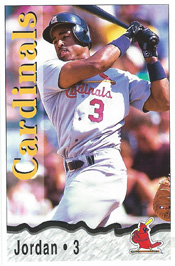
On June 1, 1988, the Cardinals chose Jordan with a supplemental pick between the first and second rounds of baseball’s amateur draft. Jordan was a junior at the University of Richmond and excelled there at football and baseball.

Though Jordan was an intriguing talent as an outfielder, there was a genuine risk he would pursue a full-time career in professional football. The Cardinals, however, were in a position to take that risk because they had three picks among the top 30 in the draft.

When Clark, their top slugger, became a free agent and signed with the Yankees after the 1987 World Series, baseball’s basic agreement with the players’ union required the Cardinals to be compensated with two additional draft picks _ one in the first round and another in the supplemental round.

Using the Yankees’ first-round pick, the 22nd overall, as compensation for Clark, the Cardinals took University of Illinois pitcher John Ericks. With their first-round pick, the 23rd overall, the Cardinals got Virginia Tech pitcher Brad Duvall.

After 26 players were drafted in the first round, four supplemental selections were made before the start of the second round. The Indians, Orioles and Giants selected before the Cardinals, with the 30th overall pick of the draft, took Jordan.

Oh, Canada

The selection of Jordan received little public notice. Instead, the headlines went to the Cardinals’ first-round picks, Ericks and Duvall. Ericks struck out 108 in 87.1 innings as a junior at Illinois. Duvall, a Virginia Tech senior, was touted by Cardinals director of scouting Fred McAlister as “kind of a country boy who brings it. You should see him pitch,” the St. Louis Post-Dispatch reported.

On June 28, 1988, Jordan still hadn’t signed and the Post-Dispatch speculated he “may return to Richmond to play football” rather than play in the Cardinals’ system. A week later, on July 7, more than a month after he was drafted, Jordan signed with the Cardinals after it was agreed he could play football at Richmond his senior season.

The Cardinals dispatched Jordan to their Class A farm club in Hamilton, Ontario, Canada, and he got into 19 games, batting .310. After bruising a bone in his right foot, he returned to school.

Jordan had a solid senior season for Richmond’s football team, got invited to play in the Senior Bowl and suffered an ankle injury. The Buffalo Bills selected him in the seventh round of the 1989 NFL draft.

Sidelined by the injured ankle, Jordan was limited to playing in 11 games for the Cardinals’ Class A St. Petersburg affiliate in 1989 before he reported to Bills training camp in July.

Hanifan helps

The Bills waived Jordan on Sept. 4, 1989, and he was signed by the Atlanta Falcons the next day. On Sept. 9, the Falcons placed Jordan, a defensive back, on injured reserve because of a broken foot.

After the Falcons lost nine of their first 12 games in 1989, head coach Marion Campbell resigned and an assistant, Jim Hanifan, was named interim head coach. Hanifan was head coach of the NFL St. Louis Cardinals from 1980-85.

One of Hanifan’s first moves after replacing Campbell was to place Jordan on the active roster. Jordan made his NFL debut on Dec. 3, 1989, against the defending Super Bowl champion San Francisco 49ers. Hanifan gave him his first NFL start on Dec. 24 in the season finale against the Detroit Lions. Jordan lined up at strong safety and made three tackles.

Falcons vs. Cardinals

The Cardinals, eager to evaluate Jordan on the diamond, invited him to their major-league spring training camp in 1990. Liking what they saw, they assigned him to their Class AA Arkansas club to start the 1990 season.

“This is going to be a big year for him,” said Cardinals manager Whitey Herzog. “If he does well in Double-A, then he’s going to have to decide between the two sports.”

Jordan’s baseball season, however, was a bust. He batted .160 in 16 games for Arkansas and injured his right wrist in May. After a stint on the disabled list, Jordan was sent to Class A St. Petersburg. He played in nine games, batted .167 and was sidelined for the remainder of the season when it was discovered he’d broken a bone in his wrist.

Jordan reported to training camp with the 1990 Falcons, who hired Jerry Glanville as head coach, earned a starting job and played in all 16 regular-season games, intercepting three passes.

The Cardinals again invited Jordan to their major-league spring training camp in 1991, though general manager Dal Maxvill openly wondered whether football was gaining the upper hand.

“He’s making more money with them (Falcons) now,” Maxvill said. “Obviously, we’re trying to get as good a look as possible. Hopefully, he’ll have some success and develop a real love for (baseball) because I can see him very shortly, if he’s in the $400,000 to $500,000 range, saying, ‘I’m going to pass on baseball.’ ”

Let’s make a deal

The Cardinals sent Jordan, 24, to their top farm club, Class AAA Louisville, to start the 1991 season. He batted .264 in 61 games before reporting to Falcons training camp.

Jordan was a starter for the 1991 Falcons, played in all 16 games and had two interceptions.

When he went to spring training in 1992, Jordan hoped to earn a spot on the Cardinals’ Opening Day roster. Instead, he was sent to Louisville, but, soon after the season opened, Cardinals outfielder Felix Jose and first baseman Andres Galarraga got injured and Jordan was called up to St. Louis.

After batting .281 in May, the Cardinals gave Jordan a $2.3 million three-year contract, with the stipulation he quit playing football.

With his NFL career ended, Jordan went on to play seven seasons for St. Louis and batted .291. His best St. Louis seasons were 1996 (.310, 104 RBI) and 1998 (.316, 25 home runs, 91 RBI).

(Updated Dec. 24, 2018)

At 17, Ray Sadecki threw with as much velocity as anyone on the Cardinals’ major-league pitching staff.

An amateur free agent, Sadecki was pursued by most big-league teams. Cardinals scout Runt Marr, who followed Sadecki for two years, recommended the club invest in the left-handed pitcher from Kansas City, Kansas.
On June 1, 1958, Sadecki signed with the Cardinals for a bonus of $50,000 and a three-year contract totaling another $18,000.

High interest

Sadecki was an exceptional prospect. At 16, he pitched four no-hitters, two in high school and two in summer league games. In his senior year at Ward High School, Sadecki was 9-0 and pitched another no-hitter. Marr said Sadecki averaged two strikeouts per inning over two high school seasons and twice struck out 21 batters in seven-inning games.

At the state high school baseball tournament at Eldorado, Kansas, in 1958, 12 of the 16 major-league teams sent scouts to watch Sadecki. Marr was joined by Cardinals minor-league director Walter Shannon. They saw Sadecki win the state championship game, capping a 17-0 season for Ward High School.

After graduating, Sadecki met with representatives from the Athletics, Pirates and Yankees. He worked out for the Orioles in Kansas City and went to Cleveland to throw for the Indians, who offered a $50,000 bonus. Sadecki returned home briefly before heading to St. Louis for a workout with the Cardinals.

Frank Sadecki, Ray’s father, asked bidders for a “$55,000 trust fund or insurance type deal that would provide a salary for life,” United Press International reported.

Hard thrower

The Cardinals announced Sadecki’s signing while he was pitching on the sidelines in a workout at Busch Stadium in St. Louis.

In his book “October 1964,” author David Halberstam wrote, “Frank Sadecki, an immigrant’s son who had not been permitted to play baseball by his father, took the $10,000 check for the first part of the bonus and showed it to his own father. The old man looked at it and broke into tears of both pleasure and anguish; the boy, he said, is making that much money just for playing a game, while he had had to work so hard all his life for so much less.”

Cardinals manager Fred Hutchinson, who pitched 10 years in the big leagues, compared Sadecki with Cardinals ace Sam Jones, who led the National League in strikeouts in 1958.

“He’s very smooth,” Hutchinson told the St. Louis Post-Dispatch. “We won’t have to do a thing with his delivery. We’ll have to develop a curveball. He throws as hard as Sam Jones does.”

In The Sporting News, Bob Broeg wrote Sadecki “has the potential of developing into one of the hardest-throwing pitchers in the game.”

After receiving mentoring from Cardinals pitching coach Al Hollingsworth in St. Louis, Sadecki was assigned to their farm club in Winnipeg.

Wild thing

Sadecki “felt some resentment from career minor-league players because he’d made so much money before he’d even thrown his first pitch,” Halberstam wrote.

On June 19, 1958, Sadecki made his pro debut, pitching a four-hitter in a win against St. Cloud. He struck out 11, walked 10 and hit a two-run home run.

Games with high totals of strikeouts and walks were commonplace for Sadecki in 1958. On July 21, he pitched a three-hitter in a win over Duluth-Superior, striking out 14 and walking 11. Facing Minot on July 29, Sadecki won a four-hitter, striking out 13 and walking nine.

Sadecki finished the 1958 season with a 9-7 record, 3.34 ERA and 11 complete games for Winnipeg. In 132 innings, he struck out 174 and walked 129.

Though he’d pitched a full schedule of high school and minor-league baseball that year, the Cardinals sent Sadecki to their Florida Instructional League for more work in October 1958.

On Oct. 15, in his debut for the Florida Instructional League Cardinals, Sadecki combined with teammates Roland Passaro and Jerry Lock on a no-hitter against the Athletics.

A month later, Cardinals pitching instructor Johnny Grodzicki said Sadecki “could be one of the game’s great left-handers. Control is his only problem.”

The Post-Dispatch called Sadecki “one of the best prospects, but he also is one of the wildest.”

VIPs impressed

On Dec. 6, with Cardinals general manager Bing Devine, manager Solly Hemus and talent evaluator Eddie Stanky in attendance, Sadecki pitched a no-hitter against the Florida Instructional League Yankees at St. Petersburg. Sadecki struck out 12, walked nine and hit a batter in a 3-0 victory.

“We won’t rush him no matter how good he looks … but we do believe that Sadecki, with his unusual speed and fine curve, can make it a quick trip to the majors,” Devine said.

Hemus, who had replaced Hutchinson as Cardinals manager, said Sadecki “throws hard and gets a lot of stuff on the ball for a boy of his age.”

Sadecki finished the Florida Instructional League season with a 5-3 record and 2.50 ERA. In 72 innings, he struck out 89, yielded 36 hits and averaged seven walks per game.

Soon after Sadecki turned 18 on Dec. 26, 1958, the Cardinals invited him to their 1959 major-league spring training camp.

Fast track

Cardinals pitching coach Howie Pollet liked what he saw from Sadecki at spring training. “We won’t try to change Sadecki’s delivery in any way,” Pollet said. “Whoever taught the boy taught him well. He has one of the finest basic, or fundamental, styles of pitching I’ve ever seen … Wherever Sadecki pitches the coming season, we’ll impress on his manager never to try to change the boy’s style. Just concentrate on having the boy practice spot control.”

In four innings pitched in Cardinals spring training games, Sadecki yielded no earned runs, two hits, two walks and struck out four.

Hemus said Sadecki “has the equipment to be a great pitcher.”

On March 26, 1959, the Cardinals sent Sadecki to their minor-league training camp at Daytona Beach, Fla., and he was assigned to Class AAA Omaha.

Sadecki was 13-9 with a 4.06 ERA for Omaha in 1959. He had 175 strikeouts and 145 walks in 193 innings.

In May 1960, Sadecki, 19, made his major-league debut with the Cardinals. He went on to earn 135 wins in 18 big-league seasons, including eight (1960-66 and 1975) with the Cardinals.

Sadecki was 68-64 for St. Louis and his best year was 1964 when he led the Cardinals in wins (20) during their run to a National League pennant. He also earned a win in Game 1 of the World Series against the Yankees.

(Updated May 24, 2025)

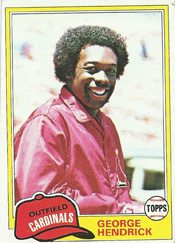
George Hendrick revived his career with the Cardinals and gave them the consistent run producer they were lacking in the outfield.

On May 26, 1978, the Cardinals acquired Hendrick from the Padres for pitcher Eric Rasmussen.
Platooned in right field by the Padres, Hendrick made it known he wanted to be traded to a team that would play him regularly. The Cardinals were happy to oblige.

Looking for lumber

The Cardinals opened the 1978 season with a starting outfield of Lou Brock in left, Tony Scott in center and Jerry Morales in right. None hit for power or average that season. Their totals: Brock (.221 batting average, no home runs), Scott (.228, one home run) and Morales (.239, four home runs).

The Cardinals needed another big bat to join catcher Ted Simmons and first baseman Keith Hernandez in the heart of the order.

Hendrick became available when he followed a strong 1977 season with a slow start in 1978 and fell out of favor with Padres manager Roger Craig.

The Padres opened the 1978 season with a starting outfield of Oscar Gamble in left, Hendrick in center and Dave Winfield in right. After batting .311 with 23 home runs and 81 RBI as the center fielder for the 1977 Padres, Hendrick hit .230 in April 1978.

Meanwhile, Craig determined catcher Gene Tenace and first baseman Gene Richards were playing out of position. In May, Craig moved Tenace to first base and Richards to left field, shifted Winfield from right to center and put Hendrick and Gamble into a platoon in right.

Hendrick and Gamble were unhappy with the arrangement and Gamble suggested he or Hendrick should be traded. When Padres general manager Bob Fontaine asked Hendrick whether he’d accept a trade, Hendrick said yes, The Sporting News reported.

Good deal

The Cardinals, Giants and Mets showed the most interest in Hendrick, Fontaine told the Associated Press. The Giants offered pitcher Jim Barr, but wanted to renegotiate the remainder of the three-year, $500,000 contract Hendrick signed in 1977, Padres owner Ray Kroc said to the Dayton Daily News.

After the Cardinals met with Hendrick’s agent, Ed Keating, an agreement was reached and the trade was made.

“He’s pleased to be coming here or he wouldn’t have approved of the deal,” Cardinals general manager Bing Devine said of Hendrick. “It was a good trade. There was no gun to our head. We wouldn’t have made it if there had been.”

Hendrick, 28, batted .243 with eight RBI in 36 games for the 1978 Padres. Rasmussen, 26, was 2-5 with a 4.18 ERA for the 1978 Cardinals after posting an 11-17 record the year before.

Cardinals manager Ken Boyer said Hendrick would be the center fielder and would bat third in the order, with Simmons fourth and Hernandez fifth.

“If Hendrick decides to give 100 percent, the deal could be Bing Devine’s best since he gave up Ernie Broglio for Lou Brock 14 years ago,” columnist Dick Young wrote in The Sporting News.

Joe Amalfitano, who was a coach with the 1977 Padres when Hendrick had his stellar season, told the St. Louis Post-Dispatch: “He’s a disciplined hitter. He’s a good base runner. He knows where he is at all times. He knows how to play this game. He never alibis. He never caused us any trouble.”

Special delivery

The Cardinals had lost 15 of their last 16 games and had a 15-31 record when Hendrick made his debut with them on May 29 in a doubleheader against the Mets in New York.

In a rare interview, Hendrick told Rick Hummel of the Post-Dispatch, “When I played against the Cardinals last year, my observation was that if they had somebody in the lineup who could protect Ted Simmons and hit 20 home runs and drive in 80 or 90 runs, I thought they could contend. I’m not saying I’m that guy, but I’m going to try to be.”

(In 2006, when Hendrick was a coach for the Rays, Hummel told the St. Petersburg Times, “He’s just a very delightful, charming, intelligent fellow and I relish every time I get to see him. People think because he doesn’t speak publicly that he’s this rude ogre, but he’s as gentle and kind a person as you’d ever want to meet.”)

Hendrick delivered for the 1978 Cardinals, batting .288 with 27 doubles, 17 home runs and 67 RBI in 102 games.

In seven seasons with St. Louis, Hendrick hit .294 and twice had more than 100 RBI in a season (109 in 1980 and 104 in 1982). He batted .321 in the 1982 World Series and drove in the go-ahead run in the sixth inning of the decisive Game 7 against the Brewers.

(Fun story about Hendrick and the 1982 World Series as told by club equipment manager Buddy Bates in an interview with Thoms R. Raber of 2004 Cardinals Yearbook: “It was real cold in Milwaukee. George was coming up to lead off the next inning. We had a heater at the end of the dugout. He laid his bat close to the heater. Well, it caught fire! Guys ran over there, stomping it out (but) his bat burned up.”)

Rasmussen, joining a rotation with Gaylord Perry and Randy Jones, was 12-10 for the 1978 Padres. He was 5-0 in July and 0-5 in September.

Rasmussen was reacquired by the Cardinals in December 1981 and pitched for them briefly in 1982 and 1983 before finishing his major-league career with the 1983 Royals.

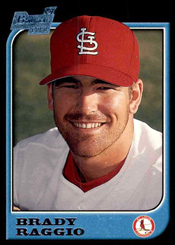
In answering a call for help from the Cardinals, Brady Raggio got into a jam and required rescue.

On May 15, 1998, Raggio started for the Cardinals against the Marlins and allowed 11 consecutive batters to reach base before he was lifted in the first inning.
Though he was sent to the minor leagues the next day, Raggio returned to the Cardinals a month later and earned redemption.

Bad results

Needing someone to fill in for Donovan Osborne, who developed a shoulder ailment, the Cardinals called on Raggio, who was with their Class AAA Memphis club, and gave him the start in the Friday night opener of a series against the Marlins at St. Louis. Raggio, who’d made 15 appearances as a rookie with the 1997 Cardinals, was 4-2 with a 2.48 ERA at Memphis.

Though the Marlins were defending World Series champions, three of their best players _ third baseman Bobby Bonilla, catcher Charles Johnson and outfielder Gary Sheffield _ were held out of the lineup against the Cardinals while the club negotiated a deal to trade them to the Dodgers.

Raggio got the first batter, John Cangelosi, to ground out. The next eight _ Edgar Renteria, Cliff Floyd, Derrek Lee, Mark Kotsay, Gregg Zaun, Craig Counsell, Dave Berg and pitcher Brian Meadows _ each singled.

The hits by Floyd, Kotsay, Zaun, Berg and Meadows produced five runs. It could have been more except Kotsay made the second out of the inning when he drifted too far off second base after Zaun singled.

The Marlins, though, weren’t done. Batting for the second time in the inning, Cangelosi walked, loading the bases. Renteria singled again, driving in a run and making the score 6-0.

After Raggio walked Floyd, forcing in a seventh run, manager Tony La Russa replaced him with Curtis King, who got Lee to ground out, ending the Marlins’ half of the first.

Raggio departed with an ERA of 94.50, yielding seven runs in two-thirds of an inning.

“They found the holes,” Raggio said to the Miami Herald. “I thought I was making pretty good pitches, but they had, like, six groundball hits.”

La Russa agreed, telling the St. Louis Post-Dispatch, “We expected him to get a bunch of ground balls. We didn’t get anything hit at anyone. I think the results were a little misleading.”

Raggio told the Memphis Commercial-Appeal he received “some encouraging words” from La Russa after the outing. “I make the same pitches that I made in that inning in 100 more innings and I get out with no runs,” Raggio said.

Keep on trying

Down 7-0, the Cardinals chipped away, scoring a run in the first, a run in the third and four in the fifth. Meadows gave up two home runs to Ray Lankford and one to Brian Hunter. The Marlins added a run in the fourth against Kent Bottenfield and led, 8-6, after five innings.

The Cardinals made Marlins reliever Jay Powell squirm in the ninth. With two outs, John Mabry doubled, scoring Gary Gaetti from first and getting the Cardinals within a run at 8-7. When La Russa sent Willie McGee to bat for pitcher Juan Acevedo, the Marlins opted to walked him intentionally, even though he represented the potential winning run. Tom Pagnozzi ended the drama by lining out to Renteria at short. Boxscore

Raggio was returned to Memphis after the game and pitched well, boosting his record to 6-3 with a 2.50 ERA. On June 15, the Cardinals recalled him. “Brady deserves it,” said Memphis manager Gaylen Pitts. “That’s what happens when you come down and work. He could have gone the other way, but he worked hard and did what he had to do to get back.”

In his first appearance for the Cardinals since his recall, Raggio pitched 2.1 scoreless innings of relief, earning the win against the Diamondbacks. Boxscore

After two more relief stints, Raggio went back to Memphis. Released after the season, Raggio was in the Rangers’ system in 1999 and spent three years (2000-2002) in Japan. In 2003, he returned to the big leagues with the Diamondbacks.

(Updated Jan. 23, 2025)

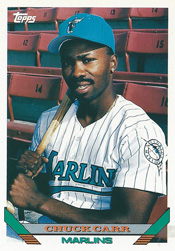
Chuck Carr, a switch-hitting speedster who appealed to the Cardinals but didn’t fit into their plans, found a home with the expansion Marlins.

On May 14, 1993, the Cardinals played the Marlins in a regular-season game for the first time. The first batter they faced was Carr, whom the Marlins selected from the Cardinals in the Nov. 17, 1992, National League expansion draft.
Carr developed into a productive player with the 1993 Marlins. He led the National League in stolen bases (58) that season, tied with Jeff Conine for the team lead in runs scored (75) and was second on the club in hits (147).

In a special edition magazine, “Marlins! Top of the First,” Dan Le Batard of the Miami Herald wrote, “If Marlins center fielder Chuck Carr hadn’t been born, Walt Disney would have created him. The cocky Carr, part cartoon and part character, added a flash of fluorescence to a game capable of being as black and white as its box scores.”

For instance, according to Le Batard, after winning a game for the Marlins with a bunt, Carr gave his interviews while staring into a mirror. He also wanted to name a son Sports _ as in, Sports Carr _ but his wife wouldn’t allow it. They settled on Sheldon instead.

The Cardinals would like to have kept Carr, but they had outfielders such as Ray Lankford, Bernard Gilkey and Brian Jordan who rated ahead of him.

Learning to hit

Carr entered pro baseball in 1986 when he was drafted and signed by Reds scout Ed Roebuck, a former big-league pitcher. After a year in the Reds’ system, Carr was released, joined the Mariners, spent two seasons in their organization and got traded to the Mets.

On Dec. 13, 1991, the Cardinals, acting on the advice of player development director Ted Simmons, got Carr from the Mets for minor-league pitcher Clyde Keller. Carr had a reputation for being a good fielder and weak hitter. “We signed him primarily as a defensive player,” Simmons told the St. Louis Post-Dispatch.

The Cardinals assigned Carr to Class AA Arkansas to open the 1992 season and sent minor-league hitting instructor Johnny Lewis to work with him.

“Chuck was just slapping at the ball … I took him aside and showed him ways he could hit the ball harder,” Lewis told the Louisville Courier-Journal.

Said Carr: “Johnny wants me to shorten my swing and put the ball in play more, just like Jose Oquendo and Ozzie Smith. It made sense to me.”

Carr hit .261 at Arkansas and was promoted to Class AAA Louisville on May 12. He batted .308 with 53 stolen bases in 96 games for Louisville.

“Carr is stirring memories of Vince Coleman,” wrote Courier-Journal columnist George Rorrer. “He’s fast enough to steal a base nearly any time he wants.”

Said Louisville manager Jack Krol: “Chuck has done more than we thought he could do … He can make it to the big leagues.”

Building block

Carr was called up to the Cardinals in September 1992 and they gave him a chance to play. He made 15 outfield starts. “His disruptive speed and defensive skills make Carr intriguing,” Dan O’Neill of the Post-Dispatch wrote.

Carr hit .360 in his first 25 at-bats and had five stolen bases. “Initially, he stirred excitement with the Cardinals,” wrote O’Neill. “Then he started hitting fly balls and his average deflated.”

In 22 games for the Cardinals, Carr hit .219 with 10 stolen bases.

After Carr was drafted by the Marlins, Cardinals manager Joe Torre said he “would have benefited us as a player coming off the bench” in 1993. “We were kind of hoping he might sneak through” the draft without being taken, Torre said.

The Marlins saw Carr as a possible cornerstone for building a lineup. “He can steal 50 bases in the major leagues,” said Marlins scout Cookie Rojas.

Run generator

Scott Pose was the Marlins’ starting center fielder and leadoff batter in their first Opening Day, April 5, 1993, but Carr took over the job on April 16 and kept it the remainder of the season.

A couple of more anecdotes from Dan Le Batard about Carr:

_ During 1993 spring training, Carr approached Lou Brock, then an Expos instructor, and asked for tips on how to be a better base stealer. “Listen, son,” Brock said to Carr, “what I’ve done can’t be taught in 15 minutes.” Carr got an autograph instead.

_ In a regular-season game against the Cubs, Carr was called out on a close play at first, taunted umpire Jeff Kellogg by pointing at his eyes and said to him, “If you are blinded by the speed, don’t make the call.”

When the Marlins came to St. Louis for the first time in a regular-season game, their lineup was Chuck Carr in center, Junior Felix in right, Dave Magadan at third, Orestes Destrade at first, Benito Santiago at catcher, Jeff Conine in left, Alex Arias at second, Walt Weiss at short and pitcher Chris Hammond.

The Cardinals’ lineup: left fielder Bernard Gilkey, shortstop Ozzie Smith, center fielder Ray Lankford, first baseman Gregg Jefferies, right fielder Mark Whiten, third baseman Todd Zeile, second baseman Geronimo Pena, catcher Erik Pappas and pitcher Bob Tewksbury.

The Cardinals won, 7-2. Carr contributed to both Marlins runs.

In the fourth, Carr got the Marlins’ first hit, lining a single to center. He swiped second _ “The throw was pretty good,” said Pappas. “He just beat it.” _ advanced to third on a groundout and scored on a single by Magadan.

In the seventh, with the bases loaded and two outs, Carr was grazed on the arm by a Tewskbury pitch, forcing in a run. “The ball was close to being a strike,” said Tewksbury. “He’s just diving into the pitch.” Boxscore

Carr batted .263 with six stolen bases against the Cardinals in 1993. The Cardinals won nine of 13 games against the expansion Marlins.

In eight major-league seasons with the Mets (1990-91), Cardinals (1992), Marlins (1993-95), Brewers (1996-97) and Astros (1997), Carr batted .254 with 144 stolen bases.


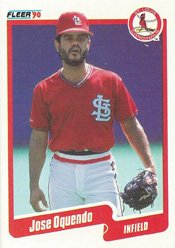
With a pitching performance as entertaining as it was admirable, Jose Oquendo impressed teammates, frustrated the Braves and earned a spot in Cardinals lore.

On May 14, 1988, at St. Louis, Oquendo was asked by manager Whitey Herzog to relieve in the 16th inning because no one on the pitching staff was available. Oquendo shifted from first base to the mound and shut out the Braves for three innings before yielding two runs in the 19th. Though he lost, Oquendo surprised most by doing as well as he did for as long as he did.

Another surprise was the performance of Jose DeLeon, a Cardinals pitcher who played the outfield in the final four innings.

Limited options

The Saturday night game matched starting pitchers Cris Carpenter, making his major-league debut for the Cardinals, against Zane Smith. The Cardinals led, 5-4, before the Braves tied the score with a run in the seventh.

Oquendo, a utility player, entered the game in the ninth as a replacement for first baseman and ex-Brave Bob Horner. In the bottom half of the inning, Oquendo and Tony Pena were on base, with one out, when Vince Coleman hit a grounder past pitcher Jose Alvarez. Second baseman Ron Gant dived, stopped the ball and started a double play, sending the game into extra innings.

In the 12th, former Cardinals catcher Ted Simmons led off for the Braves. Facing his friend, Bob Forsch, Simmons pulled a pitch hard on the ground. Oquendo ranged to his right, snagged the ball and threw to Forsch, covering first, in time to nip Simmons.

In the 15th, Herzog brought in his last available pitcher, Randy O’Neal, whom the Cardinals acquired from the Braves the year before. O’Neal had experience as a starter and Herzog figured to let him finish the game, no matter how many innings it took.

However, after retiring the Braves in order in the 15th, O’Neal said his arm hurt. Herzog had used all his pitchers except three: DeLeon, Larry McWilliams and John Tudor. All were deemed unavailable. DeLeon had pitched 8.2 innings the previous night, McWilliams was scheduled to start the next game and had been sent home by Herzog in the 10th inning, and Tudor had a tender shoulder.

Herzog turned to Oquendo, who’d made one big-league pitching appearance, a 1987 mop-up role during a blowout loss to the Phillies.

Serious business

Selecting Oquendo to pitch, Herzog needed someone to play first base. He moved Duane Walker from left field to first and brought in DeLeon to play left.

DeLeon hadn’t played a position other than pitcher since entering the big leagues in 1983. Asked how Herzog broke the news to him, DeLeon told the St. Louis Post-Dispatch, “He said, ‘Can you play outfield?’ I said, ‘Sure.’ I didn’t mind.”

Herzog approached umpire Bob Davidson to inform him of the lineup switches. Recalled Davidson: “Whitey said he was bringing in Oquendo to pitch and he said, ‘Can I forfeit?’ ”

When catcher Steve Lake went to the mound to review the pitch signals, Oquendo told him he had three pitches: fastball, slider and split-finger. “I started chuckling,” Lake said. “Then I see that he’s dead serious.”

Ken Griffey Sr. led off the 16th against Oquendo and doubled. After Gerald Perry was walked intentionally, Ozzie Virgil Jr. hit a single to right. In a decision the Atlanta Constitution described as “a blunder,” third-base coach Willie Stargell sent Griffey to the plate, where Lake awaited with the ball after fielding a strong peg from right fielder Tom Brunansky. Griffey was out by 10 feet.

“I’ve got to thank Stargell because he didn’t hold the guy (at third),” Herzog said. “The game should have been over then.”

Mix and match

As the game moved along through the 17th and 18th, Herzog continually shifted DeLeon and Brunansky in an effort “to put DeLeon where the batter was least likely to hit the pitch,” according to the Constitution. DeLeon and Brunansky switched spots in right field and left field 11 times.

DeLeon had two fly balls hit to him and he caught both. “I was a little nervous,” DeLeon said. “My knees were shaking.”

In the 18th, with Cardinals runners on first and third, none out, Lake grounded out to third. After Luis Alicea walked, loading the bases, Walker hit a broken-bat liner that was caught by shortstop Andres Thomas and resulted in a double play when Brunansky was unable to get back to the bag at third.

“I didn’t get the job done,” said Walker. “All I had to do was hit a fly ball to end the game.”

Said Herzog: “We should have won in the 18th.”

The Cardinals stranded 21 on base in the game.

Staying alive

In the 19th, Griffey hit a two-run double against Oquendo with two outs. Rick Mahler retired the Cardinals in order in the bottom half, completing eight scoreless innings of relief and sealing a 7-5 Braves victory. Mahler “pitched the best he has in three years,” said Braves manager Chuck Tanner.

Oquendo finished with a pitching line of four innings, four hits, two runs, six walks and one strikeout. “He threw a lot of sliders and a lot of split-fingers,” said Lake. “I never knew where his fastball was going. I didn’t know if he was going to drop down (sidearm) or throw overhand.”

Oquendo became the first non-pitcher to receive a decision since outfielder Rocky Colavito won a relief stint for the Yankees against the Tigers in 1968.

“I’m glad I got a chance to pitch and I’m glad nobody got hurt,” Oquendo said.

Said Braves slugger Dale Murphy, who was hitless in seven at-bats: “It wouldn’t have looked very good if we had lost. It didn’t look too good anyway, but we won.” Boxscore

Herzog said utility player Tom Lawless would have relieved Oquendo if the game had gone to a 20th inning. “That would have been brutal,” said Lawless. “I’d already thrown batting practice.”