Feeds:
Posts
Comments

Sons of Polish fathers, Stan Musial and Moe Drabowsky reached the major leagues, played central roles in a baseball milestone and honored their heritages by helping others learn the game they loved.

On May 13, 1958, Musial got his 3,000th career hit, a double against Drabowsky at Wrigley Field in Chicago. The feat forever linked Drabowsky with Musial.

The relationship didn’t end there. In September 1987, Musial and Drabowsky went to Poland together to instruct men and women in their fathers’ homeland how to play baseball.

Land of opportunity

Miroslav Drabowski, later known as Moe Drabowsky, was born on July 21, 1935, in Ozanna, Poland. His father was Polish and his mother was American. In 1938, when Miroslav was 3, the family moved to the United States and settled in Connecticut.

In America, Miroslav took the name of Myron Walter Drabowski, though nearly everyone called him Moe. He was a natural as a baseball player. In school, his name often was misspelled as Drabowsky and he stuck with that, according to a biography by the Society for American Baseball Research.

After earning an economics degree from Trinity College in Connecticut, Drabowsky signed with the Cubs and made his big-league debut with them in 1956.

Musial, whose father immigrated to the United States from Poland in 1910, entered the 1958 season needing 43 hits to become the eighth player to reach 3,000. On May 12, against the Cubs at Wrigley Field, Musial got his 2,999th hit and indicated he’d prefer to achieve No. 3,000 before the fans in St. Louis.

Work day

Cardinals manager Fred Hutchinson told Musial to sit out the May 13 game at Chicago and prepare to return to the lineup May 14 against the Giants at St. Louis. Musial went to the bullpen along the right-field line at Wrigley Field and watched the game.

In the sixth inning, with the Cubs ahead, 3-1, Gene Green led off for the Cardinals and doubled. Hal Smith was up next, with pitcher Sam Jones on deck. As Smith batted, Hutchinson motioned for Musial. After Smith grounded out, Musial walked from the bullpen to the dugout, picked out a bat and went to the plate to hit for Jones. The Tuesday afternoon crowd of 5,692 cheered in approval.

Drabowsky, 22, was glad Cubs manager Bob Scheffing showed confidence in letting him pitch to Musial. Drabowsky won 13 for the Cubs in 1957 and was considered one of their best pitchers in 1958.

“I thought, ‘Here’s a guy who deserves No. 3,000.’ A nice guy,” Drabowsky told David Condon of the Chicago Tribune. “Then I remembered our 3-1 lead and that I was trying to preserve a victory. So I told myself, ‘Sure, he’s a nice guy, but he’ll have to earn No. 3,000.’ So I bore down.”

Hugs and kisses

Working methodically, Drabowsky alternated curves and fastballs. Musial fouled off three pitches to left and watched two others go wide of the strike zone.

With the count at 2-and-2, Drabowsky threw a curve. “Outside corner, higher than intended,” Drabowsky said.

In his book “Stan Musial: The Man’s Own Story,” Musial said, “I picked up the spin of the pitch, strode into the ball and drove it on a deep line into left field. I knew as soon as it left my bat that it would go between the left fielder, Walt Moryn, and the foul line.”

Musial’s No. 3,000 was a run-scoring double. “I don’t mind him getting 3,000 off me,” Drabowsky said, “but when I had two strikes, I thought I had him _ not for a strikeout, but I figured he’d hit it in the ground.” Video

As Hutchinson ran onto the field to congratulate Musial, he was followed by a pack of photographers. Umpire Frank Dascoli retrieved the ball and handed it to Musial, who was lifted for a runner, pitcher Frank Barnes.

Before leaving the field, Musial went to the box seats next to the Cardinals dugout and kissed his wife, Lillian. A photographer asked, “Say, Stan, did you know that blonde?” Musial laughed and replied, “I’d better. That’s my wife.”

Sparked by Musial’s hit, the Cardinals scored three more runs against Drabowsky in the inning and won, 5-3. Boxscore

Polish pride

Musial, who retired after the 1963 season, batted .405 with two home runs, four doubles and six walks against Drabowsky in his career.

Drabowsky pitched 17 seasons in the major leagues with eight teams: Cubs (1956-60), Braves (1961), Reds (1962), Athletics (1962-65), Orioles (1966-68 and 1970), Royals (1969-70), Cardinals (1971-72) and White Sox (1972). His best years were as an Orioles reliever. In Game 1 of the 1966 World Series, Drabowsky struck out 11 Dodgers, including six in a row, and earned the win with 6.2 innings of scoreless relief. Boxscore

In two seasons with the Cardinals, Drabowsky was 7-2 with 10 saves.

In 1987, Musial and Drabowsky reconnected, going to the town of Kutno in Poland to teach baseball to men and women in the Polish Baseball Union. It was Drabowsky’s first visit to Poland since he left when he was 3.

With equipment provided by baseball commissioner Peter Ueberroth, Musial and Drabowsky gave out enough bats, balls, gloves and catchers’ gear to supply 12 men’s teams and six women’s teams, according to the Chicago Tribune.

“We’re here to help get them going and maybe we can invite some of their coaches to the U.S. next year to see how we train so they can come home and teach the kids more,” said Musial.

The effort by Musial and Drabowsky led to Kutno, Poland, becoming home to the Little League Baseball European Leadership Training Center.
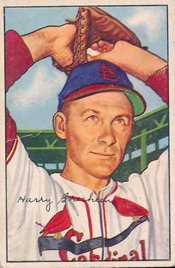
Harry Brecheen came close to being perfect for the Cardinals.

Brecheen began the 1948 season with three consecutive shutouts, including a one-hitter.

A left-hander, Brecheen followed consecutive shutouts versus the Cubs with a nearly perfect game against the Phillies. His scoreless streak reached 32 innings before the Pirates broke through with a run in the sixth inning of Brecheen’s fourth start of the season.

Hot start

Brecheen, 33, made his first start of 1948 on April 23 against the Cubs at Chicago. He yielded nine hits and a walk, but the Cubs stranded nine and the Cardinals won, 1-0. Boxscore

A week later, on May 1, Breechen got his second start, against the Cubs at St. Louis, and again held them scoreless. The Cubs got six hits and a walk, stranded seven and the Cardinals won, 4-0. Boxscore

Facing the Phillies in his third start on May 8 at St. Louis, Brecheen was extra sharp. Using a mix of screwballs, curves and fastballs, he retired the first 20 batters in a row.

With two outs in the seventh, rookie Johnny Blatnik, starting in place of slumping left fielder Harry Walker, was the batter. Brecheen got ahead on the count, 0-and-2, and decided to waste a pitch.

“I threw one in there high, above his head,” Breechen told The Sporting News.

Decisive call

Blatnik, a right-handed batter, swung at the ball and hit “a high, slow bouncer” along the third-base line, the St. Louis Post-Dispatch reported.

Third baseman Whitey Kurowski fielded the ball on the foul line and fired across the diamond to first baseman Nippy Jones. “I thought I made a good throw,” Kurowski said.

First-base umpire Babe Pinelli called Blatnik safe, an infield single that ended Brecheen’s bid to pitch the first perfect game in the big leagues since Charlie Robertson of the White Sox did it against the Tigers in 1922.

“I was aware Brecheen was pitching a perfect, no-hit game when that play came up, but if I had to call it again, it would be the same,” said Pinelli. “Blatnik was safe at first. There was no doubt about that in my mind when I called the play.”

Difference of opinions

Though the Cardinals didn’t challenge the call on the field, they were united in their belief Blatnik was out.

_ Harry Breechen: “I thought Blatnik was out at first, but, of course, I’m prejudiced.”

_ Whitey Kurowski: “From where I was standing, my throw appeared to have beaten Blatnik by a good margin.”

_ Nippy Jones: “I felt the ball hit my mitt while the base runner was still in the air. I was surprised when the umpire called him safe. In fact, I didn’t think the play was even close.”

_ Eddie Dyer, Cardinals manager: Jones “was positive in his statement when he told me Kurowski’s throw had the runner by a good half-step.”

_ Red Schoendienst, Cardinals second baseman: “I was satisfied the base runner was out.”

Throwing strikes

Blatnik was the only Phillies batter to reach base. Breechen retired the last seven in a row and the Cardinals won, 5-0. Boxscore

Brecheen exhibited pinpoint control. Richie Ashburn was the only Phillies batter who worked a count to 3-and-2, and he struck out.

After the game, Pinelli met Brecheen in a runway leading from the Cardinals’ dugout to the locker room and consoled the pitcher on missing out on a perfect performance, according to The Sporting News.

A week later, on May 15 at St. Louis, Brecheen made his fourth start, against the Pirates, and held them scoreless until, with two outs in the sixth, Frankie Gustine singled and scored on Johnny Hopp’s triple. Brecheen pitched a complete game and got the win in an 8-3 Cardinals victory.

Brecheen finished the 1948 season with a 20-7 record and led the National League in ERA (2.24), shutouts (seven) and strikeouts (149).

Seeking help in the heartland in his bid to win the Democratic presidential nomination in 1968, Senator Robert F. Kennedy of New York turned to a family friend, Stan Musial of the Cardinals.

On April 24, 1968, Musial was selected to lead National Sportsmen for Kennedy, a committee of sports figures recruited to boost the national candidacy of the younger brother of the late President John F. Kennedy.

Though Musial disliked controversy, and usually took every precaution to avoid getting embroiled in the kind of conflict politics naturally created, he waded with eyes wide open into the tumultuous 1968 presidential campaign because of his loyalty to the Kennedys.

Ties that bind

The relationship between Musial and the Kennedys began in Milwaukee in September 1959. Musial, still a prominent player at 38, was with the Cardinals for a series with the Braves. Massachusetts Senator John F. Kennedy, 42, was in town, campaigning for the 1960 Democratic presidential nomination. “I was standing in front of the hotel, waiting for the bus for the game,” Musial told The Sporting News, “and a man came up to me and said, ‘You are Stan Musial and I’m glad to meet you. I’m Jack Kennedy.’ Of course I knew him. Then he said, ‘You’re too old to play ball and I’m too young to be president, but maybe we’ll fool ’em.’ ”

In 1960, when John Kennedy ran for president as the Democratic nominee against Republican Vice President Richard Nixon, Musial was part of the first National Sportsmen for Kennedy committee. Among those joining Musial on the 1960 committee were baseball’s Hank Aaron, Orlando Cepeda, Joe DiMaggio, Whitey Herzog and Willie Mays; football’s Sam Huff and Johnny Unitas; and basketball’s Bob Cousy.

Kennedy won the election and named his brother, Robert, to the position of Attorney General.

President Kennedy met with Musial at the 1962 All-Star Game in Washington, D.C. The next day, Senator Stuart Symington of Missouri arranged for Musial, wife Lillian and daughter Janet to receive a VIP tour of the nation’s capital.

While at the Department of Justice, the Musials were greeted by Attorney General Kennedy, who asked whether they wanted to go to the White House and visit the president. Though Musial didn’t want special favors, Robert Kennedy insisted on arranging the White House meeting, and the Musials were brought to the Oval Office to see President Kennedy.

A few days later, on July 26, 1962, a letter from Attorney General Kennedy arrived for Musial at his St. Louis restaurant. Robert Kennedy wrote, “Dear Stan, many thanks for your nice note. It was good to see you and your family when you were in Washington and I am glad you enjoyed the tour of the White House and your meeting with the president.”

Two years later, in February 1964, Attorney General Kennedy and his wife Ethel attended the swearing in ceremony for Musial at the White House when the retired ballplayer was named by President Lyndon Johnson to lead the nation’s physical fitness program.

Two months after that, on April 17, 1964, with Musial at his side, Attorney General Kennedy threw the ceremonial first pitch at the Red Sox home opener in Boston.

Open competition

By March 1968, President Johnson’s popularity waned because of the United States involvement in the war in Vietnam. On March 16, Senator Robert Kennedy announced he would seek the Democratic presidential nomination. Two weeks later, President Johnson declared he wouldn’t seek re-election.

With the president out of the running, the race for the Democratic nomination centered on Kennedy, Vice President Hubert Humphrey and Minnesota Senator Eugene McCarthy. The winning candidate would need to show strength in the remaining state primaries.

Kennedy first focused on the May 7 primary in Indiana, a state considered especially challenging for an East Coast liberal.

With an eye toward boosting his appeal among Midwesterners, Kennedy tapped Musial to lead the committee of sports figures who would campaign for him. In addition to his sterling reputation, Musial also was the senior vice president of the defending World Series champion Cardinals.

Among those joining Musial on the 1968 National Sportsmen for Kennedy committee were Hank Aaron, basketball’s Bill Russell and football’s Gale Sayers, Herb Adderley and Paul Hornung.

Help with Hoosiers

On May 2, 1968, Musial played a visible role in joining Robert and Ethel Kennedy on the campaign trail in the northern Indiana towns of Elkhart and Mishawaka. An article in the next day’s St. Louis Post-Dispatch reported, “Musial perched on the back of Kennedy’s open automobile along with Mrs. Kennedy in a motorcade through Elkhart and Mishawaka.”

The sight of Musial stumping for Kennedy helped to counter the work of celebrities such as actor Paul Newman, who campaigned for McCarthy in Indiana.

Kennedy won the Indiana primary and followed that with victories in primaries in Nebraska, South Dakota, Washington, D.C., and California.

On June 5, hours after he won the California primary, Kennedy, like his brother five years earlier, was shot by an assassin. He died on June 6 at age 42.

The Democrats nominated Humphrey but he lost the election to Richard Nixon.

Previously: Stan Musial shared a special bond with JFK

Previously: While nation mourned RFK, Cards reluctantly played


The St. Louis Hawks were a first-place NBA team in 1968, but they were also-rans in the hearts of hometown sports fans.

On May 3, 1968, club owner Ben Kerner sold the Hawks to a group that moved them to Atlanta. The departure occurred 10 years after the franchise won its only NBA championship in 1958.

Though the Hawks were Western Division champions in 1968, finishing the regular season with a 56-26 record, their average home attendance was 6,288. Struggling to attract customers to St. Louis’ Kiel Auditorium, the Hawks played six of their home games in Miami during the 1967-68 season.

In 1955, when the Hawks relocated from Milwaukee, the baseball Cardinals were the only other major professional sports franchise in St. Louis. By 1968, the Cardinals and Hawks had been joined in St. Louis by the NFL Cardinals, the NHL Blues and the Stars of the North American Soccer League.

The baseball Cardinals were longtime kings in St. Louis, and the football Cardinals, as well as the Blues, who joined the NHL in 1967, surpassed the Hawks in popularity.

“Things have been going downhill slowly,” Kerner said to the Associated Press. “Since 1960, when the football Cardinals came here, people instead of buying eight season tickets from us split it four and four. The same thing happened again with hockey.”

Money ball

After beating the Boston Celtics in the 1958 NBA Finals, the Hawks had their peak home attendance years in the next three seasons, averaging 8,548 in 1958-59, 8,409 in 1959-60 and 8,561 in 1960-61, according to the Association for Professional Basketball Research.

The baseball Cardinals and the football Cardinals benefitted from the 1966 opening of Busch Memorial Stadium in downtown St. Louis. The Blues, who reached the Stanley Cup Finals in their debut season, played at St. Louis Arena.

“The Hawks, it developed, could stand everything except competition for the sports buck,” Bob Broeg wrote in the St. Louis Post-Dispatch.

Coached by Richie Guerin and bolstered by standout players such as Zelmo Beatty, Lenny Wilkens, Joe Caldwell, Bill Bridges, Paul Silas and Lou Hudson, the Hawks opened the 1967-68 season by winning 16 of their first 17 games, but ticket sales remained flat.

“When your team starts off with a 16-1 record and you have a hard time drawing crowds at home, you have to wonder,” Kerner said.

Facing the San Francisco Warriors in the first round of the playoffs, the Hawks played the first two games at St. Louis, drawing crowds of 5,018 and 5,810 to Kiel Auditorium, according to the Post-Dispatch. With the best-of-seven series tied at 2-2, Game 5 was played at St. Louis’ Washington University and attracted slightly more than 4,000.

“The crowds at the playoff games were very discouraging,” Kerner said. “This certainly was a factor in my decision to sell the club.”

Fast break

The Warriors, featuring players such as Rudy LaRusso, Nate Thurmond and Jeff Mullins, upset the favored Hawks, winning four of six games in their playoff series. Soon after, Kerner was approached by an Atlanta group, led by real estate developer Thomas Cousins and former Georgia governor Carl Sanders.

“Negotiations progressed rapidly,” Kerner said.

Cousins told the Atlanta Constitution a deal was reached quickly “because there were other cities who would have jumped in had we sat back.”

Kerner sold the Hawks for about $3.5 million, the Post-Dispatch reported.

“The attendance for the last four or five years has not been good,” Kerner said. “It appears that the interest is not there. If you have a product that people don’t want, you can’t make them buy it.”

Kerner said he tried to find a St. Louis group to purchase the Hawks, but didn’t find any.

Wrote Broeg: “Public apathy was apparent. The man was justified in selling, though it’s too bad he couldn’t have given St. Louisans one more chance or, because he’d become wealthy here, been willing to take a little less to keep it here.”

New South

Guerin told the Atlanta Constitution he was eager to coach in Atlanta because the city was “very progressive, fast-growing and, equally, fast-developing.”

“The only thing about the sale that I’m a little down about is the fact I’m parting company with such a fine man as Mr. Kerner,” Guerin said. “It has been more than just a coach-owner relationship between the two of us. Mr. Kerner is a man for whom I have the greatest respect.”

The Hawks became the third major professional sports franchise to come to Atlanta since 1965, joining the baseball Braves and the NFL Falcons.

In 1968-69, their first season in Atlanta, the Hawks played at Alexander Memorial Coliseum on the Georgia Tech campus and averaged 4,474 per home game.

The Hawks never have won a NBA championship since moving to Atlanta. St. Louis never has gotten a NBA franchise since the Hawks departed, though they did have the Spirits of the American Basketball Association from 1974-76.

(Updated Nov. 25, 2024)

When the Cardinals saw Dizzy Dean for the first time in the 1938 regular season, he looked a lot different to them. He was wearing the uniform of the Cubs instead of the Cardinals, he was throwing sidearm instead of overhand, and his pitches were slow instead of fast.

What remained familiar, however, was his result.

On April 24, 1938, in his first appearance at Chicago’s Wrigley Field as a member of the Cubs, Dean faced the team that traded him and pitched a shutout against the Cardinals.

Relying exclusively on off-speed pitches, or, “his dipsy-do stuff,” as the Chicago Tribune described it, because of a damaged right arm, Dean limited the Cardinals to four hits and two walks in a 5-0 Cubs victory. Dean also produced a single and scored twice.

Pitching on a Sunday afternoon before 34,520 spectators, including Cardinals owner Sam Breadon, Dean “caused clouds of gloom to gather over the Cardinals” with his performance, the St. Louis Star-Times reported.

Slow and steady

With an intimidating fastball, Dean was the ace of the Cardinals’ Gashouse Gang teams of the 1930s, leading National League pitchers in strikeouts four years in a row (1932-35) and posting win totals of 30 (1934), 28 (1935) and 24 (1936) in his peak seasons.

His career skidded off course in 1937, however, when he suffered a toe injury in the All-Star Game. Rushed back into the Cardinals’ lineup before the injury healed, Dean altered his delivery to compensate for pain in his toe and damaged his arm.

The Cardinals traded him to the Cubs on April 16, 1938, three days before the season opened. On April 20, Dean made his first regular-season appearance for the Cubs, starting against the Reds at Cincinnati, and got the win, yielding two runs over six innings in a 10-4 Chicago victory.

Before his second start, against the Cardinals, Dean and catcher Gabby Hartnett devised a plan for how to pitch to them. “Gabby knows them better than I do,” Dean told United Press. “All I had to do was put the ball where he said.”

Throwing sidearm, Dean “mixed a fast curve with a slow curve and a fadeaway knuckler curve that threw the Cardinals’ batters off stride,” home plate umpire Larry Goetz told the Star-Times.

Dean threw 92 pitches and, because “he didn’t have a fastball,” relied on “changing pace on a half-speed delivery,” The Sporting News reported.

The Cardinals “dug in at the plate and swung from their heels,” according to the St. Louis Post-Dispatch. “In so doing, they helped to beat themselves.”

Said Cardinals manager Frankie Frisch: “We were too eager. We swung too hard.”

Right stuff

The Cardinals’ hits were a pair of doubles by Terry Moore and a single each by Enos Slaughter and pitcher Max Macon.

Twice, the Cardinals had two runners on the bases, but Dean escaped unscathed.

In the second inning, with Johnny Mize on third, Moore on second and two outs, Dean got Mickey Owen to fly out to left on a 3-and-2 pitch.

In the sixth, Dean retired the first two batters before Slaughter singled and Pepper Martin walked. With Mize, a power threat, at the plate, Cubs manager Charlie Grimm had Charlie Root loosen in the bullpen.

Pitching knuckle-curves away from Mize, Dean worked the count to 1-and-2. His next pitch, described by the Post-Dispatch as a “firecracker curve,” was his fastest. Mize swung at it and popped out to third.

After retiring Mize for the last out in the ninth, Dean was swarmed by teammates. “They whacked him on the back, shook his hands and jostled him into a daze,” the Tribune reported. Hartnett and shortstop Tony Lazzeri wanted to lift Dean onto their shoulders and carry him off the field, the Star-Times observed, but Dean shook them off. Boxscore

Smart guy

Dean finished his gem in one hour, 38 minutes.

“One of the smartest pitched games I have ever seen,” said Goetz. “His control was his best asset.”

When the final was posted on the scoreboard at Sportsman’s Park in St. Louis, where 11,041 had gathered to watch the Browns play the White Sox, the crowd roared its approval in support of Dean.

Surrounded by reporters and photographers in the Wrigley Field locker room, Dean said, “I’m sure glad to get over that one. That was the game I was really worried about.”

About 5,000 fans waited in a runway outside the clubhouse to applaud Dean. “Police had to be summoned to make a path for the great man to leave the park,” the Post-Dispatch reported.

Though Dean said his arm was fine, it wasn’t. He didn’t pitch from May 4 through July 16 because of arm soreness. When he did pitch, he was effective. Dean produced a 7-1 record and 1.81 ERA in 13 appearances for the 1938 Cubs, who won the National League pennant. He started Game 2 of the World Series against the Yankees, but was the losing pitcher.

Dean, who pitched for the Cubs from 1938-41, went on to make eight career appearances against the Cardinals, but the shutout he pitched was his only win against them. Dean’s career record versus the Cardinals: 1-4 with a 5.58 ERA.

Though Dean’s pitching skills diminished while with the Cubs, his competitiveness never waned.

In the Book “Voices From Cooperstown,” Cubs second baseman Billy Herman told of the time during spring training with the Cubs when Dean used “sleight of hand” with two coins to win several bottles of rare whiskey in a bar bet.

“He kept one bottle and gave the rest away,” Herman said. “He never even wanted them. He just wanted to win. That was Diz. Cheat you on the golf course, tee them up in the rough, he’d do anything in the world _ just to win. He’d cheat you out of 50 cents in a card game and then take you out and spend $100 on you. Didn’t care about money _ he just wanted to win.”

(Updated July 22, 2020)

Knowing Duke Snider wasn’t enamored with the new home of the Dodgers, the Cardinals made a bid to acquire him, but the price was deemed too high.

On April 25, 1958, the Cardinals played the Dodgers in Los Angeles for the first time in the regular season. The Dodgers left Brooklyn after 1957 and relocated to the Los Angeles Memorial Coliseum while waiting for Dodger Stadium to be built.

Snider, a left-handed pull hitter who thrived at Ebbets Field in Brooklyn, was frustrated by the dimensions of the Coliseum. The distance from home plate to the fence in right-center was 440 feet and it was 390 feet from home plate to straightaway right. Snider found drives hit to right that would have been home runs at Ebbets Field were outs at the Coliseum.

The Coliseum was much friendlier to right-handed pull hitters, with a distance of 251 feet down the line from home plate to the left field fence. Though a screen stretching 42 feet high and 140 feet long was erected along the left field wall, hitters reached the seats with routine fly balls.

Musial as mentor

Snider, the Dodgers’ highest-paid player at $42,000, was batting .231 with one home run when the Cardinals arrived in Los Angeles for the first time in 1958. A gimpy left knee was bothering him and he was being booed by hometown crowds who expected the outfielder to hit with the kind of power he displayed in Brooklyn.

When asked about his knee, Snider replied to the Los Angeles Times, “It hurts like the dickens.”

Asked about the booing, Snider said, “I’m used to it and I expect it when I’m not going good. I’d boo, too. I’m supposed to be a hitter, a long ball hitter. When I don’t hit, the fans certainly are entitled to boo.”

Before the opening game of the series with the Cardinals, Snider and his St. Louis counterpart, left-handed hitter Stan Musial, met at the batting cage, and Musial tried to console him. In his book “Stan Musial: The Man’s Own Story,” Musial recalled the conversation. “You can’t let this thing throw you,” Musial told Snider. “You can’t beat a park like this, so join it.”

In the game that night, Musial practiced what he preached. He produced a double and three singles in four at-bats against a left-hander, Fred Kipp, and raised his batting average for the season to .533 in nine games.

Snider was 0-for-4, but the Dodgers won, 5-3, Boxscore

In the St. Louis Post-Dispatch, Bob Broeg wrote, “If the Cardinals can’t win with Stan Musial hitting as though he had invented the game, what’s going to happen to the Redbirds when the man cools off to _ oh, say, a simple .400?”

High stakes

The game, however, was overshadowed by Broeg’s Post-Dispatch exclusive, reporting how the Cardinals discussed with the Dodgers a proposed trade involving Snider.

According to Broeg, Dodgers general manager Buzzie Bavasi offered Snider to the Cardinals for third baseman Ken Boyer and outfielder Wally Moon. Though Cardinals general manager Bing Devine wanted Snider, whose power stroke was suited for St. Louis’ ballpark, he thought Bavasi was asking too much in return.

Cardinals manager Fred Hutchinson said, “Sure, we’d like to have Snider. He’s not hitting in this heartbreak park (the Coliseum), but he’d rattle that fence at Busch Stadium. Still, he’s damaged goods _ with that operated-on left knee _ and we wouldn’t give Boyer for him, let alone both Boyer and Moon. Besides, (at 31) he’s nearly five years older than Kenny.”

Asked by the Los Angeles Times about the Post-Dispatch scoop on the proposed Snider deal, Bavasi said, “Somebody’s been smoking the wrong stuff.”

According to the Times, Bavasi said he and Devine were being facetious when they talked about a deal involving Snider, Boyer and Moon. The Times said Devine wanted Snider, “but realizes that the chances of getting him are as remote as northeastern Nepal.”

Devine continued to shop for a left-handed hitter and admitted discussing an offer with the Reds for either of their catchers, Ed Bailey or Smoky Burgess.

The Sporting News, meanwhile, acknowledged the Cardinals’ interest in Snider was sincere, telling its readers, “The Cardinals appeared unwilling to give up Boyer, Moon and others as requested by Los Angeles for Duke Snider.”

Snider snapped out of his slump and batted .312 for the 1958 Dodgers, but his 15 home runs were far below the 40 or more he hit in each of the previous five seasons. Musial, 37, hit .337 in 1958, placing third in the National League behind Richie Ashburn of the Phillies (.350) and Willie Mays of the Giants (.347).

After the 1958 season, the Cardinals traded Moon and pitcher Phil Paine to the Dodgers for outfielder Gino Cimoli.

Seven years later, in March 1965, Joe Becker, who joined the Cardinals’ coaching staff after serving as a Dodgers coach, said the Cardinals in 1958 tried to trade Ken Boyer and pitcher Larry Jackson to the Dodgers for Duke Snider and pitcher Roger Craig, but the deal fell through, the Dayton Daily News reported.