Feeds:
Posts
Comments

Pete Mikkelsen pitched against the Cardinals in a World Series and, four years later, helped them return to another while revitalizing his career.
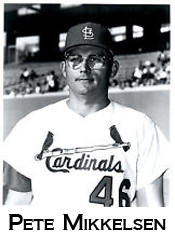
On April 22, 1968, in a trade involving four pitchers, the Cubs sent Mikkelsen and Dave Dowling to the Cardinals for Jack Lamabe and Ron Piche.

Mikkelsen, who was a rookie for the Yankees in 1964 when they played the Cardinals in the World Series, appeared in five games for the 1968 Cardinals, who won the National League pennant and advanced to the World Series against the Tigers.

Though Mikkelsen spent most of the 1968 season with the Cardinals’ minor-league Tulsa Oilers affiliate, it turned around his career. Placed in the starting rotation by Tulsa manager Warren Spahn, Mikkelsen developed an effective palmball, a pitch that helped him return to the major leagues in 1969 with the Dodgers and launched him into a successful rebirth as a reliever.

Turnaround in Tulsa

After posting a 7-4 record with 12 saves for the American League champion Yankees in 1964, Mikkelsen appeared in four games for them against the Cardinals in the World Series. He was the losing pitcher in Game 5, yielding a three-run home run to Tim McCarver in the 10th inning. Boxscore

Traded by the Yankees to the Pirates for pitcher Bob Friend in December 1965, Mikkelsen, a right-hander, made 71 appearances for Pittsburgh in 1966 and was 9-8 with 14 saves. In May 1967, Mikkelsen injured his back in a car accident, lost his effectiveness and was claimed on waivers by the Cubs in August.

Mikkelsen opened the 1968 season as a Cubs reliever, but allowed home runs in each of his first three appearances and fell out of favor with manager Leo Durocher.

When the Cardinals acquired him, they assigned Mikkelsen, 28, to Tulsa. On May 5, he made his first start in three years and pitched a five-hit shutout. After posting a 6-2 record and 1.36 ERA for Tulsa, Mikkelsen was promoted to the Cardinals on June 10, 1968.

Short stay

The Cardinals wanted Mikkelsen for their bullpen. He made his Cardinals debut on June 12, 1968, against the Braves in Atlanta and pitched 1.2 scoreless innings in relief of starter Nelson Briles. Boxscore

Mikkelsen’s most impressive outing for the Cardinals came on June 23, 1968, in the first game of a doubleheader against the Braves at St. Louis. Briles started, faced five batters and was lifted without recording an out. Mikkelsen relieved and pitched eight innings, allowing one unearned run and three hits. He also committed two errors. “The fans cheered derisively for Mikkelsen when he fielded a ball cleanly,” the Post-Dispatch reported. Said Mikkelsen: “I never had been cheered by so many people just for making a catch.” Boxscore

When pitcher Dick Hughes came off the disabled list on June 30, the Cardinals returned Mikkelsen to Tulsa, even though he’d yielded only two earned runs in 16 innings (1.12 ERA).

Championship caliber

Back with the Oilers, Mikkelsen was returned to the starting rotation by Spahn. Using the palmball, Mikkelsen pitched like an ace. “I do not have the greatest fastball and I do not have the great curve,” Mikkelsen told the Los Angeles Times. “I have to have something different … My palmball really started doing things.”

Mikkelsen finished with a 16-4 record and 1.91 ERA for Tulsa. He had three shutouts among his 12 complete games. Tulsa won the Pacific Coast League title and Spahn credited Mikkelsen and outfielder Gary Geiger for supplying leadership, The Sporting News reported.

“Mikkelsen has certainly earned another major-league opportunity,” Spahn said.

In October 1968, the Cardinals traded Mikkelsen to the Dodgers for pitcher Jim Ellis. Two Dodgers right-handed relievers, Mudcat Grant and Jack Billingham, were taken by the Expos in the expansion draft and Mikkelsen was acquired to help fill those gaps.

“God didn’t mean for me to be a star,” Mikkelsen said. “I guess He just meant for me to pitch. I am resigned to that fact now. I thought it wasn’t so a few years ago.”

Mikkelsen spent four years (1969-72) with the Dodgers and was 24-17 with 20 saves. In nine big-league seasons, Mikkelsen was 45-40 with 48 saves.
(Updated April 22, 2020)

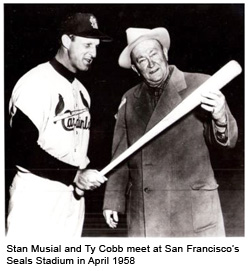
Displaying mutual respect, Ty Cobb and Stan Musial met on the field before the first regular-season game between the Giants and Cardinals in San Francisco.

On April 22, 1958, the Cardinals played at Seals Stadium for the first time since the Giants moved from New York.

Cobb, 71, a resident of Atherton, Calif., went to the game to see Musial, 37, who was in the lineup for his first West Coast regular-season game.

Like Musial, Cobb batted left-handed. Cobb played for 24 years (1905-28) in the American League and retired as baseball’s career hits leader. Cobb and Musial rank first and second all-time in career hits among left-handed batters. The top four in career hits among all batters are switch-hitter Pete Rose (4,256), Cobb (4,189), right-handed Hank Aaron (3,771) and Musial (3,630).

Cobb, dressed in coat and hat and described by the St. Louis Post-Dispatch as “tall and sharp-eyed,” went onto the field during pre-game warmups and chatted with Musial. Their conversation continued in the dugout before Cobb took a seat in the stands to watch the game.

Musial, batting third and playing first base, produced a double and two singles in five at-bats, scored twice and drove in a run. Cobb admired how Musial scored from second on Gene Green’s line-drive single to left.

In comments published by The Sporting News, Cobb said of Musial, “He showed me that his legs are still good. That’s the life of a ballplayer _ his legs. I’ve always contended Joe DiMaggio could have lasted five years longer had he used his legs more in the winter.

“Musial’s speed impressed me,” Cobb said. “Too many long ball hitters today think they’re paid only to hit homers. Musial always hits his share of them, but he also fields and runs the bases. Stan is of the stripe who played in my time. There are too few of them today.”

Drawing a crowd

Musial and his road roommate, Del Ennis, sparked St. Louis to a 7-5 victory in the first Cardinals regular-season game at San Francisco. Ennis, a left fielder who batted cleanup, hit a two-run home run against Giants starter Johnny Antonelli in the first inning and a RBI-single off Al Worthington in the seventh.

The game drew a near sellout crowd of 22,786 to Seals Stadium (capacity 22,900) on a Tuesday night, and many were there to see Musial. “San Franciscans began to line up as early as noon for the 4,000 unreserved seats,” the Post-Dispatch reported. “Approximately 1,000 reportedly were turned away when the general admission and bleacher tickets were exhausted.”

Among retired Cardinals players who visited the clubhouse were Taylor Douthit and Tommy Glaviano. Musial and a former teammate, Hank Sauer of the Giants, posed together for photographers before the game. Both wore uniforms with the No. 6.

“Musial got by far the largest hand of the night when he batted,” the Post-Dispatch reported.

According to the San Francisco Examiner, the fans cheered for Musial “just as lustily as they applauded their own Willie Mays. The crowd enjoyed Musial and gave him repeated ovations, even during batting practice.”

Said Musial: “I never thought I’d play long enough to be in the majors when the big leagues went to the Coast, but it’s quite a thrill. Personally, I’ll miss New York _ wish we could go there, too.”

Opposite field swing

With the wind blowing in from right field to home plate, Musial decided not to try pulling pitches. His singles were hit to center and his double, which produced a run against Mike McCormick, was slashed along the left-field line.

In his book “Stan Musial: The Man’s Own Story,” Musial said of Seals Stadium, “I found that the trade winds made it tough (to bat) for a left-hander … and served as an anchor on drives smashed to right.”

Willie Mays and Orlando Cepeda each had three hits for San Francisco, but the Giants stranded 13 base runners. Boxscore

After winning the series opener, the Cardinals lost the next two games when the Giants came from behind in the ninth innings of both.

In two seasons at Seals Stadium before the Giants moved to Candlestick Park in 1960, Musial batted .294, with 20 hits and 11 walks in 20 games.

Desperate for pitching, the 1943 Athletics turned to Carl Scheib, a 16-year-old with a strong arm. Eleven years later, the 1954 Cardinals, desperate for pitching, took a chance on Scheib, a 27-year-old with a damaged arm.

Scheib finished his major-league career with the Cardinals after a brief, unsuccessful stint with them.

The Cardinals’ pitching in 1954 was so bad they were willing to try just about anything to give the staff a boost. On May 7, 1954, in a creative cash transaction, the Cardinals acquired Scheib from the Athletics on a conditional basis. The Cardinals agreed to give Scheib a look in exchange for a small amount of cash to the Athletics. If the Cardinals kept Scheib for 30 days, they would increase the amount of compensation to the Athletics.

Teen-age wasteland

Scheib, born Jan. 1, 1927, became the youngest player to appear in an American League game when he debuted with the Athletics in the ninth inning of the second game of a doubleheader against the Yankees on Sept. 6, 1943. Boxscore

The 1943 Athletics had the worst pitching staff (4.05 ERA) in the league and the team, managed by Connie Mack, finished in last place at 49-105.

A year later, on June 10, 1944, Joe Nuxhall, 15, became the youngest player to appear in a major-league game when he debuted with the Reds in the ninth inning against the Cardinals.

Scheib pitched for the Athletics from 1943-45 and from 1947-54. His best season was 1948 when he had a 14-8 record and 3.94 ERA with 15 complete games. He also experienced two particularly dreadful seasons in 1950 (3-10 record, 7.22 ERA) and 1951 (1-12, 4.47).

Bargain shopping

When Scheib got to spring training in 1954, it was evident to the Athletics he was experiencing weakness in his right shoulder, according to a biography by the Society for American Baseball Research. After making his final spring training appearance, Scheib didn’t appear in another game for more than a month until given a regular-season start against the White Sox on May 3, 1954. Scheib yielded five runs in two innings and took the loss. Boxscore

Four days later, on May 7, 1954, the Cardinals made the conditional deal to land Scheib.

Cardinals pitchers gave up 34 runs in their last three games prior to acquiring Scheib. The staff would finish the 1954 season with a 4.50 ERA. Their relievers formed the worst bullpen in franchise history.

Cardinals manager Eddie Stanky said Scheib was “the best we could do because we couldn’t get a big-name pitcher without giving up too much playing strength in return.”

Two days after the deal was made, Scheib reported to the Cardinals in Cincinnati and threw pitches to coach Johnny Riddle while Stanky watched. Scheib “showed speed, a sweeping curve and promising knuckler,” the St. Louis Post-Dispatch reported.

Said Reds manager Birdie Tebbetts, a former American League catcher who had faced Scheib often: “Don’t worry about his record. He was with a poor ball club over there. If waivers had been asked on him, I’d have claimed him.”

Short stay

Scheib made his first Cardinals appearance in a start against the Phillies in the second game of a doubleheader on May 16, 1954, at Philadelphia. He struck out the first two batters, but gave up five runs, including back-to-back home runs by Johnny Wyrostek and Del Ennis, in two innings and was the losing pitcher. Boxscore

Cardinals general manager Dick Meyer said catcher Del Rice “didn’t think Scheib was as bad as those five early runs would indicate.”

Scheib was used twice in relief by the Cardinals, pitching two scoreless innings against the Reds on May 22 and yielding a home run to Cubs catcher Joe Garagiola in a stint that lasted two-thirds of an inning on May 24.

By then, the Cardinals decided Scheib wasn’t effective enough to pay additional compensation to the Athletics. On May 27, they returned Scheib to the Athletics. Two days later, the Athletics asked waivers on Scheib for the purpose of giving him an unconditional release.

Unclaimed and free to make his own deal, Scheib signed with the Portland Beavers of the Pacific Coast League. He spent two years (1954-55) with Portland and two more (1956-57) with the San Antonio Missions, managed by future Cardinals coach Joe Schultz, of the Texas League before ending his playing career.

(Updated Aug. 2, 2022)

In a feat that ranks as the St. Louis basketball equivalent of the World Series heroics performed by Cardinals such as Grover Cleveland Alexander, Enos Slaughter, Bob Gibson and David Freese, Bob Pettit lifted the Hawks onto his broad shoulders and carried them to a NBA championship.

On April 12, 1958, Pettit scored 50 points and grabbed 19 rebounds, leading the St. Louis Hawks to a 110-109 victory over the Boston Celtics in Game 6 of the NBA Finals. The triumph was the Hawks’ fourth in the best-of-seven series and gave the franchise its first and only NBA title.
Pettit, a 6-foot-9 power forward in his fourth NBA season, scored 19 of the Hawks’ last 21 points in the championship clincher. His final basket made the difference in the outcome.

Hot ticket

Until the Hawks relocated from Milwaukee to St. Louis in 1955, the baseball Cardinals were the only big-league professional sports franchise in town. There was no NHL team and no NFL team in St. Louis then, and the American League Browns had moved to Baltimore in 1954.

The Hawks reached the NBA Finals against the Celtics in 1957, but Boston won four of seven games. The same teams came back for a rematch in 1958.

The Hawks’ first three victories in the 1958 NBA Finals were by margins of two points (104-102 in Game 1), three points (111-108 in Game 3) and two points (102-100 in Game 5).

Game 6 was played at St. Louis’ Kiel Auditorium and drew 10,216. Police arrested scalpers who offered a $2.50 ticket for $5, the St. Louis Post-Dispatch reported.

The Hawks, coached by Alex Hannum, started a lineup of guards Slater Martin and Jack McMahon, forwards Pettit and Cliff Hagan, and center Ed Macauley, a St. Louis native who’d been a standout at St. Louis University.

The Celtics, coached by Red Auerbach, had guards Bob Cousy and Bill Sharman, forwards Frank Ramsey and Tommy Heinsohn and center Bill Russell.

Down to the wire

In what Harold Flachsbart of the Post-Dispatch described as a “tension-packed playoff battle,” the Hawks relied heavily on Pettit and Hagan (15 points, six rebounds), while the Celtics were led by Sharman (26 points), Heinsohn (23 points) and Cousy (15 points, nine assists).

Pettit, a former Louisiana State University standout, was “uncanny with jump shots, under-the-basket twisters and sometimes drove in for layups with his long legs covering lots of space in spurts of speed,” the Post-Dispatch reported.

Russell, who got into early foul trouble, was limited to 20 minutes of playing time, but he was in the game during the fourth quarter and assigned to guard Pettit.

According to the Post-Dispatch, Pettit “out-jumped, on numerous occasions, Boston’s great defensive star, Bill Russell, who played despite an ankle injury that hobbled him.”

The Hawks never trailed in the final five minutes of the game, but the Celtics got within a point three times in the last two minutes.

With 16 seconds remaining and the Hawks ahead by a point, Pettit tapped in a missed shot by Martin, giving St. Louis a 110-107 lead. Looking to avoid a foul, the Hawks let Sharman score an uncontested layup, narrowing the lead to one with nine seconds left, and Martin ran out the clock with a deft display of dribbling. Boxscore and video

One and done

When the buzzer sounded, ending the game, “the St. Louis players jumped into each other’s arms, received kisses from women spectators and back-pounding from male rooters,” the Post-Dispatch reported. Pettit was carried by teammates into the locker room, according to the Associated Press.

Pettit, who averaged 29.3 points and 17 rebounds a game in the series, said of the triumph, “It wasn’t me _ it was the team. I’m so happy to be with this group.”

(In 1998, on the 40th anniversary of the title, Macauley told Tom Wheatley of the Post-Dispatch, “Bob Pettit may have put on the greatest individual performance in the history of sports.” Pettit said, “It was a talented group, but it was a very, very closely knit group. It was a very unselfish ballclub.”)

The total playoff payout to the champion Hawks was $23,000, according to the Post-Dispatch. The players voted to divide the amount into 11 shares, or $2,289 per share. Hannum and nine players received full shares, and the other share was split between the trainer and two players who were there part of the season.

The championship by the Hawks was the first in a major-league sport for a St. Louis team since 1946 when the Cardinals beat the Red Sox in the World Series.

St. Louis remained a NBA town until 1968, when the Hawks moved to Atlanta, but the franchise never won another NBA championship.

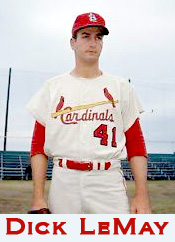
Dick LeMay was a pitcher who impressed Carl Hubbell, earned a complete-game win in his first major-league start against Bob Gibson and was the ace on Cardinals minor-league teams managed by Warren Spahn.

Unlike Hubbell, Gibson and Spahn, who were Hall of Fame pitchers, LeMay was a journeyman. Though he pitched in the big leagues for the Giants and Cubs, LeMay spent a significant portion of his playing career in the Cardinals’ system.

LeMay pitched for Cardinals Class AAA clubs during a five-year period (1964-68) when the major-league team won three National League pennants.

Screwball specialist

A Cincinnati native, LeMay, 19, received an offer to begin his professional career with the Reds, but chose to sign with the Giants as an amateur free agent in 1958 because they offered the most money, a $12,000 signing bonus.

LeMay was toiling in the Giants’ system when, in 1961, Hubbell, the organization’s director of player development, scouted him and filed a favorable report. Like Hubbell, who had been a Giants ace in the 1930s, LeMay was left-handed and threw an effective screwball.

“When I looked at LeMay, I discovered he had a good forkball and screwball, wasn’t too fast, but could consistently get his breaking ball over,” Hubbell told The Sporting News.

Backed by Hubbell’s endorsement, LeMay was promoted to the Giants and he made his major-league debut for them on June 13, 1961, with 2.2 innings of scoreless relief against the Dodgers. After two more scoreless relief stints, LeMay got his first big-league start on June 24, 1961, versus the Cardinals at St. Louis.

The game matched LeMay against Gibson, who was in his third big-league season and starting to emerge as a consistent winner.

LeMay shut out the Cardinals until the ninth, when he yielded a run-scoring single to Carl Warwick. Powered by home runs from Orlando Cepeda (a three-run shot off Gibson) and Willie McCovey, the Giants prevailed, 6-1. LeMay got the complete-game win. Gibson went five innings and gave up five runs. Boxscore

Bob Broeg of the St. Louis Post-Dispatch reported LeMay threw “soft breaking stuff with a big motion, using a screwball and forkball more than he did a fast one.”

Appearing with Cardinals broadcaster Harry Caray on a post-game radio show, LeMay said he hoped Giants manager Al Dark “lets me get back in the bullpen. You get in more games that way.”

Ups and downs

After LeMay was shelled for seven runs in 5.2 innings in a start against the Cardinals on July 8, he returned to the bullpen. He got a win against the Cardinals on July 20, with 3.1 innings in relief of starter Sam Jones. LeMay gave up a bases-loaded double to Bill White in the sixth (two of the runs were charged to Jones), but shut out the Cardinals over the last three innings. With the score tied at 6-6 in the eighth, LeMay sparked a four-run rally against Lindy McDaniel by drawing a walk on five pitches. Boxscore

LeMay posted a 3-6 record with three saves and a 3.56 ERA for the 1961 Giants.

He made nine relief appearances for the 1962 Giants and was 0-1 with a 7.71 ERA. The loss came against the Cardinals on Sept. 20 when LeMay was unable to protect a 4-3 lead in the ninth. Boxscore

Upset by the loss, Dark “knocked a box containing three dozen hardboiled eggs off a table and scattered them about the clubhouse,” the Post-Dispatch reported.

After the 1962 season, the Giants traded LeMay to the Colt .45s. Toward the end of spring training in 1963, the Colt .45s (who later became the Astros) dealt LeMay to the Cubs. The Cubs loaned LeMay to the Atlanta Crackers, a Class AAA affiliate of the Cardinals, and he was 3-3 with a 2.22 ERA for that club before being called up by the Cubs. LeMay made nine appearances, three versus the Cardinals, for the 1963 Cubs and was 0-1 with a 5.28 ERA.

Stuck in minors

The Cubs cut loose LeMay and he signed with the Cardinals, who invited him to their 1964 major-league spring training camp as a non-roster player. When the season began, LeMay was assigned to the Class AAA Jacksonville Suns and he did well for them (12-7 record, 2.81 ERA). The Cardinals rewarded LeMay by placing him on their 40-man big-league winter roster, putting him in the mix to earn a relief job in 1965.

Before the start of spring training in 1965, The Sporting News said of the defending World Series champion Cardinals, “The bullpen shapes up pretty well, with Barney Schultz and Ron Taylor as the bellwethers and such men as Bob Humphreys, Mike Cuellar, Fritz Ackley and Dick LeMay available.”

The Cardinals, however, returned LeMay to Jacksonville for the 1965 season and he again did well (17-11, 3.19) for the Suns.

Though he was excelling at the highest level of their farm system, LeMay wasn’t prominent in the Cardinals’ plans. Left-handers such as Steve Carlton and Larry Jaster surpassed LeMay as premier prospects. LeMay, who turned 28 in 1966, spent that season with the Tulsa Oilers, a Cardinals Class AAA club, and was 14-13 with a 4.35 ERA.

In 1967, Spahn, who retired as the all-time leader in wins among left-handed pitchers, became manager of the Oilers. LeMay was Spahn’s most durable starter in 1967 (13-18, 3.48) and 1968 (16-10, 3.29).

After that, LeMay went back to the Cubs organization, pitched two more seasons at the Class AAA level, retired from playing and managed the Class A Quincy (Ill.) Cubs of the Midwest League in 1971 and 1972.

LeMay pitched in 45 major-league games, nine versus the Cardinals. He was 2-1 with a 5.13 ERA against St. Louis. His overall career mark in the big leagues is 3-8 with a 4.17 ERA.

(Updated Nov. 25, 2019)

Rusty Staub, who did his best hitting versus right-handed pitchers, and Bob Gibson were matched against one another often. Though Staub didn’t hit Gibson as well as he did most right-handers, he had a couple of significant games while facing the Cardinals’ ace.

Staub had more plate appearances (162) and more at-bats (143) versus Gibson than he did against any other pitcher in his major-league career.

A left-handed batter, Staub played 23 seasons in the big leagues, starting in 1963, when he was 19, with the Houston Colt .45s before they were renamed the Astros. An outfielder and first baseman, Staub also played for the Expos, Mets, Tigers and Rangers.

Staub had career totals of 2,716 hits and 1,466 RBI, with a .279 batting average. Against right-handed pitching, he hit .291. Gibson was among the few right-handers who fared well against Staub, limiting him to a .224 batting average, but Staub was a respected adversary, compiling 32 hits, 16 walks and 15 RBI against him.

Cardinals nemesis

In 256 games against the Cardinals, Staub batted .273, with 226 hits, 109 walks and 102 RBI. He hit .300 or better versus the Cardinals every year from 1966 to 1973. Some of his performances against St. Louis were dominant: .484 batting average and 13 RBI in 1966; .328 and 15 RBI in 1967; and .343 and 15 RBI in 1975.

In a November 2019 interview with broadcaster Dan McLaughlin, longtime Cardinals catcher Ted Simmons said, “If Rusty decided he wasn’t going to strike out, you couldn’t strike him out. I mean, it wasn’t a matter of him trying to foul the ball off. He would put an at-bat on you. Every swing was critical.”

Staub was tough on Cardinals right-handers such as Nelson Briles (.384 batting average against) and Ray Washburn (.327), and one of the left-handers he solved was Steve Carlton (.308). Staub had more RBI (25) versus Carlton than he did against any other pitcher. All four of his career home runs off Carlton came while the pitcher was with the Cardinals.

Staub was 20 when he hit his first home run against a Cardinals pitcher, left-hander Curt Simmons, 35, in 1964.

Another longtime Cardinals left-hander, Ray Sadecki, struck out Staub more times (21) than any other major-league pitcher.

Perfect at plate

On May 1, 1968, Gibson pitched 12 innings, yielding seven hits and no earned runs, in a 3-1 Cardinals victory over the Astros at Houston. Staub gave him the most trouble, with four hits and a sacrifice bunt in five plate appearances.

“You can’t trick Staub,” Gibson said to the St. Louis Post-Dispatch.

Said Cardinals center fielder Curt Flood: “Staub has a good, short stride and he seems to know what kind of pitch is coming.”

Staub, batting in the cleanup spot, produced three singles and a double.

Explaining how Gibson relied on fastballs and sliders, Cardinals catcher Johnny Edwards said, “I think Gibby threw two curves all night and the only changeup was the one Rusty Staub hit up the middle (in the fourth) for a single.”

In the Astros’ half of the 11th, with the score tied at 1-1, Jim Wynn drew a leadoff walk. Staub was up next, and even though he was perfect at the plate against Gibson, Astros manager Grady Hatton instructed him to bunt. Staub executed, moving Wynn into scoring position at second base.

After Doug Rader struck out, Cardinals manager Red Schoendienst ordered Gibson to walk John Bateman to get to Denis Menke, a career .184 batter versus Gibson. Menke grounded into a forceout. Boxscore

Sweet swing

Seven years later, on April 23, 1975, Gibson was matched against Mets ace Tom Seaver in a game at New York. Staub was with the Mets then.

In the fifth, with the Cardinals ahead, 1-0, Jack Heidemann singled against Gibson and moved to second on Jerry Grote’s single. With Seaver at the plate, Gibson made a pickoff throw to second baseman Ted Sizemore. Sizemore applied a tag, but umpire Tom Gorman ruled Heidemann safe.

“He never got to the bag,” Sizemore complained.

After Seaver grounded out, Wayne Garrett walked, loading the bases, and Felix Millan hit a two-run double. After an intentional walk to Del Unser, reloading the bases, Staub came up, swung at Gibson’s first pitch, a fastball, and walloped it for a grand slam. The Mets won, 7-1.

“I’ve always said the key to hitting is to have men on base,” Staub said to The White Plains Journal News. “It doesn’t matter who bats behind you in the batting order. It matters only if men are on base in front of you and you can get a pitch to hit.”

Said Gibson: “I was having control problems and when you have control problems you don’t throw the same.” Boxscore

The grand slam was the sixth of nine Staub hit in the big leagues. Two other future Hall of Fame pitchers, Rollie Fingers and Dennis Eckersley, also yielded grand slams to Staub.