Johnny Bench made Johnny Edwards available to the Cardinals and Ted Simmons made him expendable.
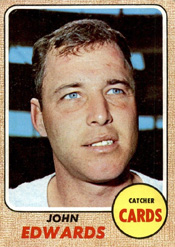 On Feb. 8, 1968, the Cardinals acquired Edwards from the Reds for catcher Pat Corrales and infielder Jimy Williams. The trade was made by general managers Bing Devine of the Cardinals and Bob Howsam of the Reds. When Devine was fired in August 1964, ending his first stint with the Cardinals, Howsam replaced him as Cardinals general manager before departing for the Reds in January 1967.
The deal brought together Edwards and Tim McCarver, giving the Cardinals an all-star catching tandem. Corrales and Williams went on to become big-league managers after their playing careers.
McCarver, the Cardinals’ first-string catcher, was outstanding in 1967. He batted .295, finished second in balloting for the National League Most Valuable Player Award and handled a pitching staff that carried the Cardinals to a World Series championship.
The Cardinals, however, wanted a strong backup who could fill in when McCarver was fulfilling his Army reserve duties one weekend a month and when McCarver needed a rest.
“It’s up to me to prove I can be of some value to them and I’m going to spring training in an optimistic frame of mind, even knowing McCarver is there,” Edwards said to the Dayton Journal-Herald.
Edwards, 29, became available because Bench, a rookie phenom, was ready to take over the starting catcher role for the Reds in 1968. Edwards, who debuted with the Reds in 1961, twice won a Gold Glove Award for fielding excellence (1963-64) and three times was named a National League all-star (1963-65) with the Reds.
He fell out of favor with the Reds when his batting averages dipped substantially in 1966 (.191) and 1967 (.206). Unhappy with being platooned and aware Bench was ready to take over, Edwards publicly requested a trade. “It was a real good deal to get out of Cincinnati,” Edwards said to The Sporting News. “The (management) people in Cincinnati were down on me.”
In joining the Cardinals, Edwards was reunited with Dick Sisler, who was Reds manager in 1965 before becoming Cardinals hitting coach in 1966. “Maybe Sisler can help me with my swing,” Edwards said. “I used to hit to all fields. Then they wanted me to try to pull the ball more.”
Recalling Wally Pipp, the Yankees first baseman who missed a game, was replaced by Lou Gehrig and never got his job back, McCarver said, “Maybe I would be better off with a little more rest, but I don’t want to get Wally Pipped out there.”
On March 10, 1968, in his spring training debut for the Cardinals, Edwards caught 14 innings in a game against the Mets and impressed his teammates.
Edwards quickly contributed to the Cardinals during the regular season. After Edwards produced three hits in a Cardinals victory over the Astros on May 1, outfielder Roger Maris needled McCarver. “I’m sure glad we had a good-hitting catcher in there tonight,” Maris said. Boxscore
A left-handed batter, like McCarver, Edwards hit a two-run home run off Juan Marichal in Bob Gibson’s 3-0 shutout of the Giants on July 6. Boxscore Edwards caught 10 of Gibson’s starts in 1968 and Gibson had a 0.89 ERA in those games, according to baseball-reference.com.
On Sept. 18, Edwards caught Ray Washburn’s no-hitter, the first by a Cardinals pitcher since Lon Warneke in 1941. Boxscore
Edwards appeared in 85 games for the 1968 National League champions, made 52 starts and batted .239.
In the World Series against the Tigers, McCarver started all seven games. Gibson won his first two starts but was the loser in the decisive Game 7. “I feel if I had caught Bob in the World Series, the result would have been different,” Edwards said to the Society for American Baseball Research.
On Oct. 11, 1968, Edwards was traded to the Astros in a deal for pitcher Dave Giusti. Simmons, a first-round draft choice of the Cardinals in 1967, was being groomed to replace McCarver and Edwards no longer was needed.
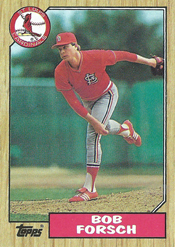 Forsch’s topsy-turvy 1988 was set in motion by the actions of the Cardinals in December 1987. Though Forsch tied for the team lead in wins (11) and also earned a win apiece in the National League Championship Series and World Series in 1987, the Cardinals released him in a cost-cutting move just before Christmas.
 Bailey, a right-handed hitter with power, played 17 years in the major leagues. Primarily a third baseman and left fielder, Bailey played for the Pirates (1962-1966), Dodgers (1967-1968), Expos (1969-1975), Reds (1976-1977) and Red Sox (1977-1978).
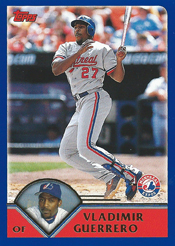 Guerrero was elected to the National Baseball Hall of Fame in 2018. In his playing career with the Expos (1996-2003), Angels (2004-2009), Rangers (2010) and Orioles (2011), Guerrero batted .318 with 2,590 hits, 449 home runs and 1,496 RBI.
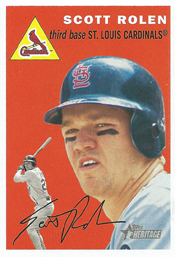 On Jan. 14, 2008, Rolen got his wish when the Cardinals sent him to the Blue Jays for third baseman Troy Glaus.
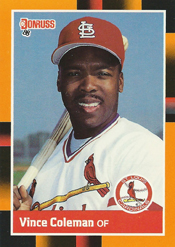 On Jan. 13, 1998, Coleman, 36, was invited to the Cardinals’ spring training camp as a non-roster player, looking to compete for a backup outfield job.
 RetroSimba