Feeds:
Posts
Comments

(Updated Oct. 26, 2024)

The Cardinals thought they were getting a short-inning reliever when they signed free agent Kent Bottenfield. Instead, they got a pitcher who transformed into a starter and eventually became a big winner for them.
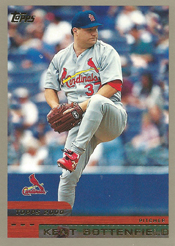
On Jan. 6, 1998, Bottenfield joined the Cardinals after two seasons as a reliever for the Cubs. A right-hander, Bottenfield, 29, received a one-year contract with a club option for 1999.

The Cardinals figured Bottenfield would set up closer Jeff Brantley by pitching the seventh or eighth inning of games, but two months into the season, with their rotation decimated by injuries and ineffectiveness, the Cardinals in desperation gave Bottenfield the chance to start.

A year later, Bottenfield became the Cardinals’ most effective starting pitcher and a National League all-star.

Comeback trail

Utilized as both a starter and a reliever, Bottenfield pitched for three teams _ Expos (1992-1993), Rockies (1993-1994) and Giants (1994) _ in his first three seasons in the major leagues.

He was released by the Giants after the 1994 season and was signed by the Tigers, who sent him to their Class AAA affiliate, the Toledo Mud Hens. Bottenfield spent the 1995 season with Toledo and was 5-11 with a 4.54 ERA.

With his career at a crossroads, Bottenfield, a free agent, was picked up by the Cubs, who placed him with their Class AAA club in Iowa. Bottenfield revived his career, posting a 2.19 ERA in 28 relief appearances for Iowa. The Cubs called up Bottenfield in June 1996 and he pitched well (2.63 ERA) and often (48 games) for them the remainder of the season.

In 1997, Bottenfield made 64 relief appearances for the Cubs and had a 3.86 ERA.

He became a free agent again and received interest from the Cardinals and Astros. When Bottenfield chose St. Louis, Walt Jocketty, the Cardinals’ general manager, declared, “We won the lottery.”

Solid journeyman

Bottenfield appealed to the Cardinals because their veteran right-handed setup man, Mark Petkovsek, had struggled in 1997, posting a 4.78 ERA in 53 relief appearances. Right-handed batters hit .314 against Petkovsek.

Bottenfield had a good spring training for the 1998 Cardinals. “Perhaps this will be one former Cub who actually helps a team win rather than drag it down,” the St. Louis Post-Dispatch noted.

With Brantley on the disabled list for the first week of the regular season, Cardinals manager Tony La Russa turned to Bottenfield to fill in as closer.

On April 4, Bottenfield earned a save with two scoreless innings against the Padres. Boxscore Three days later, on April 7, he got another save against the Rockies, preserving the first big-league win for starter Cliff Politte. Boxscore

“He’s a solid, journeyman reliever,” Cardinals pitching coach Dave Duncan said of Bottenfield. “Most of the time, he’ll do a good job for us.”

Brantley returned from the disabled list on April 9 and Bottenfield went back to a setup role.

Transformer man

A few weeks later, with the Cardinals in need of starting pitching, they turned to Bottenfield, because of his experience in the role, but he was unenthused.

“The first time the Cardinals asked me to start, I said no,” Bottenfield recalled to Stan McNeal of Cardinals Magazine. “I had revitalized my career as a reliever and that was my preference. The next week, they came back and said too bad, they needed a starter.”

On June 4, after Bottenfield made a team-leading 26 relief appearances, he joined the rotation and become the Cardinals’ 12th starting pitcher of the season. Bottenfield hadn’t started a major-league game in four years. His big-league record as a starter was 6-11 with a 5.04 ERA.

“I’m going to have to use all my pitches and mix them up a little better,” Bottenfield said.

In his first Cardinals start, June 5 versus the Giants, Bottenfield lasted three innings and yielded three runs. In his next start, June 10, against the White Sox, Bottenfield pitched five scoreless innings, allowing one hit. Boxscore

“That Kent Bottenfield … would throw one-hit shutout ball for five innings was at least a surprise, if not a shock,” declared the Post-Dispatch.

Bottenfield said to Cardinals Magazine, “Because of Dave (Duncan) and what he taught me, I learned to love starting. The process between starts was something I bought into and enjoyed. On days when I didn’t start, I used to stand beside him in the dugout and ask questions. What turned my career around was gaining the ability to assess hitters, and that came from working with Dave. Being able to read hitters and their swings became a specialty of mine. I’d spend upward of 20 hours between starts watching video of hitters I was about to face.”

On June 18, Bottenfield got his first win as a Cardinals starter, beating the Astros. In 10 starts from July 4 through Aug. 24, Bottenfield was 2-0 and lowered his ERA from 5.31 to 4.51.

“Early on, my goal was to keep us in the game,” Bottenfield said of his starting role. “The more I’ve pitched, my goal has changed, not to necessarily dominate but to try to win some games.”

Key contributor

By August, as Bottenfield established credibility, La Russa and Duncan became convinced he should remain a starter beyond 1998.

“He deserves a lot of credit,” La Russa said. “He’s developed into a starter from a short reliever. He’s built his stamina and he’s very competitive. He routinely gets us into the second half of the game with a chance to win.”

Said Duncan: “The situation being what it has been has created the opportunity for Bottenfield to start. We had no intentions of ever doing that when we got him.”

On Sept. 4, Bottenfield injured his left toe and was sidelined for the rest of the season. His 1998 totals: 4-6 record, 4.44 ERA, four saves in 44 games, including 17 starts. Bottenfield was 1-2 with a 5.50 ERA as a reliever; 3-4 with a 4.08 ERA as a starter.

“He’s shown me enough that he’s a strong candidate to do something important for the club next year,” La Russa said.

Bottenfield told Cardinals Magazine, “Everything that went well for me in 1998 would not have happened had I not been with Dave (Duncan) … I had to do the work, but a guy was there who cared about who I was on and off the field, and he put in the time with me.”

In 1999, Bottenfield developed into an ace. He was 18-7 with a 3.97 ERA in 31 starts and was selected to the all-star team. Bottenfield was second in the National League in winning percentage (.720). He led the 1999 Cardinals in wins (18), starts (31) and strikeouts (124).

On March 23, 2000, the Cardinals traded Bottenfield and second baseman Adam Kennedy to the Angels for center fielder Jim Edmonds.

Bottenfield became head baseball coach at Palm Beach Atlantic University in Florida in 2012, replacing Hall of Fame catcher Gary Carter, who died in February that year.
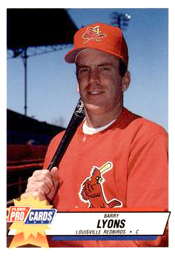
 

Though his reputation as an unwitting villain remained intact in franchise lore, Barry Lyons was welcomed into the Cardinals organization.

On Jan. 4, 1993, the Cardinals signed Lyons, a free agent, and invited him to spring training to compete for a job as backup to Gold Glove catcher Tom Pagnozzi.
Six years earlier, the notion of Lyons joining the Cardinals would have seemed unimaginable to some.

On Easter Sunday, April 19, 1987, Lyons took a place alongside umpire Don Denkinger and other perceived wrongdoers among Cardinals faithful when he barreled into the dugout while pursuing a foul ball and crashed into John Tudor, shattering a bone in the right leg of the St. Louis pitching ace.

Though Tudor returned in August and won eight of nine decisions, helping the Cardinals win the 1987 National League East Division crown on their way to their third pennant in six years, Lyons remained vilified for his role in the injury to one of St. Louis’ best players.

When the Cardinals signed Lyons, Tudor no longer was in the organization. He was a minor-league pitching instructor for the Phillies.

Stocking up

Lyons played in the big leagues for the Mets (1986-1990), Dodgers (1990-1991) and Angels (1991). He spent the 1992 season with the Tucson Toros, Class AAA affiliate of the Astros, and caught for a staff that included future Cardinals pitchers Darryl Kile and Dave Veres.

Rich Gedman, Pagnozzi’s backup with the 1992 Cardinals, became a free agent after the season. The Cardinals signed three veteran catchers _ Lyons, Erik Pappas, and Hector Villanueva _ as contenders to replace Gedman. Villanueva had been released by the Cubs. Pappas, another ex-Cub, had become a free agent after playing in the minor-league systems of the Royals and White Sox in 1992.

Cardinals manager Joe Torre liked Villanueva because he hit 13 home runs for the Cubs in 1991, but all three newcomers were expected to have shots at winning the reserve catcher role in spring training.

“We were looking for somebody to back up our catching situation and Barry Lyons and Erik Pappas are two experienced guys who were out there,” Cardinals general manager Dal Maxvill said to the St. Louis Post-Dispatch in January 1993. “… I know Joe is interested in Hector being the guy because of his home run potential, but Lyons and Pappas give us added insurance we really didn’t have last year.”

Pappas promoted

On March 7, 1993, Villanueva strained a hamstring. Lyons and Pappas each had a productive spring training and stuck with the Cardinals until being sent to Class AAA Louisville when final roster cuts were made on April 3, 1993.

Lyons and Pappas each performed well at Louisville. On April 25, 1993, Lyons hit a three-run home run with two outs in the ninth inning, lifting Louisville to a 6-5 victory over Omaha.

However, when Pagnozzi injured his left knee on May 9, 1993, and needed arthroscopic surgery to repair cartilage damage, the Cardinals called up Pappas rather than Lyons. Pappas was hitting .338 with 13 RBI in 21 games for Louisville. His batting mark with runners in scoring position was .579 (11-for-19).

For the next month, Pappas was the Cardinals’ starting catcher with Villanueva in reserve, while Lyons remained in Louisville.

When Pagnozzi returned to the lineup June 17, 1993, Villanueva was sent to Louisville and Pappas stayed with the Cardinals as the backup catcher.

Left out

With Louisville stocked with catchers, Lyons moved to first base and thrived. He hit .324 in July after being sidelined for 10 days in June because of a thumb injury.

On Aug. 12, 1993, Lyons hit a two-run home run in the ninth, snapping a 4-4 tie and leading Louisville to a 6-4 triumph over Oklahoma City. “With the possibility of getting called up by St. Louis in September, it’s a good time to get hot,” Lyons said to the Louisville Courier-Journal.

Lyons went on to lead the 1993 Louisville Redbirds in home runs (18) and was second on the club in RBI (65). He played in 107 games, including 51 at first base, and batted .269.

However, when major-league rosters expanded in September, Lyons was not promoted to St. Louis. Instead, the Cardinals called up catcher Marc Ronan from Class AA Arkansas. Disappointed, Lyons asked for and was given his release.

Lyons signed with the Reds, spent 1994 in the minors and resurfaced in the major leagues in 1995 with the White Sox.

Previously: A rough and tumble Easter for John Tudor

Previously: Erik Pappas experienced extremes as Cardinals catcher

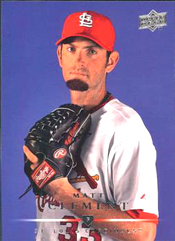
Though he hadn’t pitched in the major leagues since having shoulder surgery, the Cardinals signed Matt Clement with the expectation he would be on their Opening Day roster and ready to contribute as part of their 2008 starting rotation.

On Jan. 3, 2008, the Cardinals signed Clement, a free agent right-hander, to a one-year contract with a club option for 2009. The Cardinals guaranteed Clement, 33, a $1.5 million base salary for 2008 and a spot on their 40-man major-league roster, even though he had sat out the 2007 season while recovering from an operation that reconstructed his right shoulder.
Many hailed the move as a worthy experiment.

Seven months later, it was deemed a failure.

Clement never pitched for the Cardinals. He did walk away, however, with nearly $2 million.

Leap of faith

Clement began his big-league career with the Padres (1998-2000) and also pitched for the Marlins (2001), Cubs (2002-2004) and Red Sox (2005-2006). His best pitches were a heavy sinker and a slider. His best attribute was his reliability. Clement made at least 30 starts in each of seven straight seasons (1999-2005).

His top years were 2003, when he earned 14 wins for the National League Central Division champion Cubs, and 2005, when he was named to the American League all-star team and was 13-6 for the defending World Series champion Red Sox. Overall, though, his career marks were insipid: an 87-86 record and a 4.47 ERA.

In 2006, with his shoulder in tatters, Clement was 5-5 with a 6.61 ERA when the Red Sox sent him for surgery in August. He didn’t pitch in 2007 and he became a free agent after the season.

The Cardinals decided to invest in Clement after he passed a team physical performed by Dr. George Paletta. Cardinals general manager John Mozeliak declared Clement “100 percent healthy” and said he expected the pitcher to be ready by Opening Day, the St. Louis Post-Dispatch reported.

“It just made sense that we take this leap of faith,” Mozeliak said.

Claiming he had interest from other clubs, Clement said he chose the Cardinals because “they stepped up and believed in me right away.”

High hopes

The Cardinals projected Clement would join a 2008 rotation with Adam Wainwright, Joel Pineiro, Braden Looper and Mark Mulder. Like Clement, Mulder underwent shoulder surgery. The Cardinals expected Mulder to be ready in May.

Skeptics scoffed the Cardinals were depending too much on a retread (Pineiro), a converted reliever (Looper) and two pitchers with shredded shoulders (Clement and Mulder).

Mozeliak, however, repeatedly said he was comfortable with the composition of the starting staff as well as with the backups the Cardinals had in Todd Wellemeyer, Brad Thompson and Anthony Reyes. Of Clement, Mozeliak said, “He has high expectations, as do we.”

Bryan Burwell, a Post-Dispatch columnist, called Mozeliak’s move to acquire Clement “a calculated hunch” and a “vastly intriguing trinket to their already burgeoning Island of Misfit Toys.”

In a February Post-Dispatch poll asking “How many games will Matt Clement win this season?,” 46 percent responded 10 to 12, and 24 percent said 13 to 15. Only 6 percent said 0 to 5.

Weak arm

The breezy blather regarding Clement came to a halt as soon as Cardinals pitching coach Dave Duncan got his first look at him in spring training camp at Jupiter, Fla. Duncan determined Clement lacked arm strength. “I will be surprised if he’s ready for Opening Day,” Duncan said.

Duncan put Clement on a program of long tosses rather than throws from the mound. Meanwhile, Pineiro developed an injury and his status for Opening Day was in doubt. With the rotation at risk of unraveling, the Cardinals on March 13, 2008, signed free agent Kyle Lohse and plugged him into a rotation with Wainwright, Looper, Wellemeyer and Thompson.

On March 25, 2008, Clement pitched in a minor-league scrimmage at Jupiter. His fastest pitch was 86 mph. Clement “was not throwing with the strength or control needed to be effective,” the Post-Dispatch reported.

The Cardinals placed Clement on the 15-day disabled list and said he would begin the 2008 season in extended spring training.

Comeback aborted

At the end of May 2008, the Cardinals said Clement would begin a minor-league rehabilitation assignment. Mozeliak said the move “starts the clock” on a return to the majors for Clement.

In a June 3, 2008, start for Class A Palm Beach, Clement pitched six shutout innings. He was advanced to Class AA Springfield and in two starts was 1-0 with a 5.40 ERA.

Clement was moved up to Class AAA Memphis and in his first start for them he gave up six runs in three innings. The Cardinals decided to convert Clement into a reliever. “It seems to be clear it’s going to be difficult for Matt to contribute as a starter,” Mozeliak said.

In 13 games with Memphis, Clement was 1-0 with a 7.02 ERA.

On Aug. 2, 2008, the Cardinals released Clement. “We didn’t feel like he was going to contribute to our major-league team, so we didn’t want him to block our younger guys coming up,” Mozeliak said.

The Cardinals paid Clement the remainder of his $1.5 million salary, plus a $250,000 buyout on his 2009 option, according to the Post-Dispatch. In all, Clement got $1.75 million from the Cardinals.

Because of strong seasons from Lohse (15-6), Wellemeyer (13-9) and Wainwright (11-3), the 2008 Cardinals overcame the failures of Clement and Mulder (who made three appearances for them) and finished 86-76.

“If you want to harangue Mozeliak for taking one gamble that blew up _ spending $1.5 million on rehabbing pitcher Matt Clement _ then go right ahead, but it’s inconsequential” wrote Post-Dispatch columnist Bernie Miklasz. “Mozeliak has moved the Cardinals into a surprising position: that of a contender.”

The Blue Jays signed Clement to a contract in December 2008, but he didn’t stick with them. At 34, his pitching career was finished.

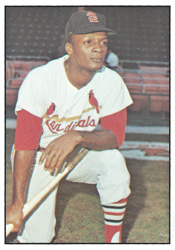
Desperate to fill the cleanup spot in the order with a potent bat, Cardinals rookie manager Red Schoendienst turned to Curt Flood, a player better known for scoring, not driving in, runs.

In 1965, Flood was the Cardinals’ No. 4 hitter in the lineup for most of July. It was the only time in 15 major-league seasons Flood batted cleanup. Flood appeared in the cleanup spot as a defensive replacement or pinch-runner four times in 1958 and once in 1959, but didn’t get any at-bats then.
Schoendienst, in his first season as a manager, chose Flood to bat fourth in 1965 because Ken Boyer, bothered by a bad back, wasn’t producing at his usual level and Bill White had an injured foot. Boyer had opened the 1965 season as the cleanup hitter and White largely had taken over the role in June.

Flood had led the Cardinals in runs scored in 1962 (99) and 1963 (112) and was second in 1964 (97), but he never had produced more than 12 home runs and 70 RBI in a season. He appeared to be better suited for one of the top two spots in the order, not the cleanup position usually filled by sluggers.

Mike Shannon and Tim McCarver could have been options to bat cleanup, but Flood was having a better season than either of them.

Schoendienst was rewarded for his faith in Flood.

In 13 games batting fourth for the 1965 Cardinals, Flood hit .345 (19-for-55) with nine RBI. The Cardinals had a 9-4 record with Flood as their cleanup hitter.

Winning combination

On June 30, 1965, White injured his right heel. The injury “has him moving like television’s Chester (Dennis Weaver’s character from “Gunsmoke”) and Grandpa McCoy (Walter Brennan’s character from “The Real McCoys”),” the St. Louis Post-Dispatch reported.

The next night, the first five batters in the Cardinals’ order against the Pirates were: Phil Gagliano, Dick Groat, Lou Brock, Flood and Boyer. Unimpressed, the Post-Dispatch wrote, “The Cardinals presented one of the lightest 3-4 punches in any batting order, Brock and Flood.”

Flood drove in two runs and the Cardinals won, 7-6. Boxscore

In seven games, from July 1 through July 7, Schoendienst kept the top five in his batting order the same. The Cardinals won six of the seven. Batting cleanup, Flood hit safely in all seven games and produced at least one RBI in four. He delivered hits that drove in the winning runs in consecutive games against the Giants July 5-6.

After July 7, over the next five games, Schoendienst used Boyer, White and Tito Francona in the cleanup role and batted Flood third or first. The Cardinals lost three of the five.

Hitting leader

Flood returned to the No. 4 spot on July 16 and remained there for four consecutive games. Flood had hits in all four games and at least one RBI in two. The Cardinals won three of the four, making their record 9-2 in games with Flood as the cleanup hitter.

On July 20, White batted fourth and the Cardinals beat the Phillies. Flood was back in the cleanup spot for the next two games, July 21-22 against the Astros, and the Cardinals lost both.

For the rest of the season, Flood mostly batted in the No. 2 or No. 3 spots. Boyer went back to being the primary cleanup hitter.

The Cardinals, defending World Series champions, finished in seventh place in the National League at 80-81 in 1965. Boyer finished with 75 RBI and White had 73. Both were traded after the season.

Flood won a Gold Glove Award for his fielding and led the 1965 Cardinals in hits (191), RBI (a career-best 83), batting average (.310) and on-base percentage (.366). He did best from the No. 2 spot, batting .360 in 30 games.

Previously: The day Curt Flood got 8 straight hits against Dodgers

Frank Lary, who mastered the Yankees during his prime with the Tigers, couldn’t beat the Cardinals when he was near the end of his pitching career with the Mets.

In the 1950s and early 1960s, Lary was a durable and consistent winner in the American League.
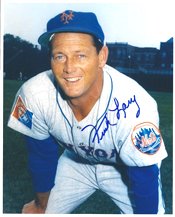
When he got sent by the Tigers to the Mets in May 1964, Lary no longer was an elite pitcher, but he still had the guile and ability to be effective as a starter and in relief.

In two starts for the Mets versus the Cardinals _ one in 1964 and another in 1965 _ Lary was matched against Bob Gibson. Lary was poised to win the first matchup until the Cardinals rallied in the ninth inning. In the second matchup, Lary hit against Gibson better than he pitched against the Cardinals.

A right-hander, Lary pitched 12 years (1954-1965) in the major leagues and posted a career record of 128-116 with a 3.49 ERA. He was 28-13 versus the Yankees, including 7-1 in 1958.

Throwback to Gashouse Gang

Lary led the American League in wins (21) in 1956 and was second (with 23) in 1961. He three times was the AL leader in innings pitched and in complete games. Unafraid to pitch inside, Lary four times led the AL in batters hit by pitch.

“He is a throwback to the Cardinals of the ’30s, a cotton-pickin’, gee-tar-strummin’, red clay Alabama farm boy, unspoiled by a little college and a lot of success,” Sports Illustrated wrote of Lary in 1961. “He is mean on the mound and a joker off it.”

In June 1963, Chuck Dressen replaced Bob Scheffing as Tigers manager. Lary and Dressen clashed. On May 30, 1964, before a game against the White Sox at Detroit, Dressen informed Lary, 34, his contract had been sold to the Mets.

“Dressen was hurting me,” Lary said to The Sporting News. “He gives up on a pitcher too soon.”

The uniform No. 17 Lary wore was inherited by a future Tigers ace, Denny McLain.

On May 31, the day after the trade, Lary arrived at Shea Stadium in New York during the first game of a doubleheader between the Giants and Mets. Lary made his Mets debut in the second game, pitching the sixth and seventh innings and retiring all six batters he faced, including Willie Mays and Orlando Cepeda. The Giants won, 8-6, in 23 innings. Boxscore

Cardinals comeback

Lary made his first career appearance against the Cardinals on July 19, 1964, at St. Louis. The Cardinals scored twice in the first and once in the second. Lary held them scoreless over the next six innings.

At one point, Lary “cheated a bit” on a pitch to Dick Groat, according to the St. Louis Post-Dispatch. Lary delivered a pitch “while standing a couple of feet short of the pitcher’s rubber,” the Post-Dispatch reported. “Third base umpire Chris Pelekoudas spotted the infraction and called it no pitch.”

The Mets took a 6-3 lead into the ninth. The Cardinals sent six batters to the plate against three Mets pitchers and each got a hit.

Carl Warwick, batting for Gibson, led off the ninth against Lary and laced a line drive into the left-field corner for a double. “He threw me a slider that broke over the plate and I was able to pull it,” Warwick said.

Curt Flood followed with his fourth single of the game against Lary.

Willard Hunter relieved and gave up three hits _ singles by Lou Brock and Bill White and a double by Ken Boyer. Each hit drove in a run, tying the score at 6-6.

With White on third, Boyer on second and Groat at the plate, Darrell Sutherland relieved. “I was surprised they didn’t walk me,” Groat said.

Mets manager Casey Stengel said he considered having Sutherland intentionally walk Groat, loading the bases and setting up a force at any base, but instead “I just told him to pitch the way he wanted to.”

With the infield playing in, Groat looped a single over the outstretched glove of second baseman Ron Hunt, scoring White from third and giving the Cardinals a 7-6 victory. Gibson, who struck out 11, got the win. Boxscore

From foe to friend

Seven days later, on July 26, Lary sparked a brawl in a start against the Braves at New York. After Denis Menke led off the game with a home run, Lary hit the next batter, Lee Maye, in the back of the neck with a pitch. Maye yelled, “That’s a lousy thing to do,” and headed toward the mound. Catcher Chris Cannizzaro grabbed Maye before he could reach Lary, but both benches emptied and fights broke out.

“I don’t know what I would have done if Cannizzaro hadn’t grabbed me,” Maye said.

Said Lary: “I was just pitching him inside. Sometimes a ball goes more inside than you want it.” Boxscore

Two weeks later, on Aug. 8, Lary was traded to the Braves.

Encore performance

Near the end of spring training in 1965, the Braves dealt Lary back to the Mets. He made his final Mets appearance on July 2, 1965, in a start against the Cardinals at Shea Stadium.

The Cardinals, who had Phil Gagliano batting leadoff and Curt Flood in the cleanup spot, scored six runs against Lary _ two each in the second, third and sixth. Flood, who batted .714 (5-for-7) in his career against Lary, had a single and a sacrifice fly.

Lary did more good with his bat than his arm. He singled twice and scored twice against Gibson. The Cardinals won, 6-3. Gibson struck out 13, hit a batter and threw a wild pitch. Boxscore

“Gibson’s ball was moving so much he couldn’t control it,” said Cardinals manager Red Schoendienst.

Said Gibson: “I didn’t know where half of the pitches were going.”

Previously: Phil Regan talks Lou Brock, Roger Maris, Al Hrabosky

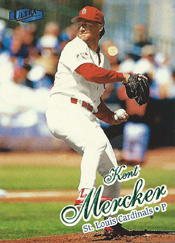
When the Cardinals signed free agent Kent Mercker, they figured him as a candidate for the back end of their starting rotation in 1998. What they didn’t project is that he would be their top winner and most prolific starter.

Seeking a replacement for Andy Benes, who departed to the Diamondbacks after being declared a free agent, the Cardinals signed Mercker on Dec. 16, 1997.

Though he had an 8-11 record with the 1997 Reds, Mercker was in demand as a free agent. He got one-year offers from multiple clubs. The Cardinals gave him a two-year contract for $5.5 million.

The Cardinals envisioned Mercker, 29, joining a rotation of Todd Stottlemyre, Matt Morris, Donovan Osborne and Alan Benes.

Investing in potential

Mercker, a left-hander, debuted in the major leagues with the 1989 Braves. He spent seven seasons (1989-1995) with the Braves and was a reliever for the first five. Used primarily as a starter in 1994, Mercker pitched a no-hitter versus the Dodgers.

In 1996, Mercker pitched for the Orioles and Indians. He joined the Reds in 1997. Two of his eight wins that season were against the Cardinals.

Cardinals general manager Walt Jocketty aggressively pursued Mercker when he became available.

“He’s a guy we feel has a great upside,” Jocketty said to the St. Louis Post-Dispatch. “He wasn’t going to be on the market long and we had to act quickly.”

Said Mercker: “I love St. Louis. I love that team. I’m not just saying that because I’m there. I’ve always loved playing there. The city is loyal. As long as you give an effort, they’re on your side.”

Best of the bunch

Mercker didn’t pitch well in 1998 spring training, but when the season opened he was in the rotation with Stottlemyre, Cliff Politte and Manny Aybar. Morris, Osborne and Alan Benes were sidelined because of injuries. Morris and Osborne returned later in April, but Benes sat out the season.

The 1998 Cardinals had a power-packed lineup with Mark McGwire, Ray Lankford, Ron Gant and Brian Jordan. McGwire hit 70 home runs that season; Lankford, Gant and Jordan each hit 25 or more.

Pitching, however, was a problem. Stottlemyre was traded to the Rangers in July. Morris was limited to seven wins in 17 starts. Osborne had five wins in 14 starts. Aybar (six wins, 14 starts) and Politte (two wins, eight starts) spent part of the year in the minor leagues. The Cardinals eventually moved relievers Mark Petkovsek and Kent Bottenfield into the rotation.

Mercker was the one constant. He was durable, though too often ineffective. Mercker was 8-11 with a 5.40 ERA before winning his last three decisions _ he helped himself by hitting a grand slam against the Marlins on Sept. 2 _ and finishing 11-11.

Left-handed batters hit .316 against him and right-handers, .309.

Still, Mercker led the Cardinals staff in wins (11), starts (29) and innings pitched (161.2). For Mercker, 1998 was the only one of his 18 major-league seasons in which he achieved a double-digit wins total.

In 1999, Mercker was 6-5 with a 5.12 ERA for St. Louis. In August, the Cardinals traded him to the Red Sox for two minor-leaguers, pitcher Mike Matthews and catcher Dave Benham.

Mercker’s two-year totals with the Cardinals: 17-16 with a 5.09 ERA.

Previously: Cardinals pitchers enjoy grand slam streak