Feeds:
Posts
Comments

Roy Sievers, a St. Louis native who began his major-league career with the American League Browns, nearly ended it with the National League Cardinals.
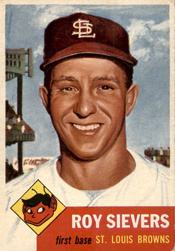
Sievers, a premier slugger in the 1950s with the Browns and Senators, was 38 years old and primarily relegated to pinch-hitting when the Cardinals invited him to spring training in 1965.

Tempted by the offer because of his friendship with Cardinals manager Red Schoendienst, Sievers instead chose to return to the Senators because of their proven faith in him.

Tabbed for power

As a youth, Sievers lived in a house three blocks from Sportsman’s Park, home of the Cardinals and Browns. Both clubs scouted him when he played for the Beaumont High School team. According to the Washington Post, Sievers modeled his swing after Cardinals Gashouse Gang slugger Joe Medwick.

After he graduated, Sievers signed with the Browns because he thought he had a better chance of playing for them than the Cardinals, he told a biographer for the Society for American Baseball Research.

A right-handed batter who played first base and outfield, Sievers won the AL Rookie of the Year Award with the Browns in 1949. He hit .306 with 16 home runs and 91 RBI for the seventh-place team.

After five seasons (1949-53) with the Browns, Sievers was traded to the Senators. Sievers four times produced 100 RBI or more for the Senators. His best season was 1957 when he batted .301 and led the AL in home runs (42) and RBI (114) for the last-place club.

While with the Senators, Sievers was selected by Warner Brothers to be the double for actor Tab Hunter in the 1958 movie “Damn Yankees.” Hunter portrayed slugger Joe Hardy, who, like Sievers, wore uniform No. 2.

“Because Hunter took his close-up cuts from the left side of the plate,” the New York Times reported, “Sievers is shown as a left-handed batter, thanks to mirror-image technology.”

Cardinals foe

Though he never played for the Cardinals, Sievers played against them when he was acquired by the Phillies. As the Phillies’ first baseman, Sievers had three home runs and nine RBI versus the Cardinals in 1962 and one home run and 10 RBI versus them in 1963.

Sievers was the Phillies’ Opening Day first baseman in 1964, but a month later John Herrnstein took over and Sievers was benched.

Hobbled by a calf injury, Sievers was batting .183 with four home runs when the Phillies sold his contract to the Senators on July 16, 1964. Sievers was grateful to Senators general manger George Selkirk for taking a chance on him and returning him to Washington.

Used primarily as a pinch-hitter, Sievers batted .172 with four home runs for the 1964 Senators and was released after the season.

Sorry, St. Louis

The Cardinals, who overtook the Phillies to clinch the 1964 NL pennant and defeated the Yankees in the World Series, were seeking a right-handed batter for a role as a pinch-hitter for 1965.

Sievers, a free agent, was interested in filling the role, according to The Sporting News, but wanted a contract and a spot on the roster.

Cardinals general manager Bob Howsam declined to offer Sievers a contract but did invite him to go to spring training and try to earn a roster spot. When the Senators made Sievers the same offer, he accepted, turning down a chance to play for the reigning World Series champions in his hometown.

“I felt I owed it to George Selkirk to go to Florida with the Senators,” Sievers said. “They picked me up when the Phillies let me go last year. They knew I had a bad leg at the time, but still paid $25,000 to get me.”

Sievers told the St. Louis Post-Dispatch he would have gone to the Cardinals if they had signed him to a contract before spring training.

“The Cardinals have the best-balanced team in the National League,” Sievers said. “They just need some right-handed punch on the bench.”

End of the line

Sievers played well enough in spring training to earn a contract and a spot as a backup to first baseman Bob Chance on the Opening Day roster of the 1965 Senators. Sievers got into 12 games, batted .190 and was released in May 1965.

Returning home to St. Louis, Sievers worked out with the Cardinals on June 8, but he was just trying “to keep in trim,” the Post-Dispatch reported. About a week later, Sievers got a tryout with the White Sox but wasn’t signed.

In 17 big-league seasons, Sievers produced 1,703 hits, 318 home runs and 1,147 RBI.

In November 1965, Sievers was hired by the Reds to be a coach on the staff of manager Don Heffner. Like Sievers, Heffner had played for the Browns. Bill DeWitt Sr., Reds president, had been owner and general manager of the Browns.

Rob Sievers, Roy’s son, played baseball for Hazelwood High School in Florissant, Mo., and was selected by the Cardinals in the sixth round of the 1970 amateur draft. Rob Sievers played two years in the Cardinals’ system, primarily as a third baseman and first baseman.
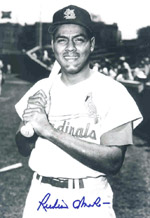
Desperate for a quality shortstop, the Cardinals turned to Ruben Amaro and gave him his first opportunity to play in the major leagues. Amaro fielded splendidly but didn’t hit well enough and the Cardinals quickly gave up on him.

Amaro played one season for the Cardinals. Traded to the Phillies after the 1958 season, he went on to have a long career as a player, coach and scout.
Though Amaro’s time with the Cardinals was relatively short, it covered a lot of ground, beginning in Mexico and ending in Japan.

Career choice

Born in Mexico in 1936, Amaro was the son of Santos Amaro, a powerful hitter who played baseball in Cuba in winter and in Mexico in summer.

As a teen-ager, Ruben Amaro caught the attention of the Cardinals when he played for the Mexican team in the Central American Games. The Cardinals offered him a contract in 1954.

At the time, Amaro, 18, was considering a career in engineering and his older brother, Mario, wanted to be a doctor, the St. Louis Post-Dispatch reported. Amaro saw baseball as a way to help pay for his brother’s education.

“All the time my father played baseball, he didn’t make much money,” Amaro told Jack Rice of the Post-Dispatch. “Maybe I can. I play baseball, Mario goes to medical school.”

The Cardinals sent Amaro to their Class C team in Mexicali, a city situated on the border of Mexico and the United States. Amaro played two seasons for the Mexicali Eagles, batting .285 in 1954 and .305 with 18 home runs in 1955.

Racial prejudice

Promoted to Class AA Houston in 1956, Amaro “arrived with the reputation of being one of the finest fielders in baseball. Possessing a great arm, sure hands and fine speed, Amaro has not disappointed,” The Sporting News reported.

Playing shortstop, Amaro batted .266 with 64 RBI in 1956.

The Cardinals assigned him to Houston again in 1957. When the club went to Shreveport, La., for a series in May, Amaro wasn’t allowed to play “because of the Louisiana racial law,” The Sporting News reported.

Humiliated, Amaro considered quitting but stuck with it after a talk with his father, according to a biography by the Society for American Baseball Research.

Climbing the ladder

Houston won the 1957 Texas League championship and faced Atlanta, the Southern Association champion, in the Dixie Series.

Though Amaro hit .222 during the season, he provided the key hit in the Dixie Series. His two-run home run off Don Nottebart in the seventh inning lifted Houston to a 3-1 series-clinching victory in Game 6.

In 1958, Amaro was assigned to the Class AAA Rochester Red Wings. St. Louis that season primarily started Eddie Kasko at shortstop. In July, when Kasko’s batting average dropped to .195, the Cardinals benched him and called up Amaro, even though he was batting .200 for Rochester.

Stan lends a hand

Amaro got to St. Louis on July 15 and was named a starter by manager Fred Hutchinson for that night’s game against the Braves. “His name was in the lineup card as soon as his foot was in the door,” the Post-Dispatch reported.

The newspaper cautioned that Amaro “is well known to the Cards as a strong fielder but a weak hitter. His batting is the sorrow of his father, Santos Amaro.”

Sports editor Bob Broeg suggested Amaro’s arrival to play shortstop “provides just another chapter in the club’s almost constant trouble at the key defensive position.” With the exception of Marty Marion in the 1940s, the Cardinals “rarely have known satisfaction at a post which ranks second to none in defensive importance,” Broeg wrote.

In his book “Stan Musial: An American Life,” author George Vecsey said the Cardinals issued Amaro a pair of uniform pants at least two sizes too big. When Musial saw the rookie looking awkward in the baggy uniform, he said to clubhouse attendant Butch Yatkeman, “Would you get this young man a pair of pants so he can play like a major leaguer?”

When Amaro stepped onto the Busch Stadium field for the first time, he timidly watched the Cardinals take batting practice. Musial called out to the players, “He’s playing today. Let him have some swings.”

Amaro was forever grateful to Musial for his kindness.

Good glove

At shortstop that night, Amaro went hitless in two at-bats against the Braves’ Joey Jay before being lifted for pinch-hitter Wally Moon, but his fielding impressed.

“After two easy fielding chances, his third was a hard-hit ball that made him range far toward third base and deeply,” the Post-Dispatch observed. “It is a testing place for a shortstop’s arm and he met the test well.” Boxscore

The next night, Amaro got his first big-league hit, a double off future Hall of Famer Warren Spahn. Boxscore

Amaro produced six hits in his first 18 at-bats (a .333 batting average) for the Cardinals, but struggled after that.

In 40 games, including 21 starts at shortstop, Amaro batted .224 for the 1958 Cardinals. He hit .364 (8-for-22) against left-handed pitchers and .167 (9-for-54) versus right-handers.

Strong resume

After the 1958 season, Amaro took part in a series of exhibition games the Cardinals played on a goodwill tour of Japan.

When the club returned home, Amaro was dealt to the Phillies for outfielder Chuck Essegian on Dec. 3, 1958. “I cried when they traded me,” Amaro said.

After a season in the minors, Amaro played for the Phillies from 1960-65. He won a NL Gold Glove Award in 1964. Amaro also played for the Yankees (1966-68) and Angels (1969).

After his playing career, Amaro was a scout, minor-league manager, executive and big-league coach.

His son, Ruben Amaro Jr., a Stanford University graduate, played in the big leagues for eight years (1991-98) as an outfielder with the Angels, Phillies and Indians. He was general manager of the Phillies from 2009-2015.

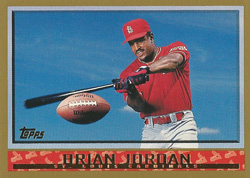
The Cardinals hoped Brian Jordan would spend the 1992 season in the minor leagues and get the at-bats he needed to continue his development as a baseball player. Instead, two games into their season, the Cardinals promoted Jordan and put him into their everyday lineup as the right fielder.

On April 8, 1992, Jordan made his big-league debut and drove in four runs for the Cardinals against the Mets at St. Louis.
Three months later, an overmatched Jordan would be back in the minor leagues.

However, his early-season experience with the 1992 Cardinals wasn’t for naught. Jordan proved he had the potential to succeed in the big leagues. That spurred him to make a fulltime commitment to baseball and end his professional football career.

Getting close

Jordan was selected by the Cardinals as a supplemental pick between the first and second rounds of the June 1988 amateur baseball draft. He split his time in 1989, 1990 and 1991 playing baseball in the Cardinals’ minor-league system and playing football as a defensive back for the NFL Falcons.

In 1991, Jordan batted .264 in 61 games for Class AAA Louisville. When he reported to spring training in 1992, Jordan was hoping to earn a spot on the Cardinals’ Opening Day roster, even though he still was considering playing football for the Falcons that year.

Jordan had a good Grapefruit League season, batting .292 with seven RBI, but with St. Louis planning to go with a starting outfield of Pedro Guerrero in left, Ray Lankford in center and Felix Jose in right, it was determined Jordan should play every day in Louisville.

On April 1, 1992, Cardinals manager Joe Torre told Jordan, 25, he wouldn’t make the Opening Day roster.

“He took it all right,” Torre said to the St. Louis Post-Dispatch. “I told him, ‘You’re really close. You could make the team, but you couldn’t play and we want you to play, to get some at-bats.’ I think he understood. He shook my hand and thanked me for the opportunity.”

Said Cardinals general manager Dal Maxvill: “He’s got an awful lot of confidence. He’s not afraid of anything. You’ve seen him fooled, taking one-hand swings _ and that’s an adjustment he’ll have to make. He knows he has to play every day. If he stayed here, he’d be sitting and that wouldn’t help his development at all.”

Call for help

Five days later, on April 6, 1992, the Cardinals opened the regular season at home against the Mets. Milt Thompson started in right field instead of Jose, who had strained his right hamstring.

The next night, Cardinals first baseman Andres Galarraga broke his right wrist when hit by a pitch from Wally Whitehurst.

With Jose and Galarraga headed for the disabled list, the Cardinals reversed course and called up Jordan. He arrived in St. Louis the morning of April 8 and was put in the lineup for that night’s game against the Mets.

Torre shifted Guerrero from left field to first base and inserted Bernard Gilkey in left field and Jordan in right.

“Jordan is going to contribute a lot and fill in well in the outfield,” said Cardinals third baseman Todd Zeile.

Good game

Torre placed Jordan in the fifth spot in the batting order, behind Guerrero and in front of Gilkey.

In his first big-league at-bat, in the first inning against Sid Fernandez, Jordan struck out on a 2-and-2 fastball.

Two innings later, facing Paul Gibson, Jordan stroked a two-run single off the glove of third baseman Bill Pecota and swiped second.

After Gibson struck him out in the fifth, Jordan contributed a RBI-double off Mark Dewey in the sixth and a RBI-groundout in the eighth. The Cardinals won, 15-7. Boxscore

Learning curve

Torre kept Jordan in the lineup, even though the rookie batted .197 (15-for-76) in April. When Jose came off the disabled list, Jordan got starts in left and center.

After batting .281 (16-for-57) in May, the Cardinals in June gave Jordan a $2.3 million three-year contract, with the stipulation he quit playing football.

After agreeing to the deal, Jordan went into a slump and began to press. It didn’t help that Falcons coach Jerry Glanville kept calling Jordan, trying to convince him to come back to football, according to the Post-Dispatch.

On July 12, the Cardinals returned Jordan to Louisville. He was batting .207 for St. Louis and he had more strikeouts (48) than hits (40).

“He didn’t take it very well,” Torre said of Jordan’s reaction to the demotion. “He was unhappy and mad, but he wasn’t disrespectful. He’s young. He’s impatient … He’s torn and distracted and he has to get himself back on track and get his confidence back. He’s not the same aggressive player we had earlier in the year.”

After several stops and starts, Jordan established himself as the Cardinals’ everyday right fielder in 1995.

In seven years (1992-98) with St. Louis, Jordan batted .291, with 671 hits in 643 games. He became a free agent after the 1998 season and signed with the Braves.


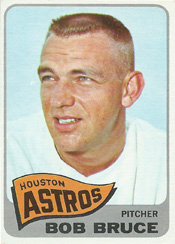
Over a two-year period, when he lost far more than he won, Astros pitcher Bob Bruce prevailed in a series of duels with Cardinals ace Bob Gibson.

Bruce was 9-18 in 1965 and 3-13 in 1966 for a combined record of 12-31. Gibson was 20-12 in 1965 and 21-12 in 1966 for a combined record of 41-24. Yet, in the four starts pairing Bruce against Gibson in those two seasons, Bruce was 3-1 with a 1.69 ERA.
In nine years (1959-67) in the majors, primarily with losing Houston clubs, Bruce was 49-71 with a 3.85 ERA. Against the Cardinals, the right-hander was 4-8 with a 2.45 ERA in 20 appearances, including 14 starts.

In a relief appearance versus the Cardinals on April 19, 1964, at Houston, Bruce became the 12th major-league pitcher to strike out three batters on nine pitches, according to the Houston Chronicle. Bruce achieved the feat in the eighth inning, striking out Bill White, Charlie James and Ken Boyer on an assortment of off-speed pitches. In the ninth, after yielding a single to Johnny Lewis, Bruce struck out the side. Boxscore

Tim McCarver, Cardinals catcher, said Bruce was a right-handed version of St. Louis left-hander Curt Simmons.

“Bruce is rough on left-handed batters with his slow stuff,” McCarver said to the St. Louis Post-Dispatch. “He has a good motion like Simmons. He keeps the ball down. He keeps you honest with fastballs on the hands.”

Another Cardinal, Phil Gagliano, said, “Bruce never gives you anything good to hit.”

Though he started multiple games against Cardinals pitchers such as Ernie Broglio, Ray Sadecki and Ray Washburn, the St. Louis opponent Bruce faced the most was Gibson.

Hot stuff

Pitching for the Houston Colt .45s in their first season in the National League, Bruce was paired against Gibson for the first time on July 22, 1962. The Cardinals won, 3-1, on a sweltering Sunday afternoon at Colt Stadium.

With the temperature in the upper 90s, Bruce pitched seven innings, giving up all three runs in the second. Gibson contributed a two-out, RBI-single.

Relying primarily on fastballs and working on three days of rest, Gibson pitched 8.2 innings for the win.

Lindy McDaniel earned the save by getting Billy Goodman to ground out with runners on second and third, two outs, in the ninth.

“I wanted a breaking ball on Goodman and Gibson didn’t have enough left,” Cardinals manager Johnny Keane told the Post-Dispatch when asked why he lifted Gibson. Boxscore

Bruce and Gibson would not be paired against one another as starters for three years. Then Bruce began his stretch of winning three of four against Gibson.

Here’s a look at those games:

Surprise slugger

Bruce held the Cardinals to two runs in eight innings and got the win in a 5-2 Astros victory at St. Louis on June 4, 1965.

Gibson was burned by home runs from a pair of players who were physical opposites. In the sixth, Walt Bond, a 6-foot-7 outfielder, hit a two-run home run into the teeth of a wind blowing in from right field. With two outs in the ninth, Ron Brand, a 5-foot-7 catcher, hit a three-run home run, snapping a 2-2 tie. It was the second of three home runs Brand would hit in an eight-year career in the majors.

Brand had hit Gibson’s first pitch of the at-bat deep but foul. The home run came with the count 1-and-2. “That first pitch was surprise enough,” Brand said. “I hardly ever hit a ball that hard. I never hit two like that in one inning.”

The Cardinals had eight singles off Bruce until McCarver led off the bottom of the ninth with a double. Jim Owens relieved and retired the next three batters, preserving the win for Bruce. Boxscore

Home sweet dome

Bruce pitched a six-hit shutout in a 2-0 victory over the Cardinals at the Astrodome on July 21, 1965. All the St. Louis hits were singles.

Gibson yielded four hits in seven innings, though he injured the little finger on his right hand reaching for a hard grounder by Joe Morgan in the fifth.

With the finger swollen and painful _ the injury later was diagnosed as a torn capsule joint _ Gibson remained in the scoreless game.

Bob Lillis, a former Cardinals infielder, broke the tie that inning with a two-run double, a pop fly to right-center that barely eluded center fielder Curt Flood. “I was a step behind the ball and I might as well have been a day late,” Flood said.

Bruce, described by the Post-Dispatch as “no Humpty Dumpty,” preserved the win by getting McCarver to fly out with two on and two outs in the ninth. Boxscore

Solid Goldfinger

Though his injured finger remained swollen, Gibson limited the Astros to four singles in a 3-1 victory at St. Louis on Aug. 5, 1965.

Gibson, who greeted well-wishers by extending his left hand, said, “The finger doesn’t bother me so much when I throw a fastball, but it really smarts when I throw curves. I bunch the fingers to throw curves and the little finger presses against the next finger on curves.”

McCarver drove in two of the three runs off Bruce without a hit. McCarver hit a sacrifice fly in the fourth and his hard groundout to first in the sixth scored Flood from third.

“I’d like to be able to pitch like Gibson _ even with a sore finger,” Bruce said. Boxscore

Eyeing a win

In his final matchup against Gibson, Bruce held the Cardinals to two hits in eight innings in a 6-1 victory at St. Louis on July 8, 1966. Gibson was lifted after surrendering four runs and eight hits in 4.1 innings.

Bruce entered the game with a record of 1-6 and a 5.98 ERA. An infection in his right eye that threatened his sight had kept him from pitching from April 20 until June 5. After beating Gibson and the Cardinals, Bruce told the Post-Dispatch he still didn’t have satisfactory vision in the eye. Boxscore


Combining talent with a relentless commitment to learning his craft and creating his own breaks, Dan McLaughlin earned one of the best jobs in baseball, becoming the signature voice of Cardinals telecasts.

McLaughlin, a St. Louis native, began his professional career with KMOX Radio in 1997. Two years later, at 25, he was doing play-by-play of Cardinals road games on TV.

McLaughlin’s annual charity golf tournament in St. Louis has raised millions of dollars for children with disabilities.

On March 23, 2017, McLaughlin consented to an interview with me in Jupiter, Fla. He was gracious with his time and with his insights.

Here is an edited transcript of that tape-recorded interview:

Q.: Of all the major-league broadcasters, you’re the best at interacting with your audience, especially through social media. What made you decide to be so accessible?

McLaughlin: “Two things. One, I felt people didn’t really know who I was. I’m kind of a smart-aleck, like to have fun, definitely don’t take myself too seriously. When I burst on the scene, a young guy, I think the perception was for a long time that I was buttoned up, no personality. That’s the furthest thing from the truth.

“No. 2, I’m involved in a lot of charities in St. Louis, including my own golf tournament, and I thought if I could promote that, maybe get a following on Twitter, maybe I could raise some more money and it would be a good thing.

“Those were the two main reasons I did it. As I got more involved, I found it to be really helpful for what I do. It was great to see the opinions _ good and bad _ of fans. It’s important to get the feel of the fan base.”

Q.: Who were the broadcasters that influenced you?

McLaughlin: “I was making $4 an hour to do producing at KMOX. I would listen to those guys on KMOX intently to see how they got in and out of commercial breaks, or how they were able to build off the anticipation of what might be a big moment.

“Those guys were, in no particular order, Jack Buck, Mike Shannon, Ken Wilson on hockey, Mike Kelly on Mizzou games. Another guy who really helped me was Randy Karraker, who was a talk-show host at KMOX. He gave me a lot of time and listened.

“All those guys, all those experiences, are what shaped what I am today.”

Q.: Can you share a story about something you learned from Jack Buck?

McLaughlin: “Jack Buck was phenomenal to me. One day in the baseball season, it was a Saturday, there was a rain delay in a game between the Cardinals and Dodgers at Busch Stadium. They knew they were going to get the game in, but it was going to be a long rain delay.

“So I get a call from KMOX and I’m told that Mike Shannon has to leave the ballpark and go to his Night at the Races show and can I fill in and work with Jack. Yeah, I’ll be there. I was doing yard work. So I shower real quick, race down to the ballpark.

“The weekend before, in Los Angeles, I had done Cardinals and Dodgers on TV. So I had all these little notes with anecdotes on all these players. I could tell you everything about every player on both sides.

“I walk into the booth and _ (McLaughlin launches into a spot-on impersonation of Buck’s comforting, gravelly growl) _ Jack says, ‘Dan, how are you?’ I said, ‘Mr. Buck, I’m excited. I’m ready to go.’ He said, ‘What are those?’ I said, ‘These are my notes. I am ready.’ He said, ‘Oh, really. Let me see those.’

“He takes them and tears them up into about a thousand pieces and slams them into the trash can. He points at the trash can and says, ‘That’s not the story.’ Then he points at the field, ‘That’s the story. Tell them what you see, kid.’

“He walked out on purpose and left me alone for a few innings to do the game. I’ll never forget it _ the story is on the field. Never forget you’re the eyes and the ears of those who can’t be there.”

Q.: You’re carrying on a Cardinals tradition of broadcaster excellence _ Harry Caray, Joe Garagiola, Jack Buck and others. Do you ever reflect on the importance of that role?

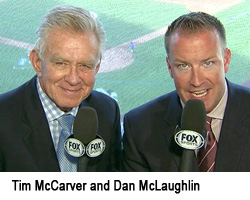
McLaughlin: “It will hit me during a game in the middle of the season. I’m sitting next to Tim McCarver, who has done 24 World Series, and I’m talking about the team I grew up cheering for, in the city I grew up in and love, and it’s like, ‘How did this happen?’
“This is a great responsibility. That’s how I look at it. This is more than a job. This is a responsibility to carry on a legacy and a tradition for these fans. I better bring my A game, at least try to, every single night because they deserve that.”

Q.: What makes Tim McCarver such an outstanding analyst?

McLaughlin: “When his playing days ended, he didn’t just say, ‘I’m a former player.’ It was the close of a chapter in a long book of his life. He wanted to be the best broadcaster he could be. He took that on just like he took on being a catcher for the Cardinals. He looked to advance the story and didn’t just settle for being a former ballplayer.

“In my mind, he’s the best baseball analyst that’s ever lived. It’s not even close.”

Q.: Mike Shannon is the Cardinals radio voice. You’re the Cardinals TV voice. Do you two interact at all?

McLaughlin: “All the time, but especially when I was younger and Mike was on the road more. We had a lot of fun together.

“He always had a place set up to go play golf. We’d play golf almost every morning on the road. Sometimes he’d have Red Schoendienst or Jose Oquendo or a player with him. They treated me like a peer, but I always looked at it like I was an invited guest. I’d just shut up and listen to what they had to say.

“Mike always has been really good to me. Still is. Very kind. He understood the role I was in as a young guy, 23, and that it wasn’t easy. He always made it easy for me.”

Q.: You’re living the dream for a lot of people. What advice do you have for someone hoping to become a major-league broadcaster?

McLaughlin: “If this is what you truly want to do, go for it. My advice, especially for high school and college kids, is write the informational letters, ask for the internship, get involved immediately and get behind a microphone.

“In this business, there are so many people who start out wanting to be behind the microphone and then wind up being behind the camera. Don’t let people say you can’t. If I can do it, anybody can.”

Q.: You’re at the top of your game now. What else would you like to try to do with your career?

McLaughlin: “I’ve had multiple opportunities to leave for different teams, networks, national stuff. This job is the ultimate to me. This is my dream. I’m where I want to be. I would hope this is the last job I’ll ever have because I really don’t have anything else I want to do.

“The Cardinals are great to me. With the platform we have in the community, you can make a difference in a lot of lives. I know that sounds corny, but I get more out of this than I would doing a national game. That doesn’t resonate with me. What resonates is doing the best job I can for this franchise. That’s clearly the most important thing in my professional life. I love it.”

What began as the feel-good story of Cardinals spring training dissolved into a feud between comeback hopeful Andy Van Slyke and manager Tony La Russa.

The rift, just as the 1997 Cardinals were launching into their season, was created by miscommunication, overreaction and ego from both sides.

Van Slyke, who had come out of retirement in a bid to earn a job as a Cardinals utility player, batted .545 in spring training in 1997 before being sidelined by a leg injury. He wanted assurances he would have a spot on the active roster when he healed. The Cardinals refused to make that kind of commitment.

That led to a war of words between Van Slyke and La Russa.

Versatile talent

Plagued by recurring back pain, Van Slyke retired after playing the 1995 season with the Orioles and Phillies.

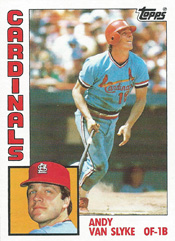
A first-round pick of the Cardinals in the 1979 draft, Van Slyke made his major-league debut with St. Louis in 1983. He played 69 games in the outfield, 30 at third base and nine at first base.

In 1984, Cardinals manager Whitey Herzog again used Van Slyke in the outfield (81 games) and at third base (32 games) and first base (30 games).

Sticking primarily to the outfield, Van Slyke’s best Cardinals seasons were 1985 (25 doubles, 13 home runs, 34 stolen bases) and 1986 (23 doubles, 13 home runs, 21 stolen bases).

On April 1, 1987, the Cardinals traded Van Slyke, catcher Mike LaValliere and pitcher Mike Dunne to the Pirates for catcher Tony Pena. In eight years (1987-94) with the Pirates, Van Slyke won a National League Gold Glove Award five times for his outfield defense and three times was named an all-star.

Comeback candidate

After his retirement, Van Slyke, who continued to reside in St. Louis, spent 1996 as a baseball analyst for ESPN and did a radio show. With his back feeling better, Van Slyke began working out, hoping to play again.

In February 1997, Rick Hummel of the St. Louis Post-Dispatch reported La Russa had invited Van Slyke to Cardinals spring training camp at St. Petersburg, Fla., to compete for a job.

“It’s intriguing,” Van Slyke said. “I’ve always wanted to end my career with a Cardinals uniform on.”

A week later, the Cardinals signed Van Slyke and another utilityman candidate, former Indians slugger Cory Snyder, to minor-league contracts.

Third base training

When Van Slyke, 36, arrived at Cardinals camp, he was given a locker between those of pitcher Dennis Eckersley, 42, and outfielder Willie McGee, 38. “They’re trying to make me feel young,” Van Slyke said.

Cardinals coaches Carney Lansford, an all-star third baseman for La Russa with the Athletics, and Mark DeJohn, a former Tigers infielder, were assigned to work with Van Slyke. The Cardinals wanted to see whether he could be a backup to Gary Gaetti at third base.

“You can’t just take a guy from the outfield and stick him at third base,” Lansford said. “But given the proper amount of time and the right instruction he could have a chance.”

Van Slyke said of playing third base, “I’m better than I was 11 years ago.”

Replied Lansford: “He’s got a long way to go.”

Big bat

What Van Slyke still could do best was hit.

In his first exhibition game, Van Slyke delivered a RBI-single off Reds reliever Jeff Shaw. “That was a professional at-bat, a big-league at-bat,” La Russa gushed.

Van Slyke produced 11 hits in his first 20 at-bats.

“He’s shown that his talent is alive and kicking,” said La Russa.

Said Van Slyke: “My biggest concern was to get a fair shot and I’ve gotten that. Even if I don’t make the team, there will be absolutely no animosity toward Tony or this organization. This organization owes me nothing. I owe the Cardinals and baseball everything.”

On March 22, Van Slyke tore a muscle in his left calf.

Hummel wrote that Van Slyke “would have made the club” if he hadn’t been injured.

Next step

On March 26, needing to set their roster as they prepared to leave Florida, the Cardinals told Van Slyke to remain at training camp and work on getting healthy.

“When I’m ready, there’s only one place I want to play _ and that’s not extended spring training or (Class AAA) Louisville,” Van Slyke said.

La Russa indicated Van Slyke likely would need to accept a minor-league rehabilitation assignment before he could be considered for a spot on the Cardinals’ roster.

“We have to see if he really wants to do this,” La Russa said. “He wants some guarantees, but there are no guarantees in this game. He has to decide if he wants to take his best shot, with no guarantees.”

Go home

On the eve of the Cardinals’ April 1 season opener, Van Slyke, working out in Florida, complained to the Post-Dispatch about his status.

“I’d like to have some communication with (general manager) Walt Jocketty and Tony La Russa,” Van Slyke said. “Communication with this new group is something that needs to be worked on … Right now, a lukewarm response would be great. At least I’d be getting one.”

Van Slyke’s comments irked La Russa, who, after stewing for a couple of days, delivered a salvo.

“That’s just not accurate,” La Russa told Hummel. “I talked to him Wednesday or Thursday before we left (Florida). I think the problem is he’s not hearing what he wants to hear.

“If he wants communication and he needs certainty, he can go home … The Cardinals don’t need to be criticized for handling his situation. He hasn’t had any communication? Well, my communication is to go home. It was all explained to him. If he can’t understand that, then go home. What he said was extremely disappointing. It just shocked me.”

End of the line

With his wife about to deliver a baby, Van Slyke returned to St. Louis and waited. By the end of April, it was clear Van Slyke’s bridges had been burned.

“I don’t think there’s any more interest from their point of view,” Van Slyke said of the Cardinals.

Said La Russa: “There are a lot of things he needs to do before he comes here that he hasn’t shown a willingness to do.”

Van Slyke’s comeback bid had ended.

Previously: How Andy Van Slyke amazed Jose Oquendo