Feeds:
Posts
Comments

(In tribute to Dallas Green, who died March 22, 2017, at 82, I am posting here a story I did that was published in the Dec. 31, 2007, farewell edition of The Cincinnati Post.)

When Lou Piniella was chosen to manage the Reds, the ball club called a press conference at Riverfront Stadium on Nov. 3, 1989.

It was unusual for me, sports editor of The Post, to attend. I usually worked from the newsroom. But I went to the stadium that day.

The Reds were a troubled franchise. Pete Rose, who had managed them since 1984, had been banned from baseball. His interim successor, Tommy Helms, had departed bitterly, saying he never would work for club owner Marge Schott again.

Piniella, who had worked for New York Yankees owner George Steinbrenner, made a strong impression. He spoke convincingly about why the Reds would succeed.

When Piniella finished, I approached Schott. I had been named sports editor in August, a few days before Rose’s banishment, and hadn’t met Schott.

“I’m Mark Tomasik, new sports editor of The Post.”

“Nice to meet you, honey,” Schott said. “I hope you’ll bring some class to The Cincinnati Post.”

From March 1989 to December 1997, I had the privilege of working for The Post, most of that time as its sports editor. It was an era of big personalities and big stories in local sports: Rose, Schott, Piniella, Sam Wyche, Paul Brown, Boomer Esiason, Bob Huggins, Pete Gillen, Rick Pitino and dozens more.

The Post already had a lot of class when I arrived. Our sports section regularly was voted best in Ohio and one of the top 10 in the nation.

The staff talent was deep, diverse. Its best attribute: aggressiveness. Most big breaking-news local sports stories of that era were reported first by The Post.

The newsroom culture was to pursue news hard. So when I came to work at 5:30 the morning of Oct. 18, 1989, and was greeted by a story across Page 1 of the Enquirer headlined, “Dallas Green offered Reds’ manager’s job,” I knew what to expect.

Within minutes, the managing editor was at my door. “We have to have something that matches or advances that story for our Page 1,” he said.

“I don’t have any reporters at this hour,” I replied.

Our Reds reporter was in San Francisco, where that night an earthquake had rocked the Bay Area, led to more than 60 deaths and halted Game 3 of the World Series. I wasn’t going to call at 2:30 a.m. Pacific time and ask him to chase the Green story.

“I’ll take care of it,” I told the managing editor.

The Post had a source list of phone numbers for many of the biggest names in sports. Green, who lived near Philadelphia, was on the list.

Just before 7, with deadline an hour away, I dialed Green’s number. He answered. I identified myself and began to explain the call.

Green responded with a string of profanities, and hung up.

“He’s not talking,” I told the managing editor.

“You’ve got to find a way to get the story,” he said.

I waited 30 minutes.

I dialed again.

“Hello.”

“Please don’t hang up,” I pleaded. “I need your help.”

Green paused. I told him what the Enquirer was reporting and asked him to deny or confirm.

“You want to know why I was so upset when you called earlier?” he said.

“OK.”

“My daughter lives in San Francisco. That mean anything to you? We’ve been trying to contact her all night. We haven’t been able to get through. We’re worried sick. When the phone rang, we were hoping it was her.”

My impression of Dallas Green changed that instant.

“I haven’t been offered the Reds’ job,” he said. “Is that what you need?”

Yes. We printed it. Page 1. All editions.

Two weeks later, Piniella was named manager.

_ _ _

Copyright: Copyright (c) 2007 The Cincinnati Post

Clearly a believer in the Mark Twain adage of “Never let the truth stand in the way of a good story,” Bob Gibson told a terrific tale about the indignity of having Cardinals teammate Dal Maxvill pinch-hit for him. Problem is, it never happened.

Toward the end of an interview published in the March 11, 2017, St. Louis Post-Dispatch, Gibson was asked by Rick Hummel, “Worst experience in baseball?”

The Hall of Fame pitcher responded by spinning a story about the time manager Red Schoendienst called upon Maxvill, the light-hitting shortstop, to bat for Gibson.

“My worst experience in baseball was when Red had Maxvill pinch-hit for me,” Gibson said. “I was so mad. I sat on the bench and Maxie swung and missed a couple of pitches and then he popped up. I walked past Red and said, ‘Don’t ever do that again.’ I took a shower and went home.”

Either Gibson, a noted prankster, was playing a gag on Hummel, or the passage of time clouded the memory of the 81-year-old Cardinals legend.

Don’t blame Dal

The facts: Maxvill was not a successful pinch-hitter, but he never batted for Gibson in either a regular-season or postseason game.

Maxvill made 12 plate appearances as a big-league pinch-hitter, according to the reliable Web site retrosheet.org. He was 0-for-11, with a walk.

Gibson didn’t pitch in any of the 12 games Maxvill appeared as a pinch-hitter.

Maxvill made six pinch-hit appearances _ three in 1962 and three in 1963 _ when Johnny Keane was Cardinals manager. He made two pinch-hit appearances with the 1972 Athletics under manager Dick Williams.

Only four of his 12 pinch-hit appearances took place for the Cardinals when Schoendienst was manager. He had one in 1965, two in 1971 and one with the 1972 Cardinals before he was traded to the Athletics.

No Gibson sub

The four times Schoendienst sent Maxvill to pinch-hit resulted in:

_ Reached on an error as pinch-hitter for pitcher Ray Washburn on June 16, 1965. Boxscore

_ Grounded out to shortstop as pinch-hitter for pitcher Bob Chlupsa on June 4, 1971. Boxscore

_ Walked intentionally as pinch-hitter for pitcher Moe Drabowsky on June 8, 1971. Boxscore

_ Struck out as pinch-hitter for injured shortstop Dwain Anderson on Aug. 15, 1972. Boxscore

Only once did Maxvill pop out as a Cardinals pinch-hitter. That took place in his major-league debut on June 10, 1962, when Maxvill, batting for pitcher Bobby Shantz, hit a pop-up to Giants pitcher Billy O’Dell. Boxscore

This scenario fits

Perhaps Gibson was confusing Maxvill with Dick Schofield.

In 1968, Schofield was Maxvill’s backup at shortstop. Schofield, a .227 career hitter, batted .220 for the 1968 Cardinals.

On April 20, 1968, Schoendienst sent Schofield to bat for Gibson in the ninth inning.

Schofield popped out to third.

Gibson couldn’t have been happy. The Cubs won, 5-1, making Gibson winless in three starts. The Cardinals scored a total of seven runs in those three games.

Though he made 11 pinch-hit appearances for the 1968 Cardinals, Schofield never would bat for Gibson again.

Gibson would go on to have his most magnificent season in 1968, producing a 1.12 ERA and 28 complete games in 34 starts for the National League champions.

Gibson in a pinch

Maxvill has a career .217 batting average; Gibson, .206.

Gibson was more successful than Maxvill as a pinch-hitter.

In 14 career pinch-hit appearances for the Cardinals, Gibson produced three hits, two walks and a sacrifice bunt.

In 13 of those pinch-hit appearances, Gibson batted for a pitcher.

The exception was on May 27, 1966, when Gibson was Schoendienst’s choice to be a pinch-hitter for left fielder Bobby Tolan. Batting with a runner on third, one out and the Cardinals trailing by a run against the Reds, Gibson struck out against reliever Billy McCool. Boxscore

Bill Hands, whose effective starting pitching helped transform the Cubs from losers to contenders under manager Leo Durocher, was a familiar opponent of the Cardinals in the late 1960s and early 1970s. His best performance against the Cardinals came on a day when the behavior of the Wrigley Field Bleacher Bums got out of hand.

Hands pitched 11 seasons (1965-75) in the major leagues and had a career record of 111-110 with a 3.35 ERA.

A right-hander, Hands was best in a three-year stretch for the Cubs when he was 16-10 in 1968, 20-14 in 1969 and 18-15 in 1970.

Against the Cardinals, Hands was 14-12 with a 2.58 ERA in his career. He had more wins (14), innings pitched (205.2) and appearances (38) against the Cardinals than he did versus any other opponent.

After posting losing records in 13 of 14 seasons from 1953-66, the Cubs had 87 wins in 1967 and 84 in 1968. By 1969, they were a threat to the reign of the Cardinals, who had won consecutive National League pennants in 1967 and 1968.

Fired up

On June 28, 1969, the Cubs were in first place in the East Division at 46-26 entering a Saturday game with the Cardinals at Chicago. St. Louis was 35-37, 11 games behind the Cubs. Looking to put a dagger into the Cardinals’ title hopes, the Cubs started Hands against Dave Giusti.

The left field stands at Wrigley Field filled quickly with Cubs fans. Known as Bleacher Bums, the group was whipped into a frenzy by the early-season success of their hometown team and by the sight of the archrival Cardinals.

As Cardinals players appeared in the outfield to shag flies and play catch before the game, “bleacher fans showered the Redbirds players with flashlight batteries, quarters, paper cups, dry ice and other debris in pregame practice,” the St. Louis Post-Dispatch reported.

Cage match

Cardinals center fielder Curt Flood told the Chicago Tribune, “They were throwing steel ball bearings at me. If I turn and catch one in the eye, it’s bye-bye career. I can start carrying a lunch pail to work.”

Cardinals pitcher Mudcat Grant said he was hit in the mouth by a hard rubber ball thrown from the left-field bleachers. Someone also flung a hard hat at him. Teammate Bob Gibson picked up the hard hat and “played the conductor’s role in leading the Bleacher Bums as they jeered the Cardinals with chants,” the Post-Dispatch reported.

According to the Tribune, bleacher fans claimed Grant retaliated by hitting three of them with baseballs he threw into the stands.

“I just lobbed the ball,” Grant said to the Post-Dispatch. “They weren’t lobbing those nails and flashlight batteries and that helmet at me.”

Grant said he “scared” the fans by throwing two baseballs hard against the ivy-covered wall.

“You ought to put a cage over them,” Grant said.

The Bleacher Bums also taunted left fielder Lou Brock, a former Cub, with calls of “bush leaguer.”

“The thing that really bothers me about it is that they are showing you people (reporters) up,” Brock said. “You have glorified them and they show their gratitude by behaving like that. It’s not right.”

Bearing down

Once the game began, Hands became the story. He held the Cardinals to one hit _ a Tim McCarver single _ through five innings.

In the sixth, with the Cubs ahead, 1-0, Flood led off with a single to left. Brock stretched his hitting streak to 13 games with a double into the left-field corner, scoring Flood.

“Both the pitches they hit in that inning were mistakes,” Hands said. “Brock hit a fastball down the middle and Flood got a hanging slider.”

Reminding himself to bear down, Hands struck out Vada Pinson and Joe Torre _ “I got Pinson on a fastball on the corner and Torre missed a slider,” Hands said _ before McCarver flied out.

The Cubs went ahead, 2-1, when Willie Smith hit a home run off Giusti in the bottom half of the inning and they added a run in the seventh.

Hands retired the Cardinals in order in the last three innings, sealing the 3-1 win and finishing with a three-hitter. Boxscore

Koufax impressed

It was the third consecutive complete game pitched by Hands.

“I knew Hands was a good pitcher, but I didn’t know he was that good,” said Sandy Koufax, the retired Dodgers ace who was broadcasting the game for NBC. “He really showed me something today.”

Said Cardinals manager Red Schoendienst: “He threw a good slider about 85 percent of the time to our right-handed batters. He had marvelous control of it _ low and away.”

The loss dropped the Cardinals 12 games behind the Cubs. “They’re far enough behind us that they’ve got to win almost every one of the (13) games left between us,” said Cubs shortstop Don Kessinger.

Though the Cardinals didn’t catch them, the Cubs couldn’t hold onto the division lead. The Mets would finish in first place at 100-62. The Cubs (92-70) placed second and the Cardinals (87-75) were fourth.

Previously: How Mike Shannon put brakes on Cubs title hopes

Prompted by his wife, Cardinals pitcher Dizzy Dean confronted a critic and initiated an argument that escalated into a brawl inside a crowded hotel lobby.

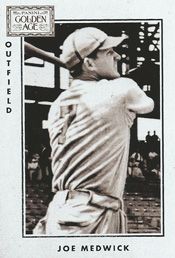
The principals in what became known as the Battle of Tampa were Dean, teammate Joe Medwick and journalists Jack Miley of the New York Daily News and Irv Kupcinet of the Chicago Daily Times.

Though the fisticuffs were real, the biggest blows may have been those that inflicted bruises to the egos of the participants.

The melee occurred on April 2, 1937, at the Tampa Terrace Hotel after the Cardinals lost to the Reds in a spring training game.

The seeds for the showdown were sown about a month earlier.

Money matters

Holding out for a more lucrative contract offer, Dean didn’t report when the 1937 Cardinals opened spring training camp at Daytona Beach, Fla.

Miley, a columnist, scolded the pitcher. According to The Sporting News, he wrote: “For a guy who was picking cotton for 50 cents a day a few years ago, Diz has an amusing idea of his own importance.”

While Dean stayed with his wife Patricia at their house in Bradenton, Fla., during the contract holdout, journalists camped out in the town, hoping for comments from the colorful Cardinals ace.

In “Diz,” a 1992 biography of Dean, author Robert Gregory wrote that when reporters cornered Dizzy and his wife at a post office, seeking an interview, Patricia “cursed them and stomped to the car, honking the horn every few seconds until he joined her.”

When Dizzy later agreed to pose for news photographers, Patricia kept the cameramen waiting five hours before allowing her husband to cooperate.

Miley went on the attack in his column. According to Gregory, Miley called Patricia “a plump, dominating cotton queen” and described Dizzy as a “hen-pecked, fat-between-the-ears sharecropper.”

Dizzy shrugged off such remarks, Gregory said, but Patricia vowed revenge.

War of words

When the Cardinals played the Reds at Tampa, Patricia spotted Miley at the ballpark. After the game, the Cardinals went to the hotel and, still in uniform, gathered in the lobby, awaiting room keys. Most of the Cardinals carried their spikes to keep from tearing up the lobby carpets.

Dizzy and Patricia were the first from the Cardinals group to get a room key. As they entered the elevator, Patricia saw Miley in the lobby _ just as Miley and Kupcinet emerged from the hotel bar, according to Gregory _ and urged her husband to confront the writer.

In the lobby were 18 Cardinals, about 20 other hotel guests and some hotel employees. Dean stepped out of the elevator and approached Miley. Piecing together accounts written by Miley, Gregory, the St. Louis Post-Dispatch and United Press, here is what happened next:

Dizzy: “Is your name Miley?”

Miley: “Yes.”

Dizzy: “I wish you would not write those things about me. You said some terrible things about me.”

As the conversation continued, 10 of Dizzy’s teammates gathered around him.

Dizzy: “You $125-a-month writers make me sick. Don’t you never mention me and my wife in one of them damned columns of yours again.”

Miley: “That’s a pleasure. I hate to write about bush leaguers anyway.”

Dizzy: “Remember what I told you. I warned you. That’s from the horse’s mouth.”

Miley: “I say it’s from a hillbilly horse’s ass. What are you going to do about it?”

Dizzy: “I’ll show you…”

Hit or miss

Kupcinet, a 6-foot, 195-pound former college quarterback at North Dakota, stepped between Dean and the rotund (5 feet 6, 250-pound) Miley.

“Why don’t you pick on somebody your own size,” Kupcinet said to the pitcher.

Dean replied: “Stay out of my way, you New York Jew.”

Dizzy unleashed a wild punch _ “a ladylike left hook,” Miley called it _ that either missed or grazed Miley’s head.

Mike Ryba, a Cardinals pitcher, reached over Dean’s shoulder and swung his spikes, cracking Miley in the forehead and opening a cut above his right eye. The blow knocked Miley to the floor.

As Kupcinet reached for Dean, Medwick landed a crunching punch to Kupcinet’s left cheekbone.

Kupcinet went sprawling into a potted palm tree “that swooshed backward and started a chain reaction, knocking down floor lamps, plants and four other palms,” Gregory wrote.

Dean scampered for cover under an overturned sofa.

As other players moved in on the fallen writers, Mike Gonzalez, a Cardinals coach, stopped the brawl from continuing.

In the Post-Dispatch, J. Roy Stockton wrote of the spectacle, “Cigar girls and bell boys were very much excited, but no serious harm had been done.”

Tough talk

As Dean strutted back to the elevator, he crowed, “There ain’t no doubt about it _ It’s still the Gashouse Gang.”

Kupcinet shouted at Dean: “I’ll fight you any place, any time you want to. Just name it.”

Miley said to Cardinals manager Frankie Frisch: “What’s the matter, Francis, can’t you control those ballplayers of yours?”

Replied Frisch: “No, I can’t.”

Kupcinet told a colleague, “Dean started the whole trouble, but when the fight started he didn’t get in it himself. They’re the Gashouse Gang all right, but they won’t fight unless they know they’ve got the edge on you.”

Post mortem

The Cardinals paid the hotel for the damages, Gregory reported.

Ford Frick, National League president, said he wasn’t inclined to take action because the fight didn’t occur on the baseball field.

Among media reaction:

_ Joe Williams, columnist for the New York World-Telegram, said of Patricia Dean: “There’s a lady for you, chums. I wouldn’t say she is hard-bitten, but Mr. Miley is lucky she wasn’t in there swinging.”

_ The Sporting News editorialized: “There is no defense for ganging up on a man. Only mobs, hysteria-crazed and cowards adopt that method … The Cardinals players who participated in that hotel scene have put themselves in the position of public scorn.”

A week later, Dizzy told the Associated Press he was “sorry” about the incident. “It’s the first time I ever had any trouble with a sports writer and you can take it from ol’ Diz it will be the last time,” he said.

In October 1937, The Sporting News reported, Miley left the New York Daily News “after a disagreement with Jimmy Powers, sports editor.” Miley joined King Features syndicate and then the New York Post.

Dean was traded to the Cubs in 1938. Kupcinet, still with the Chicago Daily Times, and Dean patched their differences, posed for a Page 1 photo and became friends, Gregory said.

In retelling the story, Dean denied he’d been in the fight and blamed Medwick for instigating it. In response, Medwick, in a letter to the Chicago Daily Times, wrote: “Dean’s right in one respect. He wasn’t in the fight once punches started to fly. He usually does a crawfish act when that happens.”

Kupcinet began writing a celebrity gossip column for the Chicago Daily Times in January 1943. It was widely read and he became an influential figure in Chicago. Kupcinet continued writing the column for the Chicago Sun-Times until the week he died at 91 in 2003.

Previously: How Dizzy Dean survived an armed robbery

The first trade made by Stan Musial as general manager brought the Cardinals the infield insurance they needed.

Seeking a player who could fill in for shortstop Dal Maxvill and provide late-inning defensive help at third base for converted outfielder Mike Shannon, Musial turned to a friend, Bing Devine.

Devine, president of the Mets, had been general manager of the Cardinals from 1957 until replaced by Bob Howsam in 1964. Musial succeeded Howsam in January 1967.

On April 1, 1967, the Cardinals acquired infielder Eddie Bressoud, outfielder Danny Napoleon and cash from the Mets for second baseman Jerry Buchek, pitcher Art Mahaffey and infielder Tony Martinez.

Bressoud capped his playing career by earning a World Series ring with the Cardinals.

Roster shuffles

The 1967 Cardinals entered spring training with no reliable backup at shortstop. The options were Buchek, Phil Gagliano and Jimy Williams.

Gagliano had big-league experience, but his best position was second base. Williams was a prospect but had played only 13 games in the majors.

Buchek had been the Opening Day shortstop for the 1966 Cardinals, but his fielding was erratic _ “He just doesn’t cover the ground, field cleanly enough or throw accurately at shortstop,” Bob Broeg wrote in the St. Louis Post-Dispatch _ and by June that year Maxvill regained the starting role.

Buchek seemed best equipped for second base, but the Cardinals had Gagliano to back up starter Julian Javier.

Meanwhile, the 1967 Mets entered spring training with a plan to platoon Bressoud and Chuck Hiller at second base. Bressoud started 110 games for the 1966 Mets: 73 starts at shortstop, 24 at third base, eight at second base and five at first base. “He’s one of the nicest gentlemen you’ll ever meet,” Mets manager Wes Westrum said to The Sporting News. “He’s done everything ever asked of him.”

Devine decided the Mets should have a starter younger than either Bressoud, 34, or Hiller, 32, at second base to pair with shortstop Bud Harrelson, 22.

Buchek, 24, seemed a promising candidate.

Betting on potential

Buchek, a graduate of McKinley High School in St. Louis, received a $65,000 bonus when he signed with the Cardinals as an amateur free agent in 1959. He had a breakout season as starting shortstop for the Cardinals’ Class AAA Atlanta Crackers in 1963, batting .287 with 33 doubles and 92 RBI.

However, in parts of five seasons (1961 and 1963-66) with the Cardinals, Buchek batted .221 and had more strikeouts (158) than hits (127). Devine thought a fresh start with another organization would help Buchek and he knew the Cardinals needed a player like Bressoud.

Bressoud debuted in the big leagues as a shortstop with the 1956 Giants and formed a keystone combination with their second baseman, Red Schoendienst. Two years later, in 1958, Bressoud’s wife Eleanor, 25, died of a brain tumor, leaving him with two sons ages 2 and 3. A year later, Bressoud remarried.

During the baseball off-seasons, Bressoud pursued his education. He earned a bachelor’s degree from UCLA and a master’s in physical education from San Jose State. He supplemented his income by teaching at high schools in the winter.

Acquired by the Red Sox in November 1961, Bressoud hit 40 doubles and 14 home runs for Boston in 1962, 20 home runs in 1963 and 41 doubles and 15 home runs in his lone all-star season, 1964.

With the 1966 Mets, Bressoud batted .225 in 133 games.

New homes

During a March 30, 1967, spring training game between the Mets and Cardinals, Musial and Devine sat together and discussed their rosters. Two days later, the trade was announced.

“Bressoud has a good arm and he gets rid of the ball well. He’s what we really needed, a proven utilityman who can fill in for Maxvill,” said Schoendienst, the Cardinals’ manager.

Buchek, happy to get a chance to be a Mets starter, said, “It would have been another wasted year with the Cardinals.”

With Maxvill providing steady play at shortstop and Shannon driving in runs as the third baseman, Bressoud didn’t play often for the 1967 Cardinals. He went hitless in his first 23 at-bats before getting a single off the Astros’ Larry Dierker.

“It’s been tough,” Bressoud said. “You replay every at-bat. You go home and punish yourself. You try to put up a false front, but if something like this doesn’t bother you, you don’t belong in the game.”

Bressoud hit his only Cardinals home run on Aug. 9 against Don Drysdale of the Dodgers.

Mostly, though, Bressoud served as a sort of player-coach.

“Eddie had some good ideas for me on playing shortstop _ and for playing second base, too,” Maxvill said. “Eddie knew how to play certain hitters and he had me make adjustments.”

Said Cardinals pitcher Bob Gibson: “Eddie Bressoud has a good arm and he’s quick. He gets in front of a lot of balls that other infielders don’t even get to, but he’s not sharp enough at times because he doesn’t play enough.”

Bressoud played in 52 regular-season games, making 18 starts at shortstop, for the 1967 Cardinals and batted .134 (9-for-67). He appeared in two World Series games as a defensive replacement.

In the book “The Original San Francisco Giants,” Bressoud said, ‘Even though I enjoy wearing my World Series championship ring, I don’t think of myself particularly as a Cardinal when I look back on my career.”

After the World Series, Bressoud retired as a player and became head baseball coach at De Anza College in Cupertino, Calif. He also was a scout for the Angels.

Previously: Mike Shannon and the spring training intrigue of 1967

In his spring training stint with the Cardinals, Mike Caldwell appeared to be a pitcher whose career was in decline. Shelled early and often, Caldwell showed no signs of developing into what he would become: a 20-game winner who would torment the Cardinals in the World Series.

Caldwell’s five-month stint as a Cardinal is a tale of a late bloomer who was in the wrong organization at the wrong time.

In March 1977, Caldwell, 28, was considered a leading candidate to fill a role in the Cardinals’ bullpen. Instead, he was traded before he got a chance to appear in a regular-season game for St. Louis.

Giant troubles

Caldwell, a left-hander, made his major-league debut with the 1971 Padres. He had a 13-25 record in three seasons with the Padres before he was traded to the Giants for slugger Willie McCovey.

In 1974, his first year with the Giants, Caldwell had a breakout season, posting a 14-5 record and 2.95 ERA.

After the season, Caldwell had surgery to remove bone spurs in his left elbow. When he returned, he struggled. “I lost some movement on my best pitch, the sinker, and I tightened up some and came sidearm at times,” Caldwell told the St. Louis Post-Dispatch.

By 1976, Caldwell was having troubles in the Giants clubhouse as well as on the mound. “I didn’t get along with a couple of the coaches and they took it personally,” Caldwell said.

The Giants’ pitching coach was the former catcher, Buck Rodgers.

Caldwell reached a low point on April 28, 1976, when Doug Clarey hit a home run, the lone hit of his big-league career, against him in the 16th inning, lifting the Cardinals to a 4-2 victory.

Caldwell finished 1-7 with a 4.86 ERA for the 1976 Giants. “I lost my confidence, tried too hard _ overthrew, I guess you’d say _ and I didn’t do very well,” Caldwell said.

Hope rekindled

On Oct. 26, 1976, the Giants traded Caldwell, pitcher John D’Acquisto and catcher Dave Rader to the Cardinals for pitcher John Curtis, outfielder Willie Crawford and utility player Vic Harris.

“I’m just glad to get away from a bad situation,” Caldwell said of leaving the Giants.

The Cardinals slotted Caldwell for the bullpen. “It’s common knowledge that the problem with the Cardinals last year was that middle relief and late relief, except for Al Hrabosky, couldn’t get the other clubs out,” said St. Louis manager Vern Rapp.

Said Caldwell: “I have no illusions. I’ve got to prove I’m good enough to make the staff.”

Bad audition

On March 12, in the Cardinals’ 1977 spring training opener against the Mets, Caldwell pitched two innings and gave up four runs. Three days later, Caldwell pitched an inning against the Dodgers and yielded three runs.

The Cardinals didn’t pitch him much after that.

On March 29, 1977, the Cardinals traded Caldwell to the Reds for pitcher Pat Darcy. In eight spring training innings, Caldwell yielded nine earned runs.

“Rapp called me in and told me, ‘Don’t get mad. You’re going to a contender,’ ” Caldwell said. “I wasn’t mad about that. I just thought he should’ve had some respect for me as a pitcher. That’s all I wanted: Throw me out there to see what I can do.”

Right fit

The Reds weren’t too impressed with Caldwell either. Three months after they acquired him, the Reds dealt Caldwell to the Brewers.

In 1978, Caldwell got a break when the Brewers named George Bamberger their manager. Under Bamberger, who had been a pitching coach for the Orioles, Caldwell fulfilled his potential. He was 22-9 with a 2.36 ERA and 23 complete games for the 1978 Brewers.

“Lots of people had given up on me,” Caldwell said to The Sporting News, noting he was traded by four clubs, including the Cardinals. “Maybe the people who gave up on me were responsible in an indirect way for my coming back. I knew I could pitch and I hope those who gave up on me will say now, ‘Well, he had the guts to battle back and win.’ ”

The third-base coach for Bamberger’s Brewers was Buck Rodgers, with whom Caldwell had feuded in his last season with the Giants. In 1980, Rodgers replaced Bamberger as Brewers manager.

Old wounds

Early in the 1982 season, Caldwell had a run-in with Rodgers aboard a plane, The Sporting News reported. In June 1982, Rodgers was fired and replaced by hitting coach Harvey Kuenn. Rodgers said disgruntled players had “tried to stab me in the back.”

Kuenn led the Brewers to the 1982 American League pennant and a matchup against St. Louis in the World Series.

Five years after he’d been dealt by the Cardinals, Caldwell would be facing them on baseball’s biggest stage.

Series drama

Caldwell, nicknamed “Mr. Warmth” by teammate Gorman Thomas because of his sometimes grumpy nature, was Kuenn’s choice to start Game 1.

Caldwell responded with a three-hit shutout in a 10-0 Brewers victory. Boxscore

Cardinals first baseman Keith Hernandez said he thought Caldwell was throwing a spitter, an illegal pitch. “He might have been throwing me screwballs, but I never saw a screwball drop like that,” Hernandez said.

Caldwell said he threw “natural sinkers.” Regarding the spitball accusation, Caldwell replied, “I look at it as a compliment. If the ball drops so much that they’re accusing me of throwing a spitter, I’ve got pretty good stuff.”

With the Series deadlocked at 2-2, Caldwell started Game 5 and again was the winning pitcher. He yielded 14 hits and two walks in 8.1 innings, but the Cardinals stranded 12 and the Brewers won, 6-4. Boxscore

The Cardinals won Game 6, setting up a deciding Game 7.

Clinging to a 4-3 lead in the eighth, the Cardinals had runners on first and second, two outs, when Kuenn lifted Moose Haas and replaced him with Caldwell. Darrell Porter and Steve Braun responded with RBI-singles, stretching the lead to 6-3, before Caldwell got Willie McGee to ground out.

Bruce Sutter set down the Brewers in order in the ninth, clinching the championship for the Cardinals. Boxscore