Feeds:
Posts
Comments

The first trade made by Stan Musial as general manager brought the Cardinals the infield insurance they needed.
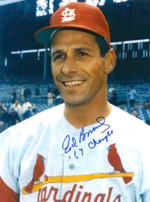
Seeking a player who could fill in for shortstop Dal Maxvill and provide late-inning defensive help at third base for converted outfielder Mike Shannon, Musial turned to a friend, Bing Devine.

Devine, president of the Mets, had been general manager of the Cardinals from 1957 until replaced by Bob Howsam in 1964. Musial succeeded Howsam in January 1967.

On April 1, 1967, the Cardinals acquired infielder Eddie Bressoud, outfielder Danny Napoleon and cash from the Mets for second baseman Jerry Buchek, pitcher Art Mahaffey and infielder Tony Martinez.

Bressoud capped his playing career by earning a World Series ring with the Cardinals.

Roster shuffles

The 1967 Cardinals entered spring training with no reliable backup at shortstop. The options were Buchek, Phil Gagliano and Jimy Williams.

Gagliano had big-league experience, but his best position was second base. Williams was a prospect but had played only 13 games in the majors.

Buchek had been the Opening Day shortstop for the 1966 Cardinals, but his fielding was erratic _ “He just doesn’t cover the ground, field cleanly enough or throw accurately at shortstop,” Bob Broeg wrote in the St. Louis Post-Dispatch _ and by June that year Maxvill regained the starting role.

Buchek seemed best equipped for second base, but the Cardinals had Gagliano to back up starter Julian Javier.

Meanwhile, the 1967 Mets entered spring training with a plan to platoon Bressoud and Chuck Hiller at second base. Bressoud started 110 games for the 1966 Mets: 73 starts at shortstop, 24 at third base, eight at second base and five at first base. “He’s one of the nicest gentlemen you’ll ever meet,” Mets manager Wes Westrum said to The Sporting News. “He’s done everything ever asked of him.”

Devine decided the Mets should have a starter younger than either Bressoud, 34, or Hiller, 32, at second base to pair with shortstop Bud Harrelson, 22.

Buchek, 24, seemed a promising candidate.

Betting on potential

Buchek, a graduate of McKinley High School in St. Louis, received a $65,000 bonus when he signed with the Cardinals as an amateur free agent in 1959. He had a breakout season as starting shortstop for the Cardinals’ Class AAA Atlanta Crackers in 1963, batting .287 with 33 doubles and 92 RBI.

However, in parts of five seasons (1961 and 1963-66) with the Cardinals, Buchek batted .221 and had more strikeouts (158) than hits (127). Devine thought a fresh start with another organization would help Buchek and he knew the Cardinals needed a player like Bressoud.

Bressoud debuted in the big leagues as a shortstop with the 1956 Giants and formed a keystone combination with their second baseman, Red Schoendienst. Two years later, in 1958, Bressoud’s wife Eleanor, 25, died of a brain tumor, leaving him with two sons ages 2 and 3. A year later, Bressoud remarried.

During the baseball off-seasons, Bressoud pursued his education. He earned a bachelor’s degree from UCLA and a master’s in physical education from San Jose State. He supplemented his income by teaching at high schools in the winter.

Acquired by the Red Sox in November 1961, Bressoud hit 40 doubles and 14 home runs for Boston in 1962, 20 home runs in 1963 and 41 doubles and 15 home runs in his lone all-star season, 1964.

With the 1966 Mets, Bressoud batted .225 in 133 games.

New homes

During a March 30, 1967, spring training game between the Mets and Cardinals, Musial and Devine sat together and discussed their rosters. Two days later, the trade was announced.

“Bressoud has a good arm and he gets rid of the ball well. He’s what we really needed, a proven utilityman who can fill in for Maxvill,” said Schoendienst, the Cardinals’ manager.

Buchek, happy to get a chance to be a Mets starter, said, “It would have been another wasted year with the Cardinals.”

With Maxvill providing steady play at shortstop and Shannon driving in runs as the third baseman, Bressoud didn’t play often for the 1967 Cardinals. He went hitless in his first 23 at-bats before getting a single off the Astros’ Larry Dierker.

“It’s been tough,” Bressoud said. “You replay every at-bat. You go home and punish yourself. You try to put up a false front, but if something like this doesn’t bother you, you don’t belong in the game.”

Bressoud hit his only Cardinals home run on Aug. 9 against Don Drysdale of the Dodgers.

Mostly, though, Bressoud served as a sort of player-coach.

“Eddie had some good ideas for me on playing shortstop _ and for playing second base, too,” Maxvill said. “Eddie knew how to play certain hitters and he had me make adjustments.”

Said Cardinals pitcher Bob Gibson: “Eddie Bressoud has a good arm and he’s quick. He gets in front of a lot of balls that other infielders don’t even get to, but he’s not sharp enough at times because he doesn’t play enough.”

Bressoud played in 52 regular-season games, making 18 starts at shortstop, for the 1967 Cardinals and batted .134 (9-for-67). He appeared in two World Series games as a defensive replacement.

In the book “The Original San Francisco Giants,” Bressoud said, ‘Even though I enjoy wearing my World Series championship ring, I don’t think of myself particularly as a Cardinal when I look back on my career.”

After the World Series, Bressoud retired as a player and became head baseball coach at De Anza College in Cupertino, Calif. He also was a scout for the Angels.

Previously: Mike Shannon and the spring training intrigue of 1967

In his spring training stint with the Cardinals, Mike Caldwell appeared to be a pitcher whose career was in decline. Shelled early and often, Caldwell showed no signs of developing into what he would become: a 20-game winner who would torment the Cardinals in the World Series.

Caldwell’s five-month stint as a Cardinal is a tale of a late bloomer who was in the wrong organization at the wrong time.

In March 1977, Caldwell, 28, was considered a leading candidate to fill a role in the Cardinals’ bullpen. Instead, he was traded before he got a chance to appear in a regular-season game for St. Louis.

Giant troubles

Caldwell, a left-hander, made his major-league debut with the 1971 Padres. He had a 13-25 record in three seasons with the Padres before he was traded to the Giants for slugger Willie McCovey.

In 1974, his first year with the Giants, Caldwell had a breakout season, posting a 14-5 record and 2.95 ERA.

After the season, Caldwell had surgery to remove bone spurs in his left elbow. When he returned, he struggled. “I lost some movement on my best pitch, the sinker, and I tightened up some and came sidearm at times,” Caldwell told the St. Louis Post-Dispatch.

By 1976, Caldwell was having troubles in the Giants clubhouse as well as on the mound. “I didn’t get along with a couple of the coaches and they took it personally,” Caldwell said.

The Giants’ pitching coach was the former catcher, Buck Rodgers.

Caldwell reached a low point on April 28, 1976, when Doug Clarey hit a home run, the lone hit of his big-league career, against him in the 16th inning, lifting the Cardinals to a 4-2 victory.

Caldwell finished 1-7 with a 4.86 ERA for the 1976 Giants. “I lost my confidence, tried too hard _ overthrew, I guess you’d say _ and I didn’t do very well,” Caldwell said.

Hope rekindled

On Oct. 26, 1976, the Giants traded Caldwell, pitcher John D’Acquisto and catcher Dave Rader to the Cardinals for pitcher John Curtis, outfielder Willie Crawford and utility player Vic Harris.

“I’m just glad to get away from a bad situation,” Caldwell said of leaving the Giants.

The Cardinals slotted Caldwell for the bullpen. “It’s common knowledge that the problem with the Cardinals last year was that middle relief and late relief, except for Al Hrabosky, couldn’t get the other clubs out,” said St. Louis manager Vern Rapp.

Said Caldwell: “I have no illusions. I’ve got to prove I’m good enough to make the staff.”

Bad audition

On March 12, in the Cardinals’ 1977 spring training opener against the Mets, Caldwell pitched two innings and gave up four runs. Three days later, Caldwell pitched an inning against the Dodgers and yielded three runs.

The Cardinals didn’t pitch him much after that.

On March 29, 1977, the Cardinals traded Caldwell to the Reds for pitcher Pat Darcy. In eight spring training innings, Caldwell yielded nine earned runs.

“Rapp called me in and told me, ‘Don’t get mad. You’re going to a contender,’ ” Caldwell said. “I wasn’t mad about that. I just thought he should’ve had some respect for me as a pitcher. That’s all I wanted: Throw me out there to see what I can do.”

Right fit

The Reds weren’t too impressed with Caldwell either. Three months after they acquired him, the Reds dealt Caldwell to the Brewers.

In 1978, Caldwell got a break when the Brewers named George Bamberger their manager. Under Bamberger, who had been a pitching coach for the Orioles, Caldwell fulfilled his potential. He was 22-9 with a 2.36 ERA and 23 complete games for the 1978 Brewers.

“Lots of people had given up on me,” Caldwell said to The Sporting News, noting he was traded by four clubs, including the Cardinals. “Maybe the people who gave up on me were responsible in an indirect way for my coming back. I knew I could pitch and I hope those who gave up on me will say now, ‘Well, he had the guts to battle back and win.’ ”

The third-base coach for Bamberger’s Brewers was Buck Rodgers, with whom Caldwell had feuded in his last season with the Giants. In 1980, Rodgers replaced Bamberger as Brewers manager.

Old wounds

Early in the 1982 season, Caldwell had a run-in with Rodgers aboard a plane, The Sporting News reported. In June 1982, Rodgers was fired and replaced by hitting coach Harvey Kuenn. Rodgers said disgruntled players had “tried to stab me in the back.”

Kuenn led the Brewers to the 1982 American League pennant and a matchup against St. Louis in the World Series.

Five years after he’d been dealt by the Cardinals, Caldwell would be facing them on baseball’s biggest stage.

Series drama

Caldwell, nicknamed “Mr. Warmth” by teammate Gorman Thomas because of his sometimes grumpy nature, was Kuenn’s choice to start Game 1.

Caldwell responded with a three-hit shutout in a 10-0 Brewers victory. Boxscore

Cardinals first baseman Keith Hernandez said he thought Caldwell was throwing a spitter, an illegal pitch. “He might have been throwing me screwballs, but I never saw a screwball drop like that,” Hernandez said.

Caldwell said he threw “natural sinkers.” Regarding the spitball accusation, Caldwell replied, “I look at it as a compliment. If the ball drops so much that they’re accusing me of throwing a spitter, I’ve got pretty good stuff.”

With the Series deadlocked at 2-2, Caldwell started Game 5 and again was the winning pitcher. He yielded 14 hits and two walks in 8.1 innings, but the Cardinals stranded 12 and the Brewers won, 6-4. Boxscore

The Cardinals won Game 6, setting up a deciding Game 7.

Clinging to a 4-3 lead in the eighth, the Cardinals had runners on first and second, two outs, when Kuenn lifted Moose Haas and replaced him with Caldwell. Darrell Porter and Steve Braun responded with RBI-singles, stretching the lead to 6-3, before Caldwell got Willie McGee to ground out.

Bruce Sutter set down the Brewers in order in the ninth, clinching the championship for the Cardinals. Boxscore


In a move that shifted the balance of baseball power in St. Louis, Branch Rickey left the American League Browns and joined the National League Cardinals.

branch_rickey2On March 20, 1917, Rickey, the Browns’ business manager, became president of the Cardinals.
Rickey’s departure was fought by Browns owner Phil Ball, even though the two men didn’t get along.

At the time, the Browns were the dominant baseball franchise in St. Louis.

Under Rickey, the Cardinals would transform from a lackluster franchise into an elite one.

Meet the new boss

In 1915, Rickey served the dual roles of Browns manager and assistant to team owner Robert Hedges. Rickey performed many of the duties of a general manager.

After the 1915 season, Hedges sold the Browns to Phil Ball. One of Ball’s first moves was to hire Fielder Jones, former White Sox manager, to be manager of the Browns and reassign Rickey to the position of business manager.

In his 1982 book “Branch Rickey: A Biography,” author Murray Polner wrote Rickey and Ball “took an instant dislike to one another.”

“Ball thought Rickey’s ideas too radical and Rickey’s endless talk and large vocabulary made him uncomfortable,” Polner wrote. “Rickey was, in turn, uncomfortable with Ball’s crudeness. He considered Ball uncouth and, in matters of baseball, virtually illiterate.”

According to Rickey, Ball agreed to honor Rickey’s contract, but told him he wouldn’t stand in his way if Rickey wanted to leave.

First choice

The 1916 Browns entered September four games out of first place and finished with a 79-75 record.

The 1916 Cardinals were a mess and finished in last place at 60-93. Ownership was strapped for cash and had trouble paying bills.

On March 5, 1917, Cardinals owner Helene Britton sold the club for $375,000 to a consortium of investors led by former team president James C. Jones.

Jones and the investors polled a group of seven St. Louis journalists for their advice on who should be hired to run the baseball operations.

The response was unanimous: Rickey.

Lucrative offer

Jones offered Rickey a three-year contract at $15,000 per year to be Cardinals president, according to the St. Louis Star. Rickey, who was to be paid $7,500 as Browns business manager in 1917, went to Ball and asked to be released from his contract.

Rickey said he received absolute assurance from Ball on March 19, 1917, that he could negotiate for a job that would better his position, the St. Louis Post-Dispatch reported.

A day later, Rickey accepted the Cardinals’ offer and signed a contract with them, according to a Page 1 story in the Post-Dispatch.

Ball, though, was having second thoughts.

Baseball battle

Ban Johnson, president of the American League, didn’t want Rickey going to a club in the rival league, Rickey said. Johnson pressured Ball to stop Rickey from joining the Cardinals.

Displaying a Browns contract Rickey signed for 1917, Ball told the Post-Dispatch, “I will insist that he fulfill his agreement.”

“Rickey seems to be confused over certain promises I made to him when he signed this (Browns) contract,” Ball said. “I promised Rickey … I would also help him in bettering himself if any opportunity offered itself for him apart from baseball.

“I at no time had the notion that he would consider this offer applicable to any proposition he might receive from one of my competitors,” Ball said. “My idea was that should Rickey care to enter the law business in St. Louis I would give him every assistance that I could.”

Ball went to court and received a restraining order that prohibited Rickey from working for the Cardinals until a hearing could be held before a judge.

In the Post-Dispatch, columnist John Wray wrote, “The battle between Rickey and Ball … seems a useless waste of time and money in which the only persons to come out of the conflict with all the honors _ and considerable cash _ will be the attorneys.”

The St. Louis Star opined, “Squeamish people who have doubted that Rickey will be allowed to preside over the Cardinals on account of a prior contract with the Browns are now inclined to view the position of Rickey as one that will impregnably withstand legal assault.”

Let’s make a deal

On April 6, 1917, the day a hearing was to be held, a settlement was reached that allowed Rickey to join the Cardinals.

“Rickey agreed to the terms of the settlement only after much persuasion,” the Post-Dispatch reported. “He and his personal attorney, George Williams, were very eager to bring the case to trial, but they were persuaded in the end, for the good of baseball, to accept the settlement out of court as proposed by Ball’s lawyers.”

Though the Cardinals under Rickey improved significantly in 1917 _ they finished in third place at 82-70 _ it wasn’t until Sam Breadon became principal owner in 1920 that the franchise had the backing it needed to solidify and blossom.

Supported by Breadon, Rickey built professional baseball’s first farm system, providing the Cardinals with a steady supply of talent trained under a shared organizational philosophy.

Rickey, who had returned to the field as Cardinals manager in 1919 while still running the administrative baseball operations, was put back in the front office by Breadon fulltime in May 1925 and the Cardinals won their first pennant and World Series championship the next year.

Previously: The story of Branch Rickey and his final journey

(Updated May 26, 2020)

Looking to build on a reputation as a keen talent evaluator and decision-maker, Ted Simmons left a front-office job with the Cardinals for an executive position with a National League division rival.

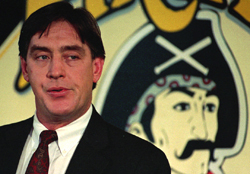
ted_simmons19On Feb. 5, 1992, Simmons, 42, resigned as Cardinals director of player development and accepted an offer to become general manager of the Pirates.
Emerging from a field of finalists that included Walt Jocketty, Simmons got the job because of the work he had done in improving the Cardinals farm system and because of his connections with Pirates president Mark Sauer.

Simmons’ rise was derailed, however, when, 16 months after becoming general manager, he suffered a heart attack and resigned.

Talent show

Elected to the Baseball Hall of Fame in December 2019, Simmons, a catcher, played 13 seasons (1968-80) for St. Louis, batting .298 and producing 1,704 hits and 929 RBI in 1,564 games.

In 1988, after Simmons finished his playing career with the Braves, he rejoined the Cardinals as head of their minor-league system.

Ray Lankford, Bernard Gilkey and Todd Zeile were among the prospects who developed into Cardinals players during Simmons’ tenure, enabling St. Louis to replace Willie McGee, Vince Coleman and Terry Pendleton.

Donovan Osborne, John Mabry and Dmitri Young were drafted by the Cardinals while Simmons was farm director.

Sauer, an Anheuser-Busch executive, joined the Cardinals as deputy chief operating officer and learned the baseball operation from Simmons.

Sauer was promoted to Cardinals executive vice president and chief operating officer in 1990. He left in October 1991 to become president and chief executive officer of the Pirates.

Search for success

Three months after he arrived in Pittsburgh, Sauer fired general manager Larry Doughty. Though the Pirates had won division titles in 1990 and 1991, Sauer was dissatisfied with the quality of the farm system under Doughty.

In his search for a general manager, Sauer identified five finalists. In addition to Simmons, they were:

_ Cam Bonifay, Pirates assistant general manager.

_ Bill Lajoie, former Tigers general manager.

_ Murray Cook, former general manager of the Yankees, Reds and Expos.

_ Walt Jocketty, director of baseball administration for the Athletics.

Simmons interviewed with Sauer in late January 1992. Simmons told Dan O’Neill of the St. Louis Post-Dispatch the session was “thorough, intense and in-depth.”

Eliminating Jocketty (who two years later would become general manager of the Cardinals) and Cook, Sauer pared the list to Simmons, Lajoie and Bonifay.

Lajoie, a scout with the Braves, was the preferred choice of Pirates manager Jim Leyland. When he was scouting director of the Tigers, Lajoie was a mentor to Leyland, who had been a player and manager in Detroit’s farm system.

Simmons told the Post-Dispatch he thought Bonifay would get the job.

Earned reward

Simmons was in a meeting when Cardinals chief executive officer Stuart Meyer came in and told him to expect a call from Sauer. A short while later, Sauer asked Simmons to be general manager.

Sauer described Simmons as “an outstanding evaluator of young talent” and “a good communicator.”

Asked whether their friendship was a factor in hiring Simmons, Sauer told the Pittsburgh Press, “My experience with Ted gives me a comfort level and confidence in what he can do, but this was not an issue of friendship. What I think made Ted the best choice was his demonstration of skills in the area of developing players in St. Louis.”

Said Simmons: “There’s no question Mark and I are friends, but there is also no question that during the time I was with Mark in St. Louis he was my boss … If I thought I stood here as general manager of the Pirates because I was Mark’s friend, No. 1, I would be embarrassed; No. 2, I would be ashamed.”

Simmons departed the Cardinals with the respect of general manager Dal Maxvill and manager Joe Torre.

“I’m extremely happy for him,” said Maxvill. “We had a great relationship. He was very loyal to me and to the organization. You couldn’t ask for better than Teddy.”

Said Torre: “He never does anything halfway.”

Pressure in Pittsburgh

Dedication and drive were qualities that helped Simmons get the job. Those attributes could become negatives, though, if not kept in check.

In their praise of Simmons, Maxvill and Sauer unintentionally foreshadowed trouble.

“His skin will have to be thick,” Maxvill said. “You can’t get too excited or too upset … You have to not let things bother you and just try to do the best you can and the best for the ballclub. I think he knows that.”

Said Sauer: “He’s very consumed with baseball. He lives and breathes baseball on many different layers.”

The Pirates won a third consecutive division title in Simmons’ first year as general manager. They were on the verge of clinching the 1992 pennant until the Braves rallied for three runs in the ninth and won Game 7 of the NL Championship Series.

With ownership putting pressure on Sauer and Simmons to cut payroll, the Pirates’ best hitter, Barry Bonds, and best pitcher, Doug Drabek, became free agents and left. Second baseman Jose Lind was dealt to the Royals for prospects.

Simmons, who smoked two to three packs of cigarettes a day, was tasked with trying to rebuild from within the organization.

Medical emergency

On June 8, 1993, Simmons, 43, was working in his office when he was stricken with a heart attack.

“I thought I was going to die,” Simmons told the Pittsburgh Post-Gazette.

“It was tolerable pain in my chest and between my shoulder blades. It was acute, intolerable pain in my upper left arm. I knew what was happening.”

Simmons called the team trainer, who got Simmons to a car and drove him to a hospital. Simmons underwent an emergency angioplasty operation to re-open a completely blocked artery to his heart.

Two weeks later, on June 19, 1993, Simmons was back at the ballpark when he announced he was resigning to focus on his health.

Sauer promoted Bonifay to the position of general manager.

In an interview in 2020 with Stan McNeal of Cardinals Gameday Magazine, Simmons said, “I’m very proud of my time in Pittsburgh because it was a very difficult time for the franchise. By getting payroll down like I did, that was essentially the first step of what was a four-step process that led to their new ballpark.”

Simmons said he stopped smoking the day he went into the hospital: “You know what helped me? I was in intensive care, and one of the nurses was a smoker. She had that cigarette smell on her clothes, in her hair, and it dawned on me: That’s how I’ve been stinking all these years.”

Though relief pitcher Clay Carroll was successful in his lone season with St. Louis, his most significant Cardinals connection came as an opponent.

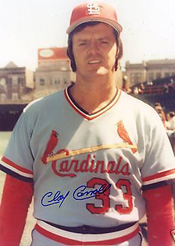
clay_carrollOn May 30, 1969, in what The Sporting News described as a storybook feat, Carroll hit the only home run of his big-league career. The improbable shot was struck against Bob Gibson in the 10th inning and it carried the Reds to a 4-3 victory over the Cardinals.

Eight years later, Carroll was traded to the Cardinals and excelled for them as a consistently reliable reliever.

Heavy lumber

Carroll’s home run against Gibson occurred in the opener of a series between the Reds and Cardinals at St. Louis. With the Cardinals ahead, 3-0, in the seventh inning, Johnny Bench tied the score with a three-run home run _ his first career hit against Gibson.

Carroll relieved Wayne Granger in the eighth and the game became a duel between Carroll and Gibson.

After Gibson retired the first two batters in the 10th, Carroll stepped to the plate with a bat he borrowed from teammate Alex Johnson, a former Cardinal. Johnson’s bats, Carroll explained to the St. Louis Post-Dispatch, “have a lot more wood in them than the one I had been using.” Johnson’s bats “normally are about as heavy as any in baseball _ some weighing as much as 40 ounces,” the Cincinnati Enquirer reported.

With the count 3-and-2, Carroll swung at a high fastball and lifted a fly ball to left. “I don’t want to brag, but when I hit the ball I knew it was gone,” Carroll said to United Press International. “Did you see it take off?”

The ball hit the top of the fence at Busch Stadium and bounced over the wall, giving the Reds a 4-3 lead.

“I was just swinging, trying to get on,” said Carroll. “Usually when I face Gibson, I just chop at the ball. That’s about all you can do against him.”

Said Reds manager Dave Bristol: “You should have seen the smile on Carroll’s face when he returned to the dugout. It looked like a cut watermelon.”

In the bottom half of the 10th, Carroll got Joe Hague to fly out before walking Lou Brock. Curt Flood grounded out, moving Brock into scoring position at second, before Vada Pinson, Carroll’s former Reds teammate, lined out to shortstop, ending the game.

Carroll pitched three hitless innings to earn the win. Boxscore

Championship caliber

Carroll was an important contributor to Reds teams that won pennants in 1970, 1972 and 1975. In 14 World Series appearances for the Reds, Carroll was 2-1 with a save and a 1.33 ERA over 20.1 innings. He was the winning pitcher in Game 7 of the 1975 World Series, shutting out the Red Sox for two innings.

Dealt by the Reds to the White Sox in December 1975, Carroll produced a 4-4 record, six saves and a 2.56 ERA for Chicago in 1976.

On March 23, 1977, the Cardinals acquired Carroll, 35, from the White Sox for pitcher Lerrin LaGrow. The Cardinals projected Carroll to set up closer Al Hrabosky.

“This is obviously what we’ve been after _ consistency and experience from a right-handed reliever, a guy who’s been under fire in championship play,” said manager Vern Rapp. “We had nobody on our staff who fit those qualifications.”

Said Carroll: “I want to work as often as possible because the more I work the more consistent I am. I like the Cardinals, especially because they’re an aggressive team at bat and on the bases.”

Carroll reported to camp at 215 pounds, according to the Post-Dispatch. Rapp wanted him to be at 200 pounds when the season began. He instructed Carroll to run extra laps each day during spring training.

A master at locating his pitches, Carroll delivered for the 1977 Cardinals. “When Carroll wasn’t saving games, he at least was dousing huge blazes to keep the Cardinals in the games,” The Sporting News reported. “The tighter the situation, the more (Carroll) seemed to enjoy it.”

Noting how Carroll got batters to swing at pitches out of the zone, Bristol said, “Carroll would rather eat a green fly at home plate than throw a strike.”

Carroll was 4-2 with four saves and a 2.50 ERA in 51 appearances for the Cardinals before they traded him back to the White Sox on Aug. 31, 1977.

3-for-1

The trade created “a lot of eyebrow raising” because Carroll had been the Cardinals’ most consistent reliever, The Sporting News reported.

The Cardinals were 10 games out of first place with about a month remaining in the season when the deal was made. The White Sox wanted Carroll because they were in contention for a division title, two games behind the first-place Royals.

St. Louis got three players in the deal: pitchers Silvio Martinez and Dave Hamilton and outfielder Nyls Nyman.

Carroll was disappointed to leave the Cardinals. “I thought I did a good job,” he said. “I guess they’re planning to go with a younger pitching staff next year.”

Two years after he made his big-league debut against St. Louis as a winner in a game that ended Bob Gibson’s career, Buddy Schultz surprised the Cardinals by becoming one of their most effective relievers.

buddy_schultzOn Feb. 28, 1977, Schultz was traded by the Cubs to the Cardinals for minor-league pitcher Mark Covert.

A left-hander, Schultz, 26, was acquired to pitch for the Cardinals’ top farm club.

When given a chance to fill in for an injured pitcher early in the Cardinals’ season, Schultz capitalized on the opportunity and gained the confidence of manager Vern Rapp.

On a staff with established talent such as Bob Forsch, John Denny and Al Hrabosky, it was Schultz who emerged as the Cardinals’ leader in earned run average that season.

Name game

Charles Budd Schultz was born Sept. 19, 1950, in Cleveland. “The middle name was for my Uncle Bud and they fancied it up by adding the extra ‘d,’ ” Schultz told Dick Kaegel of the St. Louis Post-Dispatch.

Schultz received a baseball scholarship from Miami University in Oxford, Ohio, where he earned a bachelor’s degree in industrial arts. In a game for Miami against Wright State, Schultz struck out 26 batters.

The Cubs selected Schultz in the sixth round of the June 1972 amateur free-agent draft.

Win vs. Gibson

Schultz made his big-league debut for Chicago on Sept. 3, 1975, at St. Louis. In the sixth inning, with the score tied at 6-6, Schultz relieved Tom Dettore and got Bake McBride to ground out to second, ending the inning.

In the seventh, the Cubs struck for five runs against Gibson, who had relieved Ron Reed. Pete LaCock, batting for Schultz, hit a grand slam off Gibson, giving the Cubs an 11-6 lead. Paul Reuschel shut out the Cardinals over the last three innings, preserving the win for Schultz. Boxscore

Gibson, 39, never pitched in a big-league game again, ending a career that led to induction into the National Baseball Hall of Fame.

A week later, on Sept. 10, 1975, Schultz pitched 1.1 scoreless innings in relief of Steve Stone and got his second win in the Cubs’ 7-5 triumph over the Cardinals at Chicago. Boxscore

In two seasons (1975-76) with the Cubs, Schultz was 3-1 with a 6.14 ERA in 35 games.

Getting a break

On the eve of spring training in 1977, Schultz got into a contract squabble, prompting the Cubs to make him available. Cardinals general manager Bing Devine took a chance on Schultz, signed him to a minor-league contract and instructed him to report to the Class AAA New Orleans Pelicans.

“Devine asked me what I wanted and I told him and I signed in one minute,” Schultz said. “Maybe I should have asked for more.”

On March 31, 1977, Schultz worked a scoreless eighth inning in a 2-1 Cardinals spring training victory over the Mets. He caught Rapp’s attention by retiring all three batters he faced, striking out two. “You had to like what Schultz did,” said Rapp.

However, when the 1977 big-league season opened, the Cardinals kept rookie relievers John Urrea and Johnny Sutton on the roster. Schultz stayed behind at the minor-league camp in Florida.

On April 9, two days after the Cardinals’ season opener, pitcher John D’Acquisto injured his right calf and was placed on the disabled list. Schultz was called up to replace him.

Good stuff

Mixing a slider with a fastball and palmball, Schultz pitched consistently well in long relief for the Cardinals.

On May 12, 1977, he combined with D’Acquisto and Hrabosky on a one-hitter against the Reds at St. Louis. Relieving D’Acquisto, who started and pitched four hitless innings, Schultz held the Reds hitless until Ken Griffey doubled with two outs in the eighth.

“The fastball Griffey hit was up in his eyes,” Schultz said.

Hrabosky pitched a hitless ninth, preserving the win for Schultz, who was 2-0 with a 1.23 ERA. Boxscore

A month later, the Cardinals made a series of moves that blindsided Schultz.

Strikeout artist

On June 15, 1977, the Cardinals acquired a starter, Tom Underwood, from the Phillies and a reliever, Rawly Eastwick, from the Reds.

Eastwick joined three other high-profile veterans _ Hrabosky, Clay Carroll and Butch Metzger _ in the St. Louis bullpen. Needing to open a roster spot for the newcomers, the Cardinals demoted Schultz (3-1, 1.41 ERA) to New Orleans, with instructions to use him as a starter.

Stunned, Schultz took out his frustration on American Association batters.

In his first start for New Orleans, on June 18, 1977, Schultz struck out 15 in a 9-3 victory over Denver. Schultz also contributed a double, single and RBI. “Maybe they sent me down here to work on my hitting,” he said to The Sporting News.

In his second start, Schultz struck out 10 before a blister developed on a left finger, causing him to depart in the sixth.

Over two starts for New Orleans, Schultz struck out 25 in 14.2 innings.

When John Denny pulled a hamstring and was placed on the disabled list, the Cardinals recalled Schultz to replace him.

Triumphant return

On June 28, 1977, the Cardinals gave Schultz his first big-league start in the opener of a doubleheader against the Pirates at St. Louis. Schultz, who held the Pirates to a run over 7.1 innings in a 6-1 Cardinals victory, departed to a standing ovation.

“With that, he suddenly produced a two-arm victory thrust and yelled, ‘I’m back,’ ” Neal Russo of the Post-Dispatch reported.

Before he could make a second start for St. Louis, Schultz pulled a leg muscle and was placed on the disabled list. When he returned, the Cardinals utilized him primarily as a reliever.

“He’s much too valuable to take out of the bullpen,” said Cardinals pitching coach Claude Osteen.

Schultz finished the 1977 season with a 6-1 record and a team-leading 2.32 ERA.

Previously: Bob Gibson and his final days with Cardinals