Feeds:
Posts
Comments

A right-handed pitcher and protege of Cardinals ace Harry Brecheen, Jerry Walker became the right-hand man to Cardinals general manager Walt Jocketty.

Walker was involved with professional baseball most of his adult life. At 18, he went from high school to the majors with the Orioles and was nurtured by Brecheen, the pitching coach who’d been a World Series standout with the 1946 Cardinals.

At 20, Walker became the youngest pitcher to start in an All-Star Game. He played eight seasons in the American League with the Orioles (1957-60), Athletics (1961-62) and Indians (1963-64).

After his playing days, Walker managed in the minors, then returned to the big leagues as a scout and went on to become a coach and general manager. For 13 years (1995-2007), he was an executive in the Cardinals’ front office, advising Jocketty on player personnel.

Mighty leap

Born and raised in Ada, Okla., Walker was a high school baseball phenom, posting a varsity pitching record of 52-1 and leading his club to state titles in 1956 and 1957. He hit .529 as a junior and .526 his senior season.

Most big-league teams tried to sign him, including the Red Sox, who projected Walker as a third baseman, but he chose the Orioles, in large part, because of Brecheen, an Ada resident. “Brecheen had a great deal to do with Walker’s decision,” the Baltimore Sun noted.

Brecheen told the newspaper, “I’ve known the boy and his family for a long time … I thought when I saw him in high school that he had the best curve of any kid I’d ever seen.”

After signing with the Orioles on June 28, 1957, Walker joined a pitching staff with the likes of former Negro League fastballer Connie Johnson, World War II combat veteran Hal Brown and ex-Dodgers standout Billy Loes.

A week later, Walker made a jittery big-league debut at Boston’s Fenway Park. With the Red Sox ahead, 6-2, Orioles manager Paul Richards sent Walker to pitch the seventh. He issued walks to the first two batters _ two-time American League batting champion Mickey Vernon and Jackie Jensen (past and future AL RBI leader) _ and went to a 2-and-0 count on Frank Malzone before being relieved by Art Ceccarelli, a winless left-hander. Malzone mashed a pitch that soared over the the head of right fielder Tito Francona for a triple. Boxscore

After three relief appearances, Walker made his first start, facing the hapless Athletics at Kansas City. Nervous and overanxious, he didn’t last an inning. Boxscore

Breakout game

A month later, after a few relief stints, none longer than two innings, Walker got his second start, this time at home, against the Senators. Though destined to finish in the basement, the Senators had Roy Sievers, the slugger from St. Louis who would lead the American League in home runs (42) and RBI (114) that year.

Pitching with the poise and stamina, Walker shut out the Senators for 10 innings and got the win, 1-0. He allowed four singles and a walk, totaling 111 pitches.

“Here is a kid who had never pitched nine innings in his life,” Paul Richards said to the Baltimore Sun. “The high schools where Jerry played limit their games to seven innings.”

Brecheen told the newspaper, “We knew he had a lot of ability, and he’s got a lot of heart.”

Walker dressed quickly after the game and dashed out of the clubhouse. As the Sun explained, “With a pocketful of hot change, the quiet-spoken, crew-cut kid was busting out all over in his (eagerness) to reach the nearest coin telephone to place a long-distance call to (his parents in) Oklahoma.” Boxscore

Seeing stars

After a tune-up season in the minors at Knoxville (18-4, 2.61 ERA) in 1958, Walker was one of three 20-year-old pitchers (Jack Fisher and Milt Pappas being the others) who contributed to the Orioles in 1959.

Walker sizzled early, winning his first four decisions, including a five-hitter against the Yankees. He struck out Mickey Mantle three times. Boxscore

In a rematch in July, Walker again beat the Yankees, fanning Mantle three more times and totaling 10 strikeouts for the game. “For 20 years old, you’d have to say the young man was amazing the way he struck my men out,” Yankees manager Casey Stengel said to the Sun. Boxscore

(Though he whiffed 12 times versus Walker in his career, Mantle had an on-base percentage of .500 _ 13 hits and 11 walks _ against him and slugged four home runs. Of Walker’s four career wins versus the Yankees, three came in 1959.)

A month later, Stengel, the American League manager, chose Walker to start in the All-Star Game at Los Angeles. Walker got the win, allowing one run in three innings. He twice retired the Cardinals’ Ken Boyer, struck out Eddie Mathews and got Willie Mays and Ernie Banks to ground out. Boxscore

Working overtime

On Sept. 11, 1959, the first-place White Sox, headed for an American League pennant, were at Baltimore for a Friday doubleheader on Westinghouse Night. As the Sun noted, “The air was electric with tension.”

Jack Fisher shut out the White Sox in the opener, 3-0, limiting them to three hits. Boxscore

Walker started Game 2 against a lineup headed by future Hall of Famers Luis Aparicio and Nellie Fox. He gave up two singles in the first but the White Sox never advanced another runner as far as third the rest of the night.

White Sox pitchers Barry Latman (9.1 innings) and Gerry Staley, the ex-Cardinal, were superb, too, but Walker was better. He pitched 16 scoreless innings and the Orioles prevailed, 1-0, when Brooks Robinson’s two-out single versus Staley, 39, drove in Al Pilarcik from third.

“That two 20-year-olds should pitch 25 scoreless innings in one night against the league leaders, even the light-hitting White Sox, borders on the unbelievable,” wrote Ed Brandt of the Sun.

His colleague, Lou Hatter, offered, “Walker’s performance was extra-special, incredible and then some.”

Walker told United Press International, “I could have pitched another couple of innings.” Boxscore

He finished the year 11-10 with a 2.92 ERA, but never had another winning season in the majors.

On the move

In 1960, Walker suffered from allergies “that sapped his strength,” the Sun reported, and posted a 3-4 season record. “From what they told me, I guess I was allergic to just about everything,” Walker told the Kansas City Times. “They gave me some shots and also some pills to take regularly. The shots are a long-range treatment and the doctors seem to think they should clear up the trouble completely in two or three years.”

Traded to the Athletics in April 1961, he spent two years with them, went 16-23 and got dealt again, to Cleveland, where he played his final two seasons in the majors. A highlight came on July 13, 1963, when Walker pitched four scoreless innings of relief, helping Cleveland teammate Early Wynn, 43, get career win No. 300. Boxscore

In May 1964, Walker was loaned by Cleveland to the Cardinals’ Class AAA farm club, the Jacksonville Suns, managed by Harry Walker (no relation). His teammates included pitchers Mike Cuellar, Bob Humphreys, Gordon Richardson and Barney Schultz, who went on to help the Cardinals win a pennant and World Series championship that season.

Walker was 10-9 with Jacksonville, including a one-hitter in a 1-0 victory versus Richmond in 10 innings. Called up to Cleveland in September, he pitched his final big-league games that month.

Still in the game

Walker was a manager in the Yankees’ farm system for six seasons (1968-73) and his pitchers included a pair of future American League Cy Young Award winners _ Ron Guidry and LaMarr Hoyt. Walker was a Yankees scout from 1974 to 1981, then became their pitching coach for parts of the 1981 and 1982 seasons.

From 1983-85, Walker was Astros pitching coach. His staff ace was Nolan Ryan.

After a stint from 1986-91 as special assignment scout for the Tigers, Walker was promoted to general manager by club president Bo Schembechler and tasked with rebuilding the roster. As Gene Guidi of the Detroit Free Press noted, “Walker stepped into a tough spot in Detroit. He wants to make the Tigers a better team but he has few marketable players to trade and a limited spending budget to pursue free agents.”

In Walker’s first season as general manager, the Tigers were 75-87. They improved to 85-77 in 1993, but the franchise underwent an ownership change, and Walker was fired in January 1994.

Cardinals influencer

In November 1994, Walt Jocketty, who replaced Dal Maxvill as Cardinals general manager, hired Walker to be the club’s director of major league player personnel. “He was the first guy I hired in St. Louis,” Jocketty told the Cincinnati Enquirer.

“Walker’s duties will feature special assignment scouting and recommendations to Jocketty,” the St. Louis Post-Dispatch reported.

Three years later, in February 1997, Walker was promoted, with the title of vice president of player personnel. The Post-Dispatch referred to him as Jocketty’s “right-hand man.”

According to the Cardinals 1997 media guide, Walker “assists Jocketty in personnel matters with the major league club and he is also responsible for overseeing the Cardinals player development and scouting activities.”

One of the up-and-coming Cardinals staffers in 1997 was a scouting assistant, John Mozeliak. According to the Post-Dispatch, Walker was a mentor to Mozeliak.

During Walker’s 13 years with the Cardinals, they won two National League pennants (2004 and 2006) and a World Series title (2006).

In October 2007, Jocketty was fired and replaced by Mozeliak. “One of Walt’s strong points was how he used his people,” Walker told the Post-Dispatch. “He allowed Mo (Mozeliak) to be involved, to increase his responsibilities.”

When the Reds then hired Jocketty to be team president and general manager, he brought in Walker to serve as his special assistant for player personnel.

On Sept. 4, 1987, Vicente Palacios stood on a big-league mound for the first time, a 24-year-old Pirates rookie from Mexico making his debut at Houston’s Astrodome. It must have felt to him like standing atop Mount Everest. He’d been rejected by two other organizations, White Sox and Brewers, making him wonder whether he’d lost his chance of ever reaching the majors, but here he was, pitching in the same game with none other than Nolan Ryan.

Seven years later, on July 19, 1994, his 31st birthday, Palacios was back on the mound at the Astrodome, this time as a member of the Cardinals. He’d been through multiple shoulder surgeries and experienced more rejection, but managed to persevere.

Palacios had his greatest game that night, holding the hard-hitting Astros to one hit in nine innings and pitching a shutout for the win.

Traveling man

Born about 20 miles inland from the port city of Veracruz along the Gulf of Mexico, Palacios was 19 in 1983 when he pitched his first season of professional baseball in the Mexican League with El Aguila de Veracruz (The Eagle of Veracruz).

“There was no question he was one of the top three or four pitchers in Mexico,” Terry Collins, then a scout for the Dodgers, told The Pittsburgh Press.

The Chicago White Sox purchased his contract in 1984 and sent him to the minors. A right-hander, Palacios didn’t do enough to impress while in the White Sox system. They loaned him to the Mexico City Reds in 1985 and to El Aguila de Veracruz in 1986 before releasing him.

Desperate to revive his career, Palacios, 23, experimented with developing a different pitch. “I did it on my own,” he told Bob Hertzel of The Pittsburgh Press.

The pitch Palacios came up with was a variation of the split-fingered fastball. “It’s kind of like a forkball,” catcher Mike LaValliere said to The Press. “He holds it like a knuckle-curve, only it doesn’t spin much.” Pitching coach Ray Miller described it to the Pittsburgh Post-Gazette as “a knuckle palm ball,” and broadcaster Jim Rooker, a former pitcher, called it “a knorkle ball.”

Palacios learned to master the pitch in winter ball in Mexico after the 1986 regular season, drawing interest from scouts for the Pirates and Brewers.

The Pirates signed Palacios on Dec. 4, 1986, four days before the baseball winter meetings, but the Brewers outmaneuvered them. Because he wasn’t on the Pirates’ big-league roster, Palacios was exposed to the Dec. 8 Rule 5 draft, and, much to the Pirates’ chagrin and embarrassment, was selected by the Brewers.

The draft rules required that the Brewers keep Palacios on their big-league roster throughout the 1987 season or else give the Pirates the chance to take him back.

At 1987 spring training, Palacios was nurtured by the Brewers’ 20-game winner and countryman Teddy Higuera, who focused on the mental aspects of pitching, such as managing emotions and making adjustments to game situations.

However, Palacios didn’t advance enough to earn a spot on the Opening Day roster, and was sent back to the Pirates.

“We really wanted to keep him,” Brewers general manager Harry Dalton told The Pittsburgh Press. “We saw potential in him. We would have kept him if he were a little more poised, a little more mature.”

Ups and downs

The Pirates sent Palacios to their Class AAA Vancouver farm club in 1987 and he thrived under the guidance of pitching coach Jackie Brown, who altered his pitching mechanics. “When his mechanics got straightened out, he started feeling better about himself,” Pirates director of player development Buzzy Keller told the Post-Gazette.

Palacios was 13-5 for Vancouver and led the Pacific Coast League in ERA (2.58), shutouts (five), innings pitched (185) and strikeouts (148).

Called up to the Pirates in September 1987, Palacios made his debut at the Astrodome, working two scoreless innings (sixth and seventh) in relief of Mike Bielecki and matching zeroes with opposing pitcher Nolan Ryan. Boxscore

Four days later, Palacios made his first start and outdueled Rick Sutcliffe, holding the Cubs to one run in eight innings and getting the win. Boxscore

Based on that success, Palacios was in the Pirates’ plans, but then came more setbacks. He had shoulder surgery in 1988 and again in 1989.

His comeback bid in 1990 began with Class AAA Buffalo, where Terry Collins was the manager and Jackie Brown the pitching coach. Palacios made 28 starts for Buffalo and had a 13-7 record.

The Pirates, in the thick of the 1990 title chase in the National League East, brought him back to the majors on Sept. 5. Manager Jim Leyland used Palacios in relief and got rewarded. In seven appearances covering 15 innings, Palacios allowed no runs and earned three saves, including one against the Cardinals, and helped the Pirates become division champions. Boxscore

Because he joined them after Sept. 1, Palacios was not eligible for the playoffs.

Nonetheless, his career seemed to be on an upswing. With the Pirates in 1991, Palacios was used as both starter and reliever. Though he spent a month on the disabled list because of shoulder problems, he posted a 6-3 record, with three saves and a 3.75 ERA. In seven starts, including a shutout of the Expos, his ERA was 2.72. Boxscore

The Pirates repeated as division champions in 1991, but Palacios was left off the playoff roster because his season record against their foe, the Braves, was 0-3. 

In 1992, Palacios won his first three decisions, but then his shoulder began to ache. He was placed on the disabled list in June, had his third surgery, missed the remainder of the season and was released. The Padres signed him, watched him at spring training in 1993 and released him. He returned to the Mexican League with the Yucatan Lions, who dealt him to the Aguascalientes Railroadmen.

“A lot of people think when you go to the Mexican League, you’re done,” Palacios told the St. Louis Post-Dispatch. “Then when I got traded from (Yucatan), I was worried. I started thinking there’s something wrong.”

As he had before, though, Palacios soldiered on, earning 20 saves in the Mexican League in 1993 and pitching a no-hitter in the playoffs.

On Dec. 23, 1993, the Cardinals signed Palacios to a minor-league contract and invited him to spring training as a non-roster player.

No quit

Palacios won a spot on the Opening Day roster of the 1994 Cardinals as a reliever. “I’m very impressed with his stuff,” Cardinals pitching coach Joe Coleman told the Post-Dispatch. “The only question is his durability. He’s sneaky quick and throws that ball (from) out of his uniform. It’s tough to pick up. He’s got a fastball that rides in on their hands, and he’s got the forkball to go along with it.”

In the Cardinals’ season-opening win against the Reds at Cincinnati, Palacios played a key role, pitching two scoreless innings in relief of starter Bob Tewksbury. He escaped a bases-loaded jam in the seventh by striking out Reggie Sanders. Boxscore

After making nine relief appearances, Palacios was moved into the starting rotation on May 3 when two pitchers went on the disabled list. He lost seven of his first eight decisions, but received poor run support. The Cardinals averaged 1.1 runs per game in his seven losses as a starter.

Lacking better options _ the 1994 Cardinals would finish with a team ERA of 5.14 _ manager Joe Torre stuck with Palacios.

On July 18, the Cardinals blew an 11-0 lead and lost, 15-12, to the Astros at Houston. The next night, Palacios, with his 1-7 record, was given the start against the Astros’ Darryl Kile.

The Astros, managed by Terry Collins, had a lineup with two future Hall of Famers, Jeff Bagwell and Craig Biggio, plus Steve Finley and Luis Gonzalez, and would lead the league in RBI that season.

It looked to be a mismatch, and it turned out that way, too _ but not in favor of the Astros.

Palacios issued a walk to Bagwell in the first and gave up a leadoff single to eighth-place batter Andujar Cedeno in the third, then retired the last 21 batters in a row, completing a one-hit shutout in a 10-0 Cardinals triumph. Boxscore

“I kept the ball down, mixed my pitches and stayed ahead of the hitters,” Palacios said to the Associated Press, “and our guys made a lot of good plays behind me.”

He made two more starts, then returned to a relief role, as Torre tried to find plugs for a pitching staff leaking runs.

Palacios led the 1994 Cardinals pitching staff in strikeouts (95) and was second to Bob Tewksbury in innings pitched (117.2). His season record: 3-8, 4.44 ERA.

With the 1995 Cardinals, Palacios got raked (5.80 ERA and .300 batting average against) before he underwent his fourth shoulder surgery in July. “I’ve got to find a new shoulder,” Palacios said to the Post-Dispatch.

The Cardinals released him four months later.

Determined to keep pitching, Palacios eventually worked his way back to the Mexican League. In 1999, with Broncos de Reynosa, he made 43 relief appearances and was 5-2 with 10 saves and a 0.95 ERA.

The Padres, managed by Bruce Bochy, signed him and on April 20, 2000, five years after he pitched for the Cardinals, Palacios, 36, was back in a big-league game. His opponent: the Cardinals.

Pitching in relief of Brian Boehringer, Palacios faced 13 Cardinals batters and gave up six runs, including home runs to Eli Marrero and Rick Ankiel. Boxscore

He did better after that, allowing no runs in four of his next six relief appearances, but the Padres released him in August.

Once again, Palacios returned to the Mexican League and pitched there until 2003 when he turned 40.

A hurdler in track, Dave Williams used those skills on the football field to spring above defenders and catch passes in a crowd.

The NFL St. Louis Cardinals projected him to be the deep threat who would replace longtime standout Sonny Randle.

Williams came through for St. Louis in his first three seasons, but couldn’t sustain the success. 

Athletic ability

Though born in Cedar Rapids, Iowa, Williams grew up in Tacoma, Wash., and went to Lincoln High School, where he excelled in football and track. He won a state championship for Lincoln in the hurdles in 1963.

Williams then competed in both sports at the University of Washington. According to Bob Broeg of the St. Louis Post-Dispatch, Washington head football coach Jim Owens said, “He’s the finest natural athlete I ever coached.”

Williams was a collegiate all-America in four different events in track and field _ broad jump, 120-yard hurdles, 440-yard hurdles and 440-yard relay. He qualified to compete in the 1964 Olympic trials in the decathlon.

His football career at Washington was not as consistent. As Tacoma News Tribune sports editor Earl Luebker noted, “Much of his time was spent in frustration.”

In his first varsity season as a sophomore in 1964, Williams made a mere three catches. “He started his sophomore season as one of the most widely heralded pass receivers,” the News Tribune reported, “yet, before the year had progressed too far, he found himself working as a third-stringer in the defensive secondary.”

Williams’ breakout season came as a junior in 1965 when he made 38 catches, including 10 for touchdowns. The 6-foot-2 receiver had 10 catches, including one for a touchdown, against Stanford and another 10 catches, for 257 yards and three touchdowns, versus UCLA.

“We couldn’t cover that fellow Williams,” UCLA head coach Tommy Prothro told the Los Angeles Times. “We tried to play him loose, but it was no go … Williams, who sort of reminds me of (the Green Bay Packers’) Don Hutson, has such deceptive speed. Looks like he’s running slow with that easy gait.”

As a senior in 1966, Williams “was used largely as a decoy,” the Tacoma News Tribune reported, and had no touchdowns among his 21 catches.

Promising rookie

Williams caught the attention of the Cardinals with his play in college all-star games after his senior season. In the East-West Shrine Bowl, he snared a 48-yard touchdown toss from Stanford’s Dave Lewis. Then, in the Hula Bowl, Purdue’s Bob Griese connected with Williams on touchdown throws of 43 and 40 yards.

The Cardinals picked Williams in the first round of the 1967 NFL draft. He was the second wide receiver taken. The first was Michigan State’s Gene Washington by the Minnesota Vikings.

“Williams was the surest bet to help us,” Cardinals head coach Charley Winner said to the Post-Dispatch. “He has ideal size. In addition to speed, he’s big enough to crack back as a blocker and he definitely can catch the ball in a crowd.”

Cardinals receivers coach Fran Polsfoot told the newspaper, “He excels at catching the hard passes. He’ll go up and fight for the ball with a good spring in his legs and intense desire.”

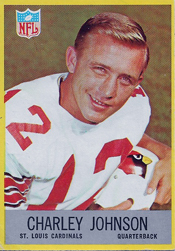
At training camp with the 1967 Cardinals, Williams was accepted by veteran receivers Bobby Joe Conrad and Sonny Randle, and quarterback Charley Johnson.

“I’ve been really surprised by the help I’ve got from the other receivers,” Williams told the Post-Dispatch. “Bobby Joe Conrad showed me how to break on my pass patterns. Sonny Randle helped me in learning to make certain alignments. Charley Johnson has helped in telling me how to read defenses and be in the right place.”

Randle said to the newspaper, “He has all the tools. As soon as he knows the right places to be, he’ll be a good one.”

Williams did so well in exhibition games that the Cardinals traded Randle to the San Francisco 49ers for a draft choice three days before the 1967 season opener.

On Monday night, Oct. 30, 1967, the reigning NFL champion Green Bay Packers played at St. Louis. Matched against Herb Adderley, destined for election to the Pro Football Hall of Fame, Williams caught touchdown passes of 49 and 48 yards from Jim Hart. On a halfback option play, Johnny Roland also completed a pass to Williams in the end zone but it was nullified by an offsides penalty on a lineman. Described by the Green Bay Press-Gazette as “jet-like” and “explosive,” Williams made six catches for 147 yards in the game.

“The kid’s good,” Adderley told the Post-Dispatch. “I predict a great future for him. He’s not like most of these rookies who go out and see how fast they can run. Williams makes moves. I backed off and played him loose the second half. He could have those short ones, but no more bombs.” Game stats and Video

Williams completed his rookie season with 28 catches and five touchdowns.

Hard to cover

Convinced Williams was headed for stardom, the Cardinals traded Billy Gambrell to the Detroit Lions for a draft choice just before the start of the 1968 season, making Williams and Bobby Joe Conrad the starting wide receivers.

Williams had 43 catches, including a team-high six for touchdowns, in 12 starts for the 1968 Cardinals before an injury to his left knee sidelined him for the final two games.

One of his season highlights was a 71-yard touchdown catch on a pass from Hart against the Pittsburgh Steelers. “I was supposed to cut him off short and (safety) Clendon Thomas was supposed to take him long,” Steelers cornerback Marv Woodson told the Post-Dispatch, “but Williams just outran Thomas, and Jim Hart threw a perfect pass. No cornerback can stop a good receiver from catching a perfect pass, no matter how well he covers his man.” Game stats

(Of Williams’ 22 touchdown receptions in his five seasons with St. Louis, 12 were of more than 30 yards.)

In 1969, Williams led the Cardinals in receptions (56). His seven touchdown catches came in two games.

On Nov. 2, 1969, Williams scored four touchdowns on passes from Charley Johnson, but the Saints beat the Cardinals, 51-42. “Here I am with my greatest day statistically, but the luster is taken off,” Williams said to the Post-Dispatch. “You come away with an empty feeling because you lost the ballgame.” Game stats

A month later, Jim Hart connected with Williams on three touchdown passes against the Steelers. Game stats

Unhappy days

Based on his first three seasons, the Cardinals had high hopes for Williams in 1970. At training camp, Bob Broeg of the Post-Dispatch observed that Williams “gives promise of leadership because he’s sharp, articulate and the kind of performer who can inspire.”

Broeg added, “Williams’ forte is the incredible leaping ability and possessiveness that permits him to get higher than backfield defenders and to out-grapple them for the ball.”

The season, though, was a bust. Williams clashed with head coach Charley Winner and told the Post-Dispatch, “Most of the players didn’t respect him.”

Williams had 23 receptions in 1970 (33 fewer than the year before) and, according to the Post-Dispatch, Jim Hart lost confidence in him. “Dave Williams was a dejected, withdrawn football player, dressing quickly and leaving the locker room before his teammates, and intentionally ostracizing himself from the club,” the Post-Dispatch reported.

Charley Winner was fired after the season and became an assistant on the staff of Washington Redskins head coach George Allen. The Cardinals offered to trade Williams to Washington for a second-round draft pick, but Winner recommended to Allen that he decline the proposal, the Post-Dispatch reported.

Bob Hollway was the Cardinals’ head coach in 1971 but Williams regressed, losing his starting job to rookie Mel Gray and finishing with 12 catches.

On Feb. 1, 1972, after the Cardinals made Oregon wide receiver Bobby Moore (who later became Ahmad Rashad) their first pick in the draft, they traded Williams to the San Diego Chargers for wide receiver Walker Gillette. (Like Williams, Moore went to high school in Tacoma.)

“Williams had been a big disappointment to the Cardinals,” the Post-Dispatch exclaimed. “His teammates often accused him of not running correct patterns, and this alienated him from the squad.”

Never a dull moment

After a season and a half with the Chargers (21 total catches, three touchdowns), Williams was placed on waivers and acquired by the Steelers in October 1973. He played in one game for them and joined the Southern California Sun of the World Football League in 1974.

Playing for head coach Tom Fears, Williams spent two seasons with the Sun and revived his career _ 59 catches, 11 touchdowns in 1974, and 21 catches, nine touchdowns in 1975. “Williams runs like a deer, is sure-handed and runs exemplary pass patterns,” the Los Angeles Times noted.

In November 1975, Williams, 30, became the first player to sign with the Seattle Seahawks, an NFL expansion team slated to begin its inaugural season in 1976. Part of his contract required Williams to make promotional appearances to generate interest in the fledgling franchise.

Williams entered a professional indoor track meet in Seattle in the spring of 1976 after receiving approval from the Seahawks. While running an obstacle course, his spikes caught in the boards and he tore cartilage in his left knee.

Meanwhile, in June 1976, Williams filed a damage lawsuit against Dr. Arnold Mandell, a former team psychiatrist for the Chargers, who wrote a book, “The Nightmare Season,” about his experiences with the team. In his lawsuit, Williams said Mandell falsely accused him of “defects of character.”

Two months later, in August 1976, the Seahawks put Williams on waivers because he failed a physical. Williams threatened to sue the Seahawks, claiming they were responsible for the knee injury he suffered in the track meet.

In December 1976, Williams told the Tacoma News Tribune that he and the Seahawks reached an out-of-court settlement. “We sat down and resolved the matter in about 20 minutes,” Williams said to the newspaper.

With his playing career done, Williams eventually became a spokesman for the Pro Football Retired Players Association.

In May 1979, a San Diego County Superior Court jury awarded Williams $300,000 in his libel trial against the former Chargers psychiatrist.

Cardinals rookie Herman Bell seemed an unlikely candidate to accomplish one of the franchise’s most remarkable pitching feats.

On July 19, 1924, Bell pitched two complete games in a doubleheader and won both against the Braves at St. Louis.

Before joining the Cardinals, Bell primarily had been working as a cowpoke on a cattle ranch and pitching on pasture diamonds for semipro teams.

He went on to pitch in three World Series and have a role in one of Babe Ruth’s epic clouts.

Soldier and cowboy

Herman “Hi” Bell was born in Mount Sherman, Ky., 10 miles from Abraham Lincoln’s birthplace in LaRue County, but moved with his family to northwest Iowa when he was a youngster.

(When he joined the Cardinals, his teammates nicknamed him “Hi,” from the expression, “Hiya, how’re you doing?” according to Sid Keener of the St. Louis Star-Times.)

Bell attended school in Sibley, Iowa, 10 miles from the Minnesota border, and also resided in Alton, Iowa, according to The Sporting News.

In 1917, when he was 19, Bell enlisted in the Army during World War I and completed his service in 1919. He then worked on a ranch in Colorado for three years (1919-21), the St. Louis Globe-Democrat reported, and played semipro baseball for town teams in Iowa, Minnesota and South Dakota.

Bell expected “to become a regular cowboy for the cattle ranch” near Colorado Springs, according to the Alton (Iowa) Democrat.

“There are probably no baseball pitchers in northwest Iowa the superiors of Herman Bell,” the Alton Democrat noted in October 1921. “He has no ambition, however, toward entering professional baseball, and has already tried ranch life and likes it.”

Bell apparently had a change of heart, because in 1922 he played for the Sioux Falls (S.D.) Soos of the Dakota League in the Class D level of the minors. When the league folded in 1923, Bell went back to pitching for a semipro team and was discovered by Cardinals scout Charley Barrett, who signed him late that summer, according to the Globe-Democrat.

After a good spring training with the 1924 Cardinals, managed by Branch Rickey, Bell, 26, was on their Opening Day roster.

Starting out

A 6-foot right-hander, Bell’s first six appearances for the Cardinals were in relief and he wasn’t particularly impressive, allowing runs in four of those games.

Then he got a start, in the second game of a doubleheader against the Pirates at Pittsburgh, and pitched into the 15th inning before allowing the winning run. “The youngster pitched exceptionally well,” The Pittsburgh Press reported. Boxscore

Five days later, on June 4, Bell got his first win, pitching a complete game versus the Phillies at Baker Bowl in Philadelphia. Then he lost his next three starts, giving him a 1-4 record. Boxscore

Double wins

The Cardinals faced consecutive home doubleheaders _ Saturday, July 19, against the Braves and Sunday, July 20, versus the Phillies.

For Game 1 of the first doubleheader, Rickey chose Bell to start for the Cardinals (34-49) against the Braves (33-50).

Bell, who entered the game with a 4.80 ERA, retired the first 22 batters in a row before Ernie Padgett lined a double to right with one out in the eighth. Cotton Tierney followed with a single, scoring Padgett, but those were the only hits the Braves got versus Bell. He completed the two-hitter, a 6-1 Cardinals victory. The Braves’ No. 3 batter, Casey Stengel, went hitless. Boxscore

Between games, Rickey had Allen Sothoron and Bill Sherdel warm up, presumably with the notion of starting one of them in Game 2, but then the manager had an idea. He asked Bell whether he wanted to pitch the second game.

According to the St. Louis Post-Dispatch, Bell replied, “Sure.” Rickey said, “Well, then, you’re the pitcher. Go to it.”

Rickey told the newspaper, “My purpose in sending Bell back was to instill confidence in the youngster and to give his teammates greater confidence in their pitcher. He is a big, strong lad and his pitching motion is such that pitching 18 innings entails no great effort.”

Bell retired the first 13 batters in Game 2. Just as in the opener, Ernie Padgett doubled for the first hit against him.

With the Cardinals ahead, 2-0, the Braves made it tense in the ninth. After Stengel’s two-out single drove in a run, the Braves had runners on first and third, with Stuffy McInnis, a career .307 hitter, at the plate.

“A trying moment for a pitcher who’d worked 17.2 innings,” the Globe-Democrat noted.

McInnis hit a grounder to third baseman Specs Toporcer, who threw to second in time to retire Stengel for the third out. Boxscore

(An oddity of note: The Cardinals had seven baserunners thrown out attempting to steal. In Game 1, Braves catcher Mickey O’Neil nailed five runners, and in Game 2 Frank Gibson stopped two.)

The Post-Dispatch described Bell’s pitching as “sensational.” The Globe-Democrat added it “was all the more remarkable considering that it rained during the greater part of both games.”

Sportsman’s Park didn’t have lights then.

As the Post-Dispatch reported, “At one stage of the opener it appeared as if the teams would be lucky to play the full nine innings. In the fourth and fifth innings of the nightcap, the ball was difficult to follow because of the darkness caused by the low black clouds rolling out of the west.”

Babe vs. Bell

Bell went winless the rest of the season, losing four more decisions, including an Aug. 6 start against the Braves, and finishing 3-8.

He spent the next year in the minors, with the 1925 Milwaukee Brewers.

Back with the Cardinals in 1926, Bell was a reliever and spot starter for a team that won the franchise’s first National League pennant and World Series title. In 19 relief appearances, Bell was 3-2 with a 1.27 ERA.

Bell’s lone appearance in the 1926 World Series against the Yankees came in a Game 4 relief stint at St. Louis _ and it was a doozy. In the sixth inning, Bell faced Babe Ruth, who had slugged home runs against starter Flint Rhem in the first and third innings. No one had hit three homers in a World Series game.

Bell worked the count to 3-and-2, then challenged The Babe. “Ruth waded into the fastball and put all his shoulders and back behind the 52-ounce bat,” the New York Times reported. “He caught the ball as flush as an expert marksman.”

As the New York Daily News noted, when Ruth made contact with Bell’s pitch, there was an “ominous crack, as loud as a rifle report” and the ball took off “as though propelled by high-powered explosives.”

This wasn’t one of Ruth’s arcing rainbows. It was, as the Daily News described, a “streak shot straight for the bleachers in center field, a direct flight.”

According to the Times, “It is 430 feet to the bleacher fence. The wall is about 20 feet high. Back of it stretches a deep bank of seats, and almost squarely in the middle of this bank” is where Ruth’s home run landed.

The Associated Press reported, “It was a terrific smash. The spectators just gasped and fell back in their seats.” Boxscore

Deja vu

Bell spent 1927 with the Cardinals, then most of the next two seasons (1928-29) with their farm club at Rochester, N.Y. On the final day of the 1928 season, with Rochester needing two wins at Montreal to clinch the International League pennant, manager Billy Southworth started Bell in both games of a doubleheader. He won both, replicating the feat he achieved with the Cardinals four years earlier.

In 1930, Bell’s last season with the Cardinals, he led the National League in saves (eight) for the pennant winners.

After another year at Rochester in 1931, Bell was drafted by the Giants and pitched three seasons for them, including 1933, when he had six wins, five saves and a 2.05 ERA for the World Series champions.

In 1935, Bell, along with Jim Thorpe, had an uncredited role as a ballplayer in “Alibi Ike,” a movie about a rookie pitcher for the Cubs with a penchant for making excuses. It starred Joe E. Brown, Olivia de Havilland and William Frawley, with Ring Lardner credited as a screenwriter.

After the 1937 season, when the Reds were looking for a manager to replace Chuck Dressen, Bell applied for the job, the Associated Press reported. Reds general manager Warren Giles, who had been Rochester club president when Bell pitched there, instead hired Bill McKechnie.

Bell operated a restaurant in Glendale, Calif., until his death from a heart attack at 51 in 1949.

In a game in which both catchers were perfect at bat, Ernie Lombardi won it for the Reds with his mitt.

On July 6, 1934, the Reds edged the Cardinals, 16-15, at St. Louis. Lombardi, the Reds catcher and future Hall of Famer who was nicknamed “Schnozz” because of his big nose, produced five hits in five trips to the plate. Cardinals catcher Spud Davis, a career .308 hitter, was 4-for-4 with two walks.

The game ended when Lombardi tagged out Leo Durocher at the plate.

Theatre of the absurd

Played on a Friday afternoon, a paid gathering of 1,100 came to Sportsman’s Park to see the last-place Reds (22-46) and second-place Cardinals (41-28).

The home team gave what the St. Louis Star-Times described as a “burlesque performance,” committing three errors, stranding 12 runners and allowing the Reds to score in six of the first seven innings.

Of the seven pitchers used by the Cardinals, three were future Hall of Famers (Jesse Haines, Dizzy Dean and Dazzy Vance), but the only one who didn’t give up a run was Tex Carleton, who worked the ninth.

The Reds led 8-0 in the second and 15-8 in the sixth, but their pitchers were as ineffective as those on the Cardinals.

More to come

Ahead by five, the Reds scored the decisive run in the seventh when Lombardi drove in ex-Cardinal Chick Hafey from second with a two-out single, extending the lead to 16-10.

However, an error by Lombardi in the bottom half of the inning gave the Cardinals a chance to create some drama.

The first batter, Jack Rothrock, hit a pop fly near the plate in fair territory. Lombardi called for it, but dropped the ball, and Rothrock was safe at first. Frankie Frisch flied out and Joe Medwick, on what should have been the third out, fanned.

Rip Collins then drove a pitch onto the pavilion roof in right for a two-run home run, getting the Cardinals within four, at 16-12.

The Cardinals scored again in the eighth, making it 16-13.

In the ninth, Tex Carleton “showed his pals how real baseball should be pitched,” the Star-Times noted, and retired the Reds in order.

Fantastic finish

In the home half of the ninth, the Cardinals had runners on first and second, two outs, when their eighth-place batter, Leo Durocher, came to the plate against Si Johnson, who was on his way to a 22-loss season with the Reds.

Durocher hit a pop-up in foul ground, but “got a break when a boy in a grandstand box prevented Lombardi from reaching over for a catch,” the St. Louis Post-Dispatch reported.

Given a second chance, Durocher drilled a double to right, driving in both runners and making the score 16-15.

Next up was the pitcher, Carleton.

Cardinals player-manager Frankie Frisch had used 20 of his 22 players, including five as pinch-hitters. Only pitchers Paul Dean and Bill Hallahan hadn’t appeared in the game. Deeming neither a better option than Carleton, Frisch let Tex bat.

(Carleton produced 100 hits in the majors, including 17 in 1934.)

Carleton hit a sharp grounder to the right of shortstop Mark Koenig, who fielded the ball, but his low throw to first wasn’t in time to nail the runner.

When Durocher, who rounded third, saw first baseman Jimmy Shevlin fumble the ball, he dashed for the plate, hoping to score the tying run.

According to the Star-Times, “Shevlin quickly recovered the ball but his throw home was bad. Lombardi reached out, pulled in the ball and wheeled around just as Durocher tried to slide under him. Umpire Bill Klem whipped off his mask and cap and shouted, ‘You’re out!’ “

Believing he was safe, an angry Durocher “wanted to throw a fistful of dirt” at Klem, “but resisted the impulse,” the Post-Dispatch reported. Boxscore


The Cardinals took out an insurance policy on their shortstop position and it turned out the timing was fortuitous.

On July 1, 1984, the Cardinals and Expos swapped utility infielders, with Chris Speier coming to St. Louis for Mike Ramsey.

Though Ramsey, 30, had been a valuable backup for the World Series champion Cardinals in 1982, manager Whitey Herzog preferred a reserve with extra-base potential at the plate. Speier, 34, was better at that than Ramsey.

With Gold Glove Award winner Ozzie Smith at shortstop, Speier’s role figured to be mostly as a pinch-hitter who filled in at third for Andy Van Slyke against some left-handers and gave Smith an occasional breather.

The plan changed when Smith got hit on the wrist by a pitch and went on the disabled list for a month. All of the sudden, Speier was the Cardinals’ shortstop.

His stint as the emergency replacement started off with a bang.

Full steam ahead

Speier was from Alameda, just across the bay from San Francisco, but was playing for a semipro team in Stratford, Ontario (where his college pitching coach had gone), when Giants scout Herman Hannah discovered him. On Hannah’s recommendation, the Giants drafted Speier, 19, in January 1970.

After one season at the Class AA level of the minors, Speier, 20, went to the Giants’ 1971 spring training camp as a non-roster player and won the shortstop job from incumbent Hal Lanier. “Here, I took his job, and he ends up being my roommate on the road, and helping me learn pitchers,” Speier said to the San Francisco Examiner.

The 1971 Giants were 18-5 in April and Speier was a key contributor, batting .319 for the month, with 30 hits and 11 walks in 22 games. “He’s been the difference in our club,” Giants manager Charlie Fox said to the Associated Press.

Though a rookie making the leap from Class AA to the majors, Speier boldly stepped into a lineup featuring Willie Mays, Willie McCovey and Bobby Bonds.

“He didn’t so much play baseball then as attack it,” Dwight Chapin of the Examiner observed, “and he had a similar approach to life. He may have led the league in hell-raising. He’d yell at teammates, umpires, anybody in sight. He threw so many batting helmets that people lost count.”

That temperament carried over to his activities off the field. “I was single, brash and very immature,” Speier recalled to the Examiner. “I partied and caroused all the time. I guess I was trying to experience everything all at once.”

(Speier got married in October 1972 and that’s “what turned me around,” he told the Examiner. As Dwight Chapin put it, Speier’s wife became “an engineer to halt the runaway train.”)

The 1971 Giants were division champions. In the National League Championship Series, Speier hit .357, scored four runs and made just one error in 34 innings, but the Pirates prevailed and went to the World Series.

Named to the National League all-star team three years in a row (1972-74), Speier was a San Francisco treat, but in 1977 he and general manager Spec Richardson came to an impasse on contract negotiations. Eligible for free agency after the season, Speier wanted a five-year contract.

On April 27, 1977, Speier was sent to the Expos for shortstop Tim Foli. The Expos’ general manager was Speier’s first manager with the Giants, Charlie Fox. He gave the shortstop the five-year contract he wanted.

Canadian convert

While with the Expos, Speier, his wife and children became year-round residents of Canada, moving to the town of Sainte-Adele, 40 miles north of Montreal. They bought “a house built in the 1930s as a replica of a 17th-century Quebec farmhouse, with big casement windows, brick fireplaces and lots of charm,” the Montreal Gazette reported.

Speier’s wife and children learned to speak French. To show its gratitude for him becoming a year-round resident, the town presented Speier with a woodcut of him in uniform, the Gazette reported.

For six seasons (1977-82), Speier was the Expos’ everyday shortstop. He became the second Expo to hit for the cycle (in 1978 against the Braves) and the first to total eight RBI in a game (in 1982 versus the Phillies.) Boxscore and Boxscore

On June 14, 1982, Speier successfully worked the hidden ball trick on Ozzie Smith. After Willie McGee flied out, center fielder Andre Dawson threw to Speier, who returned to his shortstop position while still in possession of the ball. Pitcher Bill Gullickson instinctively knew what to do. He got set on the mound as Ken Oberkfell stepped to the plate. When Smith took a lead off second, “Speier swooped down” and tagged him for the third out, the St. Louis Post-Dispatch reported. Boxscore

“I bet I haven’t seen that play in 20 years,” Cardinals manager Whitey Herzog said to the Post-Dispatch.

Speier told the newspaper it was the first time he’d tried the play. Expos manager Jim Fanning added, “It was nothing that came from the bench. It was never plotted or rehearsed … Speier is capable of pulling that off on his own.”

In 1983, Bill Virdon became Expos manager and clashed with Speier, who called it a “personality conflict,” according to the Gazette. Speier gradually was phased out of the starting shortstop role in 1983. The next year, much to Speier’s chagrin, Virdon told him he’d be a utility player.

Speier asked to be traded and, when the Expos sent him to St. Louis, he told the Gazette, “I’m out of prison. They buried me here.”

Big blast

Speier knew at least one member of the 1984 Cardinals _ coach Hal Lanier, who lost the Giants’ shortstop job to him 13 years earlier.

Speier’s first two appearances for the Cardinals were starts at third.

Then, on July 13, 1984, in the second inning of a game against the Padres at St. Louis, an Ed Whitson pitch struck Ozzie Smith on the right wrist and fractured a bone. Smith was replaced by Speier.

In the 10th, with two on, two outs and the score tied at 4-4, Speier got a hanging slider from Luis DeLeon, a former Cardinal, and slammed it into the seats near the left field foul pole for a walkoff three-run home run. Boxscore

Speier hit just two walkoff home runs in the majors. The other was in August 1975 for the Giants against the Astros’ J.R. Richard.

Replacement player

With Smith sidelined, Speier became the starting shortstop and the Cardinals called up rookie Terry Pendleton to take over at third.

“I think I’m a capable shortstop,” Speier told the Post-Dispatch. “I think I can do an adequate job, but Ozzie … is on a plateau all by himself.”

Speier made 33 starts at shortstop for the Cardinals, committing three errors in 287.2 innings. Though he batted .178, 11 of his 21 hits were for extra bases _ seven doubles, one triple, three home runs.

(Mike Ramsey hit a total of two home runs in six years with the Cardinals.)

On Aug. 17, 1984, Speier had a RBI-double and home run against Pascual Perez in the Cardinals’ 3-1 victory over the Braves. Boxscore

Two days later, with Smith ready to return, Speier was traded to the Twins for cash and a player to be named (minor-league pitcher Jay Pettibone).

“Chris played well for us,” Herzog told The Sporting News, but he noted that with Smith back and Pendleton at third, Speier would mostly sit if he stayed with the Cardinals. Trading him to the Twins gave him a chance to play before becoming a free agent after the season.

Helping hand

Speier spent two seasons (1985-86) as a utility player with the Cubs. One of his highlights for them came on June 6, 1986, when he slugged two home runs in a 9-3 Cubs win at St. Louis Boxscore

Don Zimmer, a coach with the Cubs when Speier was there, became a Giants coach in 1987 and recommended Speier, a free agent, to general manager Al Rosen. The Giants signed him and it became a happy homecoming.

Speier, 36, was a reliable role player for the 1987 Giants, filling in when injuries sidelined their second baseman and third baseman. Speier made 35 starts at third, 33 at second and seven at shortstop. He batted .400 as a pinch-hitter. On May 5, 1987, Speier’s grand slam against reliever Ray Soff carried the Giants to a 10-6 victory at St. Louis. Boxscore

“Chris Speier is the most valuable player on this ballclub,” Giants manager Roger Craig told the Associated Press in August 1987.

The Giants in 1987 won a division title for the first time since Speier’s rookie season in 1971. In the National League Championship Series against the Cardinals, Speier was hitless in five at-bats and the Cardinals prevailed.

In 1988, Speier hit for the cycle in a 21-2 Giants rout of the Cardinals and scored four runs in a game for the only time in his career. Boxscore

His last season as a player was 1989, when the Giants won the pennant and went to the World Series, but a bad back kept him off the playoff roster.

Speier went on to coach for 13 seasons in the majors with the Brewers (2000), Diamondbacks (2001), Athletics (2004), Cubs (2005-06), Reds (2008-13) and Nationals (2016-17).