Feeds:
Posts
Comments

In a matchup against the Giants, Cardinals ace Bob Gibson pitched a complete game, struck out 14 batters and slugged a home run, but it wasn’t enough to win.
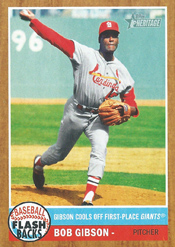
bob_gibson22On Aug. 30, 1972, the Giants beat the Cardinals, 3-2, at St. Louis despite Gibson’s dominance.

Giant killer

Gibson, 36, carried a 10-game, three-year winning streak against the Giants into his 1972 start versus them. He hadn’t lost to the Giants since Sept. 17, 1968, when Gaylord Perry pitched a no-hitter against the Cardinals at San Francisco. Since then, Gibson had posted records versus the Giants of 3-0 in 1969, 3-0 in 1970 and 4-0 in 1971.

In his only 1972 start against the Giants, Gibson held them hitless in the first inning, but yielded three singles, resulting in a run, in the second.

In the sixth, Gibson struck out the side, Bobby Bonds, Jim Howarth, Chris Speier, and led off the bottom half of the inning with a home run into the left-field seats against starter Jim Willoughby, tying the score at 1-1. It was Gibson’s fifth home run of the season and matched the career high he first achieved in 1965.

Price is right

Each of the Giants in the starting lineup struck out at least once against Gibson and he held the Giants hitless from the third inning through the eighth. “Gibson may be close to 37, but he still amazes me every time he gets out there,” Giants coach Joey Amalfitano told the Associated Press. “He’s one guy I’d pay to watch.”

The Cardinals were unable to break though against Willoughby, a rookie, and the score remained tied at 1-1 through eight.

In the ninth, a tiring Gibson yielded a walk and three singles, including RBI-hits by Dave Rader and Tito Fuentes, giving the Giants a 3-1 lead.

Bernie Carbo hit a solo home run off Willoughby in the bottom of the ninth, but it wasn’t enough for the Cardinals. Boxscore

“I’d trade those 14 strikeouts for a win anytime,” Gibson said.


Ken Burkhart was the first Cardinals pitcher to earn a save and a win in relief in his first three major-league games, according to researcher Tom Orf.

ken_burkhartBurkhart, who pitched with an unusual delivery, like someone heaving a shot put, was 28 when he achieved his feat in April 1945.

Working the farm

Burkhart (the original spelling of the name was Burkhardt) was working as a machinist in Cleveland in the summer of 1937 when he attended a Cardinals tryout camp at Columbus, Ohio. The Cardinals invited him to their baseball school at Winter Haven, Fla., the following spring.

The Cardinals signed Burkhart, 21, at the 1938 Winter Haven camp and he began an odyssey through the St. Louis farm system.

Burkhart earned 20 wins for Class B Asheville (N.C.) in 1940. A broken left leg in 1942 set him back.

After posting a 15-9 record for Class AA Columbus (Ohio) in 1944, Burkhart was invited to the Cardinals’ spring training camp in 1945. With several pitchers in military service, Burkhart was given a long look by the Cardinals and the rookie won a spot on their Opening Day roster.

“It seemed a long time coming up, but I kept aiming for the top,” Burkhart told The Sporting News.

Fast start

On April 21, 1945, Burkhart made his major-league debut in the Cardinals’ home opener, pitching two scoreless innings and getting the win in a 3-2 St. Louis victory over the Reds at Sportsman’s Park.

Following starter Blix Donnelly and Bud Byerly, Burkhart entered in the eighth with the score tied at 2-2 and retired six of the seven batters he faced in his two innings of work. In the bottom of the ninth, Johnny Hopp delivered a RBI-single against starter Arnold Carter, lifting the Cardinals to victory. Boxscore

The next day, April 22, Burkhart pitched 1.1 innings of scoreless relief in Game 2 of a doubleheader versus the Reds.

In his third appearance, April 29, Burkhart got his save.

With the Cardinals ahead, 4-3, in Game 2 of a Sunday doubleheader at Crosley Field in Cincinnati, Burkhart relieved starter Mort Cooper with two outs in the seventh. He shut down the Reds, yielding no runs in 2.1 innings. The Cardinals won, 8-3. Boxscore

Relentless grinder

Burkhart completed the 1945 season with an 18-8 record and 2.90 ERA in 42 appearances for the Cardinals. He made 22 starts and 20 relief appearances, totaling 217.1 innings. The right-hander was 12-7 with a 2.75 ERA as a starter and 6-1 with three saves and a 3.40 ERA as a reliever.

Burkhart was a combined 6-0 that season against the Cubs and Dodgers.

“He’s one of the gamest pitchers I’ve ever had work for me,” Cardinals manager Billy Southworth said. “I’ve had men with more stuff, but none who ever bore down harder all the way.”

Calling strikes

His rookie season was Burkhart’s best as a big-league pitcher.

In four seasons with the Cardinals, Burkhart was 27-17 with seven saves and a 3.60 ERA. In July 1948, the Cardinals dealt Burkhart to the Reds for first baseman Babe Young. Burkhart was 0-3 with one save and a 5.40 ERA in two seasons with Cincinnati.

With his pitching career at an end, Burkhart returned to the minors and began a second career as an umpire.

Burkhart was a National League umpire from 1957-73. He worked the 1964 World Series between the Yankees and Cardinals. It was the Cardinals’ first World Series appearance since Burkhart pitched for them in 1946.

Burkhart was the home plate umpire when the Yankees won, 2-1, in Game 3 of the 1964 World Series.

In his 1964 book “Stan Musial: The Man’s Own Story,” Musial, commenting on Burkhart as a pitcher, said, “Ken had an idea the plate was wider and the strike zone bigger than he sees them now as an umpire. He had a frozen shoulder, a strange shot-put delivery, and only limited skill, but he had a good competitive heart.”

Previously: The day Ralph Kiner hit 3 home runs vs. Cardinals

On a day when they would be expected to receive presents, five Cardinals delivered gifts to their team.

randal_grichukJulian Javier, Ted Simmons, Todd Zeile, Colby Rasmus and Randal Grichuk are Cardinals who hit grand slams on their birthdays. Each led to a Cardinals triumph.
The youngest was Rasmus at 24. The oldest was Zeile at 28. Each of the other three achieved the feat on his 25th birthday.

Four of the five grand slams occurred on birthdays between Aug. 9 and Aug. 13. The other was in September.

Here is a look at each:

Stay fair

On Aug. 9, 1961, at Forbes Field in Pittsburgh, Javier, who turned 25 that day, broke a scoreless tie with an eighth-inning grand slam off Pirates starter Joe Gibbon. The Cardinals won, 4-0, for their seventh consecutive victory.

Javier, who had been traded by the Pirates to the Cardinals a year earlier, swung at an 0-and-1 pitch from Gibbon and hit it the opposite way down the right-field line. It landed in the seats near the foul pole.

“I see fastball and I swing,” Javier said to the St. Louis Post-Dispatch.

It was the first of two major-league grand slams for Javier and one of just two home runs he hit in 445 at-bats that season.

“Best birthday present I ever had,” Javier said.

In the ninth, facing Bobby Shantz, Javier again batted with the bases loaded, but flied out to center field. Boxscore

Simba slam

On Aug. 9, 1974, at Busch Memorial Stadium in St. Louis, Simmons, who turned 25 that day, erased a 1-0 Dodgers lead by hitting a slider from starter Geoff Zahn for a grand slam in the sixth inning. The Cardinals won, 5-3.

It was the third of nine grand slams for Simmons in his big-league career.

Said Simmons: “It certainly was a nice way to celebrate.” Boxscore

Giant slayer

On Sept. 9, 1993, at Candlestick Park in San Francisco, Zeile, who turned 28 that day, stretched the Cardinals’ lead from 5-2 to 9-2 with a grand slam off reliever Terry Bross in the sixth inning. The Cardinals won, 9-4.

Zeile hit a 2-and-1 pitch from Bross over the left-field wall for the second of his nine career big-league grand slams.

“It hurts a lot,” Bross said to the San Jose Mercury News. “I could have helped the team and didn’t get the job done.” Boxscore

Dramatic duel

On Aug. 11, 2010, at Great American Ball Park in Cincinnati, Rasmus, who turned 24 that day, snapped a scoreless tie with a grand slam off starter Bronson Arroyo in the fifth inning. The Cardinals won, 6-1, a day after a brawl during which Reds pitcher Johnny Cueto kicked two Cardinals, pitcher Chris Carpenter and catcher Jason LaRue.

Rasmus drove a pitch 418 feet over the center field wall for the first of five career grand slams in the big leagues.

Bernie Miklasz, Post-Dispatch columnist, wrote, “It was one of the best at-bats of the Cardinals’ season, with Rasmus falling behind in the count 0-and-2, fouling off two pitches and working the duel back to 3-and-2 before launching a deep broadside toward the fake tugboat the Reds keep in center field.”

As the ball carried over the fence, Rasmus raised his fist in the air.

“After I hit that ball, I probably was about as jacked as I’ve been in a while,” Rasmus said. Boxscore

Streak stopper

On Aug. 13, 2016, at Wrigley Field in Chicago, Grichuk, who turned 25 that day, hit an eighth-inning grand slam off reliever Joe Smith, extending the Cardinals’ lead over the Cubs from 4-2 to 8-2. The Cardinals won, 8-4, and broke the Cubs’ 11-game winning streak.

Grichuk had been recalled by the Cardinals from Class AAA Memphis two days earlier. “I’m definitely thankful for being up here right now and getting the opportunities and I’m definitely trying to take advantage of it,” Grichuk said to the Associated Press. Boxscore

Previously: Tim McCarver, Terry Pendleton share grand feat

(Updated March 27, 2023)

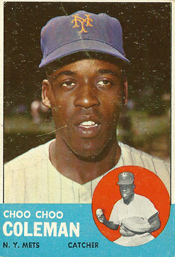
In his first game as a starting catcher for the 1962 Mets, Choo Choo Coleman dared to lead off an inning with a bunt against Bob Gibson.

choochoo_colemanBy challenging the Cardinals’ ace, Coleman played a key role in ending Gibson’s four-game winning streak and snapping the Mets’ 11-game skid.
On July 27, 1962, in the first game of a doubleheader against the Cardinals, Coleman opened the third inning with a bunt single and scored the lone run in the Mets’ 1-0 victory at St. Louis. Coleman’s batterymate, Al Jackson, who hadn’t earned a win in more than a month, pitched the shutout.

It was the only 1-0 win for the 1962 Mets and one of four shutout victories for them. Jackson pitched all four.

Runaway train

Clarence Coleman told an interviewer he got the nickname “Choo Choo” as a boy in his hometown of Orlando because he ran fast like a train.

Small for a catcher at 5 feet 9 and 165 pounds, Coleman entered the big leagues with the 1961 Phillies and batted .128 for them in 34 games.

The Mets selected Coleman in the National League expansion draft, but assigned him to Class AAA Syracuse before the start of the 1962 season. According to The Sporting News, “He didn’t take well to the demotion.”

Coleman batted .195 for Syracuse, but when Mets catcher Sammy Taylor fractured the ring finger on his right hand in July 1962, Coleman was promoted to the big club.

Getting a boost

The Mets had lost 16 of their previous 17 games entering the July 27 doubleheader versus the Cardinals.

Mets manager Casey Stengel, looking to show confidence in Coleman, put him in the starting lineup for the first time. He couldn’t have picked a much tougher opponent than Gibson.

Stengel “is currently embarked upon a psychological campaign designed to instill the big-league attitude into the shy and uncommunicative Choo Choo Coleman,” The Sporting News reported.

In the book “We Played the Game,” Mets outfielder Gene Woodling said Coleman “had the misfortune of coming out of a poor area of Florida and not getting much education … The sorriest thing I ever saw was Casey trying to teach Choo Choo how to count on his fingers. He had to paint them.”

Gibson had limited the Mets to a two-out Felix Mantilla single through the first two innings before Coleman led off the third.

Batting left-handed, Coleman bunted toward third baseman Ken Boyer and raced down the line for a single. Jackson followed with a sacrifice bunt, moving Coleman to second.

Gibson struck out Richie Ashburn for the second out.

The next batter, Rod Kanehl, hit a routine grounder. Shortstop Julio Gotay reached for the ball, but couldn’t come up with it.

Coleman, living up to his nickname, steamed around third base and dashed for home. While Gotay still struggled to field the ball, Coleman streaked across the plate with the unearned run. Boxscore

Off track

Stengel also started Coleman in the second game of the doubleheader. Facing Larry Jackson, Coleman produced the first of his two career triples, but the Cardinals won, 6-5.

Coleman played in 55 games for the 1962 Mets and batted .250. Grasping for a positive, The Sporting News said of the diminutive catcher, “Pitchers say he is one of the most adroit receivers of the low delivery.”

In his final two seasons with the Mets, Coleman hit .178 in 1963 and, after two years of exile in the minors, .188 in 1966. His career batting mark in four seasons in the majors: .197.

After his playing career, Coleman worked as a cook in a Chinese restaurant in Virginia, according to his obituary in the New York Times.

Previously: Cardinals have strong link to original Mets

Previously: Interview with former Cardinals pitcher Al Jackson

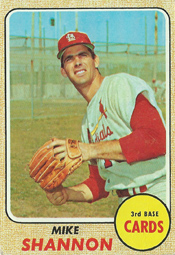
With the first grand slam of his major-league career, Mike Shannon slowed the Cubs’ momentum and helped the Cardinals split a four-game series at Wrigley Field.

mike_shannon5On Aug. 15, 1968, Shannon hit a grand slam against reliever Bill Stoneman in the second inning, carrying the Cardinals to an 8-0 victory in the finale of the series and putting a dent in the Cubs’ pennant hopes. Boxscore
Second City showdown

The Cardinals, defending World Series champions, entered the series in first place, 14 games ahead of the second-place Cubs in the National League. After the Cubs won the first two, cutting the Cardinals’ lead to 12, fans in Chicago were fired up, sensing their club was poised to get back into the pennant race.

Cardinals ace Bob Gibson dampened those hopes in Game 3, pitching a complete game in a 3-1 victory.

That set up a scenario in which the Cubs needed to win Game 4 in order to gain any ground on the Cardinals.

Get up, baby

A crowd of 23,116 turned out for the Thursday afternoon series finale and the bleachers were packed with rowdies.

Gibson, in a playful mood, pinned a button with the words “We’re No. 1” to the bill of his cap and bantered with fans in the right-field bleachers before the game. “I led the boos for Roger Maris,” Gibson said to the St. Louis Post-Dispatch, referring to his outfield teammate.

In the first inning, the Cardinals scored four runs against starter Ken Holtzman and knocked him out of the game. Shannon contributed a RBI-single.

In the second, the Cardinals loaded the bases with two outs against former teammate Jack Lamabe. With Shannon up, Lamabe was replaced by Stoneman.

Shannon hit Stoneman’s second pitch into the left-field seats. The grand slam _ the only one of his Cardinals career _ was his 500th hit in the big leagues.

“In Wrigley Field, if you get the ball in the air, you have a heck of a chance,” Shannon said.

Last laugh

The Bleacher Bums took out their frustrations on Cardinals outfielders Lou Brock, Curt Flood and Ron Davis.

“They were hitting us with everything,” said Flood. “Ice cubes, burned-out flashbulbs, fruit, tennis balls, paper cups and old sandwiches.”

Said Davis: “If you turned around, then you’d really get it. That’s when they’d start throwing things at you.”

Plotting his revenge, Flood printed a banner that stated, “We’re still No. 1.”

In the bottom of the ninth, with the Cardinals ahead 8-0, Flood took the banner with him to his position in center and spread it on the outfield grass, with the words facing the bleachers.

Knowing what was to come, Brock stuffed his ears with cotton to block out the taunts.

Day shift

Shannon finished the game 3-for-5 with five RBI and two runs scored. The performance gave him a .415 batting average (27-for-45) in day games that season.

“I just can see that ball better in the daytime,” Shannon told the Associated Press.

Nelson Briles pitched the shutout for the Cardinals. It was his fifth consecutive win and boosted his season record to 16-7.

The Cardinals went on to win the 1968 pennant, finishing nine games ahead of the Giants and 13 in front of the third-place Cubs.

Shannon finished his Cardinals career with 68 home runs. He had 16 against the Cubs, including 12 at Wrigley Field.

Previously: Mike Shannon ignited Cards with World Series blast

(Updated Dec. 25, 2018)

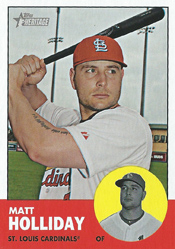
Following the advice of hitting coaches Mark McGwire and John Mabry, Matt Holliday made an adjustment in his batting stance and had his most productive game with the Cardinals.

matt_holliday7On June 16, 2012, Holliday had four hits, including two doubles and a home run, five RBI and two runs scored in the Cardinals’ 10-7 victory over the Royals at St. Louis.

In eight years (2009-2016) with St. Louis, Holliday produced 1,048 hits in 982 games, including 156 home runs, 237 doubles and 616 RBI. He batted .293 and produced a .380 on-base percentage in his Cardinals career.

Holliday 13 times had four-hit games for the Cardinals and three times had five-RBI games for them.

Only once, though, did he have four hits and five RBI in a game for St. Louis. It happened while he was in a slump.

Finding a flaw

Holliday had gone hitless in 12 consecutive at-bats before facing the Royals. He hadn’t hit a home run in almost a month.

McGwire and Mabry spotted a flaw in Holliday’s batting stance and told him about it hours before the game.

“Looking at video and working in the batting cage, Holliday was able to right what they saw was wrong,” reported Derrick Goold of the St. Louis Post-Dispatch. “He became more upright at the plate and kept from bending at the waist.”

Big bat

Making what he called a “little mechanical adjustment,” Holliday went on a tear against the Royals.

He hit a two-run home run in the first inning off Bruce Chen and a RBI-double against Chen in the second. Video The home run carried 431 feet into the Big Mac section of Busch Stadium. Video

In the seventh, with the Royals ahead 7-6, Holliday hit a RBI-single off Greg Holland, tying the score. Video

Holliday capped his performance with a RBI-double off Kelvin Herrera in the eighth. Boxscore and Video

“It’s been frustrating,” Holliday said. “My swing has felt a little off. I’ve been trying to battle, trying to get a groove, trying to find a comfort zone.”

The four-hit game lifted Holliday’s batting average from .267 to .278. He finished with a stellar season for the 2012 Cardinals, hitting .295 with 27 home runs and 102 RBI.

Previously: Left field leaders: Matt Holliday, Stan Musial