Feeds:
Posts
Comments

(Updated May 5, 2018)

Two of the best hitters of their era, Ichiro Suzuki and Albert Pujols, were in their sophomore years in the big leagues when they played against one another for the first time in the regular season. Suzuki had the better overall series; Pujols produced the biggest hit.

albert_ichiroIn June 2002, Suzuki went 6-for-12 in helping the Mariners win two of three games versus the Cardinals at Safeco Field in Seattle. Pujols was 2-for-11, but one of those hits was a grand slam that carried the Cardinals to their lone win in the interleague set.

Fourteen years later, in August 2016, Suzuki, playing for the Marlins, capped his U.S. big-league career by getting his 3,000th hit. On May 4, 2018, Pujols, playing for the Angels, got his 3,000th career hit.

Suzuki has a career .333 batting average (27-for-81) against the Cardinals.

Bat man

In 2001, Suzuki won the American League Rookie of the Year Award and Pujols won the National League Rookie of the Year Award.

They brought star power to the Cardinals-Mariners series the following season.

On June 10, 2002, Suzuki was 3-for-5 with three runs scored and two RBI in the Mariners’ 10-0 victory over the Cardinals. Suzuki singled off starter Bud Smith and had a double and triple against Luther Hackman. Boxscore

Before the game, reporter Larry LaRue of the Tacoma News Tribune visited Suzuki in the clubhouse while Suzuki examined new bats. “Each bat shipped to him from Japan comes shrink-wrapped (in cellophane) and once he unwraps a bat it’s kept in a specially-made case beside his locker,” wrote LaRue.

Mariners infielder Bret Boone called the case Suzuki’s humidifier.

Suzuki said, “No matter how well you take care of your bat, eventually moisture gets into the wood. Even clubhouse air-conditioning can effect the wood.”

Before placing a bat in the case, Suzuki tapped the barrel with his palm, then held it to his ear, listening for a tone, LaRue reported. Suzuki said, “High pitch, better wood. Low pitch, it probably gets used for batting practice.”

Pujols pop

In Game 2 of the series, on June 11, 2002, Suzuki had another strong game. He was 2-for-3 _ a double off starter Woody Williams and a single against Steve Kline _ with two walks and a stolen base, but it was Pujols who created the sweetest sound with his swing.

In the sixth inning, with the Mariners ahead 1-0, the Cardinals had runners on second and third with one out. Mariners manager Lou Piniella instructed starter James Baldwin to issue an intentional walk to J.D. Drew and face Pujols with the bases loaded.

“I’m trying to get out of the inning with a double play ball,” Piniella said to the St. Louis Post-Dispatch.

Said Pujols: “I was surprised.”

Pujols watched two curves sail out of the strike zone. Behind in the count 2-and-0, Baldwin threw a fastball. Pujols pounded it over the center-field fence for the second grand slam of his Cardinals career.

“That young guy has some real pop,” Piniella said to the Seattle Post-Intelligencer.

Pujols added a single and finished 2-for-4 with four RBI and two runs scored in a 7-4 Cardinals triumph. Boxscore

Part of 3,000

In the series finale, June 13, 2002, Suzuki doubled off starter Darryl Kile and finished 1-for-4 in a 5-0 Mariners victory. Pujols was 0-for-3. Boxscore

For the series:

Suzuki’s totals: 6-for-12, three doubles, two singles, one triple, two walks, three runs and two RBI.

Pujols’ totals: 2-for-11, one home run, one single, four RBI, two runs.

Here is how Suzuki fared in his subsequent season series versus the Cardinals:

_ 2004: 3-for-11.

_ 2010: 5-for-13.

_ 2014: 0-for-7.

_ 2015: 3-for-15.

_ 2016: 5-for-14.

_ 2017: 5-for-9.
 

(Updated July 30, 2024)

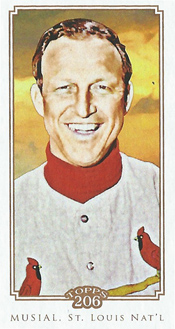
Facing three of the toughest starters in the National League, Stan Musial produced a spectacular hitting spree that propelled him to his second of seven batting titles.

stan_musial31From Aug. 11-12, 1946, Musial had 12 hits in 14 at-bats over three games against the Reds and Cubs. The surge put him atop the National League batting leaders list, moving his average from .359 to .375. He went on to win the batting crown with a .365 average.

Musial achieved his nearly perfect stretch in games started by Johnny Vander Meer and Ewell Blackwell of the Reds and Claude Passeau of the Cubs. All three would earn multiple all-star berths and were respected as much for their competitiveness as for their skill.

Asked whether he tried to guess what pitch he would get, Musial told Roger Kahn of Sport magazine, “I don’t guess. I know. I can tell by the speed. Every pitcher has a set of speeds. The curve goes one speed and the slider goes at something else.

“If I concentrate, I can pick up the speed of the ball about the first 30 feet it travels. I know the pitcher and I know his speeds. When I concentrate, halfway in I know what the pitch is going to be (and) how the ball is going to move when it gets up to home plate.”

Hard thrower

On Aug. 11, 1946, a Sunday afternoon, the Cardinals played a doubleheader against the Reds before a crowd of 32,288 at Crosley Field in Cincinnati.

The Reds started Vander Meer, a left-hander, in the opener. In his book, “Stan Musial: The Man’s Own Story,” Musial said of Vander Meer, “One of the toughest I ever hit against. An extremely hard thrower and wild. His ball moved up and in on a left-handed hitter. You didn’t know where the ball was going. I don’t think Vandy knew either.”

Musial drew a walk in the first inning, singled in the third, popped out to the catcher in the fourth and drilled a RBI-single in the sixth. After Vander Meer was lifted, Musial singled against Johnny Hetki in the seventh and tripled off former teammate Clyde Shoun in the ninth.

Musial’s line: 4-for-5 with a walk, three runs scored and one RBI in the Cardinals’ 15-4 victory. Boxscore

The Whip

In the second game, the Reds started Blackwell, a right-hander with a wicked sidearm delivery. “Blackie was one of the fastest and greatest pitchers I’ve seen.” said Musial. “He was big and gangly and because of his whip-like delivery you could hardly pick up the ball until it was in on you. He had natural stuff, including a terrific sinker.”

Musial had a double and a single in his two at-bats against Blackwell. Joe Beggs relieved and Musial reached him for a solo home run and a single. That gave Musial hits in seven consecutive at-bats over two games in the doubleheader.

In Musial’s fifth at-bat of Game 2, against Bob Malloy, he flied out to left.

Musial’s line: 4-for-5 with two runs scored and one RBI in a 7-3 Cardinals triumph. Boxscore

Suspicious sinker

The Cardinals boarded a train for Chicago and opened a series against the Cubs on Monday, Aug. 12, at Wrigley Field. The Cubs started Passeau, a right-hander. “His ball really went down,” Musial said. “I thought it was a spitter, just as others did, but Passeau, a mean competitor, always insisted it was a sinker. Wet or dry, it was a hell of a pitch.”

Musial singled against Passeau in the first inning. In the third, Passeau was lifted because of a back injury. Emil Kush relieved and Musial got three hits against him: a RBI-double in the third, a single in the fifth and a RBI-single in the seventh.

Musial’s line: 4-for-4 with two RBI and a run scored in a 5-0 Cardinals victory. Boxscore

Musial achieved his third consecutive four-hit game.

His three-game totals: 12-for-14, eight singles, two doubles, one triple, one home run, one walk, six runs scored and four RBI.

The St. Louis Post-Dispatch hailed Musial as “the National League’s closest approach to Ted Williams.”

A humble Musial told the Associated Press, “I guess it’s just a streak that comes along for everybody if they keep swinging.”

The next day, Aug. 13, Musial cooled off a bit. He was 1-for-4 against Johnny Schmitz, a Cubs left-hander.

Musial finished the 1946 season with a major league-leading 228 hits.

Mike Laga, a premier power hitter in the minor leagues, produced a long ball that became part of Cardinals lore.

mike_lagaOn Aug. 10, 1986, the Cardinals traded catcher Mike Heath to the Tigers for pitcher Ken Hill and a player to be named. Three weeks later, on Sept. 2, the Tigers sent Laga, a first baseman, to the Cardinals, completing the trade.
Laga, 26, was chosen by the Tigers in the first round of the 1980 draft. A left-handed slugger, Laga three times hit 30 or more home runs in a season in the Tigers’ minor-league system, including 34 for Class AAA Evansville in 1982. However, in parts of five seasons (1982-86) with the Tigers, Laga hit just eight home runs.

The Cardinals, who won the National League pennant in 1985, were out of contention in September 1986. With first baseman Jack Clark injured, manager Whitey Herzog put Laga into the Cardinals’ lineup.

High riser

On Sept. 15, 1986, Laga was the first baseman when the Cardinals played the first-place Mets at Busch Memorial Stadium in St. Louis. Laga hit a double off Ron Darling in the second inning.

In the third, Laga was batting against Darling for the second time when he swung at a pitch and lofted it high and foul on the first-base side. The ball carried about 150 feet into the air and landed outside the stadium.

Laga became the first player to hit a ball out of Busch Stadium since it opened in May 1966. Video

“A Cardinals official said that the distance of the stadium roof from the field was 130 feet and that the ball was found in a flower bed near the employees parking lot,” the St. Louis Post-Dispatch reported.

Fans gave Laga a standing ovation.

Said Laga: “It was pretty funny … I really didn’t think about it until the people got louder and louder. I said, ‘What the heck is going on here?’ I didn’t know it was the first one.”

After the ovation, Darling struck out Laga.

“Last year, the cheering was for a pennant winner,” wrote columnist Kevin Horrigan of the Post-Dispatch. “This year, it’s for foul balls. Lo, how the mighty have fallen.” Boxscore

Coleman challenged

Later, Herzog teasingly told Cardinals speedster Vince Coleman, “If you ever hit one out (of Busch Stadium), even behind home plate, fair or foul, I’ll buy you a Rolls-Royce.”

Teammate Ozzie Smith, overhearing Herzog’s challenge, told Coleman, “And I’ll pay for the chauffeur.”

Laga added, “If I hit it right and get it up in the air, I can hit it out of any ballpark.”

Laga hit three home runs for the Cardinals in 1986 and one each in 1987 and 1988. He spent most of the Cardinals’ 1987 championship season with Louisville, hitting .304 with 29 home runs and 91 RBI for the Class AAA club.

After the 1988 season, Laga was released by the Cardinals and was signed by the Giants. He hit three home runs in parts of two seasons with the Giants, giving him a total of 16 in the major leagues.

Previously: Why Cardinals pounced on offer for Joaquin Andujar

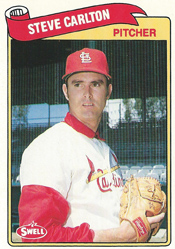
At 21, Steve Carlton was a quick study in learning the art of pitching. Combining skill with knowledge, Carlton earned his first big-league win with the Cardinals on Aug. 5, 1966.

steve_carlton6Mixing a changeup with a fastball and curve, Carlton pitched a complete game in the Cardinals’ 7-1 victory over the Mets at Shea Stadium in New York.
“Up here you need that third pitch, especially when you’re having trouble with either your fastball or your curve,” Carlton said to the St. Louis Post-Dispatch. “I wasn’t getting my curve over this time.”

It was the first of 329 regular-season wins for Carlton in his 24 years in the big leagues. He ranks second all-time in wins among left-handers. Only Warren Spahn (363) has more.

Carlton earned 77 wins in seven years (1965-71) with the Cardinals before he was traded to the Phillies.

Hall of Fame game

In 1965, Carlton’s first big-league season, he pitched in 15 games, including two starts, for the Cardinals and had an 0-0 record.

Carlton opened the 1966 season with Tulsa and was 9-5 with a 3.59 ERA in 19 starts for the Class AAA club.

On July 25, 1966, the Cardinals and Twins played an exhibition game as part of the National Baseball Hall of Fame induction festivities at Cooperstown, N.Y. Not wanting to use one of their starters, the Cardinals gave the assignment to Carlton, who still was on the Tulsa roster. Taking advantage of the opportunity, Carlton pitched a complete game and struck out 10 in a 7-5 Cardinals victory. Four of the runs scored by the Twins were unearned.

Liking what they saw, the Cardinals put Carlton on their active roster and gave him a start against the Dodgers on July 31, 1966. Carlton pitched four innings, yielded two runs and didn’t get a decision.

Pitch like a pro

Five days later, with the Cardinals looking to shake a five-game losing streak, Carlton got the start against the Mets.

The leadoff batter reached base in four of the first five innings against Carlton, but the Mets scored just once. Carlton held the Mets hitless over the last four innings.

The Mets totaled six hits: five singles and a Ken Boyer double.

“The kid has a nice, easy motion and pitches as if he’s been around for 10 years,” said Mets manager Wes Westrum. “His ball is really live.”

Said Carlton: “I was getting the ball in good spots this time, but I still was putting too many men on base. Red Schoendienst (Cardinals manager) was nice going with me as long as he did.”

Carlton was supported by three Cardinals home runs, including a three-run shot from his catcher, Tim McCarver. Julian Javier contributed a two-run home run and Tito Francona had a solo shot. Boxscore

Carlton made nine starts for the 1966 Cardinals, posting a 3-3 record and 3.12 ERA.

Previously: How Chase Riddle got Steve Carlton for Cardinals


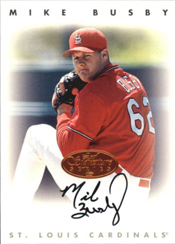
In the first week of his first season as Cardinals manager, Tony La Russa had a problem. After five games, his bullpen was overworked. Entering the finale of a six-game road trip, La Russa needed his No. 5 starter, rookie Mike Busby, to pitch as long as possible in his big-league debut against the Braves in Atlanta.

mike_busbyOn April 7, 1996, Busby absorbed a beating by the Braves, who scored 13 runs in four innings before Busby was relieved. The Braves scored twice in the first inning, five times in the second, four times in the third and twice in the fourth.
La Russa and pitching coach Dave Duncan had hoped Busby could pitch at least five innings.

Climbing the ladder

Busby was selected by the Cardinals in the 14th round of the 1991 draft. His best performance in their minor-league system was in 1993 when he was 12-2 with a 2.44 ERA for Class A Savannah.

In 1996, Busby opened the season in the big leagues for the first time as the No. 5 starter for the Cardinals behind Andy Benes, Todd Stottlemyre, Alan Benes and Tom Urbani.

After splitting the first two games of the season with the Mets, the Cardinals gave up 10 runs in a Game 3 loss to New York and won a pair against the Braves in 12 innings and in 10 innings.

Long balls

La Russa and Duncan hoped to avoid using the bullpen much in the finale of the series in Atlanta.

The Braves hammered Busby for nine hits, including seven for extra bases. Busby yielded four home runs, including a Marquis Grissom grand slam. Busby also issued four walks and hit a batter.

Duncan said Busby likely was tipping his pitches because of how he held his glove.

“The way they were swinging the bats, nothing was surprising them,” Duncan told the St. Louis Post-Dispatch.

Said Busby: “You can’t make mistakes to those big hitters. Down in the minor leagues, you can get away with those mistakes. Here, they jump all over them.”

Guts, no glory

The Braves won, 13-3. Tony Fossas and Cory Bailey each pitched two innings of scoreless relief for St. Louis.

La Russa held a closed-door clubhouse meeting after the game.

“I made it a point to commend Mike in front of everybody,” La Russa said. “He was in a tough situation, but he never once embarrassed himself or embarrassed the team. He’s got special insides. He’ll be fine.”

Said Busby: “I don’t want any sympathy.” Boxscore

Mixed results

The next day, the Cardinals sent Busby to Class AAA Louisville and called up pitcher Brian Barber. Busby spent the remainder of the season in the minors. He was 2-5 with a 6.38 ERA for Louisville.

Busby appeared again with the Cardinals in each of the next three seasons. He was 0-2 in 1997, 5-2 in 1998 and 0-1 in 1999.

Granted free agency after the 1999 season, Busby signed with the Brewers but never pitched in the big leagues again. His career totals with the Cardinals: 5-6, 6.48 ERA in 45 games.


(Updated April 17, 2022)

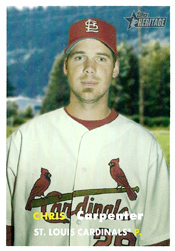
Three years after the Blue Jays removed Chris Carpenter from their big-league roster and told him he’d have to go to the minors if he wanted to remain with the organization, the pitcher returned to Toronto as a member of the Cardinals and showed why giving up on him was a mistake.

chris_carpenter11On June 14, 2005, Carpenter faced the Blue Jays for the first time since leaving them and pitched a one-hit shutout for a 7-0 Cardinals victory that was as much personal as it was professional.

The masterpiece at Toronto helped establish Carpenter as a pitcher who got big wins in the big games for St. Louis. Carpenter posted a 95-44 regular-season record and 10-4 postseason mark (including 3-0 in the World Series) as a Cardinals starter from 2004-2012.

Oh, Canada

Carpenter began his professional career with the Blue Jays. He was selected by them with the 15th pick in the first round of the 1993 amateur draft, just ahead of pitcher Alan Benes, who was chosen by the Cardinals with the 16th selection.

Four years later, Carpenter made his big-league debut. One of the teammates who influenced him was pitcher Pat Hentgen, who, like Carpenter, would pitch for the Cardinals after leaving the Blue Jays.

“He taught me the importance of what every fifth day was,” Carpenter told Cardinals Magazine. “You get one time every five days to go and make an impact, and you need to make that important. I learned from him that you have to find a way to grind through it, no matter if you feel good or not.”

Carpenter had a 49-50 record for Toronto from 1997-2002.

In October 2002, the Blue Jays removed Carpenter, who had undergone shoulder surgery, from their big-league roster and offered him a spot at Class AAA Syracuse. Instead, Carpenter chose to become a free agent and signed with the Cardinals.

He spent 2003 working his shoulder into shape and didn’t pitch in the major leagues that season. He returned to the big leagues with the Cardinals in 2004.

Good stuff

After posting a 15-5 record in 28 starts for the 2004 Cardinals, Carpenter established himself as the staff ace in 2005. He took an 8-4 record into the start at Toronto.

Carpenter’s return to Toronto drew a Tuesday night crowd of 37,536, including actor Bruce Willis. One fan held up a sign that read: “Thanks for four years of frustrating mediocrity, Carpenter.”

Carpenter responded to the wise guy with a tip of his cap.

Mostly, he let his pitching do the talking.

Effectively mixing a four-seam fastball, curve and changeup, Carpenter baffled the Blue Jays. “My stuff was good and I thought I kept them off balance pretty good,” Carpenter said to the St. Louis Post-Dispatch.

Said Cardinals manager Tony La Russa: “He had movement all over, mostly down.”

Gregg Zaun, drawing a leadoff walk in the third, was the first Blue Jays batter to reach base. The next batter, Orlando Hudson, grounded into a double play.

The Blue Jays were hitless until, with two outs in the sixth, rookie Russ Adams pulled a ball that landed barely inside the right-field foul line for a double.

Carpenter retired the last 10 batters in a row. Video

“In a game of inches, he came within a couple of inches of throwing a no-hitter,” Cardinals designated hitter Larry Walker said.

Toronto tormentor

The one-hitter was the first of Carpenter’s big-league career. It also was the 19th one-hitter by a Cardinals pitcher and the first since Vicente Palacios achieved the feat for St. Louis against the Astros in 1994.

“He wanted to come back (to Toronto) and make an impression,” La Russa said of Carpenter. “He did.”

Blue Jays manager John Gibbons told the Associated Press, “He throws downhill at you. He throws 94 mph with that big old hook that he can control. It’s tough to hit that.”

Carpenter was supported by four home runs: Walker hit a pair of two-run home runs, Reggie Sanders hit a solo shot and Albert Pujols also had a two-run home run. Boxscore

Carpenter pitched one more one-hitter. It occurred on Sept. 7, 2009, in a 3-0 Cardinals victory over the Brewers at Milwaukee. The lone hit off Carpenter was a fifth-inning double by Jody Gerut.

On June 23, 2010, at Toronto, Carpenter faced the Blue Jays for the second and last time in his career. He pitched eight scoreless innings and got the win in a 1-0 Cardinals victory.

Matt Holliday broke a scoreless tie with a two-out, RBI-single in the top of the ninth off Kevin Gregg, who had relieved starter Ricky Romero.

Ryan Franklin earned the save, yielding a single and a walk _ but no run _ in the bottom of the ninth.

Previously: Mike Matheny helped Chris Carpenter join Cards