Feeds:
Posts
Comments

As a rookie starting center fielder for the 1935 Cardinals, Terry Moore struggled initially to live up to lofty expectations. What sealed his status as a premier player was a flawless hitting performance.
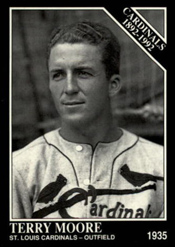
terry_mooreOn Sept. 5, 1935, Moore had six hits _ a double and five singles _ in six at-bats for the Cardinals against the Braves at St. Louis. Moore was the first Cardinals player with six hits in a game since Jim Bottomley did it on Aug. 5, 1931, against the Pirates at Pittsburgh. After Moore, no other Cardinals player got six hits in a game until Skip Schumaker achieved the feat on July 26, 2008, with six singles in seven at-bats in 14 innings against the Mets at New York.

Moore’s six-hit game secured his role as an everyday player for the Cardinals. He played his entire 11-year big-league career with St. Louis, batting .280 with 1,318 hits in 1,298 games. A four-time all-star, Moore served in the military between two stints with the Cardinals (1935-42 and 1946-48). He four times led National League center fielders in assists and twice led in putouts.

Slow start

Moore was training for a career as a printer when he was discovered by a Cardinals scout in 1932.

He had a big season in 1934, batting .326 with 213 hits in 154 minor-league games in the Cardinals’ system.

Manager Frankie Frisch declared Moore the everyday center fielder for the 1935 Cardinals, replacing veteran Ernie Orsatti.

Initially, Moore was a bust. He batted .132 (5-for-38) in April.

“He made mistakes in fielding the ball,” the St. Louis Post-Dispatch reported. “He threw to the wrong base and seemingly he couldn’t hit big-league pitching.”

The Sporting News opined, “Much was expected of him _ more perhaps than any other lad of recent transition from the minors to the big line. Moore’s trail was marked with such superlatives and so many high hopes that the youngster didn’t quite live up to the blueprints during the early part of the season.”

Frisch has faith

Frisch stuck with the rookie because he “was impressed with his courage, his speed and style in the field,” The Sporting News observed.

Said Frisch to the Post-Dispatch: “What I like about him is that he’s always trying and he’s no alibi artist. When he makes a mistake, he knows it, but he doesn’t make the same mistake twice.”

Moore, who turned 23 in May 1935, entered August with a .251 batting average, got hot and hit .419 (26-for-62) in August. His strong hitting carried into September as the Cardinals battled the Cubs for the pennant.

Battered Braves

On Sept. 5, a Thursday afternoon, Moore batted leadoff for the Cardinals against the last-place Braves before 2,700 spectators at Sportsman’s Park.

Facing ex-Cardinal Fred Frankhouse, Moore singled in the first inning and added a RBI-single in the second. After Frankhouse yielded seven runs in two innings, Huck Betts relieved. Moore reached him for a RBI-double in the third and singles in the sixth, seventh and eighth.

Moore’s final line: 6-for-6 with two RBI and two runs scored.

Betts gave up eight runs in six innings. The Braves committed five errors, three by center fielder Wally Berger. The Cardinals collected 19 hits and four walks, winning 15-3. Boxscore

Good to great

Moore batted .329 (26-for-79) in September and finished his rookie season with a .287 batting average, totaling 131 hits in 119 games.

Said Frisch: “Moore is one of the greatest young ballplayers I have seen … I think you’ll see one of the greatest center fielders in the game within two more years.”

In his book, “Stan Musial: The Man’s Own Story,” Musial, who played in an outfield with Moore and Enos Slaughter after joining the Cardinals in 1941, said, “Terry Moore was a great team leader as well as a great competitor and center fielder … Terry was a timely hitter who’ll be best remembered for his defensive plays, his ham-sized hands, accurate arm and ability to scoop up ground balls like an infielder. I’d like to have seen a defensive outfield of (Willie) Mays, Moore and (Joe) DiMaggio.”
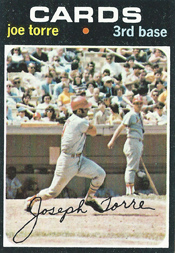
Joe Torre played in 2,209 regular-season games in an 18-year career in the major leagues. Only once did he achieve five hits in a game. It occurred for the Cardinals in a game that began on Aug. 1, 1971, at Veterans Stadium in Philadelphia and ended five weeks later on Sept. 7.

joe_torre8On Aug. 1, with the score tied at 3-3, the Cardinals scored three runs in the 12th and had runners on second and third with one out when the game was halted by rain for the second time in the inning.
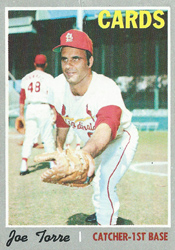
When the rain stopped, a Zamboni machine began clearing the artificial turf of water. Then, the Zamboni broke down.

“Maybe somebody put sugar in the carburetor of the Zamboni,” wrote Neal Russo in the St. Louis Post-Dispatch.

The Phillies informed the Cardinals that the Zamboni had quit working because “it was clogged with paper cups that had been thrown onto the field.”

The umpires declared the field unplayable because of the water, reverting the score to 3-3 through 11 innings and ruling the outcome a tie.

“I was told that the Zamboni had broken down and I have no way of disproving that,” said umpire and crew chief Shag Crawford. “I finally called the game because the field was unplayable.”

Cardinals manager Red Schoendienst protested, saying the game should be resumed at the point it was halted because mechanical failure, not the weather, prevented a continuation of play.

Said Cardinals coach Ken Boyer: “I finished a lot of games on fields in worse shape than this one was.”

Chub Feeney, National League president, upheld the protest and ruled it a suspended game. He said it would be resumed at the point of interruption, with St. Louis ahead 6-3, when the Cardinals visited Philadelphia again in September.

Explaining his decision, Feeney told the Post-Dispatch the umpires agreed the game could have been completed on Aug. 1 if the Zamboni had been functional.

The game forever would be referred to as the Zamboni game.

Redbirds rally

Even without the controversy involving the Zamboni, the game that began on Aug. 1 was a wild affair.

The Phillies led, 3-2, after eight innings. The Cardinals tied the score at 3-3 in the ninth on a RBI-single by pinch-hitter Ted Simmons.

Torre, batting cleanup and playing third base, flied out and struck out in his first two at-bats. In his next five at-bats, he produced five singles.

Torre had singles off starter Woodie Fryman in the sixth and eighth innings. He got his third single of the game off former Cardinals teammate Joe Hoerner in the 10th.

In the 12th, the Cardinals struck for three runs off Bill Wilson. Torre contributed to the uprising with his fourth single of the game before play was halted.

Hard on heart

When the Cardinals returned to Philadelphia in September, they split a Labor Day doubleheader with the Phillies on Sept. 6.

On Sept. 7, the Cardinals and Phillies resumed the suspended game from Aug. 1 before playing a regularly scheduled game.

The Cardinals completed the top of the 12th, stranding the runners on second and third.

In the bottom of the 12th, the Phillies scored three runs, tying the score at 6-6.

In the 13th, Torre got his fifth single of the game, a run-scoring hit off Chris Short, as part of a three-run Cardinals rally. The Phillies got two hits off Stan Williams in the bottom of the 13th but didn’t score, and St. Louis prevailed, 9-6. Boxscore

The five-hit game was the first for Torre at any level of play.

“It took me five weeks to do it, though,” Torre said.

In the regularly scheduled game that followed _ the Cardinals rallied from a two-run deficit, scoring two in the ninth and two in the 10th to win 7-5 _ Torre had three hits, giving him a total of eight in the two games that were completed that night.

“Everything was fine except that my heart is pounding too much after those two games,” Torre said.

Said Phillies manager Frank Lucchesi of pitching to Torre: “You just throw the ball and pray.”

Previously: Cards fans cheered when 1954 game forfeited to Phillies

Previously: Why Cardinals traded popular, productive Joe Torre

(Updated June 27, 2020)

Because he didn’t produce many triples, Joe Torre wasn’t a prime candidate to hit for the cycle. On the night he achieved the feat for the Cardinals, Torre increased the degree of difficulty by nearly removing himself from the game while still in need of a single.

joe_torre7On June 27, 1973, Torre hit for the cycle _ a single, double, triple and home run _ against the Pirates at Three Rivers Stadium in Pittsburgh.
Jim Rooker, in his first season with the Pirates after pitching for the Tigers and Royals, got his first National League start that Wednesday night versus the Cardinals.

Torre hit a RBI-double off the wall against Rooker in the first inning and a solo home run over the right-field fence in the third.

In the fourth, facing Bob Johnson, Torre hit a triple to left. It was Torre’s second and last triple of the season.

“I didn’t think I’d ever hit for the cycle because I’m not a triples hitter,” Torre told the St. Louis Post-Dispatch.

Needing a single to complete the cycle, Torre grounded into a double play against Johnson in the fifth inning and a drew a walk from Steve Blass in the eighth.

With the Cardinals ahead, 11-4, and figuring he likely wouldn’t get another at-bat, Torre asked manager Red Schoendienst to remove him from the game. Schoendienst, unwilling to concede the possibility of another at-bat for Torre, declined the request.

“You have to give Red an assist _ I’m glad he ignored me this time,” Torre said.

Torre was scheduled to bat fifth in the ninth inning, meaning at least two Cardinals would need to reach base to give Torre a chance at the single.

When the first two batters, Mike Tyson and Reggie Cleveland, both grounded out, the odds of Torre getting an at-bat seemed stacked against him, but Bernie Carbo and Ted Sizemore each worked a walk against Blass, who entered the game with a 9.44 ERA.

That brought Torre to the plate.

“I was pressing like crazy for the single,” he said.

Torre grounded a pitch that bounced past the mound and into center field for a RBI-single. “It was a 3-and-1 pitch and I sure wasn’t going to take another walk,” Torre told the Pittsburgh Press.

As Torre ran from the batter’s box to first base, he clapped his hands the entire way.

“If I would have hit that last ball off the wall, I would have stopped at first base,” Torre said.

Torre became the first Cardinals batter to hit for the cycle since Ken Boyer in 1964. The only Cardinals to do so since: Lou Brock (1975), Willie McGee (1984), Ray Lankford (1991), John Mabry (1996) and Mark Grudzielanek (2005).

“It’s the first time I’ve ever hit for the cycle,” Torre told the Pittsburgh Post-Gazette. “I’m not exactly a triples man, you know. It would have been a kick, though, if a lousy single had kept me from getting it.”

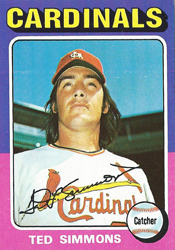
In producing the cycle and scoring four runs with three RBI, Torre overshadowed the performance of teammate Ted Simmons, who had his first five-RBI game in the big leagues.

“If I could run, I might be a triples hitter like Joe,” Simmons said to the Associated Press. Boxscore


An experiment by the Cardinals to play Ted Simmons at third base lasted two games. Simmons made three errors that contributed to two defeats, got booed by Cardinals fans and lashed out at them, saying they lacked perspective and St. Louis didn’t deserve its reputation for being a good sports town.

ted_simmons18Fortunately for Simmons, the controversy quickly faded. Simmons continued to be one of St. Louis’ best and most respected athletes, culminating his achievements with his 2020 election to the Baseball Hall of Fame.

Power shortage

The 1976 Cardinals were a deeply flawed team. In June, they traded one of their top players, outfielder Reggie Smith, to the Dodgers for a catcher, Joe Ferguson, even though the Cardinals had Simmons at that position.

One of the many problem spots for the 1976 Cardinals was third base. Their 1975 third baseman, Ken Reitz, had earned a Gold Glove Award for his fielding, but the Cardinals traded Reitz to the Giants in December 1975, opening a spot at third base for Hector Cruz, who impressed as a slugger in the minor leagues.

As an everyday third baseman with the 1976 Cardinals, Cruz was a flop. His batting average by July 20 of that season was .194.

Without Smith and with Cruz struggling, Cardinals manager Red Schoendienst sought a run producer to join Simmons in the batting order. Ferguson was his choice. Schoendienst shifted Simmons to third base and put Ferguson at catcher.

Hot corner

On July 21, 1976, at Dodger Stadium in Los Angeles, Simmons appeared at third base in a major-league game for the first time.

“Simmons had played a little third base in the minors, a little in spring training and the Florida Instructional League, too,” the St. Louis Post-Dispatch reported, “but never in the majors.”

In the 10th, with the score tied at 6-6 and reliever Al Hrabosky in his third inning of work, Bill Russell hit a routine grounder to Simmons at third. Simmons fielded the ball cleanly but threw it over the head of first baseman Keith Hernandez, enabling Russell to reach second. “The last thing I was worried about was throwing the ball away,” Simmons said. “I’ve never had any trouble throwing the ball and I’m not worried about ground balls.”

Ted Sizemore, the former Cardinals infielder, singled to center, scoring Russell and giving the Dodgers a 7-6 victory. Boxscore

“I imagine Simmons will make another error before it’s all over,” Schoendienst said. “At least he didn’t miss the ball. He just made the throw too strong.”

Cockroach game

The next night, July 22, 1976, Simmons was back at third base when the Cardinals faced the Cubs at St. Louis.

The Cardinals committed five errors _ two by Simmons, two by second baseman Vic Harris and one by Ferguson. The Cubs prevailed, 8-4. Five of their runs were unearned. Simmons miscues again led to runs for the opposition.

In the seventh, with two outs and Joe Wallis on third, former Cardinals infielder Mick Kelleher grounded to third. Simmons booted the ball and Wallis scored.

An inning later, with Manny Trillo on third, Larry Biittner on second and two outs, Wallis grounded to deep third. Trillo scored on the infield single. When Simmons threw wildly to first in a futile bid to get Wallis, Biittner scored on the misplay. Boxscore

“The Cardinals have had many low points … but last night’s game was right down there among the cockroaches,” wrote Rick Hummel in the Post-Dispatch.

Said Schoendienst: “It was bad, I’ll say that.”

Restless natives

Fans reacted with boos. Most were directed at Harris and Simmons.

A combative Simmons offered Hummel an exclusive response. His remarks were published in an article in the July 25, 1976, Sunday edition of the Post-Dispatch.

“I think the natives have been like this all along,” Simmons said. “I’ve been here seven years and they haven’t shown me anything in their reactions …

“They’ve got a right to boo, but there are things they have to take into account. They don’t understand what’s happening out there. What they have to understand is … we had a reserve at second base and we had a catcher playing third. If they can’t see past that, then they’re not showing much perspective.

“I don’t want to hear about this being a good sports town … I expect more than what I’ve seen in seven years. I’ve felt this way for a long time.”

Simmons said he didn’t want to leave the Cardinals _ “The ballclub has treated me super.” _ but felt underappreciated by fans.

“I hear people say, ‘Where are they going to hide Simmons? He can hit but he can’t field.’ So I made two errors. Maybe I’m the goat, but I didn’t ask to play third base. They asked me.”

Anticipating the reaction to his remarks, Simmons said, “I suspect I’ll get it when this comes out. I’ve never been quite what the doctor ordered for this town.”

Storm passes

On the day the article appeared, Simmons was held out of the lineup for the Cardinals’ game at Busch Stadium.

The next night, July 26, 1976, the Cardinals played at home against the Pirates. With a left-hander, former teammate Jerry Reuss, starting for the Pirates, Schoendienst benched Hernandez and started Simmons at first base.

When Simmons came to bat for the first time, “the cheers almost drowned out the boos,” Dick Kaegel of the Post-Dispatch reported.

“Not nearly as bad as I thought it might be,” Simmons said. “I was really surprised. I was really happy. I expected the worst and prepared for the worst.”

The game was called off in the fourth inning because of rain.

In 1976, Simmons went on to make 108 starts at catcher, 26 starts at first base, seven starts in left field and two starts at third base.

Simmons never appeared at third base again for the Cardinals, though he would play 16 games at third for the Brewers and 11 games there for the Braves after he was traded by the Cardinals in December 1980.


(Updated Sept. 21, 2022)

Showing a sense of place and a concern for the hometown fans, Walter Alston gave Cardinals catcher Tim McCarver a spot on the National League all-star team and a chance to play a key role.

tim_mccarver5On July 12, 1966, McCarver sparked a 10th-inning rally and scored the winning run in the National League’s 2-1 victory over the American League at St. Louis.
Played on a sweltering Tuesday afternoon two months after Busch Memorial Stadium opened, the game is best remembered for the searing heat and humidity. Game time temperature was 100 degrees and the thermometer reached a peak of 105 during the game.

Asked his opinion of the new stadium, honorary coach Casey Stengel famously replied, “Sure holds the heat well.”

Stengel also added, “The heat took the press right out of my pants.”

Right fielder Roberto Clemente of the Pirates told the St. Louis Post-Dispatch, “You could have put salt and pepper on me and fried me out in right field.”

The game attracted 49,936 spectators and 135 received first-aid treatment for ailments related to the heat, according to The Sporting News.

Often overlooked is the performance of McCarver and the role Alston played in giving the Cardinals catcher a chance to thrill the St. Louis fans.

Tim’s town

In 1966, players, managers and coaches _ not the fans _ selected the position player starters for the All-Star Game. The National League catchers who received the most votes were Joe Torre of the Braves and Tom Haller of the Giants. As was customary then for the runner-up pick, Haller was placed on the all-star squad as a reserve.

Because he had led the Dodgers to the 1965 pennant, Alston was named manager of the 1966 National League all-stars and got to choose the pitchers and the reserves. Alston selected three Cardinals for the team: pitcher Bob Gibson, center fielder Curt Flood and McCarver.

Gibson developed a sore elbow and was replaced on the all-star team by Dodgers reliever Phil Regan. Asked by The Sporting News why he chose McCarver as a third catcher for the National League, Alston replied, “Bob Gibson was forced off the squad. This is McCarver’s town.”

Haller bypassed

In the third inning, Alston had Flood bat for pitcher Sandy Koufax. Flood’s sharp grounder deflected off pitcher Denny McLain to second baseman Bobby Knoop, who fielded it behind the bag and threw out Flood.

That left McCarver as the only remaining Cardinals player.

“I didn’t think I’d get in the game because Tom Haller was still on the bench and he was voted No. 2,” McCarver said.

In the eighth, McCarver, not Haller, replaced Torre.

“I wanted very much to play,” Haller said. “I just didn’t think it was right that I didn’t.”

Said Alston: “The game was in St. Louis and the only Cardinal I’d used … was Flood and he only pinch-hit. The Giants already were well-represented with (Willie) Mays, (Willie) McCovey, (Juan) Marichal, (Gaylord) Perry and (Jim Ray) Hart. So I used Tim, the hometown boy.”

Lefty vs. lefty

McCarver, playing in his first All-Star Game, caught the eighth, ninth and 10th innings.

In the bottom of the 10th, with the score tied at 1-1, McCarver, a left-handed batter, led off against left-hander Pete Richert of the Senators.

“I know McCarver could handle left-handed pitchers pretty well,” Alston said.

McCarver said he was determined to swing at the first pitch “because I don’t like to get behind, especially against a good lefty.”

Richert threw a fastball and McCarver pulled it sharply into right field for a single.

Good jump

The next batter, Mets second baseman Ron Hunt, a St. Louis native, executed a sacrifice bunt, moving McCarver to second base.

Dodgers shortstop Maury Wills was up next. He and Richert had been Dodgers teammates. In his book, “On the Run,” Wills said, “He and I had gone out the night before to Gaslight Square in St. Louis. We listened to the Dixieland music and I played my banjo with the band and we had a good time.”

Wills worked the count to 2-and-1. “I tried to make Wills hit the ball on the ground,” Richert said.

Instead, Wills lifted a line drive to short right field for a single.

“I had a good jump and I felt I had to make them try to throw me out in that situation,” McCarver said. “I was going all the way.”

Pirates manager Harry Walker, coaching at third, had a good view of the play unfolding. Walker, a former Cardinals player, gave McCarver the green light to head toward home.

“When I saw Tim coming to the (third base) bag, (right fielder) Tony Oliva was just getting to the ball.” Walker said. “It was off-center and Oliva had to turn a little to throw it. Tim’s speed helped a lot in making up my mind.”

McCarver scored easily with the run that gave the National League its victory. Boxscore

Among the first to greet him were Perry, the winning pitcher, and Mays.

“This is my biggest thrill in baseball outside of winning the (1964) World Series,” McCarver said. Video


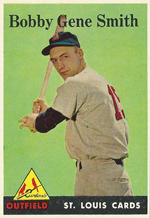
Bobby Gene Smith twice opened seasons as the starting center fielder for the Cardinals. Both times, he was unable to hit consistently.

bobbygene_smithIn 1957, Smith, a rookie, was the Cardinals’ starting center fielder from Opening Day through May 20. He was replaced by Ken Boyer, who moved from third base to center field.

In 1958, Boyer was back at third base and Smith again was manager Fred Hutchinson’s choice to be the Cardinals’ Opening Day starter in center field. He kept the job for a week, got sent to the minors and was replaced by rookie Curt Flood.

Top prospect

Smith signed as an amateur free agent with the Cardinals in 1952.

He had three consecutive impressive seasons in the Cardinals’ minor-league system:

_ In 1954, with Class C Fresno, Smith hit .305 with 22 triples and 107 RBI.

_ In 1955, still with Fresno, Smith batted .370 with 206 hits in 141 games.

_ In 1956, with Class AA Houston, Smith hit .299 with 21 home runs and 109 RBI.

Though he hadn’t played at the Class AAA level, Smith, 22, went to spring training in 1957 with the Cardinals and was tabbed by The Sporting News as a “standout candidate” for the starting center field job.

Rookie starter

Based primarily on his fielding in spring training, Smith was chosen by Hutchinson to supplant Bobby Del Greco as the starting center fielder.

In his major-league debut, Smith was 2-for-5, including a two-run home run off Art Fowler, in the Cardinals’ 13-4 Opening Day victory over the Reds on April 16, 1957, at Cincinnati. Boxscore

“That kid is going to be a real good one _ and for a long time,” Reds manager Birdie Tebbetts said.

However, the leap from Class AA to the big leagues proved too big of an adjustment for Smith. His batting average was .225 on May 21, 1957, when Hutchinson moved Boyer into center field and put rookie Eddie Kasko at third base.

Smith remained with the Cardinals as a reserve. On July 7, 1957, with Boyer nursing a stiff elbow, Smith got the start in center field and had his most productive game in the big leagues. Facing the Reds in the second game of a doubleheader at St. Louis, Smith was 3-for-4 with four RBI, including a three-run home run off Tom Acker. Boxscore

The highlights, though, were few for Smith. He hit .211 for the 1957 Cardinals, with 39 hits in 93 games. Smith made 41 starts in center and four starts in right.

On the move

In spring training 1958, Smith regained the center field job and was in the starting lineup when the Cardinals opened the season on April 15 at home against the Cubs.

Smith started in center in six of the first eight games for the 1958 Cardinals and batted .208. By the end of April, Flood was called up from the minor leagues, inserted as the starter in center and Smith was demoted to Class AAA Omaha, where he played for manager Johnny Keane.

In December 1959, the Cardinals traded Smith to the Phillies for catcher Carl Sawatski.

“We think he might be one of those players who develops as a hitter a little late,” Phillies general manager John Quinn said.

Three years later, on June 5, 1962, the Cardinals reacquired Smith, sending shortstop Alex Grammas and outfielder Don Landrum to the Cubs for him and infielder Daryl Robertson.

“We’re going to use Smith in the ballgames _ not as a pinch-hitter,” Keane, the Cardinals’ manager, told the St. Louis Post-Dispatch. ‘He’s going to be playing. We need right-handed hitters.”

Smith, sometimes platooning with Stan Musial in left field, hit .231 in 91 games for the 1962 Cardinals. In April 1963, the Cardinals sold Smith’s contract to the Red Sox, who assigned him to the minor leagues.

In four seasons (1957-59 and 1962) with the Cardinals, Smith hit .231 overall. In a seven-year big-league career with the Cardinals, Phillies, Mets, Cubs and Angels, Smith batted .243 with 13 home runs.

Two of those home runs were with the Phillies against the Cardinals: a two-run, pinch-hit home run off Bob Gibson on June 26, 1960, and a solo shot off Curt Simmons on Sept. 11, 1960.

Previously: Ken Boyer converted from infield to center