Feeds:
Posts
Comments

One month after being released and having to return to the minor leagues to prove his worth as a pitcher, Ray Burris joined the Cardinals and showed them his bat was as valuable as his arm.
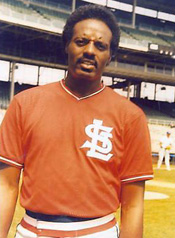
ray_burrisIn May 1986, Burris joined Dizzy Dean of the 1936 Cardinals as Redbirds pitchers to produce three RBI or more in consecutive games.

In 2016, Adam Wainwright matched the feats of Dean and Burris. Wainwright had three RBI for the Cardinals in their 11-4 victory over the Diamondbacks on April 27, 2016. Boxscore In the next game in which he batted, May 2, 2016, against the Phillies, Wainwright again had three RBI in a 10-3 Cardinals triumph. Boxscore

Eighty years earlier, Dean drove in three runs for the Cardinals in their 8-5 victory over the Braves on July 26, 1936. Boxscore In the next game in which he batted, July 31, 1936, against the Dodgers, Dean again had three RBI in an 8-6 Cardinals triumph. Boxscore

Like Bob Gibson and Bob Forsch, Dean and Wainwright are considered to be among the best-hitting Cardinals pitchers.

Burris didn’t have that kind of reputation. His performance was most unexpected.

Just hacking

Burris, 35, was released by the Brewers on April 1, 1986. The Cardinals signed him 10 days later and assigned him to Class AAA Louisville. He last had pitched in the minor leagues in 1974.

After producing a 1-1 record and 2.41 ERA in four starts for Louisville, Burris was called up to the Cardinals. “We got him because he can throw strikes,” St. Louis manager Whitey Herzog said to United Press International.

Burris, a 6-foot-5, 200-pound right-hander, was the starting pitcher in his Cardinals debut against the Giants on May 10, 1986, at St. Louis.

In the second inning, with the bases loaded and one out, Burris, facing Giants starter Roger Mason, swung at the first pitch, a ball down and in, and pulled it along the left-field line for a three-run double.

“Because I was having control troubles, I thought he’d be taking,” Mason said to the Sacramento Bee. “I was wrong.”

Burris: “I swing if the ball is in the vicinity of the plate … I guess it’s just hacking.”

Herzog: “I might bat Burris cleanup. It was nice to see that double.”

Burris pitched seven innings, departing to a standing ovation from the Saturday night crowd of 44,795, and got the win in a 6-3 Cardinals victory. Boxscore

“He’s just a crafty guy,” said Giants catcher Bob Brenly. “He takes off a little on a pitch, then puts it back on.”

Dream performance

The next game in which Burris batted was in a start on May 24, 1986, against the Braves at St. Louis.

Just like in his Cardinals debut, Burris batted in the second inning with the bases loaded. Again, he doubled along the left-field line, sending a shot past third baseman Ken Oberkfell for a three-run double off starter David Palmer.

“What I could have done was gotten ahead of him and made him hit my pitch,” Palmer told the Atlanta Journal-Constitution. “Instead, I got behind him and had to come in with one. He hit it where he should have hit it.”

Burris: “It was a flashback. It’s all a dream and I’m glad it’s happening … How can you explain it? I’m no Jack Clark.”

Herzog: “I think my pitchers are leading the team in RBI. Burris is doing the job at the plate.”

In the fifth, Burris produced his fourth RBI of the game, a run-scoring single off Duane Ward.

“The ball just keeps hitting my bat,” Burris said.

Burris pitched six innings and got the win in a 9-5 Cardinals triumph. Boxscore

Fading out

After winning his first two decisions for the Cardinals, Burris lost five of his next seven.

He was 4-5 with a 5.60 ERA in 23 appearances, including 10 starts, when the Cardinals released him on Aug. 27, 1986.

Burris produced a .148 batting mark (4-for-27) for the Cardinals, with three doubles and seven RBI.

Previously: Dizzy Dean’s dazzling RBI season for Cardinals

Previously: How Dizzy Dean did his David Freese impersonation
(Updated April 28, 2020)

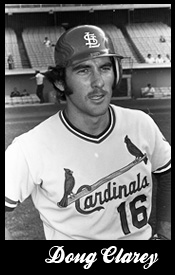
Though he appeared in only nine games for the Cardinals, Doug Clarey is a part of franchise lore because of an improbable home run.

doug_clareyOn April 28, 1976, Clarey produced the only hit of his big-league career, a two-run home run in the 16th inning that gave the Cardinals a 4-2 victory over the Giants.
The storybook feat occurred on a Wednesday afternoon at Candlestick Park in San Francisco, just north of Clarey’s boyhood home in Los Altos. Among the 4,193 in attendance were Clarey’s parents, high school coach and friends.

“It’s something you always dream about ever since I was a little boy watching the Giants play and just wishing I could be one of them,” Clarey told The Sporting News.

Just a few days before his dramatic home run, Clarey had been playing in the Class A Florida State League.

Called by Cards

Clarey, a second baseman, began his professional career in the Twins organization. The Cardinals claimed him in the December 1974 minor-league draft.

After hitting .206 for the Cardinals’ Class AA Arkansas club in 1975, Clarey was demoted to Class A St. Petersburg in 1976.

He got a break when Cardinals second baseman Mike Tyson suffered a knee injury in early April 1976.

Though Vic Harris came off the bench to replace Tyson as the starting second baseman, the Cardinals wanted someone who could fill in as a reserve fielder for a few weeks. Clarey, known more for his glove than his bat, fit the need because he could join the club quickly without having to clear waivers.

On April 20, 1976, his 22nd birthday, Clarey made his big-league debut. Batting in the sixth inning for pitcher Mike Wallace, Clarey faced Jon Matlack of the Mets and struck out. Boxscore

Stay fair

Eight days later, at San Francisco, Clarey got his second at-bat.

In the 16th inning, with the score tied at 2-2, the Cardinals had Don Kessinger on first base and two outs when acting manager Preston Gomez sent Clarey to bat for pitcher Mike Proly against Giants left-hander Mike Caldwell. Gomez was filling in for manager Red Schoendienst, who was in St. Louis to be with his daughter, Colleen, who was undergoing surgery. An inning earlier, Gomez told Clarey he’d bat if the Cardinals got a runner on base in the 16th.

“I was looking for something over the plate, something to hit,” Clarey told the San Francisco Examiner.

With the count at 1-and-1, Caldwell delivered a low, inside pitch. Giants catcher Dave Rader told the St. Louis Post-Dispatch it was a slider.

A right-handed batter, Clarey lifted the ball over the left-field fence.

“At first, I thought it was going to hook foul,” Clarey told the Oakland Tribune. “I kept saying to myself, ‘Stay fair, stay fair.’ ”

As the ball cleared the eight-foot fence, Kessinger said, ‘I couldn’t run the bases for jumping up and down. I’m so thrilled for him and us both.”

Danny Frisella retired the Giants in order in the bottom half of the 16th, saving the victory and securing Clarey’s place in Cardinals legend. Boxscore

“That’s the greatest experience of my life right there,” Clarey said. “I just wanted to get a piece of the ball.”

Said Caldwell: “That was the lowest point of my career.”

Giants manager Bill Rigney said, “Mike got it inside and his game is away. He made a bad pitch.”

After the season, the Giants traded Caldwell to the Cardinals.

Hailing a hero

In the Oakland Tribune, Ed Schoenfeld wrote of Clarey, “He’s a virtual unknown, even to his own teammates.”

The Sporting News referred to Clarey as the Cardinals’ “Cinderella Man.”

When Clarey entered the Cardinals clubhouse, he received a standing ovation. He also got a kiss from his mother and a handshake from his father, who built him a baseball backstop in the yard when Doug was almost 3 years old.

Afterward, the happy Cardinals boarded a bus to go to the airport for a flight to Los Angeles. The last to get on the bus was backup catcher Ken Rudolph, who was stationed in the bullpen when Clarey hit his home run. Rudolph alertly chased down the youths who grabbed the home run ball and traded three baseballs for the prize, the Post-Dispatch reported.

Inside the bus, Rudolph called for attention and said to Clarey, “First, the good news. Here is your home run ball. Now the bad news. Those three balls I traded cost $5 apiece. You owe the club $15.”

Clarey was speechless and everyone laughed, the Post-Dispatch reported.

When the Cardinals returned to St. Louis from their West Coast trip, the club rewarded Clarey for his achievement by presenting him with a watch, according to the Post-Dispatch.

Clarey appeared in one more game, May 4 vs. the Braves, before being returned to the minor leagues. He hit .228 in 63 games for manager Ken Boyer’s Class AAA Tulsa team.

Thanks, Mike

In July, Tyson got hurt again, breaking a finger, and the Cardinals called back Clarey.

“I’m keeping you in the big leagues,” Tyson told Clarey. “You ought to give me half your pay.”

In his second stint with the 1976 Cardinals, Clarey appeared in five games but didn’t get a hit.

End of the line

In March 1977, the Cardinals traded Clarey to the Mets for outfielder Benny Ayala. The Mets assigned Clarey to Class AAA Tidewater and he batted .125 in 28 games before he was released. Clarey signed with the Brewers and was sent to Class AA Holyoke.

In 1978, his last season as a player, Clarey joined the Orioles’ organization and hit .226 in 138 games for Class AA Charlotte.

His final big-league numbers for the Cardinals: nine games, four at-bats, one hit.


(Updated April 20, 2020)

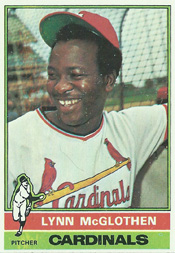
Tired of Del Unser pounding his pitches, Lynn McGlothen decided to pound Unser with a pitch.

lynn_mcglothenOn April 20, 1976, the Mets hit three two-run home runs off McGlothen in the first two innings at St. Louis and led 6-0.

Felix Millan and Unser hit home runs in the first inning and John Milner hit one in the second. Unser’s home run upset McGlothen the most.

Unser wasn’t a power hitter, but against McGlothen he swung like Babe Ruth. The year before, Unser hit two home runs against McGlothen.

When Unser came up again in the third inning, McGlothen nailed him in the left elbow with a pitch.

Enough is enough

“There are game situations where a pitcher goes out to hit a batter. This was one,” McGlothen said to the Associated Press. “He hit two home runs off me last year … I didn’t want to see it happen again.”

Said Unser: “If he’s upset because I hit a hanging curve, that’s his problem.”

McGlothen said a pitcher “has a right to try to contain the hitters. If a pitcher feels like he’s been intimidated, he has to do something.”

“I felt like I had a right to retaliate,” McGlothen told United Press International. “I threw that baseball to hit Unser. Let me make that perfectly clear.”

In response, Mets pitcher Tom Seaver told the New York Daily News, “He’s dumb if that’s his level of intelligence. If he couldn’t get the guy out, he should have walked off the mound.’

Storm the field

When McGlothen batted in the Cardinals’ half of the third, Mets starter Jon Matlack threw a brushback pitch. In the fourth, McGlothen threw two pitches near Matlack. The third struck Matlack in the hip.

Dave Kingman, the Mets’ 6-foot-6 right fielder, charged out of the dugout and rushed toward McGlothen, who “stepped off the mound, threw off his glove and struck a fighting pose,” the St. Louis Post-Dispatch reported.

Players from both dugouts stormed onto the field and fights erupted. “There was no bloodshed, but there were some bruises,” the Post-Dispatch noted.

Before Kingman could reach McGlothen, he was tackled by Cardinals first baseman Keith Hernandez, who told the Post-Dispatch, “He tried to bowl me over, and he did, but I tried to tackle him and I delayed him enough.”

In his book “I’m Keith Hernandez,” Hernandez said facing Kingman was “like a freshman defensive back in high school taking on an all-state fullback.”

“I barely had time to brace myself,” Hernandez said. “I remember being lifted off the ground from the initial shock of the attack, crashing onto the turf on my backside, and desperately trying to hang on to the V-neck of (Kingman’s) jersey as he literally crab-walked over me to get to Lynn.”

Charlie Galati, who charted pitches for the Cardinals, told the Post-Dispatch: “It looked like Mel Gray trying to block Otis Sistrunk.”

(Gray was a receiver for the St. Louis football Cardinals and Sistrunk was an imposing defensive tackle for the Oakland Raiders.)

Cardinals catcher Ted Simmons, who chased after Kingman, said, “Kingman ducked under me, and I flew over, hooking my knee.”

McGlothen told The Sporting News he was punched from behind by his former Cardinals teammate, Mets first baseman Joe Torre.

Cardinals left fielder Lou Brock said several Cardinals connected with shots to Kingman.

McGlothen and Cardinals manager Red Schoendienst were ejected. So was Mets shortstop Bud Harrelson.

No respect

Asked about McGlothen, Matlack said, “I really think I have no respect for the man.”

Said McGlothen: “I don’t think either one of us was trying to hurt anyone. I was throwing below the waist. If you want to mark a guy, you throw from the ribs up.”

Defending his pitcher, Schoendienst said, “(McGlothen) was wild all night. I’m surprised he hit anybody if he was trying.”

Regarding Unser, Schoendienst told the Post-Dispatch, “I always said that when a batter digs in, he’s digging his own hole and inviting the pitcher to come after him … When a batter goes into the ball like Unser, he stands a pretty good chance of being hit.”

The Mets won, 8-0. McGlothen was fined $300 and given a five-day suspension by National League president Chub Feeney. Boxscore

Five months later, on Sept. 19, 1976, Unser, who’d been traded by the Mets to the Expos in July, faced McGlothen in Montreal and hit a solo home run. Boxscore

Ken Boyer is deserving of a book that accurately and completely tells his story. Fortunately, “Ken Boyer: All-Star, MVP, Captain” by Kevin D. McCann delivers.

ken_boyer_bookProduced by BrayBree Publishing, this Boyer biography is a must-read for a Cardinals fan as well as for anyone who appreciates baseball, clean writing and superb research.
McCann covers every aspect of Boyer’s life and career in a compelling and richly detailed narrative. Though McCann clearly admires Boyer, this book isn’t a sugarcoated story. McCann takes readers behind the scenes of the 1950s and 1960s Cardinals in an honest and fact-based style.

Also, the book is filled with rare photos of Boyer and his teammates. The photos alone are worth buying the book.

I have a bookcase filled with Cardinals books. “Ken Boyer: All-Star, MVP, Captain” has a place on the top shelf with the best of my collection.

Here are some of the insights the book provides:

_ After the 1954 season, Cardinals general manager Dick Meyer wanted to acquire Yankees catching prospect Elston Howard, a St. Louis native. Meyer offered the Yankees their choice of one of several minor-league shortstops in the Cardinals’ system. The trade talks ended when the Yankees asked for Boyer, a third baseman with the Cardinals’ Texas League affiliate at Houston.

_ Boyer played winter baseball in Cuba after the 1954 season. Pirates executive Branch Rickey, formerly of the Cardinals, scouted Boyer in Havana and filed a glowing report.

“At third base, I saw the best ballplayer on first impression that I have seen in many a day,” Rickey wrote. “Boyer by name. He can run with very deceptive speed … Never loafs. He has big hands and knows what to do with them.”

_ Cardinals manager Fred Hutchinson didn’t care for what he perceived as Boyer’s laid-back disposition. “Boyer has everything he needs to be a great player except one thing,” said Hutchinson. “He has to develop more drive, more aggressiveness. He doesn’t push enough.”

_ After the 1957 season, Cardinals general manager Frank Lane wanted to trade Boyer to the Pirates for outfielder Frank Thomas and third baseman Gene Freese, but club owner Gussie Busch and executive vice president Dick Meyer rejected the deal. Soon after, Lane resigned and became general manager of the Indians.

_ Bing Devine, Lane’s replacement, was tempted by a Phillies trade offer of outfielder Richie Ashburn and pitcher Harvey Haddix for Boyer, but rejected the proposal. Said Boyer: “I told my wife that if I’d have been the Cardinals, I’d have made that trade.”

_ Tim McCarver, longtime St. Louis catcher, told the author that on the Cardinals “(Stan) Musial was the star, but Kenny was the leader. No doubt about it.”

_ The work relationship between Boyer and Musial was one of mutual respect. “Stan had probably as much influence on my career as anyone,” Boyer said.

_ The grand slam Boyer hit to win Game 4 of the 1964 World Series came on a changeup from Al Downing after the pitcher had shook off catcher Elston Howard’s call for a fastball. “He got the ball up in my eyes and that’s where any hitter likes to swing,” Boyer said.

_ After his playing career ended, Boyer was offered a chance to manage in the Dodgers’ minor-league system. He instead accepted an offer from Devine to manage the Cardinals’ Class AA club at Arkansas in 1970 because he preferred to return to the Cardinals’ organization.

_ The Cardinals fired manager Red Schoendienst after the 1976 season. Boyer was one of three finalists for the job. The others: Vern Rapp and Joe Altobelli. The Cardinals chose Rapp, in part, because they thought Boyer was too much like Schoendienst. Rejected, Boyer became a manager in the Orioles’ farm system.

_ After the 1977 season, Boyer was runner-up for big-league manager jobs that went to Bobby Cox with the Braves and George Bamberger with the Brewers.

_ The Cardinals fired Rapp in April 1978 and replaced him with Boyer. “It was difficult to imagine the same people who had made the decision a year ago changing their minds and giving me another opportunity,” Boyer said.


(April 13, 2020)

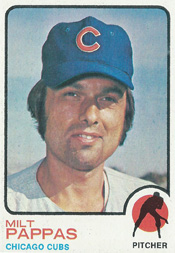
Within a span of two months in the final season of his big-league pitching career, Milt Pappas experienced one of his worst and best performances against the Cardinals.

milt_pappasOn April 13, 1973, Pappas, pitching for the Cubs, yielded 13 hits and six runs in seven innings in a loss at St. Louis.
On June 24, 1973, Pappas pitched the last shutout of his career in a win at St. Louis.

Pappas pitched 17 years in the major leagues. The first nine were in the American League with the Orioles. The last eight were in the National League with the Reds, Braves and Cubs.

St. Louis blues

A two-time all-star, Pappas was a good pitcher who found the Cardinals to be a tough foe.

Pappas had a career record of 209-164. Against the Cardinals, he was 6-11 with a 4.71 ERA, his highest vs. any team. Pappas yielded 150 hits in 116.2 career innings against St. Louis.

Among those who often hit Pappas hard were:

_ Ted Simmons, .542 batting average (13-for-24).

_ Jose Cruz, .462 (6-for-13).

_ Ted Sizemore, .455 (10-for-22).

_ Curt Flood, .412 (14-for-34).

_ Lou Brock, .397 (23-for-58)

_ Tim McCarver, .377 (20-for-53) and six walks.

_ Joe Torre, .333 (14-for-42).

Cards end skid

With Bob Gibson of the Cardinals, Al Downing of the Dodgers and Steve Blass of the Pirates, Pappas was the 1971 National League co-leader in shutouts, with five.

In 1972, Pappas was 17-7 with a 2.77 ERA and 10 complete games for the Cubs. The next year, he was 7-13 with a 4.28 ERA.

The Cardinals were 0-5 when Pappas, in his second start of 1973, faced them at St. Louis on April 13.

Pappas had won his last 11 decisions of 1972, including a no-hitter versus the Padres, but the 1973 Cardinals handed him his first loss since July 28, 1972.

Pappas yielded hits in five of the first six innings, but limited the damage to two runs.

In the seventh, with the score tied at 2-2, the Cardinals broke through with four runs off Pappas. The big blow was a two-run home run by Cruz. It was the second home run in two days for Cruz. The other came against the Mets’ Tom Seaver. “The kid is strong,” Cardinals manager Red Schoendienst said to the Associated Press.

Every starter in the Cardinals’ lineup, except pitcher Rick Wise, had at least one hit off Pappas in the 6-3 victory.  Boxscore

Pickup game

In June 1973, the Cubs returned to St. Louis for a three-game series. The Cardinals won the first two _ 3-0 (a Reggie Cleveland three-hitter) and 3-2 in 11 innings.

Pappas was the Cubs’ starter for the finale on a Sunday afternoon before 41,517 at Busch Memorial Stadium. His season record was 3-5 with a 5.21 ERA and he had made 14 starts without pitching a complete game.

Pappas, 34, held the Cardinals to five singles (two by first baseman McCarver) in earning the final complete game of his career, a 2-0 triumph.

“This was a very selfish game for me,” Pappas told the Chicago Tribune. “I wanted to show some people I’m not finished in this game. I changed my game plan a little. The Cardinals had hurt me on the slider earlier, so I went to my fastball more to see what would happen. It worked out well.”

The Cubs broke a scoreless tie in the eighth. With Rick Monday on second base and Paul Popovich on first, reliever Rich Folkers threw a wild pitch, enabling each runner to advance a base. Glenn Beckert, batting for center fielder Gene Hiser, hit a Folkers screwball to center for a single, scoring Monday and Popovich.

When the game ended, Pappas stood “arm raised, fist clenched in triumph like a warrior of ancient Greece,” Bob Broeg of the St. Louis Post-Dispatch wrote.

“It was a long time coming,” Pappas said of his complete game, “and I’m very, very happy. It couldn’t have come at a better time after losing the first two games. I hope it picks up the ballclub. I know it picked me up.” Boxscore


(Updated July 12, 2019)

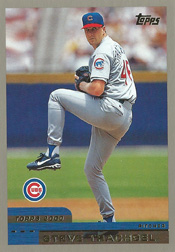
Steve Trachsel played a prominent role in two record-setting home run performances by the Cardinals. He was the starter the last time the Cardinals hit seven home runs in a game. Two years later, he yielded the home run to Mark McGwire that broke Roger Maris’ single-season big-league mark.

steve_trachselThe Cardinals’ team record for most home runs in a game is seven. They’ve done that twice.

The first time was May 7, 1940, in the Cardinals’ 18-2 victory over the Dodgers at St. Louis. Joe Medwick, Johnny Mize, Don Padgett, Eddie Lake and Stu Martin each hit a home run off starter Hugh Casey. Mize and Lake also each hit a home run off Max Macon. Boxscore

Fifty-six years later, the Cardinals did it again. On July 12, 1996, Gary Gaetti and Ron Gant each hit two home runs and John Mabry, Ray Lankford and Brian Jordan had one apiece in the Cardinals’ 13-3 victory over the Cubs at Chicago. Boxscore

All-star foe

The 1996 performance at Wrigley Field was surprising.

The Cardinals entered the game with the fewest home runs (71) in the National League, according to the Arlington Heights (Ill.) Daily Herald.

Trachsel, the Cubs’ starter, was considered an emerging ace.

Three days earlier, Trachsel had pitched a perfect inning for the National League in the All-Star Game, retiring Sandy Alomar, Cal Ripken and Alex Rodriguez.

Trachsel’s career record against the Cardinals then was 5-1.

“I know how good that young man is,” Cardinals manager Tony La Russa told the St. Louis Post-Dispatch. “I wouldn’t have bet a dime we’d hit one (home run), much less seven.”

Redbirds rip

Trachsel yielded four of the Cardinals’ seven home runs. In the third inning, Mabry hit a two-run shot and Gaetti followed with a solo home run. In the fifth, Lankford and Gant hit solo back-to-back shots, knocking Trachsel out of the game.

“They hit high pitches, low pitches, off-speed stuff, fastballs,” Trachsel said to the Chicago Sun-Times.

Said Cubs manager Jim Riggleman: “Even the elite have bad days.”

Rodney Myers relieved Trachsel and gave up the third home run of the fifth inning, a two-run shot by Gaetti, who was playing in his second career game at Wrigley Field.

“We haven’t been hitting like this,” Gaetti said to the Associated Press. “This ballpark is conducive to this, though.”

The sixth and seventh Cardinals home runs were a three-run shot by Jordan off Tanyon Sturtze in the sixth and a solo shot by Gant off Terry Adams in the eighth. Video

No. 62

Trachsel was the Cubs starter again on Sept. 8, 1998, against the Cardinals at St. Louis. In the fourth inning, McGwire hit his 62nd home run of the season, surpassing Maris’ total of 61 with the 1961 Yankees and linking Trachsel to one of baseball’s treasured records. Video

Lankford and Gant also hit home runs off Trachsel in a 6-3 Cardinals triumph. Boxscore

Trachsel yielded 28 home runs in 28 career starts vs. the Cardinals. Lankford hit four career home runs off Trachsel and McGwire hit three.