
Feeds:
Posts
Comments

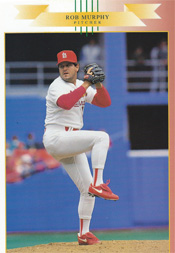
Rob Murphy Banner

Seeking a durable, dependable left-handed reliever, the Cardinals signed Rob Murphy in January 1993. Murphy delivered, establishing a Cardinals single-season record for left-handers by appearing in 73 games in 1993. He held the record until Steve Kline topped it with 89 appearances for the 2001 Cardinals.

Among relievers who inherited 20 or more runners, Murphy had the best ratio of runs allowed-to-runners inherited in each of two seasons with the Cardinals. He allowed four of 33 inherited runners to score in 1993 and eight of 33 inherited runners to score in 1994. Murphy was 4-3 with a 3.79 ERA in 50 appearances for the 1994 Cardinals before he was acquired by the Yankees a week before the start of the players’ strike.

With the Reds in 1988, Murphy led National League pitchers in appearances (76). He ranked second in the NL in 1987 (87 with the Reds) and in the AL in 1989 (74 with the Red Sox).

In 2016, Murphy, 55, is a respected youth pitching instructor in Jensen Beach, Fla., about 20 miles from the Cardinals’ spring training base in Jupiter.

On March 7, 2016, Murphy granted me an interview regarding his two seasons with the Cardinals. Thoughtful and accommodating, Murphy provided a wealth of insights. Here is an edited transcript of that taped interview:
rob_murphyQ.: After pitching for the Astros in 1992, you became a free agent. Why did you choose the Cardinals?

Murphy: “I was thinking of signing back with Houston. I had finished the (1992) season very well with them and they had put together a pretty good young team: Jeff Bagwell, Craig Biggio, Ken Caminiti.

“My agent, Alan Hendricks, called and said, ‘I got a call from (general manager) Dal Maxvill and the Cardinals are open to what you’re doing.’ They offered a guaranteed contract for two years with a base salary and incentives.

“Alan went back to the Astros and they were a little slow with moving to that level. Alan recommended I take the deal with the Cardinals.”

Q.: What was it like playing for Joe Torre as Cardinals manager?

Murphy: “Joe knew how to handle the players. That year, my older daughter, Grace, was born and I needed time off. Joe said, ‘Family comes first.’ Joe demanded 100 percent on the field, but there was a balance: You could do your job, but you knew you could take care of personal things.”

Q.: What other qualities did you see in Torre as a manager?

Murphy: “He was a good on-field manager. It was like playing for someone like Pete Rose because of his knowledge of the game. Nothing escapes him once he’s on the field. It was always a professional approach game after game.”

Q.: You had a better first half than you did a second half with the 1993 Cardinals. The St. Louis Post-Dispatch wrote that you were exposed to some situations you probably should not have faced. What did that mean?

Murphy: “I always thrived on a desire to pitch all the time. But sometimes it can go a little too far. Sometimes there are a lot of warmups that take place that don’t show in the boxscore.

“In 1993, we had a lot of young starting pitchers and they were handled with kid gloves and I think that took its toll on the bullpen. I was put in a lot. That was my job. I wasn’t complaining, but looking back, yeah, it might have been too much.”

Q.: Bob Tewksbury was the top winner on the Cardinals in your two years with them. How did such a soft tosser become so effective?

Murphy: “He knew how to get strike one. That was the key to Tewksbury’s success. He would throw strike one, then the next pitch he would throw 10 inches inside. It got the batter off the plate. Now Tewksbury owned the rest of the plate again.

“I never saw anyone do this as much and as consistently as he did. It was uncanny. If you put Tewks in a uniform from 1935, old-school baseball, he was right there. That’s how baseball is. It’s not a new phenomenon.”

Q.: Lee Smith, the closer, was your teammate with the Red Sox and the Cardinals. What was he like?

Murphy: “A great guy. One of the characters of the game. He’s a big guy, but he would take one-inch steps when he walked. Lee saved all his energy for pitching.

“He came from the back country of Louisiana and he had his own language. For example, you’d hear Lee say, ‘I wonder if the skunk on the trunk could get me some grease for the field mouse.’ What he meant was, ‘Could the flight attendant on the airplane get me some food to take home for my kids.’ ”

Q.: Should Lee Smith be elected to the Baseball Hall of Fame?

Murphy: “I think so. The guys in my memory with absolutely the best control were Lee Smith and Roger Clemens. At the time, Lee was one of the rare guys who could throw 100 mph. Now it seems like every team has a guy like that. I see that velocity go up and I see Tommy John surgery. There’s definitely a correlation.”

Q.: You played with two Hall of Fame shortstops: a young Barry Larkin with the Reds and an aging Ozzie Smith with the Cardinals. What did you see from them?

Murphy: “Barry is a wonderful guy. Gem of a human being. Outstanding ballplayer. To make it last as long as he did, that’s the reason he has that (Hall of Fame) jacket on. It’s his character, his ability and his results.

“Ozzie was like playing with Ken Griffey Jr. in Seattle. When you see them everyday, you really can embrace their greatness because those guys are almost always the hardest-working guys on the field. Even though by then he was nearly 40, Ozzie, every day, worked on catching pop-ups over his shoulder.”

Q.: What do you recall about the 1993 game when your Cardinals teammate, Mark Whiten, had four home runs and 12 RBI against the Reds?

Murphy: “I remember my jaw being in my lap. You’d watch him daily, though, and he’s one of the greatest batting practice hitters of all time. I say that in a kind way. Everyday, you could stand in Busch Stadium with your back to home plate and you’d hear the crack of the bat and know it was a Mark Whiten rocket shot. He hit so many home runs in batting practice that it was amazing. Mark had a lot of top-deck talent.”

Q.: You baffled some outstanding hitters. Dale Murphy was 0-for-14 against you. Darryl Strawberry was 1-for 12. Ken Griffey Jr. was 1-for-7 …

Murphy: “The guy that schooled me was Keith Hernandez. It was almost always with two strikes on a slider away that would get most lefties out. He’d punch it right through the 5 and 6 hole. Tony Gwynn was like that, too. Barry Bonds hit a home run on a 3-and-1 slider away to left field. I said to myself right there: I’m going to stop doing that. From then on, I threw him fastball, fastball, fastball.

“In 1994 (on April 9), Cardinals are in Candlestick Park. I get called into the game to face Bonds. Bases loaded. Bottom of the ninth. Tie score. Instead of throwing my eight warmup pitches, I threw five because I was already warmed up.

“My first three pitches to Bonds were ball one, ball two, ball three. Place is erupting. I get the ball back and said to myself, ‘Those are my eight warmup pitches.’ I threw strike one, strike two and then Bonds popped up to second. I threw him nothing but fastballs.” Boxscore

Q.: What was your reaction when the Yankees got you from the Cardinals?

Murphy: “We were in Montreal. I came back to the hotel after lunch and the light was blinking on my phone. The message said, ‘Murph, Joe Torre. Give me a call.’ I called him and he said, ‘Come down to my room.’

“I get there and he said, ‘You’re going to the Yankees.’ I said, ‘I’m going from last to first! Are you kidding me?’ I didn’t mean to be disrespectful. He said, ‘I know. It’s a great opportunity for you.’ ”

Q.: When asked then by the Post-Dispatch about that 1994 Cardinals team, you said, “We had great chemistry in spring training, but it didn’t carry into the season.” What did you mean by that?

Murphy: “We flew from spring training up to Cincinnati to open the season and we had a fight between the players before the first game. Spring training had gone well. Joe had jump-started things well. Next thing you know, we’re getting a call around midnight to tell us we already had a fight. For whatever reason, it unraveled from there and it couldn’t get reined back in.”

Previously: Why the best Joe Torre Cardinals club wasn’t good enough
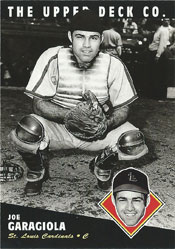
Joe Garagiola, a St. Louis native who began his big-league career with the Cardinals, hit his most dramatic home run against his hometown team.

joe_garagiola2Pinch-hitting with two outs in the ninth inning of the second game of a Memorial Day doubleheader, Garagiola hit a three-run walkoff home run that erased a 3-1 deficit and lifted the Pirates to a 4-3 victory over the Cardinals on May 30, 1952.
Garagiola was better known as a broadcaster than as a player, but he had several significant performances during a nine-year playing career in the majors as a catcher with the Cardinals, Pirates, Cubs and Giants.

His most important contribution as a player was his performance for the Cardinals as a 20-year-old rookie against the Red Sox in the 1946 World Series. Garagiola batted .316 (6-for-19), scored twice and had four RBI. He caught 42.2 innings without an error for the Cardinals, who won the championship in seven games.

A left-handed batter, Garagiola hit 42 big-league home runs. In addition to the walkoff home run to beat the Cardinals, he hit two grand slams for St. Louis.

Here is a look at those three home runs:

First base open

The 1952 Pirates were a dreadful team. After the Cardinals beat them, 3-2, in the first game of the May 30, 1952, doubleheader at Pittsburgh, the Pirates’ record was 8-33.

In the second game, starting pitchers Cloyd Boyer of the Cardinals and rookie Ron Kline of the Pirates each pitched eight scoreless innings. Clem Koshorek singled to lead off the bottom of the first for the Pirates. Boyer held Pittsburgh hitless from then through the eighth.

The Cardinals scored three in the top of the ninth, breaking the scoreless tie.

In the bottom of the ninth, Koshorek led off with a bunt single. After Bobby Del Greco popped out, Gus Bell doubled, moving Koshorek to third.

Cardinals manager Eddie Stanky replaced Boyer with Gerry Staley. A starter, Staley was making his first relief appearance of the 1952 season. He issued an intentional walk to the first batter he faced, cleanup hitter Ralph Kiner, loading the bases. A rookie, Brandy Davis, ran for Kiner.

When Jack Merson grounded out, pitcher to first, Koshorek scored, with Bell advancing to third and Davis to second.

Garagiola, who had caught the first game, was sent by manager Billy Meyer to pinch-hit for catcher Clyde McCullough. Meyer wanted a left-handed batter, Garagiola, to face the right-handed Staley.

With two outs and first base open, Stanky could have had Staley issue an intentional walk to Garagiola. On deck was George Strickland, a right-handed batter who hit .177 for the 1952 Pirates.

Instead, the Cardinals pitched to Garagiola, who ended the game with his first home run of the season. Boxscore

Trash talking

Four years earlier, playing in his first game of the season, Garagiola broke a 5-5 tie in the seventh inning with a grand slam off reliever Harry Gumbert, lifting the Cardinals to a 13-7 victory over the Reds at Cincinnati on April 30, 1948.

Garagiola hit a line drive off Gumbert, 38, a former Cardinal, that carried over the right field screen at Crosley Field, according to the Associated Press.

As he rounded the bases, Garagiola was razzed by players in the Reds dugout. Garagiola challenged one of the Reds on his way to bench, The Sporting News reported.

Said baseball commissioner Happy Chandler, who witnessed the incident: “I told manager Eddie Dyer that he’d better have a talk with Garagiola and see that it didn’t happen again.”

Garagiola was 3-for-4 with a walk, two runs scored and four RBI in the game. His teammate, Stan Musial, was 5-for-6 with three runs scored and four RBI. Boxscore

Sizzling in Cincinnati

Two years later, Garagiola hit the second and last grand slam of his big-league career. Again, it occurred in Cincinnati.

On May 28, 1950, in the first inning of the second game of a doubleheader, the Cardinals led, 1-0, and had Red Schoendienst on third and Enos Slaughter on second, one out, when Reds starter Ewell Blackwell issued an intentional walk to Bill Howerton, loading the bases for Garagiola.

The grand slam hit by Garagiola was his first home run of the season, giving the Cardinals a 5-0 lead. Garagiola went 3-for-4 with a run scored and four RBI in a 7-2 Cardinals triumph. Boxscore

Four days later, on June 1, Garagiola separated his shoulder when he tripped over the legs of the Dodgers’ Jackie Robinson on a play at first base.


(Updated Sept. 13, 2019)

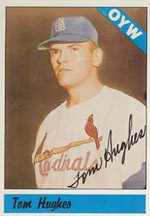
On his 25th birthday, Tom Hughes made his major-league debut as the starting pitcher for the Cardinals. His catcher was a 17-year-old, Tim McCarver, who was appearing in his fourth big-league game.

tom_hughesFrom there, the major-league careers of Hughes and McCarver took dramatically different paths. Hughes would appear in one more game for the Cardinals and never again would play in the big leagues. McCarver went on to play 21 years in the majors over parts of four decades (1959-80).
Hughes was the first native of Panama to play for the Cardinals. Subsequently, three others born in Panama also played for the Cardinals, catcher Einar Diaz in 2005, infielder Ruben Tejada in 2016 and infielder Edmundo Sosa in 2018-19.

Other natives of Panama who have played in the major leagues include Hall of Famers Rod Carew and Mariano Rivera.

For a time, it appeared Hughes would be one of the best, too.

Top prospect

Born Sept. 13, 1934, in Ancon, Canal Zone, Panama, Tom Hughes was the son of a Canal Zone police official, according to The Sporting News.

A right-handed pitcher, Hughes signed with the Cardinals in 1954 as an amateur free agent and was sent to the minor leagues.

Hughes had a breakthrough season in 1955, posting a 20-6 record and striking out 273 in 222 innings for Fresno of the Class C California League.

After that season, Hughes signed to play winter ball with the Chesterfield Smokers of the Panama Professional League.

The Cardinals invited Hughes to attend their early training camp for prospects at St. Petersburg, Fla., in February 1956, and assigned him to Houston of the Class AA Texas League.

Hot in Houston

After Hughes pitched a one-hit shutout against San Antonio on June 13, 1956, Houston general manager Art Routzong compared him with Cardinals left-hander Vinegar Bend Mizell.

“Tom right now is as good a major-league prospect as Vinegar Bend when Mizell was here in 1951,” Routzong said. “I don’t think Hughes is as fast as Vinegar, but he has a much better curve.”

Houston manager Harry Walker, the former Cardinals outfielder, also told The Sporting News he considered Hughes a major-league prospect.

In August 1956, with his record at 14-6, Hughes left Houston for St. Louis “to undergo a week’s therapy on his sore right elbow,” The Sporting News reported. The injury “baffled four Texas doctors.”

After being treated for what was diagnosed as an inflamed right elbow, Hughes returned to Houston and won his last four decisions, yielding one run in his final 39 innings.

His season totals for the 1956 Houston team: 18-6 record, 2.70 ERA, 223 innings and 16 complete games.

The Cardinals gave Hughes a look at spring training in 1957 and sent him back to Houston. He was 14-4 with a 2.87 ERA for the 1957 Houston team.

At your service

In October 1957, Hughes, 23, was inducted into the Army. He sat out the entire 1958 baseball season and most of 1959 while performing his military duty.

After his discharge from the Army, Hughes joined the Cardinals on Aug. 25, 1959. He hadn’t pitched in a professional game since September 1957.

The 1959 Cardinals entered September with a 61-72 record. Manager Solly Hemus decided to give the Cardinals’ prospects a look in the final month of the season.

“I saw a little of Hughes … at Houston (in 1957) and what I saw I liked,” Hemus said. “He showed a good assortment of stuff.”

Cuffed by Cubs

On Sept. 13, 1959, his 25th birthday, Hughes got the start for St. Louis against the Cubs at Chicago.

In the first inning, Hughes yielded a two-run single to Ernie Banks.

In the third, Banks hit a two-run home run and Irv Noren hit a solo home run, giving the Cubs a 5-0 lead. Hughes was relieved by Bob Duliba with two outs in the third. The Cubs won, 8-0, and Hughes took the loss.

Hughes’ line: 2.2 innings, 5 hits, 5 runs, 2 walks and 1 strikeout.

McCarver, batting leadoff, got his first big-league hit in that game. Boxscore

A week later, on Sept. 21, Hughes started against the Cubs at St. Louis and veteran Hal Smith was his catcher. The results, though, were about the same.

Hughes retired the Cubs in order in the first and the Cardinals scored a run off Glen Hobbie in the bottom half of the inning.

In the second, Banks led off with a triple and scored on Walt Moryn’s groundout. Bobby Thomson singled and scored on Sammy Taylor’s double, putting the Cubs ahead, 2-1. After Al Dark singled, moving Taylor to third, Hemus replaced Hughes with Ernie Broglio.

Broglio fanned Hobbie for the second out, then yielded a RBI-single to Tony Taylor and a three-run home run to George Altman, giving the Cubs a 6-1 lead. Four of the runs were charged to Hughes.

The Cubs won, 12-3, and Hughes again took the loss. Boxscore

In two games for the Cardinals, Hughes was 0-2 with a 15.75 ERA.

After playing in the minor leagues in 1960 and 1961, Hughes’ pitching career was finished two years after his major-league debut.

Previously: How Tim McCarver became a Cardinal at 17

Previously: Ernie Banks and his greatest hits against Cardinals

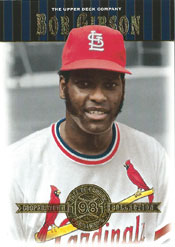
In 1972, at age 36, Bob Gibson lost his first five decisions, causing some to wonder whether he was finished as an effective player for the Cardinals. Instead, Gibson put together a remarkable season, leading Cardinals pitchers in wins and placing among the top five Cardinals hitters in home runs.

bob_gibson21Gibson had 19 wins and five home runs for the 1972 Cardinals. He tied outfielder Luis Melendez for fourth on the club in home runs. The only Cardinals to hit more home runs than Gibson that season were catcher Ted Simmons (16), third baseman Joe Torre (11) and right fielder Bernie Carbo (seven).
Gibson, though, had far fewer at-bats (103) than Simmons (594), Torre (544), Melendez (332) and Carbo (302). It’s not a stretch to think Gibson would have led the 1972 Cardinals in home runs if he had gotten as many at-bats as an everyday player.

Gibson holds the Cardinals record for most home runs in a season by a pitcher. He hit five twice _ in 1965 and 1972.

During a Cardinals career from 1959-75, Gibson hit 24 regular-season home runs and two World Series home runs.

Here is a look at Gibson’s two five-home run seasons:

5 in 1965

_ May 16, Cardinals 6, Pirates 3, at Pittsburgh: In the ninth, with the Cardinals ahead, 5-3, Gibson hit a solo home run off Tommie Sisk. Gibson got a complete-game win even though he yielded 10 hits. Boxscore

_ June 27, Cardinals 8, Cubs 0, at St. Louis: In the second, with the Cardinals ahead, 2-0, Gibson hit a two-run home run off former teammate Ernie Broglio. In pitching the shutout, Gibson struck out 12, including Ron Santo twice. Boxscore

_ Aug. 15, Cardinals 12, Reds 7, at St. Louis: In the second, with the Reds ahead, 3-1, Gibson hit a three-run home run off Sammy Ellis. Gibson yielded seven runs in seven innings, but the Cardinals scored eight in the eighth. Reliever Ray Washburn got the win. Boxscore

_ Aug. 31, Cardinals 3, Cubs 0, at Chicago: In the fifth, with the Cardinals ahead, 1-0, Gibson hit a solo home run off Dick Ellsworth. Gibson pitched a two-hit shutout. The Cubs got back-to-back singles by Don Landrum and Joey Amalfitano with two outs in the sixth. Boxscore

_ Sept. 29, Cardinals 8, Giants 6, at San Francisco: In the eighth, with the Cardinals ahead, 4-0, Gibson hit a grand slam off Gaylord Perry. Gibson gave up five runs in 8.1 innings and got the win. Boxscore

Much ado in ’72

_ June 4, Cardinals 4, Dodgers 0, at Los Angeles: In the ninth, with the Cardinals ahead, 2-0, Dal Maxvill singled with two outs and Gibson followed with a home run off Pete Richert. Gibson pitched a five-hit shutout. Bill Buckner and Wes Parker each singled twice for the Dodgers. Boxscore

_ June 21, Cardinals 14, Padres 3, at St. Louis: In the seventh, with the Cardinals ahead, 10-1, Carbo walked, Maxvill singled and Gibson hit a three-run home run off Mark Schaeffer. Boxscore

The win was Gibson’s 211th, moving him ahead of Jesse Haines and into first place all-time among Cardinals pitchers.

“What I enjoy most about the record is being able to stay with one club long enough to win that many games,” Gibson said to Dave Johnson of the Burlington (Iowa) Hawk Eye. “The longevity factor means more to me than breaking some guy’s record.”

According to the book “Gibson’s Last Stand,” the Cardinals’ ace “pitched most of the game with a pulled hamstring” after scoring on a Lou Brock triple in the second inning.

Stan Landes was the home plate umpire for Gibson’s record-setting win. Landes also was the home plate umpire when Gibson got his first career win on July 30, 1959, at Cincinnati.

_ July 12, Cardinals 7, Braves 0, at St. Louis: In the fourth, with the Cardinals ahead, 3-0, Gibson and Brock hit back-to-back solo home runs off Ron Schueler. Gibson pitched a six-hit shutout in a game played in less than two hours.

“It doesn’t take Gibson long to embarrass you,” Braves manager Lum Harris told the Associated Press.

Said Braves pinch-hitter Jim Breazeale, who struck out against Gibson: “I didn’t even need to carry a bat up there.” Boxscore

_ July 21, Cardinals 2, Braves 1, at Atlanta: With the Cardinals ahead, 1-0, Gibson led off the sixth with a home run off George Stone for the decisive run. Gibson pitched a complete game and earned his 11th consecutive win. Darrell Evans hit a home run in the seventh for the run off Gibson. Boxscore

_ Aug. 30, Giants 3, Cardinals 2, at St. Louis: Gibson led off the sixth with a home run against Jim Willoughby, tying the score at 1-1. The Giants rallied with two runs in the ninth. Gibson struck out 14, including Dave Kingman twice. Boxscore

Previously: Cardinals pitchers enjoy grand slam streak

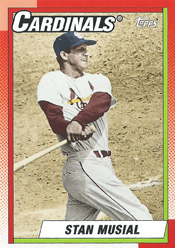
The 1946 Cardinals shifted Stan Musial from left field to first base and it worked out well.

stan_musial30Though he never had played first base as a professional, Musial replaced injured Dick Sisler on June 7, 1946, and started at first base the remainder of the season and in the World Series.
Musial, 25, started 114 regular-season games at first base for the 1946 Cardinals. He ranked second among National League first basemen in double plays turned (119), fourth in putouts (1,056) and fifth in fielding percentage (.989). Musial also led NL first basemen in errors (13).

The change in positions didn’t hurt Musial’s hitting. He led the NL in batting (.365), hits (228), singles (142), doubles (50), triples (20), extra-base hits (86) and total bases (366) for a Cardinals club that won the 1946 World Series championship.

In an editorial, The Sporting News opined, “Usually, so drastic a shift harries the player and hampers his hitting and fielding, but Stan jumped into his new position as if to the manor born.”

It was a remarkable and completely unexpected transformation.

Naval disaster

In 1945, Musial was called into military service and joined the Navy. At Bainbridge, Md., where he was sent for basic training, Musial played in a few ballgames with fellow servicemen.

In his book “Stan Musial: The Man’s Own Story,” Musial recalled, “Although by then I had a reputation as a good defensive outfielder in the big leagues, the Bainbridge athletic director, a lieutenant named Jerry O’Brien, put me at first base. I was amused. O’Brien was not.”

“Get out of there, Musial,” O’Brien ordered. “You’re terrible. You’ll never make anybody’s team at first base.”

Helping the team

That was the extent of Musial’s experience at first base until he got a surprise request a year later.

Sisler, a rookie, had been selected to be the first baseman for the 1946 Cardinals by first-year manager Eddie Dyer. Sisler replaced Ray Sanders, whose contract was sold to the Braves the day before the 1946 season opener.

Sisler was hitting .270 when he injured his hand on June 2, 1946. Harry Walker, an outfielder, replaced Sisler at first base, but Dyer had another player in mind for the position.

“When I reported in the clubhouse, I found a new first baseman’s glove in my locker,” Musial said. “I took the hint and began working out at the infield position.”

A few nights later, Musial said, Dyer asked him to play first base “for the good of the club.”

“I always liked to fool around the bag,” Musial said. “When Skip told me that I was to be the regular first sacker, I was delighted.”

On June 7, 1946, in a game against the Phillies at St. Louis, Musial made his debut as a professional first baseman. He turned two double plays, had 11 putouts and one assist and made no errors. Boxscore

Gamble pays off

After Sisler’s hand healed, Dyer kept Musial at first base.

“St. Louis players liked Musial’s work around the bag, thought the team was stronger with Stan on the infield and what started to be a makeshift developed into a permanent arrangement,” The Sporting News explained. “From all present indications, Stan will continue indefinitely at the position.”

Said Musial: “I would hate to go back to the outfield. Now I am in the game all the way in every play. Not like waiting out there for three or four chances.”

On Aug. 12, 1946, against the Cubs at Chicago, Musial handled 20 chances at first base _ 19 putouts and one assist. Boxscore

“I am quite thrilled over the way my move in converting Stan Musial into a first baseman has turned out,” Dyer told The Sporting News. “… I knew that shifting Musial to first base was a perilous adventure for me. Suppose he had fallen off in his hitting? … I had to risk that. But, then, it wasn’t too big a gamble, for I knew Musial.”

Self-assessment

Musial said his experience as a pitcher in high school and in the minor leagues helped prepare him to play first base with the 1946 Cardinals.

“That taught me how to get around the infield, field bunts and hot smashes, also to get some experience in covering first base when balls were hit to the first baseman,” Musial said.

Assessing his fielding, Musial said, “I am far from a polished first sacker.”

His weakness?

“That dilemma you find yourself in when you get a bad throw is my biggest problem,” Musial said. “Here’s what I mean: One of the infielders makes a wide relay to me. A player who is accustomed to playing the bag will leave it if he sees that he has to and will save the out. I am afraid I can’t do both. So I try to protect the bag and the ball at the same time.”

His strength?

“I can make that first-to-short-to-first double play and that throw to the pitcher when he covers the bag.”

Two-position player

In the 1946 World Series versus the Red Sox, Musial fielded flawlessly at first base. He made 61 putouts, had two assists, turned six double plays and committed no errors in 62 innings.

Musial played the entire 1947 season at first base. In 1948, Dyer moved Musial to right field and put Nippy Jones at first base.

From 1948-54, Musial primarily played outfield. He was the starting first baseman for the Cardinals from 1955-59 and returned primarily to the outfield for the last four years (1960-63) of his career.

Musial made 1,854 career regular-season starts in the outfield and 989 career regular-season starts at first base.

(Updated Dec. 16, 2025)

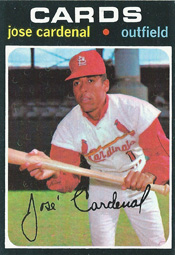
Jose Cardenal faced two daunting challenges with the 1970 Cardinals: (1) replace Curt Flood as the center fielder and (2) defend himself against comments from anonymous teammates who accused him of being selfish and lackadaisical.

jose_cardenalCardenal contributed significantly to a 1970 Cardinals lineup that included Lou Brock, Joe Torre and Dick Allen, but some teammates questioned his desire. Whether the criticism had merit or was based on stereotype is conjecture.

Traded for Pinson

On Nov. 21, 1969, the Cardinals traded right fielder Vada Pinson to the Indians for Cardenal. The Cardinals were seeking a center fielder to replace Flood, who a month earlier had been dealt to the Phillies.

In 12 years with the Cardinals, Flood batted .293, played on two World Series championship clubs and three National League pennant winners and earned seven consecutive Gold Glove awards.

Cardenal, 26, five years younger than Flood and Pinson, hit .257 with 26 doubles and 36 stolen bases for the 1969 Indians. The Cardinals became his fourth club following stints with the Giants, Angels and Indians. Cardenal had been in professional baseball since 1961 when he joined a Giants farm club at age 17 after leaving his home in Cuba.

According to Russell Schneider, who covered the Indians for The Sporting News, “Cardenal, who can be an outstanding fielder and better-than-average hitter when he wants, was a disappointment through most of 1969 … Jose has a tendency toward moodiness when things aren’t going well.”

Neal Russo, who covered the Cardinals, echoed that sentiment, writing that “Cardenal, a brilliant fielder, has a reputation for pouting because of such things as the manager shouting at him.”

Team player

Cardinals general manager Bing Devine sent scout Chase Riddle and assistant player development director John Claiborne to Puerto Rico to watch Cardenal in the winter league.

“Riddle and Claiborne said Cardenal had been doing a good job in the field and had been hitting the ball consistently to right field behind the runner,” Devine said. “He makes contact well. He’s good on the hit-and-run and he looks like he’ll be a good No. 2 man in the batting order.”

Said Cardenal: “I read where I would bat second behind a fast man like Brock. I thought I might be able to help him, my club and myself if I could hit the ball on the ground to the right side.”

Bob Broeg of the St. Louis Post-Dispatch described Cardenal as “a little center fielder with ants in his pants and with a throwing arm that could really skip a ball as fast as he’ll run on the new synthetic surface” at Busch Memorial Stadium.

Cardenal opened the season batting between Brock and Allen. He hit .353 in April and .366 in June.

Said Cardinals manager Red Schoendienst: “He can do everything. He’s one of the best players we have.”

Nasty talk

On July 13, 1970, Bob Broeg wrote in his Post-Dispatch column, “The Cardinals’ image isn’t helped when … a player like Jose Cardenal loafs or lopes to first base … The failure to go all-out with the ball in play has such a deadening effect.”

Asked about his reputation for moodiness, Cardenal told Post-Dispatch reporter Ed Wilks, “If you talk, they say you are … cocky, you talk too much. If you don’t talk, they say you are moody and you don’t want to talk. If I trust you, I talk … The best thing I can do is just smile and be quiet.”

Regarding being a Cardinal, he said, “I love it … It’s a first-class organization.”

In early September, the St. Louis Globe-Democrat reported Cardenal would be traded and quoted anonymous Cardinals players who called him a bad teammate.

Cardenal called a press conference to address the matter and said the accusations “broke my heart because they were so nasty.”

“Cardenal denied the charges that he played only when he felt like it, that he played for himself rather than for the team and that he did not hustle in the outfield or on the bases.” The Sporting News reported.

At a speaking engagement in Peoria on Oct. 31, 1970, Cardinals player Joe Hague criticized Cardenal and Allen for not being “winning types,” The Sporting News reported. Hague said Cardenal was “just not the type who will help make us a team in every sense of the word,” the Post-Dispatch reported.

Winning numbers

Based on statistics, Cardenal had a successful 1970 season. He batted .293 with 162 hits in 148 games, led the Cardinals in doubles (32), placed second in stolen bases (26) behind Brock (51) and was third in RBI (74) behind Allen (101) and Torre (100). Cardenal hit .342 with runners in scoring position.

After the season, the Cardinals acquired Matty Alou from the Pirates and projected him to play center field, with Cardenal moving to right.

Sent packing

Cardenal didn’t perform as well in 1971 as he did in 1970. Eager to give a starting spot to rookie outfielder Jose Cruz, the Cardinals deemed Cardenal expendable.

On July 29, 1971, Cardenal was batting .243 when the Cardinals traded him, infielder Dick Schofield and pitcher Bob Reynolds to the Brewers for infielder Ted Kubiak and minor-league pitcher Chuck Loseth.

“When they traded me, I was hurt and embarrassed,” Cardenal said. “They told me they wouldn’t trade me after the All-Star Game.”

Nearly a quarter-century later, Cardenal returned to the Cardinals as a coach on the staff of their manager, Torre, in 1994 and 1995.