Feeds:
Posts
Comments

Heading into the 1985 winter meetings, the Cardinals were willing to trade ace Joaquin Andujar for either a left-handed starting pitcher or a first-string catcher. They found a club willing to give them both.
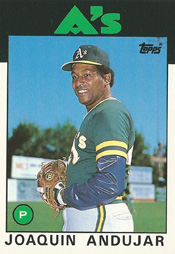
joaquin_andujar8On Dec. 10, 1985, the defending National League champion Cardinals dealt Andujar to the Athletics for catcher Mike Heath and pitcher Tim Conroy.

Heath, 30, was acquired to replace Darrell Porter, who had been released. Conroy, 25, was expected to compete for a spot in the Cardinals’ 1986 rotation alongside John Tudor, Danny Cox, Bob Forsch and Kurt Kepshire.

Neither Heath nor Conroy worked out the way the Cardinals had hoped and Andujar never achieved with the Athletics the success he had with St. Louis.

Behind the numbers

Though Andujar, 32, had an impressive regular season for the 1985 Cardinals _ 21-12 record with 10 complete games and 269.2 innings pitched _ his performance in the second half and in the postseason triggered concern.

For example:

_ Andujar was 1-3 with a 5.30 ERA in six September starts in 1985 and 0-2 with a 7.88 ERA in two regular-season October starts.

_ In the NL Championship Series against the Dodgers, Andujar was 0-1 with a 6.97 ERA in two starts. In the World Series versus the Royals, he made two appearances and was 0-1 with a 9.00 ERA.

_ He had a meltdown in Game 7 of the World Series, getting into a confrontation with home plate umpire Don Denkinger and being ejected. Peter Ueberroth, commissioner of baseball, suspended Andujar for the first 10 games of the 1986 season. Video at the 1:38 mark

Look the other way

At home in the Dominican Republic, Andujar told Braves shortstop Rafael Ramirez that people from Anheuser-Busch, the brewery that owned the Cardinals, called him and said he’d never pitch for the club again, columnist Peter Gammons reported in The Sporting News.

Dal Maxvill, Cardinals general manager, denied being told to trade Andujar. “There has not been interference from above,” Maxvill said to The Sporting News.

In comments about Andujar to St. Louis reporter Rick Hummel, Maxvill added, “I know he’s kind of crazy and I know he’s unusual, but you have to look the other way when the performance is there.”

In his 1987 book “White Rat: A Life in Baseball,” Cardinals manager Whitey Herzog admitted, “It’s been reported that Maxvill and I were ordered to trade Joaquin and I won’t deny that. I will say, though, that he might well have been traded anyway. The other players were tired of his griping and his bitching. It had gotten to the point where he was dividing the clubhouse.”

No deal

The White Sox approached the Cardinals and proposed a deal of left-handed starter Britt Burns for Andujar and pitcher Ricky Horton. Burns was 18-11 for the 1985 White Sox. The Cardinals, however, “backed off because they were concerned about a hip injury of which Burns complains,” Hummel reported.

The Cardinals approached the Red Sox and offered Andujar, Horton, Kepshire and reliever Jeff Lahti for left-handed starter Bruce Hurst, who was 11-13 for Boston in 1985.

The Red Sox rejected the offer because they were given “an immediate take-it-or-leave-it deadline” by the Cardinals and they “were afraid of taking on Andujar” and his problems, Gammons reported.

Headcases OK

The Athletics were seeking a proven winner for their rotation. They offered their starting catcher, Heath, and one selection from a pool of pitchers. The Cardinals chose Conroy.

To the Athletics, Andujar’s pitching trumped his image.

“There’s nothing wrong with a headcase or two _ as long as you don’t have eight,” Sandy Alderson, Athletics general manager, told the Sacramento Bee. “This was not a multi-headcase deal.”

To the San Jose Mercury News, Alderson said, “Flamboyance is not criminal.”

Herzog had advice for Athletics pitching coach Wes Stock, who had been Herzog’s teammate with the Orioles. “Whitey told me Joaquin still needs to be coddled,” Stock said. “He told me not to forget that.”

Asked his reaction to the trade, Andujar told St. Louis radio station KMOX, “I feel surprised. Like I always said, I wanted to die in St. Louis … I leave my heart in St. Louis.”

Unhappy Heath

Heath hit .250 with 13 home runs and 55 RBI for the 1985 Athletics. He caught 38 percent of runners attempting to steal.

According to The Sporting News, Heath asked to be traded. He feuded with Oakland management after being told he’d play only versus left-handed pitching in 1986.

“I felt I was an everyday player and I felt I would not be happy,” Heath said.

In a parting shot at the Athletics, Heath added, “When Mike Heath steps on the field, his No. 1 objective is to win. No. 2 is to win and No. 3 is to win. With the A’s, No. 1 was being compatible and No. 2 was winning.”

Change for Conroy

Conroy was 0-1 with a 4.26 ERA in 16 games for the 1985 Athletics. At Class AAA Tacoma that season, Conroy was 11-3 in 22 starts.

A first-round selection of the Athletics in the 1978 draft, Conroy made his major-league debut at age 18. In five seasons with the Athletics, Conroy was 10-19 with a 4.37 ERA.

“We probably pushed him too quickly,” Alderson said.

Conroy “had to get out of our organization … The mental strain had become too great,” Stock told the San Francisco Chronicle.

Said Herzog: “We’ve liked Conroy for a long time … We feel he was rushed in Oakland and was under too much pressure to succeed.”

The results

Heath hit .205 with four home runs and 25 RBI for the 1986 Cardinals. He caught 33 percent of runners attempting to steal.

On Aug. 10, 1986, the Cardinals traded Heath to the Tigers for pitcher Ken Hill and first baseman Mike Laga.

Conroy was 5-11 with a 5.23 ERA in 25 appearances for the 1986 Cardinals. He was 3-2 with a 5.53 ERA for St. Louis in 1987, his last big-league season. In two years with the Cardinals, Conroy was 8-13 with a 5.31 ERA.

Andujar was 12-7 with a 3.82 ERA in 28 appearances for the 1986 Athletics. He was 3-5 with a 6.08 ERA for Oakland in 1987. In two seasons with the Athletics, Andujar was 15-12 with a 4.46 ERA.

Previously: How Hub Kittle got Joaquin Andujar to Cardinals

Enticed by the chance to add a left-hander to the starting rotation and a potential power hitter to the batting order, the Cardinals gave up a Gold Glove Award winner at third base.

ken_reitzThe deal didn’t work out the way either the Cardinals or Giants envisioned.
On Dec. 8, 1975, the Cardinals traded third baseman Ken Reitz to the Giants for pitcher Pete Falcone.

Though Reitz had been awarded the National League Gold Glove for his defensive work at third base in 1975, the Cardinals thought he was expendable because of the availability of Hector Cruz, who had excelled as a slugging third baseman for manager Ken Boyer at Class AAA Tulsa.

When Boyer, a five-time Gold Glove winner and seven-time all-star as a Cardinals third baseman, endorsed Cruz, the Cardinals were confident in dealing Reitz.

“Boyer is very high on Cruz,” Cardinals general manager Bing Devine said to the Associated Press.

Carpet cleaner

Reitz debuted with the Cardinals in 1972 and was their everyday third baseman from 1973-75. He led NL third basemen in fielding percentage in 1973 and 1974.

Mike Shannon, a Cardinals broadcaster and former third baseman, dubbed Reitz “Zamboni” because, like the machine, he cleaned up everything in his path on the artificial turf carpet at Busch Stadium in St. Louis.

The Sporting News praised Reitz for having “quick hands, an extremely accurate arm, superb lateral movement.”

Reitz, 24, committed 23 errors in 1975. Noting that only eight of those errors allowed scoring or led to scoring, The Sporting News wrote that Reitz’s “great stops and throws helped save many a game” and he “has displayed the same knack shown by such former Cardinals as Ken Boyer, Julian Javier and Dal Maxvill. They rarely killed you with an error in a tight situation.”

Reitz hit .269 for the 1975 Cardinals, with five home runs and 63 RBI.

Top prospect

In contrast, Cruz, 22, batted .306 with 29 home runs and 116 RBI in 115 games for Tulsa in 1975. He made 17 errors in 289 chances at third base.

Cruz, whose brothers Jose and Tommy had been Cardinals outfielders, was named winner of the 1975 Most Valuable Player Award in the American Association and Minor League Player of the Year by The Sporting News.

“He has been the best ballplayer in the minor leagues the past two years,” said Cardinals manager Red Schoendienst.

Devine told United Press International: “We feel he’s ready.”

Falcone fits

The Cardinals saw the Giants as an ideal trade partner. The Giants needed a third baseman and they had starting pitching depth.

Falcone, 22, debuted with the Giants in 1975, posting a 12-11 record and 4.17 ERA in 32 starts. He struck out 131 and issued a team-high 111 walks.

The Cardinals’ only other potential left-handed starter was John Curtis. The Cardinals envisioned Falcone joining a 1976 rotation with Bob Forsch, John Denny, Lynn McGlothen and either Eric Rasmussen or Curtis.

“We didn’t have any good left-hand pitching prospects in the minor leagues,” said Schoendienst. “We hope to start Falcone. That’s what we acquired him for.”

The Giants were seeking a defensive upgrade at third base. Their primary starter in 1975, Steve Ontiveros, hit .289 but committed 21 errors in 89 games at third base.

Jerry Donovan, assistant to Giants owner Horace Stoneham, said, “We haven’t had a third baseman since Jimmy Davenport retired (in 1970).”

Donovan, who engineered the trade with Devine, added, “We hated to give up Pete, but we needed a third baseman badly. The Cards insisted on Falcone if we were to make the deal.”

Giants fan

Reitz was born in San Francisco and grew up in nearby Daly City. As a youth, he would scale a fence to get into Giants games at Candlestick Park. He watched as many as 60 games a season there, according to the Oakland Tribune.

His favorite player was first baseman Willie McCovey. Like McCovey with the Giants, Reitz wore No. 44 with the Cardinals.

Still, Reitz was stunned and initially disappointed to be traded. He and his wife had bought a house in St. Louis.

“I thought they’d stick with me for a couple of more years at least,” said Reitz. “I thought there was maybe one chance in 100 that I’d be traded.”

Falcone was working an off-season job as a salesman in the New York garment center while staying with his parents in Brooklyn.

“When I first learned about (the trade), I was a little mad,” said Falcone. “It was a shock. Now that I’ve thought it all over, I kind of like the idea of going to St. Louis and getting out of the cold and fog.”

How they fared

In 1976, Falcone was 12-16 with a 3.23 ERA in 32 starts for St. Louis. He led the 1976 Cardinals in strikeouts (138) and innings pitched (212) and was second in wins.

After beating the Reds on a five-hitter on Aug. 24, he was 11-11 with a 3.29 ERA, but he lost five of his last six decisions while lowering his ERA to 3.23.

Cruz hit .228 with 13 home runs and 71 RBI with a team-high 119 strikeouts for the 1976 Cardinals. He made a NL-leading 26 errors at third base.

Reitz made 19 errors in 155 games at third base for the 1976 Giants. He hit .267 with five home runs and grounded into 24 double plays.

Return to sender

After the 1976 season, the Giants traded Reitz to the Cardinals for McGlothen.

The Cardinals moved Cruz to right field. He hit .236 with six home runs in 1977 and was traded after the season with catcher Dave Rader to the Cubs for outfielder Jerry Morales and catcher Steve Swisher.

Falcone had terrible second and third seasons with the Cardinals _ 4-8 with a 5.44 ERA in 1977 and 2-7 with a 5.76 ERA in 1978 _ and was traded to the Mets in December 1978 for outfielder Tom Grieve and pitcher Kim Seaman.

Reitz remained the Cardinals’ third baseman through 1980. He was traded with first baseman Leon Durham and third baseman Ty Waller to the Cubs for reliever Bruce Sutter in December 1980. Ken Oberkfell replaced Reitz at third base.

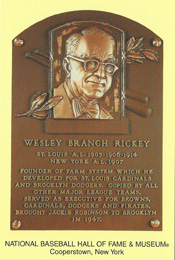
Branch Rickey, who built a baseball legacy by taking risks and defying convention, was true to self in the last major decision of his life.

branch_rickeyFaced with the choice of staying in a hospital bed or spending an evening with admirers, Rickey opted to travel from St. Louis to Columbia for his induction into the Missouri Sports Hall of Fame.
“He preferred to be among the living that night than lying dying in a hospital,” Rickey’s daughter, Mary, told her father’s biographer, Murray Polner.

On Dec. 9, 1965, Rickey, 83, died in a Columbia hospital, 26 days after he collapsed and lost consciousness while delivering an induction speech at a Missouri Sports Hall of Fame banquet.

Farm builder

After serving as manager and executive with the Browns, Rickey moved to the crosstown Cardinals as team president in 1917, beginning a long and successful career with the National League club.

In August 1918, with World War I raging, Rickey joined the U.S. Army chemical corps, was commissioned a major and was assigned to France, where he instructed American soldiers about mustard gas. After the Nov. 11, 1918, armistice, Rickey returned to the Cardinals.

With the franchise experiencing financial hardships, Rickey took on the additional role of manager in order to keep down the payroll.

Realizing the Cardinals needed better players and knowing the club was reluctant to get into bidding wars for prospects, Rickey developed the first farm system, stocking the Cardinals with a steady supply of prime talent.

“In 1919, no one had heard of a farm system _ except Rickey,” The Sporting News wrote. “He devised it as a way for the then impoverished Cardinals to combat richer rivals for talent.”

Said Rickey: “Starting the Cardinals farm system was no sudden stroke of genius. It was a case of necessity being the mother of invention. We lived a precarious existence. Other clubs would outbid us.”

Front-office focus

Rickey was both manager and top baseball executive of the Cardinals from 1919 until May 1925 when team owner Sam Breadon took away the manager role from him and appointed second baseman Rogers Hornsby as player-manager.

Though being ousted as manager “hurt him deeply,” according to biographer Polner, Rickey and the Cardinals excelled when he was focused fulltime on the front office. With Rickey’s administrative leadership and baseball acumen, the Cardinals became a premier franchise, winning six NL pennants and four World Series titles from 1926-42.

“Considering the little money Rickey had to work with in his early years in St. Louis, he was the game’s most successful team builder,” wrote Frederick G. Lieb in The Sporting News.

After the 1942 season, Rickey left the Cardinals to take over as chief baseball executive of the Dodgers. Five years later, he integrated the major leagues by bringing Jackie Robinson to the Dodgers and successfully guiding him to a Hall of Fame playing career.

Rickey ended his baseball career in 1964 after an ill-fated two-year stint as a consultant with the Cardinals. He retired and resided in a suburb of St. Louis.

Fateful day

In his book “Branch Rickey: A Biography,” Polner said Rickey suffered a sixth heart attack in November 1965 and was admitted to St. Luke’s Hospital in St. Louis.

Rickey spent two weeks in the hospital and was suffering from a high fever, The Sporting News reported. He’d been running a temperature of up to 105 degrees, according to the Associated Press. Nonetheless, Rickey went against his doctor’s orders and family’s wishes and insisted on attending the Nov. 13, 1965, Missouri Sports Hall of Fame induction ceremony.

On the morning of the ceremony, Rickey was driven the 125 miles from St. Louis to Columbia, site of the University of Missouri.

He attended a luncheon and then a football game between Oklahoma and Missouri, The Sporting News reported.

It was a “bleak and cold” afternoon and Rickey watched the game from the stands with his wife, Jane, while “huddled under a blanket, uncomfortable and in apparent distress,” according to Polner.

Afterward, Rickey went to his room at the Mark Twain Hotel and rested. That evening, he and Jane were driven to the Daniel Boone Hotel for the induction banquet. Also being inducted were George Sisler, who had played first base for Rickey at the University of Michigan and with the Browns, and the late J.G. Taylor Spink, formerly publisher of The Sporting News.

Final words

Asked to speak, Rickey talked for about 15 minutes at the dais. He was about to begin an anecdote when he paused and said, “I don’t believe I can continue.”

Those were his last words. He collapsed into a chair and slipped to the floor. A physician rushed to his aid. Rickey was unconscious.

He was carried to a fire department across the street and taken from there by ambulance to Boone County Memorial Hospital, according to Polner.

Rickey remained in a coma until he died at the hospital nearly a month later and 11 days before his 84th birthday.

In the lead to his obituary, the Associated Press called Rickey “a front-office genius who remade baseball over a span of 50 years.”

Wrote The Sporting News: “His achievements as an empire builder who invented the farm system and broke baseball’s color line rank him with the most important figures in the history of the game.”


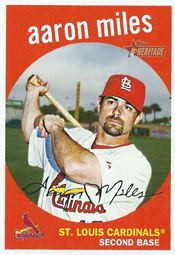
An undeterred underdog, Aaron Miles beat out the competition and emerged as the Opening Day starter at second base for the 2006 Cardinals.

aaron_miles2On Dec. 7, 2005, the Cardinals traded disgruntled reliever Ray King to the Rockies for Miles and outfielder Larry Bigbie.
King, 9-6 with a 2.91 ERA in two seasons with St. Louis, had asked to be traded after not pitching in any of the Cardinals’ nine postseason games in 2005.

For Cardinals general manager Walt Jocketty, Bigbie was the prize in the deal.

Bigbie, 28, was seen as a leading candidate to replace the departed Reggie Sanders as the Cardinals’ starting left fielder in 2006. Also competing for the job were So Taguchi and John Rodriguez.

“Right now, I see him (Bigbie) as a starter for us,” Jocketty said after the trade. “He’s still a young player who we believe has high upside.”

Bigbie had hit a combined .239 for the Orioles and Rockies in 2005. He missed most of the second half of the season because of a strained Achilles’ tendon. The year before, he batted .280 and hit 15 home runs for the 2004 Orioles.

Good hit, no field?

Miles, 29, Deivi Cruz and Hector Luna were perceived as second-tier candidates behind front-runner Junior Spivey to replace the departed Mark Grudzielanek as the Cardinals’ starting second baseman in 2006.

“Miles is considered below average defensively but is adept at reaching base,” wrote Joe Strauss of the St. Louis Post-Dispatch.

Miles hit .281 in 99 games, including 58 starts at second base, for the 2005 Rockies.

At Cardinals spring training in 2006, Miles jammed his left hand diving into a base on March 3 and sat out for nearly two weeks. That appeared to clear the path for Spivey to win the second base job.

Spivey had played for the Brewers and Nationals in 2005, became a free agent after the season and signed with the Cardinals for a guaranteed $1.2 million. However, Spivey “struggled in all aspects of the game” during spring training, the Post-Dispatch reported. He “appeared tight defensively” and his spring training batting average at the end of March was .152.

When Miles returned to the spring training lineup, he went on a tear, with six hits in 12 at-bats. He struck out once in a stretch of 34 at-bats.

“He’s been a good player,” Cardinals manager Tony La Russa said of Miles. “He takes good at-bats. He’s caught the ball well to his left and right. He starts double plays.”

Right decision

Before the regular season began, the Cardinals released Cruz, sent Spivey to Class AAA Memphis and declared Luna the backup at second base to Miles.

Meanwhile, Bigbie suffered a stress fracture above his left heel and was placed on the disabled list. Taguchi opened the regular season as the Cardinals’ starting left fielder, with Jim Edmonds in center and Juan Encarnacion in right.

(Bigbie would play in 17 games for the 2006 Cardinals and hit .240. He became a free agent in October 2006 and signed with the Dodgers. A year later, in the Mitchell Report on steroid abuse in baseball, Bigbie admitted to using performance-enhancing drugs from 2001-05.)

The 2006 Cardinals opened the regular season on April 3 at Philadelphia against the Phillies. Miles, batting eighth, was 4-for-5 with two RBI and two runs scored. He produced two doubles, a triple and a single. Boxscore

“It feels good to make sure these guys (the Cardinals) know they made the right decision with me,” Miles said.

Said La Russa: “He’s a tough out and any eighth hitter that gives you a tough out creates a lot of possibilities in the National League game.”

On July 30, 2006, the Cardinals traded Luna to the Indians for their second baseman, Ronnie Belliard, who displaced Miles as the St. Louis starter. In 54 games, including 53 starts at second base, Belliard hit .237 for the 2006 Cardinals.

Miles batted .263 with 20 doubles in 135 games for the 2006 Cardinals. He made 71 starts at second base and 33 starts at shortstop.

The Cardinals that year won their first World Series championship since 1982, defeating the Tigers in five games. Miles was 1-for-6 with a walk and two runs scored in the 2006 World Series.

In four seasons with St. Louis (2006-08 and 2010), Miles batted .288.

Previously: Mark Grudzielanek fit a need for 2005 Cardinals

Previously: Aaron Miles keyed Cardinals’ comebacks of 2006

Previously: Ronnie Belliard re-ignited Cardinals in 2006 playoffs

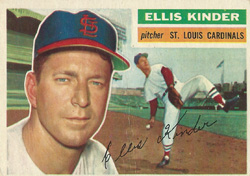
After the 1955 season, the Cardinals looked to revamp their pitching staff and one of the first moves they made was to acquire the oldest pitcher in the big leagues.

ellis_kinderOn Dec. 4, 1955, the Cardinals claimed on waivers Ellis Kinder, 41, from the Red Sox. Some saw it as desperation. To Cardinals general manager Frank Lane, it was opportunistic inspiration.
The 1955 Cardinals had finished with a 68-86 record and the worst ERA (4.56) in the National League. Their relief pitching was especially poor. Barney Schultz, who had a 7.89 ERA, was the team leader in saves, with four.

Cardinals owner Gussie Busch hired Lane, who had been successful as general manager of the White Sox, to rebuild the Cardinals. Lane’s first move was to hire Fred Hutchinson, formerly of the Tigers, as manager, replacing Harry Walker.

Lane received a call from Red Sox general manager Joe Cronin, who told him, “Francois, you pestered me plenty for Kinder when you were with the White Sox. You couldn’t have him then, but you’re in the other league now. Still want him?”

Kinder had cleared waivers in the American League, making him available to National League clubs. The Cardinals got Kinder “for a price slightly in excess of the waiver fee,” according to The Sporting News. Lane said the price was $7,500.

To Lane and Hutchinson, it was a bargain.

Control and heart

As American Leaguers, Lane and Hutchinson had seen how well Kinder pitched.

Kinder, who debuted in the big leagues as a 31-year-old rookie with the 1946 Browns, earned 23 wins as a starter for the 1949 Red Sox.

Converted to a reliever, Kinder, 39, had 27 saves, 10 wins and a 1.85 ERA in 69 appearances for the 1953 Red Sox.

In 1955, when Kinder turned 41, the right-hander still was effective, with 18 saves, five wins and a 2.84 ERA in 43 appearances for the Red Sox.

“At one time, Kinder had the greatest change-of-pace I’ve ever seen,” Hutchinson said. “He’s got control and heart _ a hell of a fine combination in a relief pitcher.”

Said Lane: “I don’t care if he’s 92 or if he does stagger in September. If he can help us early, we’re in luck.”

Kinder was stunned by the move. He had expected to end his career with the Red Sox.

“There is nothing wrong with my arm and there’s no reason why I can’t help the Cardinals next year,” Kinder said.

Red Sox trainer Jack Fadden said Kinder’s arm was sound and called him “the most courageous man I have ever seen on the pitching mound _ absolutely fearless,” The Sporting News reported.

Use it or lose it

At spring training in St. Petersburg, Fla., with the 1956 Cardinals, Kinder pitched effectively. “I throw every day,” Kinder said. “Pitchers should throw more, not less. I figure your arm is like your leg. The more you use it, the better shape it will be in.”

When Kinder made the Opening Day roster, he became the oldest Cardinals pitcher since Jesse Haines, 44, in 1937.

Hutchinson immediately showed his faith in Kinder.

On April 17, in their 1956 season opener against the Reds at Cincinnati, the Cardinals scored twice in the top of the ninth to break a 2-2 tie and take a 4-2 lead. In the bottom of the ninth, starter Vinegar Bend Mizell got George Crowe to ground out before Johnny Temple walked and Smoky Burgess singled. Ted Kluszewski flied out to center for the second out.

The next batter, right-handed Wally Post, slugged 40 home runs in 1955. Hutchinson lifted Mizell, a left-hander, and brought in Kinder to face Post.

Kinder threw three pitches _ each called a strike by umpire Babe Pinelli _ and Post struck out, ending the game and earning Kinder a save in his Cardinals debut. Boxscore

Earning his keep

On April 24, 1956, Kinder earned another save for Mizell and the Cardinals against the Reds. With two on and none out in the ninth, Kinder struck out Crowe on three pitches and got Temple to hit into a double play, giving St. Louis a 5-3 triumph. Boxscore

Six days later, Kinder earned his third save in four appearances when, with a runner on first and one out in the ninth, he retired Hank Aaron and Bobby Thomson to preserve a 2-0 Cardinals victory over the Braves. Boxscore.

“As far as I’m concerned, the old fellow has earned his salary already,” Hutchinson told writer Bob Broeg.

Said Mizell of Kinder: “If anything happens to him, I’m going to pack my bags and go home.”

Return to AL

In 12 appearances through June 6, Kinder was 2-0 with six saves and a 1.10 ERA. In his next 10 appearances through July 7, Kinder had no saves and allowed nine runs.

The Cardinals placed him on waivers and Kinder was claimed by the White Sox on July 11.

Kinder’s totals for the 1956 Cardinals: 2-0 record, six saves, 3.51 ERA in 22 games.

Kinder, who turned 42 two weeks after joining the White Sox, made a triumphant return to the American League. In 29 games for the 1956 White Sox, Kinder was 3-1 with three saves and a 2.73 ERA.

The next season, Kinder appeared in one game for the White Sox and was released in May 1957, bringing to an end his big-league pitching career.

Previously: Arthur Rhodes: 1 of 5 Cardinals age 40 in a World Series

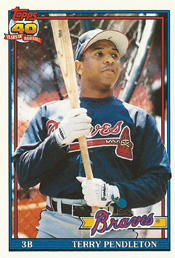
In the span of three days, two prominent players, third baseman Terry Pendleton and left fielder Vince Coleman, left the Cardinals for free-agent riches. For Pendleton, the move rejuvenated his career. For Coleman, it was a setback.

terry_pendleton2On Dec. 3, 1990, Pendleton, 30, left the Cardinals after seven seasons and signed with the Braves. Two days later, on Dec. 5, Coleman, 29, left the Cardinals after six seasons and signed with the Mets.

Pendleton, a career .259 hitter with St. Louis, helped the Braves win three National League pennants (1991, 1992 and 1996). In 1991, Pendleton won the NL Most Valuable Player Award and led the league in batting average (.319) and hits (187). In 1992, Pendleton tied with a former Cardinals teammate, the Pirates’ Andy Van Slyke, for the league lead in hits (199).

Coleman, who led the league in stolen bases in each of his six seasons with St. Louis, was a bust with the Mets. With the Cardinals, Coleman three times had more than 100 steals in a season and never had fewer than 65. With the Mets, Coleman had season totals of 37, 24 and 38 steals.

Plans for Zeile

The Cardinals had tried harder to keep Coleman than they did Pendleton.

With Todd Zeile converting from catcher to third baseman, the Cardinals figured Pendleton was expendable. The Cardinals offered Pendleton a contract for three years and $5.5 million. The Braves offered him a contract for four years and $10.2 million. Pendleton became the only Braves player besides outfielder Dale Murphy to be paid more than $2 million per season, the Atlanta Journal-Constitution reported.

“I never dreamed about making that kind of money,” Pendleton said.

Pendleton twice won a Gold Glove Award with the Cardinals (1987 and 1989) and three times led NL third basemen in assists (1986, 1987 and 1989). In 1989, Pendleton also led NL third basemen in fielding percentage (.971).

“He’s a good player with good makeup and he will be a very valuable asset to our club and to our organization,” Braves general manager John Schuerholz said to the St. Louis Post-Dispatch. “He has good leadership qualities and he’s been with a winner.”

Countered Post-Dispatch columnist Bernie Miklasz: “The Cardinals were justified in letting third baseman Terry Pendleton take his weight problem, deteriorating arm and narrowing fielding range to Atlanta.”

Pendleton praised Cardinals fans who “stuck by me even when I wasn’t playing well” and took a parting shot at Cardinals management, saying, “I’m excited about starting anew. I’m happy to go someplace where I’m wanted.”

Making an exception

Coleman and Pendleton were starters on Cardinals pennant-winning teams in 1985 and 1987. Coleman was named winner of the NL Rookie of the Year Award in 1985 when he had 110 stolen bases, scored 107 runs and produced 170 hits in 151 games.

Though the Cardinals had rookie Bernard Gilkey available to replace Coleman in left field in 1991, they wanted to keep Coleman atop their batting order.

The Cardinals initially made Coleman an offer of three years and $7.5 million. When the Mets offered him four years and $11 million, the Cardinals made what they considered a major concession. They offered Coleman four years and $10.5 million, according to the Post-Dispatch.

“Although it hasn’t been our policy in the past to offer four-year contracts, Vince is a premier player,” Cardinals general manager Dal Maxvill said. “Other players of his caliber are receiving contract offers like that and we thought it was proper to extend it a year.”

When the Mets countered with four years and $11.95 million, Coleman accepted.

“The Cardinals were in this thing until the very end,” said Richie Bry, Coleman’s agent. “He was torn by the decision.”

Asked by the Post-Dispatch what would have prompted him to choose the Cardinals over the Mets, Coleman said, “Match their offer, which they promised they’d do about a month ago.”

Maxvill denied the Cardinals promised to match any offer. “He was hoping we would match it,” Maxvill said.

Noting the difference between the Mets’ offer and Cardinals’ offer was $1.45 million, Miklasz wrote, “Spread over four years, it amounts to $363,000 a season … Why couldn’t the Cardinals come up with an extra $363,000 a year to keep Coleman?”

Separate paths

Coleman said he hoped to achieve 130 stolen bases in a season for the Mets. “I know when Lou Brock was 34 he stole 118 and I’m not close to being 34 yet,” Coleman said. “To steal 130 would be out of sight. You never know what Vince Coleman might do now that he’s got a new look on life.”

Coleman batted .270 in his three years with the Mets and totaled 99 steals. The Mets cut him loose after he was charged with a felony for throwing an explosive device similar to a grenade into a parking lot and injuring three people, including two children.

In a 13-year big-league career with the Cardinals, Mets, Royals, Mariners, Reds and Tigers, Coleman batted .264 with 1,425 hits and 752 stolen bases.

Twice an all-star with the Cardinals (1988 and 1989), Coleman never again was an all-star after leaving St. Louis and never again played for a pennant winner.

In a 15-year big-league career with the Cardinals, Braves, Marlins, Reds and Royals, Pendleton batted .270 with 1,897 hits.

Pendleton played in five World Series (two for the Cardinals and three for the Braves) and batted .298 with 28 hits in 27 games.

Previously: Why Cardinals traded Willie McGee to Athletics

Previously: Why Cardinals stopped being a Whitey Herzog team