Feeds:
Posts
Comments

The Dodgers had the cash. The Cardinals had the players. That combination led the National League rivals to make their second significant transaction of the year at the end of 1940.
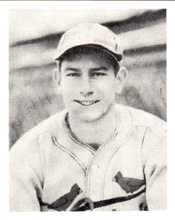
mickey_owenOn Dec. 4, 1940, the Cardinals dealt the best young catcher in the league, Mickey Owen, to the Dodgers for $65,000, catcher Gus Mancuso and minor-league pitcher John Pintar.

Six months earlier, on June 12, 1940, the Cardinals had sent left fielder Joe Medwick to the Dodgers for $125,000 and four players whom a writer described as “a few ham sandwiches.”

The Dodgers, who hadn’t won a pennant since 1920, were willing to spend lavishly to acquire the talent needed to become champions.

The Cardinals, confident their farm system could replenish their big-league roster, were willing to deal players at their peak market value to increase profitability.

Also, Cardinals executive Branch Rickey had an incentive to trade players for cash because his contract called for him to get a percentage of the sale as remuneration in addition to his salary.

Daring Dodgers

After the 1940 season, Dodgers president Larry MacPhail spoke openly of his intention to acquire Owen.

Babe Phelps, 32, had been the primary catcher for the 1940 Dodgers. He hit .295 and was named an all-star for the third time in his 11-year career in the big leagues. The Dodgers, though, wanted a younger catcher with a better arm, better defensive skills and more agility than the lumbering Phelps, who was nicknamed “Blimp.” Owen, 24, met the criteria.

Owen entered the big leagues with the 1937 Cardinals and became their starting catcher in 1938. In four seasons with St. Louis, Owen hit .257. His prime asset was his ability to deter stolen base attempts.

In 1938, Owen ranked third among National League catchers in percentage of runners caught stealing (50.9 percent). Owen was the league leader in that category in both 1939 (61.1 percent) and 1940 (60.4 percent).

By comparison, Phelps caught 33.3 percent of runners attempting to steal in 1940.

Bidding battle

Owen “is No. 1 on the MacPhail shopping list because of his youth and speed. Larry, however, isn’t at all confident of landing the fiery Redbird receiver,” The Sporting News reported.

The Giants and Cubs also wanted Owen. Rickey and Cardinals owner Sam Breadon were delighted to have multiple bidders for him. They had a hard-hitting catcher at their Columbus farm club, Walker Cooper, who was deemed ready to replace Owen.

The Cardinals “will be on the listening end of one of the most interesting _ and profitable _ bidding contests in a long time,” The Sporting News reported. “… Cardinals chieftains need only to sit back and let the other fellows do the talking and bidding … They couldn’t have done better if they had written the plot themselves.”

At the baseball winter meetings in Atlanta, the Cubs reportedly made an aggressive play for Owen. MacPhail quickly countered and sealed the deal by increasing the cash offering.

Cash trumps talent

Some were surprised the Cardinals settled for Mancuso instead of Phelps in the deal.

Mancuso, 35, who began his big-league career with the 1928 Cardinals and played in the World Series for them in 1930 and 1931, hit .229 as backup to Phelps for the 1940 Dodgers. Pintar, 27, a right-hander, posted an 11-9 record and 2.77 ERA for the Dodgers’ Texas League affiliate in Dallas.

“At first glance, it looked like the Dodgers benefitted most” with the Cardinals “getting the money they like so well,” Judson Bailey of the Associated Press wrote. Bailey called Owen “a smart defensive player and the kind of aggressive worker that (Dodgers) manager Leo Durocher likes.”

In The Sporting News, Dodgers correspondent Tommy Holmes opined, “Everybody knew MacPhail wanted Owen … What no one expected was that Mickey would come to the Dodgers for so small an outlay of useful playing material. It seems Sam Breadon … preferred the cash.”

Why not? The $190,000 the Cardinals got from the Dodgers for Medwick and Owen was a staggering sum. In 1940, the highest-paid player in the big leagues was Tigers slugger Hank Greenberg at $35,000. The average player salary in the 1940s was $11,000.

Advantage, Cardinals

In the short term, the deal worked well for both teams. In the long term, the Cardinals did better.

With Medwick and Owen as regulars, the 1941 Dodgers finished 100-54 and won the pennant, 2.5 games ahead of the second-place Cardinals (97-56).

Medwick batted .318 with 18 home runs, 88 RBI and 100 runs scored for the 1941 Dodgers.

Owen was second in the league in fielding percentage among catchers and fourth in percentage of runners caught stealing (51.8). He was named an all-star for the first time and hit .231 with 44 RBI.

In the 1941 World Series against the Yankees, Owen failed to catch a third strike pitch with two outs in the ninth inning that should have clinched a 4-3 Dodgers victory in Game 4 and evened the series at 2-2. Instead, the Yankees rallied, won the game, 7-4, and went on to secure the championship with four wins in five games.

Mancuso and Cooper formed an effective catching platoon for the 1941 Cardinals. Mancuso ranked No. 1 among National League catchers in percentage of runners caught stealing (69.2 percent) and Cooper was fifth (51.4 percent).

Cooper was the starting catcher on Cardinals clubs that won three consecutive pennants (1942-44) and two World Series titles.

Previously: How Joe Medwick got traded by Cardinals to Dodgers

(Updated Dec. 20, 2018)

John Mozeliak was mentored by Cardinals royalty. He worked with two of the franchise’s most successful executives, Bing Devine and Walt Jocketty. Because of Devine, Mozeliak can trace a line in his apprenticeship directly to the man who built the prototype of a Cardinals general manager, innovator Branch Rickey.

Mozeliak was Cardinals general manager from October 2007 until he was promoted to president of baseball operations in June 2017. He has followed in the tradition of his best-known predecessors, building championship clubs and keeping the Cardinals among the elite franchises in the big leagues.

Mozeliak is keenly aware of the lineage of Cardinals general managers. He says it is his desire to pay back those who taught him by helping others position themselves to carry on that tradition.

E-mail from Mozeliak

In November 2015, Mozeliak answered questions from Cardinals bloggers by e-mail. The opportunity to ask questions of Mozeliak came about through the efforts of Daniel Shoptaw, founder of United Cardinal Bloggers, and Cardinals communication coordinator Lindsey Weber.

In citing the tradition of prominent figures who have been Cardinals general managers _ men such as Stan Musial, Whitey Herzog, Bob Howsam, Frank Lane, Devine and Jocketty _ I asked Mozeliak whether he ever reflected on that and his role in that legacy.

“I have,” Mozeliak replied. “I have not thought about my legacy, but I have thought a lot about the people that have come before me.”

Jocketty brought Mozeliak to the Cardinals and helped grow his career. Devine provided added value as a sage.

Protégé of Jocketty

Mozeliak, a left-handed pitcher and first baseman in high school at Boulder, Colo., says he grew up a fan of Johnny Bench _ “I tried to be a left-handed catcher, but that didn’t work very well,” he wrote in his e-mail _ as well as George Brett, Ozzie Smith and Willie McGee.

After graduating from the University of Colorado, Mozeliak joined the Rockies as a batting practice pitcher. He worked his way through the organization, earning various roles in baseball operations, and made a favorable impression on Jocketty, the Rockies’ assistant general manager.

Jocketty replaced Dal Maxvill as Cardinals general manager in October 1994. Mozeliak joined the Cardinals after the 1995 season as an assistant in scouting operations.

Mozeliak became Cardinals scouting director in 1999. Jocketty brought Devine back to the Cardinals that fall as a special assignment scout.

Devine intervention

Devine served two stints as Cardinals general manager: 1957-64 and 1968-78. His trades during his first term brought Lou Brock, Curt Flood, Bill White, Julian Javier and Dick Groat to the Cardinals. The farm system under Devine’s management developed players such as Bob Gibson, Steve Carlton, Tim McCarver, Mike Shannon and, during his second term, Ted Simmons, Bob Forsch and Keith Hernandez.

In 1939, when he joined the Cardinals as a 23-year-old office assistant, Devine ran errands for Rickey. (Though Rickey formally had the title of Cardinals business manager, his role was that of general manager and included player personnel.)

Sixty years later, when Devine, 83, rejoined the Cardinals as a scout, he bonded with the scouting director, Mozielak, sharing decades of Cardinals knowledge and experience with the 30-year-old protégé.

‘He taught me a lot’

“I had a unique opportunity to work with Bing and did get to know him and actually traveled to some minor-league cities with him,” Mozeliak said in his e-mail. “He taught me a lot. He was someone who had a unique perspective on the business …

“The economics have changed drastically; how you think about development and creating assets within an organization is different, yet there (are) a lot of truisms that you still have to play the game and play the game right,” Mozeliak wrote. “I remember Bing would always reflect on that with me.”

In his 2004 book, “The Memoirs of Bing Devine,” Devine said of his 1999 return to the Cardinals, “I owe a debt of gratitude to the present Cardinals ownership. They believed I was not too old or too far removed to make a contribution from a player evaluation standpoint.”

Devine praised Jocketty as “a talented and aggressive general manager” and, in a nod to executives such as Mozeliak, he added, “The surrounding personnel are dedicated as well.”

In his e-mail, Mozeliak said of Devine, “I think about my opportunity to spend time with him as just very lucky and as I move forward I hope I can someday help the next generation.”

Efficient and effective

Jocketty promoted Mozeliak to the role of Cardinals director of baseball operations in 2001 and then assistant general manager in 2003. After Jocketty departed because of philosophical differences with ownership, Mozeliak succeeded him as general manager in October 2007, 10 months after Devine had died at age 90.

With Mozeliak as general manager, the Cardinals won two National League pennants and a World Series title.

I asked Mozeliak in what ways does he anticipate the role of general manager evolving and how, in 10 to 20 years, it will it be different than how it is today.

“The game has changed in the sense of total revenues … so just understanding this game from a more business perspective is required,” Mozeliak replied in his e-mail. “The demands on the different departments _ whether it’s international, amateur, scouting, or player development _ there are big costs to that, and running efficient and effective departments are critical.

“Most of my time, as boring as it may sound, is not necessarily focused just on the 25-man roster,” Mozeliak wrote. “It’s really making sure that we’re optimizing all those different areas that we touched on. So, I think as general managers’ roles change, it’s more about becoming a more efficient business.”


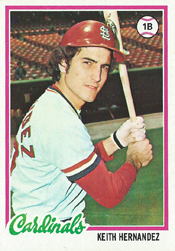
Playing for a new manager, Vern Rapp, and with a core of young, highly regarded players, such as Keith Hernandez, Garry Templeton and John Denny, the Cardinals enjoyed a successful opening to the 1977 season.

keith_hernandez5On April 7, 1977, amid strong winds and a mix of rain and light snow, the Cardinals beat the Pirates, 12-6, at Three Rivers Stadium in Pittsburgh.
New approach

The 1977 Cardinals opened the season as a franchise looking to rebuild.

In 1976, the Cardinals finished 72-90. Red Schoendienst, who had managed the Cardinals since 1965, was fired after that 1976 debacle. He was replaced by Rapp, a St. Louis native who had played and managed in the Cardinals’ system but who never had reached the major leagues.

A disciplinarian, Rapp instructed Cardinals players during 1977 spring training to shave off their moustaches and beards and keep their hair trim.

In the opener at Pittsburgh, the Cardinals started Denny, 24, against Jerry Reuss, a St. Louis native who began his career with his hometown team.

Along with established standouts such as left fielder Lou Brock and catcher Ted Simmons, the Cardinals’ lineup included Hernandez, 23, at first base and Garry Templeton, 21, at shortstop.

Denny and Templeton were making their first Opening Day starts in the big leagues.

Helped by three Pirates errors, the Cardinals scored four runs in the opening inning off Reuss. The Pirates’ sloppy start prompted “lusty boos from many of the 35,186 spectators,” the Associated Press reported.

The Cardinals never trailed. Denny held the Pirates to three runs in 5.2 innings and got the win. Templeton had two hits and scored three runs.

Hernandez, a left-handed batter, scored twice and had key hits against a pair of left-handed relievers. Hernandez hit a two-run double off Grant Jackson and a two-run home run (estimated at 425 feet) against Terry Forster. For Hernandez, it was his first four-RBI game in the big leagues.

Playing to win

“The thing about Vern Rapp is that he has us playing aggressive baseball, taking the extra base, playing at our maximum,” Hernandez said after the game. “We don’t have a lot of power, but we do have good hitting and exceptional speed and I think we’re going to make the most of it.”

Asked about playing without his signature moustache, Hernandez replied, “I’m here to play baseball. That’s what is important to me. I’ve got five months in the off-season to grow a moustache and long hair, but right now I want to help the Cardinals play winning baseball.” Boxscore

Behind stellars seasons by Hernandez (.291 batting average, 41 doubles, 91 RBI), Templeton (.322 batting average, 200 hits, 18 triples, 28 stolen bases), Simmons (.318 batting average, 21 home runs, 95 RBI) and pitcher Bob Forsch (20 wins), the 1977 Cardinals improved to 83-79.

Hernandez’s effective hitting against left-handers continued through the season. He batted .313 in 201 at-bats versus left-handers in 1977.

Previously: Cardinals debut was dream come true for Keith Hernandez

Previously: Pete Vuckovich was fearless in great escape for Cardinals

With the first of his three National League Most Valuable Player awards, Albert Pujols established himself as a dominant player, producing numbers that hadn’t been reached in decades by any Cardinals player who had earned the honor.

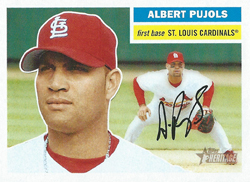
albert_pujols24On Nov. 15, 2005, Pujols, 25, was named NL MVP in balloting by 32 members of the Baseball Writers Association of America.
Pujols became the first Cardinals player to earn a NL MVP since Willie McGee in 1985.

Barry Bonds of the Giants had won the award in four consecutive years (2001-04). Pujols won NL MVP in three of the next five years (2005, 2008, 2009).

In 2005, Pujols batted .330 with 41 home runs, 117 RBI, 195 hits, 129 runs and a .430 on-base percentage.

Among the special achievements:

_ Before Pujols, no Cardinals NL MVP winner had hit 41 home runs in a season.

_ The 117 RBI by Pujols were the most by a Cardinals NL MVP winner since Joe Torre had 137 in 1971.

_ Pujols’  129 runs scored and his .430 on-base percentage each was the most by a Cardinals NL MVP winner since Stan Musial scored 135 and had a .450 on-base percentage in 1948.

_ Pujols and Chris Carpenter in 2005 became the first NL teammates to win the MVP Award and Cy Young Award in the same year since Terry Pendleton and Tom Glavine did so with the 1991 Braves.

Asked by St. Louis Post-Dispatch columnist Bernie Miklasz about Pujols being the NL MVP winner, Cardinals manager Tony La Russa said, “Our club gets a lot of its competitive nature from his personality. That’s what an MVP should be all about.”

Pujols received 378 vote points and 18 first-place votes in the balloting for the 2005 NL MVP Award.

Braves outfielder Andruw Jones was a close runner-up, with 351 vote points and 13 first-place votes. Jones batted .263 with 51 home runs, 128 RBI, 154 hits, 95 runs and an on-base percentage of .347.

“I think he deserved it,” Jones said to the Associated Press about Pujols winning the award. “The voting was the right vote. He was the right choice.”

Finishing third in balloting was Cubs first baseman Derrek Lee, with 263 vote points and one first-place vote. Lee hit .335 with 46 home runs, 107 RBI, 199 hits, 120 runs and a .418 on-base percentage.

Previously: Albert Pujols joins Stan Musial with 4 MVP seconds

Previously: Albert Pujols achieves unofficial Triple Crown

(Updated April 29, 2018)

Like Yogi Berra, Hank Bauer, Elston Howard and Whitey Herzog, Norm Siebern was a St. Louis-area athlete who was bypassed by the Cardinals and began his professional baseball career in the Yankees organization. Toward the end of his big-league career, Siebern faced the Cardinals in the World Series and got three at-bats _  all against Bob Gibson.

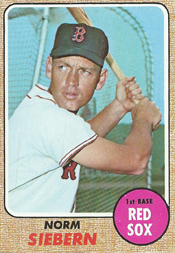
norm_siebernBorn in St. Louis and raised in the nearby town of Wellston, Mo., Siebern was an outfielder and first baseman for 12 years in the big leagues with the Yankees, Athletics, Orioles, Angels, Giants and Red Sox. He three times was named to the American League all-star team: 1962 and 1963 with the Athletics and 1964 with the Orioles.
Siebern was a basketball and baseball standout at Wellston High School in St. Louis County. He caught the attention of Yankees scout Lou Maguolo, who signed Siebern after he graduated from high school in 1951. During the baseball off-seasons, Siebern pursued a journalism degree from Missouri State (then known as Southwest Missouri) in Springfield. While there, he played on the 1952 and 1953 basketball teams that won NAIA (National Association of Intercollegiate Athletics) championships.

In 1957, Siebern had a breakout season with the Yankees’ Class AAA affiliate at Denver. He batted .349 with 45 doubles, 15 triples, 24 home runs, 118 RBI and 97 walks.

Boston bound

Ten years later, Siebern, 34, primarily was a pinch-hitter and role player. He began the 1967 season with the Giants and was dealt to the Red Sox in July.

The Red Sox were seeking a left-handed pinch-hitter and manager Dick Williams recommended they pursue Siebern. Williams, a St. Louis native, and Siebern were teammates with the 1960 Athletics.

Siebern hit .205 in 33 games for the 1967 Red Sox, but Williams kept him on the World Series roster.

Siebern vs. Gibson

In Game 1 at Boston, with Bob Gibson protecting a 2-1 Cardinals lead in the seventh inning, Reggie Smith was on first base with two outs when Williams sent Siebern to bat for catcher Russ Gibson. As Bob Gibson delivered a pitch, Smith attempted to swipe second and was thrown out on Tim McCarver’s peg to shortstop Dal Maxvill, ending the inning.

“He went on his own,” Williams said to The Sporting News. “I didn’t want him to go at that time.”

Because Siebern was at-bat, Williams was faced with either lifting him and wasting a plate appearance, or keeping him in the game. Williams opted for the latter, sending Siebern to play right field in place of Ken Harrelson.

Siebern led off the eighth with a single, moved to second on a bunt by Elston Howard and was stranded there. Gibson completed a six-hitter and got the win in a 2-1 Cardinals victory. Boxscore

In Game 4 at St. Louis, Siebern, batting for pitcher Dave Morehead, led off the eighth and flied out to center. The Cardinals won, 6-0, behind Gibson’s five-hit shutout. Boxscore

Final showdown

The decisive Game 7 in Boston was a matchup of aces: Gibson for the Cardinals and Jim Lonborg for the Red Sox.

Gibson again dominated.

In the eighth, the Red Sox, who trailed, 7-1, mounted their final threat. Rico Petrocelli doubled and advanced to third on Gibson’s wild pitch. Dalton Jones followed with a walk, putting runners on first and third with none out and “stirring the Boston crowd into shouts of encouragement,” The Sporting News reported.

Williams sent Siebern to bat for pitcher Jose Santiago.

In his book “From Ghetto to Glory,” Gibson said, “I was struggling. I decided to junk the fastball and go with the slider.”

Siebern, fooled by the slider, hit a groundball to Julian Javier at second. Javier tossed to Maxvill, retiring Jones at second on the force play, and Petrocelli scored from third. Siebern got a RBI, but Gibson, emboldened by the success of the slider, used it to retire the next two batters and defuse the threat.

Gibson completed a three-hitter in a 7-2 Cardinals victory, earning his third win of the World Series and carrying St. Louis to its second championship in four years. Boxscore

Siebern had this consolation: a World Series batting average of .333 (with a RBI) against the great Gibson.

The World Series duels versus Gibson were a last hurrah for Siebern. In 1968, his final big-league season, Siebern batted .067 in 27 games for the Red Sox before he was released in August.

Previously: Dick Williams couldn’t intimidate 1967 Cardinals

Previously: George Scott: Bob Gibson ‘won’t survive 5’ in Game 7

Previously: Do Cardinals still win if Dick Groat gets dealt for Roger Maris?

(Updated Nov. 10, 2019)

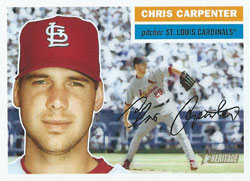
In 2005, Chris Carpenter had 21 wins, seven complete games and four shutouts for the Cardinals. No St. Louis pitcher has achieved even one of those totals in a season since.

chris_carpenter10On Nov. 10, 2005, Carpenter joined Bob Gibson (a two-time winner, 1968 and 1970) as the only Cardinals pitchers to earn a Cy Young Award.

Displaying remarkable consistency, Carpenter, 30, was a dominant and durable force for the 2005 Cardinals.

His 2005 statistics: 21-5 record, 2.83 ERA, 33 games started, seven complete games, four shutouts, 241.2 innings pitched and 213 strikeouts.

Carpenter received 132 vote points and 19 first-place votes from the 32 members of the Baseball Writers Association of America who were allowed to take part in the balloting.

The runner-up was the Marlins’ Dontrelle Willis, who received 112 vote points and 11 first-place votes. Willis in 2005 was 22-10 with a 2.63 ERA, 34 games started, seven complete games, five shutouts, 236.1 innings pitched and 170 strikeouts.

Roger Clemens of the Astros was third in the balloting, receiving 40 vote points and two first-place votes. Clemens in 2005 was 13-8 with a 1.87 ERA, 32 games started, one complete game, no shutouts, 211.1 innings pitched and 185 strikeouts.

“It’s a great feeling and honor,” Carpenter said to the Associated Press after learning he had won the award. “A couple of years ago, I didn’t think I’d even play again.”

While with the Blue Jays, Carpenter had shoulder surgery in September 2002. He became a free agent, signed with the Cardinals and had shoulder surgery again in 2003.

After a successful comeback with the Cardinals in 2004 _ Carpenter was named winner of the NL Comeback Player of the Year Award _ Carpenter emerged as the Cardinals’ ace in 2005.

Carpenter “had from the first day of spring training (in 2005) that feel that he could energize our rotation,” manager Tony La Russa said to Derrick Goold of the St. Louis Post-Dispatch. “Right from the beginning he was setting the tone for our rotation and for our ballclub. He just kept elevating his performance.”

After a loss to the Red Sox on June 8, 2005, Carpenter was 8-4 with a 3.49 ERA. After that, he was, well, Cy Young-like.

The Cardinals won 17 consecutive games Carpenter started from June 14 through Sept. 13. Carpenter was 13-0 with four no-decisions in that stretch.

Also during that period, Carpenter had 16 consecutive starts of at least seven innings per start and never allowing more than three earned runs.

The 2005 season was the only one in Carpenter’s 15-year big-league career with the Blue Jays and Cardinals that he achieved 20 wins and 200 strikeouts.

According to the Post-Dispatch, Carpenter in 2005 was:

_ Quickest Cardinal to 20 wins since Dizzy Dean did it in his 23rd start of the 1934 season.

_ First Cardinal to strike out 200 batters since Jose DeLeon in 1989.

_ First Cardinal to win 20 games since Matt Morris in 2001.

First NL pitcher to win 10 consecutive road starts since Gibson won 12 consecutive in 1970.

Previously: Nobody did it better than Chris Carpenter in 2005

Previously: Cardinals debut helped ease doubts about Chris Carpenter